

What do you think?

Selected Stories of Philip K. Dick
Philip K. Dick was a master of science fiction, but he was also a writer whose work transcended genre to examine the nature of reality and what it means to be human. A writer of great complexity and subtle humor, his work belongs on the shelf of great twentieth-century literature, next to Kafka and Vonnegut. Collected here are twenty-one of Dick's most dazzling and resonant stories, which span his entire career and show a world-class writer working at the peak of his powers.
In "The Days of Perky Pat," people spend their time playing with dolls who manage to live an idyllic life no longer available to the Earth's real inhabitants. "Adjustment Team" looks at the fate of a man who by mistake has stepped out of his own time. In "Autofac," one community must battle benign machines to take back control of their lives. And in "I Hope I Shall Arrive Soon," we follow the story of one man whose very reality may be nothing more than a nightmare. The collection also includes such classic stories as "The Minority Report," the basis for the Steven Spielberg movie, and "We Can Remember It for You Wholesale," the basis for the film Total Recall. Selected Stories of Philip K. Dick is a magnificent distillation of one of American literature's most searching imaginations.
» Introduction by Jonathan Lethem
1. Beyond Lies the Wub (wikipedia)
2. Roog (wikipedia)
3. Paycheck (wikipedia, imdb)
4. Second Variety (wikipedia, imdb)
5. Imposter (wikipedia)
6. The King of the Elves (wikipedia, imdb)
7. Adjustment Team (wikipedia, imdb)
8. Foster, You're Dead! (wikipedia)
9. Upon the Dull Earth (wikipedia)
10. Autofac (wikipedia)
11. The Minority Report (wikipedia, imdb)
12. The Days of Perky Pat (wikipedia)
13. Precious Artifact
14. A Game of Unchance
15. We Can Remember It for You Wholesale (wikipedia, imdb)
16. Faith of Our Fathers (wikipedia)
17. The Electric Ant (wikipedia)
18. A Little Something for Us Tempunauts (wikipedia)
19. The Exit Door Leads In (wikipedia)
20. Rautavaara's Case (wikipedia)
21. I Hope I Shall Arrive Soon (wikipedia)
In "The Days of Perky Pat," people spend their time playing with dolls who manage to live an idyllic life no longer available to the Earth's real inhabitants. "Adjustment Team" looks at the fate of a man who by mistake has stepped out of his own time. In "Autofac," one community must battle benign machines to take back control of their lives. And in "I Hope I Shall Arrive Soon," we follow the story of one man whose very reality may be nothing more than a nightmare. The collection also includes such classic stories as "The Minority Report," the basis for the Steven Spielberg movie, and "We Can Remember It for You Wholesale," the basis for the film Total Recall. Selected Stories of Philip K. Dick is a magnificent distillation of one of American literature's most searching imaginations.
» Introduction by Jonathan Lethem
1. Beyond Lies the Wub (wikipedia)
2. Roog (wikipedia)
3. Paycheck (wikipedia, imdb)
4. Second Variety (wikipedia, imdb)
5. Imposter (wikipedia)
6. The King of the Elves (wikipedia, imdb)
7. Adjustment Team (wikipedia, imdb)
8. Foster, You're Dead! (wikipedia)
9. Upon the Dull Earth (wikipedia)
10. Autofac (wikipedia)
11. The Minority Report (wikipedia, imdb)
12. The Days of Perky Pat (wikipedia)
13. Precious Artifact
14. A Game of Unchance
15. We Can Remember It for You Wholesale (wikipedia, imdb)
16. Faith of Our Fathers (wikipedia)
17. The Electric Ant (wikipedia)
18. A Little Something for Us Tempunauts (wikipedia)
19. The Exit Door Leads In (wikipedia)
20. Rautavaara's Case (wikipedia)
21. I Hope I Shall Arrive Soon (wikipedia)
466 pages, Hardcover
First published January 1, 1982
About the author
Philip K. Dick
1,943 books23.3k followersPhilip Kindred Dick was a prolific American science fiction author whose work has had a lasting impact on literature, cinema, and popular culture. Known for his imaginative narratives and profound philosophical themes, Dick explored the nature of reality, the boundaries of human identity, and the impact of technology and authoritarianism on society. His stories often blurred the line between the real and the artificial, challenging readers to question their perceptions and beliefs.
Raised in California, Dick began writing professionally in the early 1950s, publishing short stories in various science fiction magazines. He quickly developed a distinctive voice within the genre, marked by a fusion of science fiction concepts with deep existential and psychological inquiry. Over his career, he authored 44 novels and more than 100 short stories, many of which have become classics in the field.
Recurring themes in Dick's work include alternate realities, simulations, corporate and government control, mental illness, and the nature of consciousness. His protagonists are frequently everyday individuals—often paranoid, uncertain, or troubled—caught in surreal and often dangerous circumstances that force them to question their environment and themselves. Works such as Ubik, The Three Stigmata of Palmer Eldritch, and A Scanner Darkly reflect his fascination with perception and altered states of consciousness, often drawing from his own experiences with mental health struggles and drug use.
One of Dick's most influential novels is Do Androids Dream of Electric Sheep?, which served as the basis for Ridley Scott's iconic film Blade Runner. The novel deals with the distinction between humans and artificial beings and asks profound questions about empathy, identity, and what it means to be alive. Other adaptations of his work include Total Recall, Minority Report, A Scanner Darkly, and The Man in the High Castle, each reflecting key elements of his storytelling—uncertain realities, oppressive systems, and the search for truth. These adaptations have introduced his complex ideas to audiences well beyond the traditional readership of science fiction.
In the 1970s, Dick underwent a series of visionary and mystical experiences that had a significant influence on his later writings. He described receiving profound knowledge from an external, possibly divine, source and documented these events extensively in what became known as The Exegesis, a massive and often fragmented journal. These experiences inspired his later novels, most notably the VALIS trilogy, which mixes autobiography, theology, and metaphysics in a narrative that defies conventional structure and genre boundaries.
Throughout his life, Dick faced financial instability, health issues, and periods of personal turmoil, yet he remained a dedicated and relentless writer. Despite limited commercial success during his lifetime, his reputation grew steadily, and he came to be regarded as one of the most original voices in speculative fiction. His work has been celebrated for its ability to fuse philosophical depth with gripping storytelling and has influenced not only science fiction writers but also philosophers, filmmakers, and futurists.
Dick's legacy continues to thrive in both literary and cinematic spheres. The themes he explored remain urgently relevant in the modern world, particularly as technology increasingly intersects with human identity and governance. The Philip K. Dick Award, named in his honor, is presented annually to distinguished works of science fiction published in paperback original form in the United States. His writings have also inspired television series, academic studies, and countless homages across media.
Through his vivid imagination and unflinching inquiry into the nature of existence, Philip K. Dick redefined what science fiction could achieve. His wor
Raised in California, Dick began writing professionally in the early 1950s, publishing short stories in various science fiction magazines. He quickly developed a distinctive voice within the genre, marked by a fusion of science fiction concepts with deep existential and psychological inquiry. Over his career, he authored 44 novels and more than 100 short stories, many of which have become classics in the field.
Recurring themes in Dick's work include alternate realities, simulations, corporate and government control, mental illness, and the nature of consciousness. His protagonists are frequently everyday individuals—often paranoid, uncertain, or troubled—caught in surreal and often dangerous circumstances that force them to question their environment and themselves. Works such as Ubik, The Three Stigmata of Palmer Eldritch, and A Scanner Darkly reflect his fascination with perception and altered states of consciousness, often drawing from his own experiences with mental health struggles and drug use.
One of Dick's most influential novels is Do Androids Dream of Electric Sheep?, which served as the basis for Ridley Scott's iconic film Blade Runner. The novel deals with the distinction between humans and artificial beings and asks profound questions about empathy, identity, and what it means to be alive. Other adaptations of his work include Total Recall, Minority Report, A Scanner Darkly, and The Man in the High Castle, each reflecting key elements of his storytelling—uncertain realities, oppressive systems, and the search for truth. These adaptations have introduced his complex ideas to audiences well beyond the traditional readership of science fiction.
In the 1970s, Dick underwent a series of visionary and mystical experiences that had a significant influence on his later writings. He described receiving profound knowledge from an external, possibly divine, source and documented these events extensively in what became known as The Exegesis, a massive and often fragmented journal. These experiences inspired his later novels, most notably the VALIS trilogy, which mixes autobiography, theology, and metaphysics in a narrative that defies conventional structure and genre boundaries.
Throughout his life, Dick faced financial instability, health issues, and periods of personal turmoil, yet he remained a dedicated and relentless writer. Despite limited commercial success during his lifetime, his reputation grew steadily, and he came to be regarded as one of the most original voices in speculative fiction. His work has been celebrated for its ability to fuse philosophical depth with gripping storytelling and has influenced not only science fiction writers but also philosophers, filmmakers, and futurists.
Dick's legacy continues to thrive in both literary and cinematic spheres. The themes he explored remain urgently relevant in the modern world, particularly as technology increasingly intersects with human identity and governance. The Philip K. Dick Award, named in his honor, is presented annually to distinguished works of science fiction published in paperback original form in the United States. His writings have also inspired television series, academic studies, and countless homages across media.
Through his vivid imagination and unflinching inquiry into the nature of existence, Philip K. Dick redefined what science fiction could achieve. His wor
Ratings & Reviews
Friends & Following
Create a free account to discover what your friends think of this book!
Community Reviews
Displaying 1 - 30 of 375 reviews

August 31, 2021
my becoming-a-genius project, part 17!
the background:
i have decided to become a genius.
to accomplish this, i'm going to work my way through the collected stories of various authors, reading + reviewing 1 story every day until i get bored / lose every single follower / am struck down by a vengeful deity.
i have strayed far away from my intentions by binge reading one book and reading several more that don't even pretend to meet this project's standards, so we're getting back to business.
i love the man in the high castle so much i would kiss it on the mouth if it had one, and do androids dream of electric sheep? is also a book that exists that i have read, so this is exciting stuff.
PROJECT 1: THE COMPLETE STORIES BY FLANNERY O'CONNOR
PROJECT 2: HER BODY AND OTHER PARTIES BY CARMEN MARIA MACHADO
PROJECT 3: 18 BEST STORIES BY EDGAR ALLAN POE
PROJECT 4: THE LOTTERY AND OTHER STORIES BY SHIRLEY JACKSON
PROJECT 5: HOW LONG 'TIL BLACK FUTURE MONTH? BY N.K. JEMISIN
PROJECT 6: THE SHORT STORIES OF OSCAR WILDE BY OSCAR WILDE
PROJECT 7: THE BLUE FAIRY BOOK BY ANDREW LANG
PROJECT 8: GRAND UNION: STORIES BY ZADIE SMITH
PROJECT 9: THE BEST OF ROALD DAHL BY ROALD DAHL
PROJECT 10: LOVE AND FREINDSHIP BY JANE AUSTEN
PROJECT 11: HOMESICK FOR ANOTHER WORLD BY OTTESSA MOSHFEGH
PROJECT 12: BAD FEMINIST BY ROXANE GAY
PROJECT 12.5: DIFFICULT WOMEN BY ROXANE GAY
PROJECT 13: THE SHORT NOVELS OF JOHN STEINBECK
PROJECT 14: FIRST PERSON SINGULAR BY HARUKI MURAKAMI
PROJECT 15: THE ORIGINAL FOLK AND FAIRY TALES OF THE BROTHERS GRIMM
PROJECT 16: A MANUAL FOR CLEANING WOMEN BY LUCIA BERLIN
PROJECT 17: SELECTED STORIES OF PHILIP K. DICK
DAY 1: BEYOND LIES THE WUB
is this a pun or am i stupid?
still not sure if it's a pun but i'll tell you what's not stupid - this kickass story!
rating: 4.5
DAY 2: ROOG
two days, two stories including talking animals and species names i hate the sound of.
but also...two days with really fun and clever stories that make me :).
so wins and losses.
rating: 4
DAY 3: PAYCHECK
i already skipped a day...slumping so hard i can't even read short stories if they're on the longer side. just take me out back at this point.
hot damn the way PKD's mind works!
rating: 4
DAY 4: SECOND VARIETY
playing catch-up!
okay damn it's another long one.
the moral of this story is girls rule, boys drool.
rating: 4
DAY 5: IMPOSTER
i mean, the title kind of spoils the whole thing.
rating: 3.5
DAY 6: THE KING OF THE ELVES
you really do have to respect the fact that i have never once managed to read a story on a saturday. seemingly in the whole of this project.
everyone thinks they want to be king of the elves but then they become it and it's all, oh no, my gas station, oh no, the quirky characters about town think i'm crazy, nooo, my best friend is a troll. enough already.
rating: 3
DAY 7: ADJUSTMENT TEAM
caught up on a sunday only to skip a monday and a tuesday. folks, we are falling apart.
this is a whole ride, but the BEST part of the whole thing is the idea that dogs aren't barking at people coming - they bark to summon the event that IS a person's arrival. lit.
rating: 4
DAY 8: FOSTER, YOU'RE DEAD
feels like we'll be living this future within a year. we kind of already are.
not a fun read, for that reason.
rating: 4.5
DAY 9: UPON THE DULL EARTH
PKD's sci-fi stories are like "we are in eternal war. technology is an alien force that will drive us apart and ruin the world around us." and his fantasy stories are like "what's the weirdest thing you can think of? is it this?"
rating: 3.5
DAY 10: AUTOFAC
sounds both robotic and inappropriate.
knowing that a story is objectively interesting but still not being able to get into it...it's a weird feeling.
rating: 3
DAY 11: MINORITY REPORT
so while i've never seen the movie minority report, per se, i have seen the title approximately 1,000 times, and every single one of those times i assumed it was like, a business drama. because of the word report, i guess.
file under no reason to be mind-blowing but still is that the movie is actually presumably based on a PKD story, which is actually presumably sci-fi-adjacent.
even wilder that it's only thirty-eight pages long.
also also, this continually refers to the army as "Army" and every time i think:

other than that i didn't actually like this much.
rating: 3.5
DAY 12: THE DAYS OF PERKY PAT
once again missed a saturday. baby, i'm nothing if not consistent.
if you've ever wondered, "what if adults played dolls and took it so seriously it ruined their lives?" this is the story for you.
rating: 3
DAY 13: PRECIOUS ARTIFACT
nevertheless we persist.
either i am getting tired of these or they're getting less fun or both. but maybe spending day after day reading about the inevitable apocalyptic ruin and dystopian future bearing down upon us wasn't my best idea.
rating: 3.5
DAY 14: A GAME OF UNCHANCE
it's honestly believable to me that all of human civilization could be taken down by an inability to resist a carnival.
rating: 3.5
DAY 15: WE CAN REMEMBER IT FOR YOU WHOLESALE
according to the dust jacket, this story is the basis for the film Total Recall. PKD was the master at writing stories that inspire well-known movies i've never seen.
this was cool, but i couldn't shake picturing tom cruise, that creepy little elf. and he's not even in Total Recall.
rating: 3.5
DAY 16: FAITH OF OUR FATHERS
feeling a little and so we beat on, boats against the current, borne back ceaselessly into the past rn.
speaking of gatsby, to be honest i'm not typically a reader who really cares about how classic white male writers write women, but it is getting REALLY hard to ignore in this one.
rating: 3
DAY 17: THE ELECTRIC ANT
ok...adorable?
oh. never mind. electric ant is a term for "organic robot," and i am disappointed beyond human comprehension.
at least the idea of a currency called frogs is still cute.
rating: 3
DAY 18: A LITTLE SOMETHING FOR US TEMPUNAUTS
the singular female character in this story is simultaneously the most interesting one by a country mile AND a sex object who changes her appearance based on her boyfriend's request and drives him around while commentating on her own inability to drive as a woman.
it is with grave disappointment that i say i'm looking forward to this being over.
rating: 3
DAY 19: THE EXIT DOOR LEADS IN
well, it's a saturday, and i'm actually doing this project. if that doesn't reflect my eagerness to finish this i don't know what does.
this does contain the sentence "It was hell living in the twenty-first century." PKD, you don't know the half of it.
this one finally broke the structure, which i appreciate.
rating: 3.5
DAY 20: RAUTAVAARA'S CASE
alien spaceship cannibal jesus!!!
rating: 4
DAY 21: I HOPE I SHALL ARRIVE SOON
the final day!
i've been thinking both more fondly about this book (i saw an amazon commercial yesterday in which a man was paid to claim it was actually nice to work there and got to thinking about propaganda) and less fondly (i read PKD's wikipedia page and turns out all that on-page misogyny has a real-life counterpart!) so we'll see how this goes.
i do think this is a great name for a last story, though. but that's more credit to the editor than PKD.
solid closer. take me out before the human life span is ever 200 years.
rating: 4
OVERALL
another case where i can't tell if this starts out strong and gets less interesting, or if i just got sick of it. either way it's safe to say i care for PKD's novels over his stories - and that reading them one after the other gets you about sick to death of flat pretty love interest women and normal men thrust into sci-fi heroism and the same very present style.
the rare case in which something is LESS than the sum of its parts.
sheesh.
rating: 3
the background:
i have decided to become a genius.
to accomplish this, i'm going to work my way through the collected stories of various authors, reading + reviewing 1 story every day until i get bored / lose every single follower / am struck down by a vengeful deity.
i have strayed far away from my intentions by binge reading one book and reading several more that don't even pretend to meet this project's standards, so we're getting back to business.
i love the man in the high castle so much i would kiss it on the mouth if it had one, and do androids dream of electric sheep? is also a book that exists that i have read, so this is exciting stuff.
PROJECT 1: THE COMPLETE STORIES BY FLANNERY O'CONNOR
PROJECT 2: HER BODY AND OTHER PARTIES BY CARMEN MARIA MACHADO
PROJECT 3: 18 BEST STORIES BY EDGAR ALLAN POE
PROJECT 4: THE LOTTERY AND OTHER STORIES BY SHIRLEY JACKSON
PROJECT 5: HOW LONG 'TIL BLACK FUTURE MONTH? BY N.K. JEMISIN
PROJECT 6: THE SHORT STORIES OF OSCAR WILDE BY OSCAR WILDE
PROJECT 7: THE BLUE FAIRY BOOK BY ANDREW LANG
PROJECT 8: GRAND UNION: STORIES BY ZADIE SMITH
PROJECT 9: THE BEST OF ROALD DAHL BY ROALD DAHL
PROJECT 10: LOVE AND FREINDSHIP BY JANE AUSTEN
PROJECT 11: HOMESICK FOR ANOTHER WORLD BY OTTESSA MOSHFEGH
PROJECT 12: BAD FEMINIST BY ROXANE GAY
PROJECT 12.5: DIFFICULT WOMEN BY ROXANE GAY
PROJECT 13: THE SHORT NOVELS OF JOHN STEINBECK
PROJECT 14: FIRST PERSON SINGULAR BY HARUKI MURAKAMI
PROJECT 15: THE ORIGINAL FOLK AND FAIRY TALES OF THE BROTHERS GRIMM
PROJECT 16: A MANUAL FOR CLEANING WOMEN BY LUCIA BERLIN
PROJECT 17: SELECTED STORIES OF PHILIP K. DICK
DAY 1: BEYOND LIES THE WUB
is this a pun or am i stupid?
still not sure if it's a pun but i'll tell you what's not stupid - this kickass story!
rating: 4.5
DAY 2: ROOG
two days, two stories including talking animals and species names i hate the sound of.
but also...two days with really fun and clever stories that make me :).
so wins and losses.
rating: 4
DAY 3: PAYCHECK
i already skipped a day...slumping so hard i can't even read short stories if they're on the longer side. just take me out back at this point.
hot damn the way PKD's mind works!
rating: 4
DAY 4: SECOND VARIETY
playing catch-up!
okay damn it's another long one.
the moral of this story is girls rule, boys drool.
rating: 4
DAY 5: IMPOSTER
i mean, the title kind of spoils the whole thing.
rating: 3.5
DAY 6: THE KING OF THE ELVES
you really do have to respect the fact that i have never once managed to read a story on a saturday. seemingly in the whole of this project.
everyone thinks they want to be king of the elves but then they become it and it's all, oh no, my gas station, oh no, the quirky characters about town think i'm crazy, nooo, my best friend is a troll. enough already.
rating: 3
DAY 7: ADJUSTMENT TEAM
caught up on a sunday only to skip a monday and a tuesday. folks, we are falling apart.
this is a whole ride, but the BEST part of the whole thing is the idea that dogs aren't barking at people coming - they bark to summon the event that IS a person's arrival. lit.
rating: 4
DAY 8: FOSTER, YOU'RE DEAD
feels like we'll be living this future within a year. we kind of already are.
not a fun read, for that reason.
rating: 4.5
DAY 9: UPON THE DULL EARTH
PKD's sci-fi stories are like "we are in eternal war. technology is an alien force that will drive us apart and ruin the world around us." and his fantasy stories are like "what's the weirdest thing you can think of? is it this?"
rating: 3.5
DAY 10: AUTOFAC
sounds both robotic and inappropriate.
knowing that a story is objectively interesting but still not being able to get into it...it's a weird feeling.
rating: 3
DAY 11: MINORITY REPORT
so while i've never seen the movie minority report, per se, i have seen the title approximately 1,000 times, and every single one of those times i assumed it was like, a business drama. because of the word report, i guess.
file under no reason to be mind-blowing but still is that the movie is actually presumably based on a PKD story, which is actually presumably sci-fi-adjacent.
even wilder that it's only thirty-eight pages long.
also also, this continually refers to the army as "Army" and every time i think:
other than that i didn't actually like this much.
rating: 3.5
DAY 12: THE DAYS OF PERKY PAT
once again missed a saturday. baby, i'm nothing if not consistent.
if you've ever wondered, "what if adults played dolls and took it so seriously it ruined their lives?" this is the story for you.
rating: 3
DAY 13: PRECIOUS ARTIFACT
nevertheless we persist.
either i am getting tired of these or they're getting less fun or both. but maybe spending day after day reading about the inevitable apocalyptic ruin and dystopian future bearing down upon us wasn't my best idea.
rating: 3.5
DAY 14: A GAME OF UNCHANCE
it's honestly believable to me that all of human civilization could be taken down by an inability to resist a carnival.
rating: 3.5
DAY 15: WE CAN REMEMBER IT FOR YOU WHOLESALE
according to the dust jacket, this story is the basis for the film Total Recall. PKD was the master at writing stories that inspire well-known movies i've never seen.
this was cool, but i couldn't shake picturing tom cruise, that creepy little elf. and he's not even in Total Recall.
rating: 3.5
DAY 16: FAITH OF OUR FATHERS
feeling a little and so we beat on, boats against the current, borne back ceaselessly into the past rn.
speaking of gatsby, to be honest i'm not typically a reader who really cares about how classic white male writers write women, but it is getting REALLY hard to ignore in this one.
rating: 3
DAY 17: THE ELECTRIC ANT
ok...adorable?
oh. never mind. electric ant is a term for "organic robot," and i am disappointed beyond human comprehension.
at least the idea of a currency called frogs is still cute.
rating: 3
DAY 18: A LITTLE SOMETHING FOR US TEMPUNAUTS
the singular female character in this story is simultaneously the most interesting one by a country mile AND a sex object who changes her appearance based on her boyfriend's request and drives him around while commentating on her own inability to drive as a woman.
it is with grave disappointment that i say i'm looking forward to this being over.
rating: 3
DAY 19: THE EXIT DOOR LEADS IN
well, it's a saturday, and i'm actually doing this project. if that doesn't reflect my eagerness to finish this i don't know what does.
this does contain the sentence "It was hell living in the twenty-first century." PKD, you don't know the half of it.
this one finally broke the structure, which i appreciate.
rating: 3.5
DAY 20: RAUTAVAARA'S CASE
alien spaceship cannibal jesus!!!
rating: 4
DAY 21: I HOPE I SHALL ARRIVE SOON
the final day!
i've been thinking both more fondly about this book (i saw an amazon commercial yesterday in which a man was paid to claim it was actually nice to work there and got to thinking about propaganda) and less fondly (i read PKD's wikipedia page and turns out all that on-page misogyny has a real-life counterpart!) so we'll see how this goes.
i do think this is a great name for a last story, though. but that's more credit to the editor than PKD.
solid closer. take me out before the human life span is ever 200 years.
rating: 4
OVERALL
another case where i can't tell if this starts out strong and gets less interesting, or if i just got sick of it. either way it's safe to say i care for PKD's novels over his stories - and that reading them one after the other gets you about sick to death of flat pretty love interest women and normal men thrust into sci-fi heroism and the same very present style.
the rare case in which something is LESS than the sum of its parts.
sheesh.
rating: 3
![Profile Image for s.penkevich [hiatus-will return-miss you all].](https://i.gr-assets.com/images/S/compressed.photo.goodreads.com/users/1735525095i/6431467._UX200_CR0,11,200,200_.jpg)
July 6, 2021
PKD short stories are the perfect bedtime reading. He isn't exactly the best at transitions so you'll be like "did I nod off for a paragraph or was that transition clunky?" and it doesn't matter. You'll be so charmed by the general sense of things and the ideas are brilliant and too much fun to care. Sometimes your doorknob will talk shit to you in deeply cutting, existential ways, reality will be whipped around like an air hose popped loose, and at least once per story someone will yell "Keeee-rist!" It's a wild ride and each story is usually better than the movies that came from them.

November 7, 2015
Selected Stories of Philip K. Dick: 21 stories spanning 3 decades
Originally posted at Fantasy Literature
I’ve been reading a lot of Philip K. Dick the last two years: 10 novels, 7 audiobooks, and now three short story collections. The more I read, the more I’m drawn to his hard-luck life story and strange religious experiences in the 1970s. In particular, his VALIS trilogy was probably the strangest SF exploration of suffering and salvation I’ve ever read. The only books left to read are two biographies and his 944-page Exegesis of personal writings.
I wanted a collection that would capture the whole range of his ideas without spanning multiple volumes and thousands of pages. There are many options, and I settled on Selected Stories of Philip K. Dick, 21 stories selected by Jonathan Lethem, one of the two editors of the 8,000 hand-written journal entries winnowed down to The Exegesis of Philip K. Dick. Who better to select stories from his entire oeuvre spanning three decades?
The 21 stories contained in this collection are as follows:
“Beyond Lies the Wub” (1952), “Roog” (1953), “Paycheck” (1953), “Second Variety” (1953), “Imposter” (1953), “The King of the Elves” (1953), “Adjustment Team” (1954), “Foster, You’re Dead” (1955), “Upon the Dull Earth” (1954), “Autofac” (1955), “The Minority Report” (1956), “The Days of Perky Pat” (1963), “Precious Artifact” (1964), “A Game of Unchance” (1964), “We Can Remember It For You Wholesale” (1966), “Faith of Our Fathers” (1967), “The Electric Ant” (1969), “A Little Something For Us Tempunauts” (1974), “The Exit Door Leads In” (1979), “Rautavaara’s Case” (1980), and “I Hope I Shall Arrive Soon” (1980).
The first 11 stories are from his most prolific period in the early 1950s, and overlap with Collected Stories of Philip K. Dick. In fact, four inspired the feature films Minority Report, The Adjustment Bureau, Paycheck, and Screamers. I consider this period his Golden Age, showcasing his favorite themes: What is reality, what is human, should we create artificial minds, and will we destroy ourselves in a nuclear holocaust? These stories display a subtle black humor and sense of irony, especially the idea that robots may outlive us after we destroy ourselves. PKD loves to throw in a surprise twist that alters the characters’ perception of reality. These stories were all published in the leading SF magazines of the period, and are very entertaining.
The next six stories are from the 1960s, which coincides with the shift in the format from short stories in the 1950s to novels in the 1960s. PKD’s themes and writing also gained in depth and complexity. For example, “The Days of Perky Pat” is an early draft of his novel The Three Stigmata of Palmer Eldritch, one of his first books that directly explored hallucinatory religious experiences and shifting realities triggered by drug use. Surprisingly, the short story version does not feature any drug use, altered consciousness, or meeting an alien being that may be a lonely god, but instead focuses on the idea of people escaping into fantasy role-playing in the aftermath of a devastating war. “The Electric Ant” also has a lot of similarities with the reality-bending of Palmer Eldritch. “We Can Remember It For You Wholesale” forms the basis for the Arnold Schwartzenegger SF action extravaganza Total Recall (1991). It’s a very intricate story that is only 22 pages long and covers just the opening scenes of the film, but the ideas are fully developed.
“Faith of Our Fathers” is a notable story that first appeared in Harlan Ellison’s famous anthology Dangerous Visions (1967), a watershed collection that essentially defined the New Wave Movement and challenged established practitioners to either get with the program or be rendered irrelevant. That collection is amazing for many reasons, not least of which is that many veteran writers did take up the challenge, including Isaac Asimov, Frederik Pohl, Fritz Leiber, and Theodore Sturgeon. “Faith of our Fathers” is a story in which the Communists have conquered the world, and features a Communist Vietnam that resembles George Orwell’s 1984. The main character is given a powerful anti-hallucinogen that allows him to see that the TV broadcasts of the Great Leader are actually bizarre views of a powerful and capricious alien being that both loves and hates his creations. It’s a creepy and deliberately provocative story that presages PKD’s later religious musings but predates his strange hallucinatory experiences with the pink laser from VALIS in 1974.
The last four stories date from 1974 to 1980, which were PKD’s strangest and most eccentric period, triggered by his 1974 religious hallucinations that inspired the novels Radio Free Albemuth, VALIS, The Divine Invasion, and The Transmigration of Timothy Archer. I didn’t even know he was writing short stories at this point, but the stories found here show clearly that PKD had completely departed from his pulp SF magazine roots and was now intent on questioning reality with a much darker and more hopeless tone. You won’t find anything uplifting here, as each story has characters trapped in time loops (“A Little Something For Us Tempunauts”), covert government training programs (“The Exit Door Leads In”), dead astronauts resurrected by aliens to test their religious beliefs (“Rautavaara’s Case”), and a man being endlessly cycled through his past memories by a ship’s AI to try to prevent psychosis (“I Hope I Shall Arrive Soon”).
Overall, Selected Stories of Philip K. Dick gives an excellent overview of PKD’s evolution as a SF writer, starting with entertaining but darkly humorous pulp stories that gradually evolved into much more challenging and complex works, while still adhering to a short format with sharply-described characters and reality-bending twists. If you are looking for a single volume covering three decades of his work, this a great place to start.
Originally posted at Fantasy Literature
I’ve been reading a lot of Philip K. Dick the last two years: 10 novels, 7 audiobooks, and now three short story collections. The more I read, the more I’m drawn to his hard-luck life story and strange religious experiences in the 1970s. In particular, his VALIS trilogy was probably the strangest SF exploration of suffering and salvation I’ve ever read. The only books left to read are two biographies and his 944-page Exegesis of personal writings.
I wanted a collection that would capture the whole range of his ideas without spanning multiple volumes and thousands of pages. There are many options, and I settled on Selected Stories of Philip K. Dick, 21 stories selected by Jonathan Lethem, one of the two editors of the 8,000 hand-written journal entries winnowed down to The Exegesis of Philip K. Dick. Who better to select stories from his entire oeuvre spanning three decades?
The 21 stories contained in this collection are as follows:
“Beyond Lies the Wub” (1952), “Roog” (1953), “Paycheck” (1953), “Second Variety” (1953), “Imposter” (1953), “The King of the Elves” (1953), “Adjustment Team” (1954), “Foster, You’re Dead” (1955), “Upon the Dull Earth” (1954), “Autofac” (1955), “The Minority Report” (1956), “The Days of Perky Pat” (1963), “Precious Artifact” (1964), “A Game of Unchance” (1964), “We Can Remember It For You Wholesale” (1966), “Faith of Our Fathers” (1967), “The Electric Ant” (1969), “A Little Something For Us Tempunauts” (1974), “The Exit Door Leads In” (1979), “Rautavaara’s Case” (1980), and “I Hope I Shall Arrive Soon” (1980).
The first 11 stories are from his most prolific period in the early 1950s, and overlap with Collected Stories of Philip K. Dick. In fact, four inspired the feature films Minority Report, The Adjustment Bureau, Paycheck, and Screamers. I consider this period his Golden Age, showcasing his favorite themes: What is reality, what is human, should we create artificial minds, and will we destroy ourselves in a nuclear holocaust? These stories display a subtle black humor and sense of irony, especially the idea that robots may outlive us after we destroy ourselves. PKD loves to throw in a surprise twist that alters the characters’ perception of reality. These stories were all published in the leading SF magazines of the period, and are very entertaining.
The next six stories are from the 1960s, which coincides with the shift in the format from short stories in the 1950s to novels in the 1960s. PKD’s themes and writing also gained in depth and complexity. For example, “The Days of Perky Pat” is an early draft of his novel The Three Stigmata of Palmer Eldritch, one of his first books that directly explored hallucinatory religious experiences and shifting realities triggered by drug use. Surprisingly, the short story version does not feature any drug use, altered consciousness, or meeting an alien being that may be a lonely god, but instead focuses on the idea of people escaping into fantasy role-playing in the aftermath of a devastating war. “The Electric Ant” also has a lot of similarities with the reality-bending of Palmer Eldritch. “We Can Remember It For You Wholesale” forms the basis for the Arnold Schwartzenegger SF action extravaganza Total Recall (1991). It’s a very intricate story that is only 22 pages long and covers just the opening scenes of the film, but the ideas are fully developed.
“Faith of Our Fathers” is a notable story that first appeared in Harlan Ellison’s famous anthology Dangerous Visions (1967), a watershed collection that essentially defined the New Wave Movement and challenged established practitioners to either get with the program or be rendered irrelevant. That collection is amazing for many reasons, not least of which is that many veteran writers did take up the challenge, including Isaac Asimov, Frederik Pohl, Fritz Leiber, and Theodore Sturgeon. “Faith of our Fathers” is a story in which the Communists have conquered the world, and features a Communist Vietnam that resembles George Orwell’s 1984. The main character is given a powerful anti-hallucinogen that allows him to see that the TV broadcasts of the Great Leader are actually bizarre views of a powerful and capricious alien being that both loves and hates his creations. It’s a creepy and deliberately provocative story that presages PKD’s later religious musings but predates his strange hallucinatory experiences with the pink laser from VALIS in 1974.
The last four stories date from 1974 to 1980, which were PKD’s strangest and most eccentric period, triggered by his 1974 religious hallucinations that inspired the novels Radio Free Albemuth, VALIS, The Divine Invasion, and The Transmigration of Timothy Archer. I didn’t even know he was writing short stories at this point, but the stories found here show clearly that PKD had completely departed from his pulp SF magazine roots and was now intent on questioning reality with a much darker and more hopeless tone. You won’t find anything uplifting here, as each story has characters trapped in time loops (“A Little Something For Us Tempunauts”), covert government training programs (“The Exit Door Leads In”), dead astronauts resurrected by aliens to test their religious beliefs (“Rautavaara’s Case”), and a man being endlessly cycled through his past memories by a ship’s AI to try to prevent psychosis (“I Hope I Shall Arrive Soon”).
Overall, Selected Stories of Philip K. Dick gives an excellent overview of PKD’s evolution as a SF writer, starting with entertaining but darkly humorous pulp stories that gradually evolved into much more challenging and complex works, while still adhering to a short format with sharply-described characters and reality-bending twists. If you are looking for a single volume covering three decades of his work, this a great place to start.

July 30, 2019
Before reading this, I was awfully worried I wouldn't like these PKD stories as much (or even a fraction of the amount) of the movies that they were made into. And so I put it off, and with the help of another procrastinator, we put it off some more.
But then it finally happened. I read them. And all my worries melted away.
The core stories are all fantastic. The details in the movies flesh it out a lot, but the core stories are fantastic. :)
I won't mention all, but I will mention a few of my favorites.
Beyond Lies the Wub - a great sarcastic, meaty philosophical treat.
Paycheck - Almost play-by-play the same as the movie. Fun.
Second Variety - Screamers movie, perhaps BETTER than the movie. :)
Imposter- One of my favorite unknown PKD movies, same fundamental twist.
The King of the Elves - Funny and sad at the same time, and I would love to see this turned into a full movie.
Adjustment Team - On the fence. Probably as good as the movie.
Autofac - A great dystopia, post war, crazy.
The Minority Report - I really got into the subtleties of the *three* minority reports, this time.
The Days of Perky Pat - Creepy because we're already here.
A Game of Unchance - Carnie fun on outposts.
We Can Remember It for You Wholesale - Total Recall, anyone?
Faith of Our Fathers - Communist China has taken over the world, but who took over the Chinese?
The Electric Ant - A fantastic perception/reality fable featuring an android PoV. :)
The Exit Door Leads In - Perfect for all of us who just want to rebel. The MC is a weenie tho. :)
I definitely enjoyed these. The ones I didn't mention were not bad, mind you, after all, this is PKD. :)
But then it finally happened. I read them. And all my worries melted away.
The core stories are all fantastic. The details in the movies flesh it out a lot, but the core stories are fantastic. :)
I won't mention all, but I will mention a few of my favorites.
Beyond Lies the Wub - a great sarcastic, meaty philosophical treat.
Paycheck - Almost play-by-play the same as the movie. Fun.
Second Variety - Screamers movie, perhaps BETTER than the movie. :)
Imposter- One of my favorite unknown PKD movies, same fundamental twist.
The King of the Elves - Funny and sad at the same time, and I would love to see this turned into a full movie.
Adjustment Team - On the fence. Probably as good as the movie.
Autofac - A great dystopia, post war, crazy.
The Minority Report - I really got into the subtleties of the *three* minority reports, this time.
The Days of Perky Pat - Creepy because we're already here.
A Game of Unchance - Carnie fun on outposts.
We Can Remember It for You Wholesale - Total Recall, anyone?
Faith of Our Fathers - Communist China has taken over the world, but who took over the Chinese?
The Electric Ant - A fantastic perception/reality fable featuring an android PoV. :)
The Exit Door Leads In - Perfect for all of us who just want to rebel. The MC is a weenie tho. :)
I definitely enjoyed these. The ones I didn't mention were not bad, mind you, after all, this is PKD. :)

August 3, 2019
Philip K. Dick is one of the big names in scifi. I had heard several things about him - some love him, others hate him (both for various reasons). But I hadn't known just how many movies were based on his stories. As it turned out, most of my favourite scifi movies, in fact, started out as PKD stories.
Naturally, that meant I had to read the source material eventually and this year I finally took the plunge.
I'm happy to say that in almost none of his stories did I encounter the sexism some people claimed he often used. I'm also happy to say that I liked most of his stories well enough. Some I even loved.
For anyone wanting an overview, this selection contains the following stories:
Beyond Lies the Wub => 4 stars
Roog => I always knew there was something up with those trash collectors!
Paycheck => I liked the movie better (maybe because the MC, here, was a jerk?)
Second Variety => can’t help but think the Terminator movies are inspired by this
Impostor => much like the story before, just not as good
The King of the Elves => fantasy or just an individual having lost his mind?
Adjustment Team => have been meaning to see the movie, have to do that soon
Foster, You're Dead => not a movie but an episode in Amazon Prime’s Electric Dreams, which is especially ironic because it’s against consumerism (which Amazon kind of stands for)
Upon the Dull Earth => I really didn’t like the stupidity of the people in this one
Autofac => not a movie but an episode in Amazon Prime’s Electric Dreams
The Minority Report => one of my favorite movies
The Days of Perky Pat => eeeehhhh, VERY weird doll fantasy *lol*
Precious Artifact => another post-war story with humans working on Mars and there being something wrong with Earth
A Game of Unchance => carnival in space (well, on a colony, to be precise)
We Can Remember It for You Wholesale => another classic scifi movie (yes, I’m talking about the Schwarzenegger one) that I loved
Faith of Our Fathers => to switch things up, we have a Chinese-like setting instead of an American-like one, complete with interesting setup
The Electric Ant => Where does programming stop and free will start? What is the nature of reality and can we bend to our will?
A Little Something for Us Tempunauts => I just love time travel stories and the conundrum here was very time-wimey
The Exit Door Leads In => the MC got on my nerves but the story itself wasn’t bad
Rautavaara's Case => gods are hungry, too, don’t judge
I Hope I Shall Arrive Soon => conversations with an intelligent space ship
One thing is notable: PKD seems to have had problems with finishing a story. Or, to be more precise, to finish it with a bang. The endings often kinda drag out or he didn't really write an ending (which also didn't work the way he did it). It's really puzzling.
However, it is also obvious that the author had a great imagination and a vast amount of ideas for stories. It's the transformation from idea to finished story that often lacked for me.
Then again, these stories are relatively old. So in the meantime we've seen tons of movies and have read even more stories that more or less do what PKD's stories did. I had to remind myself a few times that the sort of twist he employed was probably not as obvious to readers back then as it was for me now. Not by a long shot.
It is therefore no suprise that so many creative people have borrowed from PKD and delighted audiences around the world for decades with the results.
I'm aware that the ratings I gave the individual stories only add up to 4 stars. I’ve added the 5th star for the author's significance (then and now and any time in between) as well as the atmosphere he always managed to invoke, even if the overall story or, more often, the ending wasn't wowing me.
Naturally, that meant I had to read the source material eventually and this year I finally took the plunge.
I'm happy to say that in almost none of his stories did I encounter the sexism some people claimed he often used. I'm also happy to say that I liked most of his stories well enough. Some I even loved.
For anyone wanting an overview, this selection contains the following stories:
Beyond Lies the Wub => 4 stars
Roog => I always knew there was something up with those trash collectors!
Paycheck => I liked the movie better (maybe because the MC, here, was a jerk?)
Second Variety => can’t help but think the Terminator movies are inspired by this
Impostor => much like the story before, just not as good
The King of the Elves => fantasy or just an individual having lost his mind?
Adjustment Team => have been meaning to see the movie, have to do that soon
Foster, You're Dead => not a movie but an episode in Amazon Prime’s Electric Dreams, which is especially ironic because it’s against consumerism (which Amazon kind of stands for)
Upon the Dull Earth => I really didn’t like the stupidity of the people in this one
Autofac => not a movie but an episode in Amazon Prime’s Electric Dreams
The Minority Report => one of my favorite movies
The Days of Perky Pat => eeeehhhh, VERY weird doll fantasy *lol*
Precious Artifact => another post-war story with humans working on Mars and there being something wrong with Earth
A Game of Unchance => carnival in space (well, on a colony, to be precise)
We Can Remember It for You Wholesale => another classic scifi movie (yes, I’m talking about the Schwarzenegger one) that I loved
Faith of Our Fathers => to switch things up, we have a Chinese-like setting instead of an American-like one, complete with interesting setup
The Electric Ant => Where does programming stop and free will start? What is the nature of reality and can we bend to our will?
A Little Something for Us Tempunauts => I just love time travel stories and the conundrum here was very time-wimey
The Exit Door Leads In => the MC got on my nerves but the story itself wasn’t bad
Rautavaara's Case => gods are hungry, too, don’t judge
I Hope I Shall Arrive Soon => conversations with an intelligent space ship
One thing is notable: PKD seems to have had problems with finishing a story. Or, to be more precise, to finish it with a bang. The endings often kinda drag out or he didn't really write an ending (which also didn't work the way he did it). It's really puzzling.
However, it is also obvious that the author had a great imagination and a vast amount of ideas for stories. It's the transformation from idea to finished story that often lacked for me.
Then again, these stories are relatively old. So in the meantime we've seen tons of movies and have read even more stories that more or less do what PKD's stories did. I had to remind myself a few times that the sort of twist he employed was probably not as obvious to readers back then as it was for me now. Not by a long shot.
It is therefore no suprise that so many creative people have borrowed from PKD and delighted audiences around the world for decades with the results.
I'm aware that the ratings I gave the individual stories only add up to 4 stars. I’ve added the 5th star for the author's significance (then and now and any time in between) as well as the atmosphere he always managed to invoke, even if the overall story or, more often, the ending wasn't wowing me.

August 11, 2007
I've read a lot of PK Dick and I truly love, love, love! his work. I also must admit that he is a pretty crappy writer. If you are looking for beautifully crafted sentences with a sensual or startling command of words, then, sorry man, time to move on. If you are looking for some seriously wacked out ideas, plots, characters, situations... here you will find the truly uncomfortable. If you are going to read only one Dick... this short story compilation is the one. Philip K Dick's writing works best in the short story format. I swear this is true! Most of his full length books are fantastic, but he never really flushes out any characters, and he sometimes ends up filling space with his rambling insanity. Stick with the stort stories. Just as you are attempting to recover from the adrenaline rush of the last story, you'll already be freaking out about the current one you are midway through. I got this particular compilation because I love Dick (heh) plus the introduction by Jonathan Lethem (who was my current art crush of the time).

September 24, 2020
Absolutely amazing. I've always meant to read some of his stuff, so a book full of short stories seemed perfect. It contains most of the stories which have been adapted into movies.
I found it fascinating from a psychology perspective too. I had heard that Dick may have been schizophrenic, and I can absolutely see where that comes from, now. So many of the stories involve paranoia, warping of reality, or a complete disbelief in reality. That he is able to tackle those themes on such a deep level and still construct fascinating stories all around it shows how much skill he had.
Ratings:- 🌟🌟🌟🌟🌟
I found it fascinating from a psychology perspective too. I had heard that Dick may have been schizophrenic, and I can absolutely see where that comes from, now. So many of the stories involve paranoia, warping of reality, or a complete disbelief in reality. That he is able to tackle those themes on such a deep level and still construct fascinating stories all around it shows how much skill he had.
Ratings:- 🌟🌟🌟🌟🌟

September 1, 2010
This book is a fairly comprehensive collection of PKD stories, included are:
Beyond Lies the Wub: The story of the "wub" a pig like alien native to mars. This story has strong vegetarian themes.
Roog: A story about what your dog is really barking at in the wee hours of the morning.
Paycheck: The story of a man who has his mind erased after a contract job, and instead of the paycheck he originally thought he was getting he only has a bag of tchotchkies. The basis for the Ben Affleck and Uma Thurman movie of the same name.
Second Variety: The story of earth after a devastating war between the Soviet Union and the West where the Americans let loose "blades" autonomous self replicating robots programmed to kill humans. The basis for the 90s movie Screamers.
Imposter: The story of a man, accused of being a robot imposter sent from an alien race from the beyond the solar system.
The King of the Elves: The story of a man who shows kindness to a lost group of elves, and ends up becoming their king.
Adjustment Team: In this story, god and the angels are members of a vast overworked bureaucracy busting their humps to make everything feel seamless for people. This is the story of what happens when they fail, just once.
Foster, Your Dead: A story of consumerism and cold war paranoia taken to their extreme. An America where people feverishly spend to keep up with the Joneses bomb shelter. This is the Story of a boy, Mike Foster, whose father isn't buying into the new society.
Upon the Dull Earth: The story of a girl with the magical ability to call angels to feed on fresh blood. Similar in many ideas to teh story "Adjustment Team."
Autofac:
The Minority Report: A story of a police force that uses psychics to catch criminals before they commit their crimes. The basis for the Tom Cruise movie of the same name.
The Days of Perky Pat: In a post apocalyptic America, where the human survivors are looked after by benevolent martians, the people occupy themselves by playing "Perky Pat".
Precious Artifact: In this story a Terraforming engineer on Mars has doubts about how Earth has fared in an interstellar war. Possibly a complimentary story to "Imposter" and "A Game of Unchance".
A Game of Unchance: In this story, settlers on Mars find aren't sure if they cheated or were cheated when they try to use psychic abilities to cheat some interplanetary carnies.
We Can Remember it for your Wholesale: A man wants to go on vacation to Mars, but can't afford it. So he pays to have memories of the trip implanted so that he thinks he went. The basis for the Arnold Schwarzenegger movie Total Recall.
Faith of Our Fathers: This short story is what 1984 would have been like if it was written by Hunter S Thompson.
The Electric Ant: The story of a man who finds out he is actually an Android, and a fairly unadvanced one at that. Possibly takes place in the same universe as Do Androids Dream of Electic Sheep (There is a throwaway line that Electric Ants are forerunners of the Replicants.
A Little Something for us Tempunauts: A group of time travelers goes a few days in the future, and finds that they were killed when they returned to their present (a few days in the past.) They have to solve the mystery of what killed them, before they go back to the past, and their deaths, in a few days.
The Exit Door Leads In: In this story a man wins admission to college from a fast food competition.
Rautavaara's Case: Told as court transcripts of an interstellar law suit. Alien's revive the brain of a recently deceased human scientist, and perform experiments on altering her perception of the afterlife.
I Hope I Shall Arrive Soon: In this story a man's mind comes out of suspended animation, while his body remains frozen for transport on a long interstellar voyage. He lives through all his old memories for 10 years.
I read this because I wanted to read the actual short story version of "The Electric Ant" before I read the Marvel Comic Adaptation. And also, because I am a big fan of Philip K Dick.
Dick is often given the left handed complement of being "high brow" pulp fiction. He does have have amazing ideas, well thought out, but the execution, the tactical writing, his use of language, etc, is nothing spectacular. However, even in this regard he is a good deal more competent than average pulp science fiction. So, I do not totally agree with this criticism.
In my opinion the literary community does not take Dick as seriously as Kurt Vonnegut, who was ultimately a quite similar writer. Vonnegut often included Kilgore Trout, a fictionalization of his friend Theodore Sturgeon but who many take and interpret as a sort of foil to himself as the author. Trout is a down and out Pulp Sci-Fi writer whose talent and ideas went largely unrecognized because of his chosen Medium. However, Dick realized the essence of Kilgore Trout as much as any man truly could. Dick is as close as can be to the platonic form of the under appreciated, struggling science fiction writer who suffers for his art.
That said, Dick's subject material, is undoubtedly the stuff of pulp fiction: Androids, psychics, secret agents, time travel, interstellar wars and the post apocalypse all feature prominently in his work. But within each of these banal sci-fi subjects, Dick explores deep literary themes.
In this collection, like much of his work, Dick wrote about religion and God's relation with respect to humans, but not in any sort of static or dogmatic ways. He examines many angles of God: Such as a bureaucratic manager of the universe, modifying subtle coincidence to manipulate humans and our affairs. As a simultaneous benevolent and malevolent force cruelly destroying us in life, but ultimately redeeming our souls. Or as a mere spiritual engineer, who engineered our realm and then passed on from the Angelic realm, as we will eventually pass on this realm, up some infinite ladder of transcendence.
In addition to religion, Dick focuses on the more ever present probem of perception. The theme of how we can never truly trust our senses runs through our work. For example, how do we know that any thing is as we left it? After all, if I'm on Mars, perhaps Earth has been destroyed by Alien invaders. The information that we are getting is so easily manipulated by others, perhaps we are unsuspectedly walking into a trap when we think we are doing the trapping. Or as the main character of "The Minority Report" finds himself trapped by information that he previously defended and promoted, when the psychics he uses to catch precriminals accuse him of future-murder. Dick also dives into the deeper problem of how do we know who we are or what we've done? If we are given false memories we could have been on Mars or we could be a Robot unexpectedly carrying out some other's will.
Dick also laments the cruel nature of humans, in his stories about war, especially apocalyptic nuclear wars like "Second Variety, as well as Man's inhumanity to animal, in "Beyond Lies the Wub" and "Roog". I don't know if Dick was a vegetarian or not, but his sympathetic stories and take on animals communicate some of my feelings about animals, better than any sort of Vegetarian propaganda.
Despite the fact that Dick had some serious literary themes going on through his work, he doesn't come across as moralizing or overly pedantic. Rather, these themes flow from his work and seem natural within it. So, they remain entertaining. Furthermore, he has plenty of stories that are just plain fun and don't dabble in high minded literary shenanigans.
I think the best way to think of Dick is as the Pop Artist. I have no doubts of his literary value or skill, however one must accept that his medium was in fact Pop art, or in this case, pulp fiction. Dick must not be judged for his choice of medium, but rather his execution within that Medium. And for me, there is no doubt that Dick is the master of this Genre. And what's more, he has successfully demonstrated that this medium is in fact a valid literary form. Which, is of course, not an easy task given the wide spread disregard for it.
Beyond Lies the Wub: The story of the "wub" a pig like alien native to mars. This story has strong vegetarian themes.
Roog: A story about what your dog is really barking at in the wee hours of the morning.
Paycheck: The story of a man who has his mind erased after a contract job, and instead of the paycheck he originally thought he was getting he only has a bag of tchotchkies. The basis for the Ben Affleck and Uma Thurman movie of the same name.
Second Variety: The story of earth after a devastating war between the Soviet Union and the West where the Americans let loose "blades" autonomous self replicating robots programmed to kill humans. The basis for the 90s movie Screamers.
Imposter: The story of a man, accused of being a robot imposter sent from an alien race from the beyond the solar system.
The King of the Elves: The story of a man who shows kindness to a lost group of elves, and ends up becoming their king.
Adjustment Team: In this story, god and the angels are members of a vast overworked bureaucracy busting their humps to make everything feel seamless for people. This is the story of what happens when they fail, just once.
Foster, Your Dead: A story of consumerism and cold war paranoia taken to their extreme. An America where people feverishly spend to keep up with the Joneses bomb shelter. This is the Story of a boy, Mike Foster, whose father isn't buying into the new society.
Upon the Dull Earth: The story of a girl with the magical ability to call angels to feed on fresh blood. Similar in many ideas to teh story "Adjustment Team."
Autofac:
The Minority Report: A story of a police force that uses psychics to catch criminals before they commit their crimes. The basis for the Tom Cruise movie of the same name.
The Days of Perky Pat: In a post apocalyptic America, where the human survivors are looked after by benevolent martians, the people occupy themselves by playing "Perky Pat".
Precious Artifact: In this story a Terraforming engineer on Mars has doubts about how Earth has fared in an interstellar war. Possibly a complimentary story to "Imposter" and "A Game of Unchance".
A Game of Unchance: In this story, settlers on Mars find aren't sure if they cheated or were cheated when they try to use psychic abilities to cheat some interplanetary carnies.
We Can Remember it for your Wholesale: A man wants to go on vacation to Mars, but can't afford it. So he pays to have memories of the trip implanted so that he thinks he went. The basis for the Arnold Schwarzenegger movie Total Recall.
Faith of Our Fathers: This short story is what 1984 would have been like if it was written by Hunter S Thompson.
The Electric Ant: The story of a man who finds out he is actually an Android, and a fairly unadvanced one at that. Possibly takes place in the same universe as Do Androids Dream of Electic Sheep (There is a throwaway line that Electric Ants are forerunners of the Replicants.
A Little Something for us Tempunauts: A group of time travelers goes a few days in the future, and finds that they were killed when they returned to their present (a few days in the past.) They have to solve the mystery of what killed them, before they go back to the past, and their deaths, in a few days.
The Exit Door Leads In: In this story a man wins admission to college from a fast food competition.
Rautavaara's Case: Told as court transcripts of an interstellar law suit. Alien's revive the brain of a recently deceased human scientist, and perform experiments on altering her perception of the afterlife.
I Hope I Shall Arrive Soon: In this story a man's mind comes out of suspended animation, while his body remains frozen for transport on a long interstellar voyage. He lives through all his old memories for 10 years.
I read this because I wanted to read the actual short story version of "The Electric Ant" before I read the Marvel Comic Adaptation. And also, because I am a big fan of Philip K Dick.
Dick is often given the left handed complement of being "high brow" pulp fiction. He does have have amazing ideas, well thought out, but the execution, the tactical writing, his use of language, etc, is nothing spectacular. However, even in this regard he is a good deal more competent than average pulp science fiction. So, I do not totally agree with this criticism.
In my opinion the literary community does not take Dick as seriously as Kurt Vonnegut, who was ultimately a quite similar writer. Vonnegut often included Kilgore Trout, a fictionalization of his friend Theodore Sturgeon but who many take and interpret as a sort of foil to himself as the author. Trout is a down and out Pulp Sci-Fi writer whose talent and ideas went largely unrecognized because of his chosen Medium. However, Dick realized the essence of Kilgore Trout as much as any man truly could. Dick is as close as can be to the platonic form of the under appreciated, struggling science fiction writer who suffers for his art.
That said, Dick's subject material, is undoubtedly the stuff of pulp fiction: Androids, psychics, secret agents, time travel, interstellar wars and the post apocalypse all feature prominently in his work. But within each of these banal sci-fi subjects, Dick explores deep literary themes.
In this collection, like much of his work, Dick wrote about religion and God's relation with respect to humans, but not in any sort of static or dogmatic ways. He examines many angles of God: Such as a bureaucratic manager of the universe, modifying subtle coincidence to manipulate humans and our affairs. As a simultaneous benevolent and malevolent force cruelly destroying us in life, but ultimately redeeming our souls. Or as a mere spiritual engineer, who engineered our realm and then passed on from the Angelic realm, as we will eventually pass on this realm, up some infinite ladder of transcendence.
In addition to religion, Dick focuses on the more ever present probem of perception. The theme of how we can never truly trust our senses runs through our work. For example, how do we know that any thing is as we left it? After all, if I'm on Mars, perhaps Earth has been destroyed by Alien invaders. The information that we are getting is so easily manipulated by others, perhaps we are unsuspectedly walking into a trap when we think we are doing the trapping. Or as the main character of "The Minority Report" finds himself trapped by information that he previously defended and promoted, when the psychics he uses to catch precriminals accuse him of future-murder. Dick also dives into the deeper problem of how do we know who we are or what we've done? If we are given false memories we could have been on Mars or we could be a Robot unexpectedly carrying out some other's will.
Dick also laments the cruel nature of humans, in his stories about war, especially apocalyptic nuclear wars like "Second Variety, as well as Man's inhumanity to animal, in "Beyond Lies the Wub" and "Roog". I don't know if Dick was a vegetarian or not, but his sympathetic stories and take on animals communicate some of my feelings about animals, better than any sort of Vegetarian propaganda.
Despite the fact that Dick had some serious literary themes going on through his work, he doesn't come across as moralizing or overly pedantic. Rather, these themes flow from his work and seem natural within it. So, they remain entertaining. Furthermore, he has plenty of stories that are just plain fun and don't dabble in high minded literary shenanigans.
I think the best way to think of Dick is as the Pop Artist. I have no doubts of his literary value or skill, however one must accept that his medium was in fact Pop art, or in this case, pulp fiction. Dick must not be judged for his choice of medium, but rather his execution within that Medium. And for me, there is no doubt that Dick is the master of this Genre. And what's more, he has successfully demonstrated that this medium is in fact a valid literary form. Which, is of course, not an easy task given the wide spread disregard for it.

May 19, 2021
Esta colectânea de contos de Philip K. Dick, dada à estampa pela Relógio D'Água, com tradução da minha autoria, contém uma ínfima parcela dos contos que PKD escreveu. PKD foi um escritor incrivelmente prolífico, e a qualidade das suas narrativas é assombrosa. Trata-se de um génio, portanto, porque só um génio conseguiria escrever tanto e com tanta qualidade. Esta colectânea inclui um conto que considero uma das obras-primas absolutas da narrativa curta de ficção científica: «Segunda Variedade». Mas todos os contos aqui incluídos dão que pensar e ficam a ressoar dentro de nós. Absolutamente imperdível.

May 7, 2013
Philip K Dick is the Kafka of scifi - or maybe just the Kafka of America - endlessly paranoid and inventive. It's dangerous to read too many of his stories in a row; they start to run together. But then, so does Borges.
My favorite right now is the last story in this collection, "I Hope I Shall Arrive Shortly."
My favorite right now is the last story in this collection, "I Hope I Shall Arrive Shortly."

July 6, 2015
A delightful way to spend American colonial Independence Day: reading the paranoiac fantasies spawned by the pressures of conformity, consumerism, and irrational reality.

April 30, 2011
I don't mean to totally knock PKD because his readers can't deny that he had some amazing ideas that were steps ahead of his contemporaries. Likewise I enjoy his excursions into self and time and what both of those truly mean.
My complaint with most of these stories is that they tend to turn out like this:
PKD: "I had this idea for a story. There's a Competent Protagonist and his Charming yet Irrelevant [Wife / Girlfriend / Secretary]. Our everyman hero is exposed to or discovers some strange situation likely involving time travel or aliens or technology beyond his ability to comprehend. Then the situation is resolved, perhaps with a twist ending."
Reader: "Sounds like fun! Tell us the story!"
PKD: "I just did."
I feel that one could take the first and last names of Generic Male Protagonist in whichever of the stories one chooses here and insert it into all the other stories and it wouldn't matter. PKD's tales are the vehicle for his incredible ideas, not a way to explore characters. Richard Matheson does the exact same thing with his stories, except he substitutes horror, unease, and the unnatural for PKD's sci-fi. There's a reason that both of these writers have been adapted and re-worked so often - they're full of interesting concepts padded with sufficiently vague exposition that just begs to be re-interpreted.
It hasn't turned me off from his work - quite the opposite. I'm looking forward to reading some of his novels where I hear he has more space to devote to fleshing out his characters.
My complaint with most of these stories is that they tend to turn out like this:
PKD: "I had this idea for a story. There's a Competent Protagonist and his Charming yet Irrelevant [Wife / Girlfriend / Secretary]. Our everyman hero is exposed to or discovers some strange situation likely involving time travel or aliens or technology beyond his ability to comprehend. Then the situation is resolved, perhaps with a twist ending."
Reader: "Sounds like fun! Tell us the story!"
PKD: "I just did."
I feel that one could take the first and last names of Generic Male Protagonist in whichever of the stories one chooses here and insert it into all the other stories and it wouldn't matter. PKD's tales are the vehicle for his incredible ideas, not a way to explore characters. Richard Matheson does the exact same thing with his stories, except he substitutes horror, unease, and the unnatural for PKD's sci-fi. There's a reason that both of these writers have been adapted and re-worked so often - they're full of interesting concepts padded with sufficiently vague exposition that just begs to be re-interpreted.
It hasn't turned me off from his work - quite the opposite. I'm looking forward to reading some of his novels where I hear he has more space to devote to fleshing out his characters.

October 19, 2009
The new Matt Damon hyperkinetic action movie The Adjustment Bureau is based on the PDK short story The Adjustment Team, in this collection. The New York Times review of the movie, “
Creepy People With a Plan, and a Couple on the Run
” is surprisingly positive. The last word: “As it turns out, romance for grown-ups isn’t dead in Hollywood — it’s just been on extended leave.”
I’m pleased that Manohla Dargis, in her review, agrees with my analysis of the appeal of PDK. She just says it better:
Anyway, it’s always best to read the story before seeing the movie, so PDK jumps to the top of the queue.
• • • • • •
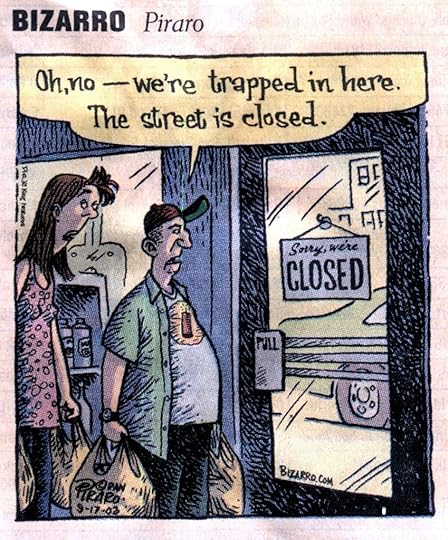
The story title “The Exit Door Leads In” reminded me of one of my all-time favorite Bizarro comics:
I’m pleased that Manohla Dargis, in her review, agrees with my analysis of the appeal of PDK. She just says it better:
One reason filmmakers like Mr. Nolfi seem attracted to Philip K. Dick’s work, beyond the brilliance of its ideas, is that his unembellished writing style leaves them room to make the stories visually their own.Whereas my review of Flow My Tears, the Policeman Said—
The movie folks love him because they can grab this central nugget of bizarreness, “re-imagine” his characters, completely re-write the dialog, and get — hopefully — a conceptually fascinating film.
Anyway, it’s always best to read the story before seeing the movie, so PDK jumps to the top of the queue.
• • • • • •
The story title “The Exit Door Leads In” reminded me of one of my all-time favorite Bizarro comics:

June 14, 2020
”My subjective reality … but that’s all there is. Objective reality is a synthetic construct, dealing with a hypothetical universalization of a multitude of subjective realities.” - from “The Electric Ant”Two things make PKD an important writer: 1) the ideas he explores (fertile and complex enough so that 7 of the 21 stories in this collection have been translated to full-length feature films); and, 2) the recurring human themes he mines so successfully (paranoia, state/corporate/social control of the individual, the dangers of technology, hubris, a search for meaning/spirituality). Thus far, I’d say this is the best collection of his stories I’ve read. There’s a kind of gleeful absurdity to much of his writing coupled with a truly sympathetic understanding of his characters.
----------------------------------
THE ONLY WORD I LOOKED UP FROM THIS BOOK: cyclothymia

Read
March 10, 2026I'm a huge Dick-head, and this just reinforces it. This has got to be one of the best short story collections I've read. Most of the stories in here were super memorable and unique yet thematically consistent touching on topics of reality and unreality, human vs machine, nuclear war, and all the other quintessential PKD themes. "Second Variety", "We Can Remember It for You Wholesale", "Faith of Our Fathers", "I Hope I Shall Arrive Soon" were all great, but the cream of the crop has to be "The Electric Ant" and "A Little Something for Us Tempunauts": these two stories are PKD near his A Scanner Darkly level of perfection. His works just get to me: they make me think, they make me laugh, they make me feel, and this collection is no exception.

January 17, 2023
Some of the best short stories I’ve ever read😤

September 24, 2019
I am unabashedly a big fan of short story anthologies. This one starts off oddly with the two stories which are my least favorite of the entire collection. After that, each story is at least good, and some are excellent.
There are definite recurring themes: the futility of war, the dangers of automation and the delegation of ever-growing tasks to robots, and the ethics of terraforming other planets after foolishly ruining our own. Philip Dick tackles the real fears of his own and current generations. In "Paycheck," he explores the consequences of allowing the Police State to split power with the corporations, at the expense of ordinary citizens.
A majority of the stories are dystopian in nature. "Second Variety" is an eerie glimpse into a hellish future landscape. In "Foster, You're Dead," Dick exposes the manipulative effects of empty consumerism and forced patriotism. "Upon The Dull Earth" is more deviously Twilight Zone than Night Gallery, but equally eerie and frightening. "Precious Artifact" exposes the emotional and psychological toll of extinction.
"A Little Something For Us Tempunauts" is a well-crafted treatise on the time-travel paradox. Think of it as an especially grim version of "Groundhog Day." Above all, "Rautavaara's Case" is flat-0ut brilliant.
There are many many good stories, and a lot of overlap, but with little tongue in cheek clever touches. Philip Dick's stories can appear simple on the surface, but there are always layers. And he does not necessarily draw conclusions for the reader. Overall, this is a worthwhile read for the science fiction reader who likes their stories to explore inner, as well as outer space.
There are definite recurring themes: the futility of war, the dangers of automation and the delegation of ever-growing tasks to robots, and the ethics of terraforming other planets after foolishly ruining our own. Philip Dick tackles the real fears of his own and current generations. In "Paycheck," he explores the consequences of allowing the Police State to split power with the corporations, at the expense of ordinary citizens.
A majority of the stories are dystopian in nature. "Second Variety" is an eerie glimpse into a hellish future landscape. In "Foster, You're Dead," Dick exposes the manipulative effects of empty consumerism and forced patriotism. "Upon The Dull Earth" is more deviously Twilight Zone than Night Gallery, but equally eerie and frightening. "Precious Artifact" exposes the emotional and psychological toll of extinction.
"A Little Something For Us Tempunauts" is a well-crafted treatise on the time-travel paradox. Think of it as an especially grim version of "Groundhog Day." Above all, "Rautavaara's Case" is flat-0ut brilliant.
There are many many good stories, and a lot of overlap, but with little tongue in cheek clever touches. Philip Dick's stories can appear simple on the surface, but there are always layers. And he does not necessarily draw conclusions for the reader. Overall, this is a worthwhile read for the science fiction reader who likes their stories to explore inner, as well as outer space.

March 8, 2021
Every time I read something new by Philip K Dick I am even more convinced of his genius; tortured genius but genius none the less.
PKD published 44 novels and 121 short stories and I have been slowly working my way through all of them. With most writers, their novels are fully formed stories while their short stories and novellas much less so. This is not true with Dick as his short stories are just as rewarding as his novels, a fact clearly shown by this book.
In Selected Stories there are twenty-one of his tales including several that were made into major motion pictures. If you watched Tom Cruz in The Minority Report or Arnold Schwarzenegger in Total Recall you were watching a PKD story from this book. The plots in these stories ranges over a vast landscape. Each one asks questions about humanity, society, ethics, and what it means to be a human being. More than entertainment, Dick’s stories are a peek into what makes us tick.
Oscar Levant is credited with saying, “There's a fine line between genius and insanity. I have erased this line.” PKD may not have said it but he clearly lived it. Dick was a troubled man who battled numerous psychological demons and drug addition throughout his adult life. Despite this, he managed to leave a legacy of some of the best science fiction ever written.
If you are new to Philip K. Dick, Selected Stories is a great place to first experience his genius. If you are an old PKD fan, Selected Stories will remind you of why you love Philip K Dick so much. This book is definitely a win-win situation for the reader but probably less so for the characters in the stories.
PKD published 44 novels and 121 short stories and I have been slowly working my way through all of them. With most writers, their novels are fully formed stories while their short stories and novellas much less so. This is not true with Dick as his short stories are just as rewarding as his novels, a fact clearly shown by this book.
In Selected Stories there are twenty-one of his tales including several that were made into major motion pictures. If you watched Tom Cruz in The Minority Report or Arnold Schwarzenegger in Total Recall you were watching a PKD story from this book. The plots in these stories ranges over a vast landscape. Each one asks questions about humanity, society, ethics, and what it means to be a human being. More than entertainment, Dick’s stories are a peek into what makes us tick.
Oscar Levant is credited with saying, “There's a fine line between genius and insanity. I have erased this line.” PKD may not have said it but he clearly lived it. Dick was a troubled man who battled numerous psychological demons and drug addition throughout his adult life. Despite this, he managed to leave a legacy of some of the best science fiction ever written.
If you are new to Philip K. Dick, Selected Stories is a great place to first experience his genius. If you are an old PKD fan, Selected Stories will remind you of why you love Philip K Dick so much. This book is definitely a win-win situation for the reader but probably less so for the characters in the stories.

January 5, 2023
Closer to 3.5 overall.
I'm rather finicky when it comes to science fiction - and I've certainly sat through more science fiction films and have read fewer science fiction books. That could be because I've spent most of my life thinking of science fiction more as a visual thing and have preferred seeing it on-screen.
But I'm still picky. A 'Star Wars' entry is likely to make my eyes glaze over but I very much like something like 'Forbidden Planet' (though that might have more to do with it being a loose adaptation of Shakespeare's 'The Tempest').
I don't take to science fiction that's standard and science fiction-y - so, for me, the actual storyline of a piece will make all the difference. Good guys and bad guys in space, pitted against each other, can be about the same as watching your average Western.
I've recently started reading some PKD novels and, so far, I'm hooked. Very much so. However, his short stories seem to be a whole different animal and it's possible that, overall, they may not be my thing.
This collection pulls from the five volumes of PKD's collected short stories. These are the ones which supposedly are the most representative of his short / shorter work. Essentially, I find them kind of standard (with a few exceptions), even if they still often have that uniquely paranoid 'PKD touch' in certain ways.
While reading, what I actually thought was this: I had the notion that PKD would approach the shorter stuff by saying to himself, 'These are the things that I write for money - but I write my novels for *me*.' I suppose I thought that because, for most of his career, PKD always, always needed money. (It wasn't until late in his life that he started to see real cold-hard-cash, largely thanks to seeing 'Do Androids Dream of Electric Sheep?' become 'Blade Runner'.)
A few of the more-engaging stories collected here have been made into films: 'Second Variety' (filmed as 'Screamers', which I liked but not as much as the story), 'The Minority Report', and 'We Can Remember It for You Wholesale' (filmed as 'Total Recall').
An early-on story - 'Roog' - is short and cute in its way. And perhaps the most ambitious tale - 'Faith of Our Fathers' - is wildly imaginative (and freaky) in its exploration of God as both good *and* evil.
None of these stories are bad - I did read the whole book - but it's likely I'm not in the real audience here, and that I'm going to be enjoying PKD's novels much more.
I'm rather finicky when it comes to science fiction - and I've certainly sat through more science fiction films and have read fewer science fiction books. That could be because I've spent most of my life thinking of science fiction more as a visual thing and have preferred seeing it on-screen.
But I'm still picky. A 'Star Wars' entry is likely to make my eyes glaze over but I very much like something like 'Forbidden Planet' (though that might have more to do with it being a loose adaptation of Shakespeare's 'The Tempest').
I don't take to science fiction that's standard and science fiction-y - so, for me, the actual storyline of a piece will make all the difference. Good guys and bad guys in space, pitted against each other, can be about the same as watching your average Western.
I've recently started reading some PKD novels and, so far, I'm hooked. Very much so. However, his short stories seem to be a whole different animal and it's possible that, overall, they may not be my thing.
This collection pulls from the five volumes of PKD's collected short stories. These are the ones which supposedly are the most representative of his short / shorter work. Essentially, I find them kind of standard (with a few exceptions), even if they still often have that uniquely paranoid 'PKD touch' in certain ways.
While reading, what I actually thought was this: I had the notion that PKD would approach the shorter stuff by saying to himself, 'These are the things that I write for money - but I write my novels for *me*.' I suppose I thought that because, for most of his career, PKD always, always needed money. (It wasn't until late in his life that he started to see real cold-hard-cash, largely thanks to seeing 'Do Androids Dream of Electric Sheep?' become 'Blade Runner'.)
A few of the more-engaging stories collected here have been made into films: 'Second Variety' (filmed as 'Screamers', which I liked but not as much as the story), 'The Minority Report', and 'We Can Remember It for You Wholesale' (filmed as 'Total Recall').
An early-on story - 'Roog' - is short and cute in its way. And perhaps the most ambitious tale - 'Faith of Our Fathers' - is wildly imaginative (and freaky) in its exploration of God as both good *and* evil.
None of these stories are bad - I did read the whole book - but it's likely I'm not in the real audience here, and that I'm going to be enjoying PKD's novels much more.

October 10, 2017
My very first read by Philip K. Dick..and I am already onto his other collections :D Anyways moving on to the review..I started this collection with "Second Variety" and half expected to find something akin to Asimov and his robots..A futuristic diorama unfolding in the imagination, of a world where humans can't live without machines and bots..But in retrospect and to my surprise, Dick's science-fiction does not rely as much on science as it does on the elements of fiction..
His stories happen to humans..husband-wife, father-son, soldiers, kids, wanderers, technicians, revolutionaries etc..And exactly for this fact, they are so much more relatable..All the while I wondered less about the aliens and the fancy gadgets and more about how the human protagonist would react..Thoughts like "What's he/she gonna do now?", "There's no way he's escaping this", "I bet he is the one!!", "Oh my God!! Open your eyes, damn it!", "No! Don't go to the old lady!!", "C'mmon! He is one of them now!!"..The stories are a touch-and-go kind..They lead on the reader, in favour of his/her suspicions..And WHAM!!..down goes the white flag of truce between Dick and the reader, as he shoots us down with epiphanies..
All I can say is : Dick is good..real good at the "Whoa!!" moments..And these being short stories, one can easily make a guess at his genius in getting the readers riled up with such short accounts..So impressed I was/am that I think each of his stories deserve a mention with their own ratings..
3★ Beyond Lies the Wub
3★ Roog
3.5★ Paycheck
4.5★ Second Variety
3.5★ Imposter
3★ The King of the Elves
3★ Adjustment Team
3★ Foster, You're Dead!
3★ Upon the Dull Earth
3.5★ Autofac
3.5★ The Minority Report "and to think this was one of the influences that led to Psycho-Pass..Nostalgia(sigh)"
3★ The Days of Perky Pat
3★ Precious Artifact
3.5★ A Game of Unchance
4★ We Can Remember It for You Wholesale
3★ Faith of Our Fathers
3★ The Electric Ant
4★ A Little Something for Us Tempunauts
3.5★ The Exit Door Leads In
3★ Rautavaara's Case
3.5★ I Hope I Shall Arrive Soon
I confess that I had known PKD only for his "The Man in the High Castle" ..But I am glad that he has written enough sci-fi stories to keep me away from other genres for a while :)
His stories happen to humans..husband-wife, father-son, soldiers, kids, wanderers, technicians, revolutionaries etc..And exactly for this fact, they are so much more relatable..All the while I wondered less about the aliens and the fancy gadgets and more about how the human protagonist would react..Thoughts like "What's he/she gonna do now?", "There's no way he's escaping this", "I bet he is the one!!", "Oh my God!! Open your eyes, damn it!", "No! Don't go to the old lady!!", "C'mmon! He is one of them now!!"..The stories are a touch-and-go kind..They lead on the reader, in favour of his/her suspicions..And WHAM!!..down goes the white flag of truce between Dick and the reader, as he shoots us down with epiphanies..
All I can say is : Dick is good..real good at the "Whoa!!" moments..And these being short stories, one can easily make a guess at his genius in getting the readers riled up with such short accounts..So impressed I was/am that I think each of his stories deserve a mention with their own ratings..
3★ Beyond Lies the Wub
3★ Roog
3.5★ Paycheck
4.5★ Second Variety
3.5★ Imposter
3★ The King of the Elves
3★ Adjustment Team
3★ Foster, You're Dead!
3★ Upon the Dull Earth
3.5★ Autofac
3.5★ The Minority Report "and to think this was one of the influences that led to Psycho-Pass..Nostalgia(sigh)"
3★ The Days of Perky Pat
3★ Precious Artifact
3.5★ A Game of Unchance
4★ We Can Remember It for You Wholesale
3★ Faith of Our Fathers
3★ The Electric Ant
4★ A Little Something for Us Tempunauts
3.5★ The Exit Door Leads In
3★ Rautavaara's Case
3.5★ I Hope I Shall Arrive Soon
I confess that I had known PKD only for his "The Man in the High Castle" ..But I am glad that he has written enough sci-fi stories to keep me away from other genres for a while :)

June 1, 2015
Philip K. Dick has some interesting ideas. Some of them feel extremely dated and paranoid, but I can also see how the content was relevant and even revolutionary at the time of writing. The biggest gripe I have with his style is that the characters are basically useless. They are essentially automatons running through the world that he has created. Each male protagonist is basically the same as the one before, and female characters always play the same roles. There were also some times where I read something that was so sexist I had to shake my head a bit. But Dick really brings the creepiness and suspense, and I enjoyed most of the stories. I have a hard time rating this book, because story-wise, I liked them to give them a three-star rating. The collection of the stories is great, though, and I feel like I've read a variety of some of the best of his short stories, so I would say it's a four-star collection.
October 5, 2023
Beyond Lies the Wub - 4 stars
Roog - 3 stars
Paycheck - 4.5 stars
Second Variety - 5 stars
Imposter - 3.5 stars
The King of the Elves - 3 stars
Adjustment Team - 4.5 stars
Foster, You're Dead - 3 stars
Upon the Dull Earth - 3 stars
Autofac - 4 stars
The Minority Report - 4.5 stars
The Days of Perky Pat - 4 stars
Precious Artifact - 4 stars
A Game of Unchance - 3.5 stars
We Can Remember It For You Wholesale - 5 stars
Faith of our Fathers - 4 stars
The Electric Ant - 4 stars
A Little Something for Us Tempunauts - 3.5 stars
The Exit Door Leads In - 5 stars
Rautavaara's Case - 4.5 stars
I Hope I Shall Arrive Soon - 4.5 stars
Roog - 3 stars
Paycheck - 4.5 stars
Second Variety - 5 stars
Imposter - 3.5 stars
The King of the Elves - 3 stars
Adjustment Team - 4.5 stars
Foster, You're Dead - 3 stars
Upon the Dull Earth - 3 stars
Autofac - 4 stars
The Minority Report - 4.5 stars
The Days of Perky Pat - 4 stars
Precious Artifact - 4 stars
A Game of Unchance - 3.5 stars
We Can Remember It For You Wholesale - 5 stars
Faith of our Fathers - 4 stars
The Electric Ant - 4 stars
A Little Something for Us Tempunauts - 3.5 stars
The Exit Door Leads In - 5 stars
Rautavaara's Case - 4.5 stars
I Hope I Shall Arrive Soon - 4.5 stars

November 16, 2017
https://osrascunhos.com/2017/11/29/re...
Eis um excepcional conjunto de contos! O que o torna excepcional não é só a qualidade de algumas histórias, mas o facto de serem, quase todos, estrondosos! Algo que ainda é de maior espanto quando sabemos que foram escritos entre 1953 e 1974 e que partem de premissas bastante simples que são levadas até às últimas consequências, algumas de forma irónica, demonstrando o ridículo da inteligência artificial ou o ridículo de seguir instruções sem capacidade de as questionar.
Esta colectânea começa com Segunda Variedade, um conto inteligente que decorre na guerra, mostrando que os seres humanos inventam mecanismos cada vez mais catastróficos para tentarem exterminar a facção oposta. Neste caso a luta é contra os russos e inventaram-se robots com aparência de verme que exterminam os que não estiverem marcados.
O problema é que as fábricas que constroem estes robots têm a capacidade de inventar variedades cada vez mais evoluídas. Não é assim de estranhar que um dia se receba uma mensagem dos russos para negociarem os termos da paz. O major Hendricks começa a sua caminhada, perspectivando a possibilidade de uma armadilha e quando encontra um rapaz carregando um urso de peluche, lá se deixa acompanhar pela criança taciturnoa e silenciosa – trata-se de um modelo robot que pretende o extermínio total dos seres humanos, modelo já conhecido pelos russos e que se sabe não ser o único. Falta identificar um modelo e até lá instala-se a desconfiança entre os poucos sobreviventes.
Tal como Segunda Variedade, também o segundo conto deste conjunto, Impostor, foi alvo de adaptação para cinema, se bem que nenhum dos filmes teve grande sucesso. No caso de Impostor, houve ainda adaptação para série, constituindo um dos episódios de Out of this World.
Um homem bem colocado militarmente é preso – os seus colegas julgam-nos um impostor, um humano substituído por um andróide que teria sido construído para não se aperceber dos seus próprios aspectos mecânicos e encarnar, na totalidade, o espécime. A caminho da lua, onde deveria ocorrer a execução, o homem escapa com um único plano em mente – provar que não se trata de um andróide programado para prosseguir com um atentado.
Um homem sai mais tarde de casa do que devia. O atraso, exacerbado por um agente de seguros que lhe bate à porta, fá-lo presenciar a desmaterialização do seu local de trabalho, levada a cabo por uma eficiente equipa de ajustamento que pretenderá reconstruir este pequeno pedaço da realidade.
Como seria de esperar, o homem entra em colapso nervoso quando se apercebe que é a ponta solta desta equipa e que poderá sofrer o mesmo destino que as pessoas do local onde trabalha. Em casa, a mulher convence-o a regressar ao trabalho, com o argumento de que teria alucinado. Mas uma vez de regresso apercebe-se de pequenas, quase imperceptíveis mudanças.
Adjustment Team é um conto relativamente curto que coloca em perspectiva a existência humana e a própria realidade. Até que ponto esta é controlada pelos seres humanos, ou até que ponto esta é imutável e viável, uma constante inalterável. É, sobretudo, uma história irónica que explora a teoria paranóica de um homem e que questiona tudo o que nos rodeia.
Adaptada para um drama em formato áudio, Nesta Mortiça Terra contém inúmeros elementos religiosos mostrando uma realidade onde os anjos existem. Sílvia é uma rapariga que aprendeu a aceitar a sua presença tenebrosa – uma aprendizagem que os restantes só tarde de mais se apercebem que poderá ser catastrófica. É que os anjos, essas entidades luminosas e pouco angelicais (no sentido de bondosas e disponíveis para ajudar), pretendem fazer Sílvia evoluir para o próximo passo do hierarquia de energia e transformá-la num deles. Ao anteciparem esta evolução desequilibram as energias das fases envolvidas.
Autofab decorre num mundo pós-apocalíptico onde uma rede de máquinas mantém o fornecimento de uma série de bens. Esta rede de máquinas inclui fábricas com capacidades de auto-replicação e robots capazes de captar, da natureza, os bens (como metais), para a sua própria preservação e expansão. Os seres humanos que restam pretendem fechar esta rede de máquinas para poderem evoluir e utilizar, eles próprios, as matérias primas de que necessitam.
Depois de tentarem, sem sucesso, provocar um erro de sistema, indicando às máquinas um erro por elas desconhecido, optam por tentar fazer com que as fábricas compitam pelos menos recursos. Não se reconhecendo como sendo da mesma facção, as fábricas tentam responder às suas necessidades por recursos lutando pela retenção dos metais.
Este é outro conto que nos apresenta as máquinas que se desenvolvem por si próprias, com capacidade para criarem novas e se inventarem consoante as adversidades que enfrentam, num ciclo sem fim, cego às necessidades iniciais. As máquinas reconhecem apenas o objectivo claro e único para o qual foram criadas, sem perceberem a origem e o desaparecimento desse objectivo.
Adaptado para cinema, série televisiva e videojogo, Minority report é um dos contos mais conhecidos de Philip K. Dick. Como seria de esperar existem algumas divergência entre a adaptação cinematográfica e o conto. O chefe da divisão pré-crime recebe um homem mais jovem que o deverá acompanhar e aprender com ele. Trata-se de um homem escolhido por razões políticas. Nesse mesmo dia o chefe da divisão recebe a informação de que ele próprio será um assassino mas desconhece o homem que é suposto matar.
Na divisão pré-crime usa-se o potencial de seres humanos deficientes que se revelaram pré-cognitivos para diversos crimes. Apenas se age em relação ao assassinatos. As indicações são geradas pela combinação de três relatório, originando um relatório maioritário e decisivo. Com base neste relatório e antes que ocorra o homicídio, a divisão pré-crime actua e prende os futuros homicidas antes que ocorra o evento.
Este conto joga com a previsão de um futuro, mostrando as várias formas como o conhecimento da previsão pode influenciar esse mesmo futuro – seja porque ele pode ser evitado, seja porque pode ser reforçado mediante determinadas circunstâncias. Por outro lado, não pode deixar de se questionar a ordem de prisão a indivíduos que são potenciais homicidas mas que, não sendo um homicídio planeado, não têm, à data da prisão, qualquer intenção ou conhecimento das circunstâncias em que tal evento pode ocorrer.
Não é a única vez em que Philip K. Dick coloca adultos a usar bonecos como elemento recreativo para fuga à própria realidade. Se em Os Três Estigmas de Palmer Eldritch os adultos se encontravam num mundo desconhecido, distante da Terra, no caso de No tempo da Rita Catita o cenário é uma Terra apocalíptica em que os poucos seres humanos que restam permanecem em crateras, sobrevivendo à custa dos recursos disponibilizados por uma espécie sapiente marciana.
Enquanto os mais novos, adaptados à nova realidade, olham com algum desdém para a actividade dos mais velhos, os adultos refugiam-se no passado brincando com uma boneca, para a qual recriam os mais diversos luxos – restaurantes e helicópteros! O jogo decorre confrontando duas equipas de dois adultos, em que fazem a boneca evoluir social e economicamente.
Quando, os adultos de um grupo de sobreviventes descobre que, noutro grupo, usam uma boneca diferente, instala-se a curiosidade e a necessidade de um confronto – como será a outra boneca? Mais evoluída? Que roupas terá? Será mais adulta?
Se em Precioso Artefacto (um dos contos menos interessantes do conjunto) um homem regressa à Terra para a mudar e adaptar novamente aos seres terrestres depois de uma Guerra, tendo-o já feito em Marte, em Recordações por atacado (We Can Rember It for you Wholesale), são as paisagens marcianas que são ambicionadas por um homem que não tem esperanças económicas de alguma vez concretizar o seu sonho.
Desloca-se, assim, a uma empresa que poderá plantar, na sua mente, uma viagem fictícia que recordará como sendo verdadeira, recolhendo, até, recordações do que nunca existiu. O problema é que, após a implementação das memórias, percebe-se que este homem aparentemente pouco importante é, na verdade, um espião esquecido das suas façanhas que, com a alteração da memória, recorda o que realmente ocorreu.
A fé dos nossos pais é uma curiosa história distópica onde um burocrata jovem e ambicioso vive, no mesmo dias, dois eventos contraditórios em termos de possibilidades futuras: por um lado é convidado a executar uma tarefa que poderá garantir a sua carreira política, por outro é-lhe vendida uma estranha substância como sendo inócua, mas que revela o aspecto estranho do líder máximo naquele estado.
Surge-lhe então, nessa noite, uma jovem que informa que outros tiveram as mesmas visões, incoerentes entre si, mas reveladoras de que o verdadeiro aspecto do líder não seria o humano que todos viam.
Passado numa distopia em que persiste o controlo máximo do cidadão, este conto apresenta o confronto com algo maior do que a humanidade, algo que incorpora todo o mal e todo o bem.
Adaptado para banda desenhada numa série do mesmo nome na Marvel, A Formiga Eléctrica acompanha Poole, um homem que descobre, após um acidente fabril, ser um andróide, um ser artificial construído com o intuito de reger uma fábrica. Chocado com a sua própria condição, explora os limites da realidade que percepciona, mexendo na cassete que supostamente lhe passa a informação do que o rodeia. Ao mexer na cassete o que vê efectivamente muda, mas será que o que muda é a realidade ou ele?
Este conto, como muitos outros de Philip K. Dick (e o anterior, A Fé dos nossos pais), explora os limites da realidade que percepcionamos – até que ponto podemos confiar nos nossos receptores ou até que ponto podemos confiar no que inferimos para nos influenciar? E será que após a ingestão percepcionamos a verdadeira realidade? E após a manipulação dos nossos receptores?
O último conto do conjunto é Tenham pena dos Temponautas, onde um conjunto de viajantes no tempo (baptizados como temponautas) viaja uns dias para o futuro. Nesse futuro descobre que o regresso foi-lhes fatal e tentam descobrir o motivo para essa fatalidade. Lentamente começam a achar que estão presos num loop temporal e tentam quebrá-lo.
Relatório minoritário é um estrondoso conjunto de contos que demonstra alguns dos temas principais que Philip K. Dick também explora em obras mais extensas, como a continuidade do tempo e a percepção da realidade, sem faltarem as alusões a entidades quase divinas nas suas capacidade, entidades que não possuem o aspecto de velhote simpático e bondoso e que conseguem ser aterradores na forma como se expressam.
Eis um excepcional conjunto de contos! O que o torna excepcional não é só a qualidade de algumas histórias, mas o facto de serem, quase todos, estrondosos! Algo que ainda é de maior espanto quando sabemos que foram escritos entre 1953 e 1974 e que partem de premissas bastante simples que são levadas até às últimas consequências, algumas de forma irónica, demonstrando o ridículo da inteligência artificial ou o ridículo de seguir instruções sem capacidade de as questionar.
Esta colectânea começa com Segunda Variedade, um conto inteligente que decorre na guerra, mostrando que os seres humanos inventam mecanismos cada vez mais catastróficos para tentarem exterminar a facção oposta. Neste caso a luta é contra os russos e inventaram-se robots com aparência de verme que exterminam os que não estiverem marcados.
O problema é que as fábricas que constroem estes robots têm a capacidade de inventar variedades cada vez mais evoluídas. Não é assim de estranhar que um dia se receba uma mensagem dos russos para negociarem os termos da paz. O major Hendricks começa a sua caminhada, perspectivando a possibilidade de uma armadilha e quando encontra um rapaz carregando um urso de peluche, lá se deixa acompanhar pela criança taciturnoa e silenciosa – trata-se de um modelo robot que pretende o extermínio total dos seres humanos, modelo já conhecido pelos russos e que se sabe não ser o único. Falta identificar um modelo e até lá instala-se a desconfiança entre os poucos sobreviventes.
Tal como Segunda Variedade, também o segundo conto deste conjunto, Impostor, foi alvo de adaptação para cinema, se bem que nenhum dos filmes teve grande sucesso. No caso de Impostor, houve ainda adaptação para série, constituindo um dos episódios de Out of this World.
Um homem bem colocado militarmente é preso – os seus colegas julgam-nos um impostor, um humano substituído por um andróide que teria sido construído para não se aperceber dos seus próprios aspectos mecânicos e encarnar, na totalidade, o espécime. A caminho da lua, onde deveria ocorrer a execução, o homem escapa com um único plano em mente – provar que não se trata de um andróide programado para prosseguir com um atentado.
Um homem sai mais tarde de casa do que devia. O atraso, exacerbado por um agente de seguros que lhe bate à porta, fá-lo presenciar a desmaterialização do seu local de trabalho, levada a cabo por uma eficiente equipa de ajustamento que pretenderá reconstruir este pequeno pedaço da realidade.
Como seria de esperar, o homem entra em colapso nervoso quando se apercebe que é a ponta solta desta equipa e que poderá sofrer o mesmo destino que as pessoas do local onde trabalha. Em casa, a mulher convence-o a regressar ao trabalho, com o argumento de que teria alucinado. Mas uma vez de regresso apercebe-se de pequenas, quase imperceptíveis mudanças.
Adjustment Team é um conto relativamente curto que coloca em perspectiva a existência humana e a própria realidade. Até que ponto esta é controlada pelos seres humanos, ou até que ponto esta é imutável e viável, uma constante inalterável. É, sobretudo, uma história irónica que explora a teoria paranóica de um homem e que questiona tudo o que nos rodeia.
Adaptada para um drama em formato áudio, Nesta Mortiça Terra contém inúmeros elementos religiosos mostrando uma realidade onde os anjos existem. Sílvia é uma rapariga que aprendeu a aceitar a sua presença tenebrosa – uma aprendizagem que os restantes só tarde de mais se apercebem que poderá ser catastrófica. É que os anjos, essas entidades luminosas e pouco angelicais (no sentido de bondosas e disponíveis para ajudar), pretendem fazer Sílvia evoluir para o próximo passo do hierarquia de energia e transformá-la num deles. Ao anteciparem esta evolução desequilibram as energias das fases envolvidas.
Autofab decorre num mundo pós-apocalíptico onde uma rede de máquinas mantém o fornecimento de uma série de bens. Esta rede de máquinas inclui fábricas com capacidades de auto-replicação e robots capazes de captar, da natureza, os bens (como metais), para a sua própria preservação e expansão. Os seres humanos que restam pretendem fechar esta rede de máquinas para poderem evoluir e utilizar, eles próprios, as matérias primas de que necessitam.
Depois de tentarem, sem sucesso, provocar um erro de sistema, indicando às máquinas um erro por elas desconhecido, optam por tentar fazer com que as fábricas compitam pelos menos recursos. Não se reconhecendo como sendo da mesma facção, as fábricas tentam responder às suas necessidades por recursos lutando pela retenção dos metais.
Este é outro conto que nos apresenta as máquinas que se desenvolvem por si próprias, com capacidade para criarem novas e se inventarem consoante as adversidades que enfrentam, num ciclo sem fim, cego às necessidades iniciais. As máquinas reconhecem apenas o objectivo claro e único para o qual foram criadas, sem perceberem a origem e o desaparecimento desse objectivo.
Adaptado para cinema, série televisiva e videojogo, Minority report é um dos contos mais conhecidos de Philip K. Dick. Como seria de esperar existem algumas divergência entre a adaptação cinematográfica e o conto. O chefe da divisão pré-crime recebe um homem mais jovem que o deverá acompanhar e aprender com ele. Trata-se de um homem escolhido por razões políticas. Nesse mesmo dia o chefe da divisão recebe a informação de que ele próprio será um assassino mas desconhece o homem que é suposto matar.
Na divisão pré-crime usa-se o potencial de seres humanos deficientes que se revelaram pré-cognitivos para diversos crimes. Apenas se age em relação ao assassinatos. As indicações são geradas pela combinação de três relatório, originando um relatório maioritário e decisivo. Com base neste relatório e antes que ocorra o homicídio, a divisão pré-crime actua e prende os futuros homicidas antes que ocorra o evento.
Este conto joga com a previsão de um futuro, mostrando as várias formas como o conhecimento da previsão pode influenciar esse mesmo futuro – seja porque ele pode ser evitado, seja porque pode ser reforçado mediante determinadas circunstâncias. Por outro lado, não pode deixar de se questionar a ordem de prisão a indivíduos que são potenciais homicidas mas que, não sendo um homicídio planeado, não têm, à data da prisão, qualquer intenção ou conhecimento das circunstâncias em que tal evento pode ocorrer.
Não é a única vez em que Philip K. Dick coloca adultos a usar bonecos como elemento recreativo para fuga à própria realidade. Se em Os Três Estigmas de Palmer Eldritch os adultos se encontravam num mundo desconhecido, distante da Terra, no caso de No tempo da Rita Catita o cenário é uma Terra apocalíptica em que os poucos seres humanos que restam permanecem em crateras, sobrevivendo à custa dos recursos disponibilizados por uma espécie sapiente marciana.
Enquanto os mais novos, adaptados à nova realidade, olham com algum desdém para a actividade dos mais velhos, os adultos refugiam-se no passado brincando com uma boneca, para a qual recriam os mais diversos luxos – restaurantes e helicópteros! O jogo decorre confrontando duas equipas de dois adultos, em que fazem a boneca evoluir social e economicamente.
Quando, os adultos de um grupo de sobreviventes descobre que, noutro grupo, usam uma boneca diferente, instala-se a curiosidade e a necessidade de um confronto – como será a outra boneca? Mais evoluída? Que roupas terá? Será mais adulta?
Se em Precioso Artefacto (um dos contos menos interessantes do conjunto) um homem regressa à Terra para a mudar e adaptar novamente aos seres terrestres depois de uma Guerra, tendo-o já feito em Marte, em Recordações por atacado (We Can Rember It for you Wholesale), são as paisagens marcianas que são ambicionadas por um homem que não tem esperanças económicas de alguma vez concretizar o seu sonho.
Desloca-se, assim, a uma empresa que poderá plantar, na sua mente, uma viagem fictícia que recordará como sendo verdadeira, recolhendo, até, recordações do que nunca existiu. O problema é que, após a implementação das memórias, percebe-se que este homem aparentemente pouco importante é, na verdade, um espião esquecido das suas façanhas que, com a alteração da memória, recorda o que realmente ocorreu.
A fé dos nossos pais é uma curiosa história distópica onde um burocrata jovem e ambicioso vive, no mesmo dias, dois eventos contraditórios em termos de possibilidades futuras: por um lado é convidado a executar uma tarefa que poderá garantir a sua carreira política, por outro é-lhe vendida uma estranha substância como sendo inócua, mas que revela o aspecto estranho do líder máximo naquele estado.
Surge-lhe então, nessa noite, uma jovem que informa que outros tiveram as mesmas visões, incoerentes entre si, mas reveladoras de que o verdadeiro aspecto do líder não seria o humano que todos viam.
Passado numa distopia em que persiste o controlo máximo do cidadão, este conto apresenta o confronto com algo maior do que a humanidade, algo que incorpora todo o mal e todo o bem.
Adaptado para banda desenhada numa série do mesmo nome na Marvel, A Formiga Eléctrica acompanha Poole, um homem que descobre, após um acidente fabril, ser um andróide, um ser artificial construído com o intuito de reger uma fábrica. Chocado com a sua própria condição, explora os limites da realidade que percepciona, mexendo na cassete que supostamente lhe passa a informação do que o rodeia. Ao mexer na cassete o que vê efectivamente muda, mas será que o que muda é a realidade ou ele?
Este conto, como muitos outros de Philip K. Dick (e o anterior, A Fé dos nossos pais), explora os limites da realidade que percepcionamos – até que ponto podemos confiar nos nossos receptores ou até que ponto podemos confiar no que inferimos para nos influenciar? E será que após a ingestão percepcionamos a verdadeira realidade? E após a manipulação dos nossos receptores?
O último conto do conjunto é Tenham pena dos Temponautas, onde um conjunto de viajantes no tempo (baptizados como temponautas) viaja uns dias para o futuro. Nesse futuro descobre que o regresso foi-lhes fatal e tentam descobrir o motivo para essa fatalidade. Lentamente começam a achar que estão presos num loop temporal e tentam quebrá-lo.
Relatório minoritário é um estrondoso conjunto de contos que demonstra alguns dos temas principais que Philip K. Dick também explora em obras mais extensas, como a continuidade do tempo e a percepção da realidade, sem faltarem as alusões a entidades quase divinas nas suas capacidade, entidades que não possuem o aspecto de velhote simpático e bondoso e que conseguem ser aterradores na forma como se expressam.

October 19, 2020
This review is also posted on my blog: https://prettypeonyblog.com/2020/10/1...
Selected Stories of Philip K. Dick is a collection of short stories in sci-fi and fantasy by Philip K. Dick. I would say it’s some of his best works. There are 21 stories and they were all enjoyable, but my favorites were:
“Beyond Lies the Wub”
“Second Variety”
“The King of the Elves”
“Adjustment Team”
“Autofac”
“The Minority Report”
“The Days of Perky Pat”
“We Can Remember It for You Wholesale”
“Faith of Our Fathers”
“The Exit Door Leads in”
“I Hope I Shall Arrive Soon”
PKD has had quite a few of his short stories and novels made into movies and TV series/episodes. Since this post is about his short stories from Selected Stories of Philip K. Dick, I’ll only be mentioning the movie adaptations from these stories. I should also mention that if you have time, read the stories first. However, if you don’t have time because you have a long list of TBRs like I do, then watch the movies.
Adaptations (those marked an asterisk are what I’ve seen):
“Second Variety” – Screamers (1995); Screamers: The Hunting (2009)
“Paycheck” – Paycheck (2003)
“Adjustment Team” – The Adjustment Bureau (2011)
“Autofac” – Philip K. Dick’s Electric Dreams episode (2017)
“The Minority Report” – *Minority Report (2002); Minority Report TV sequel adaptation (2015)
“We Can Remember It for You Wholesale” – *Total Recall (1990); Total Recall (2012); Total Recall 2070 TV series (1999)
Looks like I have a lot of watching to do. If you’ve seen any of these shows, let me know what you thought and if they are worth watching. I didn’t realize PKD had so many of his stories adapted. I think it’s crazy awesome because now I don’t have any excuse not watch TV when I have nothing else to do (non-existent, really) or need a break.
Selected Stories of Philip K. Dick is a collection of short stories in sci-fi and fantasy by Philip K. Dick. I would say it’s some of his best works. There are 21 stories and they were all enjoyable, but my favorites were:
“Beyond Lies the Wub”
“Second Variety”
“The King of the Elves”
“Adjustment Team”
“Autofac”
“The Minority Report”
“The Days of Perky Pat”
“We Can Remember It for You Wholesale”
“Faith of Our Fathers”
“The Exit Door Leads in”
“I Hope I Shall Arrive Soon”
PKD has had quite a few of his short stories and novels made into movies and TV series/episodes. Since this post is about his short stories from Selected Stories of Philip K. Dick, I’ll only be mentioning the movie adaptations from these stories. I should also mention that if you have time, read the stories first. However, if you don’t have time because you have a long list of TBRs like I do, then watch the movies.
Adaptations (those marked an asterisk are what I’ve seen):
“Second Variety” – Screamers (1995); Screamers: The Hunting (2009)
“Paycheck” – Paycheck (2003)
“Adjustment Team” – The Adjustment Bureau (2011)
“Autofac” – Philip K. Dick’s Electric Dreams episode (2017)
“The Minority Report” – *Minority Report (2002); Minority Report TV sequel adaptation (2015)
“We Can Remember It for You Wholesale” – *Total Recall (1990); Total Recall (2012); Total Recall 2070 TV series (1999)
Looks like I have a lot of watching to do. If you’ve seen any of these shows, let me know what you thought and if they are worth watching. I didn’t realize PKD had so many of his stories adapted. I think it’s crazy awesome because now I don’t have any excuse not watch TV when I have nothing else to do (non-existent, really) or need a break.
February 9, 2026
Tiresome and disturbing

March 28, 2012
Because there have been so many movies made of his short stories and novels ("Total Recall," "Blade Runner," "Minority Report," "The Adjustment Bureau," etc.), there are undoubtedly many people who, while they are familiar with the works of Philip K. Dick, are not familiar with his name.
Dick lived in the Bay Area for much of his life, graduating from Berkeley High School and attending the University of California. Many of his stories take place in the Bay Area, including the novel "Do Androids Dream of Electric Sheep?" and several of his short stories.
"Selected Stories of Philip K. Dick" from 2002 contains the genesis of several of these movies. There are 21 short stories from 1952 to 1980. The short stories from the early 1950s, some of his earliest work, didn’t attract me much, but some of his later short writing was compelling. Among my favorites were “The Minority Report” (1956, 2002 film "Minority Report"), “We Can Remember It For You Wholesale” (1966, 2000 movie "Total Recall"), “The Electric Ant” (1968), and “I Hope I Can Arrive Soon” (1980).
As with many but certainly not all science fiction writers, Dick was not very much concerned with developing a sense of place or deep characterization in these stories. He’s not a great prose stylist. Rather, he takes a "what if" idea and runs with it to a logical conclusion. Dick’s stories use many of the vehicles of science fiction, including time travel, post-apocalyptic scenes, Mars colonies, and androids. But at his best, Dick uses these props to try to pull the veil away from “reality,” to pose the questions “What is real?” and “What does it mean to be human?” and “Is there free will?”
Dick lived in the Bay Area for much of his life, graduating from Berkeley High School and attending the University of California. Many of his stories take place in the Bay Area, including the novel "Do Androids Dream of Electric Sheep?" and several of his short stories.
"Selected Stories of Philip K. Dick" from 2002 contains the genesis of several of these movies. There are 21 short stories from 1952 to 1980. The short stories from the early 1950s, some of his earliest work, didn’t attract me much, but some of his later short writing was compelling. Among my favorites were “The Minority Report” (1956, 2002 film "Minority Report"), “We Can Remember It For You Wholesale” (1966, 2000 movie "Total Recall"), “The Electric Ant” (1968), and “I Hope I Can Arrive Soon” (1980).
As with many but certainly not all science fiction writers, Dick was not very much concerned with developing a sense of place or deep characterization in these stories. He’s not a great prose stylist. Rather, he takes a "what if" idea and runs with it to a logical conclusion. Dick’s stories use many of the vehicles of science fiction, including time travel, post-apocalyptic scenes, Mars colonies, and androids. But at his best, Dick uses these props to try to pull the veil away from “reality,” to pose the questions “What is real?” and “What does it mean to be human?” and “Is there free will?”
July 4, 2012
Having never read a word of Philip K. Dick's (but having seen plenty movies based on his stories and novels) I thought it was time to dive in. Having done so, I have to conclude that Philip K. Dick, like many classic sci-fi authors, is best read when one is 13 years old or younger.
Most of the stories in this collection were just silly. Even "The Adjustment Team" (which gave us "The Adjustment Bureau") and "We'll Remember it for You Wholesale" (which gave us "Total Recall") are only slightly interesting concept-wise and utterly ridiculous writing, character and dialog-wise.
One wonders how any Hollywood exec could possibly have picked up "The Adjustment Team" and thought "Ah! this would make a GREAT movie!" One can only conclude that Dick's work, after Blade Runner and Total Recall and others, is just seen by Hollywood as "safe".
Unexpectedly, my favorite story was one I was not expecting to be impressed by: "The Minority Report". It's a clever take on time-manipulation, and takes some focused attention to follow. If only the rest of the stories were equally intricate.
Most of the stories in this collection were just silly. Even "The Adjustment Team" (which gave us "The Adjustment Bureau") and "We'll Remember it for You Wholesale" (which gave us "Total Recall") are only slightly interesting concept-wise and utterly ridiculous writing, character and dialog-wise.
One wonders how any Hollywood exec could possibly have picked up "The Adjustment Team" and thought "Ah! this would make a GREAT movie!" One can only conclude that Dick's work, after Blade Runner and Total Recall and others, is just seen by Hollywood as "safe".
Unexpectedly, my favorite story was one I was not expecting to be impressed by: "The Minority Report". It's a clever take on time-manipulation, and takes some focused attention to follow. If only the rest of the stories were equally intricate.
May 31, 2011
After finding out (way too late, frankly) that Philip K Dick has been making hollywood a crapload of money from beyond the veil, I finally picked up some of his work. I started with The Man in the High Castle, and since it was pretty damn good, I picked up this collection of short stories from the library.
While it was cool to read the source work for such films as The Adjustment Bureau & Minority Report, it doesn't take long to figure out the man was a bit schizophrenic and had some mental health issues. Which is not to say the stories aren't good, because they certainly are. Rather that there's a theme going on with nearly all of them about not being able to separate reality from fantasy and questioning ones own perceptions. It's a cool read, and I always like well-written short story collections for summer anyway (e.g., Vonnegut's Welcome to the Monkey House). Worth reading, for sure.
While it was cool to read the source work for such films as The Adjustment Bureau & Minority Report, it doesn't take long to figure out the man was a bit schizophrenic and had some mental health issues. Which is not to say the stories aren't good, because they certainly are. Rather that there's a theme going on with nearly all of them about not being able to separate reality from fantasy and questioning ones own perceptions. It's a cool read, and I always like well-written short story collections for summer anyway (e.g., Vonnegut's Welcome to the Monkey House). Worth reading, for sure.

February 26, 2016
¿Por qué, si este libro es de la época de la Ciencia Ficción donde hay cohetes y robots que funcionan con cintas, se siente menos prehistórico que Neuromancer, que tiene Softwares y Megabytes?
Me gustó el hecho de que todos los cuentos del libro tienen cohesión entre sí, a pesar de haber sido escritos en épocas diferentes e incluso para publicaciones distintas. Hay muchos detallitos que insinúan un Universo compartido.
Uno de esos detallitos es la colonización de Marte, y qué oso estar leyendo uno de los cuentos e irte imaginando los detalles para inmediatamente después notar que sí, es El Vengador del Futuro ¿Debo empezar a visualizar al protagonista como Arnold Scharzenegger? Acá casi no hay balaceras ¿Debo suponerlas entre líneas? ¡Pinche Jóligud, vas a ver! (El cuento > la película, al menos en mi opinión).
Me gustó el hecho de que todos los cuentos del libro tienen cohesión entre sí, a pesar de haber sido escritos en épocas diferentes e incluso para publicaciones distintas. Hay muchos detallitos que insinúan un Universo compartido.
Uno de esos detallitos es la colonización de Marte, y qué oso estar leyendo uno de los cuentos e irte imaginando los detalles para inmediatamente después notar que sí, es El Vengador del Futuro ¿Debo empezar a visualizar al protagonista como Arnold Scharzenegger? Acá casi no hay balaceras ¿Debo suponerlas entre líneas? ¡Pinche Jóligud, vas a ver! (El cuento > la película, al menos en mi opinión).
February 8, 2018
Adoro i trip mentali. La mia prima "partenza", da piccola leggendo "La Bella Addormentata nel Bosco". Dormire cent'anni e poi risvegliarsi. E se stessi dormendo pure io da anni? E se quella che penso essere la realtà fosse un sogno e il sogno la mia realtà? Capirete che quando ho scoperto Dick, non ho potuto fare a meno di rimanere incantata da questo autore. Ora, questa raccolta di 21 racconti è qualcosa di stupefacente (passatemi il termine) ed è oggettivamente impossibile che non possa piacere (anche ai non appassionati di fantascienza). Si spazia dal Dick delle mille realtà di "the Minority Report", "We Can Remember It for You Wholesale", al Dick della pungente critica sociale "Foster, you are dead", "The Exit Door Leads in", al gotico "Upon the Dull Earth" addirittura al fantasy "The King of the Elves" al Dick dei replicanti "Second Variety" alle storie marziane "Precious Artifact". Leggete Dick punto. Geniale, visionario, destabilizzante e mai prevedibile.
Displaying 1 - 30 of 375 reviews