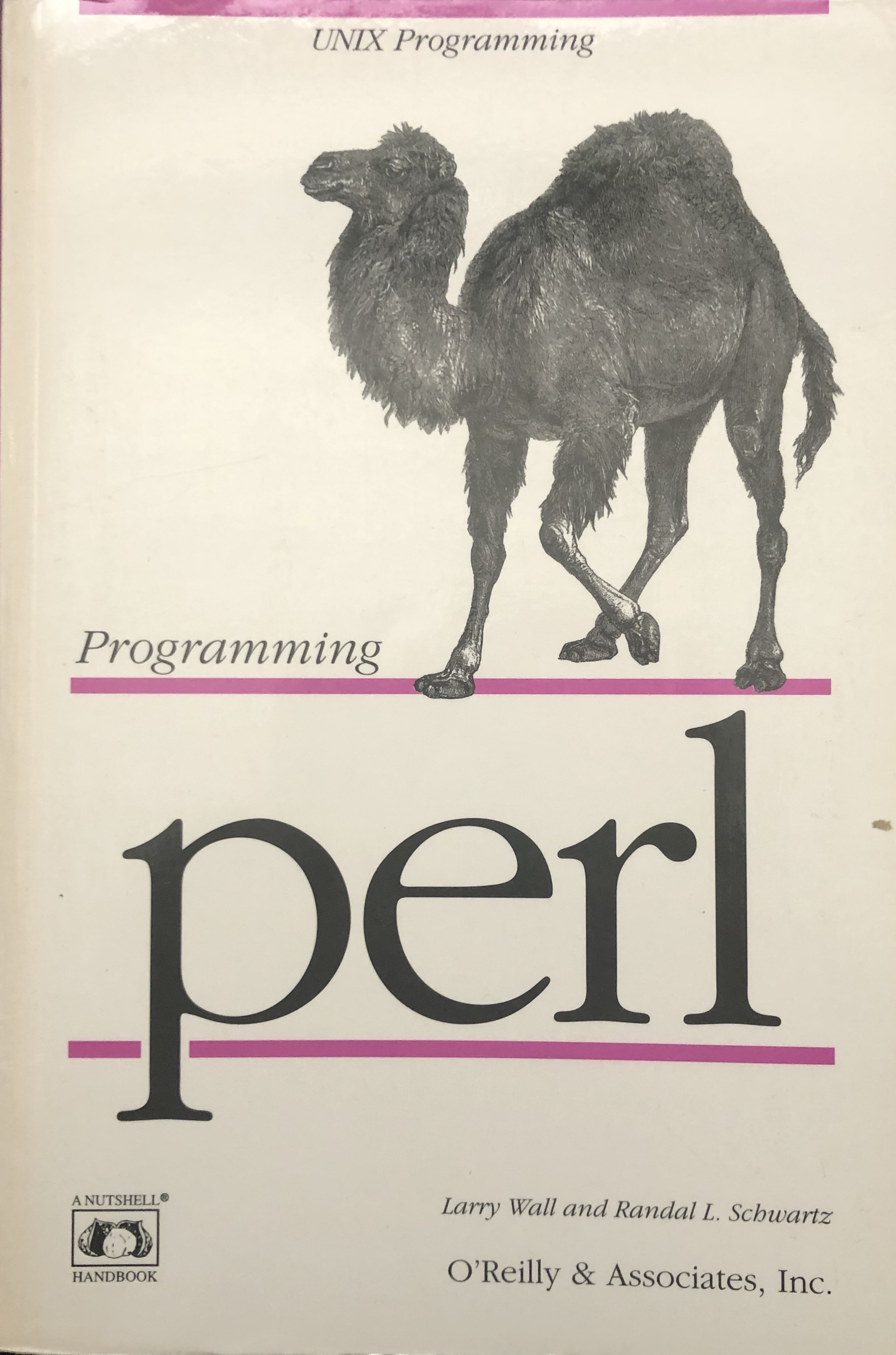
This is the authoritative guide to the hottest new UNIX utility in years, coauthored by its creator, Larry Wall. Perl is a language for easily manipulating text, files, and processes. Perl provides a more concise and readable way to do many jobs that were formerly accomplished (with difficulty) by programming in the C language or one of the shells. Even though Perl is not yet a standard part of UNIX, it is likely to be available wherever you choose to work. And if it isn't, you can get it and install it easily and free of charge.
Contents include:
An introduction to Perl Common tasks with Perl Real Perl programs; includes database manipulation, programming aids, system administration, text and filename manipulation, interprocess communication, and more Perl syntax Perl functions Other oddments; invocation options, debugging, efficiency, the Perl library, linking in C subroutines, etc. Also includes a pull-out quick-reference card (designed and created by Johan Vromans).
The "camel" book. This book should be everyone's initiation into Perl. It is a great way to get your feet wet and start to see the scope of what Perl can do. Read this one first, "Intermediate Perl" 2nd, for object oriented programming in Perl. If you're still around after that, grab the "Perl Cookbook" to learn some nifty tricks.
This book is a mixed opinion kind of thing, a lot like the language itself. I think that if you find yourself strangely attached to Perl, you will also experience a strange attachment with this book. It feels as organic and chaotic as the language design and using it as a reference is a lot like using Perl to solve a problem - it's all there, it's just arranged in potentially ridiculous ways.
If you are considering using a printed copy of this book as a reference in this day and age, you should consider other options. Do you refer to printed manpages often? I thought not. Considering the book's notorious organization (notorious lack thereof), the only way you're going to be successful in finding specific language topics in reasonable time here is if you have already read the book a couple of times cover to cover (in which case you don't need my opinion).
However, this is generally construed as one of those good books on programming languages. It has an above average level of detail, it makes for an introductory text as well as a tune-up for the advanced user, but the real charm is how naturally language concepts are explained (even if they're misguided) and the unique insight it gives on the language design resulting in moments of unexpected intuition when using Perl. I think this book is beloved by a rare sort of right-brained geeks - it's too emotional for a stereotypical coolly logical C programmer and too technical and intense for a stereotypical creative think-tank Ruby programmer. It's Perl through and through.
Would you believe it if I said that a programming manual was compusively readable? Pick up this book: I particularly recommend Chapter 27, "Perl as Culture" -- including the subsection on "Perl poetry."
Oh -- it's also a really useful reference, as should be expected, because the author is also the creator of the programming language.
Along with the camel, you'll probably want the llama.
I read this book back when it was only a couple years published. I laughed really hard and puzzled through the programming. I didn't have what it took to stick with Perl. I moved quickly into areas where I had better prospects. Recently, I've returned to dabble a little in areas where Perl is a solid choice and am having all these fond memories. I'm not sure I'll pick this up and read it again just yet. I also remember the llama book being more helpful getting me off the ground and I might revisit that!
I give it a marginal 5 stars, mostly for all the use I've gotten out of it. The organization of the book is not the best, for example it would be nice if other keywords and reserved symbols (like, say, "while" or "{") were covered in detail in an easy to find ordered reference section, as the functions are. But it's still the best Perl reference out there.
The original PERL book, written by Larry Wall, the designer/creator of PERL. Probably a bit dated now, I read this many years ago when PERL was first released and I needed to teach myself this "new" language. As with all the O'Reilly series of books, this is a good introduction to the language that will get you up and running in short order.
Excellent reference work. It was better, back in the first edition, when the programming examples were co-bound, but it's really getting so huge (all the useful libraries) I can see why they don't do that any more.
Библия perl "Camelbook" - это один из тех источников к которому обращаешься постоянно в работе с Perl. Самое фундаментальное, основательное и, что немаловажно, человекочитабельное издание легендарной книги.
Всем начинающим, и продвинутым разработчикам рекомендуется в качестве настольной книги.
To be fair, I love Perl. I learned mostly on the 2nd edition, but this is the one on my shelf. Seriously in-depth but still easy to consume and then use as an indexable reference.
This was the text for a Perl class and appropriately so as it was taught by Tom Christiansen one of the authors. Contains all the perls of wisdom you should need for this language.
One of five books I'd take to a deserted island with great internet and no Amazon delivery. Huge but worth re-reading periodically. Will teach you both Perl and Unix/Linux.