A resistance group takes America's racial reckoning into its own hands in this powerful, stirringly original debut novel
After the murder of an unarmed Black teenager by the hands of the police, protests spread like wildfire in Bliss City, New Jersey. A full-scale resistance group takes control of an abandoned housing project and decide to call it Hush Harbor, in homage to the secret spaces their enslaved ancestors would gather to pray.
Jeremiah Prince, alongside his sister Nova, are leaders of the revolution, but have ideological differences regarding how the movement should proceed. When a new mayor with ties to white supremacists threatens the group’s pseudo-sanctuary and locks the city down, the collective must come to a decision for their very survival.
Haunting, provocative, heart-pounding and tender, Hush Harbor presents a high-stakes world grounded on the thought-provoking What would you sacrifice in the name of justice?
In a headline we know all too well, an unarmed Black man is shot and killed by the police causing an uprising from citizens frustrated with the injustice. A revolution is soon formed; the members taking over an abandoned housing project they call Hush Harbor in honor of the secret spaces their enslaved ancestors would gather. As the group fights for their survival against a faction of white supremacists, their leader’s ideological differences threaten to further harm them as they try to figure out, what next?
Sometimes books are scary because of how much they represent the horrors of our reality. Anise Vance manages to create a dystopian society that feels about 2 degrees from our current society and that is the most terrifying part of this story. The setting, intensity, and fast paced plot was spot on. However, I did feel as though we are dropped into the story midway and as a result, struggled to orient myself. I think I needed a bit more world building at the start to truly connect and *click-in* to the story.
Read if you like: •speculative fiction •atmospheric settings •movie like books •dystopian rooted in reality •focus on social injustice
All in all, this is an impressive debut and I look forward to reading more from Vance in the future. Thank you HTP Books and Harper Audio for the gifted copies in exchange for my honest review.
A very original novel about police brutality and racism. The story is set in the year 2030, where a group of protesters occupy a deserted housing project in Bliss, NJ, after an unarmed black teen named Kemba is shot and killed by police who are later found innocent of any wrong doing.
The leaders of this revolution are brother and sister, Jeremiah and Nova Prince. Jeremiah was the boy's history teacher and he was seeking to adopt him, so he was particularly outraged by his death and the lack of justice to be found through the legal system. They call the area they have claimed Hush Harbor and seek 'to build an entirely new society free from white supremacy.'
Jeremiah and his sister have differing opinions about how to achieve their goals. He 'thinks he can make justice by attacking power.' Nova thinks 'we need to rewrite the definition of power.' Can this small revolution succeed? Or is it doomed from the start?
The issues of racism and white supremacy are front and center in this story--what has brought us to this point and how to change an unjust system. Is violence the way to go or can a peaceful way be found? I found the beginning a bit confusing as it jumps right into the middle of the uprising as a recruited member arrives on scene. I kept wondering what these people planned to do. What did they think the response would be to their rebellion and how would they counter that? The characters were intelligent and likable but seemed to have vastly different goals. This all comes together in a pretty exciting conclusion.
I received an arc of this new novel from the author and publisher via NetGalley. My review is voluntary and the opinions expressed are my own.
”Self-defense. We resist in self-defense. We agreed to that.” “That’s suicide, Nova.”
I never wanted this book to end. I want to stay with these characters, to know where they will go next.
The characters—Jeremiah, Nova, Quinn, Malik, Zahra—come together in a chorus of voices giving words to the internal conflict all revolutionaries must feel. Each voice felt so real. The plot flowed along in a torrent and I hated when I had to stop reading for the night, even though I’m a sleep-deprived mother whose baby will wake me up at 2am to eat regardless of when I put the book down and finally sleep myself.
I recommend this novel to fans of literary fiction with compelling plot, thought-provoking stories that ask questions with no easy answers, and readers who love strongly written, relatable characters.
I read this in one afternoon, I couldn’t put it down! One of the best books I’ve read in a very long time. Vance’s writing is so incredibly beautiful; the entire book read like a blockbuster. I will be recommending this book to anyone who will listen!
This is a predictable liberal cautionary tale of the 'violence' of revolution. These tales always ignore the violence inherent in a white supremacist society.
The revolution wouldn't be led by highly formally educated people. No lawyer is giving up their well-earned place in white supremacy, and poor folks on the street wouldn't trust such a leader.
Ferguson Uprising lasted 14 months and needed none of what was happening here.
This is a lot of 'if we fight back, we become like who we fight' liberal 'they go low, we go high' farcical thinking. To those that think this, I say, 'Get out of the way of those of us not willing to die perfect victims'. We want to see real change in our lifetimes, and we heard Audre Lorde when she stated that the masters tools will never dismantle the masters house. Real change within our lifetime is possible.
I wish this had understood what's come before it and built on that or at least spoken to real revolutionaries. Hint: probably not many enrolled in law school.
What I hoped this would address is the fate of revolutionaries. What happened to the Ferguson Uprising protectors? Most are dead, quietly murdered by our police state. The police and alphabet groups have been setting up and taking out Black revolutionaries for centuries. Cointelpro proved that beyond the shadow of a doubt.
This was largely a missed opportunity for me. I'd definitely read something by this author.
“Hush Harbor is a vision, not a place. It represents a world where a five-year-old doesn’t wait at the door for hours for his falsely accused parents to come home. A world where a fourteen-year-old wearing headphones isn’t gunned down for reaching into his pocket. A world where their killers aren’t left free because they have badges.” (p.194)
Anise‘s work in Hush Harbor is deservant of no less than five stars. It‘s incredibly inspiring, even poetic at times, full of wisdom and complexity that leaves you contemplating your own stance towards very heavy issues. The characters are beautiful and their comradeship an example of how to unite under a common goal whilst having differing perspectives, and ultimately how to resolve those conflicts and approaches. There is no black and white, no universal solution. Nova, Quinn, Zarah, Jeremiah and Malik were all beautiful and real in their own way and I hope there might one day be a continuation of their story.
“We are always just. We are always humane. We are always kind. (…) His behavior does not determine ours. We need to remember that. (p.213-214)”
Hush Harbor is about police brutality, racism, generational trauma, revolution, hope, tragedy, justice, leadership, non-/violence, sacrifice and much more. A story so timely and relevant. I loved how gracefully he managed to portray very complex nuances within the field of social justice - which speaks volumes since not many authors or activists manage to do so. It’s extremely difficult to find that line, holding truth and grace in seperate spaces. Whilst a clear enemy is portrayed, the lines start to blur, arriving at an open end that confronts the reader with humanity. “Neither saint nor devil. A person, only a person, reaching for justice.”
I had the immense pleasure to meet Anise after an interview he gave in my social justice class and can attest to the tenderness and warmth of his heart, his very educated and nuanced perspectives, his compassion and genuine passion for the craft.
Thanks to Hanover Square Press for the copy of this book!
Hush Harbor is a very unique look at a scenario we're all too familiar with: the murder of an unarmed Black teenager. In response to the shooting, siblings Jeremiah and Nova start a resistance in an abandoned housing project and call it Hush Harbor. I loved the dystopian take on the dynamics that white supremacy brings to society, and thought this was a fast-paced and fresh take.
The overall idea was interesting & the writing was great. I was definitely much more invested in the story once I reached the halfway point of the novel. But I will say that overall I was more than slightly annoyed with the lack of (for a better way to phrase this) the overall world building because I had so many questions concerning Hush Harbor the actual place & their day to day survival & other nitty gritty stuff. But all of that took a back seat to the revolution part of the story & while I understand why, you can't have one without the other. Also missing or mentioned far too briefly was why the US was in what appeared to be a fragmented state that allowed for this story to be happening at all. I'll read this author again but this book was a miss for me.
I received an advance review copy of this title from the publisher.
This is officially one of my top reads of the year.
I don’t even know where to begin because I want so badly to encompass the power of this story.
There is so much this book left me reeling with & how much I need to reflect on. It should truly be required reading.
🖤 So endlessly grateful to one of my greatest bookish friends, @thisaccountisfiction who told me about this one…
➡️ This book is a model of getting uncomfortable truth through intense, but palatable, fiction. Topics in this book are regarding very real problems in our society, just served more dystopian via excellent storytelling.
I love when an author gets me into a true groove with the characters, and in each section of this story, I felt wholly pulled into the heart of the character being focused on. Everyone’s decisions and every portion of the outcome of those decisons was directly related to a nuance in a character’s personal morals… and while there was a bleak harshness in the story’s climax, it also didnt end without enduring seeds of gratitude and hope…
I wept in anger at myself and at others, and similarly so in sadness at the injustices portrayed in this book (and their visceral connection to real life). Many portions of Jeremiah’s story are particularly powerful. So much of his evolution shapes an important journey of holding deeply deserved space and empathy for people that society is most quick to deprive of it...
Quinn’s storyline as a white woman effectively left me with an incredible amount of mindsets to confront & reflect upon. Topics such as intention vs. impact, misplaced emotional ownership and white saviorism, and one’s role in and relationship with allyship are tackled in a way that truly connects.
I could discuss endlessly each MC in this book, but I will end with: Vance is a true masterpiece writer, weaving multiple individual realities into one broad & complicated truth harrowing our society. This story shows us a true horror in our world, but it also never relents in exemplifying the enduring power of hope and survival. I’ll never forget this book.
This book is meant for discussion. It brings up so many relevant topics about racism and resistance. I think the exploration of whether resistance and change can always be ethical was particularly smart. I liked the different POVs showing different sides, motivations, and moralities of the people within the rebellion.
I’m afraid the story lacked world building. How did Hush Harbor develop and how did it mean to live independently from white supremacy? There wasn’t enough exploration of separating from a governing system while still being reliant on their resources. There wasn’t enough exploration of the systems put in place to make Hush Harbor an independent and equal society. I really wanted more of it. I wanted to read more of the intentions and possible success of Hush Harbor because at the point the book starts, it seems it is doomed to fail.
All in all, I think this book had a lot to say and is just a stepping stone to discussion and exploration of the topics it raised.
With what I expected from a book about resistance and taking control of a section of a town, I expected a higher level of intensity and action. I was thinking I would be reading about protests and marching in the street and Blank Panther type activism. I was thinking about the 1985 MOVE bombing. Instead it almost felt like a book about a well-established and smooth running commune. I don't know how much of it was due to the writing style or how much was due to the events that were described in the narrative, but it almost felt more like a story about a few of the members/leaders of the group and their personal interaction than the movement itself. I wanted something closer to a revolution and felt that this fell short of that. It was still a good story and I did enjoy it. I would have enjoyed it more if there had been more heightened drama.
Thanks to NetGalley and Harlequin Trade for a copy of the book. This review is my own opinion.
I am DNFing this book, not because its bad (it isn't), but because this book just isn't for me. I can see the talent in the author and the value in a book like this. However, right now, I am seeking books that are more of an escape, and this confronts *important* real-life issues. My one main criticism for this one, though, is that you're thrown into this world without much explanation. It is almost as if you enter the story in the middle, rather than the beginning. This made it hard for me to orient myself as a reader. Still, I think that this could be a winner for other readers.
While the larger plot line of Hush Harbor is about justice and racism and oppression and power, the underlying theme is that of relationships. The characters develop intimacy and trust with one another, and that trust sees them through the hard questions and disagreements over how to work toward dismantling a system with centuries-old bulwarks of injustice. The book leaves the reader with questions that may not have answers, and allows us to grapple, as the characters do, with which approach is right.
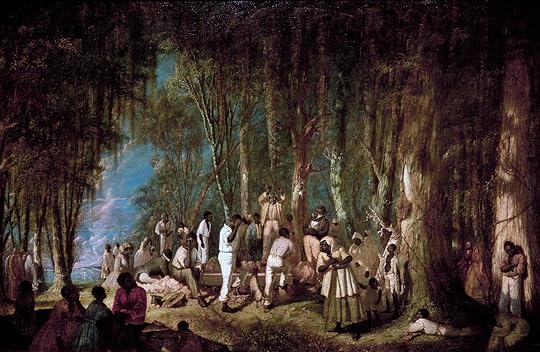
"What should we call it?" Nova's imagination had not yet wandered to that scale. What htey called Hamilton Heights might imply a name for themselves. She wanted nothing of the classic political party or rebellion group designations. No unions or associations or alliances. They out to represent an idea that spoke to human nature more than it indicated a political aim. She knew there was an ontology behind their actions. They needed a name that would give it life. The three spent several minutes in thought. Finally, Jeremiah offered an idea. "Hush Harbor," he said. Zahra nodded several times. "Like the places enslaved people would worship?" Nova considered the term. At a hush harbor, slaves could pray to whomever or whatever they wished. They could shot and dance and speak in languages unknown to their foreign masters. They could create a world spiritually distinct from the ones in which they toiled. Yes, Nova thought. It was a perfect name. An ode to the past and the future. At their newly baptized hush harbor, greed and malice and the stink of rotten hearts would remain outside the projects' gates. They would live as though in prayer, hopeful and unsure of their mark, but free, or at least as free as destiny would allow.
~~An artist's interpretation of a hush harbor from time gone by. Vance brings us a hush harbor in the near future, where oppressed persons have come together to build a society of equality for all.
First two sentences: A soldier approached the car. The dog at his side raised its snout and snarled at the darkening purple sky.
Vital statistics: Year written: 2o23 Length: 286 pages Author's home: North Carolina Setting: A city under martial law, along the Atlantic coast of New Jersey, in 2030. Genre: a thriller in the possible near future Read if: You read to expand your world view, and seek out viewpoints which challenge the status quo.
My two cents: Quinn muses, in one of the quotes, below that "how we tell a story means everything." Those of us who devour books can certainly agree with that quote. And Vance tells his story with finesse. Moral stories, in the hands of some authors, are painted in black and white. Or include a preachy narrator. Vance gives us complex characters. A few are deeply flawed, but most of them are just trying their best in an imperfect world. Through the viewpoints of the main characters we see varied ways of reacting to provocation. There's much food for thought here. Given 3.5 stars or a rating of "Very good." Recommended.
Favorite quotes: "You know what it feels like to be sad." His grandfather placed a hand on Malik's chest. It was large and warm and could catch a falling heart. "It's good to be sad when sad things happen. But did you know you can feel two things at the same time? Like when you eat ice cream too fast, you feel pain from the cold and happy because you're eating ice cream. Yes?" "Yes." "And so when you're sad, it's possible to feel hope at the same time. These symbols remind us of things that it is sometimes hard to feel."
"I like the way you tell stories." "That means very little." Quinn thought of Nova, how she'd once listed the differences between Native Son and Invisible Man to her through a mouthful of pad Thai. Nova buried deep in her seat mumbling Danez Smith poems at a screening of a prison documentary. Nova ignoring motion sickness to read Burnt Shadows on a bus to New York. What was the insight she drew from that book? There are no small corners? Quinn settled into the booth. "How we tell stories means everything."
~~"Faith isn't about religion or God. It's about belief in something fundamental. Sometimes that belief is blind, sometimes it's reasoned, and most of the time it's a little bit of both."
~~Quinn wondered at Earl and her luck. He appeared in her life a week before her mother passed. A wide-faced man with a soft voice who sat next to her at the hospital and handed her a box of crayons. Seven years old, she could not bear that kindness. She cried while clinging to her seat. He knelt in front of her and said that it was okay to cry, that it was good. That sad things happened and that, one day, happy things would happen, too. He said that he could sit with her as long as she liked. The words felt like a river gracing dry land.
~~What use was ruminating over ethical dilemmas when the present was so urgent, so complex? He set aside his need for an absolute right and looked to the sky and prayed that whoever tallied sins and deeds would find in his favor.
~~"Where are they running to?" "I don't know." "Are they running to or away from something?" "Neither." "I don't know what that means." "They're just running, Jeremiah." "But why ?" "That's what children do when they want to fly."
This book started off strong. I loved the story and felt like it was going to be a solid read. But as the story went on I struggled to stay engaged. The middle sections felt a little flat, and there were moments that dragged more than they needed to. It’s one of those books that had a lot of potential had it been shorter and more development in certain areas.
5 stars at the beginning, but it started to lose me when we split into different POVs. I was NOT expecting the connection between our other main characters and Kemba. Heartbreaking dystopian story that, unfortunately, wasn't actually too far off from reality.
Exceptional work. When I think of Anise Vance's writing, I think of an author who crafts stories brimming with balance and care. Balance and care for the levels of empathy we feel for each character. Balance and care for having the reader sit deep in reflection v. bursts of unexpected fast-paced movement. Balance and care of observing a world while not being privy to each nook. I loved the intentionality through each of Vance's choices. I am told by my household that there were even a few audible gasps as I read. Highly recommend.
I had the opportunity to read an advanced readers copy of Anise Vance's debut novel Hush Harbor, from NetGalley and the publisher. This is a book which had a lot of potential, but I ultimately feel needed to be 100 pages longer.
It is the story of a "racial reckoning" in an American city after the death of a young Black man (teenager really) at the hands of police, and the resistance tha emerged after the two officers were not indicted for the shooting. It takes place in an America similar to ours, but after an ecological crisis in which most of California falls into the Pacific due to the "big one." This is told in just a few pages, and if anything suggests that the lost of the west coast caused understandable economic turmoil. In all honesty, I am not sure why the California collapse, if that is what we call it, was in the book. It wasn't necessary to the story.
Hush Harbor was the creation of a resistance movement, where a small part of the city, an abandoned housing project, becomes a sort of self-governing zone. In all honesty, the nature of what Hush Harbor entailed was left somewhat vague, but it was a resistance cell of several hundred people, At first I envisioned some sort of island which was physically isolated from the rest of the city. But really, Hush Harbor was a metaphor for a vision of the future, drawing on the name of the places enslaved people would worship..
"At a hush harbor, slaves could pray to whomever or whatever they wished. They could shout and dance and speak in languages unknown to their foreing masters. THey could create a world spirtually ditinct from the ones in which they toiled….. it was a perfect name, and ode to the past and the futre. At their newly baptized hush harbor, greed and malice and the stink of rotten hearts would remain outside the projects’ gates. They would live as though in prayer, hopeful and unsure of their mark, but free, or at least as free as destiny would allow." (p. 235).
The story of this resistance movement, of this hoped for revolution is told in 284 pages, broke into several parts, each told from the perspective of different characters, each of whom were critical players in the movement's leadership, . Over the first 200 pages the story and building conflict comes together. But in many ways, I felt like there was too much character development which came at the cost of moving the story forward, and not enough time given to the actual conflict, and especially, the end of the book.. One major revelation near the end, as to the funders behind the movement was never really dealt with, and the book just felt rushed to a premature end.
Now there is a risk of over-writing a book, but the scope of what the author was writing, and the world the reader was being invited to get immersed in, deserved more.
In the not so distant future, a young and unarmed African American boy is gunned down by police. When he is denied justice, what begins as protests turn into a revolution led by Jeremiah Prince and his sister, Nova. Taking refuge in an abandoned housing project the group names Hush Harbor, they build a sanctuary free from oppression.
However, the siblings have very different idea on how to create the changes they want in the world, a fact that only becomes more prominent when Hush Harbor is threatened by a newly appointed mayor with ties to white supremacy. As time begins to run out for Hush Harbor, the revolutionaries must decide which lines they are willing to cross for justice.
Told through multiple perspectives, this book uses each of their individual experiences to highlight the different ways they have been impacted by racism in this country. The author does incredible job showing how these heartbreaking events shaped who they are and their views on how to create lasting change in a system made for oppression.
Powerful and thought-provoking, I lost track of how many times I had to close this book for a moment to process what I had just read. Institutionalized racism, white saviorism, and the line between us and them are only a handful of the topics that have left me deep in thought long after finishing.
Despite being set in the future, there is no question that the oppression in this story are the facts of another’s real life, and that terrifying truth will stay with me for always.
In the near future, after yet another murder of an unarmed black teenager at the hands of police, protests spread across the country and a resistance group takes over a housing project in a fictitious east coast city. Intriguing story of sacrifice, justice, white supremacy, foster homes, rebellion, racial politics, and standing up for what you believe is right. But at what cost?
“I thought I was going to be the next Thurgood Marshall or, with more than an ounce of luck, Sonia Sotomayor. But nagging questions refused to leave me. What history was the law coming from? What assumptions did it make about human nature? What powers confined it, subdued it, beat it down? The more I learned, the more I saw the law for what it was—the bruised pulp of what we once called justice.”
“At a hush harbor, slaves could pray to whomever or whatever they wished. They could shout and dance and speak in languages unknown to their foreign masters. They could create a world spiritually distinct from the ones in which they toiled. Yes, Nova thought. It was a perfect name. An ode to the past and the future. At their newly baptized hush harbor, greed and malice and stink of rotten hearts would remain outside the projects’ gates. They would live as though in prayer, hopeful and unsure of their mark, but free, or at least as free as destiny would allow.”
“She lifted that realization to the center of her consciousness. Slowly, her faze ebbed. She saw herself clearly: neither saint nor devil. A person, only a person, reaching for justice. She had instincts both righteous and horrid. She would falter more often than not. But at least she would continue on the path toward it.”
After a young, black, unarmed teen is shot and killed by police, a revolution is formed in an abandoned housing project called Hush Harbor, in honor of the secret spaces their enslaved ancestors would gather. Jeremiah Prince and his sister, Nova, are the leaders, but their ideological differences regarding how the movement should proceed differ. When a new mayor with ties to white supremacists threatens the group and locks the city down, they collectively must come up with a plan of survival.
As much as I thought this novel would be about the revolution and protests and marching - this was mostly about an already established, what felt more like a commune, movement. This also focused on the personal experience of the members, especially Malik, who, at the beginning of the novel, was getting recruited right in the middle of it all.
The story was still good and I enjoyed it, but it wasn’t what I was expecting going into it. Of course the issues with racism and white supremacy are the main focus of this book and the author did a wonderful job at writing those. I think I may have struggled with the writing style a bit. It would go from super formalic and dense to a whole page full of dialogue with no movement indication. It didn’t catch my emotions and though I was interested in the story, I didn’t care too much for the characters, minus Jeremiah’s story.
Overall, this was still a good story and an important one at that. The debut writings of this author still intrigue me to read more of his when the next release comes.
*Thank you Hanover Square Press and NetGalley for a digital advance copy of this novel in exchange for an honest review
Dystopian • Speculative Fiction • Social Justice Sci-Fi • Thriller • Race Published 5 Sep 2023
𝙒𝙝𝙖𝙩 𝙬𝙤𝙪𝙡𝙙 𝙮𝙤𝙪 𝙨𝙖𝙘𝙧𝙞𝙛𝙞𝙘𝙚 𝙞𝙣 𝙩𝙝𝙚 𝙣𝙖𝙢𝙚 𝙤𝙛 𝙟𝙪𝙨𝙩𝙞𝙘𝙚?
This is one of those books that’s part litfic, part thriller, many parts social commentary, told in an easy to ingest fictional format. It’s not a terribly long book but a powerful one, and I hope you read it.
Haunting and heart-pounding. Provocative and tender. This book has everything from high-stakes action to deep reflections on humanity. Hush Harbor is both a vision and a place, an ideological sanctuary and an abandoned housing project, where systemic racism has no place, where a resistance group is making its last stand.
In this safe haven, leaders of the revolution are starting to diverge ideologically, coming to a head when local government and white supremacist groups decide that Hush Harbor is an existential threat. Told from the perspectives of 4 individuals all of whom I connected with, I was clenching-body-parts-tense imagining all the possible outcomes and violence spiraling unto more violence. However there remained a sense of hope alongside the grim portrait of society.
I’ll be thinking of this one for a while. I highly recommend audio format. The narrator did an excellent job with inflection and brought it to life. I did switch between audio and e-reader toward the end for better reading comprehension.
Read this review and other Science Fiction/Fantasy book reviews at The Quill to Live
This next book I requested an ARC of way back in fall of 2023 and I just sort of lost track of it. Hush Harbor, by Anise Vance, is a unflinching look at a revolutionary project surrounded on all sides, with an uncertain future both internal and external.
A black teenager is murdered by the police in Bliss City, New Jersey fomenting an uprising. The Prince siblings lead a revolution and reclaim an abandoned housing project, creating a place devoid of white supremacy. Many flock there to shore up its defenses and protect the community from the growing racist backlash spearheaded by one of the murderous cops. But when the mayor who is secretly friendly to the denizens of Hush Harbor is replaced by the more hardline chief of police, the Prince’s differing beliefs on how to survive cause internal strife. Will the citizens of Hush Harbor be able to mount a defense against the might of the city?
Vance’s debut is an unglorified look at the inner workings of a small revolution. He pulls no punches when it comes to characterizing the people who would gravitate to Hush Harbor. They are human, both idealistic and flawed. They are shaped by the baggage they carry, whether it is handled with spite or love. Everyone has their own blind spots, the things they are unwilling to compromise on, and the future they wish to see. Vance does an excellent job of weaving their history’s into the narrative, giving each character a life of their own.
I was impressed that each perspective also had a different way of engaging with their past. Malik, a young man who drives up from Atlanta because his mentor is involved, is guided by his powerlessness. He exists in the now, and therefore the little bits of his past that filter through are small glimpses of when he felt he should be doing more. These little acts are portrayed as short flashes of memory that reground him in the moment, pushing him to his final act. Malik is juxtaposed against Jeremiah Prince, one of the leaders of the revolution, who sees his life in a more linear fashion. A long chain of events that brought him to where he is now, written from the moment he meets the boy, who’s death is the flashpoint of the revolution. Jeremiah, when he recollects his past in the present, views his life as a series of moves and countermoves like a chessboard. Vance doesn’t just make this explicit in how he describes the characters though, he writes it into the narrative. Malik’s perspective exists in the now, peppered with memories. Jeremiah however, has a full flashback of his life leading to the revolution. This perspective heavy writing doesn’t exist with these two either, every character is given a similar treatment.
Despite the low page count, Vance follows several characters and his writing carries it through. Each perspective feels distinct in how they look at things, what is important to them, and the problems they highlight within Hush Harbor’s short history. It’s a lush dive into a specific time and place and the conditions that it can exist in. Vance grounds the world vividly, opening a path for such a place to exist. The federal and state governments are stretched thin as California has finally had the big earthquake, and is physically separated from the rest of the continental United States. The state is not as overbearing as it could be, but the threat of force remains if they step out of line. But the new mayor sees the whole stunt as a provocation and aims to crack down. These issues are all attended to in varying degrees of interest through the different characters. You don’t even learn certain aspects about the world until certain characters bring it up because the others are focused on various things.
The final bit I want to highlight about Hush Harbor is its depiction of the victories and the frustrations of trying to birth a new world. Vance looks sincerely at the situation and tries to highlight the anxieties that come with being set upon by all sides. There are incredibly tender moments that exist within the story, as well and incredibly uncomfortable and frank discussions of strategy. Vance lets everything play out though, refusing to balk at implications and the roads that characters have been led to. Nova Prince is the perfect foil to her brother Jeremiah, even if she has her own flaws. This world does not have a single paragon, despite the people who populate it trying to create one. It’s a stressful environment even if it’s more free. You never really know the direction Vance is going to go, but that is part of the beauty and truthfullness of Vance’s story. The ending is one for the books in how scary the future can truly be.
I fucked up by not reading Hush Harbor when I first got my hands on it. If you want to read a story with incredible writing, memorable characters, and the realities of revolution, this is the book. It’s concise and delivers its punches exactly where they need to land. I hope Vance continues to write more because his voice is intoxicating.
Rating: Hush Harbor – Rush To It’s Defense -Alex
An ARC of this book was provided to me by the publisher in exchange for an honest review. The thoughts on this book are my own.
In the near future world of Hush Harbor, tension is at an all time high. After the police murder an unarmed black teenager, a group of protestors take control of a small area in New Jersey. This sanctuary, they call Hush Harbor. They are quickly surrounded by armed guards; the standoff has no end in sight. The leaders of Hush Harbor know that radical change is necessary, but disagree on how far they are willing to go. Will this revolution bring about true change, or will they be quietly swept under the rug?
This novel was deeply thought provoking and fairly depressing. The police have all the power, and it's a nightmare to think about something like this happening. Each section of the novel has a different narrator, and I really enjoyed the varying perspectives. I would have preferred a bit more worldbuilding though, instead of just being thrown into this near future USA with little understanding of how the rest of the country/world are progressing. A timely and heartwrenching story that is worth the read.
I received a complimentary copy of this book. Opinions expressed in this review are completely my own.
I received an advance copy of this book. Thank you. I found this book very powerful and compelling; although I was left a little confused by the end of the story. It starts as a story we are hearing too often. After an unarmed black youth is gunned down by police, protests rise up again. This time protests go further; a resistance movement gains momentum and a revolution is born. They take over an abandon housing project, soon forming a tight knit community. They call their new home Hush Harbor in honor and remembrance of what enslaved people used to call the area where they felt safe to gather and pray. The story is told from 5 points of view: Jeramiah Prince, Nova Prince, Zahra, Quinn and Malik; Jeramiah and Nova Prince being the leaders of the group. As the story progresses, we discover how they know each other, where they've come from, their history that compelled them to fight for their cause. Although they all want the same thing and are willing to sacrifice everything, they disagree on how to achieve this. Touching and thoughtfully written.
I'm not sure how to review this book HUSH HARBOR by Anise Vance. I finished it over a week ago. I found the book difficult to put together, but I will try.
The story takes place in 2030. There seems to be a race war that has factions forming secret enclaves for their own protection. This book centers on Hush Island which is guarded from entrance by, shall I say, the old guard of the white race. It is also guarded by the residents of Hush Harbor. Fortunately they receive food and more from unknown benefactors. These residents have schools for the education of the young. It appears to be well run.
There is another group trying to eliminate these residents. Their leader has killed friends of one of the people running Hush Harbor.
This was intriguing, but confusing. Hiding places, tunnels and escapes riddled their community. Eventually they learn who their benefactors are. Hush Harbor is doomed as is the opposing faction.
I always felt I was missing something from the story.
This book burns slow and then hot. It begins with a lot of character development and back story, then at about the halfway mark explodes with nonstop action to the end. What happens when a resistance group goes up against a group of powerful white supremicists? What actions should they take? Should they take a mostly self-defensive stance or go on the offensive? Are there actions that are beyond the pale, even if their enemies do them? How far is too far? These are moral questions the group is faced with, and they disagree amongst themselves. The story doesn't give us the answer. The end is vague, and I think that's by design. Different people will read different things into it. Very thought-provoking book and should initiate much discussion. Received a free galley from NetGalley. Thank you for the opportunity to review it.
Timely novel in the face of increasing civil disobedience through encampments for Gaza and autonomous zones. The book projects the idea of an autonomous zone that survives and grows for many months after the murder of an unarmed Black boy. The characters rebel against our capitalist, white supremacist society and succeed in arming/defending themselves. The idea was good, and I could see how strong the influence of the Black Panther Party was on the book. Nice to contrast different tensions within a movement although each character’s perspective and moral quandary wasn’t given equal weight.
I was disappointed that the ‘new world’ the characters espoused to be building didn’t move much beyond what we already know of mutual aid. The writing itself was okay, but at times odd and full of cliché, and the flashbacks didn’t flow very well.
I usually don't like near future books (except Parable Of the Sower). I picked this up at the library because it was marked as sci-fi, it's not sci-fi.
Vance writing style pulled me in and I could completely believe the story. I actually felt like it was real life unfolding. The open ending was fitting for story. I wanted to know more about the characters, especially the interracial couple. are they going to make it? Have kids? Where are they going to live? These are type of questions I normally never care about after finishing, but they were such important questions to these two characters at the end of the story, that I want to know.
No on page sex, I can't remember language- but I put it down for a few days after an emotional plot revelation, one person is shot on page, good and bad cops, BIPOC representation, no LGBTQ+ representation