

What do you think?
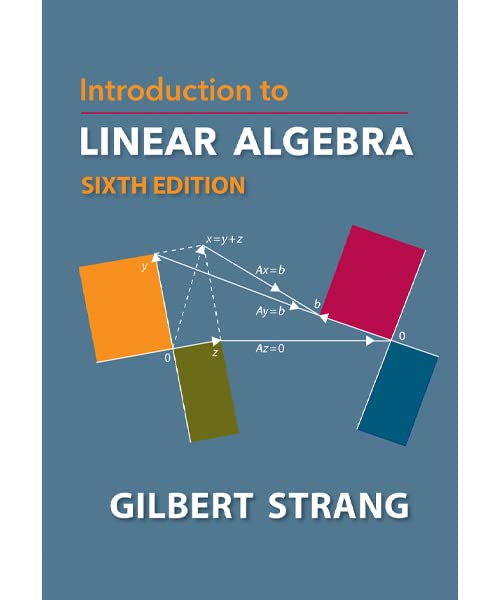
Introduction to Linear Algebra
Linear algebra now rivals or surpasses calculus in importance for people working in quantitative fields of all engineers, scientists, economists and business people. Gilbert Strang has taught linear algebra at MIT for more than 50 years and the course he developed has become a model for teaching around the world. His video lectures on MIT OpenCourseWare have been viewed over ten million times and his twelve textbooks are popular with readers worldwide. This sixth edition of Professor Strang's most popular book, Introduction to Linear Algebra, introduces the ideas of independent columns and the rank and column space of a matrix early on for a more active start. Then the book moves directly to the classical topics of linear equations, fundamental subspaces, least squares, eigenvalues and singular values – in each case expressing the key idea as a matrix factorization. The final chapters of this edition treat optimization and learning from the most active application of linear algebra today. Everything is explained thoroughly in Professor Strang's characteristic clear style. It is sure to delight and inspire the delight and inspire the next generation of learners.
440 pages, Hardcover
First published January 1, 1993
About the author
Gilbert Strang
38 books200 followersWilliam Gilbert Strang (born November 27, 1934), usually known as simply Gilbert Strang or Gil Strang, is an American mathematician, with contributions to finite element theory, the calculus of variations, wavelet analysis and linear algebra. He has made many contributions to mathematics education, including publishing seven mathematics textbooks and one monograph. Strang is the MathWorks Professor of Mathematics at the Massachusetts Institute of Technology. He teaches Introduction to Linear Algebra and Computational Science and Engineering and his lectures are freely available through MIT OpenCourseWare.
Ratings & Reviews
Friends & Following
Create a free account to discover what your friends think of this book!
Community Reviews
Displaying 1 - 30 of 65 reviews

August 10, 2011
I'm having a hard time identifying with the main characters.

October 22, 2012
Ah, what a beautiful picture.

I love this book. The attraction comes, I think, partly from the beauty of the subject, but also partly from the clean way in which Strang packages all of his mathematical expositions. I spent many a nerdy weekend morning with this book and the OCW lectures.
Which brings me to the second most important point that I'd like to get across in this review: you need to pair this book with MIT OpenCourseWare's Linear Algebra lectures (also, coincidentally, taught by the magnificent Strang). They're all freely available on the OCW site or on YouTube. These follow the book very closely and are indispensable—Strang is an even better lecturer than he is a writer. (Some friends complain of a certain "Strang-speak" in his book: a certain awkwardness with words that sometimes obscures a point. I can understand these gripes, and this is why the lectures are really absolutely necessary until one has adjusted to the writing style.)
The most important point, of course, is that I think you should read this book. Linear algebra (as portrayed by this book) is a really beautiful field—much cleaner and often more intuitive than other areas at the same level (calculus, differential equations, etc.). It will activate a new part of your mind, and give you new ways to visualize problems in other domains [1]. This book reminded me of the value of math, when other textbooks and other classes sometimes failed to do so. Give this book a try—it will change your mind!
Footnotes:
1. As a programmer, this book has opened up new opportunities for me. I can now talk fluently about the machinery behind least-squares problems, neural networks, etc., and I can now explore more advanced parts of machine learning, data mining, computational statistics, etc. etc. Absolutely worth it!
I love this book. The attraction comes, I think, partly from the beauty of the subject, but also partly from the clean way in which Strang packages all of his mathematical expositions. I spent many a nerdy weekend morning with this book and the OCW lectures.
Which brings me to the second most important point that I'd like to get across in this review: you need to pair this book with MIT OpenCourseWare's Linear Algebra lectures (also, coincidentally, taught by the magnificent Strang). They're all freely available on the OCW site or on YouTube. These follow the book very closely and are indispensable—Strang is an even better lecturer than he is a writer. (Some friends complain of a certain "Strang-speak" in his book: a certain awkwardness with words that sometimes obscures a point. I can understand these gripes, and this is why the lectures are really absolutely necessary until one has adjusted to the writing style.)
The most important point, of course, is that I think you should read this book. Linear algebra (as portrayed by this book) is a really beautiful field—much cleaner and often more intuitive than other areas at the same level (calculus, differential equations, etc.). It will activate a new part of your mind, and give you new ways to visualize problems in other domains [1]. This book reminded me of the value of math, when other textbooks and other classes sometimes failed to do so. Give this book a try—it will change your mind!
Footnotes:
1. As a programmer, this book has opened up new opportunities for me. I can now talk fluently about the machinery behind least-squares problems, neural networks, etc., and I can now explore more advanced parts of machine learning, data mining, computational statistics, etc. etc. Absolutely worth it!

December 12, 2020
Strang has a unique way to represent linear algebra, it is confusing at first but you if you start connecting with the book you would absolutely love it. Is you want to learn the concepts of this books totally, you have to learn calculus and basic trigonometry first. Linear algebra is one of the most beautiful and useful subjects in mathematics. I enjoyed reading this book very much

August 14, 2011
this is the worst textbook i've ever read. it was completely useless in learning the course. avoid at all costs. "Linear Algebra: A Modern Introduction," by Poole is much better.

November 19, 2016
I read this in conjunction with MIT's OCW Scholar class and did all the problem sets and took the tests. Took me some time to finish the course, but it was surprising to find how fun linear algebra can be. I mean matrices and vectors? They weren't nearly sexy as curvy double integrals (multivariable calculus) or kinky Markov chains (probability theory). And I took the course only because linear algebra was indispensable for making a headway into mathematical statistics, probability theory, and other higher branches of math. But I have to admit, I kind of started liking this dowdy branch of math for its plain elegance. You have to admit, it's SO plain. Just look at the cover. Squares and rectangles? Are we in elementary geometry here? Euclid is, like, so played out. BUT there's some sexiness here if you look closely: Gaussian elimination, projections, eigenvalues and eigenvectors, diagonalization, and the crux of it all, single value decomposition (yes, I know, I'm shamelessly showing off a little here because I genuinely think these are cool-sounding and actually practical concepts).
True to their reputation, Professor Strang's video lectures are golden—there was one with a bad camera and another that was hard to follow, but that's like 2 out of 33 lectures. The rest were crystal clear and made the subject sound a bit too easy. The book, on the other hand, was less clear and less useful, as it keeps bringing up new concepts ahead of time and doesn't give motivating explanations for the material (I'm still a little iffy on why diagonalization is useful, how the "particular" solution is related to "special" solutions in solving Ax = b, or how single value decomposition can be applied, for example). The biggest problem with this book is, well, the problem sets. They are really not all that helpful. He should have at least included questions from other sections (for greater learning) and more basic questions just to let the students practice the mechanics of the concepts. They were also just...disappointingly easy. Compared to, say, Blitzstein's excellent but difficult probability theory online class, the questions were either trivially abstract or too basic to be of any challenge to contribute to solid learning experience.
Overall, though, I would definitely recommend this textbook along with his lectures, but I'd complement it with a more rigorous textbook and/or online course (which I'm planning on doing with Sheldon Axler's Linear Algebra Done Right and Paul Halmos's Linear Algebra Problem Book). I did get a good grasp of the field (though far from mastery) and it was well worth the effort.
True to their reputation, Professor Strang's video lectures are golden—there was one with a bad camera and another that was hard to follow, but that's like 2 out of 33 lectures. The rest were crystal clear and made the subject sound a bit too easy. The book, on the other hand, was less clear and less useful, as it keeps bringing up new concepts ahead of time and doesn't give motivating explanations for the material (I'm still a little iffy on why diagonalization is useful, how the "particular" solution is related to "special" solutions in solving Ax = b, or how single value decomposition can be applied, for example). The biggest problem with this book is, well, the problem sets. They are really not all that helpful. He should have at least included questions from other sections (for greater learning) and more basic questions just to let the students practice the mechanics of the concepts. They were also just...disappointingly easy. Compared to, say, Blitzstein's excellent but difficult probability theory online class, the questions were either trivially abstract or too basic to be of any challenge to contribute to solid learning experience.
Overall, though, I would definitely recommend this textbook along with his lectures, but I'd complement it with a more rigorous textbook and/or online course (which I'm planning on doing with Sheldon Axler's Linear Algebra Done Right and Paul Halmos's Linear Algebra Problem Book). I did get a good grasp of the field (though far from mastery) and it was well worth the effort.
July 6, 2021
This book making me so sad right now.

June 18, 2021
Useful as a reference, and for exercises, but I don't find the style easy to read! If you have a strong aversion to the definition-theorem-proof style of most other mathematics books, then this book might work for you. However, if you tend to prefer a more 'traditional' mathematical writing style then you may find the structuring of this book uncomfortable.
The first two-thirds (or so) of the book are covered by MIT 18.06SC and the clean layout of each topic along with exercises and solutions may be easier for a learner new to this subject.
The first two-thirds (or so) of the book are covered by MIT 18.06SC and the clean layout of each topic along with exercises and solutions may be easier for a learner new to this subject.

June 9, 2020
Foi uma sorte e um achado ter tido esse encontro com Álgebra Linear através do professor Strang. Recomendaria o curso como uma porta às matemáticas e - como diria Oswald Spengler se também ele conhecesse o papel da Álgebra Linear hoje - uma expressão representativa da civilização faustiana. Pretendo continuar no assunto no livro "linear algebra and learning from data" do mesmo autor.

March 22, 2026
“Lo que nadie te quiere contar del álgebra lineal”. 10/10 super fun. Lo agarré para repasar un par de cosas y terminé entendiendo cosas que ya sabía usar

December 9, 2023
#traumatized (not the book’s fault)

Read
May 6, 2023got an A let's gooo
December 7, 2012
I skimmed through the book for the review of linear algebra. I am not satisfied with the exposition - it's "messy". Author obviously tried to make the thematic as close as possible to the novices, but in the process he created a style that will not satisfy someone more adjusted to usual mathematical flow of exposition. Concept presentation is asking more for the intuition than precision and playing more on empirical pathway to explaining with, more often than not, concepts used before giving the definition. Anyways, this book might be of use to the newcomers to linear algebra and math in general as this style might be just what they are looking for. The book does a great job at introducing applications of linear algebra and there lies it's great value.
August 30, 2018
A very good textbook on Linear Algebra, covering many topics, although lacking advanced topics such as hypercomplex number or spectral theory. In general, this is a gold example of a good textbook. The author really understands the topics, and he really try to explain them. This is in contrast to other sloppy textbooks, where the authors just copy-edit some materials and put together an incomprehensible presentation.
January 18, 2020
I found this as a reference book while I was studying Linear Algebra in 18.06 OCW. Before Stang's book and his 18.06 class, all I know about Linear Algebra was some linear equations and some matrices. But Stang showed the beautiful picture of Linear Algebra in this book. Graphs and Networks, Systems of Differential Equations, Least Squares and Projections, and Fourier Series and the Fast Fourier Transform are mainly focused.
June 6, 2017
easy to read, easy to understand with lots of examples, although not rigorous enough for a math major. For a more thorough treatment of linear algebra, I recommend Appendix B of Abstract Algebra, Clive Reis

June 7, 2017
A good book as a supplement to the MIT 18.06 video lectures. I personally prefer Linear Algebra and Its Applications by David C. Lay over this one because of the pictures and a treatment( a chapter) of affine space which is not included in this Gilbert Strang's book.
March 19, 2007
everything in this book is crystal clear. not once was i left with a misunderstanding of the concept at hand. it also made me think that linear algebra is fun ;-)

March 6, 2018
best book to start learning linear algebra. Gilbert strang უსაყვარლესია <3

Read
August 17, 2022przeczytałem w pierwszym semestrze razem z jego wykładami, Gilbert Strang to jest jeden z tych nauczycieli którzy przywracają wiarę i chęć do nauki

January 4, 2024
This book is disappointing when you consider the clear lectures of the writer on the topic. I am highlighting the essential downsides, especially for beginners intending to use the book as an introductory text on Linear Algebra. The shortcomings of the book (5th edition) are as follows:
1. The primary issue lies in its structure; anyone accustomed to reading books from renowned publications like Oxford, Cambridge, Springer, Dover, or Pearson may find it challenging.
2. Topics such as matrices are presented in a peculiar fashion. It is unclear why a topic begins with a chart outlining operations without providing information about the calculations involved in those operations. Additionally, the writer delves into special cases like difference matrices and addition matrices without clear justification. In my opinion, understanding a general matrix does not necessitate resorting to such specialized matrices. Another concern is the abrupt shift between matrix multiplication and the superposition of column vectors, which may confuse beginners.
This issue persists throughout the book.
3. Another concern is with the exercises. They lack motivation, and the problems offer little insight into the underlying theme of the involved topic. Even the challenging problems are not very engaging. Some problem statements are vague, like problem 28 in problem set 1.2. The sentence "Why do those w's lie along a line" is unclear – it's uncertain whether the writer is asking for a verbal or algebraic explanation.
4. The absence of visuals is notable throughout the book. Visual aids can greatly assist in learning linear algebra, as demonstrated in the "Essence of Linear Algebra" series by 3B1B.
5. For a beginner-friendly book, I would expect solid analogies and proper intuition, which this book lacks.
6. The absence of mathematical rigor is a noticeable drawback throughout the text. Upon completion, one gains minimal insight into how mathematical problems are approached within a proof-theoretic framework.
In conclusion, this book is not a good choice for beginners. Although my critique may seem harsh, it is influenced by my familiarity with linear algebra, viewed through the lens of a beginner. The book may serve as a companion to lecture series but falls short as a standalone resource.
While the book has positive aspects, I leave it to the readers to explore those. I have outlined the challenges one might face, and my views align with other reviews, indicating a common perspective. I express regret considering the high quality of Gilbert Strang's lectures on MIT OCW. The editors and the book reviewers could have done a better job.
1. The primary issue lies in its structure; anyone accustomed to reading books from renowned publications like Oxford, Cambridge, Springer, Dover, or Pearson may find it challenging.
2. Topics such as matrices are presented in a peculiar fashion. It is unclear why a topic begins with a chart outlining operations without providing information about the calculations involved in those operations. Additionally, the writer delves into special cases like difference matrices and addition matrices without clear justification. In my opinion, understanding a general matrix does not necessitate resorting to such specialized matrices. Another concern is the abrupt shift between matrix multiplication and the superposition of column vectors, which may confuse beginners.
This issue persists throughout the book.
3. Another concern is with the exercises. They lack motivation, and the problems offer little insight into the underlying theme of the involved topic. Even the challenging problems are not very engaging. Some problem statements are vague, like problem 28 in problem set 1.2. The sentence "Why do those w's lie along a line" is unclear – it's uncertain whether the writer is asking for a verbal or algebraic explanation.
4. The absence of visuals is notable throughout the book. Visual aids can greatly assist in learning linear algebra, as demonstrated in the "Essence of Linear Algebra" series by 3B1B.
5. For a beginner-friendly book, I would expect solid analogies and proper intuition, which this book lacks.
6. The absence of mathematical rigor is a noticeable drawback throughout the text. Upon completion, one gains minimal insight into how mathematical problems are approached within a proof-theoretic framework.
In conclusion, this book is not a good choice for beginners. Although my critique may seem harsh, it is influenced by my familiarity with linear algebra, viewed through the lens of a beginner. The book may serve as a companion to lecture series but falls short as a standalone resource.
While the book has positive aspects, I leave it to the readers to explore those. I have outlined the challenges one might face, and my views align with other reviews, indicating a common perspective. I express regret considering the high quality of Gilbert Strang's lectures on MIT OCW. The editors and the book reviewers could have done a better job.
October 8, 2019
I read the "South Asian" edition of this book. I also used to watch Prof. Strang's lectures from https://ocw.mit.edu/courses/mathemati....
The great thing about this book is Prof. Strang provides intuition into a very abstract topic. The way he did that is by using examples to illustrate the concepts. Some concepts in particular, for example linear subspaces and least squares, are beautifully explained.
I think the greatest thing I got from this book is this example based thinking to increase my intuition into what would be very abstract topics. Now, whenever I have difficulty understanding some idea or a problem, I draw an example.
Unfortunately, I think Prof. Strang went too far with this approach and it failed for Eigenvalues and Eigenvectors. There were two major problems. One, he changed the viewpoint of a matrix multiplication suddenly and without warning, from the combination of vectors to an application of an operator. Two, the theorems of eigenvalues and eigenvectors, which include some very important results for symmetric matrices, are proved in a very obscure way. I was relieved after I finished that section because it was just painful to go through it. The way I learned eigenvectors was to essentially reconstruct from the fragments in the book.
Also, I feel that the book is not very clear by itself and is supposed to be used with lectures. Prof. Strang jumps right into the topic in nearly every section without any background or motivation.
Overall, despite some shortcomings, I think this is a brilliant introduction to linear algebra. Whether your motivation is to apply linear algebra to some problem or to go into more abstract parts, this book is a great starting point.
The great thing about this book is Prof. Strang provides intuition into a very abstract topic. The way he did that is by using examples to illustrate the concepts. Some concepts in particular, for example linear subspaces and least squares, are beautifully explained.
I think the greatest thing I got from this book is this example based thinking to increase my intuition into what would be very abstract topics. Now, whenever I have difficulty understanding some idea or a problem, I draw an example.
Unfortunately, I think Prof. Strang went too far with this approach and it failed for Eigenvalues and Eigenvectors. There were two major problems. One, he changed the viewpoint of a matrix multiplication suddenly and without warning, from the combination of vectors to an application of an operator. Two, the theorems of eigenvalues and eigenvectors, which include some very important results for symmetric matrices, are proved in a very obscure way. I was relieved after I finished that section because it was just painful to go through it. The way I learned eigenvectors was to essentially reconstruct from the fragments in the book.
Also, I feel that the book is not very clear by itself and is supposed to be used with lectures. Prof. Strang jumps right into the topic in nearly every section without any background or motivation.
Overall, despite some shortcomings, I think this is a brilliant introduction to linear algebra. Whether your motivation is to apply linear algebra to some problem or to go into more abstract parts, this book is a great starting point.

July 25, 2020
I teach applied sciences.
An informal approach to linear algebra, useful for applied sciences.
If you've watched the lectures it's hard not to like this book but, objectively it appears that the information in the lectures has just been pointed at paper without regard to the fact that the ongoing narrative available in the lectures is missing from the print version.
This leaves one having to piece things together oneself, not so much the linear algebra, but what one is supposed to be focusing on. That happened to many times for me so fired up Jeff Holts book.
Ron Larson, Kuldeep Singh are also with a look for beginners.
Strang's book is a good reference but lacks cohesion for beginners or those who haven't seen his excellent lecture style.
Strang is a star, but his book needs an editor!
An informal approach to linear algebra, useful for applied sciences.
If you've watched the lectures it's hard not to like this book but, objectively it appears that the information in the lectures has just been pointed at paper without regard to the fact that the ongoing narrative available in the lectures is missing from the print version.
This leaves one having to piece things together oneself, not so much the linear algebra, but what one is supposed to be focusing on. That happened to many times for me so fired up Jeff Holts book.
Ron Larson, Kuldeep Singh are also with a look for beginners.
Strang's book is a good reference but lacks cohesion for beginners or those who haven't seen his excellent lecture style.
Strang is a star, but his book needs an editor!
July 6, 2022
Read alongside MIT 18.06 Linear Algebra course. This book is the perfect companion, and solidifies the material covered in the lectures. The lectures give you the big picture, a good overview. This book then serves to reinforce your understanding of it. I only read the parts of the book relevant to my studies so that's still about 80%. My confidence and understanding of linear algebra is much better; the problem sets are really instructive and all solutions are given on the website.
I started this book with the explicit goal of understanding Singular Value Decomposition from first principles, this was in order to augment my existing understanding of the statistical incarnation of SVD: the PCA. There are few resources I can think of that are better at reaching this goal in such a short amount of time.
I started this book with the explicit goal of understanding Singular Value Decomposition from first principles, this was in order to augment my existing understanding of the statistical incarnation of SVD: the PCA. There are few resources I can think of that are better at reaching this goal in such a short amount of time.
February 9, 2024
Read alongside the MIT opencourseware lectures.
Despite the title, I don't think this is a good introduction to linear algebra. I used the second part of it as a second course after starting with Linear Algebra Done Right. That book gave me the fundamentals but is almost useless for learning about determinants, SVD, and eigen decomposition. I used this book plus the MIT lectures for the latter. It was very intuitive if lacking a bit in rigor, but this is okay for applied topics I suppose. I skimmed the introduction and did not think it was as good as Axler, who proves all of the properties of matrix algebra whereas this book just expects you to know these, even though it is very important for proofs and deeper understanding.
Despite the title, I don't think this is a good introduction to linear algebra. I used the second part of it as a second course after starting with Linear Algebra Done Right. That book gave me the fundamentals but is almost useless for learning about determinants, SVD, and eigen decomposition. I used this book plus the MIT lectures for the latter. It was very intuitive if lacking a bit in rigor, but this is okay for applied topics I suppose. I skimmed the introduction and did not think it was as good as Axler, who proves all of the properties of matrix algebra whereas this book just expects you to know these, even though it is very important for proofs and deeper understanding.

July 17, 2026
This is just the best mathematics book I've ever read, if I can say we read mathematics... I didn't do all of the problems, that's obvious, but I read them all at least, and solved at least 10 exercises from each problem set with more or less success.
The subject I loved the most, but I'm still figuring out how to actually apply, is the SVD. It was then that all the other subjects of linear algebra came together: rank, column space, row space, eigenvalues and eigenvectors, orthogonal matrices, and diagonal matrices.
I can see how the SVD is behind the most important algorithms of our time, and the way Strang introduces the subject is just delightful, and with such mastery... Still, it's a tough muscle to work out and I can't wait to actually put it to work in some code.
The subject I loved the most, but I'm still figuring out how to actually apply, is the SVD. It was then that all the other subjects of linear algebra came together: rank, column space, row space, eigenvalues and eigenvectors, orthogonal matrices, and diagonal matrices.
I can see how the SVD is behind the most important algorithms of our time, and the way Strang introduces the subject is just delightful, and with such mastery... Still, it's a tough muscle to work out and I can't wait to actually put it to work in some code.

August 3, 2026
Strang transforms linear algebra from a dull checklist of matrix operations into a vibrant, visual landscape of vector spaces and transformations. He emphasizes the core structural concepts—like eigenvalues and singular value decomposition—that quietly power our modern computational world.
Why It Matters
Linear algebra is the hidden spine behind modern artificial intelligence, computer graphics, and data science. Strang connects abstract theory directly to real-world applications, showing how data maps onto multi-dimensional space.
So Why Read It
The definitive prerequisite for understanding the modern algorithmic landscape. Read this to build an unshakeable intuition for the mathematics that run our digital lives.
Why It Matters
Linear algebra is the hidden spine behind modern artificial intelligence, computer graphics, and data science. Strang connects abstract theory directly to real-world applications, showing how data maps onto multi-dimensional space.
So Why Read It
The definitive prerequisite for understanding the modern algorithmic landscape. Read this to build an unshakeable intuition for the mathematics that run our digital lives.

April 13, 2021
For me this book was quite hard to read, because it is often mathematically imprecise. Terms and concepts are used before they are fully introduced. Understanding sentences requires that you have already built up some amount of intuition that you don't usually have when reading an introductory text book.
While other math books often build on mathematical rigor alone and neglect building up the reader's intuition, this book neglects rigor in favor of a more intuitive approach. For me this is really difficult to follow, because the exact meaning of sentences is often unclear.
Ideally a book would have both rigor and intuition.
While other math books often build on mathematical rigor alone and neglect building up the reader's intuition, this book neglects rigor in favor of a more intuitive approach. For me this is really difficult to follow, because the exact meaning of sentences is often unclear.
Ideally a book would have both rigor and intuition.

May 13, 2020
It's a great book to level up your understanding about linear algebra from just multiplying rectangles with numbers in it to the meaning and geometry behind them. I also recommend to follow Gilbert Strang's lectures too. He is a great instructor and focuses on conveying the meaning with easy to understand examples. It's not just an introductory book, it develops from first principles, but also has some advanced stuff and their applications in the end of the book. It's the book that makes you to understand Linear Algebra not only apply it and I think the best book in this regard.
This entire review has been hidden because of spoilers.

August 7, 2022
Read this gem once and will use it for linear algebra revision in the future.
The linear algebra concept in this book is taught from the geometry perspective, which make it easier to read and follow. Practical applications in daily life are also provided to make the equations more accessible.
Exercises help consolidate the concept and are worth doing.
Overall, this is the best algebra book for self-studying. I recommend reading this book while taking the free course of Prof Strang on MIT OpenCourseWare.
The linear algebra concept in this book is taught from the geometry perspective, which make it easier to read and follow. Practical applications in daily life are also provided to make the equations more accessible.
Exercises help consolidate the concept and are worth doing.
Overall, this is the best algebra book for self-studying. I recommend reading this book while taking the free course of Prof Strang on MIT OpenCourseWare.
April 26, 2018
Good. Better check out Grand Sanderson's linear algebra videos. He did a better job in some aspects. Linear transformation should be introduced in early chapters as opposed to near the end of the book.
The book is very detailed for the first 3 or 4 chapters. Then from time to time you feel there are some gaps you have to fill in with your own proof if you can. Could've done a better job.
The book is very detailed for the first 3 or 4 chapters. Then from time to time you feel there are some gaps you have to fill in with your own proof if you can. Could've done a better job.
Displaying 1 - 30 of 65 reviews