

What do you think?

Kognitivní psychologie
This 5th edition has been substantially updated and restructured in line with new developments in cognitive psychology and the way it is studied at the undergraduate level. Established approaches covered in depth include: experimental cognitive psychology; cognitive science, with its focus on cognitive modeling; and cognitive neuropsychology, with its focus on cognition following brain damage. In addition, this edition includes extensive new material on cognitive neuroscience approaches such as brain-scanning and imaging studies in order to illustrate the principles of brain function. Throughout, this material is fully integrated with the more traditional approaches to create a comprehensive, coherent and totally current overview of perception, attention, memory, concepts, language, problem solving, judgment and reasoning. All areas covered have been extensively revised and updated while new introductory and concluding chapters put research developments into context and include new material on consciousness.
A comprehensive supplementary package will be free to qualifying adopters of the book as their main course textbook and will include a PowerPoint Lecture Course, Multiple Choice Test Bank and a Student Learning Program. An enhanced package, available to adopters who pay a yearly subscription, will include access to key journal articles and more sophisticated interactive exercises and demonstrations.
748 pages, Hardcover
First published January 1, 1990
Ratings & Reviews
Friends & Following
Create a free account to discover what your friends think of this book!
Community Reviews
Displaying 1 - 21 of 21 reviews

July 16, 2022
You know those Arby's sandwiches overflowing with slices of roast beef? Yes. That is what cognitive psychology is like. Straight meat. All sorts of subjects and disciplines intersecting with it. Overflowing with useful information.
The origins of today's cognitive psychology mostly lie in the first conference on (and usage of the term) artificial intelligence in 1956 at Dartmouth and later MIT. Around this sliver of time, Miller published his paper on approximately seven items being the capacity of human processing, Broadbent proposed his filter model of attention, Simon and Newell created their computer program Logic Theorist with elements of their eventual work on problem solving, and Chomsky critiqued behaviorism and Skinner with elements of his eventual universal grammar for linguistics. T'was indeed a magical time.
Inspired by analogies to computers, the information processing approach is used to understand the mind. This is why cognitive psychology is set with being about perception, attention, memory, language, and thinking (problem solving and creativity, decision making, judgment, and reasoning)—in that order. However,
intelligence and consciousness are two topics which are accumulations.
Supporting cognitive psychology, three other major approaches used throughout are neuropsychology, neuroscience, and (computational) cognitive science.
So then, what did I perceive, pay attention to, remember, read, think, and experience about cognitive psychology?
In terms of perception, I must admit, there were some wicked pictures and diagrams: https://imgur.com/a/KWuPo2j
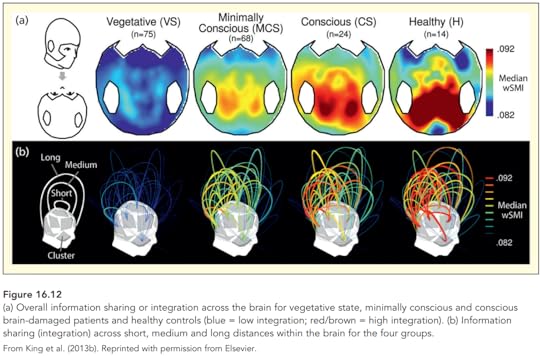
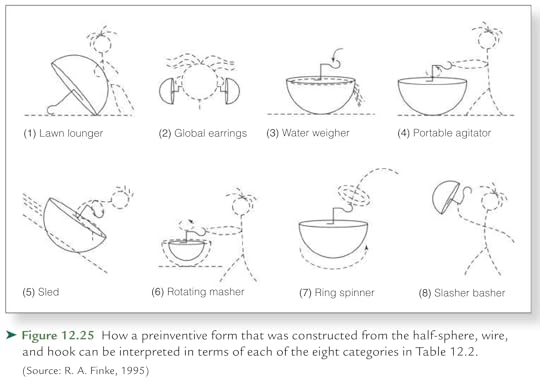
In terms of paying attention, I was most engrossed in conceptual knowledge for declarative memory and then problem solving and creativity. I took away much for my piece on philosophy. Some of my favorite ideas I discovered were production systems, semanticization of episodic memory, automatization of tasks, prospective memory, and isomorphic problems.
In terms of what I remember, upon testing myself with the practice questions on the textbook companion website, my performance was best for learning memory and forgetting, everyday memory, judgment and decision making, problem solving and expertise, and motion perception and action. Many of my errors were a result of consistently paying least attention to and thereby least remembering neuropsychology, such as specific illnesses, injuries, and parts of the brain.
In terms of what I read, I read Cognitive Psychology 5e by Goldstein, then Cognitive Psychology 7e by Sternberg, then Cognitive Psychology 8e by Eysenck. Unfortunately, I am not sure there is much utility in analyzing the underlying cognitive processes of language while reading about cognitive psychology. More on comparing the textbooks later.
In terms of what I thought, a few things:
I do believe cognitive psychology itself is a means of problem solving, a good decision, and makes adequate judgments and reasoning about judgment and reasoning. To specify, the experimental attempts to solve the problems of problem solving provide established certainties on the fundamental principles of such, whether that be steps to insight or the development of expertise. Making frequentist judgments from evolutionary and natural settings that performance would be better on problems utilizing frequencies rather than probabilities (Giberenzer and Hoffrage 1995), among other things, alludes to how the probabilities are paramount for the accuracy about the judgments of judgments. Tis science afterall. On reasoning, there were indeed theories on deductive reasoning that inevitably utilized deductive reasoning (Johnson-Laird 1983), or hypotheses about hypotheses (Sanbonmatsu et al 2015). However, here, I must observe that while I learned cognitive psychology from the textbooks, I learned science and reasoning from the evaluation parts in Eysenck. After the presentation of every theory, model, or approach, a variety of pros and cons were promptly presented. To me those parts were valuable, every single time. For these reasons, besides delving into the behavioral economics and psychology of decision making, is why the study of such may be a good decision.
Given the nature of the subject, it was nice there were so many immediate demonstrations or experiments possible for a reader to do. Among textbooks, I think this is very unique.
After reading, I have incredible respect for cognitive psychology. Sure, "Approximately 300 cognitive architectures have been proposed over the years (Kotseruba & Tsotsos, 2018)." Sure, "researchers identified approximately 70 different definitions of intelligence (Legg & Hutter, 2007)." Sure, "There are more models of parsing than you can shake a stick at." However, it is astonishing how much can be discovered about human cognition with just some timers, priming, and eye tracking. In all, there were some really clever experiments.
I am now in the belief that cognitive psychology should be required reading and one of the first things one learns for the study of philosophy. This is real world epistemology and logic, experimentally validated.
When it was written "know thyself" at the entrance of the temples of Delphi in ancient Greece, I believe cognitive psychology would come close to being a solid approach. I hope I have succeeded in acting in accordance with such.
The origins of today's cognitive psychology mostly lie in the first conference on (and usage of the term) artificial intelligence in 1956 at Dartmouth and later MIT. Around this sliver of time, Miller published his paper on approximately seven items being the capacity of human processing, Broadbent proposed his filter model of attention, Simon and Newell created their computer program Logic Theorist with elements of their eventual work on problem solving, and Chomsky critiqued behaviorism and Skinner with elements of his eventual universal grammar for linguistics. T'was indeed a magical time.
Inspired by analogies to computers, the information processing approach is used to understand the mind. This is why cognitive psychology is set with being about perception, attention, memory, language, and thinking (problem solving and creativity, decision making, judgment, and reasoning)—in that order. However,
"Intelligence is a concept that can be viewed as tying together all of cognitive psychology." —Sternberg
"The first author remembers clearly a conversation with Endel Tulving (a leading memory researcher) in the mid-1980s. He said one criterion he used when evaluating a textbook on cognitive psychology was the amount of coverage of consciousness." —Eysenck
intelligence and consciousness are two topics which are accumulations.
Supporting cognitive psychology, three other major approaches used throughout are neuropsychology, neuroscience, and (computational) cognitive science.
So then, what did I perceive, pay attention to, remember, read, think, and experience about cognitive psychology?
In terms of perception, I must admit, there were some wicked pictures and diagrams: https://imgur.com/a/KWuPo2j
In terms of paying attention, I was most engrossed in conceptual knowledge for declarative memory and then problem solving and creativity. I took away much for my piece on philosophy. Some of my favorite ideas I discovered were production systems, semanticization of episodic memory, automatization of tasks, prospective memory, and isomorphic problems.
In terms of what I remember, upon testing myself with the practice questions on the textbook companion website, my performance was best for learning memory and forgetting, everyday memory, judgment and decision making, problem solving and expertise, and motion perception and action. Many of my errors were a result of consistently paying least attention to and thereby least remembering neuropsychology, such as specific illnesses, injuries, and parts of the brain.
In terms of what I read, I read Cognitive Psychology 5e by Goldstein, then Cognitive Psychology 7e by Sternberg, then Cognitive Psychology 8e by Eysenck. Unfortunately, I am not sure there is much utility in analyzing the underlying cognitive processes of language while reading about cognitive psychology. More on comparing the textbooks later.
In terms of what I thought, a few things:
I do believe cognitive psychology itself is a means of problem solving, a good decision, and makes adequate judgments and reasoning about judgment and reasoning. To specify, the experimental attempts to solve the problems of problem solving provide established certainties on the fundamental principles of such, whether that be steps to insight or the development of expertise. Making frequentist judgments from evolutionary and natural settings that performance would be better on problems utilizing frequencies rather than probabilities (Giberenzer and Hoffrage 1995), among other things, alludes to how the probabilities are paramount for the accuracy about the judgments of judgments. Tis science afterall. On reasoning, there were indeed theories on deductive reasoning that inevitably utilized deductive reasoning (Johnson-Laird 1983), or hypotheses about hypotheses (Sanbonmatsu et al 2015). However, here, I must observe that while I learned cognitive psychology from the textbooks, I learned science and reasoning from the evaluation parts in Eysenck. After the presentation of every theory, model, or approach, a variety of pros and cons were promptly presented. To me those parts were valuable, every single time. For these reasons, besides delving into the behavioral economics and psychology of decision making, is why the study of such may be a good decision.
Given the nature of the subject, it was nice there were so many immediate demonstrations or experiments possible for a reader to do. Among textbooks, I think this is very unique.
After reading, I have incredible respect for cognitive psychology. Sure, "Approximately 300 cognitive architectures have been proposed over the years (Kotseruba & Tsotsos, 2018)." Sure, "researchers identified approximately 70 different definitions of intelligence (Legg & Hutter, 2007)." Sure, "There are more models of parsing than you can shake a stick at." However, it is astonishing how much can be discovered about human cognition with just some timers, priming, and eye tracking. In all, there were some really clever experiments.
I am now in the belief that cognitive psychology should be required reading and one of the first things one learns for the study of philosophy. This is real world epistemology and logic, experimentally validated.
When it was written "know thyself" at the entrance of the temples of Delphi in ancient Greece, I believe cognitive psychology would come close to being a solid approach. I hope I have succeeded in acting in accordance with such.

April 7, 2014
Horrible book about a wonderful subject. More cognitive neuroscience than anything else, this book is more of a review of recent research than anything else. Considering that the main topics here are how issues of attention and perception are handled in the brain, the authors fail miserable to make use of their learnings to engage or educate the reader. Honestly, I would opt for a root canal over this book. Too bad, because the field is interesting and worthy of study. Just not with this book as a guide.

February 9, 2022
برای این ترجمه حتی یک امتیاز هم زیاده. افتضاح بودن ترجمه به کنار، کتاب حتی ویراستاری درست نداره. اکثر اصطلاحات تخصصی بدون اشاره به معادل انگلیسی شون توی متن نوشته شدن و تو نمیتونی بفهمی این کلمه ی عجیب غریبی که مترجم تصمیم گرفته استفاد کنه دقیقا داره به چی اشاره میکنه!!!
توصیه میکنم اگر زبان انگلیسی تون خوبه، متن اصلی رو گیر بیارید و بخونید. چون این کتاب کمکی بهتون نمیکنه
توصیه میکنم اگر زبان انگلیسی تون خوبه، متن اصلی رو گیر بیارید و بخونید. چون این کتاب کمکی بهتون نمیکنه
March 31, 2010
An extremely competant take on Cognitive Psychology, was chosen by my lecturer as a recommended read and I must agree.
Covering almost all the essential areas of cognition,with a subtle humourous undertone. And connects the chapters beautifully, after all cognition is not unitary.
Although,presentation of some key sub-categorises should have been better signposted rather than just making it bold. It made revision that bit harder.
If you want a 1:1 or an insight into the way we "think" this is the best book.
Covering almost all the essential areas of cognition,with a subtle humourous undertone. And connects the chapters beautifully, after all cognition is not unitary.
Although,presentation of some key sub-categorises should have been better signposted rather than just making it bold. It made revision that bit harder.
If you want a 1:1 or an insight into the way we "think" this is the best book.

April 6, 2024
Difficult subjects that are hard to digest as is. This “students handbook” makes it harder. So well done. Put it through ChatGPT to save yourself time. You won’t miss out on the so called complexity of the concepts. Don’t know who benefits from this other than academia conserving the idea that academics is for the few. These are intuitive concepts, no need to overcomplicate it. It’s lazy, vague and messy. I’m also not that smart.

March 28, 2016
A very useful book for those interested in the subject.
A lot is covered in this one, allowing you to gain information in a range of areas. As always, with books like this, I wouldn’t recommend it as your sole referencing point but it is useful alongside other books to help you gain more knowledge on the subject.
A lot is covered in this one, allowing you to gain information in a range of areas. As always, with books like this, I wouldn’t recommend it as your sole referencing point but it is useful alongside other books to help you gain more knowledge on the subject.
May 4, 2014
I read this as exam preparation for one of my courses at uni. Even though the topic is very interesting, it was hard for me to grasp most of the content. In my opinion, the style was very dry, there were too many empirical studies and not enough examples. Also, the layout was quite dull and not helpful at all. Some more diagrams and sidenotes would've been nice.
March 6, 2025
Awful book. Part of the required reading for my MSc in Psychology. Impenetrable, makes what is an interesting subject so dull and confusing.
Honestly reading it has taken more than double the allocated reading time because it’s so difficult to comprehend and to stay focussed.
I’m currently searching for a better alternative.
Honestly reading it has taken more than double the allocated reading time because it’s so difficult to comprehend and to stay focussed.
I’m currently searching for a better alternative.

October 22, 2021
jakoze precetla jsem to ale byl to fakt pain

January 8, 2023
Really long. Comprehensive. Glad I'm done with this class

January 19, 2021
Apart from containing the main processes, models, theories and terms in cognitive psychology, this book also includes great examples from everyday life and there is an official website, where one can access flashcards and quizzes from the books content.
The reason why I rated it four stars is because of the length.
The reason why I rated it four stars is because of the length.
Read
July 31, 2019i think i learned a lot if i read this book

August 23, 2019
Both layout and writing felt dull and uninspiring. Hughly informative though compared to some other cognitive text.

March 10, 2023
Exists....

April 5, 2026
Manual para a faculdade...

August 3, 2026
واو، ممتع
February 10, 2017
A useful primer on a fascinating topic. The sections are clear to read, well-presented in a tight and easy-to-read typeface. There are plenty of references to seminal literature throughout the various sessions. The section on cognitive biases was handy but I would have liked more references into this area. For what it is worth, it is a worthy first foray into this area of psychology.
Read
June 18, 2014good book
This entire review has been hidden because of spoilers.

September 3, 2015
[6th edition, 2010; read at SISSA's library, Trieste]

December 9, 2016
I was in a hurry to read this for an exam, but it was so interesting that most things stayed in my head really well.

February 9, 2022
I read the 8th edition.
This textbook is a good example of how more information does not always equal better.
This textbook is a good example of how more information does not always equal better.
Displaying 1 - 21 of 21 reviews