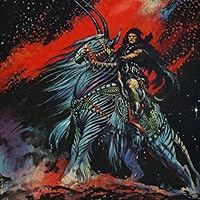
The Secret of Sinharat (95 p.) Eric John Stark was a hunted outlaw, a hard, merciless renegade with a twenty-year Moonprison sentence hanging over him. Men called him barbarian, wild man. Women called him beast.
But the Earth Police Control had a use for him, for they knew why he was on Mars. The Martian desert-tribesmen of Kesh and Shun had made alliance with the men of the Low Canals, and following the banner of the enigmatic chieftain Kynon, who promised them eternal life, they would sweep out of the deserts and cast a storm of blood across the planet. Stark was one of the outlaw mercenaries who'd been asked to help lead them.
But if he could lead those men, perhaps he could also stop them. And if the rumors which filtered into Mars' civilized border towns had truth, this uprising had to be stopped - for those behind it were more powerful, and infinitely older, than the barbarian armies they would unleash.
People of the Talisman (129 p.) When Eric John Stark escaped from the camp of the Lord Ciaran of Mekh, he was nearly dead. His mouth, crazed with fear of the bloody thing that clung to its back, laid its belly to the ground and ran wildly through the bitter wind and snow of the Martian Norlands, and Stark held his seat by a concentration that went beyond the urge to live.
He had a purpose now - to find the city of Kushat, which guarded the mysterious Gates of Death and was in turn protected by the Talisman of Ban Cruach. But the Talisman had been secretly stolen years before, and Kushat now lay helpless before the planned attack of Ciaran's mountain hordes.
What Ciaran didn't know was that Stark himself had the Talisman, and he was grimly determined to use it to exact a savage revenge on the Lord of Mekh.
Leigh Brackett was born on December 7, 1915 in Los Angeles, and raised near Santa Monica. Having spent her youth as an athletic tom-boy - playing volleyball and reading stories by Edgar Rice Burroughs and H Rider Haggard - she began writing fantastic adventures of her own. Several of these early efforts were read by Henry Kuttner, who critiqued her stories and introduced her to the SF personalities then living in California, including Robert Heinlein, Julius Schwartz, Jack Williamson, Edmond Hamilton - and another aspiring writer, Ray Bradbury.
In 1944, based on the hard-boiled dialogue in her first novel, No Good From a Corpse, producer/director Howard Hawks hired Brackett to collaborate with William Faulkner on the screenplay of Raymond Chandler's The Big Sleep.
Brackett maintained an on-again/off-again relationship with Hollywood for the remainder of her life. Between writing screenplays for such films as Rio Bravo, El Dorado, Hatari!, and The Long Goodbye, she produced novels such as the classic The Long Tomorrow (1955) and the Spur Award-winning Western, Follow the Free Wind (1963).
Brackett married Edmond Hamilton on New Year's Eve in 1946, and the couple maintained homes in the high-desert of California and the rural farmland of Kinsman, Ohio.
Just weeks before her death on March 17, 1978, she turned in the first draft screenplay for The Empire Strikes Back and the film was posthumously dedicated to her.
Leigh Brackett, the so-called "Queen of Space Opera," would have turned 100 years old on 12/7/2015, and to celebrate her recent centennial in my own way, I have resolved to read five novels featuring her most well-known character: Eric John Stark. Brackett, of course, was already something of a well-known commodity before her first Stark story appeared in 1949; she had already placed no fewer than 32 short stories and novelettes, beginning in 1940, in the various pulp publications of the day, thereby establishing herself as the most important female sci-fi author of the Golden Age (other than C.L. Moore, of course). Her Stark tales, all three of them, originally appeared in the pages of "Planet Stories" magazine: "Queen of the Martian Catacombs" in the Summer '49 issue, "Enchantress of Venus" (which I have discussed earlier here) in Fall '49, and "Black Amazon of Mars" in March '51. "Enchantress," a wonderful tale, has been oft anthologized, but the first and third stories that bracket(t) it have been extremely difficult to find. (The upcoming Haffner Press release, "The Book of Stark," will happily bring those lost tales back into print.) Fortunately for me, Brackett later reworked these tales, revising and expanding them to novel length, with the respective titles "The Secret of Sinharat" and "People of the Talisman," released in 1964 as one of those cute little "Ace doubles"--M-101, for all you collectors out there--with a hefty cover price of...45 cents. I recently laid my hands on this collectible item, and thus was finally able to read these two wonderful sci-fi/adventure novels.
"The Secret of Sinharat" and "People of the Talisman" serve as perfect introductions to Eric John Stark, the product of Earthling parents living on Mercury. Stark's parents were tragically killed in a mining accident on the blazing-hot planet, and the young boy was later raised by barbarous aborigines and renamed N’Chaka. By the time he has grown to manhood, Stark's skin has been burned almost black (no illustrator has ever gotten this trait right!), and though he comes off as an intelligent, civilized adult, that barbarous upbringing of his is never far beneath the surface. Indeed, Stark often strikes the reader as a Conan of the spaceways, what with his immense strength, superb fighting skills and superhuman climbing abilities. The Martian and Venusian backdrops in these first three Stark outings might almost be Cimmeria or Hyperborea, in fact, so primitive are the natives and their weapons; only the planetary settings and some alien supergizmos nudge the stories into the realm of sci-fi. Brackett was supposedly heavily influenced by the Martian tales of Edgar Rice Burroughs in her creation of Stark's environs, and Golden Age great Henry Kuttner served as a mentor of sorts to her, but it is assuredly Robert E. Howard who comes most forcefully to mind here. Brackett even writes like Howard on occasion, especially during her gory battle sequences and when detailing nudity, wining and wenching, but she is also more than capable of beautiful descriptive prose to flesh out her stunning imagination. "Secret" and "People" are both compulsively readable page-turners, sweeping the reader irresistibly along on their wild and violent rides.
As for the story lines, in "The Secret of Sinharat," Stark, to evade getting tossed into prison for a 20-year stretch for gunrunning, agrees to assist his old mentor, Simon Ashton. Stark will act as a mercenary in the employ of the barbarian chieftain Kynon, who is marshaling the various tribes of the Martian Drylands, as well as the evil town of Valkis on the Low-Canal, to thus form an invincible army and attack the Martian City-States. Stark's mission is to find out as much intelligence as he can and, hopefully, break up the brewing war. Thus, Stark encounters Kynon and a gaggle of his thoroughly unpleasant lieutenants, sets out on a desert trek with them, is seduced by Kynon's woman, the redheaded Berild, and ultimately encamps with the others at the ancient Martian city of Sinharat before discovering the true nature of the rebellion and the legend that gives the abandoned city such an evil reputation. Brackett throws in all sorts of imaginative touches (for example, one of Stark's enemies here is an addict of "shanga" radiation, which causes a temporary atavism back to beasthood!) and memorable set pieces into her tale. In one grueling sequence, Stark and Berild are deliberately separated from the others during a monster sandstorm, and their resultant desert crossing rivals even the one that H. Rider Haggard depicted so memorably in "King Solomon’s Mines."
In "People of the Talisman," Stark is back on Mars, this time near the north polar regions. He has agreed here to bring back the lenslike talisman of the title to the walled city of Kushat. His dying friend, Camar, had stolen it many years before, thus depriving the city of its legendary protection. Kushat, according to myth, guards a mountain pass that leads to...nobody quite knows where. And so, Stark takes the mystic thingamabob to Kushat, narrowly escaping from the clutches of the Lord Ciaran and his barbarous Mekh tribesmen en route. ("Ciaran" is a name that Brackett evidently liked, as it was also the name of one of her characters in the 1944 story "The Jewel of Bas.") In the book's gripping central set piece, Stark helps defend Kushat when Ciaran's hordes attack, and again, the use of swords, spears and battering ram is more reminiscent of a Conan story than of a futuristic Martian outing.
And later, Stark and a desperate band of city survivors attempt to climb through that nearby mountain pass, talisman in hand, and uncover its grim secret. Brackett, in this novel, offers up a twist ending that nobody should foresee, as well as presenting us with an alien race that truly is alien as regards looks, clothing, mentation and conduct. The author peoples her tale with many interesting side characters, as well, including one of the military commanders of Kushat, Lord Rogain; sadly, Brackett does not tell us precisely how much hair this man sports! The author or her Ace editors were guilty of one serious slip in this tale, sadly...when Stark refers to Ciaran's aged advisor, Otar, by name, even though he had not had a chance to learn that name yet; an error, no doubt, that was introduced when the original short story was reworked in 1964. Other than this slip, however, "People" is a wonderful short novel. I devoured this one while I was home sick over a few days and found it perfect company, indeed.
Revising and expanding these Golden Age tales for more modern times evidently began to warm Brackett to Eric John Stark again, for just 10 years later, she released the first of three new novels featuring the character: the opening salvo of the so-called Skaith Trilogy. The first book in that trilogy, 1974's "The Ginger Star," is where this reader will be heading next....
(By the way, this review originally appeared on the Fantasy Literature website at http://www.fantasyliterature.com/ ... a most excellent destination for all fans of Leigh Brackett....)
Of course I missed the heyday of the "Ace double", not really getting into this stuff till the late 1990s, but I have a bunch of these things. Brackett is a writer I've been getting into lately, ever since reading "No Man's Land in Space" for the Chrononauts podcast in 2022. I'd read a few short stories before, and enjoyed them, but I was just casually acquainted with the work of the so-called Queen of the Space Opera. With the excellent "Enchantress of Venus", her position in my mind was certainly assured. I can see how Edgar Rice Burroughs is an influence on her, but I find Brackett's prose to be much better, and her stories, while un-selfconsciously paying tribute to so many of the tropes in her genre of choice, manage to steer away from predictability and still hold surprises for new readers almost eighty years on.
These two short novels, or novellas if you prefer, were adapted from stuff she wrote for Planet Stories in the late 1940s. While Burroughs is an antecedent that many would point to, the action and intensity reminds me much more of Robert E. Howard, and the splendour and morbid atmosphere of the decadent mars is reminiscent of both Clark Ashton Smith's Martian tales and, especially, C.L. Moore's Northwest Smith stories. Both of these, along with "Enchantress of Venus", feature Brackett's recurring "barbarian" character, Eric John Stark, who I could sort of describe as "Space Conan", only the more I think about it, the more that probably does Stark (and Brackett) a disservice. Still, Stark is a mercenary who travels between the inner planets; he has a bloodthirsty reputation that may not be entirely earned; he's also strong, incredibly agile and dangerous. Like Conan, too, he's smarter than many of his enemies credit, for they assume that his barbaric origins and ferocious aspect mean he's no match for civilised wiles and cleverness. Underestimating Eric John Stark though is a mistake. He may occasionally do work on behalf of others, but he is his own man; more loyal to his heart and his friends than to gold, as it turns out.
So, in this little book, we have two fast-paced and intense adventures for our protagonist. Ther'es a definite formula to the three Stark tales I've read so far, but I'm not complaining as it works really well and, as hinted previously, Brackett throws in some unpredictable twists to put the story quite a bit above the quality that might be considered 'strictly necessary" for this kind of fiction. Occasionally, there is a little sloppiness, not in the prose itself but in the way events are related, and I wonder if this was the result of the "fixup" nature of these two, and even if a little material was cut in the transition from magazine publication. The majority of the aforementioned sloppiness appears in People of the Talisman, but oddly, that one is still probably my favourite, though Secret of Sinharat might be the more polished gem.
In Secret, Stark is recruited by the ruler of a Martian city who is attempting to unite the tribes of the land to take back land from the growing border states who have ties with Earth and Luna. His goal seems noble in some ways, but he's promised eternal life to his followers, and at first, comes off like a cult leader more than anything. Stark has another employer, too: An officer of the law who wants Stark to buy his freedom, since he's escaped from serving a long prison sentence on a lunar penal colony. The deal is: Stop this brotherhood of the tribes and the city of Valkis from going to war by creating dissention or by whatever means he can come up with. It's a bit dirty, but Stark knows he's caught in a trap, and has little choice but to at least appear to comply. All is not as it seems in Valkis, though, and the real secret of Sinharat, an ancient ruined citadel of a previous Martian civilisation which is to be the meeting place from which to stage the attacks against the border states, is something truly terrible that could change the future of the solar system forever. There are some really tense scenes in this one, with a dangerous trek across a wind-swept desert for Stark and an unexpected companion, and the fight in a kind of "drug den" between Stark and a whole bunch of men and women who have been regressed to bestiality because of some weird space radiation they are addicted to, being two of the highlights. This one also has a really satisfying climax, and ends on a note of existential reflection that was sad and poignant.
in People of the Talisman, Stark attempts to fullfill the request of a dying friend to take a precious object stolen from the old city of Kushat back to its rightful place. Unfortunately Stark runs across a horde of northern barbarians planning to sack Kushat, and their leader, Lord Cieran, knows of the talisman, and wants it for himself. The legendary talisman, it turns out, is supposed to be used in Kushat's time of need to protect it from its enemies, but noone seems to remember its real function or how it might be used. The truth turns out to be something really strange, and very alien, and for me, that was the highlight of the story. After some brutal battles, and a revelation about the story's antagonist that was really surprising and cool (not gonna spoil it here, but I really enjoyed it), we come to yet another ancient city fallen from greatness, this one belonging to a civilisation so old and strange that it is pretty much incomprehensible to mankind -- what's more, they are really decadent, and love torture and evil more than anything. These aliens reminded me of nothing less than the Cenobites from Hellraiser/The Hellbound heart, and I wish they had been more prominent in the story, but that might also be because the climax seems a bit rushed in this one. Nevertheless, the atmosphere of this story was so feverish and pervasive that this somewhat abrupt denouement, as well as a narrative thread or two that is just kind of left hanging there, didn't really bother me. It does seem too like Brackett is setting things up here for more adventures between Stark and certain characters, who will now be riding together to possibly engage in activities of war and plunder. I'm not quite sure what the order of things are with this character, or where I ought to go next, but there seem to be quite a lot of adventures, so perhaps some of this stuff is clarified a bit more later?
One fun thing I noticed about the Stark stories so far is that in each of them, Stark encounters two female characters: one innocent and sweet and childlike; another intense, dark, secretive and somewhat oriented toward evil-doing. The stories are set up to make it seem like Stark is going to have to choose between these two women as a romantic interest, but in the end, the choice is usually kind of taken out of his hands. Also, on more than one occasion, the aspects in which the women are first presented is subverted in the end. Generally, Brackett has a different way of writing women than many of her male contemporaries do. They're still seductive, incredibly alluring to her strong male protagonists, but they are full of passions, and sometimes express those in very fiery ways. She loves warrior women, and the determined, fierce speeches those characters make can only come from the heart. Here, the impassioned speeches are just as important as being able to hold their own in a fight, which of course they can, because you do get the sense that Brackett could also, in a way, be speaking for her own generation of aspiring women.
Make no mistake though: I wouldn't spend too much time searching for heavy allegories in these stories -- they are romantic adventures all the way and that's very much what she's going for. She loved westerns and wrote stuff defending what would come to be known as "space opera", a term originally meant as a pejorative, akin to "horse opera", but which she was happy to embrace. But there's still something to be learned from her stories I think, despite her apparent lack of interest in tackling the big contemporary social issues. It's like how Tolkien wanted people to "escape" into Lord of the Rings, and that was really how he thought of it: Escapism, pure and simple, and for him, that was something to be championed. I feel like Brackett thinks in a similar way, but of course she can't help but be passionate about what she's doing, and that definitely shows in her writing, which has a vividness; a sharp intensity that you don't always find in this kind of fiction. Reading her introductory letter to Amazing Stories on the eve of the publication of her first story there, "No Man's Land in Space", gives the impression of a personality that is humorous, playful, but irrefutably strong and active. It seems that in her time, many of her fellow writers, men and women, were drawn to her magnetism. She met with considerable success as a Hollywood screen-writer of hard-boiled crime and westerns, and worked with people like William Faulkner and John Wayne, and indeed, George Lucas (her screen-play for Empire Strikes Back was almost unrecognisable once everyone else had finished with it, but sadly she was dead by then, so we'll never know if she would have revised her work more to have it fit with Lucas and Co.'s vision), yet it seems that writing this kind of fiction was a true love for her, for unlike many pulp writers who made "the big time", she never came close to giving up on it. I think that's really cool, and I also respect her ability to work in different styles and genres with ease and aplomb. So yes, it's taken a while, but you could say now that I'm happily ensconced aboard the brackett ship, and am looking forward to much more.
3.0 to 3.5 stars. I previously read and reviewed The Secret of Sinharat so this review is for the People of the Talisman. Good, solid pulp era sword and planet science fiction staring Earth-born, Mercury-raised and now Martian-residing Eric John Stark. These stories a pretty well written, fast paced and a lot of fun. I liked The Secret of Sinharat a little better than this one but it was still good fun. I would say that if you think you will like this, you probably will.
Double-header of space opera sci-fi from Leigh Brackett, co-writer of the "Empire Strikes Back" screenplay, along with other notable films (she wrote the adaptation of "The Long Goodbye," as well, for instance). This book doesn't quite do it for me, but I must admit to having only a basic knowledge of the genre.
The hero of the story, in both cases, goes up against rivaling factions of Martian tribes. The whole thing comes off more as a Robert E. Howard-style situation, and I kept forgetting we were actually on Mars, and not in some ancient, sword-wielding, demonic-god-worshipping society.
The stories both get their jobs done, I suppose, and the action is enjoyable, as is the main character's inner dialogue. But I found myself just kind of wishing to get to the end.
Note: "The People of the Talisman" is the better of the two books.
This strange little double-feature was an unusual and unexpected surprise. I'd never heard of Eric John Stark before, and was unfamiliar with Leigh Brackett. But after this, I think I'm gonna check out more by her.
Interpreting Mars as a bog-standard grimdark barbarian world wasn't the most novel way to go, nor is the main character of both of these stories - a 'savage man whose had to adapt to civilization' - Eric John Stark, the most original of characters. But yet, something felt subtly different in the reading of these two tales than stories of other beefy men out on adventures. I think, perhaps, it was that most elusive of qualities called 'Good writing'. Sure, Eric John Stark is a tough and capable dude who is often correct, but we're not treated to quite so many monologues as other authors would boast, dripping in reverence for their great and mighty 'alpha male' to whom all other men are held in comparison and fall short. The world was nothing fancy, but I didn't feel myself fatigued from confused descriptions of vistas too bizarre to be adequately conveyed by poor writing. Everything was pretty much just right, and both 'The Secret of Sinharat' and 'People of the Talisman' proved to be experiences I was glad to have had. Add to that the celtic flair, of characters with irish-inspired names. How very unique!
The Secret of Sinharat is a science fantasy novel by American writer Leigh Brackett, set on the planet Mars, whose protagonist is Eric John Stark. The novel is expanded from the novella "Queen of the Martian Catacombs", published in the pulp magazine Planet Stories in the Summer 1949 issue.
Eric John Stark was the product of Earthling parents living on Mercury. Stark's parents were tragically killed in a mining accident on the blazing-hot planet, and the young boy was later raised by barbarous aborigines and renamed N’Chaka. There are similarities between his origin story and that of Tarzan’s.
By the time he has grown to manhood, Stark's skin has been burned almost black, and though he comes off as an intelligent, civilized adult, his barbarous upbringing is never faraway. Other inspiration for this character are Conan the Barbarian and John Carter of Mars.
People of the Talisman was first published under the title Black Amazon of Mars in the pulp magazine Planet Stories, March 1951.
Two novels expanding on earlier pulp novellas by Brackett, both featuring her Eric John Stark, a feral child raised by Mercurian aborigines. In "Sinharat," Stark is about to join the barbarian army of a Martian warlord when Earth intelligence offers him a deal: infiltrate the warlord's forces, stop the war and save the barbarians from being used as cannon fodder. Stark agrees, but a jealous rival among the warlord's councilors, a conniving immortalist and a desert storm all make things harder than he expects. 4 stars. Five stars for People of the Talisman, which reworks "Black Amazon of Mars" for the better. While much of the plot is similar, the aliens here are a vast improvement; rather than conventionally evil, they're stark raving mad and prone to murdering each other for kicks. But hey, these humans will be even more fun! They're creepy as hell.
Incredibly entertaining sci-fi/adventure tales from 1964 in the mold of Edgar Rice Burroughs.
The Secret of Sinharat has Earthman Eric John Stark recruited to help discover what some bands of Martians are up to. Once in, he finds old foes and possible new flames. There's a great reveal at the end. I loved the addiction that one character had and the trouble that it causes.
People of the Talisman was slightly longer and more enjoyable as Eric John Stark's promise to a dead friend has him among antagonists that want to plunder Kushat and claim the prize that lurks beyond the Gates of Death. Great villains, solid action, and--once again--a great surprise.
The only reason that these don't rate five stars is that they are very much in the traditional sci-fi/action mold. John Carter would be an easy substitute for the protagonist. That said, these are still incredibly fun to read.
The Secret of Sinharat: Brackett's Mars is marvelous and mysterious. The ancient ruins of long dead civilizations calling out to my sense of adventure. This was my introduction to Eric John Stark, and it was great. I loved the story and characters, but what really shined was Brackett's prose and dialog. 4.5/5
People of the Talisman: Here we find Stark some time after the events in The Secret of Sinharat. The mystique of Brackett's version of Mars is explored even more here. I thought that Ciaran was a great antagonist, but I wanted to see more of her. I liked this story more than the first right up until the end. I thought the end was a bit too rushed, but I still enjoyed it overall. 4.5/5
Leigh Brackett is probably best known these days because she wrote the first draft of "The Empire Strikes Back", but these stories date from a time when she was one of the few female sf writers of the days of the 30s and 40s. Both of these tales of Erik John Stark began life then, and were later adapted into these novels. They're in the vein of Edgar Rice Burroughs' "Mars" novels - a Mars that never existed, but perhaps should have - a world of alien cities and warriors. Both stories look as if they're headed in a certain direction, and then turn out to be much more subtle than that. Fine writing, plenty of action, and some fine characters make for a very enjoyable double volume.
The Secret of Sinharat. I was somewhat surprised by how much I liked this story. It takes the planet and sword genre of Burroughs and gives it much more depth. The characters are much more nuanced, and the tragedy that stalks them indeed makes the story deserving of the label of noir. Also, the writing is top-notch. Overall, an superior example of the Planetary Romance genre -- something that I didn't know existed! [7/10].
People of the Talisman. Not quite as strong as The Secret of Sinharat. This story has lost some of its modernity and is thus closer to the Planetary Romance norm. Nonetheless, it's a well-told story in the genre, and it really picks up at the ending which is terrific [6/10].
Due racconti, un protagonista che scorazza fra le dune del pianeta Marte a contatto con civiltà né troppo primitive, né tanto moderne. Leigh Brackett crea questa saga marziana e un eroe/antieroe Eric John Skart erede di Conan e John Carter e per questo forse pecca di originalità. Buona la sceneggiatura anche se il tentativo di arricchirla con ogni particolare finisce per stroncare l'azione e di conseguenza anche la lettura.
Leigh Brackett was best known as a major screenwriter for such movies as StarWars. Her selection for that film was likely based on such interplanetary swashbucklers as these two related novellas combined in an Ace Double. Like StarWars, I wasn't much impressed.
I believe these are the earliest adventures of Eric John Stark, who is a great character. I preferred the later Skaith adventures for Stark, though. I'd give these two 3 and 1/2 stars.