

What do you think?
Rocketship Galileo
Рос Дженкинс, Арт Мюлер и Морис Абрамс не са обикновени ученици от гимназията. Докато другите деца се возят в колите си или играят на топка, това трио, известно като клуб „Галилео“, експериментира с ракетни горива, подготвяйки се за бъдещото си образование в техническите университети.
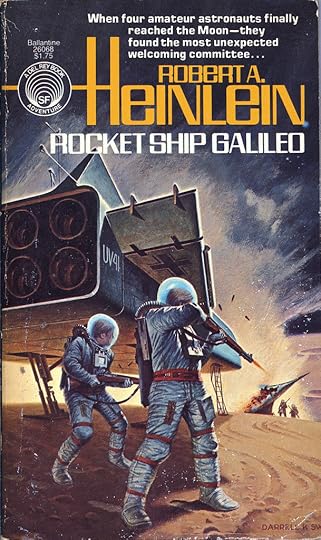
Чичото на Арт, атомният физик д-р Доналд Каргрейвс, им предлага възможността на живота им: да конструират и управляват ракета, която ще ги отведе до Луната. Каргрейвс вярва, че като обединят изобретателността и ентусиазма си, могат действително да осъществят тази цел. Но има хора, които не споделят мечтата им и няма да се спрат пред нищо, за да задържат ракетата им на Земята.
Чичото на Арт, атомният физик д-р Доналд Каргрейвс, им предлага възможността на живота им: да конструират и управляват ракета, която ще ги отведе до Луната. Каргрейвс вярва, че като обединят изобретателността и ентусиазма си, могат действително да осъществят тази цел. Но има хора, които не споделят мечтата им и няма да се спрат пред нищо, за да задържат ракетата им на Земята.
160 pages, Paperback
First published January 1, 1947
About the author
Robert A. Heinlein
1,082 books10.8k followersRobert Anson Heinlein was an American science fiction author, aeronautical engineer, and naval officer. Sometimes called the "dean of science fiction writers", he was among the first to emphasize scientific accuracy in his fiction, and was thus a pioneer of the subgenre of hard science fiction. His published works, both fiction and non-fiction, express admiration for competence and emphasize the value of critical thinking. His plots often posed provocative situations which challenged conventional social mores. His work continues to have an influence on the science-fiction genre, and on modern culture more generally.
Heinlein became one of the first American science-fiction writers to break into mainstream magazines such as The Saturday Evening Post in the late 1940s. He was one of the best-selling science-fiction novelists for many decades, and he, Isaac Asimov, and Arthur C. Clarke are often considered the "Big Three" of English-language science fiction authors. Notable Heinlein works include Stranger in a Strange Land, Starship Troopers (which helped mold the space marine and mecha archetypes) and The Moon Is a Harsh Mistress. His work sometimes had controversial aspects, such as plural marriage in The Moon Is a Harsh Mistress, militarism in Starship Troopers and technologically competent women characters who were formidable, yet often stereotypically feminine—such as Friday.
Heinlein used his science fiction as a way to explore provocative social and political ideas and to speculate how progress in science and engineering might shape the future of politics, race, religion, and sex. Within the framework of his science-fiction stories, Heinlein repeatedly addressed certain social themes: the importance of individual liberty and self-reliance, the nature of sexual relationships, the obligation individuals owe to their societies, the influence of organized religion on culture and government, and the tendency of society to repress nonconformist thought. He also speculated on the influence of space travel on human cultural practices.
Heinlein was named the first Science Fiction Writers Grand Master in 1974. Four of his novels won Hugo Awards. In addition, fifty years after publication, seven of his works were awarded "Retro Hugos"—awards given retrospectively for works that were published before the Hugo Awards came into existence. In his fiction, Heinlein coined terms that have become part of the English language, including grok, waldo and speculative fiction, as well as popularizing existing terms like "TANSTAAFL", "pay it forward", and "space marine". He also anticipated mechanical computer-aided design with "Drafting Dan" and described a modern version of a waterbed in his novel Beyond This Horizon.
Also wrote under Pen names: Anson McDonald, Lyle Monroe, Caleb Saunders, John Riverside and Simon York.
Heinlein became one of the first American science-fiction writers to break into mainstream magazines such as The Saturday Evening Post in the late 1940s. He was one of the best-selling science-fiction novelists for many decades, and he, Isaac Asimov, and Arthur C. Clarke are often considered the "Big Three" of English-language science fiction authors. Notable Heinlein works include Stranger in a Strange Land, Starship Troopers (which helped mold the space marine and mecha archetypes) and The Moon Is a Harsh Mistress. His work sometimes had controversial aspects, such as plural marriage in The Moon Is a Harsh Mistress, militarism in Starship Troopers and technologically competent women characters who were formidable, yet often stereotypically feminine—such as Friday.
Heinlein used his science fiction as a way to explore provocative social and political ideas and to speculate how progress in science and engineering might shape the future of politics, race, religion, and sex. Within the framework of his science-fiction stories, Heinlein repeatedly addressed certain social themes: the importance of individual liberty and self-reliance, the nature of sexual relationships, the obligation individuals owe to their societies, the influence of organized religion on culture and government, and the tendency of society to repress nonconformist thought. He also speculated on the influence of space travel on human cultural practices.
Heinlein was named the first Science Fiction Writers Grand Master in 1974. Four of his novels won Hugo Awards. In addition, fifty years after publication, seven of his works were awarded "Retro Hugos"—awards given retrospectively for works that were published before the Hugo Awards came into existence. In his fiction, Heinlein coined terms that have become part of the English language, including grok, waldo and speculative fiction, as well as popularizing existing terms like "TANSTAAFL", "pay it forward", and "space marine". He also anticipated mechanical computer-aided design with "Drafting Dan" and described a modern version of a waterbed in his novel Beyond This Horizon.
Also wrote under Pen names: Anson McDonald, Lyle Monroe, Caleb Saunders, John Riverside and Simon York.
Ratings & Reviews
Friends & Following
Create a free account to discover what your friends think of this book!
Community Reviews
Displaying 1 - 30 of 345 reviews

February 5, 2012
Rocket Ship Galileo is a Heinlein classic, good, straight up science fiction, and a fun story with some genuine twists.
True, it is not ageless, the 1947 publication date speaks volumes about what the reader will encounter, but reading between the lines, the reader can also find the beginnings of RAH’s budding libertarianism.
Not too far removed from his time in the Navy, a crisp, starched, straight postured militarism is still noticeably present. Good fun.
** 2019 addendum - it is a testament to great literature that a reader recalls the work years later and this is a book about which I frequently think. I need to re-read Heinlein's juvenile works, campy and corny as they can be, they're also a lot of fun.
True, it is not ageless, the 1947 publication date speaks volumes about what the reader will encounter, but reading between the lines, the reader can also find the beginnings of RAH’s budding libertarianism.
Not too far removed from his time in the Navy, a crisp, starched, straight postured militarism is still noticeably present. Good fun.
** 2019 addendum - it is a testament to great literature that a reader recalls the work years later and this is a book about which I frequently think. I need to re-read Heinlein's juvenile works, campy and corny as they can be, they're also a lot of fun.

April 11, 2015
The first thing that you need to know would be that this book was written for children. I knew that before reading, but I still had high expectations for it. I was not that impressed with this one, and I can thank the last 1/3 of the book for that.
The novel started out really strong. Anything space related is interesting for me, especially the moon. Like I said, this book is for children, so normally the author would introduce characters of the same age as the targeted audience. Lately that hasn't been a huge problem for me, and that isn't really the reason why I didn't like this that much.
The main reason would be that the transition was way too fast and the pacing was lost around 60-75% of the novel.
3/5 stars. Most people would probably find this boring, but the novel is way too short for you not to give it a try. While it was not mind-blowing in my experience, and it will probably never be part of my top read books, I still believe that you should give this a try for a quick adequate read.
---Spoilers beyond this----
The first half of the book was about the three young guys who had plans of going to the moon. When they met their uncle by accident, they finally got what they wished for. They got their parents' consent and were finally allowed to go to the moon. The part of them meeting their uncle, and the persuading part were both very long, but all of a sudden the next chapter says that they're ready for take-off. I honestly hate novels with bad transitions, and unfortunately this falls under the bad ones. There were a lot of redeeming qualities, but unfortunately this is a low three-stars for me. I'm going to continue on with the series for sure, but I might just listen to the rest instead of reading them.
Last point, I didn't expect the Nazis to be there. While the idea was unique, I didn't find it enjoyable. It seemed too unrealistic to happen for me, and that's why I didn't like it that much.
The novel started out really strong. Anything space related is interesting for me, especially the moon. Like I said, this book is for children, so normally the author would introduce characters of the same age as the targeted audience. Lately that hasn't been a huge problem for me, and that isn't really the reason why I didn't like this that much.
The main reason would be that the transition was way too fast and the pacing was lost around 60-75% of the novel.
3/5 stars. Most people would probably find this boring, but the novel is way too short for you not to give it a try. While it was not mind-blowing in my experience, and it will probably never be part of my top read books, I still believe that you should give this a try for a quick adequate read.
---Spoilers beyond this----
The first half of the book was about the three young guys who had plans of going to the moon. When they met their uncle by accident, they finally got what they wished for. They got their parents' consent and were finally allowed to go to the moon. The part of them meeting their uncle, and the persuading part were both very long, but all of a sudden the next chapter says that they're ready for take-off. I honestly hate novels with bad transitions, and unfortunately this falls under the bad ones. There were a lot of redeeming qualities, but unfortunately this is a low three-stars for me. I'm going to continue on with the series for sure, but I might just listen to the rest instead of reading them.
Last point, I didn't expect the Nazis to be there. While the idea was unique, I didn't find it enjoyable. It seemed too unrealistic to happen for me, and that's why I didn't like it that much.

March 25, 2013
Re-Read 6/29/24:
Another buddy read, but this time with a new victim -- I mean, a receiver of wholesome rocket-ship building from before the ACTUAL space race.
I think it's just so -- can do. We don't get much of this at all these days. And while it does feel like a new adult kind of novel, it's all about the spirit of adventure.
The funny thing is, I just read this last year, and yet I don't mind revisiting it at all. :)
Original Review:
I had to show my girl some of the old SF greats. Being a juvenile, herself, I thought it would be best to give her a taste of Heinlein's Juveniles, AND WE'RE BOTH GLAD WE DID.
This particular book was published in 1947, and considering the TIME it was published, it's pretty amazing. Consider the fact that Heinlein was writing about nuclear power rockets using as much of the science he was able to learn, as accurately as he could, in a YA. And not only was it hopeful and adventuresome with a hefty dose of can-do attitude, we even got a little popular ANTIFA action against the Nazis. RAH (Robert A. Heinlein) RAH RAH RAH!
It was delightful. A handful of young men and their mentor go to the moon. Sure, there's a little gloss-over with pre-fabbed rockets (an industry well under way) and a lot of everything else, but the basic science was there and it was written in a fun way.
Best of all, I have to point out that our own real space race had not gotten into gear yet. People's imaginations were not quite ready to pour so much of our resources into the grand competition. But Heinlein was there. Early. And serious about the science. :)
As for my girl, she was always attentive and loved the math (because she likes math) and thought the story was pretty damn fun. (Her words.) We flew through it together and she says she wants to read a LOT more Heinlein.
Ah, I love it. I remember when I went crazy, too, just a little older than her. :)
Another buddy read, but this time with a new victim -- I mean, a receiver of wholesome rocket-ship building from before the ACTUAL space race.
I think it's just so -- can do. We don't get much of this at all these days. And while it does feel like a new adult kind of novel, it's all about the spirit of adventure.
The funny thing is, I just read this last year, and yet I don't mind revisiting it at all. :)
Original Review:
I had to show my girl some of the old SF greats. Being a juvenile, herself, I thought it would be best to give her a taste of Heinlein's Juveniles, AND WE'RE BOTH GLAD WE DID.
This particular book was published in 1947, and considering the TIME it was published, it's pretty amazing. Consider the fact that Heinlein was writing about nuclear power rockets using as much of the science he was able to learn, as accurately as he could, in a YA. And not only was it hopeful and adventuresome with a hefty dose of can-do attitude, we even got a little popular ANTIFA action against the Nazis. RAH (Robert A. Heinlein) RAH RAH RAH!
It was delightful. A handful of young men and their mentor go to the moon. Sure, there's a little gloss-over with pre-fabbed rockets (an industry well under way) and a lot of everything else, but the basic science was there and it was written in a fun way.
Best of all, I have to point out that our own real space race had not gotten into gear yet. People's imaginations were not quite ready to pour so much of our resources into the grand competition. But Heinlein was there. Early. And serious about the science. :)
As for my girl, she was always attentive and loved the math (because she likes math) and thought the story was pretty damn fun. (Her words.) We flew through it together and she says she wants to read a LOT more Heinlein.
Ah, I love it. I remember when I went crazy, too, just a little older than her. :)

February 3, 2013
FIRST HIGHSCHOOL GEEK: Okay guys, welcome to the Moon!
SECOND HIGHSCHOOL GEEK: Explain again how we got here?
FIRST HIGHSCHOOL GEEK: Wallace and Gromit showed us how to build a moon rocket in our basement. The rest was easy.
THIRD HIGHSCHOOL GEEK: Who?
NAZI IN SPACESUIT: Guten Abend, meine Herren! Ve are all on ze same side, nicht wahr?
FIRST HIGHSCHOOL GEEK: Sorry Fritz, there's been a change of plan. [Shoots him]
NAZI IN SPACESUIT: Schweinhund! Aaargh!
SECOND HIGHSCHOOL GEEK: I thought that in space, no one could hear you scream?
FIRST HIGHSCHOOL GEEK: Don't be silly, Sigourney Weaver hasn't been born yet.
THIRD HIGHSCHOOL GEEK: Who?
SECOND HIGHSCHOOL GEEK: Explain again how we got here?
FIRST HIGHSCHOOL GEEK: Wallace and Gromit showed us how to build a moon rocket in our basement. The rest was easy.
THIRD HIGHSCHOOL GEEK: Who?
NAZI IN SPACESUIT: Guten Abend, meine Herren! Ve are all on ze same side, nicht wahr?
FIRST HIGHSCHOOL GEEK: Sorry Fritz, there's been a change of plan. [Shoots him]
NAZI IN SPACESUIT: Schweinhund! Aaargh!
SECOND HIGHSCHOOL GEEK: I thought that in space, no one could hear you scream?
FIRST HIGHSCHOOL GEEK: Don't be silly, Sigourney Weaver hasn't been born yet.
THIRD HIGHSCHOOL GEEK: Who?

November 17, 2023
Man did I love the Heinlein young adult SiFi as a kid. they really got me into the genre. Great read for a young reader just getting into SiFi. Recommended

December 15, 2020
"A man isn't a collection of chemical reactions; he is a collection of ideas."
La primera novela publicada de Heinlein y la primera de sus famosas novelas juveniles de Scribner's.
⠀
Por desgracia se convierte en una de las más flojitas que he leído hasta ahora. Creo que pudo haber sido mucho mejor de haber explotado el tema de las ruinas. Le tiro la culpa al hecho de haber sido escrita muy cerca del final de la Segunda Guerra y la fiebre del atomic power.⠀
⠀
Y eso es, la energía atómica en este libro es usada no para otro proyecto Manhattan, sino para propulsar naves espaciales. Emocionante, sí; aunque tal vez más emocionante por aquella época, veintidos años antes del Apolo 11. Sin embargo, hubo algo que sí hizo retorcer mi alma de emoción: la idea de la fundación de Luna City, la primera ciudad selenita. Vamos, ya, NASA, ¿cuándo una basecita lunar?⠀
⠀
Y como no podía ser de otra forma, porque lo hecho por el Führer hizo que querramos seguir leyendo historias solo para derrotarlos nuevamente, se encuentran en la luna con.... ya lo digo... viene spoiler.... ¡NAZIS! Sí, nazis con planes atómicamente disparatados.⠀
⠀
Si sirve de consuelo, la relación Heinlein/Luna mejora con el tiempo. Si no me creen, échenle mano a La luna es una cruel amante. Una de las mejores novelas de ciencia ficción que he tenido el placer de leer.
La primera novela publicada de Heinlein y la primera de sus famosas novelas juveniles de Scribner's.
⠀
Por desgracia se convierte en una de las más flojitas que he leído hasta ahora. Creo que pudo haber sido mucho mejor de haber explotado el tema de las ruinas. Le tiro la culpa al hecho de haber sido escrita muy cerca del final de la Segunda Guerra y la fiebre del atomic power.⠀
⠀
Y eso es, la energía atómica en este libro es usada no para otro proyecto Manhattan, sino para propulsar naves espaciales. Emocionante, sí; aunque tal vez más emocionante por aquella época, veintidos años antes del Apolo 11. Sin embargo, hubo algo que sí hizo retorcer mi alma de emoción: la idea de la fundación de Luna City, la primera ciudad selenita. Vamos, ya, NASA, ¿cuándo una basecita lunar?⠀
⠀
Y como no podía ser de otra forma, porque lo hecho por el Führer hizo que querramos seguir leyendo historias solo para derrotarlos nuevamente, se encuentran en la luna con.... ya lo digo... viene spoiler.... ¡NAZIS! Sí, nazis con planes atómicamente disparatados.⠀
⠀
Si sirve de consuelo, la relación Heinlein/Luna mejora con el tiempo. Si no me creen, échenle mano a La luna es una cruel amante. Una de las mejores novelas de ciencia ficción que he tenido el placer de leer.

June 30, 2024
My apologies to Mr. Heinlein for not reviewing this the day I read it but I was out and about. In no way does that reflect on my enjoyment (or lack thereof) of this story.
This is the first of the so-called "juvelines" by RAH. It's about a nuclear physicist and three high school students (a nephew of the scientist amongst them) who form a club and build a rocketship to go to the Moon. Mind you, this must have been about a decade before the actual space race. They actually succeed but would have never guessed who they meet and the danger they will all be in ().
What an adventure! Sure, it's not set in the future, there is no impressive tech. But there is ingenuity, a kind of McGyver spirit (long before that show existed) and a can-do mentality!
If only I had known stories such as this one back when I was a teen! I'd have freaked my teachers out with all the questions about the physics of the rockets and whatnot. *loool* No, teachers here are not as intrepid as one knows at least from American movies / TV shows and don't seem to read this kind of can-do literature themselves either. And you can forget about me having uncles like that. Which makes it all the more heart-warming to read about such people in books like this.
Not my favorite of the few I know so far but I can see the allure of it and it was really a fun romp.
This is the first of the so-called "juvelines" by RAH. It's about a nuclear physicist and three high school students (a nephew of the scientist amongst them) who form a club and build a rocketship to go to the Moon. Mind you, this must have been about a decade before the actual space race. They actually succeed but would have never guessed who they meet and the danger they will all be in ().
What an adventure! Sure, it's not set in the future, there is no impressive tech. But there is ingenuity, a kind of McGyver spirit (long before that show existed) and a can-do mentality!
If only I had known stories such as this one back when I was a teen! I'd have freaked my teachers out with all the questions about the physics of the rockets and whatnot. *loool* No, teachers here are not as intrepid as one knows at least from American movies / TV shows and don't seem to read this kind of can-do literature themselves either. And you can forget about me having uncles like that. Which makes it all the more heart-warming to read about such people in books like this.
Not my favorite of the few I know so far but I can see the allure of it and it was really a fun romp.

May 23, 2010
I can just see Heinlein as a teenager, hiding under his blanket and playing with his wand, astronomy textbooks splayed all around him with their covers spread wide. This is a guy who may just get his astrobation on more than Arthur C Clarke.
Herein lies the tale of three teenaged boys who like building rockets and get pulled into an inventor's crazy scheme to build a rocket that can make it all the way to the moon!!!!!!! I know, right? Remember, this is from 1947, so when this puppy came out, this idea was so "out there" quite a few publishers rejected it based on its outlandishness.
But Heinlein got it published, and began his illustrious decade of juvinile novels, followed by his Golden Period starting with Starship Troopers. This morphed into his Creepy Old Man period, which was unfortunately the last period he had. If my reliable sources (wikipedia and Aerin) are reliable, his Creepy Old Man period's primary themes are incest, time travel, incest, free love, incest and incest.
That being said, this book is less fun than the other two I've read by him so far. The primary reasons for this are the vague characterizations of the children and the sheer level of technical sense-o-wonder scenes: "They connected the A-Valve to the primary submodilator, which sent a combustion of zinc fibers up the right chamber of the whozawhatsee, which created a reaction that used reverse gravitational magnetism to propell the rocket forward." Imagine paragraphs like that. That's my made up version of the technoporn going on here; perhaps the stuff he's coming up with in this book means something. I'm not scientifically minded enough to know.
But the end does a lot to redeem the lackluster first 100 pages. ***SPOILER ALERT FOR REST OF THE REVIEW*** You see, when they arrive on the moon, they find the remnants of a moon people civilazation...which is cool enough...but THEN...they find...NAZIS! AAAAAH!
Although World War II is over, a small group of Nazis are camped out on the moon with some big-ass bombs, ready to initiate Project Nuke The Good Guys. Our crew has to use their brilliance to out-think the Nazis if they ever want to make it back to Earth.
One thing I loved here was the fact that the children did everything important. The scientist got scared when he was trying to land the ship and one of the kids had to do it. The kids had to defend them against the Nazis because the adult got knocked unconscious. The kids also came up with a lot of the most brilliant ideas. So, this book sense the message to kids that, by cooperating with both adults and other kids, they can do huge and important things, like fly to the moon and kill Nazis.
Would I read it again? Sure. It took all of two hours, and it had its fun parts. Would I recommend it? Uhhh....as a cultural artifact, it's quite amusing. Nothing like reading old SF to see how continually surprising and hard to predict scientific progress can be.
*******
(Since the original review got a vote, it hasn't been deleted. It has just been pushed down here.)
I suppose this is going to spoil the book's one big surprise for you, but I imagine it's the only way to get you to read a juvenile from the forties about a (GASP!) trip to the moon. So here it comes, big spoiler alert.....drumroll......NAZIS MADE IT TO THE MOON BEFORE US! AAAAAAH! And it's up to three meddling kids to stop their evil schemes!
Real review coming up. I'm too A.D.D. this morning to formulate more than one paragraph of cohesive thought at once.
Herein lies the tale of three teenaged boys who like building rockets and get pulled into an inventor's crazy scheme to build a rocket that can make it all the way to the moon!!!!!!! I know, right? Remember, this is from 1947, so when this puppy came out, this idea was so "out there" quite a few publishers rejected it based on its outlandishness.
But Heinlein got it published, and began his illustrious decade of juvinile novels, followed by his Golden Period starting with Starship Troopers. This morphed into his Creepy Old Man period, which was unfortunately the last period he had. If my reliable sources (wikipedia and Aerin) are reliable, his Creepy Old Man period's primary themes are incest, time travel, incest, free love, incest and incest.
That being said, this book is less fun than the other two I've read by him so far. The primary reasons for this are the vague characterizations of the children and the sheer level of technical sense-o-wonder scenes: "They connected the A-Valve to the primary submodilator, which sent a combustion of zinc fibers up the right chamber of the whozawhatsee, which created a reaction that used reverse gravitational magnetism to propell the rocket forward." Imagine paragraphs like that. That's my made up version of the technoporn going on here; perhaps the stuff he's coming up with in this book means something. I'm not scientifically minded enough to know.
But the end does a lot to redeem the lackluster first 100 pages. ***SPOILER ALERT FOR REST OF THE REVIEW*** You see, when they arrive on the moon, they find the remnants of a moon people civilazation...which is cool enough...but THEN...they find...NAZIS! AAAAAH!
Although World War II is over, a small group of Nazis are camped out on the moon with some big-ass bombs, ready to initiate Project Nuke The Good Guys. Our crew has to use their brilliance to out-think the Nazis if they ever want to make it back to Earth.
One thing I loved here was the fact that the children did everything important. The scientist got scared when he was trying to land the ship and one of the kids had to do it. The kids had to defend them against the Nazis because the adult got knocked unconscious. The kids also came up with a lot of the most brilliant ideas. So, this book sense the message to kids that, by cooperating with both adults and other kids, they can do huge and important things, like fly to the moon and kill Nazis.
Would I read it again? Sure. It took all of two hours, and it had its fun parts. Would I recommend it? Uhhh....as a cultural artifact, it's quite amusing. Nothing like reading old SF to see how continually surprising and hard to predict scientific progress can be.
*******
(Since the original review got a vote, it hasn't been deleted. It has just been pushed down here.)
I suppose this is going to spoil the book's one big surprise for you, but I imagine it's the only way to get you to read a juvenile from the forties about a (GASP!) trip to the moon. So here it comes, big spoiler alert.....drumroll......NAZIS MADE IT TO THE MOON BEFORE US! AAAAAAH! And it's up to three meddling kids to stop their evil schemes!
Real review coming up. I'm too A.D.D. this morning to formulate more than one paragraph of cohesive thought at once.

November 19, 2025
This is the first of Heinlein's juvenile SF novels written under contract with Scribner's in 1947. I read it as a part of the multi-month Buddy read endeavor in November 2025 at Hugo & Nebula Awards: Best Novels group. Scribner's published the first 12 novels between 1947 and 1958, but rejected the 13th, Starship Troopers. That one was instead published by Putnam. A 14th novel, Podkayne of Mars, is sometimes also listed as a "Heinlein juvenile". Actually, only Have Space Suit—Will Travel (1958) and Starship Troopers (1959) were nominated for Hugo Award, but this was partially because most of them were published before the award was introduced in 1953 and partially because it was considered more an award for ‘adult’ SF.
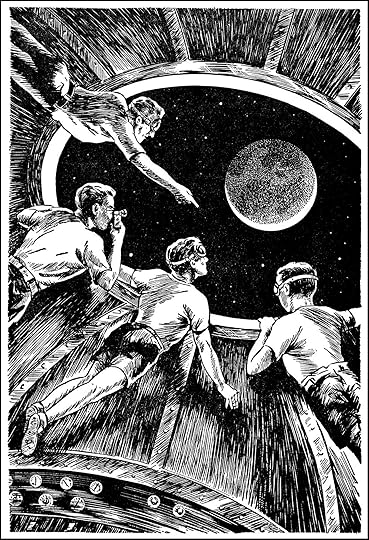
This novel starts by introducing the reader to a bunch of boys (their exact age isn’t supplied, but they are still going to school, so 15-17 years in the likeliest range): Ross Jenkins, Art Mueller, and Morris Abrams as they are launching a self-made rocket. They are members of the Galileo Club and their distant and unreachable goal is to reach space. However, the goal becomes attainable as Art's uncle, the nuclear physicist and potential Nobel prize winner Dr. Donald Cargraves, offers them the opportunity to construct and crew a nuclear-powered rocket to journey to the moon. Unlike a lot of stories in a similar vein, where the union of an older person and a bunch of younger ones is quick and easy, here the author spends time to, on the one hand, address the point “why schoolboys and not say MIT’s graduates?” and on the other, to persuade boys’ parents that the enterprise won’t harm their other plans.
The group successfully launches the rocket and reaches the destination only to meet a lot of surprises and dangers there. This was a debut in juvenile SF for Heinlein, and the story feels a bit inchoate, plus too close to the present day. All the later novels are set after interplanetary and sometimes even interstellar travel is an ordinary thing, which allowed them to age better. However, this book has some very interesting ideas. For example, the Doctor suggests that the USSR could be first in space (10 years before Sputnik), for neither the USA gov’t nor business is interested in such a waste of resources. Also, on margins, readers can note the campaign to give the UN nuclear arsenal and to make the organization a much stronger peace-keeper. In reality, the campaign failed after the Soviets tested their bomb in 1949.
Overall, I acknowledge the nostalgia value of this book (I first read it in translation like 35 years ago), but I doubt that a lot of the present-day juveniles will like it. It is a product of its time, and back then, it was quite good.
This novel starts by introducing the reader to a bunch of boys (their exact age isn’t supplied, but they are still going to school, so 15-17 years in the likeliest range): Ross Jenkins, Art Mueller, and Morris Abrams as they are launching a self-made rocket. They are members of the Galileo Club and their distant and unreachable goal is to reach space. However, the goal becomes attainable as Art's uncle, the nuclear physicist and potential Nobel prize winner Dr. Donald Cargraves, offers them the opportunity to construct and crew a nuclear-powered rocket to journey to the moon. Unlike a lot of stories in a similar vein, where the union of an older person and a bunch of younger ones is quick and easy, here the author spends time to, on the one hand, address the point “why schoolboys and not say MIT’s graduates?” and on the other, to persuade boys’ parents that the enterprise won’t harm their other plans.
The group successfully launches the rocket and reaches the destination only to meet a lot of surprises and dangers there. This was a debut in juvenile SF for Heinlein, and the story feels a bit inchoate, plus too close to the present day. All the later novels are set after interplanetary and sometimes even interstellar travel is an ordinary thing, which allowed them to age better. However, this book has some very interesting ideas. For example, the Doctor suggests that the USSR could be first in space (10 years before Sputnik), for neither the USA gov’t nor business is interested in such a waste of resources. Also, on margins, readers can note the campaign to give the UN nuclear arsenal and to make the organization a much stronger peace-keeper. In reality, the campaign failed after the Soviets tested their bomb in 1949.
Overall, I acknowledge the nostalgia value of this book (I first read it in translation like 35 years ago), but I doubt that a lot of the present-day juveniles will like it. It is a product of its time, and back then, it was quite good.

August 12, 2024
Of all the Heinlein juvenile novels (well, of the ones that Dad owned, or that they had at the local public library), this is the one that I read the least. And revisiting it now for the first time in ... 45 years? Probably something along those lines ... I can kind of see why. It's not that it's a bad book; it's just that there's not very much there there.
EDIT: I exaggerated. Looks like I last read the book in 2005, so I guess only 20 years? But that doesn't change any of my conclusions.
This one was first published in 1946, so must've been written in the immediate aftermath of WWII. It takes place at least a few years in the future, at least relative to when it was written (so probably 60-70 years in our past; as I recall, the only concrete date mentioned is 1951, when they're talking about an event that happened in the past relative to the events of the book). Heinlein doesn't really go deeply into the background of the setting -- that's not why we're here -- but apparently the UN has been established as a sort of supreme power (although nations still exist, as long as they don't try to wage war on each other) and trans-oceanic or trans-continental rockets are fairly common but nobody has gone to the Moon yet.
Hence our story, which actually reminds me in some ways of nothing so much as The Wonderful Flight to the Mushroom Planet, except that I assume all of the orbital mechanics, thrust/weight ratios, etc., have been worked out in much greater detail.
As we open, our three protagonists, Ross, Art and Morrie (all just out of high school) are out in the countryside conducting some fairly large-scale (and not entirely successful) rocketry experiments when Art's uncle Donald Cargraves (a veteran of the Manhattan Project) shows up and recruits them for his next project -- buying a surplus mail rocket, outfitting it with a thorium reactor for the drive, and heading off to the Moon. Which plan, needless to say, the boys enthusiastically support; their parents, perhaps less so.
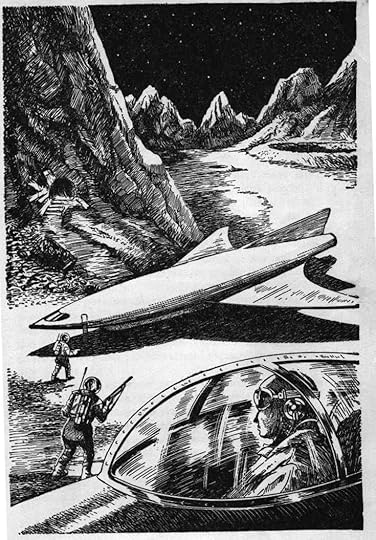
And so out to the New Mexico desert for a good bit of engineering (and some apparent attempted sabotage by Bad Actors) prior to liftoff and then the whole thing ends with the discovery of a Nazi base on the Moon (promptly taken out of commission) and evidence that the Moon once housed intelligent beings of its own.
I think it may also be the shortest of his juveniles? So I'm not going to say don't read it if you're in the mood for that kind of thing and have a few hours to kill (and have a reasonably high tolerance for "folksy" dialogue), but know that you could do better with, well, pretty much any of his later juveniles. (Personal favorites include but are not limited to Space Cadet, Red Planet and Citizen of the Galaxy.)
EDIT: I exaggerated. Looks like I last read the book in 2005, so I guess only 20 years? But that doesn't change any of my conclusions.
This one was first published in 1946, so must've been written in the immediate aftermath of WWII. It takes place at least a few years in the future, at least relative to when it was written (so probably 60-70 years in our past; as I recall, the only concrete date mentioned is 1951, when they're talking about an event that happened in the past relative to the events of the book). Heinlein doesn't really go deeply into the background of the setting -- that's not why we're here -- but apparently the UN has been established as a sort of supreme power (although nations still exist, as long as they don't try to wage war on each other) and trans-oceanic or trans-continental rockets are fairly common but nobody has gone to the Moon yet.
Hence our story, which actually reminds me in some ways of nothing so much as The Wonderful Flight to the Mushroom Planet, except that I assume all of the orbital mechanics, thrust/weight ratios, etc., have been worked out in much greater detail.
As we open, our three protagonists, Ross, Art and Morrie (all just out of high school) are out in the countryside conducting some fairly large-scale (and not entirely successful) rocketry experiments when Art's uncle Donald Cargraves (a veteran of the Manhattan Project) shows up and recruits them for his next project -- buying a surplus mail rocket, outfitting it with a thorium reactor for the drive, and heading off to the Moon. Which plan, needless to say, the boys enthusiastically support; their parents, perhaps less so.
And so out to the New Mexico desert for a good bit of engineering (and some apparent attempted sabotage by Bad Actors) prior to liftoff and then the whole thing ends with the discovery of a Nazi base on the Moon (promptly taken out of commission) and evidence that the Moon once housed intelligent beings of its own.
I think it may also be the shortest of his juveniles? So I'm not going to say don't read it if you're in the mood for that kind of thing and have a few hours to kill (and have a reasonably high tolerance for "folksy" dialogue), but know that you could do better with, well, pretty much any of his later juveniles. (Personal favorites include but are not limited to Space Cadet, Red Planet and Citizen of the Galaxy.)

February 7, 2025
رمان کوتاهی ست پیش از جنگ جهانی دوم درباره سفر به ماه.علم هوافضا در این کتاب به خوبی برای دوران طلایی سفرهای فضایی در دهه پنجاه و شصت میلادی پیش بینی شده بود اگر چه نظام سیاسی به گل و بلبلی که هاینلاین تصور میکرد اتفاق نیافتاد.فضای کتاب نوجوانانه است و یک بار خواندن آن اشکالی ندارد چون نثر تمیز و شست و رفته ای دارد.

November 16, 2015
What can I say? This book epitomizes everything that is right, and everything that is wrong, with young adult fiction. Especially, young adult fiction written by Robert Heinlein.
The basic plot: three high school boys (interested in science and engineering, but well rounded and NOT ANTI-SOCIAL NERDS) get an offer to help one boy's uncle -- the noted Nobel Prize Winning physicist and self-made businessman -- to go to the moon. They work through all their technical setbacks, and eventually blast off to great acclaim. But are they the first to reach the moon? Or has a dark, sinister group beaten them there...
The wrongs: there are no female characters in the book. None. Zero. Nada. One of the characters has a mother, but she has one line, in which she contradicts her husband. Yes, it's quite possible that this was a marketing decision. Back in the late 1940s, science fiction was nearly exclusively a boys club. "Why dilute your core demographic," I could hear some modern-day book packager ask. "You know how these nerd boys are on the subject of girls, seeing as how they've never spoken to one their entire lives." But still, geez, give us a female radio operator, shop clerk, something.
The wrongs: If Isaac Asimov's timing is correct, Robert Heinlein was entering his deeply libertarian phase now. What the hell is it about libertarian authors that they feel they have to stop the story to lecture us about how wonderful libertarianism is? Show, don't tell, says every fiction instructor, everywhere. And the topics! It was during the lecture about "How do you know there's an unseen side to the moon?" that I was certain the boys were going to maroon Uncle Don in the crater Tycho.
BUT, there's also a lot right with the book:
The rights: The book was written by an American right after World War II, so it is relentlessly optimistic. In recent (2015) years, it sometimes feels that the only Young Adult science fiction is dystopian. I seriously wonder if the lack of "big science fiction ideas" is hurting our increasingly science-fictional society. Heinlein had no such worries. Remember, he had just come from an experience in which 19 year olds piloted multi-million dollar bombers over enemy territory. It was a small leap to expect these 19 year olds to pilot a ship to the moon.
The rights: strangely enough, the non-didactic portions of the book were probably the most instructive. Heinlein does what a novelist is supposed to do: he shows us, rather than tells us, how the team ran into setbacks with their plan, but thought (and experimented, and worked) their way back on track. Essential teachings for any scientific-technological endeavor.
The rights: Space Nazis!!!!!!!! You can't go wrong with space Nazis!
The basic plot: three high school boys (interested in science and engineering, but well rounded and NOT ANTI-SOCIAL NERDS) get an offer to help one boy's uncle -- the noted Nobel Prize Winning physicist and self-made businessman -- to go to the moon. They work through all their technical setbacks, and eventually blast off to great acclaim. But are they the first to reach the moon? Or has a dark, sinister group beaten them there...
The wrongs: there are no female characters in the book. None. Zero. Nada. One of the characters has a mother, but she has one line, in which she contradicts her husband. Yes, it's quite possible that this was a marketing decision. Back in the late 1940s, science fiction was nearly exclusively a boys club. "Why dilute your core demographic," I could hear some modern-day book packager ask. "You know how these nerd boys are on the subject of girls, seeing as how they've never spoken to one their entire lives." But still, geez, give us a female radio operator, shop clerk, something.
The wrongs: If Isaac Asimov's timing is correct, Robert Heinlein was entering his deeply libertarian phase now. What the hell is it about libertarian authors that they feel they have to stop the story to lecture us about how wonderful libertarianism is? Show, don't tell, says every fiction instructor, everywhere. And the topics! It was during the lecture about "How do you know there's an unseen side to the moon?" that I was certain the boys were going to maroon Uncle Don in the crater Tycho.
BUT, there's also a lot right with the book:
The rights: The book was written by an American right after World War II, so it is relentlessly optimistic. In recent (2015) years, it sometimes feels that the only Young Adult science fiction is dystopian. I seriously wonder if the lack of "big science fiction ideas" is hurting our increasingly science-fictional society. Heinlein had no such worries. Remember, he had just come from an experience in which 19 year olds piloted multi-million dollar bombers over enemy territory. It was a small leap to expect these 19 year olds to pilot a ship to the moon.
The rights: strangely enough, the non-didactic portions of the book were probably the most instructive. Heinlein does what a novelist is supposed to do: he shows us, rather than tells us, how the team ran into setbacks with their plan, but thought (and experimented, and worked) their way back on track. Essential teachings for any scientific-technological endeavor.
The rights: Space Nazis!!!!!!!! You can't go wrong with space Nazis!

January 23, 2010
This is one of my favorites among the juveniles. It is often the Heinlein novel that I suggest to someone new to him. One trait I've noticed several times is that Heinlein will take something that sounds like a parody of bad sci fi and then make it completely and totally possible. Very early in his life in a letter, rather than in fiction, he talked about the implausible mapping of human culture onto aliens as a form of laziness in writing and then parenthetically says, "Some day, I should write a novel about a Martian named 'Smith'." With no hint of irony or self-parody, this of course becomes his most famous and probably most-loved novel.
Similarly, Rocket Ship Galileo has Space Nazis. Space Nazis! Not just in some vague, metaphorical sense. I mean "New Reich" swastika wearers found in space. And it is done completely plausibly and makes for a great yarn.
The novel has all the normal treats of a Heinlein juvenile. We have earnest, young characters committed to take the world by the tail and shake it. They team up with a gruff older guy and take the world, or perhaps I should say moon, and the Space Nazis by storm.
2013: The kids loved this one. Though this ended up being the third Heinlein I read with them, it had been the one I had originally intended to be first, thinking it a perfect introduction. It was a perfect continuation.
2015: This has become only the second re-read with kids. They barely remember it, and have no idea what is to happen. With the notably exception of The Star Beast, they seem to have mostly forgotten the first Heinlein we read. It came off extremely well with the kids. It is funny to me that at 9 and 7, they're starting to find the juveniles a little too thin. They want deeper stories with richer characters. They've found some of that in Heinlein's later work already, and are craving more. Our family reading may soon need to stretch beyond Heinlein.
2026: This one was an early favorite of Lisa's.
Similarly, Rocket Ship Galileo has Space Nazis. Space Nazis! Not just in some vague, metaphorical sense. I mean "New Reich" swastika wearers found in space. And it is done completely plausibly and makes for a great yarn.
The novel has all the normal treats of a Heinlein juvenile. We have earnest, young characters committed to take the world by the tail and shake it. They team up with a gruff older guy and take the world, or perhaps I should say moon, and the Space Nazis by storm.
2013: The kids loved this one. Though this ended up being the third Heinlein I read with them, it had been the one I had originally intended to be first, thinking it a perfect introduction. It was a perfect continuation.
2015: This has become only the second re-read with kids. They barely remember it, and have no idea what is to happen. With the notably exception of The Star Beast, they seem to have mostly forgotten the first Heinlein we read. It came off extremely well with the kids. It is funny to me that at 9 and 7, they're starting to find the juveniles a little too thin. They want deeper stories with richer characters. They've found some of that in Heinlein's later work already, and are craving more. Our family reading may soon need to stretch beyond Heinlein.
2026: This one was an early favorite of Lisa's.

January 28, 2011
This was Robert A. Heinlein's first full-length novel. It's one of his "juveniles," which is another way of saying it's rollicking "golly gee whiz"-style adventure that could have just as well been published in Boy's Life magazine as in hardcover by Scribner's.
Three high school seniors on the cusp of graduation get the opportunity of a lifetime when one of their uncles, Dr. Cargraves, a nuclear physicist, is so impressed with their scientifically minded tinkering that he offers to take them with him to the moon for a little expedition.
The premise may seem silly, but Heinlein does a good job of making the characters seem serious, and he sticks to accepted science of the mid-'40s when described space flight and rocketry.
The trio of 18 year-old boys and Dr. Cargraves establish a base on the moon (an airtight Quonset hut), and claim it for the United Nations. They'll soon discover, however, that a bunch of dirty Nazis -- in hiding since the end of World War II -- have already established a base on the moon, from which they plan to mount atomic attacks against the earth.
The climactic action (and the revelation about prehistoric inhabitants of the moon) is probably the silliest section of the book, but overall I really enjoyed Rocket Ship Galileo. It still instilled a sense of wonder and excitment in me, even though it was published more than 60 years ago.
On a side note, this is the first audiobook I've listened to in a long, long time, and I enjoyed Spider Robinson's narration. He's more nasal than most voice artists, but he tells the story very well, and his boyish, adenoidal twang added something to the "gee whiz" aspect of the story.
Three high school seniors on the cusp of graduation get the opportunity of a lifetime when one of their uncles, Dr. Cargraves, a nuclear physicist, is so impressed with their scientifically minded tinkering that he offers to take them with him to the moon for a little expedition.
The premise may seem silly, but Heinlein does a good job of making the characters seem serious, and he sticks to accepted science of the mid-'40s when described space flight and rocketry.
The trio of 18 year-old boys and Dr. Cargraves establish a base on the moon (an airtight Quonset hut), and claim it for the United Nations. They'll soon discover, however, that a bunch of dirty Nazis -- in hiding since the end of World War II -- have already established a base on the moon, from which they plan to mount atomic attacks against the earth.
The climactic action (and the revelation about prehistoric inhabitants of the moon) is probably the silliest section of the book, but overall I really enjoyed Rocket Ship Galileo. It still instilled a sense of wonder and excitment in me, even though it was published more than 60 years ago.
On a side note, this is the first audiobook I've listened to in a long, long time, and I enjoyed Spider Robinson's narration. He's more nasal than most voice artists, but he tells the story very well, and his boyish, adenoidal twang added something to the "gee whiz" aspect of the story.

November 23, 2014
It's easy to dismiss the pre-1965 sci-fi books as "quaint" when read from today's understanding of science and space travel. However these 1940-1960 works are the gems of the golden age.
If you can suspend your 21st century hubris and read the story from a mindset of a 1950s reader, Rocket Ship Galileo holds up as a great read. The storytelling is strong, and is a classic representation of the style of the era. When read with an open mind, it also provides the unexpected enjoyment of getting a glimpse of the perspective and imaginative mindset of the pre-space generation on what science, politics and our exploratory future might look like, with an unintended aspect of nostalgia for today's reader.
An easy read. An enjoyable read. For fans of the genre and of Heinlein, a recommended read and a richly presented fantasy tale.
If you can suspend your 21st century hubris and read the story from a mindset of a 1950s reader, Rocket Ship Galileo holds up as a great read. The storytelling is strong, and is a classic representation of the style of the era. When read with an open mind, it also provides the unexpected enjoyment of getting a glimpse of the perspective and imaginative mindset of the pre-space generation on what science, politics and our exploratory future might look like, with an unintended aspect of nostalgia for today's reader.
An easy read. An enjoyable read. For fans of the genre and of Heinlein, a recommended read and a richly presented fantasy tale.

June 7, 2016
Lunar Shocker: Nazis have secret base on the moon! "Fortunately, a trusty group of teenagers were able to save the day."
Heinlein demonstrates mastery with writing stories for adolescents.
Heinlein demonstrates mastery with writing stories for adolescents.

December 5, 2018
Morrie, Art, and Ross are teens that just graduated high school and are ready to go to technical university in the fall. They are highly advanced science students who've been experimenting with rocket technology as long as they can remember. Their test launch for Starstruck V goes horribly wrong and explodes hitting Art's nobel prize winning Uncle Cosgraves. But Cosgraves is highly interested in the technology they've evolved on their own and they set out to make a trip to the moon. First they go to a secure location in New Mexico to build their rocket, the Galileo, and then to plan their trip. But spies seem to be messing with their plans and they've no idea why.
Heinlein is a fantastic author. He has a way of building excitement even in a young adult novel. I was brought back to my experience of the first time I watched the film The Explorers as a kid in the 80s. This kickstarted my love of science fiction and space travel in particular. Especially the idea of doing the impossible, like the very first trip to the moon. Heinlein has at least a rudimentary understanding of rocket sience, chemistry, physics and astronomy as it plays heavily in his narrative.
I found it hilarious when they talk about the theories surrounding the moon. For example, what's on the back side. No one's seen the backside of the moon so there may not even be a back side. One of the boys had a theory that "moon people" must have gotten into an atomic war to make the moon look the way it does because things like meteors wouldn't wreak such havoc. This quote sent me into a fit of giggles: "They blew their atmosphere off and the seas boiled away." My very favorite part was when Cosgraves referenced flat earthers and the ridiculousness of that theory. I wanted to say, well its 57 years later and we're still dealing with those idiots.
Overall, I highly enjoyed this book. It has all the elements of an exciting adventure: space travel, science, and spies. I was pulled in immediately and felt my heart racing with excitement as they made these new discoveries and took this perilous journey. It made me feel that joy and newness of exploration beyond imagination. I can't wait to read more of his work. I give this a very strong 5/5 and highly recommend it to fans of sci fi.
Heinlein is a fantastic author. He has a way of building excitement even in a young adult novel. I was brought back to my experience of the first time I watched the film The Explorers as a kid in the 80s. This kickstarted my love of science fiction and space travel in particular. Especially the idea of doing the impossible, like the very first trip to the moon. Heinlein has at least a rudimentary understanding of rocket sience, chemistry, physics and astronomy as it plays heavily in his narrative.
I found it hilarious when they talk about the theories surrounding the moon. For example, what's on the back side. No one's seen the backside of the moon so there may not even be a back side. One of the boys had a theory that "moon people" must have gotten into an atomic war to make the moon look the way it does because things like meteors wouldn't wreak such havoc. This quote sent me into a fit of giggles: "They blew their atmosphere off and the seas boiled away." My very favorite part was when Cosgraves referenced flat earthers and the ridiculousness of that theory. I wanted to say, well its 57 years later and we're still dealing with those idiots.
Overall, I highly enjoyed this book. It has all the elements of an exciting adventure: space travel, science, and spies. I was pulled in immediately and felt my heart racing with excitement as they made these new discoveries and took this perilous journey. It made me feel that joy and newness of exploration beyond imagination. I can't wait to read more of his work. I give this a very strong 5/5 and highly recommend it to fans of sci fi.

April 19, 2015
Not a bad read. It's one of the Heinlein "teen' books that I missed when i was younger. AND this one does read a bit younger than some of hie other youth books.
This is the story of young people who get to participate in a private moon shot. One of the more interesting parts of the book (for me anyway) is the dated science. This is a pre-computer, pre-minaturization book and that gives an interesting (did I already use that word?) look at earlier science fiction.
This is the story of young people who get to participate in a private moon shot. One of the more interesting parts of the book (for me anyway) is the dated science. This is a pre-computer, pre-minaturization book and that gives an interesting (did I already use that word?) look at earlier science fiction.

February 18, 2026
3.25⭐️

April 16, 2022
Obviously did not release in the 21st century

February 3, 2011
Ok the first thing to remember was that was written in 1947 - before any form of space flight let alone man on the moon. Next accept that this was written in the true boys own adventure style - where a phone call to a far away store can secure anything - from atomic material to a second hand rocket ship and finally accept that its all left to the men to do the science and college students at that!
If you can accept all this wait till you see what they discover on the moon, it was a fun slice of science fiction history but even by Heinlein standards (which i am sure there are many out there who want to criticise) this was dated and not so inspiring piece but still it was fun to read.
If you can accept all this wait till you see what they discover on the moon, it was a fun slice of science fiction history but even by Heinlein standards (which i am sure there are many out there who want to criticise) this was dated and not so inspiring piece but still it was fun to read.

July 31, 2026
The premise of Heinlein's first juvenile scifi novel is, of course, a very silly one: three teenage boys hastily build, with the help of a physicist uncle, the first Moon rocket a fly to the Moon after World War II. If you can live with that, and the fact that the characters are very thin indeed, Rocketship Galileo is mostly an entertaining read. During the first half of the book Heinlein lectures about rockets etc., but if you've read Verne and lived through it, Heinlein's lectures are no big deal.
It would have been a three-star novel, but the last quarter or so went to the territory that has been parodied a lot subsequently, and that gave another half a star. I wasn't expecting that, so it was a delight to discover.
3.5/5
It would have been a three-star novel, but the last quarter or so went to the territory that has been parodied a lot subsequently, and that gave another half a star. I wasn't expecting that, so it was a delight to discover.
3.5/5

November 24, 2020
This was one of the first Heinlein novels I read as a 13- or 14-year-old, back in the 1980s, and I recall that it (along with Red Planet and Space Cadet) kindled my love not only for science fiction but for science itself, and the broader universe around us. Upon rereading in 2020, it was much as I remembered — not award-winning, but fun. And fun is, afterall, the reason I read fiction.
(I published a longer review on my website.)

April 9, 2021
Showing it's age
This Heinlein's first "Juvenile" science fiction book, written in 1947. It appears to be set in the mid-to-late 1950s, which is about the same era I read it for the first time.
Three boys just out of high school team up with an eccentric atomic scientist to build an atomic-powered moon rocket on the cheap.
It's a rip-roarin' adventure with an interesting plot complication near the end, but the science and engineering haven't aged well.
Not one of Heinlein's best.
This Heinlein's first "Juvenile" science fiction book, written in 1947. It appears to be set in the mid-to-late 1950s, which is about the same era I read it for the first time.
Three boys just out of high school team up with an eccentric atomic scientist to build an atomic-powered moon rocket on the cheap.
It's a rip-roarin' adventure with an interesting plot complication near the end, but the science and engineering haven't aged well.
Not one of Heinlein's best.

March 3, 2026
A very imaginative story by Robert Heinlein where four amateur astronauts manage to reach the Moon only to find representatives from a historic evil empire are already there.
The amateur astronauts also find evidence of an old civilisation on the Moon.
The amateur astronauts also find evidence of an old civilisation on the Moon.

May 12, 2013
Originally reviewed at FanLit:
http://www.fantasyliterature.com/revi...
When I was a kid I loved the “Heinlein Juveniles.” Rocket Ship Galileo, Heinlein’s first Juvenile, is one I missed back then. It won’t hold up well today (actually, it wouldn’t have held up well when I was reading Heinlein Juveniles in the 1980s) but sometimes it’s fun to read these old science fiction stories for kids and I did have fun recently reading Rocket Ship Galileo even though I am very much aware of its flaws. Let’s remember that it was published in 1947, just after World War II and well before we managed to put a man on the moon.
Ross, Art, and Morrie (I love those retro names!) are three teenage boys who love science and each have special geeky skills. When Morrie’s uncle, a Nobel Prize-winning nuclear physicist, discovers that the boys are building a rocket ship, he gives them some funds and a little help and off they all go to the moon. When they get there they discover that they’re not the first ones there. The humans who’ve covertly come before have dangerous plans. Can the boys stop them before the bad guys destroy the Earth?
Okay, that’s just fun, right? In the year 2013 it’s impossible to take Rocket Ship Galileo seriously. I don’t know if they did back in 1947. I suspect not because I doubt anyone thought it was possible to build a space ship in your backyard or to mail order space suits and asbestos shoes. Still, boys can dream, and Rocket Ship Galileo is definitely an exciting dream, especially when you get to not only fly to the moon, but kill Nazis and save the Earth on top of it all. Too cool!
Other than the outlandishness of it all, the main problem with Rocket Ship Galileo is all the teachy technobabble. Some of it is real science, some of it is made up (I hope kids can tell this apart), most of it is dated, and a lot of it is boring because it’s delivered in Uncle Cargraves’ lessons or the boys recitation of what they’ve previously learned. Heinlein has an issue with this in his adult novels, too. If the lessons don’t turn kids off they might enjoy experiencing the fantasies of teenage boys in the 1940s.
The audiobook I listened to was narrated by Spider Robinson who has the tone just right. When he narrates the boys’ parts he sounds appropriately wide-eyed, innocent, and geeky. Golly, Mr. Robinson, great job!
http://www.fantasyliterature.com/revi...
When I was a kid I loved the “Heinlein Juveniles.” Rocket Ship Galileo, Heinlein’s first Juvenile, is one I missed back then. It won’t hold up well today (actually, it wouldn’t have held up well when I was reading Heinlein Juveniles in the 1980s) but sometimes it’s fun to read these old science fiction stories for kids and I did have fun recently reading Rocket Ship Galileo even though I am very much aware of its flaws. Let’s remember that it was published in 1947, just after World War II and well before we managed to put a man on the moon.
Ross, Art, and Morrie (I love those retro names!) are three teenage boys who love science and each have special geeky skills. When Morrie’s uncle, a Nobel Prize-winning nuclear physicist, discovers that the boys are building a rocket ship, he gives them some funds and a little help and off they all go to the moon. When they get there they discover that they’re not the first ones there. The humans who’ve covertly come before have dangerous plans. Can the boys stop them before the bad guys destroy the Earth?
Okay, that’s just fun, right? In the year 2013 it’s impossible to take Rocket Ship Galileo seriously. I don’t know if they did back in 1947. I suspect not because I doubt anyone thought it was possible to build a space ship in your backyard or to mail order space suits and asbestos shoes. Still, boys can dream, and Rocket Ship Galileo is definitely an exciting dream, especially when you get to not only fly to the moon, but kill Nazis and save the Earth on top of it all. Too cool!
Other than the outlandishness of it all, the main problem with Rocket Ship Galileo is all the teachy technobabble. Some of it is real science, some of it is made up (I hope kids can tell this apart), most of it is dated, and a lot of it is boring because it’s delivered in Uncle Cargraves’ lessons or the boys recitation of what they’ve previously learned. Heinlein has an issue with this in his adult novels, too. If the lessons don’t turn kids off they might enjoy experiencing the fantasies of teenage boys in the 1940s.
The audiobook I listened to was narrated by Spider Robinson who has the tone just right. When he narrates the boys’ parts he sounds appropriately wide-eyed, innocent, and geeky. Golly, Mr. Robinson, great job!

January 22, 2019
This book was about an after school high school boys' club making a rocket spaceship and going to the moon in it. Seriously.
Heinlein had a hard time finding a publisher for this book. It was rejected several times for being too far-fetched before it was finally accepted. It's also a juvenile. Some juveniles can be appreciated equally by adults. This book can't, and never could have been. It was written solely to appeal to kids.
That it's a book only boys could enjoy is a problem because I don't think there exists a 21st century boy who could possibly find reading this book worthwhile. Boys no longer interact with one another, if they ever truly did, the way these boys do. That means the book has no audience today.
So why did I read it? Purely for historical interest. It has a little of that, but then, everyone knows this book's tropes even in our time, how in the late-1940s the Cold War was beginning. Fears the Nazis would resurrect themselves provided easy fiction fodder, and Heinlein doesn't miss a cliche in this forgettable tripe. The only reason it gets three stars rather than two is because the plot still holds together. The book has a beginning, middle, and end. Some modicum of suspense is successfully created. It's not a bad novel; it just isn't any longer good either.
Heinlein had a hard time finding a publisher for this book. It was rejected several times for being too far-fetched before it was finally accepted. It's also a juvenile. Some juveniles can be appreciated equally by adults. This book can't, and never could have been. It was written solely to appeal to kids.
That it's a book only boys could enjoy is a problem because I don't think there exists a 21st century boy who could possibly find reading this book worthwhile. Boys no longer interact with one another, if they ever truly did, the way these boys do. That means the book has no audience today.
So why did I read it? Purely for historical interest. It has a little of that, but then, everyone knows this book's tropes even in our time, how in the late-1940s the Cold War was beginning. Fears the Nazis would resurrect themselves provided easy fiction fodder, and Heinlein doesn't miss a cliche in this forgettable tripe. The only reason it gets three stars rather than two is because the plot still holds together. The book has a beginning, middle, and end. Some modicum of suspense is successfully created. It's not a bad novel; it just isn't any longer good either.

May 12, 2022
I’m aware that to some extent this is a worse-than-usual Heinlein book, but it’s far and away my favorite. Its model is just as much Horatio Alger or even Hardy Boys as it is science fiction, and its science fiction models are very much in the Gernsback mould. But this lack of ambition means that Heinlein cannot fail (as he so often does for me). And furthermore the didacticism (which is not wholly absent) seems less like Heinlein and more like a Alger / Stratemeyer didacticism. Maybe that *shouldn’t* make a difference, but to me it took the edge off my teeth (or whatever). It just felt like part of the genre, and not Heinlein’s heavy hand.
And what you have left is a wonderful Boy’s Own story with lots of science. The hard parts are too easy (always a problem with Heinlein, I think), but there are moments when I thought it was going to be really hard, and that was exciting to me.
And what you have left is a wonderful Boy’s Own story with lots of science. The hard parts are too easy (always a problem with Heinlein, I think), but there are moments when I thought it was going to be really hard, and that was exciting to me.

December 27, 2017
There are two stars here but I actually enjoyed it more than the rating indicates, because it was exactly what I needed to read these days. A "Chums of Chance" style of adolescent story, outdated, obnoxious and kind of silly because, well, we went to the moon and it was nothing like that. It's not great, but if you are in the mood for it and you don't mind the outdated flaws, you will enjoy this, how could you not, there are Nazis on the moon and moon people and adolescent boys fighting for freedom and they also cook a nice meal on their way to the moon, go away NASA with your pre-packaged food and safety precautions...
Displaying 1 - 30 of 345 reviews