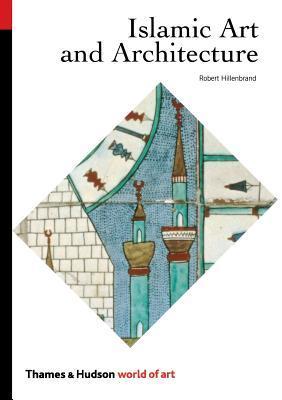
Covering one thousand years of history and an area stretching from the Atlantic to the borders of India and China, Robert Hillenbrand incorporates all the latest discoveries and interpretations in this authoritative guide to the arts of Islam. From the supreme confidence of the Dome of the Rock in Jerusalem to the scores of exquisite buildings of Ottoman Istanbul; from the extraordinary virtuosity of Persian painting in the fifteenth century to the vivid ceramic tradition of Ottoman Iznik―Hillenbrand does justice to both the highlights and the ongoing evolution of the full range of Islamic arts. Supported by a glossary of Islamic terms, a time line, and maps, this book traces the architecture, calligraphy, book illumination, painting, ceramics, textiles, and metalwork of a vastly accomplished and influential civilization.
This is a solid introduction to the world of Islamic art and architecture written by an author who knows this field well.
It covers all the key periods in the history of Islamic empires and the version I read was a newer edition that adds a chapter on 1700-1900 so it includes the later developments in Islamic art and architecture that were missing in the previous edition.
Each chapter starts with a summary of the politics of the time and this does a great job of giving context to each age that the author takes us through.
While it is billed as an introduction to this area it's ultimately a reference book so the writing is dry and you'll want to have a thesaurus at hand, and not just for the art and architecture terms.
I wouldn't recommend reading it cover to cover, rather the first few pages of each chapter before skimming the rest and dipping in where a piece or building grabs your interest.
It's a beautifully illustrated introduction to this genre.
This book is very comprehensive and well-organized on the world of islamic art--an often very-little studied area in the art world. I read it after hearing a series of Hildebrand's lectures in an art history class at the University of Edinburgh. This man is an amazing speaker and so passionate and extremely knowledgeable about what he does.
The book was more about the politics of the times and places in which the art was made than about the art itself. Too much history, not enough information on the art.
Another book for school. This one was for the History of Islamic art and though I found the contents interesting and helpful for the class I found the information difficult to read and dry. There is no way to make art interesting for non artists however I feel for an american class the book which is written in a proper english style was quite hard to get into and the word use didn't always make sense to me (dang my poor education) Over all though it was great. Just wish the images were better.
3,5/5. A politically charged explanation of art history in Islamic premodern empires, from the Ummayads to the Ottomans. Full of illustrating examples, and follows a thematic categorization in every chapter, doing the major art forms justice.
This is a truly illuminating survey, written in a lively, forthright style that captures the author's character and perspective without undercutting the book's objective task. (I especially enjoyed Hillenbrand's use of a delightfully broad vocabulary, that kept even this English M.A. thumbing his dictionary!) I was grateful for Hillenbrand's wide range in describing metalwork, pottery, textiles, book illustrations (those dreaded "minor arts"), as well as architecture.
The illustrations are good and the information comprehensive and presumably accurate, but somehow the text manages to make a deeply interesting subjective sound deadly boring. Written in a tedious, pedantic style that taxes the reader's patience.
This was a pretty strong introduction to Islamic art and architecture. The way in which Robert Hillenbrand writes shows clear passion and expert knowledge on the subject. In fact, sometimes he goes into so much detail that it can be dry for someone with more casual interest, but only occasionally. Each chapter begins with a short description of the political changes that form the background to the visual culture of that particular period/region. He also explains the aims and characteristics of each ruling dynasty and their empires/kingdoms. I really appreciated this, because it then allows you clearly trace how rulers and new attitudes shaped changes in art, even if subtle. The book did also not just focus on merely architecture and 'high art', but also more 'minor art', from pottery to textiles to carpets.
Nevertheless, the major flaw of this work is that it claims to be an introduction to Islamic art and architecture more broadly, and yet developments of Islamic art in South and South-East Asia (which represents roughly 45% of today's global Muslim population) and Sub-Saharan Africa (around 15% of the globe's Muslims) are not mentioned at all. I understand that not everything can be covered, but to miss out the culture of 60% of the global Muslim population seems to be a huge misstep. Not even a chapter on the Mughals, who constructed the Taj Mahal and some of the largest mosques of the world at the time?
It may be better to name this book 'Near Eastern Islamic Art and Architecture' or 'Art and Architecture of the Central Islamic World' (which is usually taken to mean the Arabian Peninsula, Iran, Turkey, North Africa, the Fertile Crescent and Central Asia). But otherwise, it's a great place to start for a taste of this subject.
The author begins by telling you how much was left out. That’s because it’s impossible to give a comprehensive survey of Islamic Art.. Nevertheless he still covers a lot of ground giving a great deal of historic background to each period. I wish some of the illustrations were bigger but that’s due to the limitations of the size of the book. I came out knowing a lot more than I did when I went in and am now inspired to read further on the subject!
This book was a very fasinating read. Obviously, as stated in the prologue, this novel cannot cover everything about Islamic art. Realistically, it barely scratches the surface, I'm sure. However, every sentence was richly packed with information on the respective subject! I would highly recommend this to anyone who wants to study what makes Islamic art unique and fascinating!
Me and wife not Muslims. But admirers of Islam. My wife regularly travels to Turkey, and bought this book from a dusty book shop in Istanbul. I like art and architecture, and loved this book. Recommend it to anyone who are into art and architecture.
This is a thorough overview of Islamic art from the 7th century to about the 17th century. Well written and easily read, its a great introduction to the Islamic arts.
Hillenbrand's book is great. It is comprehensive, well written, includes helpful maps, timelines, and photographs that capture the beauty of the art he discusses. He covers everything from painting, to calligraphy, to the beautiful Persian rugs, to architecture. If you're interested in any kind of art, I would highly recommend!
For the Summer Course I am TA-ing, but still a very interesting introductory look at Islamic Art. The only issue is that the text excludes Islamic art of India.