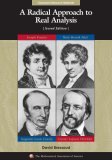
In the second edition of this MAA classic, exploration continues to be an essential component. More than 60 new exercises have been added, and the chapters on infinite summations, differentiability and continuity, and convergence of infinite series have been reorganized to make it easier to identify the key ideas. A Radical Approach to Real Analysis is an introduction to real analysis, rooted in and informed by the historical issues that shaped its development. It can be used as a textbook, or as a resource for the instructor who prefers to teach a traditional course, or as a resource for the student who has been through a traditional course yet still does not understand what real analysis is about and why it was created.
Let me preface this by saying that Real Analysis sort of kicked my butt in college. I was a physics major and (obviously) used calculus all the time. I kept hearing from friends that Real Analysis is the subject that puts calculus on mathematically rigorous footing. But my first time around the block with RA left me confused. Years later I tried again using this textbook, which made things much clearer because rather than presenting the subject as a finished, polished structure, Bressoud reconstructs the intellectual struggles that led to its creation.
The book’s central thesis is that students understand analysis more deeply when they see how 19th‑century mathematicians actually wrestled with limits, convergence, and continuity.
Throughout the book, Bressoud frames RA through the lens of its development: from the intuitive calculus of Newton and Leibniz to the rigorous foundations built by Cauchy, Bolzano, Weierstrass, and others. This historical arc gradually reveals why concepts like uniform convergence, completeness, and the ε–δ definition of limit were actually necessary.
Instead of starting with axioms, the book builds toward them. Bressoud uses sequences and series as the natural entry point. Counterexamples motivate the bullet-proof definitions still used today in, for example, chapters on sequences and series in any mathematical physics book. This approach helps readers internalize WHY definitions and proofs look the way they do. Highly recommended for students in any STEM field who want to understand calculus more deeply.
This is a good book at the college level. However, when nearing some parts in here, you need an instructor (college professor) to help guide you through the confusing areas