

What do you think?

Deep Cuts #1-6
Deep Cuts
New Orleans, 1917: a clarinet player meets his hero. Kansas City, 1940: a young girl investigates the mystery of her father's lost love of music. Los Angeles, 1977: a band embark on a world tour that may be their last. Writers KYLE HIGGINS and JOE CLARK (RADIANT BLACK) are joined by an ALL-STAR CAST OF ARTISTS for an anthology of stories that weave tales of struggle, joy, and hope through the history of jazz! Collects DEEP CUTS #1-6
312 pages, Paperback
First published May 22, 2024
Ratings & Reviews
Friends & Following
Create a free account to discover what your friends think of this book!
Community Reviews
Displaying 1 - 30 of 38 reviews
![Profile Image for s.penkevich [hiatus-will return-miss you all].](https://i.gr-assets.com/images/S/compressed.photo.goodreads.com/users/1735525095i/6431467._UX200_CR0,11,200,200_.jpg)
June 15, 2024
‘It's not the notes you play, it's the notes you don't play,’ Jazz icon Miles Davis once said about the distinction between good and bad music. It’s the silence between the notes that matter just as much and in Deep Cuts a rocking graphic novel compendium of jazz tales, we are treated to the notes we don’t hear or see in the music: the notes of life off the stage as well as on it. Writers Kyle Higgins and Joe Clark are joined by an impressive line-up of visual artists to tell six stories of musicians ranging from 1917 New Orleans to a global tour in the late 70s where each tale is as varied as the eye-popping visuals. It’s like a graphic novel as an album that reaches in multiple directions yet still has a unifying central theme that all the notes orbit around. And sure, someone once said ‘writing about music is like dancing about architecture,’ (the quote has been attributed to everyone from Miles Davis and Frank Zappa to Steve Martin and George Carlin but the actual origins are unknown), the combination of words and art here really drive home some wonderful stories that go beyond the music. So plug in, turn up the volume, and get ready for a wild ride with Deep Cuts.
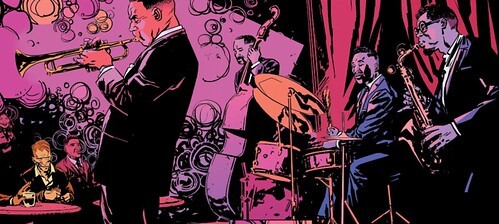
Starving artists, youngsters looking for their first gig, long-time artists still looking for their big break, musicians who’ve given up the life, experimental artists, musicians on a downward spiral and more all populate the pages of the six stories in Deep Cuts. The tales move from New Orleans to Chicago in the days leading up to Black Tuesday, Kansas City in 1940, New York in 1956, LA in 1968 and then again in 1977, each with their own unique artistic style but all with a deep love of jazz and the people who move it or are moved by it. Included in this visual line-up are Danilo Beyruth, Helena Masellis, Diego Greco, Ramón Pérez, Juni Ba and Toby Cypress, with Igor Monti having provided the cover art for each individual issue as they were being released.
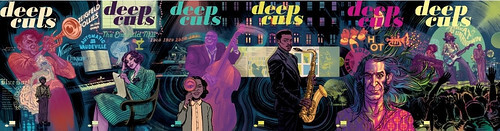
I really loved this and while, admittedly, some of the stories are better than others a lot of them hit hard. The first story would have made an excellent short story in just prose but the visuals really bring it to life.
And I can’t help but love all the various representations of the bands playing and how, despite moving across many years and into the era of electric instruments, there is still this central idea of jazz where you look at them and know “this is a jazz band”
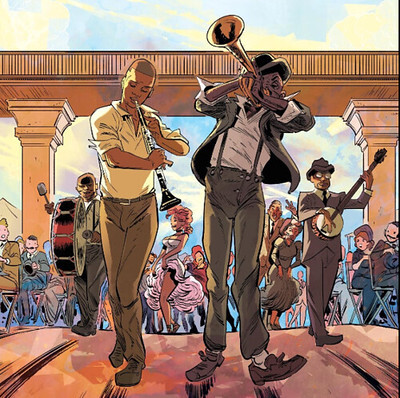
1917
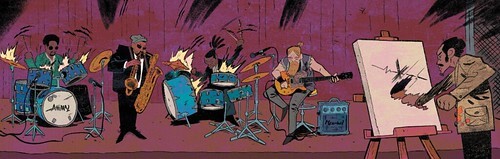
1968
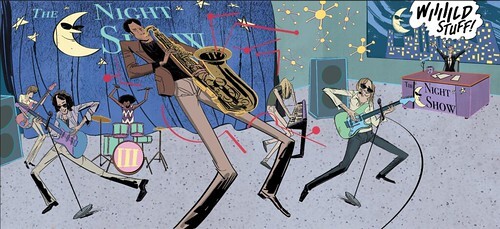
1977
”Jazz is dead.”?
God, maybe. Jazz? No.
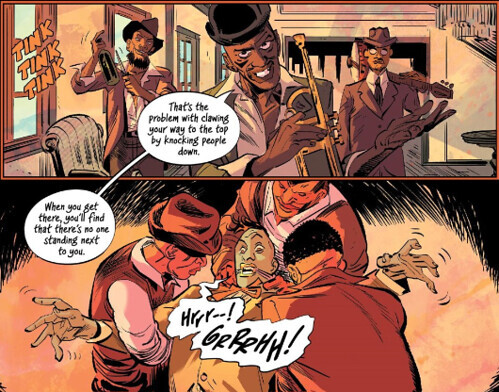
There is a real playfulness here too. We have stories of a journalist trying to recover from a bender getting lost in the world of jazz and art and flailing to comprehend their intentions, a woman determined to write the greatest jazz song ever in order to save her play, musicians on the wrong side of the law, or musicians struggling with band dynamics and nervous about going solo. The art matches these stories quite effectively, and I was particularly charmed by the story of the young girl who, hooked on detective comics, begins to tail her father thinking there must be some dark secret why he left the music world and settled down. It’s a rather heartwarming tale set during the Christmas season and the interplay of reality and her comic-book-imagery imagination is delightful:
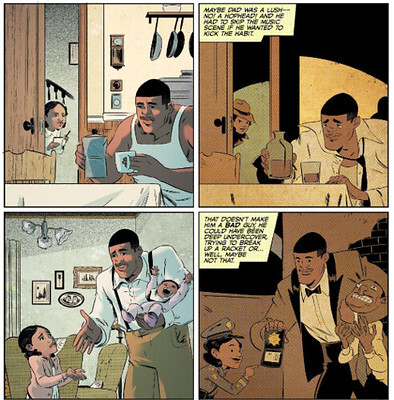
The fourth story is done as a noir and the style of the art with the many interrelated frames and the use of colors in that one is incredible too:
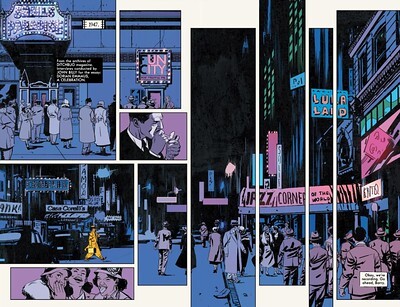
All in all, this is just a really fun and fascinating book that is perfect for music lovers, though anyone could really enjoy it. It did make me want to pick up my instruments the moment I’d set down the book though too.
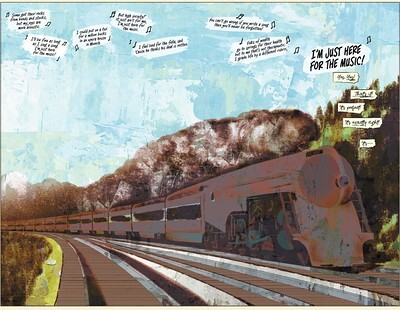
So follow the beat across the 20th century with Deep Cuts, a heartfelt and warm collection that is an astonishingly lovely variety of art and storytelling that captures the human spirit in its quest to make art. This collection could be enjoyed by anyone too, and while there is a bit of adult content its pretty tame and could be read by both teens and adults. So get in the groove with Deep Cuts.
4/5
Starving artists, youngsters looking for their first gig, long-time artists still looking for their big break, musicians who’ve given up the life, experimental artists, musicians on a downward spiral and more all populate the pages of the six stories in Deep Cuts. The tales move from New Orleans to Chicago in the days leading up to Black Tuesday, Kansas City in 1940, New York in 1956, LA in 1968 and then again in 1977, each with their own unique artistic style but all with a deep love of jazz and the people who move it or are moved by it. Included in this visual line-up are Danilo Beyruth, Helena Masellis, Diego Greco, Ramón Pérez, Juni Ba and Toby Cypress, with Igor Monti having provided the cover art for each individual issue as they were being released.
I really loved this and while, admittedly, some of the stories are better than others a lot of them hit hard. The first story would have made an excellent short story in just prose but the visuals really bring it to life.
And I can’t help but love all the various representations of the bands playing and how, despite moving across many years and into the era of electric instruments, there is still this central idea of jazz where you look at them and know “this is a jazz band”
1917
1968
1977
”Jazz is dead.”?
God, maybe. Jazz? No.
There is a real playfulness here too. We have stories of a journalist trying to recover from a bender getting lost in the world of jazz and art and flailing to comprehend their intentions, a woman determined to write the greatest jazz song ever in order to save her play, musicians on the wrong side of the law, or musicians struggling with band dynamics and nervous about going solo. The art matches these stories quite effectively, and I was particularly charmed by the story of the young girl who, hooked on detective comics, begins to tail her father thinking there must be some dark secret why he left the music world and settled down. It’s a rather heartwarming tale set during the Christmas season and the interplay of reality and her comic-book-imagery imagination is delightful:
The fourth story is done as a noir and the style of the art with the many interrelated frames and the use of colors in that one is incredible too:
All in all, this is just a really fun and fascinating book that is perfect for music lovers, though anyone could really enjoy it. It did make me want to pick up my instruments the moment I’d set down the book though too.
So follow the beat across the 20th century with Deep Cuts, a heartfelt and warm collection that is an astonishingly lovely variety of art and storytelling that captures the human spirit in its quest to make art. This collection could be enjoyed by anyone too, and while there is a bit of adult content its pretty tame and could be read by both teens and adults. So get in the groove with Deep Cuts.
4/5
December 3, 2024
Not all comic book heroes wear capes or shoot spider webs from their hands.
Some blow a horn or tinkle on piano keys and make the dance halls jump for joy.
This collection of six inter-linked sketches is dedicated to the masters of jazz, embracing almost a century of the musical development of the genre and its cross-country travels from one emblematic city to the next.
The writing is good, especially to those of us who are already jazz enthusiasts and familiar with its landmark changes in expression and with its greatest players. For the comic book lover, the greatest attraction was the experimental graphic style that changes with each sketch and showcases several less known but very talented artists.
What it Means
New Orleans, 1917
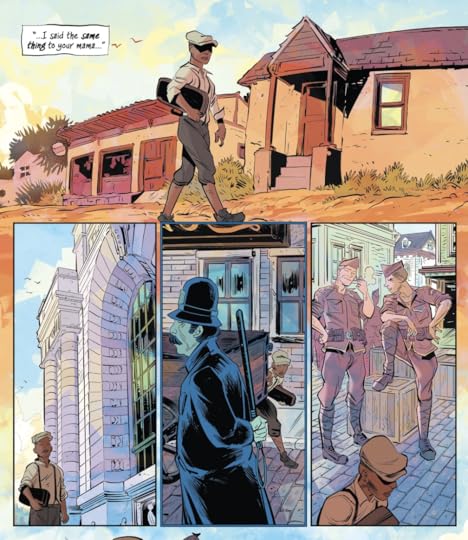
A teenage boy called Ace is stalking the streets of the ‘Vieux Carre’ at night, listening to ragtime / dixie bands and playing along on his clarinet. He eventually gets picked up by a band leader to play for customers in a brothel, but it is soon evident that the man is exploiting the boy and his talent. In the end, true talent shines through and the boy will play in a real ragtime band. Ace is also composing a tune he calls ‘The Ace-High Stomp’ for one of the girls who has been kind to him.
Sorry, But I Can’t Take You
Chicago, 1928
Gail Geldstein, a ‘lady composer’, tries to break into the Broadway men’s club with a new musical show. Her producer threatens to cut her show unless she comes up with a hit jazz tune in a couple of days. She goes to La Salle Street in search of inspiration.
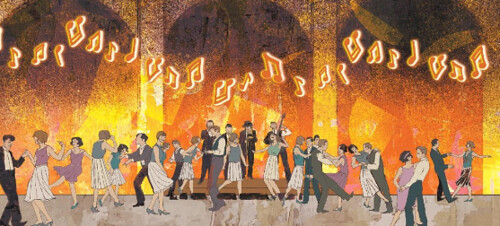
‘Jazz isn’t just notes on a page’ her friends tell her, then take her to Prohibition Era underground clubs where the real bands are playing.
She meets a black musician, and the discussion gets a bit too technical for me, but apparently Gail has once heard as a kid a New Orleans clarinet playing the most beautiful note she ever heard. The passion has been passed over from one generation to the next. Gail’s aspirations for a Broadway career are squashed, but her Chicago jam sessions produce the hit tune she was searching for, just not for her but for other singers. It’s called ‘I’m Just Here for the Music’.
K. C. Blues
Kansas City, 1940
A young girl reads adventure comics under her blanket by lantern light, as her father comes in late at night from work. Otis used to be a popular bass player in clubs, but now he stays home with his wife, babysitting their new kid, doing housework and trying to make ends meet.
His old pals are asking him to come back and help them in a new band, while his imaginative older daughter tries to find out why he quit music in the first place. In the end, Otis must once again choose between a loving but struggling family life and a musical career.
Blue Notes
New York City, 1956
Synesthesia, mixing the colours of be-bop and cool jazz, with drug induced depression and a once stellar career for horn player Dorian Emmaus is presented here in a series of interviews with the people who knew him. ‘Sometimes you just need a happy song’ writes a friend who gives Dorian the chance of a come back with the tune ‘Acai Berry’, a song that includes musical themes from the earlier sketches.
Seeking // Secrets
Los Angeles, 1968
Journalist Hudson is hung over from a drunken party at his boss and late at his job the next day. He gets assigned to write up about a free jazz musician who is touring in town. Hudson hates experimental jazz and sees this as a punishment for dancing on his boss’s expensive Japanese table.
Hudson quarrels with musician Adler Burns who tells him that all the answers to the reporter’s questions have been given with his live music. Instead of giving up, Hudson buys all the Burns records and several books on jazz history and bunkers down in his pad, searching for inspiration... which comes when the music critic accidentally starts listening to the music while high on LSD.
Some existentialist questions soon arise about art and life and critics.
The Great Unknown
Worldwide, 1977
Where do we go from here? Jazz has been hijacked by disco and pop tunes, years later by New Age and easy listening. Barry, one of the most popular and in demand musicians, leaves on a world tour with a hit dance tune but gets depressed at his own lack of musical integrity.
Barry and his band will try to reconnect with the past with the help of the tunes already mentioned in previous episodes. Django Reinhardt has a cameo panel.
Jazz is alive and constantly evolving. It survives today because it has such strong roots, because of such landmark cuts / recordings as those showcased in here.
>>><<<>>><<<
I had a great time with these stories as I re-read them for this review, written a couple of months after my first read through. I am struggling to catch up on my reviews before year end, and this is why I did not include my usual panel captures for comic write-ups. But believe me, the artwork is just as good as the writing in this one.

June 26, 2024
Jazz is music, but it's also a representation of freedom, hope and feeling. In this episodic graphic novel, Higgins and Clark explore what exactly that means from various perspectives.
Deep Cuts is a collection of six short stories, all set in the United States of the 20th-century. We meet a sophisticated author of Broadway shows, a young boy in New Orleans hoping to make it big and a struggling band touring in the 70s. Each chapter presents us with a new set of characters and a different set of characters, though if you pay close attention there are parallels drawn between the stories.
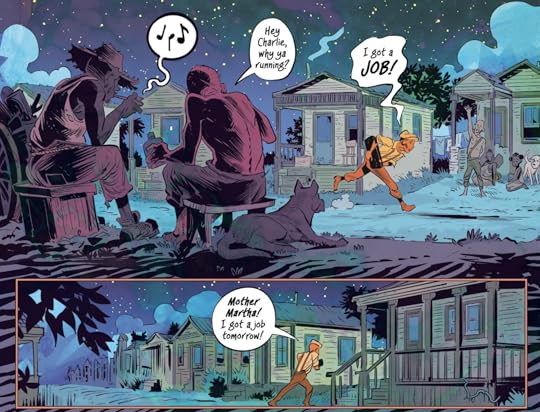
I enjoyed the variety – both narratively as well as visually. The first volume is an absolute stunner: it's set in 1917 and introduces us to the young boy who goes by the name Ace and who wants to play Jazz music more than anything else in his life. I loved both the story (though a little clichéd) as well as the absolutely stunning art style: gorgeous colours and almost cinematic frames it manages to add a lot of heart to a story this short. I was almost disappointed when I realised that we wouldn't be making a return to this world that had just opened up to me going forwards.
But the other stories had their charm as well – even though to varying degrees. While I thought half of the six chapters were strong and hard-hitting for different reasons (one touching, one sweet and the other sad), the other half felt a little undercooked to me or weren't able to really stick to me the same way. I appreciated the mix overall though and there's enough here for you to not get bored even if you aren't able to connect with one particular chapter.
Jazz is alive – ever-growing and ever-changing. What stays is the overarching feeling that Jazz is more than just the notes you play. I also enjoyed that at the end of each chapter, the author introduces us to a particular jazz musician that is either a friend of his or made an impact on him and includes sheet music of a piece of theirs, which is such a cool way not only to support pals, but also to draw the bridge to present day.
So while I didn't love all of this, it certainly was a pleasant read and something I'd recommend to anyone who appreciates a bit of jazz in their life!
Deep Cuts is a collection of six short stories, all set in the United States of the 20th-century. We meet a sophisticated author of Broadway shows, a young boy in New Orleans hoping to make it big and a struggling band touring in the 70s. Each chapter presents us with a new set of characters and a different set of characters, though if you pay close attention there are parallels drawn between the stories.
I enjoyed the variety – both narratively as well as visually. The first volume is an absolute stunner: it's set in 1917 and introduces us to the young boy who goes by the name Ace and who wants to play Jazz music more than anything else in his life. I loved both the story (though a little clichéd) as well as the absolutely stunning art style: gorgeous colours and almost cinematic frames it manages to add a lot of heart to a story this short. I was almost disappointed when I realised that we wouldn't be making a return to this world that had just opened up to me going forwards.
But the other stories had their charm as well – even though to varying degrees. While I thought half of the six chapters were strong and hard-hitting for different reasons (one touching, one sweet and the other sad), the other half felt a little undercooked to me or weren't able to really stick to me the same way. I appreciated the mix overall though and there's enough here for you to not get bored even if you aren't able to connect with one particular chapter.
Jazz is alive – ever-growing and ever-changing. What stays is the overarching feeling that Jazz is more than just the notes you play. I also enjoyed that at the end of each chapter, the author introduces us to a particular jazz musician that is either a friend of his or made an impact on him and includes sheet music of a piece of theirs, which is such a cool way not only to support pals, but also to draw the bridge to present day.
So while I didn't love all of this, it certainly was a pleasant read and something I'd recommend to anyone who appreciates a bit of jazz in their life!

December 28, 2025
This slice anthology doubles a love letter to the history of jazz and it's history. The six loosely connected stories herein take place at different points of the 1900s and all have to do with how jazz has impacted each of the main characters and what the genre means to them. Some for the better and some for the worse.
The writing for the most part is good, but I wasn't always a fan of the artwork. If you're not familiar with jazz, you may be a little bit lost. If you're a fan or passionate about music, I would give it a try.
My thanks to the publisher and NetGalley for gifting me a digital copy of this book. My opinions are my own.
The writing for the most part is good, but I wasn't always a fan of the artwork. If you're not familiar with jazz, you may be a little bit lost. If you're a fan or passionate about music, I would give it a try.
My thanks to the publisher and NetGalley for gifting me a digital copy of this book. My opinions are my own.

May 25, 2024
Deep Cuts is a fantastic experience as the creative team dwells deep into the history of Jazz music and brilliantly illustrated slice-of-life story that captures the coming-of-age lessons of a musician trying to find their way in the world with talent, wit, and the weight of family legacy to guide them. Deep Cuts has been a wonderful series. From beginning to end each story has its own merits and I've really enjoyed reading these Deep Cuts stories and am kind of sad that the series has to end.

July 14, 2025
de belles histoires d'amour du jazz

July 1, 2024
How do you write the story of American Jazz without writing about the story of the Black American experience? You don't.
What this book does do, however is keep the music at the forefront of the story. We could so easily have been lost in the story of who's allowed to drink where, of why Black Artists often recorded under pseudonyms, of Civil Rights Movements. Instead we're in the room with the individuals finding their sound, hoping for their big break.
Like the sounds of the jazz, there's such a mix of emotions it almost all comes out bittersweet. Not everyone makes the big time, some fade to obscurity, while others are remembered for generations. But to there is still a sweetness, there's a certain contentment in all outcomes.
To quote the obvious with a comic book, we're reading the story but also seeing it. By which I mean the art styles of the artists match harmoniously with the story. They flow into each other so well, it felt so good reading the stories with era appropriate soundtracks. From the wavy lines of late 20th century jazz fusion all the way back to the warm colours and beautiful patrons of French Quarter New Orleans. Every single artist understood the brief and put out some of their best work in this book.
What this book does do, however is keep the music at the forefront of the story. We could so easily have been lost in the story of who's allowed to drink where, of why Black Artists often recorded under pseudonyms, of Civil Rights Movements. Instead we're in the room with the individuals finding their sound, hoping for their big break.
Like the sounds of the jazz, there's such a mix of emotions it almost all comes out bittersweet. Not everyone makes the big time, some fade to obscurity, while others are remembered for generations. But to there is still a sweetness, there's a certain contentment in all outcomes.
To quote the obvious with a comic book, we're reading the story but also seeing it. By which I mean the art styles of the artists match harmoniously with the story. They flow into each other so well, it felt so good reading the stories with era appropriate soundtracks. From the wavy lines of late 20th century jazz fusion all the way back to the warm colours and beautiful patrons of French Quarter New Orleans. Every single artist understood the brief and put out some of their best work in this book.

August 21, 2024
This was an interesting read. I liked it. I feel like I missed a lot because I don't have a jazz history background, but I was still able to appreciate the different stories. I love how they connected (even if it took me a while to figure that out). I would have preferred a more clear history lesson in jazz but this was still fun.

March 24, 2025
A nearly perfect comic book! I love anthologies because each story is effectively an "A-plot" with very little room for B-plots, runners, or random clutter that creeps into ordinary comic series. Higgins and Clark write very well with a diverse cast of characters drawing from real-life inspiration. I would say this book is to the history of jazz what Kavalier and Clay was to the history of comics. Each story has its own artist to give it a distinct feel for the character, time, and setting. Will definitely be returning to this book in the future!
June 23, 2024
What a great collection. Loved how the stories connected, but not in overly obvious ways, and the artwork was phenomenal. Would give it an extra star if I could just for including lead sheets in the back.
July 1, 2024
Awesome and beautiful
I hunt for comics like this every day but have trouble finding them. Wish there were comics with something to say about life and the human spirit.
I hunt for comics like this every day but have trouble finding them. Wish there were comics with something to say about life and the human spirit.

July 4, 2024
Sings.

April 25, 2023
I received an advanced copy of this and I’m not normally one for a story about musicians (despite having been a professional musician for a decade) but I loved this comic. Deep Cuts, which hits stands April 26, tells the story of a teen boy nicknamed Ace in 1917 New Orleans. Orphaned by his parents, all Ace wants is to do is play clarinet in a jazz band. When a prominent local jazz musician notices him and starts giving him work, Ace finds out that the life of a gigging musician isn’t all parties and money. It’s a cut throat world filled with disappointment and betrayal, but also joyous moments of aural pleasure. It’s a great oversized story and one I’d say every young musician should read (but I’m gonna rate this as a teens and up comic due to the brunt of Ace’s gigs taking place in a brothel.) But musicians and anyone with a desire for creativity needs to read this great little story about how we use art to find our way through tough times. Thumbs way up.

July 21, 2024
A lovely little anthology about Jazz and the way that it impacts and moves people throughout the decades. It was arguably less sentimental than I had hoped. Although, it never felt cloying or heavy handed either. Solid read.
August 23, 2024
Wonderful anthology series revolving round jazz, clearly a labour of love.
Once of the best books of 2023. All 5 stories are top quality. Great characters, dialogue. Abundance of passion, knowledge and heart.
Once of the best books of 2023. All 5 stories are top quality. Great characters, dialogue. Abundance of passion, knowledge and heart.

May 1, 2023
Wow! I really loved this! Incredible art! Wonderful story telling!
November 12, 2025
My thanks to NetGalley and Image Comics for an advance copy of this graphic novel that uses the history of an music genre to highlight the lives, loves, ups and downs of various musicians, performers, and aficionados all with a color and soundtrack that is uniquely jazz.
For a Bronx Irish Catholic my father had a distinctly bohemian streak. Not beatnik, though he did rock facial hair way before it was acceptable, my father just had a lot of interests. Books outside the mainstream, movies that were banned by the Catholic church. A love of comics that continued well into adulthood. And jazz. I can remember some jazz playing in my youth, but most of our music was AM radio staples. I came to jazz after college, and began to listen to the albums my father still had, but one's he had not listened to in years and years. We never really discussed what drew Dad to jazz, nor what drew jazz to me. I liked the music, the way it felt in my ears, and my brain, not so much vocalists as the music, hard bop bebop, electic, acoustic and well just Miles Davis. As a comic book reader I have read a few graphic novels that use jazz as their subject matter be it fiction, nonfiction, or just out there speculative gonzo stories. None have really captured what makes jazz, well jazz. Until this title. Deep Cuts is written by Kyle Higgins, with art from a panoply of artists Joe Clark, Danilo Beyruth, Helena Masellis, Diego Greco, Ramon Pérez, Juni Ba, Toby Cypress and tells the story of this unique American art form, through the lives of those who play, sing, write, listen and are effected and affected by the music that is jazz.
The book is told in six chapter, each from different time periods and telling a story linked by a song, a player, and how that music makes people free. In 1917 a young man finally meets the person whose music means so much to him, but finds that sometimes are heroes are awful people. Ten years later a woman trying to make her way on Broadway runs into problems when the play she is working on is not so hot, but that all could be changed if she can just find the right song. It is 1940 and a promising bass player is trying to give up music and take care of his family, something that is getting harder and harder to do, as music keeps pulling at him, while his daughter wonders how one can give up a dream. Three other stories follow, all sharing bits with each others, of songs sung,the legacy of music, and how hard being a creative person can be.
I have a read a few graphic novels about jazz, mostly biographical or historical. This one gets not only the historical right, but does not lose sight of the people who play music. Art comes from a life that is being lived, or that dreams of something better for all of humanity. Which comes across on these pages. Kyle Higgins has long been a writer of graphic novels that I have enjoyed. Higgins is a very good writer, who can create characters readers want to like, and want to root for. Or in some cases boo at. The story is good and can be enjoyed for that reason, but the history that Higgins is covering is also quite good, and the balance of the two makes for good reading. Added to this is the art, which fit each story perfectly. A mix of cartoony when needed, realistic when necessary, but also an apt fit where needed. Most anthology stores have a story that sometimes seems shoehorned in. Not this one. A really solid story, that looks beautiful.
A book for people who love graphic novels, for both story and art, with all that jazz. One of my favorite graphic novels, and one that makes me excited for the medium, and to see what Kyle Higgins might be working on next.
For a Bronx Irish Catholic my father had a distinctly bohemian streak. Not beatnik, though he did rock facial hair way before it was acceptable, my father just had a lot of interests. Books outside the mainstream, movies that were banned by the Catholic church. A love of comics that continued well into adulthood. And jazz. I can remember some jazz playing in my youth, but most of our music was AM radio staples. I came to jazz after college, and began to listen to the albums my father still had, but one's he had not listened to in years and years. We never really discussed what drew Dad to jazz, nor what drew jazz to me. I liked the music, the way it felt in my ears, and my brain, not so much vocalists as the music, hard bop bebop, electic, acoustic and well just Miles Davis. As a comic book reader I have read a few graphic novels that use jazz as their subject matter be it fiction, nonfiction, or just out there speculative gonzo stories. None have really captured what makes jazz, well jazz. Until this title. Deep Cuts is written by Kyle Higgins, with art from a panoply of artists Joe Clark, Danilo Beyruth, Helena Masellis, Diego Greco, Ramon Pérez, Juni Ba, Toby Cypress and tells the story of this unique American art form, through the lives of those who play, sing, write, listen and are effected and affected by the music that is jazz.
The book is told in six chapter, each from different time periods and telling a story linked by a song, a player, and how that music makes people free. In 1917 a young man finally meets the person whose music means so much to him, but finds that sometimes are heroes are awful people. Ten years later a woman trying to make her way on Broadway runs into problems when the play she is working on is not so hot, but that all could be changed if she can just find the right song. It is 1940 and a promising bass player is trying to give up music and take care of his family, something that is getting harder and harder to do, as music keeps pulling at him, while his daughter wonders how one can give up a dream. Three other stories follow, all sharing bits with each others, of songs sung,the legacy of music, and how hard being a creative person can be.
I have a read a few graphic novels about jazz, mostly biographical or historical. This one gets not only the historical right, but does not lose sight of the people who play music. Art comes from a life that is being lived, or that dreams of something better for all of humanity. Which comes across on these pages. Kyle Higgins has long been a writer of graphic novels that I have enjoyed. Higgins is a very good writer, who can create characters readers want to like, and want to root for. Or in some cases boo at. The story is good and can be enjoyed for that reason, but the history that Higgins is covering is also quite good, and the balance of the two makes for good reading. Added to this is the art, which fit each story perfectly. A mix of cartoony when needed, realistic when necessary, but also an apt fit where needed. Most anthology stores have a story that sometimes seems shoehorned in. Not this one. A really solid story, that looks beautiful.
A book for people who love graphic novels, for both story and art, with all that jazz. One of my favorite graphic novels, and one that makes me excited for the medium, and to see what Kyle Higgins might be working on next.

October 30, 2025
Deep Cuts is a series of six visually rich historical fiction stories that interconnect to explore the history of Jazz in the United States. Each of the collected issues in this single volume looks at a specific time period, following a character through a pivotal life moment or process of discovery. Higgins is best known for his work with superhero tales (Radiant Black, Nightwing and The Power Rangers), worked with co-writer (and composer, arranger and trumpeter) Joe Clark and a diverse range of talent artists bring to create this mini series.
Deep Cuts opens in 1917 New Orleans where young Charlie is desperate to find somewhere he can play his clarinet, and falls in with the fast talking and spirited Jack who connects him to a job performing in the bar of a Whore house. Here Charlie learns to play and forms friendships with those working and tries to live up to the memories of his musician father. Lessons are learned and the narrative closes with debts paid, one way or the other.
This first issue sets the theme for the following stories, we are quickly introduced to the central character and the struggle or issue they are attempting to overcome. Sometimes they are collapsed in a short period of time, while others play out over months or years.
We focused on Charlie in 1917 for issue 1. Story 2 visits Chicago in 1928 where Gail is desperate to write her best song ever, in the hopes of having a hit. Chapter 3, my favorite, moves to Kansas City in 1940 where we see Alice and her newly enlarged family struggle to keep up and mange school and work as the winter holidays approach. Chapter 4 takes place in 1956, NYC and has a much different tone from the other entries. This one plays out through snippets from interviews and is much less straightforward. It tells the story of a talented but troubled musicians and the one record he was able to make. Chapter five sees the 1960s via Los Angeles in a very Peter Bagge Hate Comics style. It follows a past his prime writer and critic Hudson forced to cover the acid jazz scene where he struggles to make sense of it. The last story focuses on a successful touring band on the brink of something more in 1977, but they're falling apart.
The stories are well told, but mostly have safe and pat endings. A bonus is the sheet music for music for each issue, expanding beyond just the written page. If anything is lacking, it would be the why. Or something from the writers about why two white guys were the best people to tell this story and what their research process was or even the key figures they sought to emulate or share a twist on their story. There is some reference to the issues of race in American history, but it is far from the focus, they often come out in sub-themes. (For example Alice and her family need to use a Green book to find a hotel, but its assumed the reader will know what that is and why the family needs to use it).
The art is overall wonderful and having a different lead artist for each issue really helps differentiate the separate stories. Most use a very realistic style, one or two are more cartoon-y.
Recommended to readers of music history, graphic novels or interconnected stories.
I received a free digital version of this book via NetGalley thanks to the publisher.
Deep Cuts opens in 1917 New Orleans where young Charlie is desperate to find somewhere he can play his clarinet, and falls in with the fast talking and spirited Jack who connects him to a job performing in the bar of a Whore house. Here Charlie learns to play and forms friendships with those working and tries to live up to the memories of his musician father. Lessons are learned and the narrative closes with debts paid, one way or the other.
This first issue sets the theme for the following stories, we are quickly introduced to the central character and the struggle or issue they are attempting to overcome. Sometimes they are collapsed in a short period of time, while others play out over months or years.
We focused on Charlie in 1917 for issue 1. Story 2 visits Chicago in 1928 where Gail is desperate to write her best song ever, in the hopes of having a hit. Chapter 3, my favorite, moves to Kansas City in 1940 where we see Alice and her newly enlarged family struggle to keep up and mange school and work as the winter holidays approach. Chapter 4 takes place in 1956, NYC and has a much different tone from the other entries. This one plays out through snippets from interviews and is much less straightforward. It tells the story of a talented but troubled musicians and the one record he was able to make. Chapter five sees the 1960s via Los Angeles in a very Peter Bagge Hate Comics style. It follows a past his prime writer and critic Hudson forced to cover the acid jazz scene where he struggles to make sense of it. The last story focuses on a successful touring band on the brink of something more in 1977, but they're falling apart.
The stories are well told, but mostly have safe and pat endings. A bonus is the sheet music for music for each issue, expanding beyond just the written page. If anything is lacking, it would be the why. Or something from the writers about why two white guys were the best people to tell this story and what their research process was or even the key figures they sought to emulate or share a twist on their story. There is some reference to the issues of race in American history, but it is far from the focus, they often come out in sub-themes. (For example Alice and her family need to use a Green book to find a hotel, but its assumed the reader will know what that is and why the family needs to use it).
The art is overall wonderful and having a different lead artist for each issue really helps differentiate the separate stories. Most use a very realistic style, one or two are more cartoon-y.
Recommended to readers of music history, graphic novels or interconnected stories.
I received a free digital version of this book via NetGalley thanks to the publisher.

January 19, 2026
My Selling Pitch:
A historical graphic novel of interconnected standalone short stories about fictional musicians.
Pre-reading:
Love a graphic!
(obviously potential spoilers from here on)
Thick of it:
Love the art style and color of this!
These are great! I don’t know any of the historical figures they’re mentioning, but the graphic novel is a lot of fun. (They are fictional characters.)
Oh, it’s fun that it’s a short story collection and it switches up the art.
A me!
The art in this is beyond gorgeous.
The yellow colorwork is so good!
The interview is losing me. Idk who’s who and who’s speaking anymore.
This style reminds me of the Dexter cartoon.
I don’t love the art in this last one. There’s something uncanny Valley about it, and the people are looking creepy.
Post-reading:
The first story was definitely the strongest, and then they just kept getting weaker. The interview stories really lost me. It was hard to keep straight who was talking and why they were relevant. I like that the last story tied the whole collection together. I don't have much knowledge of history, and I really don't know music, so there might be more to appreciate here if you're already familiar, but from the outside looking in, the book kept reading like I should know who all these big influential players were, but from my understanding, they're all fictional. There's no influence on the music scene to know. They didn't exist.
This collection has some gorgeous artwork. It's worth flipping through just to appreciate the different art styles and stunning colorwork.
I don't think you need to rush out and read this, but I don't think you'll regret your time if you do pick it up.
Who should read this:
Music history fans
Heavily stylized graphic novel fans
Ideal reading time:
Anytime
Do I want to reread this:
No, I'll remember it.
Would I buy this:
I wouldn't turn down a copy, but I think this is a good one to get from your library.
Similar books:
* Groupies by Helen Mullane-graphic novel, historical, paranormal thriller, queer
* Blacksad by Juan Diaz Canales-graphic novel, historical, noir detective
Thank you to Netgalley and the publisher for a copy of this book in exchange for an honest review.
A historical graphic novel of interconnected standalone short stories about fictional musicians.
Pre-reading:
Love a graphic!
(obviously potential spoilers from here on)
Thick of it:
Love the art style and color of this!
These are great! I don’t know any of the historical figures they’re mentioning, but the graphic novel is a lot of fun. (They are fictional characters.)
Oh, it’s fun that it’s a short story collection and it switches up the art.
A me!
The art in this is beyond gorgeous.
The yellow colorwork is so good!
The interview is losing me. Idk who’s who and who’s speaking anymore.
This style reminds me of the Dexter cartoon.
I don’t love the art in this last one. There’s something uncanny Valley about it, and the people are looking creepy.
Post-reading:
The first story was definitely the strongest, and then they just kept getting weaker. The interview stories really lost me. It was hard to keep straight who was talking and why they were relevant. I like that the last story tied the whole collection together. I don't have much knowledge of history, and I really don't know music, so there might be more to appreciate here if you're already familiar, but from the outside looking in, the book kept reading like I should know who all these big influential players were, but from my understanding, they're all fictional. There's no influence on the music scene to know. They didn't exist.
This collection has some gorgeous artwork. It's worth flipping through just to appreciate the different art styles and stunning colorwork.
I don't think you need to rush out and read this, but I don't think you'll regret your time if you do pick it up.
Who should read this:
Music history fans
Heavily stylized graphic novel fans
Ideal reading time:
Anytime
Do I want to reread this:
No, I'll remember it.
Would I buy this:
I wouldn't turn down a copy, but I think this is a good one to get from your library.
Similar books:
* Groupies by Helen Mullane-graphic novel, historical, paranormal thriller, queer
* Blacksad by Juan Diaz Canales-graphic novel, historical, noir detective
Thank you to Netgalley and the publisher for a copy of this book in exchange for an honest review.

November 11, 2025
Deep Cuts is a collection of six short stories, all about Jazz. They all seem to have different art-styles, but still form somewhat of an unity. They aren’t all of the same level, but I enjoyed them none-the-less.
All six stories were strong, both in art-work and narrative. The storylines flowed pretty well together. Though, I can’t help but think I would have liked Deep Cuts better if the art work was a little more consistent. The variety is nice, but it just pulls me out of the story a little bit if I need to get adjusted to a new art style six times in a row. I think the last story had my least favourite art style, it felt a little wonky.
Even though these are short stories, the characters do not feel one-dimensional. Each one has some depth in them, for as far as that is possible in a few pages. They feel like people, instead of comic book characters. Not all six stories are equally strong with this, but they all have their own charm.
My favourites were the 1st one and the 3rd. They just had so much soul, and the art-style was easier on the eyes than the other four. Doesn’t mean the other four weren’t good, but they were just a little less good. My least favourite one was the 4th. I just didn’t feel it, sadly enough. It wasn’t bad, but it wasn’t amazing either. The story-telling was pretty good over all six comics, there isn’t one that is truly bad. It was a enjoyable read for sure. I feel like I know more about jazz now than I did before reading Deep Cuts.
One thing I really loved about all six comics, was how they came together in the last one. It might not be my favourite art-style wise, but I loved how it wrapped up all of the story lines!
Definitely a comic worth reading! It is a pretty quick read, you can do it in a single evening if you set your mind to it. And if you don’t have as much time, you can go for one story a night. It’s the perfect relaxation comic for just before bedtime!
Disclaimer:
Thank you to NetGalley and the publisher for the opportunity to read this ARC in exchange for a honest review.
All six stories were strong, both in art-work and narrative. The storylines flowed pretty well together. Though, I can’t help but think I would have liked Deep Cuts better if the art work was a little more consistent. The variety is nice, but it just pulls me out of the story a little bit if I need to get adjusted to a new art style six times in a row. I think the last story had my least favourite art style, it felt a little wonky.
Even though these are short stories, the characters do not feel one-dimensional. Each one has some depth in them, for as far as that is possible in a few pages. They feel like people, instead of comic book characters. Not all six stories are equally strong with this, but they all have their own charm.
My favourites were the 1st one and the 3rd. They just had so much soul, and the art-style was easier on the eyes than the other four. Doesn’t mean the other four weren’t good, but they were just a little less good. My least favourite one was the 4th. I just didn’t feel it, sadly enough. It wasn’t bad, but it wasn’t amazing either. The story-telling was pretty good over all six comics, there isn’t one that is truly bad. It was a enjoyable read for sure. I feel like I know more about jazz now than I did before reading Deep Cuts.
One thing I really loved about all six comics, was how they came together in the last one. It might not be my favourite art-style wise, but I loved how it wrapped up all of the story lines!
Definitely a comic worth reading! It is a pretty quick read, you can do it in a single evening if you set your mind to it. And if you don’t have as much time, you can go for one story a night. It’s the perfect relaxation comic for just before bedtime!
Disclaimer:
Thank you to NetGalley and the publisher for the opportunity to read this ARC in exchange for a honest review.
December 1, 2025
Deep Cuts is an ode to Jazz. It is beautifully illustrated drawing inspiration directly from each story’s respective timeline. We are transported to different cities who pioneered some of the most intimate music scenes such as New Orleans, Chicago, and New York. This comic's unique overall Jazz theme carried with it dreamers holding on to a feeling. We quickly come to recognize early on “It's a different beauty, making music as an experience. Music that you can never quite pin down perfectly on paper. Living life that way, living a whole series of those special, imperfect moments…..Well there's no words for it”.
As someone who doesn’t usually gravitate towards comics or graphic novels, I really enjoyed this collection. Maybe I am slightly biased as a Jazz lover but I could feel the energy and hear the notes in some of the earlier stories. I loved Part 3 which is taken in Kansas City and is shown through the eyes of an imaginative young girl curious about her father’s origin story. It reminded me that a dream shouldn’t die when it has the opportunity to pivot. I also really appreciated the details in the color themes such as found in Part 4. I could almost feel the unspoken chill on the Manhattan streets and smell the cigarette and leather wrapping the club scene inside. I did feel like the overall art style could have been mildly tweaked as the eras changed instead of a dramatic art jump as seen in Part 2 or 5. However, I do respect the need for the change in direction and felt the writer and illustrator worked well together. Overall this collection inspired me to step outside of my comfort zone in the future.
As someone who doesn’t usually gravitate towards comics or graphic novels, I really enjoyed this collection. Maybe I am slightly biased as a Jazz lover but I could feel the energy and hear the notes in some of the earlier stories. I loved Part 3 which is taken in Kansas City and is shown through the eyes of an imaginative young girl curious about her father’s origin story. It reminded me that a dream shouldn’t die when it has the opportunity to pivot. I also really appreciated the details in the color themes such as found in Part 4. I could almost feel the unspoken chill on the Manhattan streets and smell the cigarette and leather wrapping the club scene inside. I did feel like the overall art style could have been mildly tweaked as the eras changed instead of a dramatic art jump as seen in Part 2 or 5. However, I do respect the need for the change in direction and felt the writer and illustrator worked well together. Overall this collection inspired me to step outside of my comfort zone in the future.

December 27, 2025
From the smoke-filled clubs of 1917 New Orleans to the neon glow of 1968 Los Angeles, Deep Cuts is inspired by true events and follows the trailblazers who bled for the music that moved their souls. Each chapter riffs off the last—musicians trading melodies across generations, shaping and echoing one another’s lives in a grand composition of rhythm, risk, and revelation culminating in one soulful crescendo. Deep Cuts introduces readers to the shared, “found family” legacy that is built note-by-note, bar-by-bar, into a song that never ends for those who know that good music never dies.
A chronological history of jazz music in America told from the views of 6 different artist at different moments in history.
The first story is moving to the point to make you cry for many reasons as well as cheer for our protagonist. As we move through the volumes you see how each build off the other as the past touches whatever time we are in as the beauty and legend of jazz grows.
The art itself is as gorgeous as the music it tells of.
Highly recommended. This wasnpublishednover a year ago but don't let that deter you from checking it out. The history is timeless.
Thanks to @netgalley and Image Comics for the opportunity to read this eArc in exchange for my honest and unbiased opinion.
A chronological history of jazz music in America told from the views of 6 different artist at different moments in history.
The first story is moving to the point to make you cry for many reasons as well as cheer for our protagonist. As we move through the volumes you see how each build off the other as the past touches whatever time we are in as the beauty and legend of jazz grows.
The art itself is as gorgeous as the music it tells of.
Highly recommended. This wasnpublishednover a year ago but don't let that deter you from checking it out. The history is timeless.
Thanks to @netgalley and Image Comics for the opportunity to read this eArc in exchange for my honest and unbiased opinion.

October 30, 2025
“Deep Cuts” is the story of Jazz told throughout the generations. Each chapter is a different time period with different artists. Each unique in their style and the writing of the story in each chapter matches.
My favorite art was the second chapter. I loved the period of time, style, dress, and how the art reflected it. Love the reference to the Jack Benny “Your money or your life.” reference. Pure gold.
There is some language and drug and alcohol use. So just know that going in.
Great story and how it all weaves together. The ending panel is perfect. And an added bonus is you can go to your favorite streaming site and hear an original song written by Joe Clark, one of the authors of this graphic novel. It is the song that chapter 2 revolves around, “I’m Just Here for the Music”.
I received this ARC from NetGalley and the publisher in exchange for an unbiased review.
My favorite art was the second chapter. I loved the period of time, style, dress, and how the art reflected it. Love the reference to the Jack Benny “Your money or your life.” reference. Pure gold.
There is some language and drug and alcohol use. So just know that going in.
Great story and how it all weaves together. The ending panel is perfect. And an added bonus is you can go to your favorite streaming site and hear an original song written by Joe Clark, one of the authors of this graphic novel. It is the song that chapter 2 revolves around, “I’m Just Here for the Music”.
I received this ARC from NetGalley and the publisher in exchange for an unbiased review.
October 30, 2025
This graphic novel absolutely blew me away.
Deeps Cuts is an anthology that guides us through the legacy and evolution of Jazz in the United States. It follows several musicians through the decades, showcasing the effect their art had on not only themselves and those around them, but those that came after and the entire art form as a whole.
The story here is incredible, the art is absolutely stunning, and the colors are so thoroughly entwined with both of them at times that it's truly jaw-dropping. The love and passion for both Jazz and comics as an art form bleeds through every single page.
It's no exaggeration when I say this is one of my favorite graphic novels that I've ever read. Do yourself a favor and pick this one up.
Thank you to NetGalley and Image Comics for the review copy!
Deeps Cuts is an anthology that guides us through the legacy and evolution of Jazz in the United States. It follows several musicians through the decades, showcasing the effect their art had on not only themselves and those around them, but those that came after and the entire art form as a whole.
The story here is incredible, the art is absolutely stunning, and the colors are so thoroughly entwined with both of them at times that it's truly jaw-dropping. The love and passion for both Jazz and comics as an art form bleeds through every single page.
It's no exaggeration when I say this is one of my favorite graphic novels that I've ever read. Do yourself a favor and pick this one up.
Thank you to NetGalley and Image Comics for the review copy!

November 2, 2025
Big thanks to Image Comics and NetGalley for the ARC of Deep Cuts!
This anthology is a smooth, soulful tribute to jazz and storytelling — part time capsule, part jam session. Each issue feels like a new song, full of emotion and rhythm, and the first three stories absolutely hit all the right notes. The characters, the art, and the atmosphere all come together like instruments in perfect sync.
One line that really stuck with me was:
“Look around. This moment, everything you see, it’s already gone. The moment has passed. We can’t control that. And that’s okay.”
That quote sums up the tone of Deep Cuts beautifully — nostalgic, bittersweet, and quietly profound. The book captures fleeting moments, just like good jazz does, and leaves you both satisfied and wanting an encore.
A stylish, heartfelt read that proves comics can swing just as hard as music.
This anthology is a smooth, soulful tribute to jazz and storytelling — part time capsule, part jam session. Each issue feels like a new song, full of emotion and rhythm, and the first three stories absolutely hit all the right notes. The characters, the art, and the atmosphere all come together like instruments in perfect sync.
One line that really stuck with me was:
“Look around. This moment, everything you see, it’s already gone. The moment has passed. We can’t control that. And that’s okay.”
That quote sums up the tone of Deep Cuts beautifully — nostalgic, bittersweet, and quietly profound. The book captures fleeting moments, just like good jazz does, and leaves you both satisfied and wanting an encore.
A stylish, heartfelt read that proves comics can swing just as hard as music.

December 1, 2025
Thank you to NetGalley for my Advanced Reader's Copy of this book.
I realize that this book was written over a year and a half ago (I have no idea why it was available as an ARC for 1.5 years after publication) but I have to review it. It is rare for me to give 5 stars for a comic but this one earned it. A chronological history of jazz music in the United States told from the perspectives of 6 different individuals at different times, I was drawn in from the first story and only put it down to sleep. Once I woke up, I promptly picked it back up. While telling the story of jazz, the writers and illustrators also show the social climate of the times, what different people from different places and backgrounds experienced and what trouble they faced. I highly recommend.
I realize that this book was written over a year and a half ago (I have no idea why it was available as an ARC for 1.5 years after publication) but I have to review it. It is rare for me to give 5 stars for a comic but this one earned it. A chronological history of jazz music in the United States told from the perspectives of 6 different individuals at different times, I was drawn in from the first story and only put it down to sleep. Once I woke up, I promptly picked it back up. While telling the story of jazz, the writers and illustrators also show the social climate of the times, what different people from different places and backgrounds experienced and what trouble they faced. I highly recommend.

May 8, 2026
"Deep Cuts" is a bold and beautiful story that celebrates and explores the origins and history of Jazz. The book loosely ties together characters and events from across the twentieth century in a tribute to the art form and the musicians, known and unknown, who drove its creation and growth. The strong story telling, multiple points of view and varied and visually stunning imagery featured in this book should captivate most readers and create a memorable and moving experience.
Thanks to NetGalley and the publisher, Image Comics for providing me with a DRC in exchange for my honest review.
Thanks to NetGalley and the publisher, Image Comics for providing me with a DRC in exchange for my honest review.

August 2, 2026
I liked this very much! Great and varied art and the interconnected stories were solid if occasionally a little bit hard to follow (the one with the interview framework was oddly convoluted but ultimately fine!) and I did tear up at the end when it really circled back to the beginning. So much of making art is, in many ways, about remembrance and the desire to be remembered is so lovingly, embarrassingly human, and this was a clever and lovely way to see that play out.

December 5, 2025
The art is so incredibly beautiful . I enjoyed reading all of the volumes! The one that took my heart had to be the first one! I don't know much about jazz history, and in general jazz. I really enjoyed seeing the art of jazz through this collection.
5/5!
Thank you NetGalley for the ARC in exchange for my honest review.
5/5!
Thank you NetGalley for the ARC in exchange for my honest review.

February 8, 2026
I truly loved it. I think it was a brilliant narrative with some nice loose threads connecting each story. I loved the different art designs included, showing how Jazz connects us all. Also, the sheet music at the end, how innovative!
I love Higgins's tokusatsu stuff, so this was a wonderful surprise!
I love Higgins's tokusatsu stuff, so this was a wonderful surprise!
Displaying 1 - 30 of 38 reviews