In this compelling new book, accompanying the PBS television series of the same name, historian Michael Wood, whose renowned adventures have taken him to many remote and exciting places around the globe, now goes in search of four powerful Shangri-La, the Golden Fleece, the Queen of Sheba, and the Holy Grail. Gorgeously illustrated by Steve Razzetti, with full-color photographs of some of the most beautiful landscapes and cities on earth, In Search of Myths and Heroes is a series of real journeys to real places and an encounter with the living descendants of the ancient cultures that produced the four legends. From the mountains of Tibet to the coasts of Ethiopia and Yemen to the city of Jerusalem and the far west of Ireland, Wood brings us along as he separates fact from fiction and discovers why these famous stories still captivate us.
Michael David Wood is an English historian & broadcaster. He's presented numerous tv documentary series. Library of Congress lists him as Michael Wood.
Wood was born in Moston, Manchester, & educated at Manchester Grammar School & Oriel College, Oxford. His special interest was Anglo-Saxon history. In the 70s Wood worked for the BBC in Manchester. He was 1st a reporter, then an assistant producer on current affairs programmes, before returning to his love of history with his 1981 series In Search of the Dark Ages for BBC2. This explored the lives of leaders of the period, including Boadicea, King Arthur, Offa, Alfred the Great, Athelstan, Eric Bloodaxe & William the Conquerer (& gave rise to his 1st book, based upon the series).
In Search of Myths and Heroes In Search of Myths and Heroes
Once upon a time, tales tell of a man, slim of hip and youthful of face, who appeared in the homes of many, many people, speaking to them, face to face, although he was far away. Some said he had already passed into the West, yet his voice was still heard, and the tale of his searchings passed down the generations: the Dark Ages; the Trojan War; Alexander the Great; a pair of jeans that wouldn't cut off circulation to his nether regions. Were these tales based on truth, was there a real man behind them, distinct from the later accretion of legends? Join me now, as I go In Search of Michael Wood...
The man who would come to be known as Michael Wood first appears in the historical record in a far distant age: the 1970s. To give you some idea of how different the world was then, if you wanted to communicate with someone, the best way to do it was by sitting at a table, getting a piece of paper, covering it with illegible squiggles that was known as 'handwriting', wrapping it up and licking a little square of paper to stick on it, and then putting it into one of the magic red boxes that were all over the country in the 1970s. Mind, you had to select the correct red box. The one for this form of communication was round and chest high, with a slot in it; there were other, square, red boxes, taller than a human being, which people disappeared into for varying lengths of time, standing within them immobile while holding a wire attached object to their head. Some archaeologists suggest they were recharging their neural implants, but there are no records of neural implants that early, so it remains mysterious what they were doing in these red boxes.
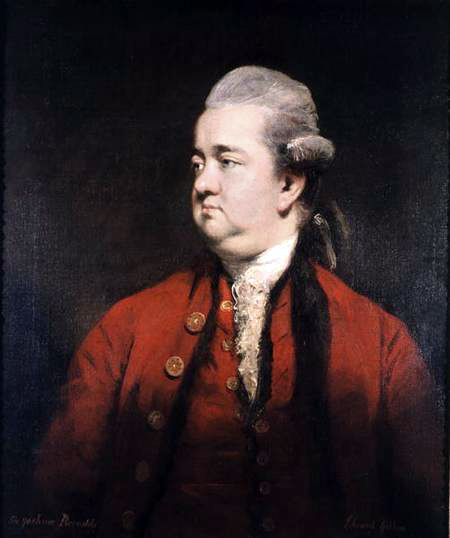
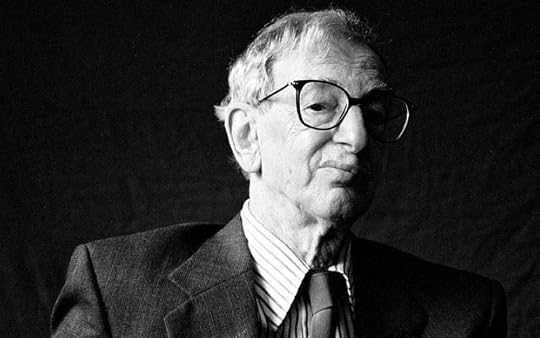
Now, legend has it that Michael Wood was a historian. Let's look at the evidence. Here are some pictures of historians through the ages:
Edward Gibbon
Eric Hobsbawm
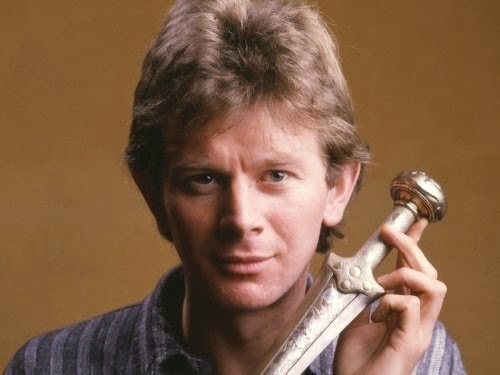
And now, here's a purported photo of Michael Wood:
Clearly, this is not the portrait of a historian.
Then what is he?
Reading some of the other books to which his name was attached, I thought he might be a writer. This hypothesis still might hold true, if we argue that In Search of Myths & Heroes is mainly the work of later redactors, drawing together some common tropes in the Woodian corpus to make a reasonable but not, to the expert eye, totally convincing facsimile: viz, the recurring travel motif, the anecdotes of discomfort, the well-turned phrase. But, being the work of a redactor (or redactors - there may have been many involved in producing this text from within the Woodian community), it lacks the touches that confirm authenticity, in particular the overall sense that this narrative is going somewhere.
But if Michael Wood is a writer, then what to make of these supposed appearances on film and TV? I would like here to propose a hypothesis. What we see on screen is, in fact, a projection of the dreams and desires and hopes of the Woodian community that produced these texts: the shifting image (so like the chthonic world of the subconscious) coalesces to produce, for a fleeting hour, the ideal 'Michael Wood', that the Woodian community be reaffirmed in its commitment to its Woodian ideals. And thus the Woodian cult continues.
It was Michael Wood's 'In Search of the Dark Ages', t.v. series and later the book that turned me on to all things 'Woody'. 'In Search of Myths and Heroes' was published, accompanying the BBC2 series, in 2005. There are four myths that Wood sets out in search of; Shangri-La, Jason and the Golden Fleece, The Queen of Sheba and Arthur:The Once and Future King. I have read around half a dozen of this authors books, each one has been classed with four stars. 'Myths and Heroes' is a slight departure into a more fanciful and nebulous set of expeditions. As a post-graduate in Anglo-Saxon history, Wood is more at home on the latter topic, in providing a comprehensive overview of the dark age shadow of Arthur/Ambrosius. Yet, as written in his Introduction these stories "are largely the invention of many generations of story-tellers; but my search for them took me on real journeys to real places, to the living descendants of the ancient cultures that produced the stories." The book is wonderfully illustrated by photographs, particularly those of Steve Razzetti.
I really enjoyed this book; I checked it out specifically because if the chapters on Arthur and the Queen of Sheba. These were very well written and explored many theories related t the myths. I was less interested in Shangri-La and Jason, but they were still well done and interesting.