

What do you think?

The Elric Saga #3
El misterio del lobo blanco
El trono de Imrryr, la ciudad de los sueños, joya resplandeciente del imperio de Melniboné, ha pasado a manos de Yykoon, el odiado usurpador, y Cymoril, dueña del corazón de Elric, ha sido recluida en un mágico letargo. Atormentado por el amor y por el odio, Elric emprende el camino de la venganza y regresa a Melniboné acompañado de una armada de los Reinos Jóvenes. Y así, entre la sangre y la destrucción, se escribe un nuevo capítulo de la terrible historia del portador de la espada negra.
Michael Moorcock ha recibido los premios Nebula, British y World Fantasy, Guardian Fiction y John W. Campbell Memorial a lo largo de una prolífica y controvertida carrera que lo ha consagrado como uno de los más importantes escritores contemporáneos.
Entre su obra de fantasía destaca el conjunto de novelas dedicadas al Multiverso, con las que revolucionó el género y consagró la figura del héroe acosado por las fuerzas del destino.
Michael Moorcock ha recibido los premios Nebula, British y World Fantasy, Guardian Fiction y John W. Campbell Memorial a lo largo de una prolífica y controvertida carrera que lo ha consagrado como uno de los más importantes escritores contemporáneos.
Entre su obra de fantasía destaca el conjunto de novelas dedicadas al Multiverso, con las que revolucionó el género y consagró la figura del héroe acosado por las fuerzas del destino.
160 pages, Paperback
First published March 1, 1977
About the author
Michael Moorcock
1,243 books3,900 followersMichael John Moorcock is an English writer primarily of science fiction and fantasy who has also published a number of literary novels.
Moorcock has mentioned The Gods of Mars by Edgar Rice Burroughs, The Apple Cart by George Bernard Shaw and The Constable of St. Nicholas by Edward Lester Arnold as the first three books which captured his imagination. He became editor of Tarzan Adventures in 1956, at the age of sixteen, and later moved on to edit Sexton Blake Library. As editor of the controversial British science fiction magazine New Worlds, from May 1964 until March 1971 and then again from 1976 to 1996, Moorcock fostered the development of the science fiction "New Wave" in the UK and indirectly in the United States. His serialization of Norman Spinrad's Bug Jack Barron was notorious for causing British MPs to condemn in Parliament the Arts Council's funding of the magazine.
During this time, he occasionally wrote under the pseudonym of "James Colvin," a "house pseudonym" used by other critics on New Worlds. A spoof obituary of Colvin appeared in New Worlds #197 (January 1970), written by "William Barclay" (another Moorcock pseudonym). Moorcock, indeed, makes much use of the initials "JC", and not entirely coincidentally these are also the initials of Jesus Christ, the subject of his 1967 Nebula award-winning novella Behold the Man, which tells the story of Karl Glogauer, a time-traveller who takes on the role of Christ. They are also the initials of various "Eternal Champion" Moorcock characters such as Jerry Cornelius, Jerry Cornell and Jherek Carnelian. In more recent years, Moorcock has taken to using "Warwick Colvin, Jr." as yet another pseudonym, particularly in his Second Ether fiction.
Moorcock has mentioned The Gods of Mars by Edgar Rice Burroughs, The Apple Cart by George Bernard Shaw and The Constable of St. Nicholas by Edward Lester Arnold as the first three books which captured his imagination. He became editor of Tarzan Adventures in 1956, at the age of sixteen, and later moved on to edit Sexton Blake Library. As editor of the controversial British science fiction magazine New Worlds, from May 1964 until March 1971 and then again from 1976 to 1996, Moorcock fostered the development of the science fiction "New Wave" in the UK and indirectly in the United States. His serialization of Norman Spinrad's Bug Jack Barron was notorious for causing British MPs to condemn in Parliament the Arts Council's funding of the magazine.
During this time, he occasionally wrote under the pseudonym of "James Colvin," a "house pseudonym" used by other critics on New Worlds. A spoof obituary of Colvin appeared in New Worlds #197 (January 1970), written by "William Barclay" (another Moorcock pseudonym). Moorcock, indeed, makes much use of the initials "JC", and not entirely coincidentally these are also the initials of Jesus Christ, the subject of his 1967 Nebula award-winning novella Behold the Man, which tells the story of Karl Glogauer, a time-traveller who takes on the role of Christ. They are also the initials of various "Eternal Champion" Moorcock characters such as Jerry Cornelius, Jerry Cornell and Jherek Carnelian. In more recent years, Moorcock has taken to using "Warwick Colvin, Jr." as yet another pseudonym, particularly in his Second Ether fiction.
Ratings & Reviews
Friends & Following
Create a free account to discover what your friends think of this book!
Community Reviews
Displaying 1 - 30 of 458 reviews

May 19, 2007
This third volume of the series—according to the Elric chronology—includes the two Elric stories Moorcock wrote first, the novellas “The Dreaming City” and “While the Gods Laugh" (each published in a separate issue of Science Fantasy in 1961). In the first, Elric, rightful emperor of Melnibone, leads a fleet against its capital city Immrryr to exact revenge and rescue his princess consort, but his sword Stormbringer literally has a mind of its own, bringing about disastrous consequences. In the second novella, Elric and Shaarilla of Myyrrhn go on a quest for the Dead Gods’ Book (Elric seeks a deity beyond Law and Chaos, and Shaarilla seeks an end to her deformity: she wants to have her wings restored.)
Elric tales are grim, in general, but these two arise from a particular despair. Moorcock was twenty-one, coming off a bad love affair, and drinking far too much. Heartache and the sense of a merciless fate pervade the atmosphere here.
The effect of these stories is somewhat lightened by two other pieces: a prequel, “The Dream of Earl Aubec,” which reveals the origin of the Young Kingdoms, and “The Singing Citidel,” in which Balo the Jester to the Gods makes a disorienting appearance on earth.

March 16, 2020
Actual rating: 2.512457856 stars. Because I'm in a good mood today.
Were I NOT following the Tor reading order for this series (internal series chronology), I might have enjoyed this installment more. But I am, so I didn’t.
Had I NOT read my Barbarian Paramour’s mightily titillating adventures before the Grumpy Albino’s, I might have enjoyed this installment a lot bloody shrimping more. But I did, so I didn’t.
Because:
① Incongruities and Inconsistencies R Us.
The stories in this collection were the first Moorcock wrote in this series, even though they take place after the events depicted in books 1-3 of the saga. And oh my squid, does it show. It feels like Elric got a personality transplant (more or that later) and his actions here make no bloody fishing sense (especially in The Dreaming City) Most discombobulating this complete lack of coherence is.

Yes, this is me being slightly discombobulated. Sorry for the overabundant pilosity, by the way, but quarantine's a bitch when it comes to hair removal.
And while I understand that this being Moorcock’s initial foray in Elric’s world could explain some discrepancies, it doesn’t explain why he never bothered reconciling the rest of the saga against these earlier stories. I mean, narrative continuity, it’s a thing and stuff.
② Conan Wannabe, Begone!
Two of the stories in this collection are complete Conan rip-offs and feature all the elements of a classic Barbarian Mine tale (same plot structure and cast breakdown, use of similar—if not identical—words and/or phrasing). This wouldn’t be a problem if the writing wasn’t so not good and lacklustre and stuff. But it is. Moorcock is no Robert E. Howard (far from it). Also, my Cimmerian Cutie Pie isn’t around, which is quite unacceptable. Also also, as much as I like Stormbringer, the sentient sword is a complete joke compared to Conan’s weapon of choice, the most lethal beef-bone. So blah and stuff.
③ Poor Execution Inc.
Such lazy writing, much meh. There’s so much potential in this series. The premise, the characters…So much room for development here! But did Moorcock bother to give some substance to his story, dig a little deeper into his characters and/or try to make them more complex? Don’t be silly now, that would have been way too much work! Why exploit your arc and characters to their full potential when you can write repetitive, uninspired plots and turn your cast members into underdeveloped, sketchy as fish plot devices? 👋 waves at Yyrkoon the comic book villain and Sweet Cymoril the ever-sleeping damsel in distress 👋 And talking about poorly written cast members, believe me when I tell you that you don’t want to get me started on the way female characters are portrayed here. Oh no, you don’t.

Precisely.
④ Elric of the Previous Installments, Where Art Thou?
In books #1-3, Elric has all the markings of a beautifully fished-up, harem-worthy character in the making. He is the moody as fish albino with the grumpy sword (aka YUM). In this book, however, his flat-as-a-Dover-sole character is naught but an arrogant, selfish ass with no agency whatsoever. Does our almighty hero actually save the day even once? Oh, please he’s got better, more important things to do with his life! “So what does he do when faced with an evil foe,” you ask? Why he callsGhostbusters Arioch (his personal, on-demand deus ex machina), of course. Well either that or he lets Stormbringer do all the work for him. And is Elric ever conflicted about this constant, complete lack of control? Nope. Does it ever seem to bother him or present some sort of internal struggle that his sword is a bloodthirsty homicidal maniac, and makes him skewer every shrimp that gets in his way? Nope nope and nope. The guy is just there. Totally unresponsive. And about as emotional as a rock. Yay.
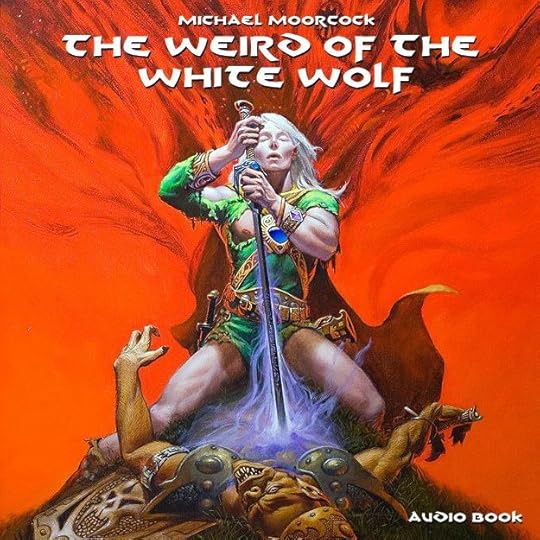
➽ Nefarious Last Words #1 (NLW™): The more I think about this book, the more I realize the best thing about it is probably its 1977 cover.

I restin my case and stuff.
👋 To be continued and stuff.
• Book 1: Elric of Melniboné ★★★★★
• Book 2: The Fortress of the Pearl ★★★★★
• Book 3: The Sailor on the Seas of Fate ★★★★★
• Book 4: The Weird of the White Wolf ★★★
• Book 5: The Vanishing Tower (aka “The Sleeping Sorceress”) - to be read.
• Book 6: The Revenge of the Black Rose - to be read.
• Book 7: The Bane of the Black Sword - to be read.
• Book 8: Stormbringer - to be read.
• Book 9: Elric at the End of Time - to be read.
• Book 10: Daughter of Dreams - to be read.
• Book 11: Destiny’s Brother - to be read.
• Book 12: Son of the Wolf - to be read.
(Following the Tor reading order)

[Pre-review nonsense]
FYI, this was NOT me while I was reading this book:

This, however, might very well have been me:

Full review to come and stuff.
P.S. Mr Moorcock, the crustaceans are NOT amused.
Were I NOT following the Tor reading order for this series (internal series chronology), I might have enjoyed this installment more. But I am, so I didn’t.
Had I NOT read my Barbarian Paramour’s mightily titillating adventures before the Grumpy Albino’s, I might have enjoyed this installment a lot bloody shrimping more. But I did, so I didn’t.
Because:
① Incongruities and Inconsistencies R Us.
The stories in this collection were the first Moorcock wrote in this series, even though they take place after the events depicted in books 1-3 of the saga. And oh my squid, does it show. It feels like Elric got a personality transplant (more or that later) and his actions here make no bloody fishing sense (especially in The Dreaming City) Most discombobulating this complete lack of coherence is.
Yes, this is me being slightly discombobulated. Sorry for the overabundant pilosity, by the way, but quarantine's a bitch when it comes to hair removal.
And while I understand that this being Moorcock’s initial foray in Elric’s world could explain some discrepancies, it doesn’t explain why he never bothered reconciling the rest of the saga against these earlier stories. I mean, narrative continuity, it’s a thing and stuff.
② Conan Wannabe, Begone!
Two of the stories in this collection are complete Conan rip-offs and feature all the elements of a classic Barbarian Mine tale (same plot structure and cast breakdown, use of similar—if not identical—words and/or phrasing). This wouldn’t be a problem if the writing wasn’t so not good and lacklustre and stuff. But it is. Moorcock is no Robert E. Howard (far from it). Also, my Cimmerian Cutie Pie isn’t around, which is quite unacceptable. Also also, as much as I like Stormbringer, the sentient sword is a complete joke compared to Conan’s weapon of choice, the most lethal beef-bone. So blah and stuff.
③ Poor Execution Inc.
Such lazy writing, much meh. There’s so much potential in this series. The premise, the characters…So much room for development here! But did Moorcock bother to give some substance to his story, dig a little deeper into his characters and/or try to make them more complex? Don’t be silly now, that would have been way too much work! Why exploit your arc and characters to their full potential when you can write repetitive, uninspired plots and turn your cast members into underdeveloped, sketchy as fish plot devices? 👋 waves at Yyrkoon the comic book villain and Sweet Cymoril the ever-sleeping damsel in distress 👋 And talking about poorly written cast members, believe me when I tell you that you don’t want to get me started on the way female characters are portrayed here. Oh no, you don’t.
Precisely.
④ Elric of the Previous Installments, Where Art Thou?
In books #1-3, Elric has all the markings of a beautifully fished-up, harem-worthy character in the making. He is the moody as fish albino with the grumpy sword (aka YUM). In this book, however, his flat-as-a-Dover-sole character is naught but an arrogant, selfish ass with no agency whatsoever. Does our almighty hero actually save the day even once? Oh, please he’s got better, more important things to do with his life! “So what does he do when faced with an evil foe,” you ask? Why he calls
➽ Nefarious Last Words #1 (NLW™): The more I think about this book, the more I realize the best thing about it is probably its 1977 cover.
I rest
👋 To be continued and stuff.
• Book 1: Elric of Melniboné ★★★★★
• Book 2: The Fortress of the Pearl ★★★★★
• Book 3: The Sailor on the Seas of Fate ★★★★★
• Book 4: The Weird of the White Wolf ★★★
• Book 5: The Vanishing Tower (aka “The Sleeping Sorceress”) - to be read.
• Book 6: The Revenge of the Black Rose - to be read.
• Book 7: The Bane of the Black Sword - to be read.
• Book 8: Stormbringer - to be read.
• Book 9: Elric at the End of Time - to be read.
• Book 10: Daughter of Dreams - to be read.
• Book 11: Destiny’s Brother - to be read.
• Book 12: Son of the Wolf - to be read.
(Following the Tor reading order)
[Pre-review nonsense]
FYI, this was NOT me while I was reading this book:
This, however, might very well have been me:
Full review to come and stuff.
P.S. Mr Moorcock, the crustaceans are NOT amused.

April 25, 2022
“I can accept then, that we are more than forsaken, because there was never anything there to forsake us.”

Elric's plans to rescue his fiancee while destroying the City of Dreams, the seat of power from which his family ruled Melnnibone for centuries, not surprisingly runs into quite a few snags in Michael Moorcock's The Weird of the White Wolf. I'm still really enjoying the worlds that Moorcock continuously and almost seemingly without effort builds as Elric explores new realms and planes of existence. I like that these worlds are not just inventive; they are strange and unexpected and I think that's the way it should be.
Elric's plans to rescue his fiancee while destroying the City of Dreams, the seat of power from which his family ruled Melnnibone for centuries, not surprisingly runs into quite a few snags in Michael Moorcock's The Weird of the White Wolf. I'm still really enjoying the worlds that Moorcock continuously and almost seemingly without effort builds as Elric explores new realms and planes of existence. I like that these worlds are not just inventive; they are strange and unexpected and I think that's the way it should be.

August 2, 2011
*** 2024 reread -
British author Michael Moorcock collaborated with the band Blue Oyster Cult on a song called Black Blade, and it is of course inspired by Moorcock's imaginative rune sword, Stormbringer, being wielded by his evil anti-hero Elric of Melnibone. Stormbringer is a sentient weapon that steals its victims souls as it takes their lives and shares this life energy with Elric, an albino who is physically weak and relied on potions and magic to sustain him. With Stormbringer, Elric can remain strong and vibrant with the sword, especially when it is doing it's thing and cutting people down like a scythe to wheat.
I've read articles or reviews that suggested that this book (a collection of short works) was of diminished quality based upon Moorcock's troubles during this time, alcoholism and the results of a bad breakup, and certainly he is moving in a different direction, and the tone is different, but this is still well written and improves on his multiverse world building in several significant ways.
We see an expanded character gallery as Moorcock moves this somewhat from introspective and mystical to a more adventure based sword and sorcery template. While purist fans of his earlier works may lament this more commercial approach, this does build his Eternal Champion multiverse and we get to know and understand Elric more in relation to the others around him.
One of the coolest scenes in the Star Wars canon was at the end of Rogue One. Up until then, generations of fans had known that Darth Vader was evil, and we had seen what he could do to a village of sand people and to the temple with the younglings, but the terror that he could create was mainly off screen. In what would be a prologue to the first Star Wars film, we see Vader being next level badass and the direction of the actors protraying the fear they experienced running for their lives away from him was golden.
Here we have Elric, and we know he's evil and does his own thing but there is a scene where you say, "Oh! Damn, he really is chaotic evil." This dramatic tension helps to make this better all the way around.
Good times, highly recommended for fans of this genre.
British author Michael Moorcock collaborated with the band Blue Oyster Cult on a song called Black Blade, and it is of course inspired by Moorcock's imaginative rune sword, Stormbringer, being wielded by his evil anti-hero Elric of Melnibone. Stormbringer is a sentient weapon that steals its victims souls as it takes their lives and shares this life energy with Elric, an albino who is physically weak and relied on potions and magic to sustain him. With Stormbringer, Elric can remain strong and vibrant with the sword, especially when it is doing it's thing and cutting people down like a scythe to wheat.
I've read articles or reviews that suggested that this book (a collection of short works) was of diminished quality based upon Moorcock's troubles during this time, alcoholism and the results of a bad breakup, and certainly he is moving in a different direction, and the tone is different, but this is still well written and improves on his multiverse world building in several significant ways.
We see an expanded character gallery as Moorcock moves this somewhat from introspective and mystical to a more adventure based sword and sorcery template. While purist fans of his earlier works may lament this more commercial approach, this does build his Eternal Champion multiverse and we get to know and understand Elric more in relation to the others around him.
One of the coolest scenes in the Star Wars canon was at the end of Rogue One. Up until then, generations of fans had known that Darth Vader was evil, and we had seen what he could do to a village of sand people and to the temple with the younglings, but the terror that he could create was mainly off screen. In what would be a prologue to the first Star Wars film, we see Vader being next level badass and the direction of the actors protraying the fear they experienced running for their lives away from him was golden.
Here we have Elric, and we know he's evil and does his own thing but there is a scene where you say, "Oh! Damn, he really is chaotic evil." This dramatic tension helps to make this better all the way around.
Good times, highly recommended for fans of this genre.
June 17, 2015
Before getting reacquainted with the ongoing saga of Elric, the albino sorcerer king that spent the previous volume as a vagabond mercenary, self-exiled from his own people and from the throne he inherited, Moorcock offers us a glimpse at the cosmology underlying his imaginary universe in The Dream of Earl Aubec. Within the standard sword & sorcery structure of the adventure (the champion swordsman of a fantasy realm goes on a quest to conquer a last bastion for his queen), the author debates the nature of reality, the question of predestination and other existentialist tropes.The Castle of Kaneloon ( Brooding and mysterious, the castle seemed to have a defiant air, for it stood on the very edge of the world. ), like other constructions in the Moorcock's universe, has a dual presence - at the same time solid and imaginary. Earl Aubec moves through the halls in a dreamlike trance, fighting not the scions of a powerful sorceress, but the demons of his own imagination, the doubts and fears that keep one awake in the small hour of the night with thoughts of mortality and pointlessness. The border that the castle Kaneloon guards is a fluid one, the place where the solid earth of Order meets the sea of Chaos. Here sanity battles nightmare and new territories (or theories) can be created by pushing back against the unknown. Aubec is a stand-in for Elric, who has been plagued by the same sort of questions since the first moments the reader lays his eyes on him. Like Elric, Aubec decides that even if the questions are unanswerable, the only thing a man can do is to pick up his sword and go into the unknown, to carve out his own fate. Whether he is succesful or not... well, that's another story.
The doom of Imrryr in The Dreaming City , capital of the ancient race of Melniboneans, has been promised since the introduction of the series and in this second novella of the present collection, the dark deed is done - Elric returns from his wanderings among the Young Kingdoms to find his throne usurped by his cousin Yyrkoon and his fiancee Cymoril enchanted into a cursed sleep. Enraged, the albino opens the gates of the city to a host of pirate ships who set the whole town on fire and goes on to hunt for his traitorous cousin.
Two things I found memorable in this novella: the issue of responsibility for one's own actions, a leitmotif in the whole Elric series, and the fantastic talent of Moorcock to condense an epic struggle in a relatively short format. On the question of free-will, Elric started out as a rebel against Fate, leaving behind the destiny decided for him by his ancestors, and sometimes going against even his sponsor deity, Arioch the Duke of Hell. As we progress into the series, it becomes evident that Elric is subverted in his quest by the very thing that gives him power - the magic sword Stormbringer, a sentient artefact with a malevolent will of its own. As in the opening story of Earl Aubec, the symbiotic/ parasytic relationship between the sword and its master here mirrors the internal struggle within the soul of the main character, the eternal battle between Chaos and Order.
We must be bound to one another, Elric murmured despairingly. Bound by hell-forged chains and fate-haunted circumstances. Well, then - let it be thus so - and men will have cause to tremble and flee when they hear the names of Elric of Melnibone and Stormbringer, his sword. We are two of a kind - produced by an age which has deserted us. Let us give this age cause to hate us!.

'The Dreaming City' is Elric darkest moment so far. It is very difficult to find attenuating circumstances for his crimes and betrayals. He is doomed by his own hand, and 'the sword made me do it!' is a feeble argument even in the albino's own conscience. Elric is once again an exile, a sellsword without a country to call his own, without loyalties and without hope for redemption. Where will he go from here?
While the Gods Laugh gives an answer to my last question. Elric's monumental melancholy, his tortured soul and his gloomy moods may be insignifiant in the larger scheme of things. But the existential questions give our hero no rest, and when a new quest is offered, Elric is only too eager to set out on another adventure:
One night, as Elric sat moodily drinking alone in a tavern, a wingless woman of Myrhhn came gliding out of the storm and rested her lithe body against him.
Shaarilla of the Dancing Mists knows of a secret (beside the bedroom ones), the Dead Gods' Book, an ancient manuscript that is alleged to hold the answer to all questions, and needs a champion to do battle with the book's guardian, Orunlu the Keeper. Shaarilla would like to get her wings back. Elric would like to know if there is any higher power that decides the fate of man.
Despairingly, sometimes, I seek the comfort of a benign God, Shaarilla. My mind goes out, lying awake at night, searching through the black bareness for something - anything - which will take me to it, warm me, protect me, tell me that there is order in the chaotic tumble of the universe; that it is consistent, this precision of the planets, not simply a brief, bright spark of sanity in an eternity of malevolent anarchy.
The path to the hidden keep where the book rests is long and filled with dangers. Savage beasts are followed by revenant riders, and ultimately by the signature Moorcock scenes of psychedelic kaleydoscopes in primary colours, suffocating mists and dreamlike trances that remove all references to a logical reality : They lost all sense of time and Elric began to feel as if he were living through a dream. . I wonder what kind of drugs they were on, maybe I can try some.
The conclusion is by now not unexpected : Elric is stymied in his efforts by an ironic twist of fate . There is no easy solution, and the albino must keep searching. I like the notion of the relativity of the concepts of good and evil, replaced here by Order and Chaos. L E Modessitt Jr. uses a similar device in his long Recluce series, where the black wizards and the white wizards often change roles who gets to play the good guys and who the bad guys. Neither Chaos nor Order could survive without each other, and the universe is the result of the balance between the two forces.
We exist only to fight - not to win, but to preserve the eternal struggle. says Orunlu the Keeper, a theme that is reiterated in the last novella of the colection, and explains why Elric is considered an incarnation of The Eternal Champion.
The Singing Citadel is a rinse and repeat of the previous story. The temptress that seduces Elric with her charms and with the promise of adventure is a certain Queen Yishana. Her kingdom is threatened by a mysterious castle that appears suddenly within the borders. Her soldiers and peasants are lured there by esoteric music, never to be seen again. Yishana's pet wizard and former lover, the mage Teleb K'aarna is unable to cope with the powerful enchantments and will soon add jealousy to his list of complaints about Elric. This story was a tad too similar to the fare promoted by Robert E Howard and his Conan pulps. I expect more from an Elric story, and only in the end dialogue with Balo the Jester, a trickster deity in the mould of Loki, was some of the old magic recaptured.
- I intend to establish my own Realm on Earth - the Realm of Paradox. A little from Law, a little from Chaos - a Realm of opposites, of curiosities and jokes.
- I'm thinking we already have such a world as you describe, Lord Balo, with no need for you to create it!
I plan to continue with the Elric saga over the summer, as I find the different novellas complete each other well into a bigger picture, with a definite continuity and progress in the evolution of the main hero. From a quote used by Moorcock as the title for 'The Laughing Gods', it looks like I must also add Mervyn Peake to my wishlist.

September 9, 2017
These shorts and novellas almost all revolve around Elric, the tormented anti-hero that sits in the palm of Chaos thanks to his intelligent and willful sword Stormbringer.
As sword and sorcery stories go, this one really stands out. It's not so much Conan as it is straddling the line between shifting realities and the world, wanting to be free of the fate of the Champion of Chaos while being the penultimate brooder with unimaginable powers, seeking peace at any cost.
Whenever I think of Elric, I think of the ultimate archetype, and there's a lot to point at to prove it. The writer walks the careful line of making him and his quest larger than life, full of magic and conquest, sea battles, monster battles, and even going so far as to open the book of life, as stolen by the greatest necromancer... only to have all answers crumble before him.
Chaos and Law are the maelstroms that Elric traverses, and even though the theme is very much done and done again even in this cycle, the quest is always the thing. We're always meant to come away with the same conclusions as Elric, the great and evil Elric, deciding to give the world the misery it so seems to desire.
Pretty powerful stuff, really, and these really should be placed in their proper time, the sixties and seventies, introducing us to the template to one of the greatest tragic heroes and sometimes horrendous villains.
As sword and sorcery stories go, this one really stands out. It's not so much Conan as it is straddling the line between shifting realities and the world, wanting to be free of the fate of the Champion of Chaos while being the penultimate brooder with unimaginable powers, seeking peace at any cost.
Whenever I think of Elric, I think of the ultimate archetype, and there's a lot to point at to prove it. The writer walks the careful line of making him and his quest larger than life, full of magic and conquest, sea battles, monster battles, and even going so far as to open the book of life, as stolen by the greatest necromancer... only to have all answers crumble before him.
Chaos and Law are the maelstroms that Elric traverses, and even though the theme is very much done and done again even in this cycle, the quest is always the thing. We're always meant to come away with the same conclusions as Elric, the great and evil Elric, deciding to give the world the misery it so seems to desire.
Pretty powerful stuff, really, and these really should be placed in their proper time, the sixties and seventies, introducing us to the template to one of the greatest tragic heroes and sometimes horrendous villains.

January 7, 2023
Michael Moorcock's Elric of Melniboné stories has significant influence on the sword and sorcery genre's development. The stories presented in this collection are the oldest written about Elric, but in terms of the in-world chronology happen some time later after the saga's beginning. Don't know if I'll read the entire saga, but after reading this, I definitely will be reading Elric of Melniboné.
Elric of Melniboné is the former emperor of the Melnibonéan Empire, also called the Bright Empire. Once a mighty force, the empire is decaying and many of the Young Kingdoms are seeking to rebel. Elric aids them. He wants to see his despicable cousin Yyrkoon deposed of and to be with in love with his other cousin Cymoril. With an army at his side, a soul-sucking blade called Stormbringer in his hands, and a pact with an ancient Lord of Chaos called Arioch, Elric will rise to the occasion. But Elric is not called a doomed hero for no reason.
The Weird of the White Wolf contains the stories “The Dream of Earl Aubec,” "The Dreaming City," “While the Gods Laugh," and "The Singing Citadel" in that order. I had been curious about the Elric saga for awhile because of my interest in sword and sorcery, a title which Michael Moorcock himself initially rejected after Fritz Leiber initially suggested it as the subgenre's name. However, I was initially put off of Moorcock's works after reading his take on J. R. R. Tolkien and The Lord of the Rings in his essay "Epic Pooh" and other places. That might sound childish of me, and perhaps it is, but Moorcock's view of Tolkien's high fantasy epic came off quite bitter to me. I am glad that I was able to look past that, Moorcock is one Hell of a writer. The stories found in this collection are top-notch, albeit not perfect. In my research on Elric himself, I learned that the character and some of the stories he stars in are roman à clefs. I was curious as to who Elric was supposed to be or be based on. He's the antithesis or opposite of Conan the Cimmerian, but is he Moorcock himself? To some extent, probably:
"“The Dreaming City” and “While the Gods Laugh” are, admittedly, the works of a young man who, in 1964’s “The Secret Life of Elric of Melniboné,” describes himself as under the influence of “a long-drawn-out and, to me at the time, tragic love affair which hadn’t quite finished its course and which was confusing and darkening my outlook. I was writing floods of hack work for Fleetway and was getting sometimes £70 or £80 a week which was going on drink, mainly, and, as I remember, involved rather a lot of broken glass of one description or another.”"
(Source)
The titular Elric is a former emperor who grew disillusioned with the people of his culture (this is more so alluded to here than actually shown) and is of a sickly constitution. His only source of renewing his strength, other than long rests, is the demon sword Stormbringer. Whenever it siphons another's soul, Elric is reinvigorated. At the end of "The Dreaming City," Elric attempts to throw Stormbringer away after a terrible loss it caused him, but he simply can't part with it. He's reliant on it and powerless without it despite his pact with a Lord of Chaos. He also cannot permanently be with any woman he desires. One way or another, he will part with them.
Perhaps Elric here is Moorcock. But let's put that all aside now and actually review these stories, shall we?
“The Dream of Earl Aubec” is the shortest of all the stories in The Weird of the White Wolf and is essentially a prequel to the entire saga. It introduces Myshella, Dark Lady of Kaneloon, who will eventually reappear in Elric: The Sleeping Sorceress, and Aubec, the former wielder of Stormbringer. The story's purpose is to introduce of the cosmology of the Elric saga, the constantly uneasy forces of Law and Chaos, the former which Myshella serves, the latter Elric. Not much here, but a nice story.
"The Dreaming City" is the most significant story as it ties into Elric's past and is a major turning point for him. Elric and his Young Kingdom allies march by way of naval battleships upon Elric's home city of Imrryr. There, Elric tries to awaken his slumbering cousin Cymoril, whom he loves, and fights against her brother, the current Emperor Yyrkoon. This story shows Moorcock's strength in coordinating and writing battle sequences. Everything moves so smoothly, and Moorcock is able to hold onto Elric's emotional and mental responses to the fights while describing everything with succinct detail without losing pace. The fight scenes are quite gory, but there's no overly graphic details. "The Dreaming City" ends, as I said above, quite tragically. During the fight with Yyrkoon, Elric accidentally kills Cymoril and his allies are all mostly decimated as they flee Imrryr. Elric cannot let go of Stormbringer, which is both his strength and his ruin.
If I have any criticisms about this story, it's that there's so little of Cymoril despite how important she is to Elric. Given that this was one of the first stories written about Elric, I would've been quite disappointed back those sixty plus years ago when it first came out concerning Cymoril. I am hoping that Moorcock fleshes her out in other stories and books.
“While the Gods Laugh" was probably my favorite of these stories. It is tragic, probably a little more so than "The Dreaming City," and its reveal might be ironic to some. However, the reveal is partially already given away to you by the title. In this story, Elric meets Shaarilla, a wingless bird woman who seeks the Dead Gods' Book in hope of restoring her wings. Elric becomes interested because he hopes the books will provide him and answer to his question of meaning in this world. Is there an overarching God above the Lords of Law and Chaos? Is Chaos, the natural anarchy, what Elric clings to, the true state of the world? Elric believes so, but he hopes for some sort of order. This discussion with Shaarilla is an improvement on Elric's character development from the previous story. Despite all the doom and gloom and dissolution he has toward the world, a small part of Elric does hope for something better. He is also still clearly haunted by Cymoril's death. Moonglum, Elric's most trusted friend, is also introduced in this story and he joins Shaarilla and him to find the Dead Gods' Book. Elric and them eventually find the book and when he opens it...it crumbles to dust. Elric is enraged and rebukes Shaarilla, leaving her behind and going with Moonglum.
This revelation is what I meant when I said that the reveal is given away in the title. The Lords of Law and Chaos for all their struggle against one another and uneasy balance are probably laughing at Elric, laughing at his melancholy.
I enjoyed this story the most because of how complex and conflicting Elric is with himself regarding his philosophical worldview. Despite Moorcock's personal "No gods, no masters" beliefs, Elric himself is a tormented and perceptive individual. And Lord knows (no, not the Lords of Law and Chaos; I mean the Big J) I've certain had those questions and have been plagued by them in the past.
"The Singing Citadel" is a bit more light-hearted and fun than the other stories, and I think that's a good thing. It's a good way to close the collection out. Elric and Moonglum find themselves in the Kingdom of Jharkor, the ruler of which, Queen Yishana, is the half-sister to one of Elric's perished allies in "The Dreaming City." She requests Elric's services after some of her people and soldiers have gone missing. Along with her Pan Tang sorcerer, Theleb K'aarna, Yishana and Elric ride out and find the titular citadel built from Chaos. Yishana is drawn in and Elric follows, only to met a jester of the Lords of Chaos. Here, we finally see Elric's contracted Arioch in his true form and the twisted magic of a Pan Tang sorcerer. The story ends mostly happily, but Elric is enraged and goes after Theleb with Moonglum in tow.
Moorcock's prose is utterly impressive throughout this entire collection. I question some adjective and verb choices sometimes, and Moorcock will remind you that the characters are "doomed" but quite literally using that word multiple times in one story, but the prose is still quite good. Atmospheric--there's a hint of Gothicness to it--, descriptive, attractive without being purplish, and flowing. The pacing is very well done as well and the prose aids to that. Other than the previously stated criticisms, my only other one is that some of these stories are a bit too quick and I think Moorcock could've lingered on certain feelings of Elric a bit more.
Overall, a great introduction to Elric of Melniboné.
Elric of Melniboné is the former emperor of the Melnibonéan Empire, also called the Bright Empire. Once a mighty force, the empire is decaying and many of the Young Kingdoms are seeking to rebel. Elric aids them. He wants to see his despicable cousin Yyrkoon deposed of and to be with in love with his other cousin Cymoril. With an army at his side, a soul-sucking blade called Stormbringer in his hands, and a pact with an ancient Lord of Chaos called Arioch, Elric will rise to the occasion. But Elric is not called a doomed hero for no reason.
The Weird of the White Wolf contains the stories “The Dream of Earl Aubec,” "The Dreaming City," “While the Gods Laugh," and "The Singing Citadel" in that order. I had been curious about the Elric saga for awhile because of my interest in sword and sorcery, a title which Michael Moorcock himself initially rejected after Fritz Leiber initially suggested it as the subgenre's name. However, I was initially put off of Moorcock's works after reading his take on J. R. R. Tolkien and The Lord of the Rings in his essay "Epic Pooh" and other places. That might sound childish of me, and perhaps it is, but Moorcock's view of Tolkien's high fantasy epic came off quite bitter to me. I am glad that I was able to look past that, Moorcock is one Hell of a writer. The stories found in this collection are top-notch, albeit not perfect. In my research on Elric himself, I learned that the character and some of the stories he stars in are roman à clefs. I was curious as to who Elric was supposed to be or be based on. He's the antithesis or opposite of Conan the Cimmerian, but is he Moorcock himself? To some extent, probably:
"“The Dreaming City” and “While the Gods Laugh” are, admittedly, the works of a young man who, in 1964’s “The Secret Life of Elric of Melniboné,” describes himself as under the influence of “a long-drawn-out and, to me at the time, tragic love affair which hadn’t quite finished its course and which was confusing and darkening my outlook. I was writing floods of hack work for Fleetway and was getting sometimes £70 or £80 a week which was going on drink, mainly, and, as I remember, involved rather a lot of broken glass of one description or another.”"
(Source)
The titular Elric is a former emperor who grew disillusioned with the people of his culture (this is more so alluded to here than actually shown) and is of a sickly constitution. His only source of renewing his strength, other than long rests, is the demon sword Stormbringer. Whenever it siphons another's soul, Elric is reinvigorated. At the end of "The Dreaming City," Elric attempts to throw Stormbringer away after a terrible loss it caused him, but he simply can't part with it. He's reliant on it and powerless without it despite his pact with a Lord of Chaos. He also cannot permanently be with any woman he desires. One way or another, he will part with them.
Perhaps Elric here is Moorcock. But let's put that all aside now and actually review these stories, shall we?
“The Dream of Earl Aubec” is the shortest of all the stories in The Weird of the White Wolf and is essentially a prequel to the entire saga. It introduces Myshella, Dark Lady of Kaneloon, who will eventually reappear in Elric: The Sleeping Sorceress, and Aubec, the former wielder of Stormbringer. The story's purpose is to introduce of the cosmology of the Elric saga, the constantly uneasy forces of Law and Chaos, the former which Myshella serves, the latter Elric. Not much here, but a nice story.
"The Dreaming City" is the most significant story as it ties into Elric's past and is a major turning point for him. Elric and his Young Kingdom allies march by way of naval battleships upon Elric's home city of Imrryr. There, Elric tries to awaken his slumbering cousin Cymoril, whom he loves, and fights against her brother, the current Emperor Yyrkoon. This story shows Moorcock's strength in coordinating and writing battle sequences. Everything moves so smoothly, and Moorcock is able to hold onto Elric's emotional and mental responses to the fights while describing everything with succinct detail without losing pace. The fight scenes are quite gory, but there's no overly graphic details. "The Dreaming City" ends, as I said above, quite tragically. During the fight with Yyrkoon, Elric accidentally kills Cymoril and his allies are all mostly decimated as they flee Imrryr. Elric cannot let go of Stormbringer, which is both his strength and his ruin.
If I have any criticisms about this story, it's that there's so little of Cymoril despite how important she is to Elric. Given that this was one of the first stories written about Elric, I would've been quite disappointed back those sixty plus years ago when it first came out concerning Cymoril. I am hoping that Moorcock fleshes her out in other stories and books.
“While the Gods Laugh" was probably my favorite of these stories. It is tragic, probably a little more so than "The Dreaming City," and its reveal might be ironic to some. However, the reveal is partially already given away to you by the title. In this story, Elric meets Shaarilla, a wingless bird woman who seeks the Dead Gods' Book in hope of restoring her wings. Elric becomes interested because he hopes the books will provide him and answer to his question of meaning in this world. Is there an overarching God above the Lords of Law and Chaos? Is Chaos, the natural anarchy, what Elric clings to, the true state of the world? Elric believes so, but he hopes for some sort of order. This discussion with Shaarilla is an improvement on Elric's character development from the previous story. Despite all the doom and gloom and dissolution he has toward the world, a small part of Elric does hope for something better. He is also still clearly haunted by Cymoril's death. Moonglum, Elric's most trusted friend, is also introduced in this story and he joins Shaarilla and him to find the Dead Gods' Book. Elric and them eventually find the book and when he opens it...it crumbles to dust. Elric is enraged and rebukes Shaarilla, leaving her behind and going with Moonglum.
This revelation is what I meant when I said that the reveal is given away in the title. The Lords of Law and Chaos for all their struggle against one another and uneasy balance are probably laughing at Elric, laughing at his melancholy.
I enjoyed this story the most because of how complex and conflicting Elric is with himself regarding his philosophical worldview. Despite Moorcock's personal "No gods, no masters" beliefs, Elric himself is a tormented and perceptive individual. And Lord knows (no, not the Lords of Law and Chaos; I mean the Big J) I've certain had those questions and have been plagued by them in the past.
"The Singing Citadel" is a bit more light-hearted and fun than the other stories, and I think that's a good thing. It's a good way to close the collection out. Elric and Moonglum find themselves in the Kingdom of Jharkor, the ruler of which, Queen Yishana, is the half-sister to one of Elric's perished allies in "The Dreaming City." She requests Elric's services after some of her people and soldiers have gone missing. Along with her Pan Tang sorcerer, Theleb K'aarna, Yishana and Elric ride out and find the titular citadel built from Chaos. Yishana is drawn in and Elric follows, only to met a jester of the Lords of Chaos. Here, we finally see Elric's contracted Arioch in his true form and the twisted magic of a Pan Tang sorcerer. The story ends mostly happily, but Elric is enraged and goes after Theleb with Moonglum in tow.
Moorcock's prose is utterly impressive throughout this entire collection. I question some adjective and verb choices sometimes, and Moorcock will remind you that the characters are "doomed" but quite literally using that word multiple times in one story, but the prose is still quite good. Atmospheric--there's a hint of Gothicness to it--, descriptive, attractive without being purplish, and flowing. The pacing is very well done as well and the prose aids to that. Other than the previously stated criticisms, my only other one is that some of these stories are a bit too quick and I think Moorcock could've lingered on certain feelings of Elric a bit more.
Overall, a great introduction to Elric of Melniboné.

September 23, 2024
A novel, but with 4 distinct parts. All of which are really well-written high fantasy fair with an interesting protagonist.
The Dream of Earl Aubec
Where we get a mysterious origin of the metaphysical battle between Law and Chaos.
The Dreaming City
Elric attempts to rescue his beloved and regain his city and throne.
While the Gods Laugh
Elric travels to find an ancient text that may reveal secrets for him.
The Singing Citadel
Elric helps overthrow a villain of Chaos who set up home in the real world.
Comics!
This one has a bit of a history - P Craig Russell adapted two seperate parts of the novel then Roy Thomas and FirstComics did the whole novel in one book using some of Russell's work.
The Dream of Earl Aubec - in the comic they put puts of this story throughout which I think was an excellent idea. A good framing mechanism for each issue. Michael T. Gilbert
The Dreaming City - previously published in Marvel Epic 3+4 and as a Marvel Graphic Novel in full. Here they just give a brief summary of the story. I wonder why they didn't publish the full story again. Drawn by P. Craig Russell. Odd missed opportunity but I guess they would imagine most Elric fans would already own that comic.
While the Gods Laugh - previously published in Marvel Epic 14, it's published here in full again.
Drawn by P. Craig Russell. A little more rare than The Dreaming City, so it makes some sense to publish the whole thing again.
The Singing Citadel - Elric helps overthrow a villain of Chaos who set up home in the real world. Drawn by Michael T. Gilbert.
The Dream of Earl Aubec
Where we get a mysterious origin of the metaphysical battle between Law and Chaos.
The Dreaming City
Elric attempts to rescue his beloved and regain his city and throne.
While the Gods Laugh
Elric travels to find an ancient text that may reveal secrets for him.
The Singing Citadel
Elric helps overthrow a villain of Chaos who set up home in the real world.
Comics!
This one has a bit of a history - P Craig Russell adapted two seperate parts of the novel then Roy Thomas and FirstComics did the whole novel in one book using some of Russell's work.
The Dream of Earl Aubec - in the comic they put puts of this story throughout which I think was an excellent idea. A good framing mechanism for each issue. Michael T. Gilbert
The Dreaming City - previously published in Marvel Epic 3+4 and as a Marvel Graphic Novel in full. Here they just give a brief summary of the story. I wonder why they didn't publish the full story again. Drawn by P. Craig Russell. Odd missed opportunity but I guess they would imagine most Elric fans would already own that comic.
While the Gods Laugh - previously published in Marvel Epic 14, it's published here in full again.
Drawn by P. Craig Russell. A little more rare than The Dreaming City, so it makes some sense to publish the whole thing again.
The Singing Citadel - Elric helps overthrow a villain of Chaos who set up home in the real world. Drawn by Michael T. Gilbert.

December 20, 2011
In my last two reviews, I have talked about how Moorcock's fevered imagination keeps these books aloft, even when the plot seems to grow disconnected from the series, or the characters grow repetitive, but he seems to be losing steam, for this book moves along apace, advancing the plot here and there, but not materially adding anything new to our understanding of the world or the characters.
Moorcock's shorter plot arcs lack the grand set pieces and focus which make Leiber's and Howard's works so delightful, and even if the brief episodes which make up the larger plot might be called 'short stories', they do not show the completeness or unity of idea of Conan or Lankhmar.
I keep longing for a return to form from Moorcock, wishing that he could combine those moments of lucid, pretty prose with his wild metaphysical magics and the brooding introspection which first defined Elric. But alas, it grows harder to look past his errors when he begins to repeat himself.
As usual, he has problems finding scenes which illustrate his characters, and so he ends up relying on exposition, or on the characters talking at length about their own thoughts and reactions, which always ends up feeling stilted and incomplete, especially when those traits are not always outwardly demonstrated.
the series itself begins to grow repetitive, as Elric is always followed by some bosom compatriot, who by the end will be betrayed, or killed, or lost, or all three. Likewise there are the female interests, who seem to traipse in and out of Elric's life to torment him, but who often have little character of their own.
The series focuses narrowly, sometimes unsparingly, upon Elric himself, but it feels as if much more could be done with his character if he had an equally strong supporting cast to play off of. When secondary characters are summarily introduced and dropped, it becomes harder for them to have any effect on Elric--and if they do produce some sudden effect upon him, it can feel rather overly convenient if the relationship has not yet been fully-developed.
One of the hallmarks of the Conan series is that in each story, Howard shows us very different sides of Conan: different humors, desires, fears, and outlooks. In the first three stories we get Conan young, aged, and full-grown, and each portrayal depicts a different sort of man.
Clearly, with Elric, we would not expect so drastic a shift, as we follow him from place to place in chronological order, but I do find myself disappointed that we don't tend to see other sides to Elric: he is always brooding, somewhat naive, and less callous than he imagines himself. I keep waiting to find something surprising in him, some aspect of depth before unexplored.
In short, I wait for the mad philosophical explorations which live in Moorcock's magic to reach Elric, to show up in him in some fundamental way, to change him or leave a trace on him, to become an exploration of his character, and more than that, of his possibility.
The series is always looking forward, always moving forward--sometimes too quickly, sometimes without a chance to build or pause or ponder--but always moving; and I have to ask myself: for what? Where are we going?
Certainly there are hints, there are moments of conflict and feeling for Elric, but rarely are they given time to emerge, rarely is the story constructed so as to reveal them naturally. If they are not constructed carefully, over time, then when they arrive, they will always be too early, or too late, and seem almost inconsequential in the face of the vast cosmic conflict which tends to make up the heart of the story.
Elric feels weak and unsure. He travels somewhere to reach something strange and magical which has piqued his interest. He battles an otherworldly thing, which he defeats, but he now feels drained. He wanders through a strange dimension and faces another thing, which is powerful and dangerous. He almost dies, but then he summons something and it saves him. the most recent of a series of doomed soldier friends saves him and makes an ironic quip (always ironic). Elric departs no richer than he arrived, and despondent at his failure.
I am still enjoying this series, and it shows a lot of promise, but at this point, the gap between what it is and what it could be is widening. Sure, it's still more interesting, original, and better-written than most of the fantasy out there, but I'm desperate for it to really find its groove. Moorcock has the tools, I just want to see him use them all at once.
My List of Suggested Fantasy Books
Moorcock's shorter plot arcs lack the grand set pieces and focus which make Leiber's and Howard's works so delightful, and even if the brief episodes which make up the larger plot might be called 'short stories', they do not show the completeness or unity of idea of Conan or Lankhmar.
I keep longing for a return to form from Moorcock, wishing that he could combine those moments of lucid, pretty prose with his wild metaphysical magics and the brooding introspection which first defined Elric. But alas, it grows harder to look past his errors when he begins to repeat himself.
As usual, he has problems finding scenes which illustrate his characters, and so he ends up relying on exposition, or on the characters talking at length about their own thoughts and reactions, which always ends up feeling stilted and incomplete, especially when those traits are not always outwardly demonstrated.
the series itself begins to grow repetitive, as Elric is always followed by some bosom compatriot, who by the end will be betrayed, or killed, or lost, or all three. Likewise there are the female interests, who seem to traipse in and out of Elric's life to torment him, but who often have little character of their own.
The series focuses narrowly, sometimes unsparingly, upon Elric himself, but it feels as if much more could be done with his character if he had an equally strong supporting cast to play off of. When secondary characters are summarily introduced and dropped, it becomes harder for them to have any effect on Elric--and if they do produce some sudden effect upon him, it can feel rather overly convenient if the relationship has not yet been fully-developed.
One of the hallmarks of the Conan series is that in each story, Howard shows us very different sides of Conan: different humors, desires, fears, and outlooks. In the first three stories we get Conan young, aged, and full-grown, and each portrayal depicts a different sort of man.
Clearly, with Elric, we would not expect so drastic a shift, as we follow him from place to place in chronological order, but I do find myself disappointed that we don't tend to see other sides to Elric: he is always brooding, somewhat naive, and less callous than he imagines himself. I keep waiting to find something surprising in him, some aspect of depth before unexplored.
In short, I wait for the mad philosophical explorations which live in Moorcock's magic to reach Elric, to show up in him in some fundamental way, to change him or leave a trace on him, to become an exploration of his character, and more than that, of his possibility.
The series is always looking forward, always moving forward--sometimes too quickly, sometimes without a chance to build or pause or ponder--but always moving; and I have to ask myself: for what? Where are we going?
Certainly there are hints, there are moments of conflict and feeling for Elric, but rarely are they given time to emerge, rarely is the story constructed so as to reveal them naturally. If they are not constructed carefully, over time, then when they arrive, they will always be too early, or too late, and seem almost inconsequential in the face of the vast cosmic conflict which tends to make up the heart of the story.
Elric feels weak and unsure. He travels somewhere to reach something strange and magical which has piqued his interest. He battles an otherworldly thing, which he defeats, but he now feels drained. He wanders through a strange dimension and faces another thing, which is powerful and dangerous. He almost dies, but then he summons something and it saves him. the most recent of a series of doomed soldier friends saves him and makes an ironic quip (always ironic). Elric departs no richer than he arrived, and despondent at his failure.
I am still enjoying this series, and it shows a lot of promise, but at this point, the gap between what it is and what it could be is widening. Sure, it's still more interesting, original, and better-written than most of the fantasy out there, but I'm desperate for it to really find its groove. Moorcock has the tools, I just want to see him use them all at once.
My List of Suggested Fantasy Books

August 13, 2020
This was a short novel but very important for Elric - kind of the point of no return, where he becomes THE Elric, brooding and cynical hero, that reminded me strongly of another brooding and cynical white haired hero, called White Wolf...
Also, couldn't stop thinking about Targaryens, yay! White haired masters of dragons from far away continent with specific customs. Who's with me to point out the same?
Anyway, Elric has to face his own bad decisions from the book 1 and everything turns out from bad to worse. Terrible, horrible, no good, very bad day for Elric.
Also, couldn't stop thinking about Targaryens, yay! White haired masters of dragons from far away continent with specific customs. Who's with me to point out the same?
Anyway, Elric has to face his own bad decisions from the book 1 and everything turns out from bad to worse. Terrible, horrible, no good, very bad day for Elric.

June 24, 2020
This is chronologically the third book in Moorcock's Elric saga, but it contains the first story to be published, The Dreaming City from way back in 1961; the other two stories are The Singing Citadel and While the Gods Laugh. Elric meets his constant and faithful companion Moonglum in this book, Stormbringer's influence grows, and Elric's past comes back to haunt him again. It's very good swords & sorcery fiction that's a key part of Moorcock's vast multiverse study of Balance between Law and Chaos, but stands quite well as thrilling adventure on its own.
March 11, 2024
4.25/5 - In this one, Elric's doomed fate officially starts to play out. Following the tragic events of the Dreaming City, Elric becomes more obsessed than ever with trying to discover the purpose of his existence and an ultimate Truth. This is where he starts to really become the morally grey "hero" he's known for. The Dreaming City was good but a bit choppy, particularly at key moments. While the Gods Laugh and The Singing Citadel were tighter and more riveting, especially The Singing Citadel which had a lot of action. I'm excited to start the Vanishing Tower and see if the story continues there, but need to go pick up it up from the store.

July 19, 2015
One of the tropes running through the Elric books is Premonitions of Doom. Moorcock is not shy about hinting that things aren't going to end well. Why do I mention this? No particular reason …
It's an odd experience rereading these after so many years. I had forgotten the adventure of the Mad God's Book right up until the very end where I had a flash of familiarity at the climax. Granted, it's been a good thirty years at least since I last read these, but it's occasionally dismaying how much I appear to have forgotten.
Also, despite these being billed as novels, they're really more collections of shorter stories–novellas, perhaps, or just lengthy short stories. My sense of exactly what constitutes novella–or even novelette–length is hazy. Anyway, each volume so far has featured several distinct tales, with the only through-line being that they chronologically relate the adventures of Elric. This makes sense since they were originally published in magazines. And, while I wouldn't be surprised if Moorcock revised–or at least polished them up–for the books, to edit them together into more conventional novel form would have taken a great deal more work.
Still, while calling them “novels” may be slightly misleading, they're definitely thrilling stories. Elric is a character for the ages. Recommended!
It's an odd experience rereading these after so many years. I had forgotten the adventure of the Mad God's Book right up until the very end where I had a flash of familiarity at the climax. Granted, it's been a good thirty years at least since I last read these, but it's occasionally dismaying how much I appear to have forgotten.
Also, despite these being billed as novels, they're really more collections of shorter stories–novellas, perhaps, or just lengthy short stories. My sense of exactly what constitutes novella–or even novelette–length is hazy. Anyway, each volume so far has featured several distinct tales, with the only through-line being that they chronologically relate the adventures of Elric. This makes sense since they were originally published in magazines. And, while I wouldn't be surprised if Moorcock revised–or at least polished them up–for the books, to edit them together into more conventional novel form would have taken a great deal more work.
Still, while calling them “novels” may be slightly misleading, they're definitely thrilling stories. Elric is a character for the ages. Recommended!

July 4, 2010
Michael Moorcock has created many characters who are an aspect of the Eternal Champion, who battles sometimes on the side of Law and sometimes on the side of Chaos, depending on his incarnation. In the incarnation of Elric of Melnibone, a man weak in body except when augmented by the stolen souls provided through the medium of the perilous sword Stormbringer, he is powerful in intellect, passion and magic.
Yet more than that, he is a man who is the very embodiment of the hard choices which Fate can inflict on a soul. Torn between obligation, a desire for vengeance and simply to be allowed by the gods and demons of the Universe to have a measure of peace, Elric is both deadly and beautiful, pitiless and deserving of sympathy.
An unforgettable anti-hero, and this is just one installment in the series of his personal incarnation. An outstanding line of books for lovers of saga and epic fantasies, sword and sorcery which blasts its unforgettable images into your heart and soul.
Yet more than that, he is a man who is the very embodiment of the hard choices which Fate can inflict on a soul. Torn between obligation, a desire for vengeance and simply to be allowed by the gods and demons of the Universe to have a measure of peace, Elric is both deadly and beautiful, pitiless and deserving of sympathy.
An unforgettable anti-hero, and this is just one installment in the series of his personal incarnation. An outstanding line of books for lovers of saga and epic fantasies, sword and sorcery which blasts its unforgettable images into your heart and soul.

June 10, 2012
More pulpy sword & sorcery, episodic, fast-paced to the point of parody.
Includes what is now the obligatory cryptic prologue. Prologue here has the virtue of self-riducule, wherein the hero is not Elric, but his ancestor Aubec, from whom he had the sword in volume I, prior to achieving the nuclear-sword with which he is more famously associated. Aubec has gone to the edge of the world to incorporate the last castle into the empire, but is tricked by its occupant to win not merely the castle, but also "that which lies beyond," the formless chaos which might be tamed to yield "new plains, new mountains, new seas--new populations, even--whole cities full of people fresh-sprung and yet with the memory of generations of ancestors behind them" (24). This conquest beyond, we are told in tolkienian tone, births the new kingdoms and leads to the death of the Empire (26).
Whatever. But: it is an accurate description of what Moorcock is doing. The world of the text is bordered by formless chaos in his mind, and, as each new installment is published, and Elric needs more areas to despoil and more persons to slaughter, the author can introduce hitherto unmentioned (and unthought by the writer until his agent reminded him that he is past deadline) portions of the setting, deities to trouble the protagonist or aid him, persons to be used or abused or both. It's extremely weak setting development, and, as there is really not enough space for character development, these being smallish volumes, with a loose focus on Elric's moping, not much of interest in personal interaction. His prior ally, Smiorgan, is snuffed out without much thought (66), during Elric's bizarre adventure to rescue his old fiancee (fails) by sackingRome his imperial capital (half-succeeds). (The capital receives some stunning descriptions just prior to its destruction, though (39-40)).
Sure, cool that he's "truly rootless" (59), after Rome's destruction: "He could envisage no future, for his future had been bound up with his past" (id.)--he had "destroyed the last tangible sign that the grandiose magnificent Bright Empire had ever existed"--a nice bit of proto-fascist ideology--"He felt that most of himself was gone with it" (id.)--and yet, still, even so, "his mind reluctantly brooded on Cymoril" (id.). War on memory lost, or simply abandoned by author?
The first part settles all scores from volumes I and II, effectively ending any connection to the setting described therein--now rootless, he's vested in the life of the wanderer, who acquires tasks in taverns--no shit! (71 & 122)--to visit places never before described. The first such task involves a fairly trite and hyper-powered quest for a Super Book of some sort or another.
I get that these types of occurrences are features, instead of bugs, when it comes to sword & sorcery--but what is more or less unforgiveable in this installment is that Elric's prior war against memory is largely left aside, and instead he becomes a fucking fundamentalist, wondering if the Super Book will tell him whether "an ultimate God exists" (77). He seeks "the comfort of a benign God" (id.). FFS. (There is later acknowledgement that "he failed to forget Cymoril" (127)--indicating that the series may not be completely hopeless.)
After a number of trivial and tedious encounters, he and his new companions discover the Super Book, which "throbbed with light and brilliant color" (110), and then "disintegrated" into "yellowish dust" (110-11). Failed quests in heroic fiction are good, of course. The companion, a "materialist," takes the gems that encrusted the destroyed book, "worth a fortune" (112)--apt commentary on volumes such as this, though they yellow into dust, worth a fortune in the publisher's hands.
Third act is even more forgettable, except that it suddenly begins referring to Elric as a wolf in various ways (118, 119, 122)--which apparently explains the title, but as that merely removes the lupine mystery one step, hardly constitutes dispositive explanation.
Recommended for eternal skeptics, priest-aristocrats, and tiny creatures in the palm of the jester of chaos.
Includes what is now the obligatory cryptic prologue. Prologue here has the virtue of self-riducule, wherein the hero is not Elric, but his ancestor Aubec, from whom he had the sword in volume I, prior to achieving the nuclear-sword with which he is more famously associated. Aubec has gone to the edge of the world to incorporate the last castle into the empire, but is tricked by its occupant to win not merely the castle, but also "that which lies beyond," the formless chaos which might be tamed to yield "new plains, new mountains, new seas--new populations, even--whole cities full of people fresh-sprung and yet with the memory of generations of ancestors behind them" (24). This conquest beyond, we are told in tolkienian tone, births the new kingdoms and leads to the death of the Empire (26).
Whatever. But: it is an accurate description of what Moorcock is doing. The world of the text is bordered by formless chaos in his mind, and, as each new installment is published, and Elric needs more areas to despoil and more persons to slaughter, the author can introduce hitherto unmentioned (and unthought by the writer until his agent reminded him that he is past deadline) portions of the setting, deities to trouble the protagonist or aid him, persons to be used or abused or both. It's extremely weak setting development, and, as there is really not enough space for character development, these being smallish volumes, with a loose focus on Elric's moping, not much of interest in personal interaction. His prior ally, Smiorgan, is snuffed out without much thought (66), during Elric's bizarre adventure to rescue his old fiancee (fails) by sacking
Sure, cool that he's "truly rootless" (59), after Rome's destruction: "He could envisage no future, for his future had been bound up with his past" (id.)--he had "destroyed the last tangible sign that the grandiose magnificent Bright Empire had ever existed"--a nice bit of proto-fascist ideology--"He felt that most of himself was gone with it" (id.)--and yet, still, even so, "his mind reluctantly brooded on Cymoril" (id.). War on memory lost, or simply abandoned by author?
The first part settles all scores from volumes I and II, effectively ending any connection to the setting described therein--now rootless, he's vested in the life of the wanderer, who acquires tasks in taverns--no shit! (71 & 122)--to visit places never before described. The first such task involves a fairly trite and hyper-powered quest for a Super Book of some sort or another.
I get that these types of occurrences are features, instead of bugs, when it comes to sword & sorcery--but what is more or less unforgiveable in this installment is that Elric's prior war against memory is largely left aside, and instead he becomes a fucking fundamentalist, wondering if the Super Book will tell him whether "an ultimate God exists" (77). He seeks "the comfort of a benign God" (id.). FFS. (There is later acknowledgement that "he failed to forget Cymoril" (127)--indicating that the series may not be completely hopeless.)
After a number of trivial and tedious encounters, he and his new companions discover the Super Book, which "throbbed with light and brilliant color" (110), and then "disintegrated" into "yellowish dust" (110-11). Failed quests in heroic fiction are good, of course. The companion, a "materialist," takes the gems that encrusted the destroyed book, "worth a fortune" (112)--apt commentary on volumes such as this, though they yellow into dust, worth a fortune in the publisher's hands.
Third act is even more forgettable, except that it suddenly begins referring to Elric as a wolf in various ways (118, 119, 122)--which apparently explains the title, but as that merely removes the lupine mystery one step, hardly constitutes dispositive explanation.
Recommended for eternal skeptics, priest-aristocrats, and tiny creatures in the palm of the jester of chaos.

November 26, 2023
While Tolkien is mostly considered the father of modern fantasy, and usually rightfully so, it would be a crime to not include Moorcock as another father of modern fantasy - in some cases even more so than Tolkien.
This collection of Elric stories is so far my personal favorite. It brings a lot of the plot lines from the first book to a climactic end and is just fantastic. Modern fantasy owes so much to Moorcock - the Elric novels have Chaos gods (a direct influence to Warhammer), shaved head eunuch warriors (just like the Unsullied in A Song of Ice and Fire), and also Elric's own race, a fierce group of people with a psychological predispotion to blind rage and fury among other things and who happen to have tamed and ride dragons (again, just like the Targaryens in ASOIAF).
Overall these books are incredible and each one just keeps getting better and better. These are must-reads for any fantasy fan.
This collection of Elric stories is so far my personal favorite. It brings a lot of the plot lines from the first book to a climactic end and is just fantastic. Modern fantasy owes so much to Moorcock - the Elric novels have Chaos gods (a direct influence to Warhammer), shaved head eunuch warriors (just like the Unsullied in A Song of Ice and Fire), and also Elric's own race, a fierce group of people with a psychological predispotion to blind rage and fury among other things and who happen to have tamed and ride dragons (again, just like the Targaryens in ASOIAF).
Overall these books are incredible and each one just keeps getting better and better. These are must-reads for any fantasy fan.

April 5, 2022
This book is a weird mishmash of at least two short stories. The big event that I had assumed would be the climax of the novel was over in a paragraph less than a third of the way through.
These books are extremely corny but moorcock is great at setting a mood. He has loads of cool ideas that considering the age of these books have been copied multiple times by better known works.
I’m not well read in the fantasy genre but if Michael moorcock isn’t the granddaddy of dark fantasy I don’t know who is.
These books are extremely corny but moorcock is great at setting a mood. He has loads of cool ideas that considering the age of these books have been copied multiple times by better known works.
I’m not well read in the fantasy genre but if Michael moorcock isn’t the granddaddy of dark fantasy I don’t know who is.

May 6, 2021
A handful of Elric stories, including the excellent and character defining "The Dreaming City". I read a bunch of Elric stories about 25 years ago and, while I forgot most of them, "The Dreaming City" always stuck with me.

January 15, 2024
Loved this one! So much adventure with lots of sorcery!
December 21, 2017
4/5
El misterio del Lobo Blanco está formada por 4 historias. La primera de ellas es presentada como prólogo y no está protagonizada por el albino, sino por un personaje anterior en el tiempo llamado Aubec. Ciertamente, la inclusión de esta historia en este volumen despista un poco, pues no presenta ningún tipo de continuidad con el resto, o al menos no que yo haya podido percibir, y los hechos ocurren en un momento muy anterior. No obstante, su lectura resulta muy entretenida.
El relato de mayor calibre es el que sigue, "La ciudad de Ensueño", con una crudeza totalmente explícita, que definirá la personalidad de Elric en adelante. Los terribles hechos narrados en esta historia dotarán al personaje de una apatía y oscuridad características.
La tercera historia y la última presentan bastantes similitudes. La más notoria es la presencia de un personaje femenino que acompañará al albino en su aventura, pero que en ningún caso determinará sus actos finales. En la primera, la búsqueda de un libro que alberga un conocimiento ambicionado concluirá de forma demasiado alegórica. En la última, sin embargo, el final da pie a una clara continuación, que tiene pinta de ser muy interesante.
Después de haber releído los cuatro primeros del tirón la conoceré, o recordaré más bien, tras una breve pausa por el londinense barrio de Whitechapel en el siglo XIX.
El misterio del Lobo Blanco está formada por 4 historias. La primera de ellas es presentada como prólogo y no está protagonizada por el albino, sino por un personaje anterior en el tiempo llamado Aubec. Ciertamente, la inclusión de esta historia en este volumen despista un poco, pues no presenta ningún tipo de continuidad con el resto, o al menos no que yo haya podido percibir, y los hechos ocurren en un momento muy anterior. No obstante, su lectura resulta muy entretenida.
El relato de mayor calibre es el que sigue, "La ciudad de Ensueño", con una crudeza totalmente explícita, que definirá la personalidad de Elric en adelante. Los terribles hechos narrados en esta historia dotarán al personaje de una apatía y oscuridad características.
La tercera historia y la última presentan bastantes similitudes. La más notoria es la presencia de un personaje femenino que acompañará al albino en su aventura, pero que en ningún caso determinará sus actos finales. En la primera, la búsqueda de un libro que alberga un conocimiento ambicionado concluirá de forma demasiado alegórica. En la última, sin embargo, el final da pie a una clara continuación, que tiene pinta de ser muy interesante.
Después de haber releído los cuatro primeros del tirón la conoceré, o recordaré más bien, tras una breve pausa por el londinense barrio de Whitechapel en el siglo XIX.

February 7, 2020
Elric made an incredibly foolish and selfish decision at the end of the first book, and now it's finally come back to bite him where it hurts. He abandoned his role as proud ruler of Melniboné to pursue a life of fleeting pleasures and infinite learning in distant lands. Now the dreadful fates of the dreaming city Imrryr, Yyrkoon the hated usurper and Elric’s beloved Cymoril hang in the balance of chaos. All are at risk of falling to the fury and unearthly power of the albino prince Elric and his soul devouring sword Stormbringer because of a choice he made that unknowingly set his own downfall in motion. With no other options left, Elric confronts his doomed fate in the haunted era he's trapped in.
This was the best of the Elric saga so far because Elric finally starts to display evil tendencies. His sword has always had a mind of its own, but now the wills of Stormbringer and Elric have blurred together. Elric is a slave to his evil sword, it takes away the things he loves one by one and drives the prince mad. Elric becomes more selfish, brooding, impulsive and scornful, hating his sword, his dirty soul and the wretched destiny he can't escape from.
The battles are bloodier and the setting is even more grim. It seems the harder Elric tries to break free from his cruel fate, the more harsh, chaotic and unforgiving his life becomes.
This was the best of the Elric saga so far because Elric finally starts to display evil tendencies. His sword has always had a mind of its own, but now the wills of Stormbringer and Elric have blurred together. Elric is a slave to his evil sword, it takes away the things he loves one by one and drives the prince mad. Elric becomes more selfish, brooding, impulsive and scornful, hating his sword, his dirty soul and the wretched destiny he can't escape from.
The battles are bloodier and the setting is even more grim. It seems the harder Elric tries to break free from his cruel fate, the more harsh, chaotic and unforgiving his life becomes.

March 7, 2016
So far I'm able to read one Elric volume per day. Eat this, George R.R. Martin. With the third volume, all my worries that Elric might turn into a boring white knight are blown away. On the contrary, he's more bad-ass than ever, annihilating his own civilization, earning the title womankiller and becoming the most notorious villain of the multiverse. Way to go!
Again, friends come and go, usually by death caused by our hero. Women are consummated, Elric moves on. Mysterious places, other planes, demons aplenty. A breathless fighting fantasy romp where my search for deeper meaning gets lost in the pace of events.
Again, friends come and go, usually by death caused by our hero. Women are consummated, Elric moves on. Mysterious places, other planes, demons aplenty. A breathless fighting fantasy romp where my search for deeper meaning gets lost in the pace of events.

April 21, 2023
This was the weakest of the novels in first collected volume (by Saga Press). And no wonder, these novellas were written even before The Elric of Melniboné and only later given structure and novelization in the form of The Weird of the White Wolf. Btw, where was that weird exactly?
The Sailor on the Seas of Fate had a lot more foreshadowing than this.
This Elric also behaved differently than the Elric in previous two novels which I liked. And I mean since the beginning. I'd understand the change in tone after the tragedy that befalls him at the end of part one but he's different from the beginning. But hey, at least there was no nonsensical post-modernist crap with the villain like in the first novel.
The Sailor on the Seas of Fate had a lot more foreshadowing than this.
This Elric also behaved differently than the Elric in previous two novels which I liked. And I mean since the beginning. I'd understand the change in tone after the tragedy that befalls him at the end of part one but he's different from the beginning. But hey, at least there was no nonsensical post-modernist crap with the villain like in the first novel.

April 7, 2023
Once again good stuff here. In this third volume of the series, 2 of the stories were the first published stories back in the early sixties. The dark brooding tone is present throughout. Moorcock was young when he wrote those 2 stories snd his personal struggles can be felt in his writing. I love re-reading these.

Read
October 27, 2022In the first book of this series, emperor Elric of Melnibone is betrayed by his cousin, Yyrkoon, who covets the throne for himself. Yyrkoon attempts to assassinate the emperor, but Elric survives with the aid of magic. He spares Yyrkoon's life, but punishes him by sentencing him to cannibalize his co-conspirator.
Yyrkoon escapes, however, kidnaping Elric's lover, Cymoril, and fleeing the imperial capital, Imrryr the Dreaming City. Elric pursues, overtaking Yyrkoon, and defeating him again, this time with the aid of Stormbringer, a vampiric sword with a mind of its own.
But Elric spares Yyrkoon for the second time. Then he decides to take a break from ruling to wander the world. So who does Elric leave in charge of the empire during his absence? Why, his twice-treasonous cousin, Yyrkoon.
In this, the third book of the series, Elric returns to Melnibone after many supernatural adventures abroad, only to find that Yyrkoon--surprise!---has betrayed him yet again. There follows a terrific battle of swords and sorcery that leaves Yyrkoon, Cymoril, and countless others dead, the Dreaming City a smoldering ruin, and Elric himself a permanent, melancholy exile.
It's hard to feel sorry for Elric though. I mean, he should have seen that coming.
Yyrkoon escapes, however, kidnaping Elric's lover, Cymoril, and fleeing the imperial capital, Imrryr the Dreaming City. Elric pursues, overtaking Yyrkoon, and defeating him again, this time with the aid of Stormbringer, a vampiric sword with a mind of its own.
But Elric spares Yyrkoon for the second time. Then he decides to take a break from ruling to wander the world. So who does Elric leave in charge of the empire during his absence? Why, his twice-treasonous cousin, Yyrkoon.
In this, the third book of the series, Elric returns to Melnibone after many supernatural adventures abroad, only to find that Yyrkoon--surprise!---has betrayed him yet again. There follows a terrific battle of swords and sorcery that leaves Yyrkoon, Cymoril, and countless others dead, the Dreaming City a smoldering ruin, and Elric himself a permanent, melancholy exile.
It's hard to feel sorry for Elric though. I mean, he should have seen that coming.

February 21, 2009
This is an old favorite, and it hasn't lost any of its charm. The three novellas here are "The Dreaming City", "While the Gods Laugh", and "The Singing Citadel".
All enjoyable, but "The Dreaming City" stands out, way out. This was where Elric first appeared in 1961, and everything else came from that. This story alone rates 5-stars. It has all of the tragic punch of the Elric saga and the story flow is fantastic.
The other two stories are very good too, coming in a 4-stars each. They tell of some of the early events of Elric's post-Immyr travels, including his first meeting with his companion Moonglum.
All in all, a great sword and sorcery adventure that can be soaked up in just a few fun hours.
All enjoyable, but "The Dreaming City" stands out, way out. This was where Elric first appeared in 1961, and everything else came from that. This story alone rates 5-stars. It has all of the tragic punch of the Elric saga and the story flow is fantastic.
The other two stories are very good too, coming in a 4-stars each. They tell of some of the early events of Elric's post-Immyr travels, including his first meeting with his companion Moonglum.
All in all, a great sword and sorcery adventure that can be soaked up in just a few fun hours.

December 24, 2011
Excellent entry in the saga, finds Elric at his darkest hour and the prologue offers hints toward more darkness still to come. Book one Elric at his most Melnibonean and his greatest despair so far. Book two his hopes are dashed again and book three a return to form as he defeats a great enemy and is once again thwarted in vengence.

October 4, 2021
Le prime storie di Elric (in ordine di pubblicazione) sono disperate e affascinanti. Viene finalmente a nascere l'anteriore Elric.

May 25, 2022
Elric is rather dynamic. After a rather tragic first act, instead of justice he seeks peace.

Read
April 26, 2022Proud prince of ruins yet again torn between chaos and order, hoping for order and purpose, yet serving his chaotic master, struggling to keep his will intact under the influence of his parasitic companion which gives him power and takes the most out of him.
Displaying 1 - 30 of 458 reviews