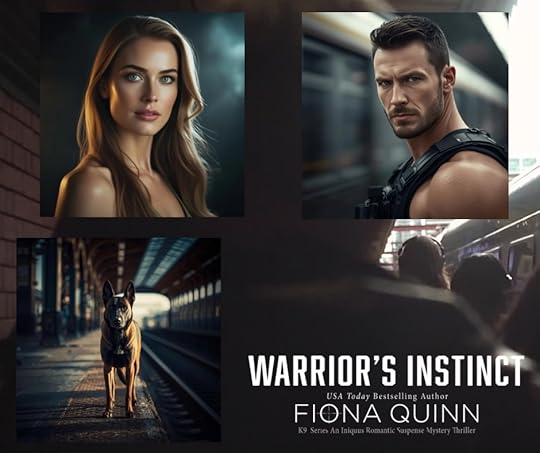
It'll take every instinct this warrior has to get them out alive . . .
Heath "Ares" Sterling thought he'd never see Hailey again. But now that fate—and Iniquus Logistics—has brought them together again, he'll do whatever it takes to earn a second chance with the one who got away. If only they were meeting under less deadly circumstances . . .
Hailey Stapleton hates the idea of being a damsel in distress. But when her latest humanitarian efforts land her in a warzone, she needs help fast. It shouldn't surprise her that Ares races to her rescue—or that she's as attracted to him as ever. Too bad their timing couldn't be worse . . .
Can Ares—and his K9 partner Judge—get Hailey to safety and convince her to take one more shot at happily ever after? His instincts say yes.
Racing against time, Ares's job is keeping Hailey alive as they struggle together for survival and a chance at forever love.
Fiona Quinn is a USA Today bestselling author, a Kindle Scout winner, and an Amazon All-Star.
Quinn writes action-adventure romance in her Iniquus World of books including Lynx, Strike Force, Uncommon Enemies, Kate Hamilton Mysteries, FBI Joint Task Force, Cerberus Tactical K9 Team Alpha, and Delta Force Echo series.
She writes urban fantasy as Fiona Angelica Quinn for her Elemental Witches Series.
And, just for fun, she writes the Badge Bunny Booze Mystery Collection with her dear friend Tina Glasneck under the pen name Quinn Glasneck.
Canadian born, Fiona Quinn is now rooted in the Old Dominion where she lives with her husband. There, she pops chocolates, devours books, and taps continuously on her laptop.
The following ratings are out of 5: Romance: 💚💜💙❤️🩷 Heat/Steam: 🔥🔥 Chemistry: 🧪🧪🧪🧪 Story/Plot: 📕📗📘📙📔 World building: 🌏🌍🌎🌏🌏 Character development: 😋🙂😘🥰🥰 Narrator(s): 🎙🎙🎙🎙🎙 Narration type: Solo Narration
🦸🏻♂️ Hero Spotlight: Ares
Ares is a Green Beret K-9 handler stationed in Africa, tasked with training and advising local military forces. Stoic, loyal, and quietly intense, he’s bonded not only to his mission but to his dog Judge—a fiercely protective Belgian Malinois. When Ares meets Hailey, a humanitarian worker with a heart as strong as her convictions, it’s instant connection. Their love blooms in a fragile landscape, and even Judge falls for her, shadowing her like a guardian. Ares proposes, and Hailey says yes—but fate has other plans.
🦸🏼♀️ Heroine Spotlight: Hailey
Hailey works for World Cares NGO, originally arriving in Africa to help a village recover from an earthquake. What was meant to be a short-term mission turns into a year-long commitment. Alongside her friend Kibbi, she runs a school and spearheads clean water and solar energy initiatives for local women. Though the region simmers with tension, Hailey never witnesses violence—until the day everything changes.
🔥 Plot Pulse
A brutal militia attack on the school compound leaves Hailey the sole survivor. Her survival is owed to Ares and Judge, but the trauma sears her soul—and her connection to Ares becomes tangled in grief. She returns to Kansas to heal, and years pass before their paths cross again.
In the present day, Ares and Judge are part of Cerberus Team Bravo, a K-9 tactical unit with Inniquus Security near Washington, D.C. Hailey remains committed to humanitarian work, now coordinating global aid efforts. When tensions rise in Eastern Europe, she’s tasked with pre-positioning supplies in a vulnerable Russian town. But when the transport falls through, a risky plan emerges: enlist a security team headed to the same town. That team? Ares and Judge.
❤️🔥 What Hit Home
• 🌍 Immersive World-Building: The author’s research shines—whether it’s the logistics of humanitarian aid or the precision of K-9 operations, the realism adds weight and urgency. • 💔 Second-Chance Romance Done Right: I’m not usually drawn to this trope, but the emotional complexity here worked. Hailey’s trauma and her association of Ares with the worst day of her life made their reunion feel earned and raw. • 🎬 High-Stakes Action: The pacing is relentless. Just when you think the characters are safe, the war erupts, pulling them into danger and suspense.
🤨 Room to Grow
• 🧠 More of Hailey’s Inner World: While Ares’ POV dominates, I craved deeper insight into Hailey’s emotional recovery and her decision to distance herself. Her silence speaks volumes—but I wanted to hear her thoughts.
🎧 Narration Vibes
Narrated in dual POV by Aiden Snow (solo performance), this audiobook surprised me. I typically prefer dual narrators, but Snow’s voice—deep, resonant, and emotionally grounded—carries both perspectives with skill. He brings Ares’ intensity and Hailey’s vulnerability to life in a way that feels intimate and authentic.
📝 Final Thoughts
This audiobook delivers a gripping blend of romance, trauma recovery, and geopolitical tension. The emotional stakes are high, the action unrelenting, and the narration pitch-perfect. If you’re looking for a second-chance romance with teeth—and a dog who steals the show—this one’s worth the listen.
Ms. Quinn, you never fail to amaze me. Through a gift you have been given you illuminate so many societal issues and realities. I saw the parallel, however will not be giving it away. These two individuals, Area and Hailey lived through so much, yet it also "broke" them. Everyday we see on the news horrible details of what man does to one another, in many countries, especially the USA seeing and reading about it, with television, newspapers, electronic print, still isolated us from the reality. Like Kerry, at the beginning of the book we may cry over horrible situations, but we are not there to realize just how terrible it truly is, yet her very adult explanation to six year old Hailey led her on a trajectory for her adult life from that moment. Hailey, becomes one of the "helpers" to areas that need it in war torn, or natural disaster areas. Unfortunately, it has a devastating effect on Hailey. So devastating all her joy is lost with her new engagement with Ares. Time passes and Hailey finally returns to helping, but in a capcity that allows her aid but no longer in the same position. She simply is unable to handle emotionally being part of the work, but yet she brings what is needed to begin for others. Ares and Judge leave the Green Berets and joins Cerberus, part of Iniquus. Now, you have a reason to read as this prefaces these two and the rest of their story. They meet again in an area where Russia is, as usual, thinking of taking over. Hailey is there to provide needed supplies for setups and humane action, and Ares is there to help removal of American citizens for a client of theirs. Their meeting up is unique and frankly unparalleled. But, it means Hailey sees Ares, her love , and Judge her K9 savior. Now you must read! Ms. Quinn, my thanks for the preface to this novel, I will not be researching these areas. 🙂 But, your realism in this novel makes me want to learn more about world humane help groups. Doctors without Borders, does much, yet deep research also disappointed me... The almighty dollar, pound, dinero, etc pollutes DWB, unfortunately. And the people who DONATE their time and specializations recieve nothing but the self gratification for what they are able to do. Your descriptive writing put me dead in the place where the story begins and ends, regardless of tragedy or joy, I felt as if there. The ending truly was stupendous.
Wow starts with joy and immediately turns horrific before moving on to living life after the horrors of war. So much is brought to light, survivors guilt, moving on and the search for peace. Joy is delivered.
Warrior Instinct was an outstanding book and Fiona Quinn does a stellar job in writing a romance set against the backdrop of an impending war. I loved, loved, loved it! The strong parallels to the onset of the Ukrainian war were timely and captivating. I was captivated from the first to the last page. I was really impressed with the dialog about the ramifications of a war with Russia. The story is well paced and the final few chapter are tense, suspense filled and exciting.
Ares, his K9 Judge and Hailey have a history and now they're in one another's orbit again for the first time in three years. After surviving a murderous attack in Africa, Hailey's need to heal both mind and body meant they had to part ways and that was devastating for Ares but he had no choice but to abide by her wishes. Hailey is still driven to help those in need regardless of the circumstances. Ares is not thrilled that she's endangering herself in what could become a war zone and is determined to extricate her no matter what. Seeing him again is the impetus for her to declare her feelings and apologize for their separation. Their renewed love in a time of crisis truly does cement their future.
I have enjoyed every book I’ve read by Fiona Quinn, even the cliffhanger that she wrote involving Lynx – and I abhor cliffhanger endings. I was angry with the writer because of that unnecessary non-ending but I still appreciated her writing style, her complex characters, and her equally complex plots. And…I love the K9s in Iniquus’ Cerberus Tactical K9 teams; each has his/her own personality that leaps from the pages of their books.
This fourth entry in the Cerberus series, however, does not have that same verve, if you will. Warrior’s Instinct is a love story, albeit to a different degree. The first book in this series, Survival Instinct, hooked me. I was hopelessly wowed. Protective Instinct, the second book in the series and my favorite, featured K9 Zeus whom I adored. The story of Zeus’ partner, Ridge Hansen, and artist Harper Katz is topnotch. The third book, Defender’s Instinct, was intense with behind the scenes looks at K9 training and agility games. It left me in withdrawal…until this current book.
I’m not sure why this book left me lukewarm. I did not care for the heroine, Hailey Stapleton. She was too good, for all that this is not a reason to dislike a character. Hailey’s entire life – every last bit of it – is wrapped up in doing for others, and she excels at this. But she is dull and filled with angst that she has manufactured for herself while blaming the distress and suffering that took place in Hatari, East Africa, three years prior. She walked away from a man she loved, the book’s hero, Heath “Ares” Sterling, and his K9 Judge. Ares is also good through and through, and yet there is more to him than good deeds. Hailey is just her good deeds. How odd! I liked the K9, Judge, who loved Hailey, so I tried to like her, too, failing miserably at that task.
Hailey has compartmentalized her life and refuses to entertain thoughts about Ares and Judge. She has apparently placed all the trauma that occurred at the Hatari station on Ares and Judge. Yet, after seeing Ares again, she introduces herself to folks she is helping and calls herself by his last name. They were never married. Hailey agreed to marry him the day she left him and then refused to see him again. Affixing his last name to hers is strange and seems largely out of character. Presumably it is meant to show that Hailey is stunned to see Ares again and memories come spinning back.
This book has more errors in it than I’m used to seeing in Ms. Quinn’s books. She is a consummate artist with the way she paints pictures with words; her books are as insightful as they are entertaining. I have noticed that Ms. Quinn uses a lot of standalone dependent clauses when she writes. Usually, they become self-explanatory within a sentence or two, but in this book, some of them stop a reader’s forward momentum, forcing the reader to pause and wonder what the writer is trying to say. For instance: “While Hailey was given the task of supporting one tiny city.” Uh…OK…while Hailey supported the city, what happened? We don’t know. “Hailey blinked up at Ares some tension, some expectation and some confidence.” I have no idea what the writer is trying to say. Did Hailey blink with tension, et al? Was Ares tense and such? Who knows? “While they had met the first time at the disastrous earthquake.” This is another dependent clause and again the reader has to wonder what happened while they met during an earthquake. The writer doesn’t tell us. N.B.: I’m not sure why the writer uses so many dependent clauses as sentences. She is certainly aware of their proper uses. She wrote this: “While they were smaller, their impact accumulated.” It makes more sense to have an independent clause to hang onto; in this sentence, we understand exactly what happened while they were smaller: their impact grew (“accumulated”).
There are more grammatical/typographical errors in this book as well. For example: “…you’ll have eight hours to gather you kit….” I’m pretty sure that should be, “…you’ll have eight hours to gather YOUR kit….” “It was located across the street from train station.” This is narrative; it is not someone speaking in the vernacular. It should read, “It was located across the street from THE train station.” “He used hem of the shirt to clean her glasses….” Another misplaced definite article, this should read, “He used THE hem of the shirt to clean her glasses….” “…Cerberus Tactcial K9…” is a typo and should read, “…Cerberus Tactical K9….” “…and Hailey did to much stooping to talk to kids….” This is the wrong homonym and should be, “…and Hailey did TOO much stooping….” “Everyone I’ve spoken with seem to think it is very little.” Use of the word, “everyone,” is always up for a lively debate. Without a doubt, grammatically, the word is singular and refers to a group, not to each individual within the group. But…when it is paired with other words in a sentence, experts disagree, particularly when used with plural pronouns like “their.” However, it’s straightforward here. It’s used as a singular noun and the sentence should read, “Everyone I’ve spoken with SEEMS to think it is very little.” At times, punctuation is placed oddly: “…just winging this – uhm , making decisions as you go….” The comma should not be surrounded by spaces and should be, “…just winging this – uhm, making decisions as you go….” “…Mr. Rodgers was right when he said, ‘When I was a boy and I would see scary things in the news, my mother would say to me, “Look for the helpers. You will always find people who are helping.”’” I believe this is Mr. Rogers of Mr. Rogers’ Neighborhood fame (1968 – 2001). If so, his name is misspelled and should be, “…Mr. Rogers was right….” “Hailey was both concerned for those left behind, but she was thrilled that Iniquus wasn’t changing their minds….” The word, “both,” connotes two things, the one as well as the other. First, she’s concerned for those left behind; and second, she’s concerned for…what…? We aren’t told. I think the word, “both,” should be removed. “But he did get transceivers incase the phones went down….” The word, “incase,” is an alternative spelling for the word “encase,” meaning to enclose. Here, the conjunction, “in case,” should have been used. The sentence should read, “But he did get the transceivers IN CASE the phones went down….” “…it was my job to negotiate an agreement to allow safe passage through a certain area a canyon that was a set up for a death valley.” I believe there’s a missing preposition and the sentence should read, “…through a certain area OF a canyon…” or possibly, “…IN a canyon….” I’m not sure what the writer wants to emphasize here. “…were glad that I gave it a go liked I did.” I think this is a typo and should be, “…I gave it a go LIKE I did.”
Readers have come to expect errors in books these days, but when the errors yank a reader out of the story in order to puzzle over what the writer is trying to say, it is detrimental to a good reading experience. I know that Ms. Quinn’s books have been well-edited and proofread in the past, but this book seems rushed and so, perhaps, the editing and proofreading were also rushed.
I rated this book 3.5 stars and rounded up because I so enjoy Ms. Quinn’s writing. I always learn something in her books. This latest one is especially timely given what is happening right now in the Ukraine. The parallels between current events with Russia attacking the Ukraine and the events in this book are remarkable and eerily accurate. The world waits on the edge of a precipice while piling on still more sanctions against Russia. Will they work? We don’t know. And this parallels the book’s concerns, too.
A fifth Cerberus Tactical K9 book is due out in November. I would willingly wait until December or even January (later, even…!) if it would mean that the book would have an opportunity for a final quality edit and proofreading. The number of errors in this book was distracting and at times confusing. I hope the next book contains many fewer off-putting mistakes.
I’ve read the majority of this authors books & have enjoyed them. This one was a disappointment. Hailey comes across way too selfish, ignorant & weak for the role she is supposed to have. The overall storyline was thin & uninspiring.
I suppose we are all capable of surprising ourselves. But oddly enough, I'm surprised when I manage to do it. My reading habits are morphing in a direction I never would have foreseen. I started out with the discovery of Robert Heinlein' s juveniles some 60 years ago, and then spent the next fifty reading nothing but SF. Then ten years ago, my wife's penchant for mysteries led to Lescroart (a fellow San Franciscan at the time) and then Connelly and o the rmysteries. And thrillers - cant forget them!
And somehow, in some weird way, they all led me to Fiona Quinn's world of action romances. I could never have predicted it - hence, my surprise. Her world centers around a security firm built with veterans known as Iniquus, with various divisions and teams (in this particular case, Cerberus is the K9 branch). That allows here to blend all her books so that not only is there relatedness within a series (such as Cerberus) but between them as well. For instance, just before the team that Ares, her hero is on deploys to fulfill a contract removing an American corporation's employees and their families from an impending war zone with Russia (the remarkably resembles the Ukraine), they all need to replace their electronics because spyware was found in another series that involved an Iniquus operative.
That kind of world building, begun in Weakest Lynx, some 16 books ago, to expand as it has. But it isn't the only commonality. The other is romance, and it's proven to be as attractive to me as her quasi-military security firm. All the males are bunks who are fit and strong. her biggest challenge has been creating women to serve as fitting foils. And she succeeds once again here. One is a war correspondent (featured in a previous book), and the primary heroine, Hai!ey, is a logistics coordinator for an NGO. Area and Hailey knew each other. They had just agreed to get married when the village she was in was invaded. She was saved Ares and his K9, airlifted out as the sole survivor, and during her recovery and their separation had left the relationship lapse.
As you can imagine, they are the main story - but just as importantly,, Quinn has her characters speaking to life in countries about to be invaded. I'm not sure how close to the actual invasion of Ukraine she wrote this, but it's pretty clear she was studying up on what was coming. Well done and thought provoking work.
As with all her books, they end up together - so that's not really a spoiler. Read her books - so far they've all resolved from two protagonists into a couple. And, surprise, surprise, every time I need a tissue!
Given the horrors currently being perpetrated on the people of a certain Eastern European country, you will likely find yourself on the edge of your seat from the first page to the last as you read about a suspiciously similar event unfolding within the pages of this book. Having narrowly survived an incredibly harrowing ordeal 3 years ago in East Africa, Hailey Stapleton, a humanitarian aid-worker has only barely managed to get her life back on track by cutting all ties with her former fiancé, Heath Sterling (known as Ares to his Cerberus Tactical K9 Bravo Team colleagues). Being around him or his K9, Judge, is simply too painful a reminder of that horrifying day when she lost so many close friends and valued colleagues. Despite her profound struggle with survivor’s guilt, life goes on. Natural disasters and political crises stop for no one and she musters the fortitude to continue her life’s work – helping those in need. Her latest assignment is to coordinate humanitarian aid to an Eastern European town, Nezdolannyy, that is thought to be in the crosshairs of Russia’s unrelenting war machine. As fate would have it, Ares is sent to the very same town on a mission of his own. Old familiar sparks begin to fly when their paths cross. This amazing story has something for everyone. I found the deft blending of current headliner events with the fast-paced, well-plotted adventure of the main characters to be completely riveting. The sheer volume of research that obviously went into crafting a tale of this caliber is readily apparent given the detail of political analysis, military tactics, and humanitarian aid challenges described so convincingly. All of this makes this book an absolutely spellbinding read, but add in Fiona Quinn’s signature style of sizzling romance and you have quite a treat in store when you pick up this book. Be prepared to stay up late, you won’t want to put it down.
I have read all of Fiona Quinn's World of Inniqus, Cerebus Tactical K9 and Delta Force books and, to greater or lesser extents, loved them all. This one is loosely based on the Russian invasion of Ukraine, with a fictional city in a fictional country. I only gave this one 4 stars rather than the usual 5 because - all of the books have a romantic element and some, graphic sex. It seems to me that the romantic and sex element has grown in some of the later books, so that it is equally as important as the action/adventure. In this book there is no sex, and in fact the love story is rather sweet. But - I never buy books that come under the heading of romance. I like it as an integral, if not too big, part of the larger story. The goal of each book, apart from the usually great, exciting stories, is to get each operator married off. In this book, the story of the romance between Ares and Hailey is the main point of this story. The desperate evacuation of the city in the face of Russian invasion comes over as simply the vehicle for them to find each other. I like that a character from a previous book is part of this one, and as a seasoned war reporter she gives a very graphic account of what non fighting civilians, especially women, can expect to happen to them in an invasion such as this. However, the book ended very quickly and the epilogue was a continuation of the love story. A lot of Fiona Quinn fans will love this as much as the previous books, and in spite of everything I can't say I didn't enjoy it. But not the best for me.
By now I've come to expect nothing short of top-notch from Quinn, and she has yet to disappoint. Warrior's Instinct is another worthy addition to this World she has so meticulously created and populated with characters who are always endearing and captivating. From the men and women who fight to defend the innocent, to their friends and loved ones, to the canine characters who assist them in their vocation, each one of these characters crawls into your heart, causing you to become deeply invested in their success.
Meet Ares and Judge, and Hailey. Life has conspired to give them a second chance at grabbing the gold ring, but life is also going to make them work for it. In the pages of Warrior's Instinct, Quinn weaves a story that is timely. Compelling, this narrative might have stepped off the front pages of the latest newspapers. The in-depth research this author does gives the reader the feeling that they are on the front lines seeing events as they unfold.
I am always ready to read another installment in the world of intrigue and subterfuge that Quinn's characters step into regularly, Warrior's Instinct is another masterful work you should not miss. Grab it now!
[I was fortunate to receive an Advanced Reader Copy of the book from the author, with no obligation to review. The opinions expressed herein are given freely and are entirely my own.]
Heath (Ares) Sterling is a former Green Beret, K9 handler and current operative for the elite Cerberus Tactical K9 Team. He's seen war and he's seen rescue with his K9, Judge. But Ares is empathetic and thoughtful, as well as, the ultimate warrior. He meets Hailey Stapleton during a variety of rescue missions where both his team and her private rescue organization are providing services. She is the ultimate caregiver: kind, patient, but also intelligent, thorough and determined. They are perfect together. Until tragedy strikes and derails their life plans. When next they find themselves together, they are still performing the jobs they love, but the circumstances are much different. Instead of natural disaster they are facing the specter of devastating war. The trauma that overtook Hailey still haunts her, but Ares presence finally begins to remind her what life is really about. The mission they are both facing is described in excruciating, truthful detail. This insight explains the horrors of war and the devastating results. The instincts both Ares and Hailey exhibit make this story gripping and their interactions with their fellow workers, friends and compatriots provide stirring reality and action to the story. Their reality is honest, hard, but in the end, magical.
DNF. Maybe it’s brilliant when it gets going, but I didn’t like it.
Maybe this book could be really good but I didn’t like the beginning, so it wasn’t a good start. The prologue is three years previously, when Hailey and Ares are madly in love and he’s proposing to her. Hailey is an aid worker, and Ares is a Green beret. When Hailey’s camp is overrun by terrorists, she’s badly injured and so is Ares tactical dog. It never says what her injuries are, or why they split up. It hints at Hailey not coping with life, but that’s it.
Fast forward three years later and Hailey is still working as an aid worker, and Ares has left the Green berets and gone to a private company. This is where it lost me. There’s pages and pages of details about his company, her company and I kept zoning out. I’ve got no interest in computer systems and what they can do, or the latest in microchips, or how they train their dogs.
Hailey is the other problem for me. She went through something horrific and yes it has changed her. She comes across as cold, apart from Ares dog who she obviously loves. She never once thinks about Ares and what could have been. He thinks about her. She never talked to him after she injured, about how she was feeling. She just stopped answering his texts and calls, and I found that really sad.
Warriors Instinct is the fourth book in the Cerberus Tactical K9 series by Fiona Quinn. Ares is in the military when he meets Hailey. Hailey works for an organization that provides humanitarian aid and they go in to help after a disaster strikes. Ares and Hailey spend a lot of time together and Ares proposes, Hailey accepts. Then the unthinkable happens, Hailey as well as the other workers and children are attacked and it takes everything Ares and Judge can do to save Hailey. Hailey returns home to heal but she is suffering from survivors guilt and has stopped communicating with Ares who was still in the military and was unable to be with her while she healed. Ares leaves the military and takes a job with Iniquus, Ares team is called up on a mission and when he arrives at the location the first person he sees is Hailey. Can his heart take being so close to her and not being able to hold her? Will they be able to get together and make it work or is it all just too much for Hailey to handle? Will she let her past dictate her future? I loved this book, the story was original and heart wrenching at times. The characters are amazing and I love the added character of Judge the K9. This is a must read.
This is an emotional and physical whirlwind as it details the preparations of evacuating the citizens of a city prior to an invading army. The story is enticing and riveting. I love the storyline and amazing characters. The topics dealt within are realistic and detailed. The author has built a world of characters that I trust and can find joy in. I was unable to put this book down my mind would not turn loose and relax until I read the last page. This author never ceases to amaze me but I was not prepared for the storyline straight from real life. The character development is beyond enticingbecause even the secondary characters play a major role in the storyline. The dogs and their part of the story is so well done that your heart is beating every time they do their job. The parallels to the Ukraine war make the premise realistic. This book details the mental and physical strain on the population of a small town preparing for a Russian invasion. I loved this book and would highly recommend it and applaud the author for her realism.
I adore second chances, and this one was a roller-coaster ride of emotions. Don’t get too far away from the tissues because there’s a very real possibility you’re going to need them before this story is done. I couldn’t help but hope for Ares and Hailey to put things back to rights. Their highs were stratospheric, but their lows could break even the strongest individuals. This book could almost have been taken from current headlines. In fact, if it weren’t “fictional”, this mission we see Ares and Hailey on likely would still be classified. The amount of research and detail that the author has brought into the story is readily apparent. The environment, politics, and characters are dense – they’re not simply cardboard cut-outs filling up the background. They all have purpose, even if that purpose is to rip the still-beating heart from the chest of the reader. I received a complimentary advanced copy of this book from the author.
Hours after she’d accepted Heath ‘Ares’ Sterling’s proposal to take their whirlwind romance permanent, health worker Hailey Stapleton found herself the sole survivor of the sole survivor of an outpost geared to save women and children in an African encampment and she owed her life to Ares and his K9 partner, Judge.
Hailey’s too a step beyond survivor’s guilt, including over Judge’s injuries, to continue her relationship with Ares as he prepares to leave the green berets. Three years later, Ares and Judge are part of Iniquus-Cerberus’ effort in a politically themed ‘wink at the headlines’ evacuation due to a Russian invasion. Hailey’s there installing a medical facility.
The years have done nothing to diminish the feelings Ares and Hailey have for each other, especially under the endangered life situation they find themselves in as the town prepares to be torn apart by war. Rating: 4stars
Warrior's Instinct is such a relevant book to this time (and for those that read it years from now, this is what was happening!). Fiona's books suck you in until you are finished and can't wait for the next one. This story was thrilling, loving, suspenseful, heartbreaking yet romantic. I discovered Fiona's books last year and have read through the entire series and all of them are excellent. Warrior's Instinct is no different. Fiona Quinn has become a must read author for me and I can't wait for the next books (always seems too long to wait). The characters are strong and realistic. I wasn't expecting the setting and was blown away with how relevant it is to today's "event" in that part of the world. And the K9's - can't forget the love and role they play in the story. Fabulous! Thank you!
Hailey, Ares,And Judge had been through hell when the village was slaughtered and lost their way.
Hailey was there to help the villagers recover after a disaster. Ares and His K9 Judge were part of a Green Brea training outfit close to the village. They fell in love. But then hell landed one day! The village was attacked and because of the Green Brea’s trying to come to the rescue Hailey was the only person to come out alive. But Judge was hurt and Ares decided to leave the Service. Her joined a K9 corp called Cerberus they helped save Judge. But nothing it seemed could save the relationship between Hailey and Ares. It took three years and another disaster to bring them back together. This time the threat of a war and the chance to save thousands of people brought them together. Will it be enough to break through the mess they have made.
Unusually, this is set in a scenario of current events which makes it hit all the harder. Three years ago Hailey was caught in a series of events in Africa which broke her new engagement to Ares. When she is sent to provide humanitarian support in a conflict zone, she finds Ares is also sent by Iniquus to help evacuate American civilians. They reconnect but Hailey still feels guilty for the injuries to Ares' K9 but gradually she and Ares rekindle their relationship. We all see the images and reports from Eastern Europe but Fiona Quinn has brought to life the parts we don't see everyday and make us realise just how many people are risking everything to help another nation. Parts can be difficult to read, but overall I found this a real page turner - well written and researched.
I enjoy reading about organizations that utilize K9s and ex military personnel. The situations they find themselves in are so believable, so…that could happen at any time situations. Ares and Judge, handler and K9 partner, former Green Beret, Judge removed from service so Ares went with him. Now working as search and rescue for a world renowned agency, meet Hailey in Africa and like turns into something more. On the morning he asks and she says yes their world is torn apart. Fast forward 3 years and they are alone, continents apart. Until the world turns and things start heating up. Taking a page from recent history, events play out to bring them back together. This is their story. I know you will enjoy it too.
I’m not grading this one as I didn’t get far enough. And I can’t say I didn’t like it. But for me as a dyed in the wool romance reader, as far as I made it, there was little to no romance. What there was, was a lot of information about war, talk of war, talk of invasion into Eastern Europe. I know there’s an audience for that kind of genre. In fact I’ve been watching a lot of videos about Ukraine fighting back about Russia, but a large reason I read romance is escapism from all the ugliness going on around us. This book was reminding me of it.
This is not a slight at all against fans of this book, none whatsoever. I’m glad I tried this author and the next person will love it and give it 5 stars and I’ll give them a thumbs up.
this plot setting is starting to align with current day events. there is steady pace and rekindled love happening here alongside threats of war. not a lot of steambor romance, however the love interests were together from the start so it was a wonderful reconnecting of 2 hearts. not a lot of action either but padt characters appear and the K9's are wonderful. I enjoy Fionas books as they keep me interested and I like to puzzle out what's going to happen. I'm listening to all these stories in chronological order so names and events are flowing through nicely.which is something I enjoy. Aiden Snow...just love his narration, looking forward to the next book.
I absolutely loved this latest book in the Cerberus Tactical K9 Team Bravo Series! I was on the edge of my seat and couldn’t put the book down. It has action and suspense in a soon to be war torn country. Teams rush aide and work to evacuate the innocents while two leaders relive their past and try to live in the present. Ares and his K9 Justice have loved and lost Hailey once and both are determined to not lose her again. Buckle up and grab you tissues and settle in for a wonderful story (well minus the war thing). This one deserves 10 Stars!
A love story with heart wrenching turns. Ares knew Hailey was the one for him. His proposal left her feeling such joy she could hardly wait to share her news with her friend at the station she had set up. Danger strikes and only Area and his K9, Judge's quick action saves her. Unfortunately, reconnecting with him only reminds her of pain, loss, and quilt! He has to let her go in order for her to heal. Will fate step and give them a second chance or will they be ripped apart forever?
This story unfold with happiness that is soon interrupted by horrors of human inhumanity to each other. In a country torn by devastation from both mother nature and warring. Orphans left behind, entire towns destroyed. The rescue groups go in to help, Hailey works with one, while Ares, once a Green Beret and his K9 Judge, are now with a K9 tactical support team. It's a crazy ride thru the real horrors of war and love mixed together, if it can survive
I enjoyed this story of Ares and Hailey. I like how she shows the connections between the K9’s and handlers in this Series. I read everything that Fiona Quinn writes because I love her books’ mix of adventure, action-suspense, and romance. Read all her stuff—-it is great! I’m leaving only 4 instead of 5 stars because although this one was also quite good, it’s s the first book of hers that I found myself scanning/skipping to get past some detailed background to get back to what was currently going on.
Thank you for writing this story! I loved reading it and learning some about other cultures and how they face extreme issues. I traveled to Sarajevo and talked with some of its citizens. Every time I see Ukrainian news, I think what the Sarajevo citizens went through and how they’re surviving so many years later. It breaks my heart. This book also gave insight as to how those helping the attacked ones assist and deal with the issues. Definitely not the same as experiencing but better understanding than just watching the news.
This story seemed disjointed at 1st But man it got so good
I can't say enough about the characters in this book. Each had a different personality each was likable Each had their own job in the story to do and the author pulled it off beautifully. The story line was Entertaining, interesting and educational. It is not a short It is not a short story by any means and you need time to think things through the author brings up in the story or at least I did. I reckon recommend this book very highly.
Powerful storyline! Travel from Hatari, East Africa, to the borders of Poland, Ukraine and Russia, volunteers and American Tactical Teams rescue those in danger. When Hailey of World Cares NGO survives enemy attacks in Africa, she moves onto helping those trapped behind the borders of war-torn countries. The storyline is involved, must have required intense research and hours of writing in order to publish this great book. Thanks for keeping me totally involved within the pages of this book. Hugs to Judge who loved Hailey.