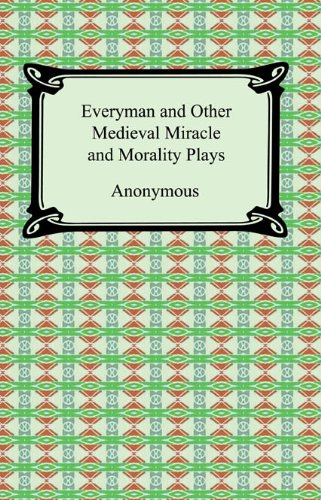
The medieval morality play, which became popular in Europe during the 15th and 16th century, is a allegorical drama in which personal attributes are personified and the moral of choosing good over evil is generally conveyed. In this volume you will find one of the most famous examples of this genre in the play "Everyman" along with the following other plays: "The Deluge", "Abraham, Melchisedec, And Isaac", "The Wakefield Second Shepherds' Play", "The Coventry Nativity Play", "The Wakefield Miracle-Play Of The Crucifixion", "The Cornish Mystery-Play Of The Three Maries", "The Mystery Of Mary Magdalene And The Apostles", "The Wakefield Pageant Of The Harrowing Of Hell", and "God's Promises."
Books can be attributed to "Unknown" when the author or editor (as applicable) is not known and cannot be discovered. If at all possible, list at least one actual author or editor for a book instead of using "Unknown".
Books whose authorship is purposefully withheld should be attributed instead to Anonymous.
A morality play: a religious allegory preached to the converted.
Everyman 4/5 stars: Basically a very long way of saying 'you can't take it with you'. An otherwise happy person, Everyman is told he's going to die soon, so scrambles about trying to find anyone willing to accompany him on his terrifying final journey. Family, friends, manifestations of money and pleasure all quickly find excuses, and ultimately it's only Everyman's Good Deeds who willingly takes his hand. It's a simplistic moral, yes, but an enjoyable read and I'd love to watch it performed some day, if only to see the costume concepts for the metaphorical characters.
The rest of the plays, bar the last, are just episodes from the Bible and to a contemporary audience they may have been very compelling. From my modern perspective, however, they were sorely lacking:
The Deluge: 2/5 The story of Noah making a giant zoo boat. The central comedy figure is his wife, who thinks her husband is insane and refuses to get on the boat, until the local gossips start panicking about the rain. Also, Noah's wife, in Genesis, the First Testament, says the line 'By Christ not' and Noah says 'so thou are by St John?':
Abraham, Melchisedec, And Isaac: 2/5 The play argues that the 'sacrificing' Isaac episode proves God is better than Abraham, because when the time comes to sacrifice his own son Jesus, he makes sure no lamb is shoved in the way first.
The Wakefield Second Shepherds' Play: 3/5 The misadventures of the shepherds just before they stumble upon the manger of Jesus. This felt like a deleted scene from Life of Brian, with a bumbling sheep thief trying to explain away a missing ewe in his house by claiming his wife gave birth to it. The humour falls flat.
The Coventry Nativity Play 3/5 Considerably more gory than the one I remember from school. Includes mass infanticide, Herod screaming and running through the audience, and the Joseph doubting Mary subplot is resolved rather quickly.
The Wakefield Miracle-Play Of The Crucifixion: 2/5 Basically a long dialogue of the torturers cackling about all the awful things they're doing to Jesus, and yet it's still more tasteful than Gibson's The Passion of the Christ.
The Cornish Mystery-Play Of The Three Maries 2/5 Three Marys mourn Christ. Mary Magdalene finds him in a garden. The end. Yay?
The Mystery of Mary Magdalene and the Apostles 2/5 Magadalene brings the good news of the Resurrection to the Apostles. They all cheer, save for Thomas, who is a doubting Thomas and a cantankerous arshole to Magdalene.
The Wakefield Pageant Of The Harrowing Of Hell 2/5 Jesus busts into Hell to take John the Baptist, Adam and some other good souls to heaven, bitch slapping Satan on the way. It's not as awesome as it sounds and is the only play in this collection that remains in Middle English for some reason.
God's Promises: 3/5 A series of acts where God constantly wants to kill everyone, is convinced not to and makes promises to certain mortals. It's the only mildly interesting play besides Everyman, here's the rundown: Adam: Be good and I'll let you have Jesus in several generations. Noah: God: 'I will drown all of earth!' Noah: 'Oi! I live here!' God: 'Alright, you may live, as you're so eloquent. How's your carpentry skills?' Abraham: God wants to destroy Sodom and Gomorrah. Abraham begs him not to, so God agrees to spare the city if he can find fifty good souls amongst the bad. Then Abraham basically barters with God, asking what if there's only forty, or thirty, then twenty, etc, and at no point does God inflict him with boils or explosive diarrhea for this. Moses: Moses convinces God not to kill everyone if they follow the rules. David: God: 'David, you ignorant slut, I curse you and wish death on the innocent people around you! Don't worry, through, I promise one of your kids will be a fabulous king'. Esaias: God, an all powerful deity and creator of the Universe, is still whining that people don't love him, but ends up promising the Messiah again. John the Baptist: God realises all these threats of destruction are getting him no where, so uses honey instead of vinegar and promises to send his considerably less hot headed (or monstrous) son to convince mankind to be good.
Bonus play: St George 1/5 Considering the utter slog of these plays, I thought this would be a well deserved treat for me, as I have a big soft spot for stories and ballads about our Patron Saint, but I was quite wrong. A Turkish Knight rushes into a tavern, followed by Father Christmas (seriously) and the King of Egypt. Then a man kicks open the door, crying: 'Here come I, St George, From Britain did I spring!' No he did bloody not, mate, sit your imposter arse back down. A dragon shows up and Not St George kills it, along with several people for no real reason. Then a necromancing doctor appears and revives everyone just so Not St George can slay them again. Finally, (as part of the actual script) the actors beg for money from the audience. This play has no morals, no miracles and no point.
Honestly, I'd advise anyone to simply read Everyman on its own and ignore everything else in this book. The rest is mediocre at best, enragingly asinine at worst.
the five stars are for everyman, which is really pretty amazing... it's funny and terrifying and immediately grabs you (i don't think i looked up from the page once from the first line to the very end) and actually surprisingly effective in making this reader at least actually consider the way he's living his life... i don't know why i never read such an incredibly famous (and ridiculously short and easy-to-read) piece before; i think maybe i thought it was going to be dry and dull? but instead it's kinda like samuel beckett... samuel beckett with hope, maybe... though that hope is not easily come by... i can see myself reading this again and again... i mean, this is like chaucer-type good (though without irony)... really just incredibly vivid... and i especially love the conversation he has with his worldly goods!! they are some tricky little bastards...
the other three plays in the collection, on the other hand, are, well, kinda boring... though the second shepherds' play is legitimately funny in parts (and the whole sheep-baby thing is really WEIRD)... noah's flood is kind of charming in a school-plays-from-the-movie-rushmore kinda way... but the last play, hickscorner... ? dunnowhatsupwiththat
but yes, everyman! now i get it! i totally understand where this guy's coming from.
"Everyman" is an excellent play, but "Hickscorner" had no discernible plot and the other two inclusions were just ok. I won't be keeping this Dover Thrift Edition, but do suggest you enjoy "Everyman" via Project Gutenberg.
This was, shockingly, the only version of "The Everyman" I could find in the system, but I wanted to include it as it is a classic and I well enjoyed it.
I have included a quick summary below:
The messenger? Death. The message? God has summoned you to stand before Him and give a reckoning of your life. What do you do? The protagonist of this play, the shocked and distraught Everyman, faces this exact issue. But he is granted a day's grace to gather together anyone who will travel with him and help him at his judgment. As this moral allegory unfolds, however, poor Everyman learns that neither possessions, nor accomplishments, nor character traits will follow him to the grave. He must face his reckoning alone... Perhaps because Everyman's problem is our problem, this play, one of the earliest extant dramas in English, still provokes thought and discussion nearly 700 years after it was written
"We must all suffer from one of two pains: the pain of discipline or the pain of regret. The difference is discipline weighs ounces while regret weighs tons.”~Jim Rohn
As part of my quest to read more classic plays I picked up Everyman for a quick read (only 39 pages). Everyman is a one act play that was written centuries ago. The earliest English version dates from approximately 1520. It's amazing how relevant the play is nearly 500 years later, although concerns of morality and mortality never really change.
The play/poem starts with Death visiting Everyman. Naturally Everyman does not feel prepared for the day of reckoning and pleads for more time. Death denies the request; however, he allows Everyman a little time to find someone to speak in support of him. Everyman goes to Fellowship, Cousin, and Kindred asking for help and they all promise to help him with anything he needs. When he tells them what he desires they all understandably renege on their promise.
He visits Goods who he has "loved the most", for surely he will go with him. Everyman pleads with Goods to come and says, "Money maketh all right that is wrong." Goods responds, "Nay, Everyman, I sing another song, I follow no man in such voyages. For and I went with thee, thou shouldst fare much the worse for me; for because on me thou did set thy mind, thy reckoning I have made blotted and blind." That's good stuff right there.
Next he visits Good-Deeds who hardly knows him and who is weak due to lack of attention. Everyman says, "Therefore I come to you, my moan to make; I pray you, that you will go with me." Good-Deeds responds, "I would full fain, but I cannot stand verily." Everyman responds, "Why, is there anything on you fall?" Good-Deeds says, "Yea, sir, I may thank you of all; if ye had perfectly cheered me, your book of account now full ready had be. Look, the books of your works and deeds eke; oh, see how they lie under the feet, to your soul's heaviness."
Finally Everyman meets Knowledge and Confession who introduce him to others that can help him such as Discretion, Five-Wits, Beauty, and Strength. In the end, it is only Good-Deeds that can go with him to plead his case.
As you can see from the couple examples I cited, it is actually a fascinating read. It is well worth thirty minutes of your time. You'll thank me later.
Considering this is just a collection of four short medieval plays, there's not much to review. Props to Dover for putting this out just to get the plays in circulation; they're invaluable in studying theatre and the mindset of the medieval era. Heavy hitters included are obviously "Second Shepherd's Play" and "Everyman" (I say obviously because, of course, the whole world is as drenched in medieval drama as I am...sorry about that). These are the go-tos for medieval theatre, usually, the ones you find in the anthologies and collections for unsympathetic high schoolers filling elective requirements in their last semester (why yes, that IS how I got into medieval drama, how did you know?). The other two plays are the Chester version of Noah (I think York is better, personally) and a play I'd never read called "Hickscorner", which is not, in fact, about the town gossip in Kentucky. In fact, I'm not really sure why it's called "Hickscorner", as the character Hickscorner is not really that important at all and, in fact, most of the book is about the conversion of Freewill and Imagination. One of the fantastic things about medieval drama, and these plays in particular, is that they're fairly well written and they're funny. Noah's wife is a wench who won't listen to her husband (parallels, anyone?), Everyman's friends are so freaking shallow it's like watching "Mean Girls", Imagination is kind of a playa, and the shepherd's are a little...slow on the uptake. Also, sheep. So they're quick reads, they're a lot of fun to perform/read out loud; yeah, medieval drama is fun, yo.
Decided to stop reading the book - did not find it enjoyable. The old-English writing made my head hurt, and I often did not understand what was being said. Reminded me of why I relied on Cliff Notes so much in high school. I would love to have a discussion with someone who rated this book 5 stars. Did they really enjoy it that much, or are they giving themselves the 5 stars for slogging through the thing?
Good. I found an interesting reference to migraines in the fourth play, Hickscorner, which is a rather bawdy play to start with. I dare anyone to be able to read that section (the whole Hickscorner play) and keep a straight face!
Honestly, other than for their historical value, and their influence on Elizabethan/Jacobean drama, I find medieval morality/mystery plays completely boring.
I just read two of the plays in this book for my British Drama class so I’m just commenting on those two, Everyman and The Second Shepherds’ Play.
Medieval drama is not something I was completely familiar with though I knew a few of the conventions. These are two really interesting examples of the genre. Everyman is a morality play and The Second Shepherd’s Play is a miracle play.
Everyman is the story of a man who’s been called to give his account to God and he’s not ready. He wants more time. When Death comes to deliver the message, he realizes there is no more time. He starts asking various people if they will go with him on this journey. This is an allegory so the people are actually things like Fellowship, Kindred and Goods. None of them are willing to go with him to meet God. He asks his Good-Deeds to go with him and this ends up being the only one that goes all the way to the end with him. Knowledge stays a while and so do a couple of his other traits but in the end, only Good-Deeds goes all the way.
It’s definitely a way to teach the audience some good Catholic doctrine and there was a plug for how wonderful the priests were, probably coming at a time when some of the corruption in the church was starting to come to light. A play like this is so enjoyable for a modern audience whether they are religious or not. It’s just a really clever, thought-provoking piece of writing.
The Second Shepherds’ Play is a miracle play. It’s part of the cycle of Bible stories that were presented at festivals. It deals with the shepherds out watching their flocks when a fellow they know stops by to visit. They know him to be dishonest but they let him stay if he will sleep in the middle of them. He still manages to steal one of their sheep and take it home to his wife. When the shepherds come looking, he and his wife conspire to hide the sheep in a crib and pretend it’s a new baby. Much hilarity ensures. I mean that truthfully, not sarcastically. In the end, the shepherds find out the truth and do not punish the thief to the degree they could have. When they return to the fields, they are met by the angels who tell them of the Saviour’s birth and they make their way to Bethlehem. There are so many parallels and contrasts between the first part of the story and the second part of the story that it’s just fun to discuss and think about.
Medieval drama will never be my love but it’s pretty cool once in a while.
I was torn over whether or not to give five stars. Without a doubt, I enjoyed this book of medieval plays far more than I expected. I was assigned to read all but "Hickscorner" for a my Intro to Theatre class (for my fine arts elective in college). Though I didn't enjoy each play equally, this is such a great little book, and a hidden gem among the troves of age-old literature/drama. I feel that it is necessary to give a short review of each of the four plays (with my rating out of 5):
1. "Noah's Flood" - 3/5 Not much to be said here. Very short play, and definitely an interesting dramatic take on the flood account in Genesis.
2. "The Second Shepherd's Play" - 4/5 This play is a fairly well-known piece, and there are some superb performances on YouTube if you're interested. Anyway, this play is essentially a funny little story about a sheep-robber having a run-in with the shepherds he is stealing from. The twist comes at the end, when the angel appears to reveal that a baby has been born in Bethlehem. The play ends with the shepherds praising the infant Jesus, the God of salvation manifested in the flesh.
3. "[The Summoning of] Everyman" - 4/5 "Everyman" is a great allegorical work revolving around the character Everyman, who represents all of mankind, in a sense. Ultimately, this allegory is very prototypical to John Bunyan's "The Pilgrim's Progress." It is the story of the everyday man on the road to salvation. There are some heavy medieval themes (penance, venerated saints, etc.), but it is still a gripping and remarkable drama worth reading.
4. "Hickscorner" - 5/5 Somehow, there is hardly any information about this work on the internet. Yet, I found this one to be the best in the book. It tells the story of three godly man beckoning their persecutors to trust in Christ's work and to turn from their old sinful lives of violent and sexually immoral lives. There is quite a bit of explicit content mentioned (in medieval verbiage, that is), but this allegory-like work displays the glorious freedom from bondage to sin and death that is offered in Christ alone. I will definitely pick this one up to read again someday (and I plan to keep it in mind for great gospel illustrations!).
Hopefully this was helpful, and hopefully your interest is piqued. If you ever get the opportunity, the last two are worth the time to read.
I bought a copy of this from ThriftBooks. You can often find better deals on books there than on Amazon. I give myself four stars for being able to understand the early English quite well. Kudos to the editor who provided footnotes for the outdated terms. It's fun to think about how old these plays are, yet the plays first two plays, Noah's Flood and The Second Shepherds' Play, are about events much, much older. I pictured myself taking a time-machine and sailing on Noah's Ark. I've been on a cruise ship but it's not the same. It made me want to see the Ark Encounter in Kentucky. It's a four hour drive from where I live. The last two plays, Everyman and Hickscorner, seemed seemed more philosophical. I think the cover art might depict Death's character as the skeleton interacting with Everyman's character as the human. I wonder if the art was from the same time period as the book. I haven't been able to find anything out about the cover. Some stories don't have a "moral to the story," but these definitely do, hence the term "morality plays." Everyman's moral is that you can't take any of your worldly possessions when you leave this life, but, as Kierkegaard would say, "ethics are eternal." Considering that the freewill debate is still going on in 2024, it's interesting to see Freewill as a character in Hickscorner; and said play's reinforces my suspicion that religion played an important role in the development of today's conception of freewill.
Telling allegory on the state of man. Everyman is called to give account to God and finds himself woefully unprepared to meet God and answer for his life. In pleading for more time and a companion to join him, he realizes that all forsake him, even friends and family. His strength, beauty, wits, and discretion cannot take this final journey with him. Only Good Deeds can go, and only after he visits Confession and repents. Written with a heavy Catholic worldview, I take biblical issue with the view that one's good deeds can secure him/ her a favorable place or condition with the Almighty God; but the play, in its deepest levels, is relevant and thought-provoking. Our good deeds do have value and a place in the Kingdom, but only once we have come to the desperate realization that we can only enter the King's presence on the merits of and through the sacrifice of His Wonderful Son, Jesus.
A worthy read! Great for discussion with young people. Themes: Live for Tomorrow; Final Judgment; Deceptiveness of Sin
O eternal God, O heavenly figure, O way of righteousness, O goodly vision. Which descended down through a virgin pure to redeem every man, which Adam forfeited by his dis-obedience. O blessed Godhead, elect and high divine, forgive my grievous offense. Here I cry your mercy in this presence.
O ghostly treasure, O ransomer and redeemer, of all the world hope and conductor, mirror of joy, and founder of mercy, which illuminates heaven and the earth besides, hear my clamorous complaint, though it is late. Receive my prayers, and though I am a sinner most abominable, yet let my name be written in Moses' table.
O Mary, pray to the Maker of all things to help me at my ending. And save me from the power of my enemy, for Death assails me strongly. And, Lady, I crave that I may, by means of your prayers, be a partner of your Son's glory, by the means of his passion. I beseech your help to save my soul.
Five stars for Everyman. Hands down my favorite monologue prayer. Second Shepherd's play was really funny.
This was a really interesting book. I didn't know about Christian drama during the 14th-15th century until I read this book for work. It was interesting to read something from those times. I would give it four stars. These plays were originally produced in groups called cycles. I wish the book had included entire cycles of manuscripts rather than one play from each of the 4 cycles that survived. It is interesting though. I enjoyed this book and I rate it at 5 stars, but I wish it had more content.
I would recommend this for anyone with an interest in medieval history (especially Christian history during the medieval times) or a reader who enjoys reading plays. This book is especially good for someone who prefers short reads.
I thought Everyman was fine for what it is, a medieval morality play. It is heavy handed and not terribly dramatic, but this was not its purpose necessarily. However, the Second Shepherd's play is terrible. It is bizarre and poorly constructed. The grafting of the Nativity Play doesn't work either. Adam, a morality play not included here is even worse. It reeks of anti-Semitism and is unoriginal and formless. The first few scenes are drawn directly from Genesis, probably the point, and the testimony from other prophets doesn't add much to the work.
5/5 for Everyman itself. It's excellent and timeless. I think its wisdom is pretty universal and it ought to be considered one of the great books of western civilization. I read it in one go.
The others are more or less academic. A lot of it just propaganda for the medieval church. Do this or else sort of deal. I guess they are somewhat interesting as literary reflections of Augustinian and Thomistic theology but they are less universal and don't really grab your attention. I didn't enjoy them like I enjoyed Everyman.
A cheap and enjoyable selection of late-medieval plays that demonstrate a sense of popular religious culture. They are simultaneously bawdy and pious, which makes for a strange mixture. The selection is limited to only four plays, with "Everyman" being the centerpiece, and the texts themselves are paired with footnotes that define unfamiliar words. As a sampler of early English theater, this is a solid and affordable introduction, but for further study I might recommend the Oxford World Classics edition of the York Mystery Plays.
I read this because I wanted to remember the story of Everyman. I read it in High School English but had forgotten it. Now I remember why. It is verbose cubed. The act of reading it is tedious. The idea of anthropomorphizing virtues and concepts seems a little silly. The other three stories comes off no better. I reread it. I am glad that I did so and made a few notes. I will never have to read it again.
A good historical source, though the reading can be tough going. If you're going to work through these, I'd recommend reading this set of selections in an updated English version, unless studying for language purposes. It was a little much for comprehension at times.
"Everyman" was perhaps the best of the lot, and gives a unique window into the spirituality of another time. It is recommended, paired with an audio or video performance.
Do you ever wonder what it was like being in the crowd for these? What was the "staging"? The costumes? How many people in the audience were bored and annoyed but faking it for fear of... I dunno... a big fire in the village square?
Historically relevant, of course, and worth the few hours to read them for that reason, despite being (or because they are?) total clunkers.