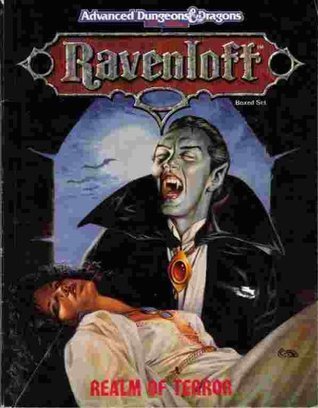
In the dead of night, as mists cloak the land, a traveler walks a country road. Footsteps echo behind him, in pace with his beating heart. Is it Death who follows? The man turns, and so turns the phantom. A flash of fang, a bloodcurdling howl, red eyes fueled by a passion from beyond the grave. The traveler discovers what others have learned before him: all roads lead to Ravenloft. Ravenloft is a new realm of terror for AD&D adventures, rooted in the Gothic tradition. It is a demiplane of dread and desire, a world whose misty fingers can reach into any other campaign setting and draw unsuspecting heroes into its midst. Once it holds them in its icy embrace, it may never let them go...
What lurks beneath the covers of this box?
A 144-page book detailing a complete, terrifying new campaign world, which was inspired by the classic TSR adenture "Ravenloft." You'll find new twists on magic and the AD&D rules, tips for adding fear to your games, plus a portrait of over 30 new lands and the powerful lords who rule them - from vampires, ghosts, and werewolves to men who are even more monstrous.
4 big, full-color maps, detailing deadly domains and shadowy settlements.
Another of Dungeons and Dragons' 2nd edition setting that came after the popular Forgotten Realms.
This one is different from traditional fantasy as it delves into gothic horror and the setting is not a world in the traditional sense, but a bunch of floating islands made for the type of campaign the designers wanted.
It is also worth nothing that it was based on an adventure of the same name that was very popular in the 80s.
We had many fun nights with this one and is a classic.
One of the D&D spin-off settings that took the game to new themes and in new directions, Ravenloft seeks to tackle the genre of Gothic Horror. The book isn't just crunch. In fact, there's hardly any of that. This tome is full of beautiful, wonderful fluff and guides for running a horror adventure.
The most crunch the book has is how to modify monsters to make them more scary and how to massage player character classes to make them feel just a little less powerful. The rest is filling in the setting. It gives you tools to disorient the players. It gives you colorful villains who are at once irredeemable but pitiable. It gives you plenty to throw at your players.
It also comes with tips for working a horror game. Ravenloft is not the high fantasy D&D normally subscribes to and most of the key villains will wipe the floor with an unprepared party. And it's something D&D often doesn't do anymore. The slow release pace of 5th edition has shunted every released adventure path into the Forgotten Realms even if it wasn't really needed. They don't really do setting books anymore (with the occasional exception like newcomer Ravnica). The original Ravenloft adventure saw a 5E update with hints of the greater Ravenloft setting. Here's hoping they take the next step some day.
I read everything in this box. The ideas in the setting are cool, but I never quite used any of it, because horror and ad&d never really quite mixed to me. At least not in an actual gaming session.
mi so dimenticato di aggiornarlo. anyway. necessario da leggere per capire ravenloft nella sua interezza, leggere solo van richten senza questo sarebbe come basare la propria opinione su qualcosa sentendo le informazioni dopo un gioco di telefono che va avanti da 30 anni.
#3 of my ongoing Ravenloft project, which will cover the core box set (when they introduced the idea of Ravenloft as a campaign, rather than just as an adventure) and the Monstrous Compendium volume 1.
First, I want to talk about the mood of Ravenloft, because as the kids would say, it's primarily a vibe. That vibe is gothic terror, or at least it's supposed to be: you're not just supposed to be scared for your characters' lives (though that too), but also really to feel horror at this world.
And despite the almost cheesecake cover, I think the core is more-or-less successful at that by highlighting that vibe: the interior art by Stephen Fabian is mostly crisp black-and-white illustrations of horror-related things -- a masked ball where one terrible mask may in fact not be a mask, a vampire threatening a lady (this actually looks more like Hammer cheese than early Universal monster horror), etc. The core also starts out, now with a description of this world, but a short 3-page primer on Gothic horror, including suggested reading. (It was, in fact this core that I got when I was 12 that led me to read Dracula and Frankenstein for the first time.) The book also is pretty liberal with using quotations from literature about horror and dread, which gives it a classy vibe. Or at least, that's what I remember when I was 12.
Reading it now, well, there's still that ambiguity that I remember about what Ravenloft is: evil people come into Ravenloft, get caught by the Dark Powers (sometimes just called "The Mists of Ravenloft") and get made into a Lord of a domain that they can no longer escape, and which in some way taunts them with their inability to fulfill the dreams that are probably why they became evil. So the paradigm of this is Lord Strahd, a guy who killed his brother and a bunch of other people because he was in love with his brother's fiancee; now he's a vampire and every once in a while a woman appears in his domain who might be the reincarnation of the woman he loved (who, it should be said, killed herself to escape him), but he can never capture her. A lot of the other lords of the domains have similar stories: you wanted power, you sacrificed others for power, now you can never gain new power. (So the wizard lich Azalin can't really learn new spells, while the warlord Markov has no way to invade other countries.)
So seems like this is a Twilight Zone-esque prison for these evil people, yeah? And yet, these lords gain power in their domain and tend to make life bad for everyone else who just happens to be in there with them. (Which at some point includes the PCs.)
This ambiguity about what Ravenloft is is not an accident or something they overlooked -- it explicitly comes up a few times (if not here, at least elsewhere) -- but I wonder if that's why the world itself starts to feel a little samey-samey: for a world built on the idea that every villain has a particular story, there sure are a lot of "the folks here are oppressed by the evil vampire/werewolf duke's tax collectors." Maybe that's to give it the air of a b&w monster movie, with the small Bavarian town or something, but I feel like it's a missed opportunity in this book.
(This may also be why they include what I think is a really bad idea: because they want this to look more-or-less like a Universal monster movie, they say that most of the people are humans, and dwarves/elves/etc. who come in to town will get a worse reaction, up to a possible lynch mob.)
But at least it is coherent: this is a world of horror and fear, so here's some new horror and fear rules. This is a world where the PCs may be a little helpless or at least not so easily tell good from evil, so here's changes to some spells. Here's some expanded rules on vampires and lycanthropes (which would of course be the seed for the future Van Richten's guide series); and here's just about everything you would find in an old monster movie (curses, Romani, fortune-telling).
If you take all that together, I would say that the majority of this book is about mood and tone and genre trappings; but as a single chapter, the largest is the gazetteer of the domains. Weirdly, they write two* separate chapters -- one on the lands and one on the people, mostly the dark lords -- that really should be a single chapter, since the adventures in the lands are either directly related to the dark lords themselves or merely directly related to their themes.
(* I just remembered they actually write three separate chapters, because they have a chapter for the single continent where most of the domains are and then a separate chapter for the island domains. Again: all of these should be the same chapter.)
Looking at these domains now, especially after the 5e revision of Ravenloft, I am struck by how many there are and how thin, uninteresting, or un-horrorful some of them are. So, for instance, they have
* a bunch of domains that are inhabited by monsters rather than people -- Arak (drow) and Bluetspur (illithids) -- which doesn't really lean into the gothic horror angle. * multiple domains ruled by members of the same poison-loving family that feel really similar (Borca and Dorvinia); * a few ghost-run lands (Forlorn, Keening, Mordent, Staunton Bluffs), many of which are basically the size of a house; * a lot of vampires (Strahd in Barovia, Gundarak, Valachan -- slightly different because he turns into a panther rather than a wolf -- Sanguinia**); * many were-creatures (though the game makes a distinction between a person who can transform into an animal and an animal who can transform into a person), with some variety, like "riverboat captain who is a werewolf" (Arkandale), "werewolf who is a bard and lives in a land of song" (Kartakass), etc. (Verbeek, Farelle); * a few grimy cities (the wererat-run Richemulot, the murder-plagued Zherisia, the hypnotist-manipular dominated Dementlieu); * the authoritarian states (Darkon, ruled by a lich; Falkovnia, ruled by a warmonger; G'Henna, the theocracy; Hazlan, the wizard-ruled); * the classic monster movie/novel-defined domains (Lamordia with its Frankenstein monster, Markova with its Moreau-folk, Nova Vaasa with its Jekyll/Hyde ruler, maybe Invidia with its Romani-related lord?); * the monster defined domains (Sithicus with its death knight, the hags of Tepest, the mummy of Har-Akir, the zombies of Souragne, the rakshasa demon of Sri Raji -- or maybe it would be better to classify some of these as defined by culture (Louisiana Acadian, Egyptian, Indian?)); * and two lands defined by the fact that they change a lot (Nightmare Lands and Vechor).
** Yeah, there's gonna be a lot of obvious names in this campaign setting, but at least it's a good way to learn new words when you're 12.
Some of these lands get a few pages, but a few get maybe half a page -- not really enough to flesh out an adventure here, or rather, entirely replaceable with maybe a list of keywords or a single logline: "hunted by werewolves" or "haunted manor, history of tragic murders." Compared to the 5e version, this box set has entirely too many lands and not enough info on any of them.
The core book is rounded out by a few monsters -- mostly different types of ghosts, vampires, etc.
But after the core book, you get the part of this box set that I still really love: a set of heavy cardstock pages that show an image on one side -- mostly locations or family portraits -- with a bunch of stats/guides on the other side. I really like that they give, for instance, a random inn*** as a location alongside most of the evil-inhabited castles; and the family portraits do a lot to bring out the foppish evil of the poisoner or the curdled rage of the werewolf son. In a way, these pictures do more to help me think of and run adventures than some of the descriptions in the book.
***ETA: On reading another book, I realize what I took to be a random inn is actually the unofficial headquarters of another dark lord, which makes more sense, but I find a little disappointing.
---------------------------
The Monstrous Compendium largely follows the core box set in goal: it is a monster book, but it starts with several pages on how to run monster encounters to increase fear and horror, which I appreciate.
The monsters themselves... I kinda like. They really do some work towards moving the feeling of D&D from outright fantasy to something more like horror-fantasy. So yes, we have elementals and plant monsters, but the elementals are things like "what if an earth elemental was created from graveyard dirt?" and the plant monsters include a pod people plant.
But on the other hand, they lean a lot on the pattern set by the core box set monster pages: we know what ghosts are like, but what are ghosts like in Raveloft (here's a few different types of ghosts). Perhaps the strongest example of this thinking is the 13 pages on vampires, covering what different demihuman vampires are like (here's an elf vampire, here's a dwarf vampire, etc.) -- though I also think the fact that they have three different evil tree entries is a close runner-up. Like: if I'm thinking of an adventure and need an evil tree, I probably only need one.
***
Weirdly, though the core box set has some adventure seeds (you get trapped in a manor with a monstrous baby; or when the werewolf dad attacks; or in a town where everyone hates you because of doppelgangers), and they spend a lot of words on how to set up the mood of this campaign, I still don't entirely know what an adventure in this world looks like, so next time I'll be covering the first three adventures (more or less).
I remember reading this when I was in High School, and how inspired and uplifted I felt about DMing adventures with a horror twist. It was several years until I actually got to use any of it. Still, I could always single out this, the original Ravenloft “black box” as the most influential source of my DMing skills. I am running a 5e Ravenloft game for a new group, so I’m re-reading the old Ravenloft for inspiration. It doesn’t disappoint. Reading it now, 26 years later, I can see where I went from here, but the material still feels fresh and inspiring. RPG writing has changed a lot in all this time; this book assumes a lot and leaves a lot open for DMs to figure out on their own (references to rules and game mechanics are probably less than 30% of the book). A DM used to the style and ‘crunchiness’ of 3.5 and 4e probably won’t find much that is immediately useful here, but I like my sourcebooks like this one more for inspiration than for ready-made encounter material. The ideas and suggestions for building horror in an RPG session are as valid and useful today as they were 26 years ago when this first came out. All in all, this book has aged remarkably well. It’s quite wonderful to ponder now, as an adult, how all of this material was intended primarily as tools to spur the imagination of teenagers, and compare it to the more mechanical, game-balance-oriented, rules-heavy, ready-for-consumption style of subsequent versions. Although I appreciate and like the evolution of my hobby, I do miss the old D&D.
The setting itself never really struck my chord, but the book is great to read even outside that context if you're a fan of horror at all: it's got a great deal of good advice for how to run horror games, how to stick to the themes and make it scary and fun, as well as a boatload of new rules and options that hold up well even without the setting.
Zajebisty dodatek! Mało kto ma w komplecie całe pudło. Ja niestety zapoznałem się tylko książka, innych dodatków jak mapki i takie tam nigdy na oczy nie widziałem. Klasyczek. Bardzo dużo informacji i pomysłów na przygode. Nie zestarzał się tak jak inne dodatki do 2ed