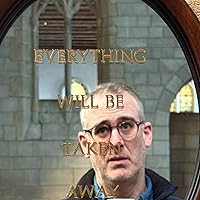
First of all, some of the best writing I’ve had the pleasure to read in a long time; Dubois is very talented.
In this story, a young American woman has learned she has inherited Huntington’s disease, which she had seen take away her father’s mind such that he was no longer himself for years before dying. Average symptoms begin at age 32, and she doesn’t want to burden the loved ones around her by having them watch her go through the same thing.
Meanwhile, on the other side of the globe, a chess prodigy grows up in squalor and hardship in Soviet Russia, but has some opportunities to make a better life for himself because of his abilities. He falls in with political dissidents and runs a huge risk by distributing their newsletter. He compromises his ideals somewhat as he rises to chess champion of the world, but later in life is openly critical of the government under Putin, and runs for office against him.
The American finds that her father had written the Russian a letter, asking him how he coped with a chess match at the point in which he knew he was doomed to lose. Somewhat absurdly, she drops everything in her life and travels to Russia to find him, and to ask the same question.
The plot may seem a little odd, but it’s woven together well and I found this a wonderful book.
What are the lost causes? Facing a cruel terminal disease that, before killing, will slowly strip one’s mind of all memories, and ability to control one’s body. Being at the top of one’s game, but knowing that someone (or something) will come along and knock you down soon enough. Attempting to make progress against a totalitarian, corrupt regime, knowing that one’s cause cannot win, at least in the short-term, and knowing that to struggle is to make oneself a target, and yet doing so anyway.
What does it mean to come to terms with one’s transience, with the meaninglessness of one’s tasks in life? How does one live under such compressed and absurd circumstances, how does one love? Because of their situation, they are improbably bound together, and have heightened awareness to the conditions that I suppose we all face in lesser form. There are no magic answers to the hard questions, as there are none in life. They continue on with introspection and dignity, and the result is both poignant and uplifting.
Quotes:
On death:
“My father had a limitless capacity to be touched by the histories of other nations, the fates of other people – and more than that, he loved the intricate ballet of advance and retreat. He loved it all in real life as much as on the chessboard. Like Lear – like anyone – he wanted to see who won and who lost. He wanted to see how things would turn out.
And if I’m honest, that’s a good part of my grief these days. Not a majority – that’s composed of good old-fashioned fear, the animal will to survive tangling with the cold pronouncements of medical science. But a fairly significant amount – maybe 15 percent or so – is just sorry that I don’t get to see the end.”
On the death of a parent:
“I opened the window and thought about my father. Like most people, I was not my best self at twelve. And it bothered me sometimes to think of this version of myself as the last vision my father had of me before his mind went – as if this made any sense. As if he was standing on the opposite end of some magic beam of rainbow light, remembering me in my youth, carrying around a smudged mental snapshot of who I used to be. Really, it was the other way around. But in weak, sentimental moments, I wanted to tell him: look. I grew up with a sense of humor, anyway. You would have liked me if you didn’t already.”
On democracy:
“Democracy is the least bad form of government, he says. It maximizes the liberty of the individual, and in this world – in this uncertain, claustrophobic, ever shrinking world, but really, in any world – is that not the highest good? Is there anything more important than writing what you think, and saying what you think, and walking along a river at night unsupervised? Maybe he doesn’t say that last part. And one day in Russia, he says. One day in Russia, too.”
On empathy, or lack thereof:
“I always felt guilty for ruining the other person’s day, and the other person invariably felt guilty if their day hadn’t been sufficiently ruined. I will admit it sometimes felt strange to me to make the confession to someone and later catch them laughing, or flirting, or eating a sandwich, instead of tearing at the injustice of it all or sitting quietly at the center of a grand and monstrous grief. The disaster of my life might be only the worst thing another person heard that afternoon; they might have forgotten by dinnertime; they might have been more heartbroken by watching certain movies. I’m always confronted, quite horrifically, with my exact net worth in the eyes of the other person – whether they cry, or have to sit down, or pull their mouth into the expression of a frown even though their eyes are somewhere else.”
On love lost, and memories:
“And then, just like that, her mouth was on his, although he wasn’t sure how. One moment he’d been speaking, and another moment the space between their mouths had disappeared. He drew one hand to her face, brought the other to feel the small instrument of her rib cage. Then she was drawing back, with each beat of his heart she was disappearing from his arms, and it seemed to him that he would always remember this: a sequence of snapshots of a woman, laughing with her eyes down, in each image a little farther away.”
And this one, which I loved:
“It was startling how completely an absent person could fill the empty spaces in your brain – how all the uncharted dark matter could illuminate to reveal nothing but the same face, the same voice, carbon-copied over and over like a piece of underground artwork. It was bewildering, the way that reality could be overtaken, wrestled down, and murdered by the sheer weight of possibility. It was nonsense, he’d be the first to admit, to pine for a year for a woman whose moment in his life had been incidental, glancing, as implausible as a meteor shower or a brain aneurysm. She had bobbed to the surface of his life, then disappeared again. She’d hovered for half an hour above his personal lake of loneliness, a sea monster in a smudged photograph, probably not even real. She’d been above water for minutes. She’d barely even waved.”
And:
“Then I understood, from the way Aleksandr clenched his jaw and the way he erased his eyes and the way his words seemed to shiver on a tightrope, that he had loved her. And I was struck by the unforgivable stupidity of refusing love. And I was further struck by the violence of my own mistake, and I felt lucky for the limited time I would have to live with it.”
On meaninglessness:
“When you get ready to die, you look back over a lifetime and try to unravel its enduring questions. You retroactively assign meaning to chaos, you make coincidence into portent. You scan your past for moments that might have been road signs, and then you try to see which way they were pointing. It’s an unrelenting striving for tenuous links, a dazed hunting for patterns that may or may not exist. You are a child looking for a lost thing in the sand, racing against the tide and the approaching darkness, trying desperately to remember where you might have buried it.”
On mortality, and travel:
“This world is stranger and more beautiful than could ever be imagined ahead of time. I am struck with enormous gratitude for having gotten to see some of it.”
“I look down at this strange, partially discovered place and think of all the others that exist, half formed and lurking, in my mind: the sheets of light wheeling over the Andes; the snaking, sculpted sand dunes of Namibia; the ancient cities cluttered with a millenium’s worth of objects left lying around – when the volcano erupted, when the city was sacked, when the plague swept through the streets and crumpled half the population in a week. There are many things I have not seen. But there are a few things that I have. Maybe living in the world for a time is enough, even if you don’t get to see all of it. Maybe it is enough. At any rate, it will have to be.”
On Moscow:
“Moscow was upon us in bits, incrementally visible through the murk. The traffic was horrendous, the graffiti multilayered and emphatic. The men were light-skinned and square-jawed, with the kind of bland good looks that have always made me feel slightly menaced. In the women you could see the jostling of the centuries. The old women were Tolstoyan and nearly toothless, with gnomic features and fiercely wrapped handkerchiefs. The young women were as elaborately assembled as the women of the Upper West Side, although some were elegant (swept hair and dark clothes, sparse and gleaming bits of jewelry) and some were tacky (bejeweled bosoms, tricked-out hair, the ruffled pelts of varies unidentifiable Siberian weasels). They moved through the streets like the competing emissaries of various historical periods. In front of a department store, a man sat on a box with a chained and collared chimpanzee. I watched everything in a daze, retroactively registering the miracle of air travel.”
And this one, which I laughed over and admired for the writing:
“The smell, too, was different. Both cities, I noticed, smelled bad – unforgivably, devilishly, abusively bad – in places. There was a smell in one corner near my hotel in Moscow that seemed to make the air opaque; your knees wilted, your spirit flagged, when confronted with it. It seemed concocted, preordained. It didn’t seem like the kind of smell that could have emerged organically without supernatural intervention. If some people look at the complexity of the universe and see proof of God, I look at the dire complexity of that smell and see the suggestion of Satan.”
On relationships, and meeting new people:
“I could see Viktor Davidenko gearing up to think me some kind of puzzle, and this never works – not because people solve you, particularly, but because they learn there’s nothing much to solve. Seeing yourself through somebody else’s eyes is liking taking a guest through your long-unvisited apartment. The bits of your personality that you’ve come to take for granted are like the souvenirs of a life you are already bored of remembering. This old thing?, you want to say, pointing to your personal trivia or your political beliefs or your body. Got in Barcelona for four euros. It’s not real. This joke? I make it all the time. You’ll get sick of it. I am sick of it. But the new person doesn’t know that yet, and you are not actually about to tell him.”
On transience:
“I slid my tongue along my lower teeth, feeling the unevenness that had resurged in recent years. All that orthodontia, such an investment, for what? Though I knew this was a rabbit hole that did not warrant pursuing. When you thought about it, everything – all of life – could seem a series of wasted preparations. Why did you exercise, and why did you consume the appropriate staggering amount of vegetables per day? And why were you vain about your body or your brain or whatever it was you were vain about? And why did you sob for a week and refuse food and lie the wrong way in bed and watch the necrotic light creep over the horizon only because a boy who never loved you still did not? Such anguish, such narcissism, such ahistoricism. All the grand projects were, after all, not so grand. Little petty fits, all of them, piecemeal staving off of the inevitable, scraps and dregs of self-distraction, all of it existing only to mitigate the fact, the central fact, the unbelievable irreducible fact, of our transience.”