Jump to ratings and reviews
Rate this book

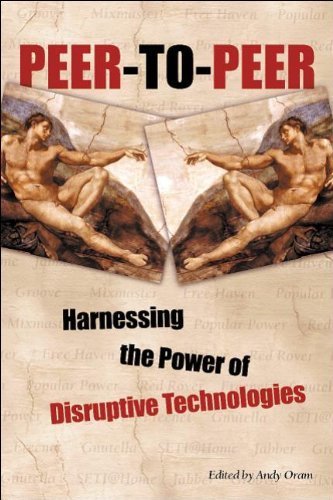
Peer-to-Peer : Harnessing the Power of Disruptive Technologies 1st edition by Oram, Andy (2001) Hardcover

Rate this book
Peer-to-Peer is a book about an emerging idea. That idea is that the traditional model of participating in the Internet, in which a small computer operated by an everyday user (a "client") asks for and receives information from a big computer administered by a corporation or other large entity (a "server"), is beginning to give some ground to a new (new to the fringes of the Internet, anyway) model called peer-to-peer networking. In peer-to-peer networking, all participants in a network are approximately equal. Furthermore, the participants are usually ordinary computers run by everyday people. The ICQ chat service and the Napster music-sharing community are examples of what this book is about. The chief advantage of peer-to-peer networks is that large numbers of people share the burden of providing computing resources (processor time and disk space), administration effort, creativity, and--in more than a few cases--legal liability. Furthermore, it's relatively easy to be anonymous in such an environment, and it's harder for opponents of your peer-to-peer service to bring it down. The primary disadvantage of peer-to-peer systems, as anyone will attest who's had an MP3 download prematurely terminated when a dialup user went offline will attest, is the tendency of computers at the edge of the network to fade in and out of availability. Accountability for the actions of network participants is a potential problem, too.This is a book about the idea of equipping ordinary Internet users' computers with mechanisms that enable them to connect, more or less automatically and without human attention, to other everyday Internet users' machines. By forming networks of computers at the so-called "edge" of the Internet, it's possible to offer valuable services without the burden of building and administering large, centralized computer systems of the sort that host traditional Web sites. Napster is the most successful example to date, though nerds will note that it's not a completely peer-to-peer system because users register their file libraries with a central server when they log on to the service.Don't approach this book expecting to learn how to build the next Napster system. It's not a how-to book. It's not even much of a why-to book. Rather, it's a book that aims to get its readers thinking about what happens when information systems shift away from the client-server model and toward the peer-to-peer model (that's one of the book's points, by the way, that this is not a one-or-the-other architectural decision).Mostly, Peer-to-Peer makes its point by letting experts in peer-to-peer take turns in the spotlight. Any other approach would be kind of ironic, wouldn't it? In any case, David Anderson explains how SETI@home puts space buffs' idle computing cycles to use in analyzing radio noise from outer space. Gene Kan explains how Gnutella (a truly serverless environment) works. The architects of Publius explain how distributed computing is especially resistant to censorship and denial-of-service attacks. Other contributors discuss peer-to-peer chat software, anonymous remailing services, and other applications of peer-to-peer design.There's no one from Napster represented as an author in this collection of essays, but Clay Shirky presents an essay called "Listening to Napster." In that essay, Shirky gives an opinion on why Napster has It focused on providing something consumers wanted, and bypassed Internet conventions (like the Domain Naming System) because they weren't the best way to provide the service. This is not an earth-shattering revelation, but it's true, and it's something developers of any new service (Internet-based or otherwise) need to keep in mind.Some of the technical proposals presented here will get readers thinking. An Require that senders of e-mail solve a moderately complex math problem before recipients' mailboxes will accept their mail. The problem would be no big deal for a mailer to solve if he or she were sending messages one at a time, but the processor load would really add up for spammers who blast tens of thousands of unwanted emails onto the Internet in a single session. Another mechanizing the concept of reputation so people know whose thoughts and whose creative works (like software) are worth using or believing.More business-oriented readers might want to read more about the more subtle ways of incorporating peer-to-peer components into business models. Lots of traditional Web services--Amazon.com is an example--are supplementing their client-server activities with others that have peer-to-peer characteristics. Amazon.com, for example, lets operators of small Web sites promote goods and rely on the centralized resources for billing and fulfillment. There's no distributed software (other than a few links), but the company takes advantage of creativity and marketing efforts outside of its official core. Coverage of that sort of "soft" distributed computing might be a good supplement f...

Hardcover

First published January 1, 2001

3 people are currently reading
38 people want to read

About the author

Andy Oram

42 books7 followers

Ratings & Reviews

What do you think?
Rate this book

Friends & Following

Create a free account to discover what your friends think of this book!

Community Reviews

5 stars
4 (10%)
4 stars
12 (31%)
3 stars
15 (39%)
2 stars
4 (10%)
1 star
3 (7%)
Displaying 1 - 3 of 3 reviews
Profile Image for Dave Peticolas.
1,377 reviews45 followers
October 8, 2014

This is a collection of articles by technologists and thinkers in the "Peer to Peer" movement. This book was published at the height of the peer-to-peer buzz and introduces many of the projects and technologies that comprise (or comprised) peer-to-peer. There are articles about specific projects like SETI@home, Jabber, Gnutella, Freenet, Groove, and many others. There are also articles about concepts that are import in peer-to-peer like metadata, privacy, trust, performance, and reputation.

The articles are primarily technical, making this book feel something like a conference proceedings. Also, much of the book's emphasis is on wide-scale, anonymous publishing and file-sharing, with little treatment of small-group collaboration. Also, in the passage of time since this book was published, several of the represented projects and companies have become defunct. Nevertheless, this is a very good introduction to peer-to-peer.

Profile Image for Gabriel Chartier.
31 reviews3 followers
March 9, 2022
The most interesting part about this book (written in 2001) to me is how it all amounted to (kind of) nothing. It makes me sad to see how close we were to creating the foundations for a better web that had decentralization baked into it. So many of the things I see being talked about today in the web3 space, specifically in DAOs, are just now catching up to some of these essays. Where did we go wrong?

First section had some good insights about p2p that still hold up today and it was fascinating to read the excitement of the future of p2p hot off the tail of Napster.

Skimmed the second section because, while it was interesting, it was a bit too outdated and technical.

Third section had some great topics that are important for conversations happening now in web3: Trust, Accountability, Reputation, Security, Interoperability.

It's been over 20 years since this book came out and we're still having these conversations. Will it take another 20 years to implement a web that isn't morally bankrupt? Fuck if I know
Profile Image for Gabe.
10 reviews2 followers
November 24, 2014
Doesn't mention bittorrent at all... so that's a huge hit right there.

The other technologies are interesting but are not as prevalent.
Displaying 1 - 3 of 3 reviews

Can't find what you're looking for?

Get help and learn more about the design.