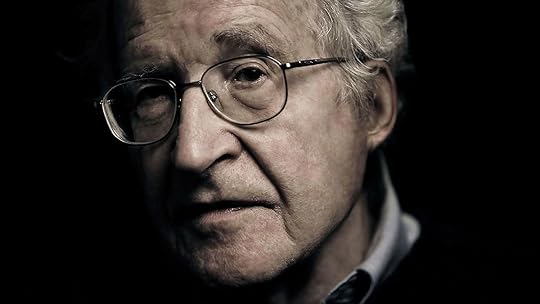
"Theres no doubt that one of the major issues of twentieth century history, surely in the US, is corporate propaganda.... Its goal from the beginning, perfectly openly and consciously, was to control the public mind, as they put it. The reason was that the public mind was seen as the greatest threat to the corporations."Noam Chomsky
Avram Noam Chomsky is an American professor and public intellectual known for his work in linguistics, political activism, and social criticism. Sometimes called "the father of modern linguistics", Chomsky is also a major figure in analytic philosophy and one of the founders of the field of cognitive science. He is a laureate professor of linguistics at the University of Arizona and an institute professor emeritus at the Massachusetts Institute of Technology (MIT). Among the most cited living authors, Chomsky has written more than 150 books on topics such as linguistics, war, and politics. In addition to his work in linguistics, since the 1960s Chomsky has been an influential voice on the American left as a consistent critic of U.S. foreign policy, contemporary capitalism, and corporate influence on political institutions and the media. Born to Ashkenazi Jewish immigrants (his father was William Chomsky) in Philadelphia, Chomsky developed an early interest in anarchism from alternative bookstores in New York City. He studied at the University of Pennsylvania. During his postgraduate work in the Harvard Society of Fellows, Chomsky developed the theory of transformational grammar for which he earned his doctorate in 1955. That year he began teaching at MIT, and in 1957 emerged as a significant figure in linguistics with his landmark work Syntactic Structures, which played a major role in remodeling the study of language. From 1958 to 1959 Chomsky was a National Science Foundation fellow at the Institute for Advanced Study. He created or co-created the universal grammar theory, the generative grammar theory, the Chomsky hierarchy, and the minimalist program. Chomsky also played a pivotal role in the decline of linguistic behaviorism, and was particularly critical of the work of B.F. Skinner. An outspoken opponent of U.S. involvement in the Vietnam War, which he saw as an act of American imperialism, in 1967 Chomsky rose to national attention for his anti-war essay "The Responsibility of Intellectuals". Becoming associated with the New Left, he was arrested multiple times for his activism and placed on President Richard M. Nixon's list of political opponents. While expanding his work in linguistics over subsequent decades, he also became involved in the linguistics wars. In collaboration with Edward S. Herman, Chomsky later articulated the propaganda model of media criticism in Manufacturing Consent, and worked to expose the Indonesian occupation of East Timor. His defense of unconditional freedom of speech, including that of Holocaust denial, generated significant controversy in the Faurisson affair of the 1980s. Chomsky's commentary on the Cambodian genocide and the Bosnian genocide also generated controversy. Since retiring from active teaching at MIT, he has continued his vocal political activism, including opposing the 2003 invasion of Iraq and supporting the Occupy movement. An anti-Zionist, Chomsky considers Israel's treatment of Palestinians to be worse than South African–style apartheid, and criticizes U.S. support for Israel. Chomsky is widely recognized as having helped to spark the cognitive revolution in the human sciences, contributing to the development of a new cognitivistic framework for the study of language and the mind. Chomsky remains a leading critic of U.S. foreign policy, contemporary capitalism, U.S. involvement and Israel's role in the Israeli–Palestinian conflict, and mass media. Chomsky and his ideas are highly influential in the anti-capitalist and anti-imperialist movements. Since 2017, he has been Agnese Helms Haury Chair in the Agnese Nelms Haury Program in Environment and Social Justice at the University of Arizona.
Noam Chomsky, the “linguist, philosopher, cognitive scientist, historian, social critic and political activist” (from Wikipedia – and I like that introduction) and all-around smart guy, published this series of interviews between himself and David Barsamian in and around 1998.
Discussing such topics as politics, media, history, psychology, sociology, etc etc. the two huddle up over some beers and solve all the world’s problems.
Most notable, to me at least, was his dissertations on how we must be very critical of the press and observe with scrutiny anything we see and hear from the corporate news. Students of history will know that papers have always been biased, but Chomsky makes some great points, way back in the 90s, that modern news sources can “cancel” a story just by minimizing it, or just not reporting at all.
Also fun to read was Chomsky’s ideas about how the “internet” would change our society and he cautioned that some people could become addicted. Prophetic.
I own a copy of this book, and I'm glad I do, because this is the kind of book that deserves a reread. The title of this book is pretty descriptive, but it is worth mentioning that this book deals with a variety of topics. It is written in an interview form, and a reader can feel a bit like he is conversing with Chomsky. The title isn't exactly misleading, but there is more to this book than just the theme of propaganda (as important to this book as it is).
Propaganda and the Public Mind is definitely a book that I will reread. I reviewed it first years ago on my old goodreads profile but I figured I might write something about it- again. Because I really haven't come across that many similar books that were of the same quality. What impressed me most about this book was how it was so straight to the point. Chomsky doesn't beat around the bush (pun not intended but while it slipped in, I might as well mention that Bush's politics are also analyzed in this book.)
Propaganda is something that surrounds us all, whether we notice it or not. It always influences us, whether we notice it or not. I can think of a number of interesting fields that can be connected with this book. Now, that I think of it, Propaganda and the Public Mind can be a pretty good starting point for a research. Chomsky seems to be a man after the truth in this book. Not the pleasant politically correct truth. Just plain truth. Chomsky brings his thoughts to logical conclusions. Take for example this quote: “We still name our military helicopter gunships after victims of genocide. Nobody bats an eyelash about that: Blackhawk. Apache. And Comanche. If the Luftwaffe named its military helicopters Jew and Gypsy, I suppose people would notice.” Would people notice if Germany hadn't lost the WW2? That's the question I'd like to see answered as well. Does it always comes to that- history is written by winners?
I remember what I thought when I first read this book, finally a an intellectual that really thinks with his head. There are so many intelligent people out there that aren't really independent thinkers. Being an independent thinker sometimes seems to be more a matter of character than anything else. Some people have a high IQ but they can't think independently to save their lives. This book felt like an independent opinion- and I guess that is why I appreciated Propaganda and the Public Mind so much. Written as a series of interviews focusing mainly on the important events of the 90-ties with just a bit of linguistics at the end, this book is pure gold. It goes strait to the point (or rather points since it deals with different problems and comments different events) and it is very easy to read.
By being easy to read, I don't mind it is a light reader. I just meant to say that the information is presented in a coherent and logical way. There is nothing light about the themes it deals with, either. Moreover, this book is filled with information. There is so much information in this book that I wasn't familiar with (and I thought I knew something about the topics covered). What I liked most about Propaganda and the Public Mind is that it speaks about things that I have been thinking about, that have been bothering me, about issues that I care about- just I was not able no to arrange them so clearly in my head or connect them in a way Chomsky did. The author speaks in such a simple and direct way that it is quite easy to follow even when he jumps from one topic to another. Speaking of which, it is worth noticing that not all the topics covered deal with public propaganda. This is a collection of interviews and there are many topics covered.
It is nice to see that someone is trying to grasp the complexity of the 90-ties world politics (wars, conflicts, aggression and all that has been going on). There is so much simplification out there in the media and in general. It is so refreshing to read a book that actually tries to understand and explain the dynamics of world politics. Besides putting acts of violence into perspective and striping them out of ideological excuses, there was another part of the book that is very important in my view. I think that another burning issue was well handed- the issue of loss of personal freedom. The power that different interests group have over the world is growing, the gap between the poor and the rich has never in the course of human history been greater--- We have to ask ourselves, do we really live in a democracy?
To conclude, this is a very relevant book for our time. It may speak about (recent) past, but pretty much everything it talks about is still relevant. We all sometimes victims of propaganda. We all sometimes fail to see what is really going on- and sometimes it is really hard to figure out what is truth. Most media is own by someone, it is increasingly hard to believe any news reports, and the world politics is getting more complex by the minute. That is why books like this can be so useful. Whether you agree with Chomsky or not, you have to admit that his thinking is always quite logical and his analysis straight to the point.
It is always enlightening to seek out what is omitted in propaganda campaigns. Take, for example, the Gulf War (1990/1991). When queried as to why the U.S. and Britain were bombing Iraq the most frequently given answer was that Saddam Hussein was a monster, that he committed heinous atrocities against his own people. It was a reply that was doled out in near unanimity and one that was quite impossible to refute.
Chomsky warns that any answer that is given equivocally and unanimously is worthy of a red flag.
Case in point: a quick Google search shows that yes, Saddam did indeed gas his own people. This “ultimate horror” occurred in March of 1988 and then again in August of 1988. The next logical question is: ‘how did the U.S. and Britain react?’
Answer: they reacted by continuing, nay, they reacted by ACCELERATING their support for Saddam. Therefore, the pat answer as to why the U.S. and Britain were bombing Iraq couldn’t possibly be true. Every news story and press conference that pointed out that “Saddam was a monster who committed atrocities against his own people” omitted three very important words: “with our support.” Yes he was a monster and yes he committed atrocities but he was a monster WITH OUR SUPPORT. He committed atrocities WITH OUR SUPPORT.
“If we choose, we can live in a world of comforting illusion.”
Joseph Goebbels is credited, rightly or wrongly, with pointing out that people will believe that a square is in fact a circle IF the misinformation is repeated often and with conviction. “They are mere words, and words can be molded until they clothe and disguise ideas.”
At the end of almost every lecture, Chomsky closes with an open mic Q&A. Quite often someone in his audience will say that they can't believe anything he says because it is in total conflict with everything they were told from the media, from their parents, or from their peers; and they don't have time to go look at all the footnotes. Chomsky’s response is simple and clear. The internet is a lethal weapon. Make time to look at the footnotes. Check your sources. Think for yourself.
“These are not laws of nature. They can be changed; they can be changed right here. Unless they're changed in the United States it's not gonna matter much what changes elsewhere.” ~Noam Chomsky
Finally a man (and an intellectual) that really thinks with his head. Written as a series of interviews focusing mainly on the important events of the 90ties with just a bit of linguistics at the end, this book is mind-blowing. It goes strait to the point (or rather points since it deals with different problems and comments different events) and it is very easy to read.
There is so much information in it that I wasn't familiar with (and I thought I knew something about the topics covered). What I liked most about it is that it speaks about things that I have been thinking about, that have been bothering me, about issues that I care about- just I did not manage to arrange them so clearly in my head or connect them in a way Chomsky did. The author speaks in such a simple and direct way that it is quite easy to follow even when he jumps from one topic to another.
It is nice to see that someone is trying to grasp the complexity of the 90ties world politics (wars, aggressions and all that has been going on). There is so much simplification out there in the media and in general...It is so refreshing to read a book that actually tries to understand and explain the dynamics of world politics. Besides putting acts of violence into perspective and striping them out of ideological excuses, there was another part of the book that is very important in my view. I think that another burning issue was well handed- the issue of loss of personal freedom. The power that different interests group have over the world is growing, the gap between the poor and the rich has never in the course of human history been greater--- We have to ask ourselves, do we really live in a democracy?
This is definitely a book that I will reread. Moreover, this is a book I will make people read!
kudos to any american taking any time to read anything by Noam Chomsky. there's probably no more important author to read than noam. also, few people who are totally committed to long term social change 24/7 have a photographic memory - noam can read something once and then may recall it in perfect detail years later - it's amazing. my mom also had it and was the first woman to get a phd from yale and got it in 2 years which was also unheard of - anyway - 1. noam has this photo memory and so remembers pretty much everything so he can do more than other activists because he can juggle so many different ideas and facts. 2. he asks questions - the few "reporters" left have trouble asking even inane questions 3. he asks hard core questions few ask and yet questions which MUST be asked for the sake of the people - instead of "when do we bomb iraq?", he asks "what gives us the right to bomb iraq?" 4. his opposition rarely notes that he admits mistakes when he feels he has made a statement hastily. 5. he is the consumer reports of activists - he doesn't take corporate money. 6. he doesn't need fame or popularity and so acts independently of what we think of him. 7. most americans either are too afraid to read anything he has ever written. maybe they think their head will explode if they even touch a book by noam. isn't he a communist or something? :) this means it's even more important for those of us who are not afraid of actually reading non-fiction let alone non-fiction reading of which could actually lose you friends because it suggests suggesting improvement rather than the constant echo of american exceptionalism. - it's even more important for us to keep at it- keep reading and educating those around us on where to find information necessary for a functioning democracy for the people in apposition to the Pavlovian state.
if i found out my father was secretly killing people and he told me he was doing it to stop their future crimes - i'd think he was crazy - and i'd dedicate my life to stop him - even though he was my father. but when most people see evidence through noam and others (not mainstream media) that their own government has/is secretly and openly killing people in the name of the people, they pretend they saw nothing and go back to their flat screens, sport statistics, and vacation planning rather than standing up and attempting to work with others to reverse the non-stop bipartisan corporate attack on the New Deal (on the little guy and most of us) since FDR dealt it.
ok, but what is this particular chomsky about? this book covers noam with david from 1998-2000. give you some 5 star comments of noam? 1. think tanks create catchy well tested lines to repeat ad nauseam on the airwaves and to counter it you must provide a whole backstory before someone's eyes glaze over or they think you're simply from mars. 2. the flood of unanimous consent for war and other illegal activities by the corporate media assures the marginalization of all dissenting views outside the amplified circle. 3. the reason the US is happy to look so out of control and aggressive on the world stage is that these actions are merely a candy gram to europe and the others - get out of our way, we're violent and dangerous. intentionally acting openly as a rogue state - what we say goes... (see Strategic Command's CHILLING planning document called "Essentials of Post-War Dominance") 4. the US was originally in favor of tibet being controlled by the chinese (because the US wrongly believed chiang kai shek would run it). so much for US caring about tibet's freedom, ha, ha... 5. noam brilliantly states the advantage of taking on unpopular issues where you can actually do a lot rather than treading obvious ground with everyone else - of course this way you get more flak and more marginalization. 6. we virtually destroy cambodia, laos, and vietnam, four million corpses and untold birth defects from agent orange and all we hear about in the mainstream press is OUR suffering. 7. the reagan administration looked at highways and saw it was cheaper to repair potholes but why do it because the cost could be passed on to the public which improves the efficiency of the economy. 8. enough reasons already to buy this book, this book is FILLED with brilliant comments no one else is giving you in order to understand what has been daily done in OUR name since before we were born. it's time for all americans to understand - staying in your seats means it gets worse for you and your children and this country we love - guaranteed. only by working strategically with others will we make our voices heard above the 24/7 corporate media which no longer covers power but instead only covers for power.
One of the best Chomsky works I've read yet. The title is a bit misleading, since it's a collection of interviews that covers countless topics outside of propaganda, but I suppose that's an editorial decision. The book sort of catches Chomsky right at the point in time when he was courageously speaking out about the atrocities in East Timor (the late-90s atrocities, that is - he had also spoken out about the original mid-70s invasion and associated atrocities when they occurred), and thus it serves as a PERFECT example of how a responsible intellectual conducts themselves when they see an injustice happening in the world. In other sections he also does a great job of pointing out the ties between "globalization" and imperialism, particularly with respect to global financial markets, so IMO it's also an important read for those interested in economics who want a critical viewpoint on these issues.
Plainly put: Chomsky is a genius. Many consider him to be way left. I consider him to be the most moderate of any living intellectual. His criticism of US and Western foreign policies are hard to argue against.
Great book. Dr. Chomsky has a clear, intelligent speaking style. Unfortunately, I think his purpose of speaking out is misunderstood. I've had friends refer to him as "Anti-American" (something Noam addresses in this book) among other colorful "traitor" comparisons. He's nothing of the sort. In fact, exactly the opposite. If you think about the message that he's sending, it's that we have all of this information available, in a country where our Constitution guarantees freedom of speech - something not enjoyed by many other countries. Yet, most of us choose to walk around zombie-like and brainwashed with the lies and half-truths our elected leaders (and business leaders) feed us daily. Noam isn't a hacker or a CIA insider. The information he "exposes" is available to all of us if we know where to look. He even uses the phrase, "You can read this for yourselves" often in his speeches. Noam Chomsky is telling people to think about what they're being told - consider the source and the intentions of the source.
In a series of rambling and quite interesting interviews dating from the late 1990s through early 2000, Chomsky talks about East Timor, Colombia, the drug war vs. the tobacco-non-war, U.S.-sponsored violence in Central America, India, Pakistan, the Middle East, the Vietnam war, the Balkans, Iraq, nuclear proliferation, education, income and wealth inequality, protests against globalization, linguistic theory. Everything is related to propaganda and power. It's democratic societies that need propaganda, because non-democratic societies can already control people with the military/police/authoritarian apparatuses. [Ed. note: Though increasingly those apparatuses are seen and relied on in democratic societies - witness the use of Tasers, and the public's largely unquestioning acceptance of them.]
I think I had to listen to this about 15 times to even begin to grasp some of the 500 topics covered by Noam in this two disc audio set. Narcotrafficking, terrorism, Clinton presidency analysis...there are a lot of areas covered. But it was incredibly interesting and enlightening to say the very least. I would recommend this to anyone.
The world is a better place because it has Noam Chomsky and his books. And it’s in that spirit that Haymarket books has taken up the task of putting out a series of new Chomsky books and republishing and updating some new ones for our benefit. And Propaganda and the Public Mind is a good place as any to start with this collection.
Composed of his interviews with David Barsamian (who Chomsky calls his publicist), Propaganda and the Public Mind hits the sweet spot as far as Noam Chomsky books are concerned because it’s mostly devoid of the dense writing and language that make up his more formal books. Instead, it reads (as it should) like a conversation. And although it’s called Propaganda and the Public Mind, this remarkably slender book covers a large range of issues and, as you can imagine, what the US’ role was. What range indeed, as Barsamian and Chomsky cover topics such as the US’ interest in regulating world trade agreements, the media’s role in distracting and misleading the population, East Timor, the Seattle riots, and the democratic state in India. We even get some insights into Chomsky’s personal life and his jock grandson.
Of course, there are plenty of times I felt a little lost and the conversation went right over my head. But that’s just a great excuse I’m going to have for rereading his books. This book, as with all of Chomsky’s books, ought to be studied.
I just remembered that I read a whole bunch of books by Chomsky when I was young and radical. Now I’m jaded and cynical and disenchanted with politics.
Chomsky could be the greatest living intellectual or the greatest living crackpot, depending on your political inclination. But I think at least some of the times he makes good points to anyone who reads him with fairness and open mind. Some other times, I myself find him downright annoying and irrelevant. Like him or not, he’s one of the top-10 most cited authors of all times. He’s up there with Freud and Plato and other giants.
As Putin's war against Ukraine is unfolding and the world is learning about the years of making the Ukrainian people an enemy of the Russian State this book was certainly a great read/listen. The ideology behind this book is to push us to question the things we are not being told, what was left out of the article. There are many historical examples throughout the book where the public was not given the truth and we remained completely unaware. I believe this is an important ideology because it is good to remain aware and it is good to think. As it seems like more and more Americans slide into the pattern of disliking one another, it is good to be aware that we do not hold any of the answers.
The audiobook format is in the form of an interview. While not my preferred style of books, it seemed to work very well.
Noam Chommsky is a range of essays and interviews discusses the way governments including the United States of America use propaganda to influence public opinion and direct attention elsewhere. He points out how the American government criticized the Khmer Rouge for emptying out Phnom Phenh but overlooked the US bombed the city and drove residents out. He discusses other world wide incidents and American role in them as well. Interviews are from the 1990s through to the 2000s. Interesting stuff.
Chomsky trebuie citit de oricine are pretenția că operează cu ideologia, indiferent dacă ești sau nu de acord cu el. Modul în care expune elementele aparent banale ale propagandei statelor vestice este debordant adesea. Totuși, trebuie remarcat că nu se transformă într-un apologet al politicii Rusiei, statelor totalitare sau criminalilor de război, ci marchează modul în care trebuie privită informația pe care o primim ”de la centru”. Propaganda and the Public Mind e o serie de interviuri foarte bine transpusă în hârtie, cu mențiunea că deși aveam așteptări mai mari, nu sunt deloc dezamăgit de lucrare. Marele său minus este că discuția se petrece în 1999-2000, în perioada pre-11 septembrie.
When I picked up this book the first time - it felt very dry. All the chapters are the interviews Chomsky did with David Barsamian and I initially found it hard to connect with what he was talking about. I dropped it and picked it up after a while and then somehow magically I could connect with what he was trying to say. The interviews are done in 1998-99 and 2000 i.e before the dawn of the 21st century. Some of his predictions have turned out to be right - notably the privacy issue on the Web and that’s quite remarkable. It will be interesting to read what he thinks now about many of those issues, and the world-changing events that have occurred since then (9/11, Internet, social media etc).
In the chapter “US to the World : Get Out of The Way” - Chomsky provides evidence how the US has taken the world institutions for a ride. It seems there have been different standards for other nations and for the U.S.A. The US simply disregards international conventions and treaties and simply does what it wants to do. Somewhere, NC points out that it was part of a conscious strategy under Reagan’s administration to develop a violent, aggressive image for the country.
He points out how U.S initially provided arms and weapons to regimes which used them to oppress the opposition in their countries respectively. Later the US went after those regimes under the pretext of human rights violations when it found it convenient. He points out that if you go through the list of U.S aid recipients you’ll find that all countries are big human rights violators. The countries - Iraq, Libya, Haiti, Indonesia and Nicaragua.
Also, U.S has also indulged in biological and chemical warfare while obliterating its enemies. By destroying the sewage plants, hospitals, water treatment plants - the population of the inflicted countries were exposed to all kinds of diseases and sufferings. Specially in the Vietnam war where Agent Orange was used at a large scale. It resulted in large scale deformities in the future generations. In Laos, the landmines were spread throughout the country and they continued to take lives of innocent children long after the war was over. The U.S didn’t even agree to provide technical expertise to detect and defuse these forgotten ticking time-bombs.
Overall, the theme of the U.S on the international stage was complete disregard of widely accepted practices and it flouted them based on what served it better.
In the book Chomsky also talks about how the phrase “human intervention” has been blatantly misused - a pretext for military action against a country. He gives the examples of East Timor, Yugoslavia where the major powers (the U.S and the NATO) intervened and their intervention had calamitous results. It destabilized the country and they never provided aid for it to bounce back. Like in Kosovo, it was sprayed with cluster bombs and landmines but the U.S didn’t provide expertise for the clean-up after the military intervention was over.
Chomsky basically says that there are hardly any positive examples of “humanitarian intervention” with the exception of India’s war with Pakistan which resulted in the liberation of Bangladesh (I am disappointed he used the word “invasion”).
Also, a consistent pattern is that the human rights violations which happens as a result of intervention are never reported in the media - let alone be tried in the war tribunal.
Another great comparison which Chomsky does is between Bertrand Russell and Albert Einstein. Einstein is usually praised in the mainstream for the stance he adopted against nuclear weapons and the Nazi party. But Chomsky throws a different light on to it. Both Bertrand Russell and Albert Einstein signed statements against the adoption of nuclear weapons. And then Einstein went back to his research while Russell continued his struggle on the streets, raising voice and trying to bring awareness on that issue. In Chomsky’s words Einstein didn’t rattle too many cages but Russell tried to do something about it. Thus, Russell was viciously attacked by the NYT and others. He was disregarded as a public intellectual and rather considered a crazy madman.
It is a good reminder of how going against the mainstream narrative cuts down your possibilities and opportunities. Perhaps, explains why so many celebrities do not tend to use the powerful platform they have by calling a spade a spade.
This chapter also has a discussion about India - how it has grown economically and how U.S is changing its policies w.r.t it (circa 1990s). Interestingly, Chomsky calls India’s landmark 1991 reforms as subordinating the country to the corporate dominated globalization system. Not very off-the mark in a way.
********************************** Few highlights from this book were -
#1 You shouldn’t believe what I am saying is true. The footnotes are there, so you can find out if you feel like it, but if you don’t want to bother, nothing can be done. Nobody is going to pour truth into your brain. It’s something you have to find out for yourself.
#2 We should not become a society where we are just obsessed with ourselves and do not worry about the elderly person starving on the street.
#3 Road to Privatization - i) Make the system malfunction (by underfunding) ii) Generate popular support to hand it over to the corporate sector
Similar to the "Skeptics Guide to the Universe", there are many complicated ideas and thought-provoking stories. The author illustrates the importance of keeping a clear mind and not letting unruly propaganda sway one's opinion easily. Though this is less of an intriguing book, the ideas and lessons it emanates are important for any to thrive in our society today.
I've always heard great things about American linguist/famed dissident Noam Chomsky, so I borrowed this book from the local library.
Granted that the interviews were given close to a decade ago, the material remains relevant to the modern-day social malaise afflicting countries all over the world. By asking simple questions, Chomsky skillfully dissects the concepts that we have taken for granted all this while, which makes for really thought-provoking reading.
For instance, the idea that uneducated people are in a way liberalized because they are free to think and construct their own ideas outside of education, a systematic and propagandistic indoctrination of the people.
I also particularly enjoyed how he cuts through the bullshit and trumped-up statistics by governments and analysts to show the truth (if there can ever be one, as Mr. Chomsky would highly dispute) behind the smoke screens of "economic growth" put up to distract us from the inequality and poverty plaguing modern-day societies.
Speaking as a rather ignorant reader, I also found some of the cases he mentioned useful, although I had to do my own research on them because little context is provided.
Edward Herman's questions were all right although he sometimes asked the wrong questions, which Chomsky would swiftly shoot down. I'd have preferred if the book was penned entirely by Chomsky instead of a compilation of his interview excerpts, so that there could be more clarity in the prose.
Overall, a highly enjoyable and interesting read and a good start to my Chomsky collection.
Excellent. What is so valuable about this book is the manner which David Barsamian picks Noam Chomsky's mind on a wide range of topics. Probably this book is more useful after you've already done some work to build up some historical understanding---otherwise so much of this information is going to be flying at you that it's going to be hard to make sense of it all (or, you'll *think* you're making sense of it all, but really important points will in fact be lost to you). So I recommend this as a follow-up after you've already built up some knowledge of US foreign policy post-WWII.
Classic Chomsky. Covers a wide range of his intellectual capabilities and a wide range of issues of society as a whole. Even though it was written 10 years ago, the topics are still quite relevant today. After having read much of Chomsky's work, this one goes down as a summary of sorts for my personal collection of Chomsky. I would recommend it highly to anyone who would like to get a broad introduction to the work of this invaluable political mind.
I started this book with high expectations. And it really met them but the late part of the interviews are kind of obvious. In other words, we are almost sure of Chomsky position on a certain topic. On the other hand; the last part about the education and competitiveness is very informative and useful for the daily life.
"This is very much a business-run society. About one out of six dollars in the whole economy is spent on marketing. That's an extremely inefficient use of funds. Marketing doesn't produce any public goods. Marketing is a form of manipulation and deceit. It's an effort to create artificial wants; to control the way people think."
citizens of the US should consider it something of a compliment that so much effort is expended to persuade them that the US is benevolent. they are not immune to the expenditure, poor things.
Honestly speaking, I don't like dialogue books, even if the topic interests me, and Noam Chomsky is such an important person to know about, besides maybe Plato's Apology.