The story of Henry V, the soldier-king who forged England's greatness.
One of the most exciting historical novels ever written, 'Monmouth Harry' has for its background the turbulent, lusty days of the early 15th century. Out of the savagery and splendour of those times looms Henry V, warrior and lover, who set his nation on the path to glory.
A. M. Maughan’s Monmouth Harry, also published as Harry of Monmouth, is a 1956 novel focusing on the life and reign of Henry V that is now, sadly, out of print. I say “sadly” because this is easily the best novel about Henry V’s life that I’ve read.
This isn’t necessarily a sign of quality: those I’ve read (The Star of Lancaster, Fortune Made His Sword and Good King Harry) were just not good. That being said, Monmouth Harry is a strong piece of work. It is engaging, well-written and the characterisation work is frankly excellent. It surprised me how much I ended up liking Maughan’s Henry – yes, he is somewhat white-washed but she also makes it clear the cost of kingship on him and how it has deformed his character and sense of self-worth.
My major complaint is that I wished it was longer. There are no great time skips in the narrative – we’re not told in precis about important events, there isn’t a great deal of exposition and where it is, it’s handled deftly. But the first section, dealing with Henry V’s childhood, is very rushed. We’re introduced to Henry’s parents and grandfather on the first page. By the twelfth, his mother is dead (1394), his father is exiled (1398) and his grandfather is dead (1399). It’s a lot to take in. Nor do we spend much time developing Henry’s relationship with Richard II – a relationship that ends up looming over Henry, where he is tormented on his deathbed on Richard’s ghost.
There are also areas of Henry’s life that are unexplored – his interest in music is all but hinted at and notable figures such as John, Duke of Bedford, Richard Courtenay, Bishop of Norwich, and Isabeau of Bavaria, Queen of France are barely glimpsed. In fact, Bedford – despite being present at Henry’s deathbed – is not even mentioned after a reference to him relieving the siege of Harfleur in 1417. There are also figures that are given early prominence and then seemingly forgotten - Gwenillian Glendower, Isabelle of Cambridge, and Joanna of Navarre for instance. Joanna of Navarre is introduced and depicted negatively – clearly, I thought, in preparation for her to be depicted as plotting Henry’s death during his reign, as she was unjustly accused of doing. But that isn’t even mentioned! Her last appearance is Henry’s triumphant entry in London after Agincourt!
That said, Maughan does give serious and wonderful attention on other figures in Henry’s life, like his half-uncle, Thomas Beaufort, and Henry Chichele, Archbishop of Canterbury. As someone who hasn’t thought much about these relationships, I really appreciated it.
I also felt that the parts of the book between the Battle of Agincourt and Henry’s marriage to Catherine de Valois were undeveloped and confusing. It’s long been noted that a lot of treatments of Henry V tend to follow Shakespeare by jumping from Agincourt (1415) to the Treaty of Troyes (1420) and while Maughan doesn’t do this, her attempt to sketch out that time felt directionless and confusing. In fairness, I don’t know if this is Maughan’s failing or if this was an issue with the resources that were readily available to her.
The age of the book is another issue. As usual, there are developments and rediscoveries in our understanding of this time that Maughan just couldn’t have known about. For instance, we know how severely Henry was injured at the Battle of Shrewsbury due to the discovery for John Bradmore’s account of treating the wound in the 1990s and I could only wish Maughan had known about it to write about it. And with the advent of the internet, it’s very easy for historical novelists to find and access resources about their chosen topics – but this wasn’t the case for Maughan. So there are errors are in the text, such as Joan Fitzalan, dowager Countess of Hereford and Henry’s maternal grandmother, living see Henry’s death in 1422 but we know she died in 1417, Henry being depicted as born in 1387 not 1386, or Henry spending the night of his father’s death in discussion with Henry Chichele instead of the anchorite.
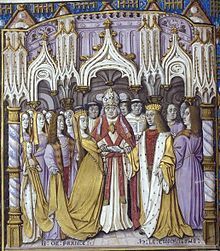
A small niggle was that Maughan tended to refer to a character by the title they were originally introduced as. So Henry IV is referred to as “Derby” throughout which I found odd. I also found some characterisation choices questionable – I couldn’t quite grasp what Maughan was doing with Hotspur, who she seemed to acknowledge was someone Henry hero-worshipped but also tended to abuse Henry’s trust and admiration. And the relationship with Catherine was – while very sweet – was seriously weird with Henry falling madly in love with her based on a portrait he sees of her! Insta-love based on a portrait? Ugh, no.
There is a reliance on Shakespeare – some bits of the dialogue seemed to be very much a rewriting of Shakespeare. The depiction of Henry’s “wild youth” also owes much to him and his early modern sources and not any contemporary evidenced accounts.
But, you know what? This was a really, really good read. I was emotionally involved in this and while there were parts I wished were better, I was also very pleased. I found myself tearing up at the final scenes too.
To the best of my knowledge, I read the 1956 edition of Maughan's Harry of Monmouth, which I haven't found listed here. I remember it as an excellent historical novel.
I would rate it closer to 4½ stars if I could. A compelling, in-depth read on England’s King Henry V, a rich historical tapestry, woven through with the many intriguing people and events of his life. This is a read that snuck up on me before I was even aware of it. I did not realize how emotionally invested I had become in Henry's life, this was especially true as I reached the last 50 pages and found I did not want to reach the end. I actually stretched the ending out over two days. I could have read on through with tired eyes and finished sooner but I really wanted to give those remaining pages the attention they deserved so I could better appreciate quotes as this.
”All that was laid upon me at my hallowing have I tried to keep. I tried to be as a King to you, though I were no King.”
Maughan brings Henry V to vivid, heroic life. After meeting a happy, contented six year old Harry, his fortunes quickly change, from being gently held as prisoner by Richard II, during his father, Henry Derby's exile, to suddenly becoming the Prince of Wales, then warrior, hero and King. The third person narrative from varied points of view; family members, friends, and enemies, gives a well rounded picture of Henry and his times and illustrates the stark contrast between his early behavior and reputation for drinking and carousing to the man who bravely bore the weight of an unexpected crown. The epilogue, done in the first person, from the King’s Steward, Walter Hungerford, foreshadows the troubles that would befall England as well as the legacy left by Henry.
”…some part of his spirit must ever lie in the realm, as sunlight lies imprisoned on an Abbey floor, in shafts and slants of brightness.”
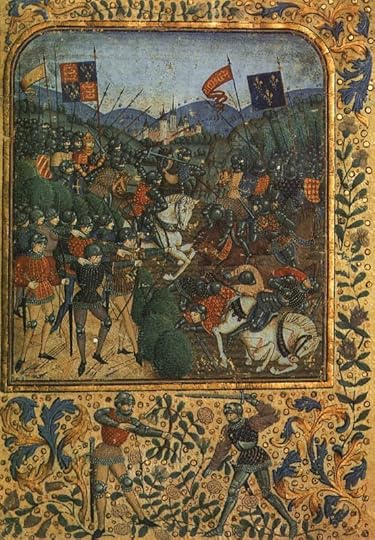
There is no over embellishment, the author lets the facts stand on their own merit and plausibly fills in the unknown. Considering the many battles, the annual Welsh Marche battles against the formidable foe Owen Glendower (Owain Glyn Dwr), the pivotal Battle of Shrewsbury, to the major Battle of Agincourt, there are no graphic blow by blow descriptions or scenes weighed down by military strategy. Yet, it is the smaller scenes revolving around the battles that leave a lasting impression. The final battle with Glendower and the intriguing interpretation of his final years, a one on one battle in a tunnel between Henry and Sire de Barbazan, the execution of Henry Scrope, the death of Henry's brother Tom, and the relationship with Harry 'Hotspur' Percy leading to the sensitive and poignant scene of Hotspur's death as well as its effect on Henry. The author adroitly handles the long march to Calais that leads to the Battle of Agincourt. The reader feels the despair, hunger and anguish of men beyond their endurance buoyed on by the strength and character of their leader and their bone weary devastation at seeing Calais within reach but barred by the French forces. I appreciated that there was no explanation given as to why or how the English achieved victory, leaving it for the readers to form their own conclusion.
A few minor complaints. During his childhood and young adult years I would sometimes feel as though I was missing something, or that info was being thrown at me. There would be a build up and anticipation for an event and then almost as quickly it was over, leaving me wanting more. The 327 pages of small, tight font is equal to about a 500 page standard size font book today, but even then there were people and events I wanted to spend more time with; Harry 'Hotspur' Percy and Catherine of Valois, and the Southampton Plot. Characters were compellingly pulled into the story then rarely or ever heard from again; Gwenillian Glendower, Isabelle of Cambridge, Edmund Mortimer and Sire de Barbazan. Was this was due to editorial decisions or the author's writing style? To me it just felt like the author had much more to say and many more pages to fill. Maybe this was just me, since this was a time period I haven’t read too much about and I was just eager for more. A pet peeve for me was the over use of certain words or phrases, such as chivalry and its variations, “hard by” and “high stomached”. Maps of England and France would have been appreciated, especially in regards to the important battles and the march to Calais. Dates would have helped to give a clearer picture of the passage of time in certain sections. When this book was published (1956, reissue 1973) maybe maps and dates were not in use but how I really wish there was an author’s note.
For those looking for romance, this would disappoint you, although it is hard to resist the allure a man who would wait all those years for the woman he loved. This is a clean read, no sex, no violence and no foul language, just a very good, enjoyable read.
This wonderful book would not leave me when I finished its pages and Henry refused to be forgotten. I also did a lot of internet research upon completion, and it desperately made me want to read more about Henry V and his times, all of these are indicators of a great historical fiction read. Monmouth Harry (AKA Harry of Monmouth) is a forgotten, out of print gem that deserves rediscovery.
This is probably the best novel ever written about Henry V, although that isn't saying much as (perhaps surprisingly) not one of the really top HF writers has ever written a novel about him. Maybe, like me, they don't find the guy a particularly sympathetic character.
Personally I disliked the tendency of the author to retain the same title for the character throughout. For example, Henry Bolingbroke is always referred to as 'Derby' even once he has become King Henry IV. While I can understand the desire to keep things simple for the reader, I find such things irritating.
Kudos to the author for discovering Edmund of Langley's otherwise unknown second daughter, Elizabeth of York.
My favorite King Henry V novel. Maughan takes the reader when Prince Hal is just a small child, grandson to John of Gaunt, Duke of Lancaster, past his father's rebellion and usurpation of the throne from King Richard II to Harry becoming king and his battles in France to regain that kingdom by right of blood. Maughan describes the battle of Agincourt as if you're hearing King Henry give that great speech in Shakespeare's Henry the Fifth play. Good novel I've always reread when I need something familiar.
I just didn't care for this book. I felt like it relied too much on contemporary and Shakespearean accounts of history that are widely considered to be in accurate.
Also, I thought some of the dialogue was weird and stilted. Why Hotspur Percy and his father were the only characters to speak in a dialogue that was not perfect modern English was beyond me. Even when interacting with the characters from other countries they managed to speak perfectly and then there was the Percys. I really disliked that part of the book.
To be honest, I just finished up The Bloody Field of Shrewsbury which made it harder to enjoy this book. The characterizations of the primary characters in both books were so vastly different it was like reading about completely different people.
I randomly found this book in the children's section of my university's library. I have no idea why it was with the books for kids, but I'm glad I found it. This is one of my favorite books ever. It's one of the best that I've ever read.
Actually 3-1/2 stars. An enjoyable read for my first HF English royalty read. I should be posting my full review soon. I understand your next Misfit. Dawn's husband, Ron