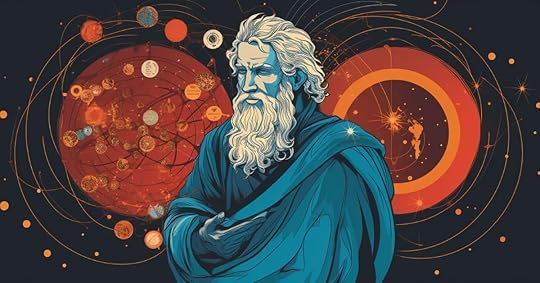
THIS BOOK WILL NO LONGER BE AVAILABLE AFTER SEPTEMBER 10, 2021. Carlo Rovelli, a leading theoretical physicist, uses the figure of Anaximander as the starting point for an examination of scientific thinking its limits, its strengths, its benefits to humankind, and its controversial relationship with religion. Anaximander, the sixth-century BC Greek philosopher, is often called the first scientist because he was the first to suggest that order in the world was due to natural forces, not supernatural ones. He is the first person known to understand that the Earth floats in space; to believe that the sun, the moon, and the stars rotate around it—seven centuries before Ptolemy; to argue that all animals came from the sea and evolved; and to posit that universal laws control all change in the world. Anaximander taught Pythagoras, who would build on Anaximander’s scientific theories by applying mathematical laws to natural phenomena. In the award-winning The First Anaximander and His Legacy , translated here for the first time in English, Rovelli restores Anaximander to his place in the history of science by carefully reconstructing his theories from what is known to us and examining them in their historical and philosophical contexts. Rovelli demonstrates that Anaximander’s discoveries and theories were decisive influences, putting Western culture on its path toward a scientific revolution. Developing this connection, Rovelli redefines science as a continuous redrawing of our conceptual image of the world. He concludes that scientific thinking—the legacy of Anaximander—is only reliable when it constantly tests the limits of our current knowledge.
Carlo Rovelli is an Italian theoretical physicist and writer who has worked in Italy and the USA, and currently works in France. His work is mainly in the field of quantum gravity, where he is among the founders of the loop quantum gravity theory. He has also worked in the history and philosophy of science. He collaborates regularly with several Italian newspapers, in particular the cultural supplements of Il Sole 24 Ore and La Repubblica.
Was the attempt to take away the power of gods insane?- Clearly. I'm sure this was an overlap of genius and madness and it worked wonders for us all. Few have managed this in thousands of years.
The premise of this short book seemed unpromising: a physicist with no formal training in classics or history was apparently claiming that Anaximander, a Greek philosopher about whom almost nothing is known, is the spiritual father of modern science. But, in the event, it was much better than I'd expected. Rovelli is certainly not a historian, but he appears to know Latin and Greek, has read widely, and had enough interesting things to say that he kept me thoroughly entertained. I started this afternoon at Luton airport, and didn't put it down until I finished just now in Geneva.
A large part of the book is concerned with the question of what "science" is, and in what ways it differentiates itself from religion. Rovelli's central argument is that the distinguishing mark of science is that it is always willing to question established authority. This, above all, is why he wants to argue that Anaximander should be considered the founder of the scientific tradition. Anaximander's teacher, according to later authors, was Thales of Miletus; but rather than simply accepting his master's ideas as holy writ and further developing them, Anaximander changed them in many important ways. Even if the story is just a myth - Rovelli is happy to admit that the facts are extremely uncertain - I think he has a good point. This way of reasoning about things is historically unusual. The philosophical/scientific tradition may not have started exactly here, but it began around this point in time, and, if nothing else, Anaximander is a nice way of symbolizing the break with what had gone before.
The book has many thought-provoking examples that I had not previously come across; here is the one I liked most. Rovelli is discussing the question of cultural relativism. Different societies have different belief systems, and on what grounds can we say that one is "better" or "more true" than another? It is fashionable, at least in some circles, to say that the terms make no sense. But Rovelli has a nice case study concerning the Greek mathematician Eratosthenes, who accurately measured the circumference of the Earth in the third century B.C. by comparing the shadows cast at widely separated locations. This part of the story is famous; what I hadn't heard was that a Chinese astronomer performed the same experiment several centuries later, but reached completely different conclusions. The Chinese believed that the Earth was flat, so the astronomer, seeing the different shadows, thought that he had determined the distance to the Sun, which would have been quite close. The interesting thing is what happened when the Chinese and Western traditions finally collided in the early 17th century. The Westerners just smiled at the misapprehensions of the Chinese astronomers; the Chinese, on the other hand, rapidly agreed that they had got it wrong. There was no question of the two accounts being different but equally valid.
If you are interested in the faith/science debate, you may also enjoy Rovelli's book. He comes across as a pleasantly intelligent and open-minded person, something that is unfortunately all too rare in this area.
This is another amazing book by an amazing author. Just one amazing thing about the book is the fact that it examines, evaluates, discusses the astonishing scope of a man that we know so little about, a man who lived some 2,600 years ago, a man that many of us have never even heard of. It is impossible to summarise any book in one sentence. But one sentence from this book will stick with me forever: “The world is infinitely more complicated than the naïve images we create to find our way through it.”
The Italian physicist Carlo Rovelli (b. 1956) is a fluent writer who manages to translate difficult parts of science (especially theoretical physics) into readable language. Moreover, he makes us sensitive to both the strengths and the limitations of science as we know it today. He does this in this booklet as well. Through the early Greek philosopher Anaximander (early 6th century BCE), he provides insight into what is essential to the scientific method: the continuous critical questioning of prior insights. So, science is not about verified certainties, - as many people think -, but about systematically built-up and scrutinized but always preliminary insights, in a process that will never end.
That is, of course, true, and it is a fine response to the current anti-scientific climate in the Western world. When you see the irresponsible policies currently being pursued in the United States—for example, in the fields of healthcare and ecology, deliberately going against scientific insights—you know that Rovelli’s message absolutely is legitimate.
Nevertheless, a few caveats. Rovelli does underemphasize the rigid nature of contemporary science, firmly anchored as it is in the academic world with its shielded (pay)walls and compartmentalized thinking. And – related to this – he also underemphasizes how science as we know it today sometimes wears an overly reductionist, Cartesian-mathematical, and materialistic lens, and remains blind to other, more creative approaches to reality.
My main criticism of this booklet aligns with this. Rovelli turns Anaximander into the champion of freethinking, the man who had definitively broken with a stifling religious view of the world. He actually portrays him as the hero of the modern world, who had already grasped just about all the revolutionary insights of modernity. With all due respect, based on the sources we have regarding Anaximander, this is, to say the least, an exaggeration. So, my advise is to take the good parts of this book to heart, and use your critical capacities to tackle the bad parts. More on that in my History account on Goodreads: https://www.goodreads.com/review/show....
I was looking for the author’s brief lessons in physics and spotted this book as well. To be honest, I thought this one sounded more interesting than the lessons book, so I grabbed it too. It’s a curious little book.
As someone who doesn’t believe in god, I’m more or less on the same page as the author of this. He is arguing that Anaximander (a Greek philosopher who died about 100 years before Socrates was born) was the father of science. There is a nice bit in this where he runs through some of the other contenders for the title – up to about Newton – and so makes the point, you know, that the title really does depend on what you are going to mean by it.
His reason for picking Anaximander for special mention is that he was a student of Thales, but unlike the expectation that many students and followers would be hyper-protective of their teacher, he felt the highest praise he could provide his master was to prove him wrong. This was and is and will likely remain the greatest strength of the scientific method and the reason it can claim to have done so much to change the world. I believe Aristotle said that as he liked Plato as a friend, he preferred the truth. Now, this really isn’t something that religion can match, as is pointed out repeatedly throughout this book. And as the author says, this has meant that science and religion have increasingly found themselves in separate spheres, where religion’s sphere has been constantly diminishing over time – a situation that has not necessarily brought a sense of joy to the religious.
He mentions some of the martyrs of science along the way too – Hypatia and the library of Alexandria are two examples I still get upset about – but he does this mostly to highlight the social and cultural situation in Ancient Greece that allowed, for a time anyway, for science as a radically critical appraisal of the world to flourish. He also points out, with reference to the murder by the state of Socrates, that this situation of radical doubt and acceptance of alternative viewpoints was hardly universal – the fact Socrates was murdered for blasphemy and corrupting the youth of Athens makes his point, and is, of course, something else I still haven’t quite gotten over.
Greece is presented as being unique because it sat betwixt and between other powerful civilisations – with Egypt, for instance, proving much older than the Greeks even believed the world to have been. The constant friction these other civilisations provided allowed room in Greece for a kind of radical doubt.
Again, this is clearly a point of difference with religion – based as it is on faith. I have to say that I find certainty one of the more terrifying forces in the universe. Those who ‘know’ are too often wild and terrifying beasts, and the more certain their knowledge, the more terrifying they tend to be - religious or not. The crime isn't so much religion, I feel, but certainty. As my friend Yeats has it, 'the best lack all conviction while the worst are filled with a passionate intensity'.
The end of this book discusses theories for the origin of religion, and, as often happens when I read such theories, I’m left feeling unconvinced. I started reading The Bicameral Mind last year, but felt it was, as the author here says about other things – an interesting idea, but also that ideas are two-a-penny, and not nearly enough on their own. He appears to have more time for the bicameral mind than I did, but it isn't entirely clear to me why. Personally, I tend to think that humans are narrative centred creatures – we make meaning from the scraps of evidence we find about us, and that is one of the key reasons why science’s radical doubt proves so important for us, because without it we will, quite literally, believe just about anything.
This is an interesting wee book - it is rather short and yet covers a lot of ground. Well worth taking a look, I think.
In my experience, working scientists often get history of science wrong - in this case, as it's arguably more history of philosophy, I can't say whether or not Carlo Rovelli is straying far from what's known to make his point, but what he has to say about the Greek philosopher Anaximander from the 6th century BC is fascinating.
All I really knew about Anaximander was that he had proposed an early cosmology, with a cylindrically shaped Earth and the light of the Sun and stars produced by fire contained in rings that had holes in to let the light out. This was interesting, but not necessarily hugely inspiring. By contrast, what Rovelli proposes is that Anaximander came up with a number of steps forward that were effectively foundational for the scientific method.
At first this seemed like hyperbole from someone championing a particular favourite, but by the end of the book I was convinced. What Rovelli attributes to Anaximander are the idea of a non-flat Earth floating in space - surrounded by the heavens, rather than a flat Earth with the heavens above; building on Thales' example as the first known explanation for physical processes without divine intervention; introducing the concept of natural law; and challenging his master's ideas rather than simply building on them.
The next step Rovelli takes is to try to understand why 6th century BC Greece was pretty well the only such starting point. He emphasises, for instance, that despite their impressive mathematics, astronomical observation and technological developments, Chinese philosophers and scientists never came up with the insight of a non-flat Earth floating in space, only switching to this viewpoint when they received information from missionaries in the seventeenth century. He suggests that it was the combination of having the first fully phonetic simple alphabet, the lack of dominant royalty and the independence of the city states that enabled this revolution in thinking in Miletus where Anaximander was based.
The rest of the book (about half of it) concentrates on what science is, the dangers of cultural relativism and understanding the world without gods. I found this a lot less interesting, partly because I'd seen most of it before, and partly because it is more a matter of paddling in the murky waters of philosophy of science rather than the more interesting (to me) origins of the history of science.
For the first half alone, though, this is a book well worth having. Rovelli has improved hugely since his early super-waffly titles - if you have an interest in where science came from, this is arguably his best so far.
This little book certainly has its merits (see the review on my general account on Goodreads: here). But while reading I was frequently annoyed, due to my hypersensitivity to historical inaccuracies. After all, Rovelli turns the early Greek philosopher Anaximander (early 6th century BCE) into just about the discoverer of everything, and even the father of modern science, and especially physics. And – in my honest opinion - that is largely unjustified, at least based on the knowledge we have now.
According to Rovelli, Anaximander was the first in just about everything: “Anaximander (is) one of the intellectual giants of the ages. But Anaximander’s legacy is still greater. He paved the way for physics, geography, meteorology, and biology. Even more important than these contributions, he set in motion the process of rethinking our worldview—a search for knowledge based on the rejection of any obvious-seeming “certainty,” which is one of the main roots of scientific thinking.”
Nice, but this statement really is built on quicksand. To begin with, we have not inherited a single written work or word from Anaximander; everything we know about him and his “teachings” is based on hearsay, sometimes from generations and centuries later. Of course, that does not mean that this information is necessarily wrong. But it calls for caution, at the very least. Especially since not very many texts about him have been preserved. Robin Waterfield lists them in his overview of the Presocratic philosophers (The First Philosophers: The Presocratics and Sophists): from Anaximander there are barely 14 substantive references in later authors; on top of that, there are strong suspicions that the references in Aristotle for example are a very distorted representation of what Anaximander supposedly argued. In any case, this is stuff for endless debates between specialists, who question just about every word in those references. Relying on those fragments to proclaim Anaximander a hero, as Rovelli does, seems to me a very risky undertaking.
But what bothered me most is that Rovelli proclaims Anaximander as the initiator of non-religious thinking. He is said to have been the first to not appeal to gods or mythology for explanations of the world. Once again, we must be careful with the fragments on which this claim is based. But the most annoying thing is that Rovelli starts from an absolute dichotomy: either you appeal to gods and a religious explanation, or you leave those gods out and provide a completely secular, material explanation. That dichotomy is absolutely old-school. It ignores, for example, that within the mythologies of the Near East, and also those of early Greece, a systematic approach and semi-rational principles of order emerged that clearly served as a starting point for a more rational, pre-scientific approach. Among others, the recent work of Carolina Lopez-Ruiz, Greek Mythology: From Creation to First Humans (2025), makes this clear.
Another point where that dichotomy fails is that it starts from a view of the religious as the domain of absolute truths, of infallible statements about reality. Quod non. If Paul Veyne made anything clear with his little book, Did the Greeks Believe in Their Myths? it is that this view of pre-modern religions is simply flawed. It also narrows religions and mythology down to the domain of “explanations of phenomena,” whereas they are primarily general philosophical systems in which pre-modern man developed an image and/or a narrative (or rather: narratives) with which he could better place and interpret chaotic reality, and within which he also could “function” in the very broad sense of the word.
At some point, Rovelli apparently sensed that he was exaggerating somewhat with his adoration of Anaximander. For at a certain point he writes: “A thick fog veils the sixth century before the Common Era, and we know too little of the man Anaximander to be able to attribute this immense revolution to him with certainty. Still, this revolution, the birth of a thinking based on curiosity and change, took place. In the end, whether this change was wrought personally by Anaximander, or whether “Anaximander” is simply the name used in ancient sources to identify it, matters little.” Frankly, at that moment, as a reader, I felt deceived.
Does all this mean that the Greek Anaximander had no merit at all? No, I am certainly not going to claim that. In early Greece, and specifically on the Ionian coast in the 6th century BCE, certainly milestones were set; a new way of looking at reality was introduced (I have to concede that Rovelli had that right). But to immediately single out one man as thé hero of that revolution—no, that is going too far. The evidence is truly too fragmentary and dubious for that. I guess Rovelli here ventured into a field, the historical, in which he has absolutely no expertise. And the fact that his references and bibliography are mostly based on works from at least 20-30 years ago speaks volumes.
I just want to say, very very quickly and hoping to encourage future readers of this book who are maybe on the fence trying to decide whether this would be a wise purchase or not, that the (luckily, few) reviews that complain about Rovelli going off on merely personal and unsupported speculations about Anamixader's thought show absolutely zero understanding of what the book is about.
For one thing, Rovelli says explicitly, in the very first chapter, that this won't be a historical reconstruction of Anaximander's thought, and that he is not aiming at historical-philosophical accuracy in his presentation of the Milesian philosopher - also in light of the fact that he is neither a philosopher nor an historian, and therefore this kind of work doesn't fall within his training and capabilities as a scholar. What he does, instead, is discuss what we know, or believe to be accurate, about Anaximander's thought (and his sources are quite rich in this respect), to discuss this information in terms of why and how this is relevant for understanding the development of the scientific enterprise, and of scientific, naturalistic rationality, as we understand these concepts today.
This very clear theoretical aim, which he clearly explains at the beginning of the book, also implies that even if we've got some relatively small number of facts about Anaximander wrong, that doesn't nullify the claim that, based on the written traces at our disposal, several defining characteristics of science and the scientific mindset (such as constitute Rovelli's focus in this book) were first conceived in the Greece of the VI century BCE. Even more importantly, Anaximander's ideas provide Rovelli with a compact historical and philosophical signpost, so that Rovelli can take the cue from this to talk, as a scientist, about science itself.
At one point in the book (I believe in the chapter about meteorology, but I'm not sure), Rovelli suggests that judging the results obtained by these ancient Greek philosophers-scientists based on whether they were right or wrong, or seeing their results as clairvoyant, is terribly short-sighted (in Italian, he uses the word "miope"). That's not the point at all. The point is the method: naturalism, curiosity, constructive and respectful (self-)criticism. These are the things that the book is about. So don't be miopi yourselves and actually listen to the books that you take the trouble to read.
Miletul a fost un oraș portuar prosper de pe coasta de vest a Asiei Mici.
Anaximadru a trăit în Milet, în secolul VI î.e.n. Este primul filosof care a propus o perspectivă naturalistă asupra lumii. Până la Anaximandru fenomenele naturale erau explicate întotdeauna în termeni mistici și religioși: ploia era adusă de Zeus, vântul de Eol, valurile sunt create de Poseidon.
Cu toate acestea, cercetarea legilor matematice subiacente fenomenelor naturale lipsește cu desăvârșire. Această idee va apărea mai târziu, în școala pitagoreică. Absentă este și ideea de experiment. Abia odată cu Galilei, adică două mii de ani mai târziu, putem vorbi despre experiment.
Carlo Rovelli é o Carl Sagan do século XXI. Nenhum outro divulgador de ciência consegue fazer o que ambos fazem: relatar informação científica impregnada de emocionalidade. É preciso uma paixão imensa pelo que se faz e se quer expressar para chegar aqui, e do muito que tenho lido, Sagan e Rovelli são inigualáveis.
I'm really baffled by the horde of positive reviews of this book. The first few chapters are rather entertaining, introducing Anaximander and his historical context. From there onwards, it just goes into "I'm writing my blog" territory, introducing a series of opinionated diatribes on different positions and questions around the evolution of scientific thought. Even if you stay with the Anaximander part, there are serious flaws with what Rovelli writes. Not only does he ignore major research on the topic, but he goes on to fill in the gaps with his own imagination. I appreciate being creative and thought-provoking, however, building a whole story around it is stretching it a tad too far. Actually, the constant thought I had while reading it was that if Rovelli proceeded like this within his own field, his editors would reject the manuscript for lack of proof. It's ironic how scientists demand proof to sustain certain theories, but arbitrarily decided it doesn't apply to other fields. Also, I must confess that his dismissiveness and clear ignorance of Eastern Asian civilizations itches me too much.
Don't get me wrong, I appreciate and even agree with many of his arguments, but the extreme reductionism with which he approaches many of the topics of the book is problematic for me. And it's again ironic as one of his major points is that you must keep an open mind and be capable of adapting to different contexts.
Carlo Rovelli has written a book about Anaximander who was born around 610BCE in Miletus in modern day Turkey and then goes on to discuss the nature of science and how progress is made by people reimagining the world on a continual basis.
Anaximander wrote a treatise in prose called On Nature. This book is now lost and only one fragment remains quoted by Simplicius of Cilicia in his commentary on Aristotle's Physics:
The effort to reconstruct Anaximander's ideas from indirect sources has been extensive, but does ultimately show that this man was the first to undertake scientific thinking as we know it today. Anaximander was always searching for knowledge to progress his understanding of the world.
This is quite profound because at the time people believed in gods and regarded them as the source of earthquakes, thunder, and lightning. Anaximander regarded these events as natural phenomena. He understood that rainwater is water from the sea, rivers, and lakes that has been evaporated because of the sun's heat. He also believed all animals originally came from the sea and understood that the planet Earth floated in space.
La storia appassionante dei filosofi greci magistralmemte raccontata mette in evidenza la figura determinante di Anassimandro al quale non è stato dato il giusto riconoscimento riguardo la scoperta scientifica che riguarda il fatto che la terra non è piatta.
"Science is the human adventure of accepting uncertainty, eploring ways of thinking about the world, and being ready to overturn any and all certainties we have possessed to this point.. This is among the most beautiful of human adventures." - Carlo Rovelli, Anaximander
I adore Carlo Rovelli. I've read most of his books. This one was great. It is a great book arguing that Anaximander was the Father of science. The first genius that attempted (often close, sometime wrong) to explain the natural world (the world, wind, earthquakes, etc) NOT through some god or gods act, but using natural explanations. I lived as a kid near Miletus in Turkey. The irony of traveling quite a bit as a kid was only fully appreciating places I've been fully years and years afterwards. Miletus was also, just a few years later, the home of Pythagorus. The 6th Century BCE was an intellectual banger in Western Turkey. Anyway, I adored the book. Not as poetic as some of his other books specifically on Physics, but the prose was fantastic (thanks also to the translator M. Rosenberg).
It’s hard to make an assessment of this book. On its face, it seems to be a historical study of the place of Anaximander in the development of modern science. And, for the first half of the book, it really is that. But from there, Rovelli takes off into a much more loosely bound discussion of truth, reality, relativism, religion, language, and the fate of the world.
I’ll start with Anaximander. It’s a cliche that history is told by the winners. But if science is a “winner”, then Rovelli is telling the winner’s history of science. His claim, at the highest level, is that Anaximander produced the first “scientific revolution”, the beginnings of science itself.
What Anaximander does is remarkable. But I’m not convinced by Rovelli that Anaximander’s thought traces the beginning of a solid line toward modern science.
Here are some key aspects Rovelli calls out in Anaximander’s thought as a progenitor of science: - that the world may be different than it appears to us - knowledge as a progression of dialogue and debate based on questioning what has previously been thought - a new model of the shape and position of earth (not flat, resting on a foundation of some sort, but a cylinder freely floating in the universe)
Certainly, in the terms of Anaximander’s thinking, and in the absence of any explicitly mythological elements, there is a strain that we could call “naturalistic.”
But I think he’s actually more interesting and puzzling than that. In what we have of Anaximander’s actual writings, there are two concepts that seem difficult, in our own time and terms, to reconcile.
One concerns change and multiplicity — that “all things originate from one another, and vanish into one another.” Anaximander is traditionally interpreted in naturalistic terms, although his claim is not unambiguously naturalistic, at least not in modern terms. What he means by “originate” could as well be given a logical or purely conceptual interpretation as a naturalistic one. And in fact, the cosmologies of ancient Greece commonly told of such things as order and difference as developing from prior unities or chaos.
The second concept is the “apeiron” as the origin or principle (“arche”) of all things. “Apeiron” is sometimes translated as “the infinite” or “the indefinite” or “the undifferentiated.” I think it a stretch to give an unambiguously naturalistic interpretation of “apeiron”. In a naturalistic interpretation, you could read it as a truly empirical “thing” — an undifferentiated substance out of which all the multiplicity of things we are familiar with originates. Or you could see it as a logical concept, as the origin of multiplicity in undifferentiated unity. In fact, I think the distinction between a naturalistic interpretation and a logical one is something we lay over Anaxminder’s thought — it simply wasn’t a mature distinction at the time.
Correspondingly, what comes after Anaximander is neither pure naturalistic science nor pure rationalism. The themes that Rovelli pulls from Anaximander’s thought and times are important for the future history of knowledge, but in various guises besides anything we would call “science” in a modern sense.
For example, Parmenides, certainly not a “scientist”, explicitly separated the world as it appears to us (the world of “seeming”) from the world as it really is (the world of “truth”). Aristotle refined a method of presenting the thoughts of earlier philosophers as a basis for his own arguments and positions, providing an explicit structure for progress in thought, but not a method of science per se.
Likewise, Plato’s rationalist dialectic has roots in dialogue and debate of a conceptual sort, and is embedded in his idealist metaphysic of “forms”, at best a distant kin to modern science.
All of this is criticism of Rovelli’s history based on a popular conception of what is meant by “science”. And were Rovelli an adherent of that popular conception, one that revolves around strict adherence to observation, hypothesis, experiment, and “method”, then he would be a scientistic teller of fables about the emergence of science from the darkness of superstition and myth.
But he wants to construct a different understanding of what science is, one he refers to at one point as “science as a cognitive activity” (p. 111). He gives at least one explicit definition: [Science] means building and developing an image of the world, which is to say a conceptual structure for thinking about the world, effective and consistent with what we know and learn about the world itself. There’s a lot packed into that sentence.
He says also, “It [i.e., science] is, above all, an ongoing exploration of new ways of thinking.”
Rovelli is doing at least two things at once in this part of the book. He is telling a story about the history of science, finding its origins in Anaximander’s thought (or more broadly, that of the Milesian philosophers), but he is also, in doing so, recommending that we think a little bit differently about what science is, that we crack away some of the rigid, technical structures we’ve built around the enterprise of science and get back to something that may have been more fitting to Anaximander’s time, a less tightly bound search for the terms in which to understand the world.
In doing so, he steps into the territory of modern philosophy of science. In his chapter on “What is Science?” he attempts to find his footing within that debate, with Kuhn, Feyerabend, Lakatos, and others. The discussion is very short, and his criticisms of those thinkers abrupt and controversial. But in a way, that doesn’t matter — it’s not the point of this part of the book. The point, I think, is to, with the help of Anaximander’s thought, turn our understanding of science in a more conceptual direction — into an explicit focus not only on facts and observation per se, but on the terms in which we think about and organize the facts and observations of science. Rovelli thinks that, in fact, this is what great scientists do.
The second (roughly) half of the book takes off into a broad discussion coming to rest eventually in a discussion of science and religion. While Rovelli is not so strident a proponent of science over religion as some of his contemporaries, you will find familiar themes here — in particular an attack on “absolutism” as a defining characteristic of religion.
Discussions of religion vs. science tend to be one-sided, and Rovelli’s is no exception. I found particularly presumptuous this characterization of science as acceptance of uncertainty and religion as assertion of absolutism. In practice, the difference doesn’t seem so stark. Scientists often assert absolute postitions. Sometimes it’s the truth of theories, and other times, equally forceful, the absolutism of method. And religion is often a dynamic of faith and doubt, and sometimes acceptance of mystery. Broad strokes don’t do either side justice.
All in all, Rovelli has made me think more deeply about Anaximander, and about what “knowing” really is, in the time of the pre-Socratics. Maybe fittingly, I don’t find his account to be “true”, but enlightening.
Carlo Rovelli is an Italian physicist who I admire. I’ve read and loved Seven Brief Lessons on Physics, The Order of Time and Reality Is Not What It Seems. This book is a little different. It’s not a science book, but a book about the origin of science and the first scientist. Since it’s written by a scientist instead of a historian, the focus is on Anaximander’s contribution to science, its true meaning and significance in historical context, and, in the tradition of Greek philosophy, the development of scientific thoughts. There is no detailed discussion of source materials, although they are listed in the back of the book.
Reading the book makes me realize I know so little about Greek philosophy. Anaximander was a pre-Socratic philosopher. According to Rovelli, he was the first geographer, the first biologist and the first astronomer. He contemplated the possibility that living beings evolved over time. He proposed that earth was a finite body floating free in space, and natural phenomena, such as rains and clouds, were indeed natural, not caused by gods. More importantly, he was the first to propose two conceptual tools that would prove fundamental to scientific activity: the idea of natural law and the use of theoretical terms to postulate new entities. Finally, he realized the first great conceptual revolution in the history of science that became the main characteristic of scientific thinking: what seems most obvious to us about the world can be false; scientific thinking is, therefore, a continuous quest for novel ways of conceptualizing the world.
To have scientific thinking is to accept uncertainty and the possibility of change.
The second half discusses the nature of science, cultural relativism and absolute thoughts, and religion and science. I especially like the chapter about cultural relativism and absolute thoughts. The author presents a nuanced view on how we can interpret cultural history and cultural phenomena under the light of multiculturalism while maintaining the ability to tell the right and the wrong. I always think absolute relativism is just another type of absolutism, and when liberals deny scientific truth, they hand over the playground to the far-right.
I might be pessimistic, but the words I scribbled down after the last sentence of this book were "self-destruction". Otherwise pretty enjoyable (and possibly slightly idealised) treatise on the value of the scientific method as a means rather than an end, supposedly pioneered by the Pre-Socratic natural philosopher Anaximander.
I really disliked this book. It is extremely repetitive and he ranges into areas for which he has no expertise, notably intellectual history, the origin of consciousness and the origins of religion.
Rovelli believes that science began with Anaximander, not Thales. It has long been thought that philosophy and science began with Thales. After all, Thales looked for a naturalistic ground for explanations of the way things worked, not the gods. That is on him. But, according to Rovelli, Anaximander gets the title because he disagreed with Thales. It is the disagreement that matters.
But that is explained by the fact that Rovelli has an odd definition of scientific thinking which he claims “is a continuous quest for novel ways of conceptualizing the world.” That sounds to me like a number of German idealists, notably Leibniz, Kant, Hegel and Schopenhauer.
His favorite philosophers of science are Kuhn, Popper and Feyerabend. He sees science as subversive. He is a relativist. He never mentions it but follows Popper’s ‘critical rationalism.’
He condemns Western culture for its imperialism, religious dogmatism-especially the Catholic Church and the religious right-and its destruction of the planet through the Industrial Revolution. This is a strange position to take as Feyerabend’s position is “anything goes.” And that does include religion.
He sees us in the West as selfish and encourages us to read ancient Hindu texts.
Near the end he says, “I prefer the path of uncertainty.” And yet, he takes some very strong anti-western positions in this book. Hmm.
Si fa sempre più chiaro che i buoni scienziati riescono a parlare della storia della cultura infinitamente meglio dei cosiddetti umanisti. La conoscono fin nei più reconditi accessi e ne sono dei grandi estimatori. Mi vengono in mente per esempio oltre a Carlo Revelli, parlando di italiani viventi, Edoardo Boncinelli e Piergiorgio Odifreddi. Attraverso le loro parole si intravvede una sorta di cartone dell'affresco rappresentato da noi, dalle nostre culture nella organicità delle loro diverse manifestazioni. Alcuni dei concetti chiave del libro sono in ordine alfabetico: antiscientismo, commensurabilita' delle teorie, empirismo, falsificazionismo, ignoranza, incertezza, meccanica quantistica, mistero, naturalismo, pensiero mitico religioso, pensiero scientifico, quantizzazione della gravità, razionalismo, relativismo, relativismo culturale, relatività generale, relatività ristretta, ribellione, riti, rivoluzione scientifica, traducibilità.
“Aγεωμέτρητος μηδεὶς εἰσίτω No one ignorant of geometry can enter here.”
Rovelli’s books always seem to transcend their original premise. They begin with a central thesis—this one being Anaximander’s contributions to the birth of science—work their way up toward far broader overarching concepts, and eventually interpret these concepts through thoroughly erudite exposition.
The beginning of this book is an interesting look into the origins of the hellenic world; the Mycenaean influence on developing Greek thought, the development of a rational, naturalistic worldview starting from Thales and the seven sages of Greece, to Anaximander and his revolutionary conceptions of the world, to Aristotle and Plato, the Ancient Eastern thinkers, Augustine, Aquinas, and beyond.
The middle is a compelling circumscription of historical context; the genesis of the empirical, naturalistic worldview, knowledge as the building block of further progressive paradigm shifts, and the deep anthropological roots of cultural context that bounds scientific progress to continual human development.
“Knowledge is born from a respectful but radical act of rebellion against what we currently think.”
The latter half is utterly fascinating. It goes over everything—the nature of thought, religion, consciousness, myth, ritual, cultural context, uncertainty, scientific paradigms—sublimating it into the overarching theme seamlessly, whilst referencing compelling sources, aided by original interpretive commentary by Rovelli himself.
Something about Rovelli's worldview resonates with me deeply. He is not only a humble, intelligent, and eloquent writer, but also a curious, rational, and interdisciplinary physicist.
This is another great book by Rovelli, and another I wouldn't mind reading again.
The ultimate conclusion of not only this book, but Rovelli’s entire oeuvre, is that regarding the world —nothing is certain.“Our knowledge, like the Earth, floats in nothingness.” Anything, anyone, or any order that asserts to ultimate truths cannot be trusted; for history shows that in Time, “truth” is temporary. Prior certainties are replaced by further knowledge. Yet in spite of the implicit nature of uncertainty, it is nothing to fear. We should embrace it, for it is the foundation of our continued quest for knowledge, and the building blocks of blossoming civilizations and cultures that tackle the great mysteries of existence.
Carlo Rovelli consideră că Anaximandru din Milet a avut un rol central în nașterea gândirii științifice, căci a fost primul care a încercat să explice lumea fără a face recurs la supranatural și zei, ci oferind explicații naturaliste ale lumii.
Mi-a plăcut că autorul a început prin a-l încadra pe filosof în timp și spațiu, prezentând modul cum arăta lumea în secolul șase î.e.n și ce fel de civilizații existau în acel moment. Astfel a putut oferi sugestii referitoare la motivul pentru care Anaximandru a putut fi critic legat de status quo-ul explicațiilor lumii, precum faptul că Ionia se afla într-o perioadă prosperă, democrată, în care educația era accesibilă. De asemenea, a putut sublinia diferența calitativă între modurile de gândire care îl preced și cea pe care a inițiat-o Anaximandru.
Am savurat cartea, căci Rovelli prezintă într-un mod pasionat două dintre interesele mele: știința și filosofia. Mi-a plăcut și poziția sa față de controversa știință-religie, căci a susținut că acestea vor fi mereu în conflict, datorită faptului că religia se bazează pe acceptarea unor adevăruri care nu pot fi niciodată contestate, pe când gândirea științifică presupune a pune la îndoială orice premisă care devine insuficientă și a accepta noi dovezi și idei. În plus, nu pot decât să fiu de acord cu fervoarea sa de a îmbrățișa incertitudinea, care nu înseamnă a relativiza totul, ci a accepta și aprecia cunoașterea pe care o avem până acum, dar a fi conștienți că ea va putea fi infirmată în orice moment.
A surprisingly provocative and inspiring book about the birth of scientific thinking 2600 years ago and its trajectory to our current knowledge about “reality”.
Offered some really nice quotable wisdom as well, painting science as critical rebel and passionate embrace of uncertainty, just a few highlights here:
“Knowledge is born from a respectful but radical act of rebellion against what we currently think.”
“The nature of scientific thought is critical and rebellious. It does not suffer a priori conclusions, reverence, or untouchable truths.”
“[Science’s] strength lies not in the certainties it reaches but in a radical awareness of the vastness of our ignorance.”
“Given our puny knowledge, we can't not accept living in the midst of mystery.”
I'm not really sure what I was expecting when I ordered this book. I knew that Anaximander has few surviving writings (all of which are either quotes from more recent authors or a couple phrases here or there). What I got was an interesting exploration of science by a scientist as well as an informed history of Anaximander.
I primarily was expecting a good explanation of the history of Anaximander, and Rovelli does a great job of explaining what we know, and also what he thinks are the important scientific takeaways. His history of Anaximander is the facts as historians know it along with the cultural milieu of ancient Greece. As Rovelli explains, it doesn't really matter if Anaximander exists for some of these takeaways, so long as the idea originated from people (or a person) of the era. The idea of the Earth floating in space, of naturalistic accounts of nature (no supernatural explanations), and of accepting uncertainty are the breakthroughs inherent in Anaximander's work, and the groundwork for much of modern science.
For history, I found that Rovelli did a very good and thorough job of explaining things. I was astonished to learn that the Chinese thought the Earth was flat until Jesuit missionaries in the late 1500s came, and I think it an interesting example of a scientific idea being a world changer (in a literal sense).
I have a few quibbles on the history, though. First, Anaximander's theory of the origin of humankind doesn't seem to imply an evolution of humans from fish-like creatures. When I read the English translation on Wikipedia, for example, it seems like humans (in their current form) were in the fishes and thrown on land when land was made available (also The Dream of Reason by Gottlieb says the same thing about Anaximander not having thought of evolution even in the proto-form of animals changing into other animals). Second, Hypatia and the state of religion vs. science after the Fall of Rome is mentioned in a way that I think is a bit unfair. Hypatia was murdered, but it seems more for being associated with a rival bishop than for her scientific achievements, so it's not really a science vs religion issue, and while I agree that science wasn't achieving great advances during the Middle Ages, it wasn't as stark as it is sometime made out (see the Oxford calculators for example).
For the science and "religion" essays, I found them interesting and thought provoking. Rovelli explores what science is, and he talks about the philosophy of science well. He seems well-acquainted with the various theories that have been put forth, and does not favor any one side too strongly (I think a nice summary of the ideas, and his own thoughtful definition, if one could call it that). He explores what drives us to look for explanations, what that might mean, and ends reinforcing that accepting uncertainty is a crucial part of humanity's improvement of the past millenia.
This is an interesting read, esp. if you have an interest in ancient science and philosophy of science. I think it's worth a read if you have such interests.
Carlo Rovelli books have become a real pleasure in my reading pile, a lovely mix of poetic and intellectually engaging. So it was an unpleasant surprise that I really disliked this one, his first book which has just been translated into English for the first time. It is less physics, and more Rovelli's take on what science is and where it comes from. Turns out, that take is largely that science is what religion is not, and where it comes from is largely the Western* canon. It is, ultimately, a somewhat rigid view of how thought evolves, and while I applaud Rovelli's passion for open debate, I think he has too narrow a conception of who gets invited to it.
*Rovelli is at pains to credit Arabic thinkers and to condemn Christian thinkers - but ultimately, this is a very Enlightenment narrative about science.
Una breve opera divulgativa di Carlo Rovelli, il fisico autore del best-seller "Sette brevi lezioni di fisica". Questo libro è precedente, del 2012.
Si parte da quello che l'autore considera il primo scienziato ante-litteram, Anassimandro, per allargarsi ad una riflessione più ampia sul ruolo della scienza e del pensiero critico.
Anassimandro è uno dei filosofi pre-socratici, che spesso scivola anonimo tra le prime lezioni di filosofia al liceo. Ma in questo libro (e ricordo un simile accenno nei documentari di Carl Sagan) lo si eleva a prima incarnazione storica dello spirito "scientifico", non essendosi accontentato nelle sue spiegazioni dei fenomeni naturali di tirare in ballo gli dei, ma avendo elaborato una proposta del tutto fisica.
Ancora una volta Rovelli conferma il suo grande talento di divulgatore, non tanto di argomenti scientifici concreti, in questo caso, quanto di storia del pensiero.
Certo non è un trattato enciclopedico. Il taglio è analogo a quello di "Sette brevi lezioni di fisica": brevi capitoli, neanche una parola di troppo, abbondanti riferimenti a voci le più diverse (si spazia dalla Grecia classica, a Lucrezio, ad autori cristiani, a sociologi come Durkheim).
Ma non si spaventi il lettore digiuno di studi umanistici (come, per dire, me): la lettura scorre sempre facile, il dibattito non si fa mai sterilmente accademico, animato com'è dalla prosa energica dell'autore, e dal suo ottimismo di fondo.
Rovelli infatti non si accontenta del ruolo "tecnico" della scienza, di fare previsioni affidabili. Questo è, sì, il metodo per validarne le teorie, ma a sottendere queste c'è, necessariamente e soprattutto, un modo di vedere, raccontare, costruire il mondo. Che un quanto tale ha un'influenza più ampia.
E quindi, ad esempio, richiamando le riflessioni di Kuhn sulle "rivoluzioni scientifiche", non è preciso parlare di incommensurabilità tra paradigmi scientifici successivi: due teorie si parlano, eccome; nel contesto in cui nascono, nei risultati verificabili che implicano. E' solo, appunto, a questo livello più profondo di modo di vedere il mondo che esse differiscono. Il libro fa proprio, come Kuhn, l'esempio di Copernico e Tolomeo: i loro due trattati si assomigliano nella struttura, "si parlano"; si dice, con una bellissima immagine, "si cercano come due innamorati".
Ecco, in questo senso questo saggio è sempre temperato da una sensibilità umanistica, con vette che giungono quasi alla poesia.
Una parte significativa è dedicata alla polemica verso l'irrazionalismo. A volte velata, sempre rispettosa e prodiga di argomenti. E con una fiducia immutate nelle capacità umane di conoscere, sempre di più. Non tutto, si badi bene: questa sciocca arroganza è del tutto assente.
Per usare le parole dell'autore: "Il mondo è terribilmente più complicato delle immagini che ce ne facciamo [...]. Siamo obbligati a scegliere se chiuderci in certezze vuote oppure accettare questa incertezza profonda [...]. Preferisco l'incertezza. Mi sembra [...] più degna, più onesta, più seria, più bella."
Dopo Sette brevi lezioni di Fisica e L'ordine del tempo, anche questo libro merita la mia ammirazione per la capacità di questo intellettuale di riuscire così bene a divulgare problematiche complesse. Non c'è una semplificazione dei concetti, che rimangono impegnativi, ma è l'uso della lingua comune declinata su ambiti specifici, ma non settoriali ed esclusivi, a rendere la lettura fluida e comprensibile.
Il contenuto riguarda soprattutto la filosofia della scienza, delle sue finalità primarie e dei suoi obiettivi, del rapporto e conflitto con le religioni da cui, proprio Anassimandro, iniziò a prendere le distanze; figura questa sottovalutata, ma rivoluzionaria per l'epoca in cui tutti i fenomeni naturali erano ricondotti alla volontà degli dei. Nel dettaglio, le intuizioni del filosofo greco sono ben sviluppate nei capitoli iniziali, ma i concetti analizzati, al di là dell'impossibilità di portare prove per mancanza delle necessarie conoscenze e tecnologie, rimangono sorprendentemente attuali, più per metodo (o coraggio) che per contenuto. Nella seconda parte, l'autore fa un'analisi antropologica della nascita e sviluppo delle relazioni tra gli umani e le divinità, intese come costrutti cognitivi necessari alla coesione sociale, così come li descrive ampiamente Harari nei suoi testi.
E' una lettura istruttiva e gradevole, adatta anche agli adolescenti.
Tra tutte le rivoluzioni scientifiche che hanno caratterizzato la storia, il noto fisico teorico ci illumina la figura del filosofo pre-socratico Anassimandro, a sua detta il primo vero scienzato. Le sue intuizioni cosmologiche e non (soprattutto la visione della terra come un masso sferico sospeso nel vuoto e il ciclo dell'acqua), per quanto oggi risultino elementari, erano d'avanguardia per l'epoca e addirittura per il millennio a venire, soprattutto perché non si basavano su convinzioni mistiche ma un primo tentativo razionale di osservazione. Su questo motivo si sviluppano poi molte delle riflessioni presenti, sulla necessità di slegare la ricerca di qualcosa che motivi i fenomeni piuttosto che osservarli e descriverli, intendere ogni teoria scientifica come non cristallinizzata e quindi "falsificabile", oltre alle posizioni aperte, citando vari esempi storici e moderni, contro l'assolutismo oscurantista e più di tutto, il relativismo culturale che oggi impera. Il tutto risulta una profonda quanto "semplice" introduzione epistemologica.