This is the story of three people: Sten Duncan, a soldier of humanity; Niun, last warrior of the mri, humanity's enemies; and Melein, priestess-queen of the final fallen mri stronghold. It is the story of two mighty species fighting for a galaxy, humanity driving out from Earth, and the enigmatic regul struggling to hold their stars with mri mercenaries. It is a story of diplomacy and warfare, of conspiracy and betrayal, and of three flesh-and-blood people who found themselves thrown together in a life-and-death alliance.
This is the 1st DAW paperback printing. Cover Artist: Gino D'Achille
Currently resident in Spokane, Washington, C.J. Cherryh has won four Hugos and is one of the best-selling and most critically acclaimed authors in the science fiction and fantasy field. She is the author of more than forty novels. Her hobbies include travel, photography, reef culture, Mariners baseball, and, a late passion, figure skating: she intends to compete in the adult USFSA track. She began with the modest ambition to learn to skate backwards and now is working on jumps. She sketches, occasionally, cooks fairly well, and hates house work; she loves the outdoors, animals wild and tame, is a hobbyist geologist, adores dinosaurs, and has academic specialties in Roman constitutional law and bronze age Greek ethnography. She has written science fiction since she was ten, spent ten years of her life teaching Latin and Ancient History on the high school level, before retiring to full time writing, and now does not have enough hours in the day to pursue all her interests. Her studies include planetary geology, weather systems, and natural and man-made catastrophes, civilizations, and cosmology…in fact, there's very little that doesn't interest her. A loom is gathering dust and needs rethreading, a wooden ship model awaits construction, and the cats demand their own time much more urgently. She works constantly, researches mostly on the internet, and has books stacked up and waiting to be written.
EVERYONE knows that SF BUFFanatics are all ARCH HIP, COOLaphonic and loaded with silky, smooth BREEZYness, right? RIGHT? Good...however, despite sharing the above stats, SFantasticos often vary greatly in the kind story they like to fill up on. From funny to campy to light-hearted to hearted to character-driven to world-builders to actiony to mega-actiony to detailed orientated to serious to socially conscious to thought-provoking to operatic to epic to life-changing, and all combos and sequences in between.
Thus two equally awesome SFyers may have vastly different opinions on a given novel, depending on what offs their particular rocks. I happen to like just about every variety of the above, asking only for "quality" in the book, and so I read a lot of different kinds of SF.
I would say this piece fits neatly in the detail orientated, character-driven, operatic department....and I REALLY LIKED it. This is the third book by C. J. Cherryh that I have read (the other two being Downbelow Station (Company Wars, #3) and Cyteen) and I have enjoyed them all (especially Cyteen which blew my hair back and left me staggered by Cherry's uber skill, though it was a very tough read). As much I as I liked this book, based on your SF taste buttons, I can certainly see why this would not be everyone’s cup of tea. However, before I get to that, here's a brief plot summary.
PLOT SUMMARY
This is the opening installment of the “Faded Sun” Trilogy and takes place within the author’s Alliance-Union universe. Humanity has been at war for decades with the alien Regul. The Reguls do not personally engage in combat and so all of their fighting has been done by the Mri who act as mercenaries for the Regul under a contract thousands of years old. Despite the Mri’s superior fighting ability, the humans sheer numbers have proven too much and the Mri have been brought to the brink of extinction.
Thus, the book opens as the Regul have surrendered and agreed to give up disputed territories to the humans, including the planet Kesrith, the homeworld of the remaining Mri. In preparation for a human takeover, a human ambassador named George Stavros and his assistant, former special forces soldier Sten Duncan are being transported as guests aboard a Regul ship to Kesrith in order to begin the orderly transition of administration of the planet.
While the above summarizes the basic plot, it is not what the book is really about. The book is really (1) a detailed introduction to the alien races of the Mri and the Regul and (2) a character study of three individuals: Nuin, a member of the Mri warrior caste, Melein, Nuin’s sister and member of the Mri ruling class and Sten Duncan, who attempts to assist the Mri in the aftermath of the war. As I have mentioned often before, I am a BIG FAN of world-building and reading about alien cultures and there are few writers who are better at creating authentic, three dimensional alien cultures than Ms. Cherryh.
However, while I really like the author’s detailed description of the alien societies, I can see why others may find this TOO DETAILED to the point where it becomes dull and plodding. For me, I was fascinated to spend page after page learning about their culture and following their non human thought-processes as they dealt with the events of the book. But, of course, different strokes and all that. Thus, I wanted to make sure I pointed out that this book is really about immersion into these alien cultures and the three main characters and not about a really exciting, action orientated plot.
With that said, I thought it was terrific. Very well written and at only 250 pages is something that can be read fairly quickly. I am looking forward to finding out what happens to the characters in the next two volumes.
4.0 stars. Highly Recommended.
Nominee: Hugo Award for Best Novel Nominee: Nebula Award for Best Novel Nominee: Locus Award for Best SF Novel
Okay, this novel reminded me of Dune. Kesrith, like Arrakis, is a desert planet; the burrowers are reminiscent of the Shai-Hulud (sandworms); the Mri bear more than a passing resemblance to the Fremen, or as far as their lifestyle on Kesrith is concerned. Yet, despite all this, the novel never felt like a knock off. It goes off in a whole different direction, and, being only the first chapter in the Faded Sun trilogy, can not be read as a stand-alone.
There is one other Dune comparison I can draw. Kesrith (the novel), too, is bloody magnificent. It’s been a while since I’ve been quite so swept up in a story. Yes, it’s not an action fest, and this first novel in the trilogy lays down quite a bit of back story, but it’s really atmospheric and just really good.
Cherryh’s prose is a delight. Her focus is on the story and the characters. There isn’t a lot of technobabble or gadgetry in here, which might be a let-down if that’s your thing. However, I would strongly recommend lovers of both Science Fiction and Fantasy to at least give this a try. I went into Kesrith with high expectations (the Faded Sun Trilogy seems to be universally revered) and I wasn’t disappointed. Not even a little. The two sequels are Shon'jir and Kutath. I’ll be reading them soon.
Since the individual books are out of print, look for the omnibus edition (The Faded Sun Trilogy) which boasts the same great Michael Whelan cover art as Kutath.
This is a story of three people: Sten Duncan, a soldier of humanity; Niun, last warrior of the mri, humanity's enemies; Melein, priestess-queen of the final fallen mri stronghold. This is the story of two mighty species fighting for a galaxy: humanity driving out from Earth, and the enigmatic regul struggling to hold their stars with mri mercenaries. This is a story of diplomacy and warfare, of conspiracy and betrayal, and of three flesh-and-blood people who found themselves thrown together in a life-and-death alliance.
A solid space opera from one of the best writers in the genre. Comparisons with the much more famous Dune series are not far fetched, both in worlbuilding and plot, and in the quality of the writing. I would even go so far as to say that Cherryh does a better job at creating interesting and relatable characters, and that the prose is more streamlined, with less padding but without sacrificing on the big vision and the major issues. An added bonus are the fantastic covers done by Michael Whelan. My one slight complaint is an overabundance of apostrophes.
Most of the action takes place planetside on Kes'rith, but the implications are galaxy spawning. At the debut of the three book series, a forty year old war between the two major civilizations expanding into galactic space, human and regul, has been concluded with a peace treaty. According to the terms of the treaty, the humans gain control of the planet Kes'rith from the regul, but both races ignore the rights and the concerns of the local inhabitants of the planet, the mercenary mri and of their semi-intelligent native pets, the bear-like dus. The regul are a commercially oriented race, whose massive bulk in adult form makes them unable to move without mechanical carts. For war and personal security, the regul have been using mri mercenaries for almost two millenia. In the war with the humans these mri have been sistematically sacrificed as cannon-fodder (pitching swords against machine guns), and Kesrith is the last homeworld for their dwindling numbers. What follows in the first volume is a duel between the last regul governor and the newly arrived human ambassador for control of the mri, with one human aide-de-camp, Sten Duncan, sent to contact the mri and find out their intentions.
Coming back to the Dune analogy: planet Kes'rith is similar to Arrakis not only in its harsh desert climate, but also as a unique planet that is home to a nomadic warrior people hardened by their environment and by their strict moral code. Kes'rith is also home to a species of giant sandworms, but that is more likely just a homage paid to Dune, because they don't play any major role in the ensuing events.
It erupted, a circumference twenty times the length of a dus, a cloud of sand from the edge of the burrower's mantle as it rose and dived again a few lengths farther.
The mri are a culture closed to outsiders, secretive and distrustful of strangers, very like the fremens and yet originals to this new series : a cross between the nomadic Bedu of the Arabian sands and the warrior caste of Japan - the samurai with their Bushido code (called a'ani here). The mri are organized in three castes : ke'len or warriors, those who look outward, and the only ones who can have contact with outsiders, generally designated as tsi'mri (aliens / non-people). Like the Bedu, the mri cover themselves from head to foot in black veils and robes, both as protection against the weather and as a method to preserve their privacy. They keep the other castes private two : the blue robed child bearers and yellow clad wise-men/women. For the purpose of the novel, the ke'len are the best fighters in the galaxy, spending long years learning the arms trade and being relentless in the pursuit of their enemies, as well as loyal and incapable of deceit. They also value personal proficiency with ritual swords and knives as the ultimate skill that can decide the fate of a battle, or of an internal political struggle, in a duel of respective champions. The mri problem in the fight against humans is that these tsi'mri have no concept of honor, prefer killing from a safe distance, and do not distinguish between military and civilian targets (sounds familiar?)
It had been the death of the People, that humans refused a'ani and preferred mass warfare; and he began to realize now that humans simply could not fight. Tsi'mri.
To finish with the Dune analogy, Duncan may be a reincarnation of Paul Atreides in his Muad'Dib guise, as the saviour of the fremen/mri who comes from off-planet and embraces their customs and their mentality, leading them out of the isolation and the threat of extermination. I am simplifying things here, as I want to leave enough details out for potential readers.
In the clash of cultures and the series of misunderstandings and/or wilful destruction of an alien society, I am reminded how the more we discuss the distant future and the foreign planets, the more we are actually touching on current issues in out present world, where an ancient culture (Arab) is demonized for its different traditions and adherence to a different set of values than the dominant military power on the current geopolitical map. Fear of the stranger translates into a 'shoot first, ask questions later' atitude where every member of the alien culture is seen as an automatic threat, regardless of age, gender or personal opinions. What the mri actually want may be the simple freedom to live their lives as they see fit without interference from outside. Most of the first volume in the saga is told from the perspective of Niun, the 'last samurai', the only young ke'len remaining in the mri fortress on Kes'rith:
Bloody-handed savages, he had heard one of the regul younglings call him in the town. But the regul built fences and made machines that scarred the earth, and tried to divide up space itself into territories and limits and parcels to be traded like foodstuffs and metals and bolts of cloth. It was ludicrous in his eyes.
The nomadic mri recognize no borders and no authority except that of their elders, yet they are contracting as mercenaries in order to get the material economic advantages their desert homeworld is unable to sustain. The reasons why they prefer a warrior society to an agricultural or industrial one remains secret at the end of the first book, with only the young queen-bee Melein being privy to the long term agenda of their race. Niun would like to have his questions answered, but this is not possible in the rigid caste system he belongs to. The arrival of Duncan breaks some of these restraints free, but is still far from elucidating all the puzzles:
Knowledge without power was the most bitter condition of all.
To discover these answers, I have already started the next book in the series.
C.J. Cherryh does it again, creating a compelling, inventive, unusual world, and peopling it with alien beings who feel truly alien and altogether authentic. As usual, I imagine her somewhat oblique style would be off-putting to some, but I treasure the confidence with which she goes about telling her story, never giving away too much, and always managing to craft surprising turns. Her depth of understanding of how cultures shape people creates endlessly fascinating moments. I look forward to continuing with this trilogy.
On a desert world named Arrakis Kesrith, live the last of a noble, black-clad warrior race known as the Fremen Mri, who must navigate a treacherous landscape where at any time a misstep could see them devoured by gigantic subterranean creatures known as Sandworms Burrowers.
O.K, so C.J Cherryh’s Kesrith shares a few similarities with a certain landmark work of SF, something that is probably hard to avoid if you’re writing a sci-fi novel set on a desert planet (damn Herbert and his genius!).
Don’t let that put you off. Beyond these similarities, Kesrith is its own novel with an engaging, interesting story centred on the aftermath of an interstellar war.
This war was fought with humans on one side, and on the other the long lived Regul, a race with eidetic memories who grow huge and slow with age until they are forced to move their great bulks around in slightly Harkonnen-ish mobility chairs. On the Regul side (doing all the fighting) was the enigmatic warrior race known as the Mri, a severe, rigidly caste structured race of warriors who have served Regul for two thousand years.
The Mri have been almost driven to extinction by the combination of human battle tactics and Regul tactical ineptitude and their remnants live on the eponymous planet Kesrith, where they simmer in their resentment of the two races that have brought them low. Kesrith is an arid world where physical exertion can be dangerous, the landscape is infested with wily predators ready to pounce on any unwary travellers, and water is dangerously rare. To be blunt it’s a bit of a shithole, which does raise the question as to why the Mri live there, a mystery that the novel deals with later in the story.
As the action takes place after the war this is no pew-pew military SF novel. Instead we are witness to the rocky start to a contested peace as humanity – the victors in the war – are gifted the rather crappy gift of the inhospitable, mineral rich world where their most bitter enemies are ensconced.
Ex-soldier Sten Duncan - travelling as an aide to a diplomat - is enroute to Kesrith on a Regul ship to take control of the world for Earth. Meanwhile, on Kesrith, young warrior Niun, last of the young fighters left on the world, yearns for combat glory he knows he will now never have, his anger at humans and threatening the hard-won self-control his warrior caste prizes.
Unbeknowst to both however, the Regul commander of the ship Duncan is on has his own underhanded plans to both undermine the human takeover and keep the Mri ignorant of the newcomers arriving on their world. His actions could spark another war, and end two thousand years of Regul-Mri cooperation.
So yeah, not so Dune-y after all.
Kesrith pulls the none-too-easy trick of being similar to an earlier great work of SF without aping it, and it carves a worthy niche as a compelling story of its own even if I did occasionally expect Shai-hulud to leap from the sands of the eponymous desert world.
Cherryh does a great job building an intricate and convincing world of very different cultures and the clashes between them. The story twists and turns in unpredictable ways, and is dotted with sequences of high-stakes tension that keep it moving.
It’s well worth your time and I’m looking forward to reading more of Cherryh’s work. Don’t expect a complete resolution at the end though - the narrative finishes leaving many questions unanswered while setting things up well for the second book in the series.
Kesrith is an inhospitable desert world, the stronghold of warrior Mri race. For two millennia Mri were mercenaries working for another race – Regul. The last war Regul fought with humans and lost it just before the book starts, in final battles throwing duty-bound Mri to die in thousands in the meat-grinder of the war.
The story follows the lines of Niun, a mri warrior and Sten Duncan, a human assistant to the diplomat with Regul. Regul are merchants, not warriors, the society of extreme gerontocracy, where young ones should follow every whim of the old immobile Regul – Duncan play the role of human equivalent to younglings.
The war is over, diplomats replace warriors with only one problem: no one asks Mri, even if their world Kesrith is one of the bargaining items.
The setting, as a lot of reviewers noted, is quite similar to Dune – desert world, warrior group/race, strength of traditions. However, for me another analogy is more valid: Mri are heavily influenced by medieval Japanese system – from honor of Samurai to formalized suicides. This is captured by illustrators, who depict mri ninja/samurai like up to katanas in their hands.
The story is interesting, but more ‘average SF adventure’ than other novels I’ve read by C.J. Cherryh. It is overburdened with mri words, which often aren’t clearly defined/translated and for me (having some other issues to settle except to fully dissolve in the novel) this was a significant drawback
I am a big Cherryh fan and I was excited to find yet another corner of the Alliance-Union universe I hadn't explored yet as well as the aftermath of the Mri-Human War that is hundreds of years after all of the other Cherryh books I have read so far. I was not disappointed, the action and character arcs are great and I loved the way we see the story develop on the desert planet Kesrith which often reminded me of Dune. I don't want to spoil the series, but I can highly recommend this one because the sequel, Shon'jir is even better!
The most ambitious and rich society building I've read from Cherryh since the appendix of alien species descriptions in Chanur's Venture.
What occurred to me while engaged in this narrative, is how like a D&D campaign Cherryh's method of running the story appears - setting up the basics of the involved characters, vaguely outlining the societal structures, then heading off and revealing finer details of the world as things progress; without any prior indication of the specifics of technological levels present in the realm, a scene with certain elements can come as if invented right there.
The world of Star Wars feels like an easy comparison, with desert planet and nomadic tribes thrown in with star traveling technologies. The ending of book #1 indeed left my mind humming as if something John Williams-y. Intrigued to see where things will go.
(In usual fashion, couple more thoughts in the reading updates below).
There’s something haunting about reading a book that centers on a mysterious alien culture right on the brink of extermination. The atmosphere is sad, richly themed, high stakes in a unique way because you really don’t want their whole multifaceted way of life to go extinct.
The mri are a nomadic, mercenary people who live by a strict code of honor. Their society is divided into castes: the kel (warriors), the sen (scholars / priestesses), and the kath (mothers and children). Outsiders only encounter the kel, so the mri present as cold, formal, and veiled—literally covering everything but the eyes. They value strength and dignity above life itself, accepting extinction rather than dishonor.
Kesrith is set at a time right at the end of a long war between humans and regul, who are a slow, bureaucratic, mercantile race that seems to have some kind of insectoid biology.
The regul are a bit fascinating themselves if revulsive. One of the key differences between them and other species is that they remember everything exactly as it happened; their memories don’t get muddled and change as humans memories do. This has a variety of resulting effects which are explored: lying is very taboo and difficult psychologically for them to do, although they can in fact do it.
They also have little need of writing and other storage mediums and are frustrated with other species needing things to be repeated which were already said once. They also tend to hoard knowledge and value it highly. They make decisions based on all their past history and knowledge, which has many advantages.
One disadvantage they have however is an inability to imagine things and to handle emergent situations that have never been seen before. As a result, they are very bad at warfare.
That’s where the mri enter in. The mri are very good at warfare—and really, that’s the only thing they are “good for” from the perspectives of the regul. Mri are very closer to outsiders and the fact that their one caste which presents to the outside world is completely veiled (minus the eyes) is no accident. They are secretive to a fault.
The mri culture values strength and honor above all else. It is not a very warm culture. To outsiders, it presents a solid mask (literally—the caste that has contact with outsiders veils everything but the eyes). But somehow the challenge of it makes it the more intriguing.
Aside: I like the interesting fact that their warrior caste (which is mostly male, but has some women as well) wears veils and dresses in black. They have all sorts of religious rules around their weapons, too. They love swords and throwing stars and throwing knives and have a whole discipline built up around each of those. They also use “distance weapons” (guns) as a practical necessity but given the chance, always prefer one on one combat with their traditional weapons. For them, combat is a way of life.
And then there are the dus. These enormous, bear-like companions live in deep bond with the mri, almost like partners rather than pets sometimes because they form one-on-one bonds with mri individuals that are very unique, and if they lose their partner, a dus will usually go mad in grief.
The dus are awesome. Expressive, affectionate, protective, and extremely dangerous, the teddy-bear-on-steroids dus embody the same qualities of loyalty and endurance that define the mri themselves. AND, they basically have this feeling-level telepathy—it’s not full on sharing thoughts, but they pick up on your feelings so strongly that if you’re having an argument with someone they might just go ahead and rip that persons arms off. They’re a dangerous pet to have around!
But they also add a tenderness to the otherwise severe mri, showing that this warrior culture lives in harmony with something wild and lethal. The mri–dus partnership is one of the most original and evocative details Cherryh creates.
There’s no way she wasn’t inspired by Dune. The desert planet, the veiled warriors, the mystique of an alien people nearly extinct—it all echoes Herbert. But the surprising thing is, I enjoy these characters way more than Dune and it’s just more readable and engaging. I love how Cherryh invents species with cultures that feel very original. The mri are reminiscent of some middle eastern cultures but they are much more nuanced than that. It’s a rich culture you get to explore over the course of the trilogy.
And she’s just a lot better at capturing the inner worlds and perspectives of her characters in such a way that you really believe them, you inhabit them.
And some of the main characters (being mri) are pretty brutal. They are not nice people in the way we would think of it. But it’s a culture difference. And Cherryh does such a good job of building up their worldview and perspective that I still care about them even though they do harsh things I would never do. That’s a skill.
Plot-wise, it begins with humans arriving to take control of the desert planet Kesrith after a long war. The regul, an older species of bureaucratic overlords, shuffle loyalties and wash their hands of the mri. The mri, too proud to submit, cling to their ways. Sten Duncan, a human soldier, provides the outsider perspective, showing us how baffling and compelling the mri appear to others. It’s interesting to get that outsider perspective on the mri by someone they capture.
I did have one hang up while reading. And I can’t really talk about this book without some spoilers. About halfway through, basically this city gets blown up from space and supposedly the last spaceship containing almost all of the remaining mri is destroyed. But it happens offscreen and I just didn’t buy it. So much of the plot leading up to this point was about getting that last remnant of the mri home, and then suddenly—“oh no, I guess Niun and Melein (the two main characters who are mri) are the last remaining mri in the universe.” I kept expecting a “surprise! psych” moment where we find out the ship moved right before the bombing. But the thing is, there never was.
And then you get to the ending of the first book and it’s just like, well, there’s no mri left but just the two of them, and it’s impossible for them to repopulate the mri race…so…it just leaves you with this feeling of where is there to go from here? The ending doesn’t really hook you for the next book.
In my case I did go ahead and read the next book because of trust in the author and the fact that everything she has written so far in the first book was so interesting, and I’m glad I did.
The events of the next two books heavily influenced how I understood the events of the first book, so I’m going to tell you a little bit (just the premise, basically) of what happens in the trilogy. I’m going to spoil the end of book two but not book three because honestly I think (for me at least) it actually would help enjoyment to know where the story was going, not hurt it.
Basically the story of the second book is about the last two mri traveling back through hundreds of star systems trying to find if there are any other mri left in the galaxy, and the answer is constantly “no” as they find dead world after dead world, all the way until they reach their home planet, which it turns out has the last remaining other mri in the galaxy.
But as they travel back, humans and regul follow them to finish the job of committing genocide on this race that they are so afraid of (despite the fact that there are so few of them left! They just can’t catch a break).
So basically the story as a whole across these three books is about whether this alien culture will be completely exterminated or not.
In hindsight, now that I have read the next book and I understand the structure of the overall story, I think that my problems with the ending of the first book wouldn’t bother me whatsoever when I re-read this series later. Sometimes it helps to know where the author is going.
I have now gotten up into book three and I am already looking forward to re-reading this trilogy again someday and soaking in the pathos and everything. This is a great series. You should read it.
Kesrith is perfect for readers who love political intrigue, immersive alien cultures, slow-burn worldbuilding, and character-driven tension wrapped in classic space opera, or if you just never got your fix of desert culture Sci-Fi from reading Dune.
Kesrith is an incomplete story, and yet even after this second reading, I'm tempted to not go ahead with the second and third books to find out what happens next. I'm completely mystified at the boneheaded actions of the mri. They're alien, of course. But they have no sense of self-preservation or species preservation. They're motivated by mysteries that even most of their people are not allowed to know about. Maybe there are answers later in the series.
What I did appreciate with this reread is how very different the three alien species' ways of thinking area. The mri, the regul, and the humans really do not seem to understand the others' behaviors and motivations, even when they believe they know their history. Cherryh is really great at alien psychology.
If you have read Dune, you will quickly realize while reading this that there are some passing resemblances 😎, yet, Kesrith is by no means some type of knockoff of Herbert's classic work. Kesrith is the name of a planet first colonized by the mri, a vague hybrid of Fremen (Dune's desert dwellers) and medieval Japanese Shogun. The mri made Kesrith their homeworld over 2000 years ago, and when the regul came to colonize Kesrith, the mri offered them service as mercenaries.
The regul are an interesting alien species for sure; vaguely hominid, they live long lives and possess eidetic memories. They are also pacifists and welcomed the mri 'services'. The mri, also hominid, but closer to human type, possess a strictly stratified culture, where the warriors, the Kel, train from age one and cannot read or write. The Sen are the scholars and leaders, and do not interact with other species (non-mri, or in their language, non-people; a telling tidbit).
Kesrith begins with the announcement in the mri 'keep' (for lack of better words) that the 40 year war between the regul and humans is over, and that the planet will be ceded to humanity. There are only a handful of mri left on Kesrith, the rest going to the war, and the regul sacrificed the mri in great numbers over the years, vastly dwindling the mri race.
Cherryh alternates primarily between two POVs, the mri compound where we learn about mri culture, with a focus upon Niun, the youngest Kel warrior who was left behind to protect the elders at the mri compound, and the regul still on Kesrith, who are busy evacuating before the humans arrive. We also are introduced to the human diplomatic team who will be arriving on Kesrith on a regul ship ahead of the human colonial mission.
Mri culture is fascinating and Cherryh obviously has a knack with alien species, even here in one of her very early works (this was first published in 1978). Honor and tradition play a fundamental role for the mri, whose warriors settle matters in one-on-one combat; so unlike the humans who engage in 'mass war'. While I felt very sympathetic to the mri, the regul less so. Cold, calculating with long memories, the regul may be pacifists, but they engage in power struggles nonetheless.
Kesrith comprises the first of a trilogy, which really should be considered one book; especially as very few things are resolved in this first installment. We are introduced to the various players and cultures involved in this epic here, but nowhere reach anytype of a conclusion. All in all, a fascinating read, yes, with shades of Dune, as once again Cherryh transports the reader to an alien landscape. 3.5 faded stars!b
5 stars for the physical book and 2.5 stars for the atrocious Kindle version.
My gosh, the Kindle version of this is absolutely riddled with errors!! Normally I read my physical copy, but since my eyes aren't what they used to be I bought the Kindle version. CJ Cherryh has always been a phenomenal author, so to see her work so sloppily converted into a half-baked Kindle book is somewhat distressing.
This story takes place at the tail end of a long war between the Regul and Humanity that lasted for forty years. We have three main species we're dealing with. Humans of course don't need any explanation. The Regul are a duplicitous and cowardly bunch that like to fight by proxy. And the Mri are the mercenary species hired by the Regul to (1) fight the humans on their behalf, and (2) serve as a type of cannon fodder while the Regul pull a fast one and get out of Dodge. Well, there actually is a fourth main species indigenous to Kesrith, (the world in which the events occur), and that would be the Dusai. They tend to be intimidating companions to the Mri.
The author's characters and alien species are always intriguing. The Mri utilize a caste system and are very rigid in their customs, laws, warrior training and beliefs. The Regul, (aside from being cowardly Sneaky Petes), are the technologically advanced species with perfect recall. I always picture them as looking like Jabba the Hut. And the Dusai are sort of venomous bear/ursine-like creatures with empathic and other mysterious abilities.
In addition to outstanding characterization, the author also has a knack for extending and ratcheting up the tension in her stories. She really excels at that. I don't think I have ever read a book of hers that didn't feel as if the Sword of Damocles was about to fall all over everything and everyone! I think that style is a great part of her written charm.
If you like a good and absorbing character-driven tale, this'll do the trick. If you anticipate heavy action, not so much. If you're a fair weather science fiction fan that doesn't like an emphasis on the science/pseudoscience, this fits the bill. (I admit that I fall into this category!)
This was a little too dry for me though I did end up liking it. C.J. Cherryh writes well and does a really good job in this story creating believable aliens that I came to care about during the story. I guess in the end it was just a bit too slow moving for what I was in the mood for.
I found reviewing this book as difficult as I found reading it, and it's why even though I enjoyed goo portions of it, I couldn't give it a really high review.
I have read C.J. Cherryh's fiction in other places, most notably in short-fiction anthologies like Sword and Sorceress and Thieves World. It was those works that lead me, quite some time ago, to put this book on my to-be-read shelf.
The book itself is set in an interesting world of sorts in which a conflict involving three races has just ended, setting up another. The Mri are a 'warrior' species. Or perhaps more aptly a mercenary one. They have a complex caste system based on some sort of mystery religion, in which their religious caste dictates from the inner mysteries to the warrior and servant castes of the outer mysteries. The Mri are the warriors for the Regul, a race of pondorous merchants whose traits include the inability to lie, photographic memories, and a society based both on house loyalties and an extreme Gerotocracy. That is a rule by elders. The Regul, when they become old, loose their mobility and thus, with there minds full of elaborate knowledge, they become the leaders of their culture and society. Humanity forms the last group and a war between the Regul/Mri and the Humans has just concluded with a human victory. Kesrith, the world of the title, is a 'new' home-world of the Mri that has been surrendered in the peace treaty between Regul and Human.
The Book from there follows several paths, mostly that of the changing fates of the last of the Mri and of Duncan, a human sent to Kesrith to oversea the initial stages of the hand-over.
The book had the sort of interesting world-building I really enjoy, but while the Human parts were fascinating, as were the Regul, I just found so much fo the Mri bits tedious. The central Mri character is a sort of 'Warrior who finds himself without a war but will discover he has a greater destiny. Learns what self-sacrifice means, etc.' form to it, and itbecomes a bit grating to sit through. I suspect for some-one not as enamoured as I am with concepts of xenobiology and strange cultures, with the various 'alien' words thrown in it might be intolerable.
There are seeds of very interesting stories here, and given that the series goes on for a host of books, perhaps they are played out in that series. Ultimately though I found my interest wandering and what I thought would take me a few days ended up taking me quite some time.
This was the start of one of my favorite sci-fi trilogies of all time. I was thinking about it the other night and went hunting through my bookshelves until I found it, thinking I might re-read it. It is so old that it pre-dates ISBNs. So much for scanning with the Goodreads app. The paperback edition cost $2.95 and it was published in 1978. But I felt even sadder when I opened it and the ancient glue of the binding cracked, so I've just ordered the omnibus reprint of all 3 novels from Amazon. I hate to think my collection of sci-fi and fantasy paperbacks won't survive me. Then again, though the pages are yellowed and the glue that binds them has become brittle, I can still read the words over 30 years later. I very much doubt my Kindle will still be working in 30 years.
After four tries with four different books, I have finally managed to finish a C.J. Cherryh book. She's one of those authors who had great success back in the 80s-00s, but kind of dropped off the radar as time went on except for one or two books. I actually saw an omnibus of this series in a new book store a few weeks ago, and Downbelow Station has had some staying power. I've found her writing exceedingly dry, which in this case of a Dune "influenced" story, I guess was fitting enough to power through.
Desert planet, Arabian-esque honourable warrior tribe, it's all a bit shameless. Cherryh does make an effort to put her own spin on it, if not quite to the level of Kingsbury's Courtship Rite. Kesrith has (alkali) rain, possibly psychic bears, and the cultural quirks of the mri are much more detailed. The mri, unlike the fremen, are not well-adapted to their harsh environment, slowly declining to extinction on it. She expands on the underexplored Dune lore that the Fremen are planetary nomads, making the mri's roaming from planet to planet over thousands of years more central, and their origin somewhat mysterious.
The first two thirds of the book are very, very slow and introspective, with a mri funeral taking up a large portion of that. The main perspective is from a young mri warrior, and he shows some depth of character, even while constantly being "honour and tradition above all". He has dreams, regrets, misgivings, all filtered through the mri worldview. The obese regul aliens, while similar in role to the Harkonnens, and their fatness obviously evokes Dune's Baron Vladimir, have enough cultural quirks of their own, and a few segments where we get to see their perspective on the political situation.
The story doesn't really start until that two thirds point, and it emphatically does not provide an actual ending. Much like Villeneuve's Dune: Part One ends on a more or less random, in no way conclusive scene, so does this first book. It seems likely that much like Cyteen, this was really intended to be read as one long book. In that sense it's hard to say what this series is even about. A human man, Duncan, briefly has to travel with some mri, and seems like he's about to go through the whole Lawrence of Arabia thing. A macguffin of unclear purpose is unearthed near the end. The bear-like dusei seem to exhibit strange abilities and considerable intelligence (for a bear, anyway). The reason the mri seek service with other races, and their ultimate origin, are left unclear. The connection to the wider Alliance-Union universe isn't clear.
Cherryh bombards you with invented names and terms, so the slow pace is arguably necessary to ease into understanding the difference between kel'en, kel'e'en, kel'ein and kel'nath. If mid-word apostrophes give you hives, DO NOT READ THIS BOOK.
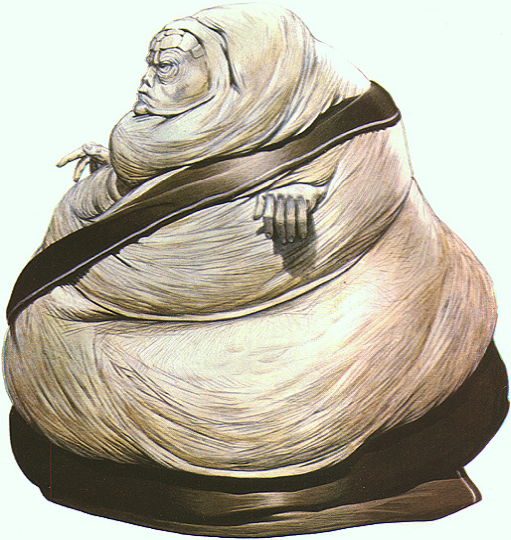
Rather than the mri, which have some cat-like features ("manes" rather than hair, tufted pointed ears, and Niun at one point takes a dust bath) but are otherwise humanoid, Barlowe chose the much weirder regul. He takes some liberties - the elderly regul Hulagh is capable of standing up, and even walking up stairs with extreme effort and aid, but I think this drawing is arguably more faithful to the intent of the creature than Cherryh's own imagination. Keep in mind, this was published in the late 70s. Back then, "incredibly fat" would've probably topped out at Chris Farley level. Barlowe's drawing is much closer to the subjects of My 600-lb Life, but with a more even fat distribution for a creature for which this is the normal condition of life. While a grotesque image in itself, Barlowe gives the regul a severe look, which fits well their portrayal in the book. Cherryh mentions pouches, and that regul are sexually indistinguishable until full maturity, even to other regul, but the question of how these beings achieve reproduction is (mercifully?) left unsaid for now.
First of all: this terrible, terrible kindle edition almost ruined my reading experience. There are errors on every page and I'm not exaggerating. It's not only missing or superfluous punctuation, it's "ri" becoming "n", "i" becoming "l", sometimes even a "th" becoming a "m" which changes "than" to "man" and leaves me trying to figure out what the hell that sentence is supposed to mean. In a book with a lot of alien words, it is even more difficult. And of course, I bought the whole trilogy on kindle. Yay.
The book itself: So far the weakest Cherryh I've read but she is such an amazing author that I still enjoyed it a lot. The three stars reflect a sort of intra-Cherryh rating. Overall, it's more of a four star book. The writing is beautiful, the world Cherryh creates is rich and imaginative. One thing I really, passionately dislike in sci-fi books is unfortunaltely prevalent here: only the humans adapt to alien customs, never the other way around, no trying to meet in the middle or understand the other. I feel like it's this arrogant speciesist notion that only humans are able to understand that cultural norms are not universal. Other intelligent, *space-faring* aliens are just like "this gesture is disrespectful in my society therefore it must be a universal truth". That took away from my enjoyment of the book and ultimately the immersive quality that the book otherwise had. As with every Cherryh book, this one took a while to get into and the first chapter was more like "oh, look, words" but that was to be expected. All in all, I'm glad I've read it and look forward to the next two parts although I'm not going to jump into them immediately.
First off, this book has a different take on the usual alien-colonizes-Earth bit, turning it around a little so that the humans are trying to colonize an alien planet, Kesrith, which belongs to the Regul and the mri, who are essentially the Regul's mercenary army. The problem with that is the mri have been decimated by the humans, who the mri think fight without honor. It becomes more apparent as the book goes on that the enemies of the mri may not be who they seem.
The mri are one of the more interesting humanoid alien species I've come across in my sci-fi adventures, mostly because of their caste system which favors females, in a way. The warriors, or kel, must keep covered in black cloth, veiling even their faces- and the kel can be male or female. The kel also aren't supposed to think for themselves, only do what they're told, when they're told to do it. This leads to some interesting situations, as the Regul aren't really concerned with what's best for the mri, despite using them rather ruthlessly.
What I loved best about this book is obviously the intensive worldbuilding, because it seems like that and alien politics take up half the book. Not much goes on for the first parts, other than getting to know the characters and the world around them. I must say I'm partial to the addition of the dusei, which are bear-like creatures that kind of remind me of a mountain lion-bear cross. Although I don't feel the artist does them justice on the cover, just imagine that critter but much deadlier-looking. They are natives of Kesrith, but have chosen to allow the mri to keep them as almost spiritually relevant animals (that the mri consider sentient beings).
I didn't feel like some points of the book were necessary, other than to convince you the Regul may actually have some brains to their blob-like bodies. I can't recall if it was just one chapter from the Regul perspective, but if it was just one, it was one chapter too many: everything you already knew through Niun and Sten's point-of-view chapters was reiterated through the Regul's eyes. There were also parts where Niun was completely at sea within his own thoughts, even though as a warrior, he isn't supposed to do such things. When you read this book, you know it is a start to a series due to all that worldbuilding and other introductory periods.
Kesrith may take place many galaxies away from us, but I did find myself lost in its environs and politics. Yes, there were points I wondered when the book would pick up, but when the dramatic crescendo of the story hit me, I was completely swept away. If you enjoy books set in a galaxy, preferably one far, far away, I would recommend Kesrith for your next read.
Rating: 4 of 5 Stars for an excellent science fiction novel that builds slowly.
This is old CJ Cherryh. Not a series of hers that is especially well known, although it should be as it features many of the strengths of FOREIGNER and the CHANUR series.
KESRITH has action but is not action packed. It is filled with mysteries and politics, written up only the way that CJ can do it. You get the conflicts within characters, conflicts between departments and sections of governments, conflicts within species and between species. You also get friendships. Relationships that rock the worlds they are set in. Foe and Foe somehow finding common ground.
Conflict and friendship both are presented against a backdrop of some great world/universe building. The planet of Kesrith seems real and dangerous with it's deadly alkali sea and treacherous windflowers. But going there is worth it if only so that one can see dus.
There are probably flaws therein but I keep getting swept up in the story and have not noticed them any of the times I'm read this series. I read it first when I was young and in college. I'm re-reading it now when I'm old; and this time I'm enjoying it just as much. [I am warning people as of 2015 to avoid the kindle trilogy version if typos drive them crazy.]
~ This is good solid story telling but I would advise you to pick it up when you're in the mood for something with intricacies and politics. This is not a shoot-em-up.
A most excellent series. I found this one on my bookshelf, and found the reason I had kept it all these years. This is one of the first of the alternate world series I so love. The language that CJ Cherryh uses is finely-honed - not the big thick books that have come to be more recently in this genre, but sparse and evoking of the worlds and the peoples she creates here. I had to really focus on the story to be sure I was pulling from it as much as I could. The three (4 if you count the dus, which I do) species - mri, regul and humna - do not understand each other and the reader must learn to understand each as well. The story is an old one - vying for land and struggle to preserve a way of life. Most excellent.
I really wanted to like this--I do love old school sci fi a la Ursula K Leguin, original Star Treks, etc., but I just couldn't do it. I'm all for invented languages and names, but both of those were so frequent in this book that it essentially wasn't written in English. And pains weren't taken to reveal the meanings of these invented linguistics, either. You're just expected to jump right into the world, feet first, instantly fluent in these alien tongues. I suppose it might ultimately be readable if you create diagrams and stuff along the way, but I wasn't up for that.
It is very much a setup for the series, which will either appeal to you or not but it appears to have been serialized in initial publication, so it makes total sense to me. Plus I am consuming the entire series via audible anyways. And each instalment is pretty short, so I doubt it overstays it’s welcome for anyone.
The narration is pretty strong, thankfully! He does a good job of differentiating between characters and inflection seems on point. Not the best performance but when you listen to ad many audiobooks as I do, I find this narration much better than average.
It’s short enough, clips along fairly well pacing wise, and changes up worldbuilding from show and tell, which I personally don’t mind but may grate on the reader who prefers “show” and hates infodumps.
Decent prose and I’m just in the mood for this kind of old sci-fi—and it does feel very much like older sci-fi for better and worse. There won’t be anything here that will blow you away or feel innovative if you’ve read current sci-fi. But it does feel distinctive from Dune, where I wasn’t sure if it would or not. It’s more concerned with the cultural underpinnings of the various races and seeing where those drives take them, and the intrigue around that—then the scheming political and philosophy of Dune. I myself go back to Dune for my interest in culture/religion/philosophy, so I find these books pretty different (and overall prefer the Dune books) but I feel like that distinction might let other readers decide if they’d give this a go if they did not like Dune and were worried this was too similar.
Stuff I Read – Faded Sun: Kesrith by C J Cherrhy Review
Having completed Kate Elliott’s King’s Dragon not long ago, I have turned my attention now to science fiction in my attempts to read more female authored novels. And the biggest name I could think of (definitely the one I have been meaning to read the most) is C J Cherrhy. During high school a friend of mine told me to read the Faded Sun Trilogy, and I had fully intended to and then simply didn’t. Shame on me, I guess, because the first book in the series, Faded Sun: Kesrith, delivers a great story and an interesting universe to explore. Things take part at the closing of a great way that pitted humanity against the forces of the regul, an administrative race of creatures that move slowly and never forget and their mercenaries the mri, an honor-driven people bred to be warriors. The story takes place with the mri decimated and the regul in retreat. The action takes place on the planet Kesrith, the latest of the mri home worlds. There the last of the mri prepare for what is next in their race’s destiny while the regul prepares to cede the planet to the humans.
Really it skips between the human soldier Duncan and the mri warrior Nuin. They begin worlds apart, with Duncan dealing with the regul and Nuin dleaing more with his own people and their traditions. The author does an excellent job giving depth to all the people and races involved, and even manages to get some mileage from t he regul, who at least seem to be the “bad guys” of the series. They are definitely the least sympathetic, the most prone to “inhumanity.” There is a definite sense that where the mri are capable of nobility, of honor, the regul are not. Which is rather odd because the conflict that decimated the mri was against the humans, and yet the book more than anything else seems to be putting that blame on the regul, where both humans and mri seem to be able to get along. Mri and regul or humans and regul, though, seem to not be able to truly work together, because the regul are just too different. That difference and similarities between humans and the mri become the main thrust of the book, as the story eventually unites Duncan and Nuin as they must work together to try and save what is left of the mri.
I’m not sure if it’s a trend, but here again I see that here is a female author and she just kicks the crap out of her characters, really hitting them while they’re down. Part of me wonders if part of that has to do with a feeling of powerlessness that I imagine has to exist when one is a female author, because society is still very male controlled, but perhaps again that is looking into things too much. Because the book is at least about trying to save something after a long and bloodied war that has done damage to both sides. But the mri have been decimated, and are getting ready to try and survive. They are a culture and a people who are shown to be worth saving, even if they did much in the service to the regul that hurt people. They, as the humans come to see it, were just soldiers, like the humans, while it was the reguls who really made the blunders that meant death for mri and humans alike.
But the story also seems to take some sort of sick joke in making the characters suffer, and eventually we see almost all hope of survival and recovery disappear and it seems at points that the entirety of the mri are destroyed. By the end there doesn’t seem to be much hope of survival as a species, though I’m guessing that’s going to change in the next few books. What we are given is a situation that devolves until humans and regul are forced to work together and humans and mri are forced to work together. The cooperation between humans and reguls, however, is lacking trust and openness, is full of hidden meaning and half truths, while the cooperation between mri and human is much more open and honest. If you look at it as the two species, mri and regul, represent different aspects of humanity, then it seems the author is making a claim on which parts of ourselves are more harmonious, more beautiful, and which are more cunning, more deceptive, more ugly. It is an interesting thought, though hardly something new, as the romanticizing of warrior culture is prevalent in pretty much every human culture.
Still, the book provides good, well fleshed out characters, and does delve into the minds of some odd choices, like a regul leader and the human in charge of colonizing the planet after the regul leave. It’s a little strange because there are times when, more than one important character being present, it jumps between perspectives, but it isn’t difficult to figure out whose thoughts are being shown or anything like that. And this turns out to be a solid science fiction that resolves a conflict only to introduce a much larger one, one to be resolved later in the series. And I liked the setting, the characters, the plot. It does rather kick you in the face at times by doing something very drastic, but that is good, too. It works well, and for that I give it an 8/10.
This entire review has been hidden because of spoilers.
I’m learning now that a certain classic science fiction book spawned a line of derivatives, or perhaps even its own sub-genre. Kesrith is one such book. I personally loved the progenitor and have liked the few subsequent tributes I’ve come across. Be forewarned, though, like the original, this is a fantasy experience that requires a lot of upfront work. These are the exotic, invented or otherwise irregular terms and names introduced in the first chapter: wind-child, sun-child, Kath, shon’ai, Kel, as’ei, fire-child, star-child, song-weavers, Game of the People, dawn-child, earth-child, Sen, rune-makers, kel’en, kel’ein, Kel-caste, Sen Sathell, Niun, Sathell s’Delas, Sen-caste, Kel’anth, Eddan [these previous are all on page 1], regul, sen’anth, dusei, mri, tsi’mri, Nurag, Mab, a’ani, zahen’ein, sen’ein, she’pan, Pasev, kel’e’en, yin’ein, Dahacha, Sirain, Nisren, Palazi, Quaras, Lieth, Guragen, Liran, Debas, truebrothers, dus, Elag, Kesrith, She’pan Intel, she’panei, the Pana, Sil’athen, Melein s’Intel Zain-Abrin, kel’e’en, sen’e’en, Kel, Sen. The following are more familiar terms but which, when reading, you know stand for customs, practices, or titles that you are going to have to learn in order to understand the fantasy world: laugh-bringers, the House, home-leaders, scholars, gold-robed, caste, elders, the People, the Mother, lords, the Game, Lady Mother, the Holy, the Gods, the Revered Objects, the Dark, gold-robes, light bearers, high-caste, Hand, Mind, Chosen, the Mysteries. That’s 79 terms in the first eight pages.
A light sprinkling of fantasy terms and a slow introduction into the depths of the fantasy world can be an enriching technique. Cherryh, here, adopts the deluge method instead. For all of my imagined fantasy and science fiction authors out there reading my reviews so as to better understand your reader, know that this is a bad idea. A stroll through a mist can be whimsical, enchanting, and captivating. A trek through a downpour is wearisome, depressing, and consternating. The flipside, I suppose, for those readers whom haven’t yet abandoned the book after the first several chapters, is that suffering together brings a form of camaraderie. This upside to the hazing experience doesn’t appear until about one-fourth or perhaps one-third of the way through the book. The downpayment is sizable, but fortunately so is the pay-off.
Once you’ve suffered through the third-of-the-book long orientation, Cherryh really does have something to offer. She cycles through several first-person perspectives giving us a look at the assumptions, biases, and worldviews of our main characters and then she deftly pushes the plot to emphasize misunderstandings, mistakes, and unseen motivations. This makes for rich and well-constructed characters and personal dramas. Once you’ve gotten here, you’ve already struggled through the difficult parts, and the rest of the book is simply there for you to enjoy seeing how these characters and their plots intersect in this fantasy world. I found the end result well worth the initial discomfort.
My first experience with Cherryh was with her Chanur series. This Faded Sun first is better written than the Chanur first (and the Chanur first was, by far, the best of the Chanur). Cherryh isn’t a poet, and she doesn’t do word play. Her only flair is that fantasy-technical writing where new terms and concepts are the adornments. Though the writing was generally functional, I must complain that I still don’t understand exactly what happened at the plot climax. I read through it twice, and it simply isn’t clear. I couldn’t pickup who did what to whom and in what order. The consequences were clear, but it was still immensely frustrating not to understand what happened in the biggest action scene in the book. This was actually a common problem in Chanur, and it fortunately happened only a couple of times here. My final grievance was the story arc. Ultimately not much really happened in this book. Cherryh wasn’t guilty of giving us an unfinished first book; it resolved what it set out to at the beginning. Cherryh simply didn’t plot out much of a story. Thus what you really have is a small drama set in a deep world- and character-building book. With each book of the trilogy reaching approximately 250 pages, and all having been published within a year of one another, this would have been better, I suspect, as a single 750 page book. I’ll be better able to tell you when I finish the series, but if the other two are like this, then I’ll conclude that it would have been a great single book but ranks only as a middling series.
Although this was a 250 page book it was a slow read due to the many details. I read the first page 3 times to make sure I understood all the cultural implications. If you like very detailed world building and understanding an alien culture, then you will enjoy this. I was very frustrated when it ended just as the action began - until I found out that this is the first in a series (yay). Getting into the heads of three different species and realising where misunderstandings were made was fascinating, although I found myself cheering for the Mri most of the time even though I understood the motivations of the Regul and Human.
Riveting, exciting, creative and original. As usual, Cherryh nails it. And as usual I must proceed with #2. Only drawback, it's only available in paperback or hardcover with SMALL print that it strains my eyes to read. Gah.
Plot or Character Driven: A mix Strong character development: Complicated Loveable characters: Complicated Diverse cast of characters: Yes Flaws of characters are a main focus: Complicated
In some ways, this book reminds me of Dune, by Frank Herbert. It isn't as intricate, but it does favour it a bit. Kisreth is a desert planet (where this story takes place).
I enjoyed the story, but I do feel that the author kept the reader at arm's length.
This Science Fiction story, has a lot of Fantasy elements. One of the Fantasy elements that I had the most problems with...was that everyone, and thing, and place had a name...which just bogged down the immersive enjoyment of the story. I feel that the author could've shown, more than told...about who, what, when, and where, instead of naming the "whatever" some odd sounding/pronunciation...that at the moment it was introduced, the reader had no where to put all this information.
The main protagonists are Sten Duncan (a human diplomat) and Niun (a Mri warrior), with Melein (a Mri priestess) a close secondary character in the story.
The war between the humans and the other races have been going in favour of the humans, but they are not well regarded by other races in the galaxy...especially the nomadic Mri that live on Kisreth. The Mri are incredibly spiritual, and are just trying to save their culture from extinction.
The struggle (with what is happening in the galaxy, and on the home planet of the Mri, even though the humans have been given it as a war spoil from the regul) that occurs during this book was enticing, and heartwarming (how Duncan and the Mri work things out on Kisreth), and I am really interested on how the next two books, Shon'Jir (second book) and Kutath (third and final book in the trilogy.
Kesrith does what I love most in a hard sci-fi story, and throws you headfirst into intricate worldbuilding unforgivingly. Every other sentence is a puzzle from which one has to decode meaning, even if the worldbuilding itself created more questions than it answered. On top of that, the story is an excellent study in perspective, different chapters narrating a war from individuals on conflicting sides. That said, nearly every other aspect of the story falls short. It’s bloated with unnecessary mundanity; clumsily written in awkwardly formal language that the author doesn’t seem familiar with properly wielding; and—I’m not sure if it was because of the edition I had—riddled with errors that should’ve been caught in proofreading, to the point where I found myself struggling to read simple sentences. The political intrigue is less intriguing than a documentary I watched recently on the failed Superconducting Super Collider in Texas. And unlike Dune, which it seems to be trying to imitate to an extent, there doesn’t seem to be any reflection or commentary on contemporary society or issues. But nothing’s as much of an egregious let-down as the characterization of the cast, all of which except Niun were so poorly written—lacking motivations, sufficient backstories and relationships, and morals—that they might as well have been wet mops. Because I couldn’t care less about these characters, I couldn’t be bothered to finish the series.
If you’re looking for just some solid sci-fi, this should be a good contender.
What this book does feel like though, is a beginning rather than a story onto itself. There’s a lot of set up. It takes a lot of time to feel like you even have a handle on the new species and the dynamics and cultures (all of which are pretty plot relevant).
It doesn’t feel like the last part of a book when you turn the last page. More like the end of a Part 1 in a larger novel, where there is no expectation for any kind of closure or any real self-contained story within the trilogy’s wider story arc.
So I liked it, but it was also slow to get going. I expect things to pick up significantly from here though.
But yeah, maybe, if you can manage it, pick up one of the omnibus versions so that you can read this whole thing as one book instead of three.
This was my choice for a book I'd never read that was published in 1978. I must confess that I chose it from my list of options in part because it was a shorter book and I thought it would be a quicker read. Wow, was I wrong. C.J. Cherryh really is incredible at creating believable, intricately thought out alien cultures, but it can create a steep learning curve when trying to figure out both the culture and the plot!
I was a bit disappointed in the ending, until I remembered that the three books in the trilogy were one longer story that got chopped into three parts and it made a lot more sense. I think I'll have to see about reading the other two soon, while this one is still close to front of mind.