Easily the funniest super-hero comic to come down the pike since Harvey Kurtzman and Wally Wood's Superduperman, Angelman is Austrian cartoonist Nicolas Mahler's sardonic take on super-heroes, their fans, the businessmen behind them, the current media obsession with them, not to mention fancy-ass Ultimate collections of dopey super-hero comics.
Created by Korporate Comics in a flash of money-grubbing cynicism appalling even by their standards, Angelman's powers (which include empathy and the ability to be a good listener) prove less than adequate to deal with the sinister threat of the insane plastic-surgeon villain Gender Bender or for that matter with the fickleness of fashion, the rapacious super-heroine Lady Dentata, the increasingly desperate re-boot attempts by Korporate Comics, his oddly twin-like wife, a disastrously bad movie adaptation that single-handedly brings the vogue for super-hero movies to a screeching halt all delineated in Mahler 's trademarked ultra-minimalism (albeit this time in spectacular color), and with his drier-than-dry wit.
Includes a special checklist/price list of Angelman comics, a gallery, and extensive historical and explanatory footnotes by the author, this book will occupy a place of pride on the bookshelf of any comic book geek or anyone who just likes hilarious comics.
Austrian author and illustrator Nicolas Mahler has illustrated numerous school books and worked on several animated films, shown at festivals throughout Europe. Known for his striking minimalist drawing style and sardonic deadpan wit, Mahler's graphic novels have been published in France, Spain, the Czech Republic, Poland, Canada, and the United States as well as his native Austria. He has published over 20 books and created drawings for international magazines, newspapers, and anthologies.
Everyone pretty much knows that superhero publishing is a joke, right? That storylines and characters and art choices are market-driven rather than a natural growth from organic narrative processes? That Big Corporate books (i.e. those from Marvel and DC) are mired in stunts that hope hopelessly to keep the interest of current readers while simultaneously attracting new blood? That comics sales dwindle from stagnation, a direct market, and an inability to do anything that feels real with characters whose legacy and recognizability are more important that the stories they inhabit? Everyone knows superhero comics are like this, right?
But they don't. I doubt anyone in my office knows this—after all, they don't read comics. I doubt my brother knows this—after all, he doesn't read comics. I know my wife didn't know until a few years back when she married me—after all, she didn't read comics. Even now that she does, she spends very little time in the corner with the superheroes—so it's pretty possible that she still doesn't know this. (fn1) My guess is that the people who read superhero books (but aren't also in junior high) are pretty well aware of the shenanigans involved in their pastime but suffer those slings and arrows to get one more taste of their four-colour crack. And the people who don't care about superhero comics generally won't know about the shenanigans because they don't care about superhero comics.
And this is, I think, the biggest problem with Nicolas Mahler's Angelman.
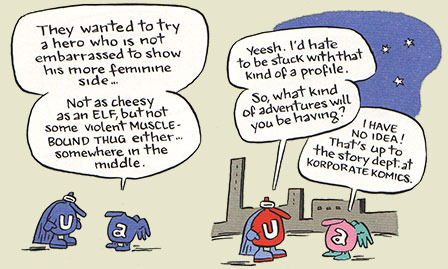
In Angelman, Mahler skewers the superhero industry, satirizing their ridiculous marketing ploys and the way they abuse their characters in order to just-maybe wring some profit from their heroic husks. The book follows the life and history of a new hero, Angelman, as he tries to adapt to superheroing and find acceptance among colleagues. Along the way he is constantly hampered by his writers and editors at Korporate Komics, as they seek to use him to fill ridiculous niches hoping to bring in new readers. While Angelman is given a nemesis, it quickly becomes clear that his true antagonist is the editorial team at Korporate.
The problem then is that while Mahler ably satirizes big superhero publishers—using wit and amusement as his chief weaponry—it's never clear who will appreciate his book. Readers of superhero books are already probably well aware of his punchlines; after all, they're immersed in the stuff. They'll probably find Mahler's book amusing, (fn2) but probably not nineteen buck worth of amusing. And people who don't read superhero books probably won't catch the jokes or, worse, won't care in any case.
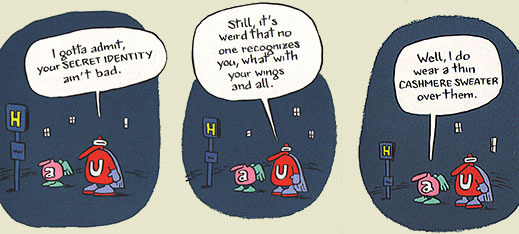
It's too bad, really, because Mahler is a talented creator. I very much enjoyed his slim earlier effort Lone Racer and he shows at least as much talent here—and possibly even more polish. The narrative concept that governs Angelman is really pretty genius (fn3) and the book's use of colour delightful. As per what I've seen from Mahler before, his characters are amusing abstractions, mostly noses and torsos—and sometimes even without visible arms. The book's backmatter is likewise amusing and relevant and includes a price guide for Angelman issues, covers from the character's short-lived series, and an afterward guide to the supporting cast's stories.
Angelman is well-published and sharply produced. Its critique just wasn't anything I hadn't read on comics blogs over and again for the last seven years. Honestly, it's probably worth reading but probably not worth owning. Which seems sadly apropos in a way. I'd much rather recommend Lone Racer. Perhaps I'll review that soon.
Footnotes 1) Although, since she proofs these for me, she knows by this point right here at least.
2) And it really is amusing. Mahler's a smart writer and his jokes betray that intelligence. In a way, Angelman does taste a little like the seasoned games player thoroughly schooling his jock cousin at risk every Thanksgiving, a kind of intellectual bullying. We all know that superhero books occupy the low end of the comics gene pool, and when Mahler pokes fun at the genetic deficiency it starts to lack a little grace. Maybe. It's possible I'm being too compassionate. After all, superhero books, ammirite?
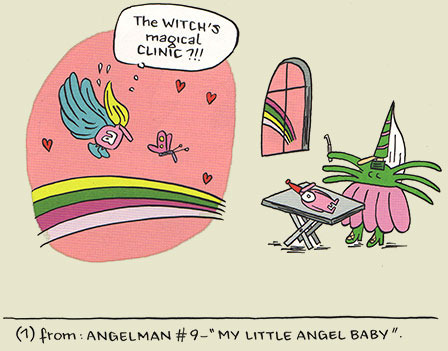
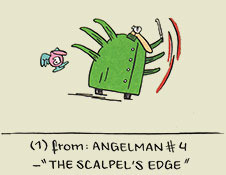
3) Each page brings to life a discrete incident from Angelman's story (either from his narrative or his meta-narrative) and anchors the telling in footnotes that recall issue numbers and story titles related to that page's event. Like so: ________________________
ANGELMAN is a funny, clever, sarcastic, and still at times oddly moving and sentimental story about possibly the world's least impressive superhero: a corporate invention called "Angelman" whose superpowers include empathy and the ability to listen well. From endless reboots and "grim and gritty" attempts at relevance to continuity and price guides, Austrian cartoonist Nicolas Mahler skewers all aspects of superhero comics and their fans--less with loving parody and more with a genuine sense of wonder about the peculiarities of this subculture. The book is beautifully produced and in full color, and is sure to generate a lot of laughs. I have to admit it's not exactly the first Mahler book I would have chosen to publish in English were I Fantagraphics, and I also have to admit I didn't feel the translation was a very effective or artful one. (Full disclosure and bias: I have translated Mahler's work into English for another publisher.) I selfishly hope this book sells well because I'd like to see more of Mahler's work available in the USA--he is a truly unique cartoonist, and that first sentence above captures his general style well: funny, clever, sarcastic, and still at times oddly moving and sentimental.
Angelman: Fallen Angel by Nicolas Mahler is a tongue-in-cheek, heavily-layered satire about the superhero industry wrapped up in simple yet precise figures. The book takes up the task as to why corporate-controlled superhero stories, and even the superhero genre, is a sham that follows certain patterns and committee oversight to remove all creative freedom in order to sell products. To Angelman, even independent superheroes face many of the same problems of their corporate kin. The satire is so bitter that it creatively points out the lack of creativity found in the superhero genre landscape, and that may be its greatest strength.
The most problematic part of this book is that Angelman’s committee-brainstormed arch nemesis is named Gender Bender who is a sexual reassignment surgeon by day and evil for some reason at night. At first, this comes out as extremely crass and borderline transphobic. However, the book is pointing out that superhero stories will go to whatever lengths necessary to sell products, even if it means insulting a significant portion of its fan base. The point is also that superheroes are so out of ideas that the most creative thing people can come up with is a villain named Gender Bender. Still, it's not great that it's used as a punchline so often.
Ultimately, Mahler comes away with the argument that, no matter how attractive superhero stories are at first, their pattern in both text and other popular media robs them of any originality. No matter the creative team, superheroes are inevitably rebooted, sold off, and retconned making many of the stories forgettable and uninteresting. I tend to agree with this viewpoint, and it’s part of the reason I do not read as many superhero books as I used to.
Nicolas Mahler satirises superhero comics and the industry behind them in "Angelman", a superhero whose superpowers are sensitivity, open-mindedness and being a good listener. The only thing that can destroy him is intolerance, his superhero identity is concealed by working as a female editor of a women's magazine and his nemesis is a gender reassignment surgeon called Gender Bender.
Mahler mixes fact with fiction, having Angelman exist in the real world as his employers at Korporate Periodicals give him his identity and storylines while the public read about him in their comics. The book is quite funny at times, especially as Angelman is a lame superhero who is constantly being rebooted to make him more appealing to a wider audience. So he's given weapons, and a wife, and new missions, until he falls apart from stress, becomes addicted to drugs and develops serious mental problems.
The story is told in 1 page strips drawn in Mahler's own simplistic yet strangely appealing way and reads like a series of New Yorker cartoons. It's a very enjoyable book that fans of superhero comics will get the most out of and if you've enjoyed Mahler's previous books like "Van Helsing's Night Off", you'll enjoy this too. An excellent indie comedy comic - just imagining Angelman going up against Batman or Spidey is enough to make me chuckle. Great fun.
Finally, a superhero comic where not every muscle is painfully articulated and the characters aren't stiff and unrealistic caricatures of good and evil. Thank you, Nicolas Mahler, even though I sense you're not a fanboy. You seem even sarcastic about the medium. Well, I'm willing to give you the benefit of the doubt because Angelman is such a well-drawn and dynamic character. Yes, I chuckled, too, at your punchlines that land at the expense of an industry that has given up the paper ghost for the multiplex. Sure, comicbooks are just a business, and like any business the bottom line is solely financial, which means that they're really just fodder for profit. No matter how elevated or artistic they pretend to be, we all know what's behind the mask. More reason to love Angelman, for his tragic trajectory makes him a martyr for the media. His death was not in vain. Oh, sorry, "spoiler alert."
Angelman is a pretty amusing (and more than a little scathing) satirisation of the superhero publishing industry. It does make some nice points at times, and I think the more you are a fan of superhero comics and are aware of industries faults, you’ll even more about of it.
I did enjoy the read, especially some of the points Mahler makes, but I think it’s one to pick up from the library, rather than splash out on. Although I did manage to pick it up in a sale
This was very different from all of the other comics I've read as it sort of makes fun of the comic industry. I enjoyed the extent to which the author went to bring his premise to life, with the references to specific issues and covers for those issues. But I didn't love the artwork. I think I like the idea better than the story as it appears.
A brilliant graphic novel that plays on stereotypes about gender roles, super heroes, publishing, and more. The dry wit in this book is perfect, and the characters never cease to amuse! Very meta. My favorite book of the year.
Fantastic satire of, among other things, the comics industry, the treatment of comics creators, character reboots, film adaptations of comics, gender, and violence in schools. Fun and charming.
Decidedly odd, even by Eurocomic standards. Mahler has an incredibly minimalist style going. There are numerous metatextual goings on. Wonderfully absurd stuff!