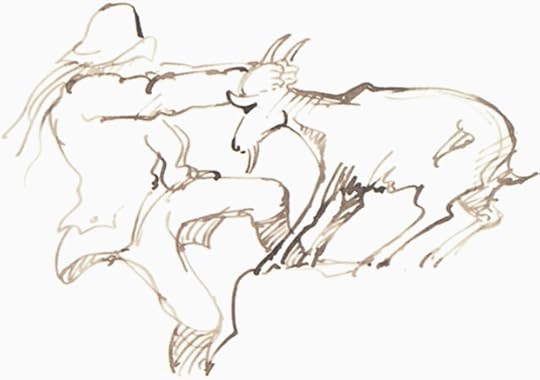
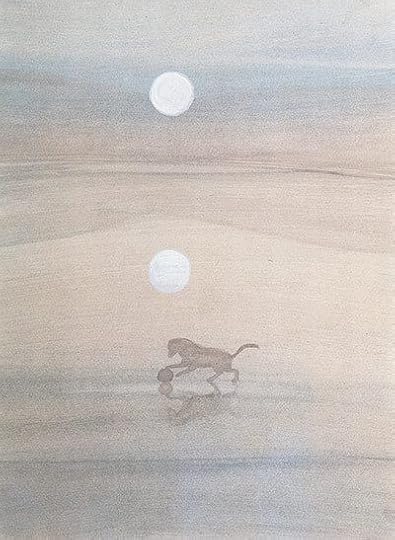
I first learned of Tomi Ungerer by watching the documentary which shares the title of this book. From the get-go, I was fascinated by his story and his diverse, yet controversial artistic career (certainly, you don't see very many children's book illustrators simultaneously releasing subversive anti-war cartoons and adult books with such titles as "Erotoscope"). After watching the doc I acquainted myself with some of his classic picture books, but I still wanted more, so I put Far Out Isn’t Far Enough on my Christmas list. Of all the books I received last Christmas, this one is my favorite. Far Out Isn’t Far Enough is a memoir in sketches (in both the artistic and literary senses) in which Ungerer reflects on the first year he and his wife spent living on “the wild Atlantic coast” of Nova Scotia. The area they lived in was rural, but by no means sleepy. Through whimsical wit and shrewd observations, Ungerer writes about the curious people and traditions that encompass this obscure patch of Canada. The language here is wryly poetic, the imagery is haunting in the best possible way, and on nearly every page there is a passage that made me chuckle or wish I had written myself. Wordplay is Tomi’s game, and here are just a few standouts:
“Change of the seasons, anticlimates and anticlimax.... Fall files the petition for summer’s bankruptcy.”
“The firemen are volunteers, and so are the fires, it seems.”
“The arm of the law here is boneless...”
What makes this work so compelling is the fact that Ungerer is writing from the perspective of a beginner, and an outsider. Whether it be butchering his first pig, interacting with the gruff locals, or helping an ewe give birth to a lamb, Ungerer is consistently imbued with a sense of awe and reverence about the situations and the landscape he has immersed himself in. By the time I got to the last page, I realized I would have followed Tomi regardless of how far he went.
Tomi’s illustrated journal of life in Nova Scotia reads like one of his peculiar stories. The lives there as ephemeral and acerbic as the tides, leave the people feeling more like apparitions. Their intermittent visits an offering of comic relief in a place where humor’s only service lies in making light of loss. And that loss in Gull Harbor, steady yet unpredictable, becomes an immutable fixture of the landscape, taking on a life of its own.
Life in New York City (what drove Tomi and Yvonne to Nova Scotia) favors callous, and that callous shelters a burgeoning romanticism for reclusion. If you’re feeling the hermit’s itch, this book will indulge with a hearty scratch and makes for an especially poignant read in winter.
“I had often heard the expression ‘a car wrapped around a telephone pole.’ Well, we actually saw one. This car had missed a curve and hit a simple, modest, unpretentious little pole. The pole did not break, but the car, an American whale of a thing, had its chassis bent so that the front bumper literally met the rear bumper. That vehicle must have practiced yoga for quite a while to be able to accomplish such a feat. The driver, his pals, and the telephone pole walked out unharmed.”
“As my wife said the other day, ‘One always exaggerates by telling the truth.’”
I fell in love with this book while on a train traveling across Canada in the mid-80s. It was an impulse buy, and sat in one of my to-read piles until the end of a post-grad term. For the trip: perfect. The story unrolled as the Prairies bolted by my window.
Life on a farm. The brevity of life on a farm. Eloquent drawings and prose about the 'necessaries' of living, thriving, and dying.
A sometimes touching, heartwarming tale of a NY artist and children's storyteller who moves with his wife to a farm in Gull Harbour, Nova Scotia. As they struggle to live self-sufficiently, the book provides some insights into what life must have been like for early settlers. Although the author was incredibly adaptible and inventive, life was never easy. The harsh reality of life on the edge of civilization often jolts you from the idyllic into the brutal life and death struggle going on every day. As much as we like to fantasize about living in early pioneer days, the truth is that few of could survive in such a harsh environment. This is the other side of the coin from Thoreau's Walden Pond.
A clarifying reminder of the pleasures and pains of living life in rhythm with nature, the seasons and in the confines of a small community. The illustrations alone make this worth a peek.
Well this was ok. I wanted to like this more than I did. It was bloody and real, but little more than well observed sketches in a journal of an author’s couple of years on their Newfoundland small holding.
Not one for vegetarians, it’s depiction of small town small mindedness includes brave but obvious prejudices and backwardness and you feel like the couple are an island of 70’s post-hippie of their own. The author fails to humanise them and they come across a little too loud about their publishing and a little too self righteous in their lifestyle choices. I really wanted to like Toni and his wife more than his text allowed me to.
Illustrated nicely also like a journal, I like the gloomier ones especially. Not a book I’d re-read but happy enough to have read it, and with many illustrations it’s a quick read.
Tomi Ungerer is an illustrator with a true eye, who can write a fair Hemingway-esque line as well.
In 1974, French-born Tomi and his wife left New York City for the back of beyond, Nova Scotia. This little book lovingly illustrates their time there. Tomi describes in sketch and pastels, watercolors and words the animals, plants, ocean, pond and people of that little farm on the northeastern coast and the nearby town. The animals are lovingly sketched -- and butchered. What else can a gourmet do except raise his own fresh and wholesome produce? The human friends the Ungerers make are a huge help, both in labor and information, in friendship and in wonder, wonder that folks can be so far outside one's ken, that folks can wonder so at what you yourself consider delightful and tasty and beautiful.
On the farm and in town, life flourishes and life dies, and both are accepted as the way things are. "Here today, gone tomorrow" is heard more than once. Cows and houses, beaches and sheep, dogs and fish, cars and friends come and go like the tide. And Tomi Ungerer has given us the gift of this loving look at all that passed before him. It makes me look and look again at all that is passing before myself.
In my quest to read as many of Tomi Ungerer's books before summer's end, Far Out Isn't Far Enough: Life in the Back of Beyond is the one I was least looking forward to. It's Mr. Ungerer's memoir of his time spent living in the remote coastal town of Gulf Harbour, Nova Scotia and a documentation of nature and wildlife in the surrounding area. Oh joy.
Needless to say, I was pleasantly surprised. I like how matter-of-factly he wrote of his unrefined neighbours and fellow townspeople and the humour he found in nature. And of course, his illustrations were wonderful as always.
Ungerer and his wife moved to the back of beyond, a remote fishing village in Nova Scotia, where they learned to butcher pigs, raise sheep, and battle the weather. Ungerer's dark side comes out here and there (making a pate in the shape of a swastika for German visitors, for example), but this is mostly a matter-of-fact account of a year on a farm. The sketches and watercolors are wonderful, as are his careful observations of the creatures and people they encounter. Highly recommend.
Tomi Ungerer's fragmentary and self-aggrandizing illustrated memoir of life on his Nova Scotia farm in the early 70s.
Had to ditch this one on page 115. Ungerer is very smug and closed-off in this book, which undermines the whole purpose of a memoir. The very first sentence of the book is a premonition of how little he intends to share and how selectively he'll let you in. He writes, with his habitual cringe-worthy wordplay,
“Yvonne and I left New York City in 1971, head over wheels. We were suddenly fed up with city life: racing along, our lives had run out of fuel, stalled, and so we struck out on foot on the first side road, not even expecting the unexpected."
We're never told why he and his wife left New York, only that they "were suddenly fed up." Likely story. Instead, he gives us a half-baked car metaphor for our trouble.
He occasionally includes untranslated phrases in French. He loves to sketch his wife, but declines to show us her face. He discloses early on that this book began as a private diary, but it doesn't have the feeling of a private diary. It has far too many mercurial, pointed omissions, as if he didn't totally trust whoever would go on to read it.
What he has no problem sharing are his accounts of the constant butchering of animals he enacts on his farm.* Butchery is a fact of life on the farm, and if you eat meat, you're a tacit participant. But his butchery is one of the only things he describes with appreciable detail and passion. He's proud of his new skill, and he says as much, scorning the fools and hypocrites who don't know what real, fresh meat tastes like. He and Yvonne whip their meat up into all kind of French dishes that I've never heard of before. There's an air of gourmand connoisseurship, which belies the performance of macho "it is what it is" resignation he attempts elsewhere. He's not a wind-whipped Nova Scotian, inured to the harsh violence of country life. He's a foreigner, a visitor, and he's thrilled by the differences between he and his neighbors, and thrilled by the opportunity to partake in the daily violence of their lives. Alcoholism, car crashes, gun violence, robbery, and arson are endemic to the community which hosts his farm. He never once expresses sadness. Instead, he tries on the weather-beaten mask of the frontiersman, in an actorly fashion.
All this wouldn't be as wretched if Ungerer's writing was decent, but it's not, it's terrible, full of dopey wordplay that belongs in the Sunday funnies and failed attempts at stoic mountain man poetry. He describes a cormorant stretching its wings as being in "an attitude of beatitude, an anchorite bird of pray." (geddit?) While lording over his cheeses in the cellar he finds maggots festering in one crock and tosses it out, "relish[ing] the pickled arrogance of power." (geddit?) Bizarre, nonsequitor visual metaphors and cutesy, self-satisfied plays on words are endemic to Boomer writing, and always crop up even when they're least appropriate.
It's too bad, because some of the art is really quite excellent. It should've been a monograph book.
*Not to mention more casual violence, such as when he shoots his neighbor's dog for eyeing his sheep, or when he pelts a wild fox with a stone, killing it, in an act of vengeance for its attack on his livestock. Whenever he kills an animal he expresses rue and explains that he had no other choice, but I don't buy it. He and Yvonne packed up and left Nova Scotia only a few years after they arrived.
Found this book by chance - didn't know Tomi Ungerer, one of my favorite illustrators- had moved to rural NS in the 70s. Having just moved to a rural community in NS myself, I found dome parallels... even 50 years later. Dark, sad, but also loving and hysterically funny... loved this mix of diary entries, observations, illustrations, story telling.
I love to read about illustrators and artists and Ungerer is certainly a great artist and storyteller. His autobiographical tale of life on a small island where the definition of sanity is fluid is fascinating and the urban sketching a real eye opener for those, like me, who know him as an illustrator.
A terrific package, the humor, stories, paintings, sexuality, learnings about animal husbandry & butchery. Writing style is delicious, so I started re-reading as soon as completing the book.
favorite story, p 118, where the crow pecks poor Sacha's (Newfoundland) paw, and then steals his meaty bone.
Entails some gruesome details during his living in Nova Scotia. Some parts, too are humerous and some just plain shocked me (He chronicles conversations with local residents). Life is just different in some parts of the world, and Ungerer shares an insightful look at the people and rituals in ragards to way of life during the 60's in Gulf Harbor.
Beautiful illustrations. Memoir of an artist/author who moved from New York to a very remote town in Nova Scotia. Though the landscape seems beautiful, the state of the town and its residents are bleak and disheartening.
Quirky memoir of living out in a tiny fishing village for a few years and farming. Oddly written but he does say, it's just notes and journaling. The book has marvelous illustrations! Worth reading for them alone.
illustrated colorful history of a fishing village in Nova Scotia during hard times... lovely vision this guy had, enchanting turns of phrase, and vivid images.