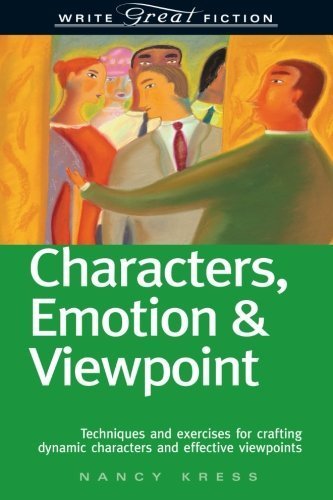
I found this book to be very useful at helping me work through some issues with the characters in my novel. The relatively narrow focus means Kress can delve deeply into each of the issues she covers. The first seven chapters are about deciding and showing who your characters are, including how their outer presentation might not match their inner thoughts, and how they might (or might not) change over the course of the book. I appreciated the level of detail here. I thought I had a pretty good handle on my main characters, but every chapter encouraged me to think about something new, or in more depth than I had before. The middle four chapters deal with how to think about and then show your characters' emotions. This time around, I especially appreciated the chapter on how different types of people respond differently to frustration, and how to express that for your main characters. This is key for just about any story, since whatever it is your characters want to achieve, if they got it easily you'd have a short book! The last four chapters go into wonderful detail about point of view strategies. I appreciated how the author gave the pros and cons for each type, including which are currently more popular, without coming down hard on either a literary or a commercial stance. That is, she never says, "This is better, and you should do it this way," but instead says, "If you decide to do it this other way, you should know what difficulties you'll face."
Throughout the chapters, Kress uses examples very effectively. When she refers to classic characters, she usually uses several, so that if you haven’t read all of the same books, hopefully you recognize at least one or two (she also describes them). If you haven't read any of the books, you'll be at a disadvantage. But I'd think reading a synopsis online would give you enough of an idea of, say, Anna Karenina or Mr. Darcy to understand what Kress means.
Since this is a book that I already know I'll be going back to again and again, I appreciate how well-organized it is, with clear sub-section headings within each chapter so you can quickly find the part you want to re-read. At the end of each chapter, Kress gives a recap of the chapter and includes several exercises to try. I didn't see much point in the recaps, but they didn't take up much space. The exercises were hit and miss. I usually don't actually do exercises anyway, but I like to think them through. When the exercises were specific to the characters in my WIP, they made the most sense to me. And some of the exercises about observing others' behavior (e.g., in public, or interacting with friends) and thinking about how that applies to writing were also interesting. However, many of the writing exercises were completely unrelated to the reader's WIP characters and seemed off-track; presumably anyone reading this book wants to apply it to a current project.
Overall, it's a great craft book, and I would definitely recommend it.