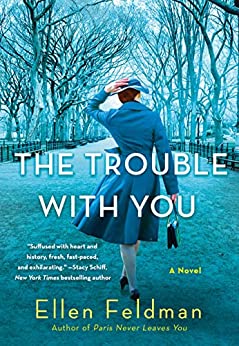
Have you ever read a book you wished would never end, and yet found yourself unable to stop reading it? That was the case for me with "The Trouble with You," by Ellen Feldman. I listened to the audiobook, superbly read by Kathryn Markey, who is a very talented member of SAG, which I did not
know until the book had ended, but I suspected the reader had to have training in acting. The novel is historical fiction of a dark, ever changing period of time in America following the Second World War, and moving into the 1950s, in which shameful acts of blacklisting were occurring throughout the arts. It was the days of the horrific McCarthy hearings. Talented writers and performing artists were being accused of being part of the Communist Party, and while some had looked into it during the 1930s, most were never that which they had been accused of being. They were fired from jobs, denied work, prevented from doing the things they wanted to do, and were asked to rat on their friends and acquaintances. Many did, thinking they would save themselves, only to learn they wronged others, and were not saved at all. The investigations were brutal. This was a shameful time in American history which may seem as if it could not happen again, absolutely could. There are whisperings of it even now.
At its heart, this is the story of a strong young woman faced with hardships and having to decide whether to choose herself or whom she thinks she needs to be for her daughter and for society. This was an era when women were realizing they did not have to stay home to cook, iron, and always be ready to be an appendage on their husbands' arms. Fanny Fabricant was college educated and told by her family that her education would help her meet the right kind of many to marry. That may sound foreign to many, but there were still those conversations going on in the years just before my generation of women were heading to college. It did not shock me, as it might a younger reader. At the start of the novel, Fanny and her 5 year old daughter, Chloe, have recently welcomed home Max, Fanny's husband and Chloe's father. Max was one of the lucky ones. He came home, while Fanny's best friend, Mimi, had not been so lucky when her husband left for the war and did not return. Shockingly, though, Fanny was widowed not long after and found herself bereft and unmoored, with a child to raise, and very little money with which to do so. She took a job as a secretary to a woman who produced several successful serial radio shows (a/k/a radio soap operas). There, Fanny met and came to know Charlie, a lead writer, and she would remain connected to him in one way or another, for many years to come. When he was blacklisted, she received a secret offer that could change her life forever, but it was not without risk to her and her family. Her one confidant was her spunky Aunt Rose.
Some of the early years of the novel were during the polio epidemic. I remember the tail end of that time, but not the fear in which people lived, and how swimming pools were thought to be unsafe, as were movie theaters and places were people were in close contact. When Chloe became ill, Fanny feared the worst and took her to see a young doctor named Ezra. Ezra became a part of Fanny's and Chloe's life, but when compared to Charlie, they were night and day. Both men cared deeply for her, but Charlie respected Fanny's drive and talents, while Ezra felt shamed by the same. Fanny was torn between the two men, but really, she was torn between what she wanted, and what was expected, which was influenced by the times in which she was living as well as in her fear of what others might think of her. It takes growth and strength even now to be whom we want to be, when the world is watching and judging, or so we think (when really, no one cares; they are too busy worrying about themselves). I felt the story was as much about that, i.e, figuring out how to be our genuine selves, as anything else, while also being a period piece of the years just before what I think of as modern times. The last chapter moved into the 1960s and up to 1970 which were the dawn of the life we have all lived for decades, even though we can see that we are slipping back, way too far back, into the ways of the 1950s, as if people do not remember how dark those times were for many who just idolize "the good old days," forgetting about the negatives, and about the lack of rights for women. Women could don't get their own credit cards, or checking accounts, and were still subservient second class citizens. There were exceptions, but those women were often scorned.
Women of all ages need to read this book. Younger women need to question if they want to go back to the lives lived by their mothers, grandmothers, and great grandmothers, or if they want to stand up for women here and now and not let men dictate how we can live. I not only loved "The Trouble with You," but I found myself getting angry at how men (and unfortunately even other women) have treated womanhood over the years. It is so well written, fast paced, and interesting. I fell in love with Charlie, but not so much with Ezra, though other women may prefer Ezra and his dependable, staid ways. If you read it, let me know what you think! Beautiful book!