Jump to ratings and reviews
Rate this book

Gaea #3

Demon

Rate this book

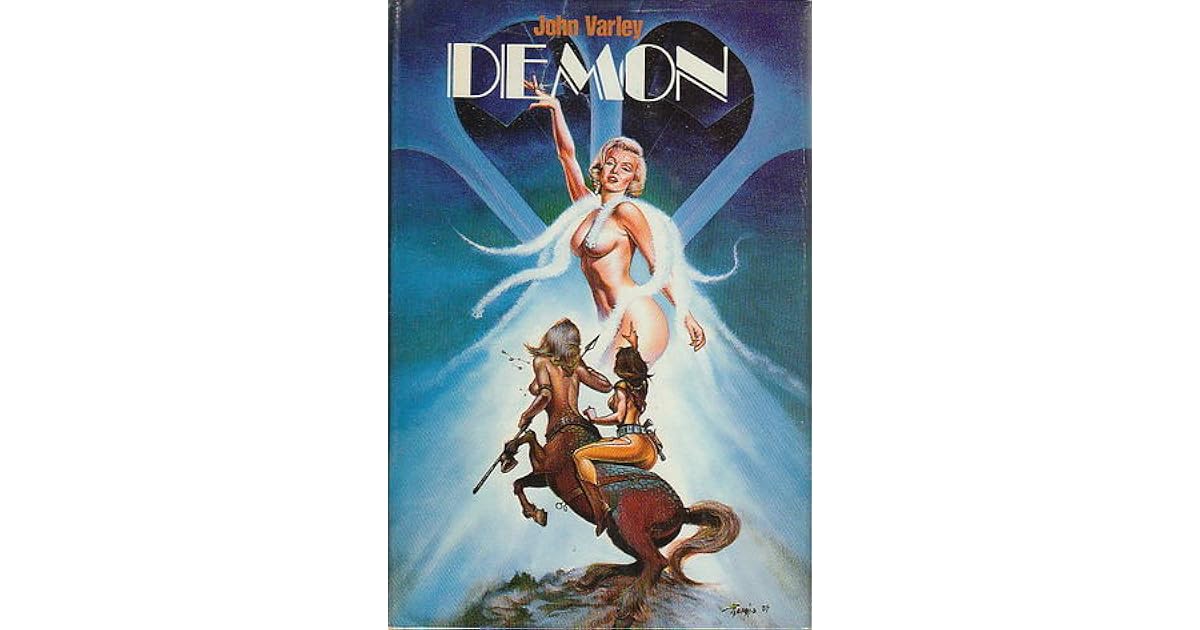
The satellite-sized alien Gaea has gone completely insane. She has transformed her love of old movies into monstrous realities. She is Marilyn Monroe. She is King Kong. And now she must be destroyed.

464 pages, Paperback

First published January 1, 1984

80 people are currently reading
1285 people want to read

About the author

John Varley

233 books603 followers
Full name: John Herbert Varley.

John Varley was born in Austin, Texas. He grew up in Fort Worth, Texas, moved to Port Arthur in 1957, and graduated from Nederland High School. He went to Michigan State University.

He has written several novels and numerous short stories.He has received both the Hugo and Nebula awards.

Ratings & Reviews

What do you think?
Rate this book

Friends & Following

Create a free account to discover what your friends think of this book!

Community Reviews

5 stars
1,427 (36%)
4 stars
1,415 (36%)
3 stars
830 (21%)
2 stars
163 (4%)
1 star
37 (<1%)
Displaying 1 - 30 of 140 reviews
Profile Image for Lyn.
2,009 reviews17.6k followers
June 19, 2024
I read the first two books of John Varley’s magnificent Gaean trilogy, Titan and Wizard, when I was in high school, back in the mid eighties and I really enjoyed them. Somehow, inexplicably, I never read the third, Demon. When I began reading again in 2008 (after graduating from law school) and then especially when I connected with Goodreads in 2011, I remembered the trilogy and decided to finish what was started.

Demon was first published in 1984 and completes the trilogy of humanity's encounter with a living being in the shape of a 1,300 km diameter Stanford torus, inhabited by many different species such as the centaur-like Titanides, living blimps, iron masters, and the god-like, insane entity known as Gaea in orbit around Saturn.

The protagonist of the trilogy is Cirocco Jones, a charismatic but complex super-hero who displays a dramatic counter figure to the deliberate antagonist of Gaea. The real quality of the trilogy is Varley’s wonderfully imaginative, uniquely original world building.

In contrast with the Tolkien inspired sub-genre of fantasy series, this is a decidedly American fantasy.

*** 2024 reread -

I've read lots and lots of science fiction and fantasy and I think this series is one of the best in the genre.

Cirocco Jones is a great protagonist and Varley fills this up with a cornucopia of great characters. Also noteworthy is Varley's inimitable world building. Finally, the way he puts all this down is exceptional.

I'm also a big Philip K. Dick fan and I want to invite my fellow PKD aficionados who don't know about Varley to try this one out. He's as imaginative as Phil but maybe more approachable.

Good times.

description
Profile Image for Bradley.
Author 9 books4,865 followers
January 2, 2018
For the most part, I absolutely love this trilogy. On the idea front, it's wild with some of the coolest and strangest story combinations, from a life-as-a-movie-set to an intentionally perverse Greek Mythos setup to the enormous annihilation of humanity in the Fifth Nuclear War (some twenty years after book 2), to the fact that we're on an all-out trip to overthrow a god here on the artificial moon.

Cirocco Jones is something around a hundred and twenty years old at this point and she's completely turned on Gaia who seems to be going batshit crazy. If you don't believe me, check out her children, her affair with King Kong as a 50 ft Marylin Monroe, or her myriad lies or new fascinations. She's been around a long time. She's also a fan of the human culture. Hell, I like Gaia because she's a big fan of movie monsters and science fiction epics and doesn't mind playing around with all the creations in the world to fill her whims. Cirocco Jones should have been her wizard and go-between, but a lot of that sours because of that little demon that was put in her (and others') heads. It's easy to do anything and go completely crazy as a god. Especially if you're not.

Hints and oddities aside, not to mention outright spoilers, the outright strangeness and world-building of these novels are absolutely amazing. I can't do them justice in twenty pages of lists of creatures or alien oddities, and they're all great, even the ones built off of our own science fiction past. The god is a fan, as is the author, and this, more than anything, makes me want to scream and jump and shout at everyone to say, "Hey, this shit is BRILLIANT, Yo!"

I didn't even have a problem with the fundamental story this time. It has gotten better and the shape of everything from the first to the third novel has become something rather awesome.

So why didn't I give it a full 5 star? Or the rest of them, for that matter?

I was annoyed. I really don't care whether authors like to go all out with atheism or not in their text. It doesn't bother me. I actually found the undead Martin Luthers (not Jr.) spouting their undead religion rather funny. I didn't even find the intellectual (and wild) creation of the Titanides' sexual congress too much. It was fascinating to learn about, with time.

I suppose what bothered me was the heavy (and I mean heavy) focus on sex and sexuality. I'm not particularly prudish or anything and I've read romance novels that can make any maiden aunt blush, but the way it is explored in these novels was SF, idea-exploring, theoretically uplifting and often squirm-inducing. It ran the whole course, from humans becoming Titanides with three sex organs to the oddities of the Amazonians to normal couples to monster sex. And he's trying to make deep points and make logical and heart-felt leaps... and none of it quite hits the mark.

If the sex had been just a sideline part of the novel, this might not have been much of an issue for me. As it was, sex, sex, sex was a huge part of the narrative, conflict, and deep discussion of all three novels. And let me be clear: little of it was meant to titillate or amuse or get us hot as readers. It's weird how I might even have forgiven *that* more than what actually happened.

I'm not saying it's not worthwhile, however, and some readers might be a lot more forgiving in their final estimation than me. And then others might just perform a handwavium exercise and forgive it all because the rest is truly a fantastic work of the imagination. :)

I was tempted. I really was. I almost did the handwavium thing. :) But the balance was off. It was *almost* perfect, but that flaw *was* just a bit too much.

I still recommend this book even with such caveats. It's a fun and easy read for all that, but above all, it's wild with ideas and imagery and a lot of the actual writing is pretty brilliant in its descriptions.

I'm quite willing to put this up there with some of the biggest SF classics of all time even as I grumble about the parts that annoy me. The weight of the good far far outweighs the bad. :)
Profile Image for Martin.
327 reviews173 followers
March 26, 2022
The satellite-sized alien Gaea had gone completely insane
She held control of a complete world with her mind

description

See;
Angels,
Witches,
Zombies,
Lesbians,
King Kong,
Sentient Blimps,
Animated cameras,
Centaur Titanides,
The fountain of Youth,
Whales that smash ships,
Baby eating Iron Masters,
A fifty foot high Marilyn Monroe,
Hollywood movies of the 30's to the 90's,
Fighter aircraft versus flying buzz bombs,
With every country having the Bomb - World War V.
Epic science fiction on a grand scale.

description

Cirocco Jones, former astronaut, turned Wizard and now Demon, challenges Gaea, the world goddess for mastery of a living satellite. Watch Cirocco collect a diverse crew, who are all determined to overthrow Gaea, and shape them into a Hollywood style army.


The obligatory fight scene
There was nothing he could do to help the women. There were at least six men attacking them. So he would follow the man with the baby, because of all the things that could happen in Gaea he felt being sold to the Iron Masters was the worst. He was already after the man when the screaming began. Against his will, he looked back.
It was like a tornado. The women had knives in each hand, and knives in their boots, and they were whirling madly, shrieking at the top of their lungs, slashing and stabbing. One man took seven wounds before he had time to fall down and start to die. Another tried to hold his throat together as a second blade entered his bowels. Four were down, then five, as others moved in with knives drawn.
It was too bad, really. It was the most amazing display of sheer, furious will to fight he had ever seen, but he didn’t see how the two could hold off an army. They were going to take a fine honor guard to hell with them, but they were going to die. The least he could do was save the child of the older warrior.

description

Baby Adam's view of this strange new world
The last member of the party was the happiest of the lot.
He had been near death three times in his short life, but he did not know that. His mother had been his first potential murderer. Robin had thought long and hard on it, when she saw what she had miraculously brought forth from her troubled womb into a troubled world.
Most recently he had almost been killed by a babylegger. His memories of that were vague. It had all been over so quickly. He remembered the man who had smiled down at him. He liked the man.
There were a lot of new people. He liked that. He liked the new place, too. It was easier to walk here. He didn’t fall down so much. Some of the new people were very big, and they had a lot of legs. They were many exciting colors, so bright and vivid that he laughed in delight every time he saw them. He had learned a new word: Tye-Nye.
A bright yellow Tye-Nye was carrying him now. He was satisfied with the ride. Only two things marred an other wise perfect afternoon. His ass felt wet, and he was wondering if it was about time for dinner
He was just about to mention these points when the Tye-Nye handed him to mother. Mother put him on the Tye-Nye’s back, and he watched the Tye-Nye’s long, fluffy pink hair bouncing above him as his mother changed his diaper. The Tye-Nye turned her head around, and he found that hilarious. And mother was laughing! She hadn’t been doing that much lately. Adam was ecstatic.
Robin opened her shirt, lifted him, and he found the nipple.
And now the world was perfect.

Home made movies Gaea style - the King Kong showdown
Gaea bit the head off a second man. This one was dressed in an orange robe. The first had been in a traditional priest’s collar and black vestments.
It was a warm-up for the match with Kong. The giant ape could be seen hovering in the background of some of the shots. The bolex who shot them had been more concerned with the eating of the holy men. Each shot was rock-steady and carefully framed.
The fight began. Gaea and Kong grappled. Kong went sailing over Gaea’s head to land on his back. He seemed stunned as Gaea lumbered over and pinned him. Gaea was thrown off the great beast. He came after her. There was a gap, and Kong was down again. Gaea hovered over him, then pounced.

description

Luther - a zombie priest
Luther stalked the docks of a Bellinzona as empty of people as the dusty streets of the western town in High Noon, with Gary Cooper. It is possible his mind made the connection, as he had recently seen the film at Pandemonium.
He didn’t look like Gary Cooper. He looked like Frankenstein’s monster after a three-day bender and a car wreck. Most of the left side of his face was gone, baring some jawbone and cracked teeth, part of a mastoid, and a hollow eye socket. Greenish brain tissue showed through a ragged crack in his skull, as if it had leaked out and been haphazardly stuffed back in. His remaining eye was a black pit in a red sea, blazing with righteous fury. Sutures encircled his neck; not scars, but actual thick threads piercing the skin. If they were removed, his head would have fallen off.
All of his body but his hands was concealed behind a filthy black cassock. The hands bore stigmata which wept blood and pus. One of his legs was shorter than the other. It was not a deformity, but a simple mechanical problem: the leg had once belonged to a nun. It did not slow him down.

Zombie attack
She got up, yawning, padded to the window, and stuck her head out. She looked down.
What she saw was frozen in her memory for all time.
There was a thing climbing up the outside of the house. She saw its arms, which were made of bones and snakes, and the top of its head, which was covered with cracked parchment and scraps of long hair. But the true terror was in its hands. She could see the bare finger bones, pieces of rotting flesh, and mouths. Each finger ended in a little blind snake with a wide mouth and needle-teeth, and when the hand grasped the vertical wall the snakes bit into the wood with an audible crunch. The thing was coming up fast, hand over hand. She was fumbling for her gun, realizing belatedly that she had no clothes on, when the thing looked up. It had the face of a skull. Worms swarmed in the eye sockets.
Nova was not easily frightened. Even that horrific face was not enough to make her scream. But then she turned to get her gun and was face to face with the second thing, hanging from the wall beside the window, its face two feet away from her own. Above its eyebrows there was just jagged bone and a boiling mass of worms. It reached for her and she screamed.

Dive bombing the enemy
The jet waggled its wings, dipped one, and dived. It leveled out at a hundred meters or so, and now the crazy thing had a full-throated roar. Hard to believe it could do anything, but still, to a flock of people who had seen at least four war movies a week for years the scene had a certain nervous familiarity. It had some of the flavor of those passes the F-86’s took in The Bridges at Toko-Ri, or maybe more like a Jap Zero skittering down toward that big scow the Arizona in Tora! Tora! Tora! Or a hundred other air combat pictures where the plane moves in fast and hot and starts shooting, only in those pictures you mostly saw the action from the air, where everything bloomed up toward you in terrific technicolor, not from the ground, where in a few short seconds things were beyond belief.
The entire row of temples went up almost simultaneously. There would be a hypersonic streak of fire and the smart missiles would go right through the front door and boom, nothing but splinters and a mushroom of flame. The plane was strafing, too, but instead of going ka-chow ka-chow ka-chow and making little fountains of dirt in neat rows, these damn things twisted and turned and chased you, and went off like hand grenades when they hit.

description

With cameos from; a Sand-worm, Alex Guinness, Monty Python and popular culture references this is an epic of an adventure!

Quotes from the producers;

Stupidity got us into this
mess—why can’t it get us out?
—Will Rogers

What we want is a story that
starts with an earthquake and
works its way up to a climax.
—Sam Goldwyn

I was always an independent,
even when I had partners.
—Sam Goldwyn

You’ve got to take the
bull by the teeth.
—Sam Goldwyn

Include me out.
—Sam Goldwyn

Enjoy!
Profile Image for Starch.
224 reviews44 followers
February 5, 2025
I liked it, overall. It was a fitting ending to the trilogy.

The idea of a god slowly losing their mind and becoming absorbed in fiction is, on its own, a top tier one. But the execution didn't live up to the premise.

The story is full of storytelling cliches. It's presented as meta, with Gaea loving human stories and manipulating events to resemble one. But the reader still has to read a story full of storytelling cliches, and being intentional is not enough to compensate for that.

For example: suddenly Gaea makes zombies, and they take a decent chunk of the early parts of the story for no good reason. Then the good guys accidentally discover the fatal weakness Gaea intentionally gave the zombies. Then we practically never hear of them again (with one notable exception). All I could think was: Mr. Varley, why would you write that? Why?

And there are many more similar examples. Half of the plot feels random, as if Varley was just trying to pad the runtime; the other half is the aforementioned storytelling cliches, presented as clever meta -- and maybe it was when the book first came out, but if that's the case, then it didn't age well in my view.

The first book tried very hard to make the world of Gaea feel scientifically grounded. The second book was more flexible with the rules, and this one throws the rules away. There's magic now; the book pretends it's technology, but it's magic. And I, for one, felt cheated.

Varley's exploration of gender is a bit blunt at times, with the women getting the vast majority of the exploration and possessing significantly more agency and influence than the men, but he's probably over-compensating for a perceived lack of those things in the stories of his time, which is understandable. Or maybe he's just more interested in exploring women, which is also a fair point. His heroines are more nuanced and complex than many of our modern ones. But they sometimes feel like he was just writing men, which is another way of saying that he was afraid of exploring "feminine" qualities in these women, which is fine, but personally I want more depth.

But I liked it. Varley can be clever, he can be philosophical, he can be psychologically astute, and he can be funny. I'll probably read more of his books in the future.
Profile Image for Terence.
1,313 reviews469 followers
March 14, 2012
SPOILER WARNING: As I’m combining the reviews of all the books in The Gaean Trilogy in this entry for Demon, there may be spoilers ahead (though I’ll keep them to a minimum). With that in mind, I’ll get my solid recommendation to read these books out of the way. The story and characters are interesting; Gaea is a fascinating concept, and definitely a place I’d love to visit; and the Titanides are one of the coolest alien races ever invented.

I first read Titan when I was a teen-ager. I can remember the hardcover library copy I checked out multiple times, and I can remember the illustrations that accompanied the text. Some of them were naked women! (Or centauroids, which was just as good to a newly pubescent adolescent. Fortunately, the paperback edition that I now own – printed in the days when PBs sold for $2.50 – preserves the illustrations.*) Having reread the trilogy and being a better reader, I find myself reversing my original ratings (4-3-4 to 3-4-3) for – like the original Star Wars trilogy – the middle book is the better one. In fact, I was strongly reminded of Star Wars: Titan is like “A New Hope” in that we have a straightforward quest tale. The crew of DSV Ringmaster must journey from Gaea’s rim to her hub and discover a way home (there are elements of “The Wizard of Oz” here, too, which Varley explicitly exploits). In Wizard, we get a more nuanced view of the world. The characters’ motivations are less clear and the lines between right and wrong blurrier, and – as in “The Empire Strikes Back” – our actors are more fully realized and interesting. In Demon, the story is brought to a dramatic end but at the expense of the closeness we felt to the continuing characters from the first two books and any new ones. And though they were never Ewoks, the Titanides in Demon lose some of their charm because their capabilities become too good to believe. (If Lucas had substituted Titanides for Ewoks in “Revenge of the Jedi,” it would have been a far better film – Titanides whipping Stormtrooper ass being more believable than ambulatory advertisements for plush toys. And Titanide Jedi would have been AWESOME!) The other downside for some to the final volume is that we get far more exposition about Varley’s thoughts on politics and philosophy, especially the chapters dealing with the taming of Bellinzona (sort of Heinlein-lite: A lot of emphasis on individual liberty & responsibility and the negatives of government and the pitfalls of having power but more nuanced than Heinlein and his clones usually are). I have a fair amount of sympathy (if not total agreement) with Varley so it didn’t distract or annoy me as it might other readers.

Despite its flaws, The Gaean Trilogy remains a favorite for two reasons. The first, as I’ve alluded to above, are the Titanides:


You can learn all about Titanide sex in the comment thread on my Titan page. I think they represent everything Varley sees as worthwhile in humans with just the right tweaks to make them better (what we should be like). That wish-fulfillment aspect is taken to an extreme in Demon, as I mentioned, and it weakens the story but I like them, and riding with (note, not on) a Titanide is in the top ten of my fantasy “bucket list.”

The second – and chief – reason I love these books is Cirocco Jones, erstwhile captain of Ringmaster (Titan), erstwhile Wizard of Gaea (Wizard), and finally the Fury who brings her down (Demon):


She ranks up there with my favorite SF characters like Signy Mallory (Downbelow Station), Pyanfar Chanur (The Pride of Chanur), Jean-Luc Picard, Spock, Tavore & Trull Sengar (Malazan Book of the Fallen), etc.

The common thread is that they’re all smart, compassionate people who struggle to do what’s right in the face of individual and institutional evil whatever the personal cost.

* The illustrations aren't that salacious. PG-13 at most.
Profile Image for Wanda Pedersen.
2,296 reviews366 followers
January 18, 2016
It strikes me, as I finish up Demon, that John Varley’s trilogy is in many ways a mirror-image of Arthur Clarke’s 2001, a Space Odyssey. While both stories begin with humans exploring alien technology in the outer solar system, Clarke’s is all about the computers, space travel, and alien technology, while Varley’s is all about human relationships. Clarke’s aliens are aloof and cold, leaving behind technology just in case humans manage to develop into something interesting; Varley’s Gaea is intensely interested in humans—luring them to her world, sometimes with very convoluted methods, and using their films to express her insanity in this final volume of the trilogy.

About mid-book, Conal (a man from Earth with all of the prejudices associated) and Nova (a woman from a lesbian society on a human made satellite) have an argument/discussion which I think articulates Varley’s view of things rather well. Conal came from a society in which males were privileged and Nova came from one which demonizes men. They are thrown into a situation where they will have to co-operate and they must work out their differences and an interesting discussion on in-groups and out-groups ensues. Conal realizes that Nova’s choice of wardrobe (or lack thereof) is really none of his business (and shouldn’t affect how he relates to her) and Nova realizes that you don’t have to be a lesbian female to be a worthy companion. I re-read this particular section 2-3 times, just because I enjoyed it so much—it fit so well into the action, without feeling overly preachy (at least to me).

Needless to say, this whole series passes the Bechdel test with flying colours, very refreshing in a works from the 1970s and 1980s. The whole Gaean world, with its odd plants and animals, is interesting and fun to explore and has its own internal logic that made perfect sense to me as I read it, despite its oddity.

Book 205 of my science fiction & fantasy reading project.
Profile Image for Spider the Doof Warrior.
435 reviews253 followers
January 1, 2019
This is a strange book. It's a lot to take in. It's got zombies, centaur like creatures, lesbians, witches, a giant Marilyn Monroe and so much more.


So I read it again. I bought the Gaea series directly from John Varley's site. It cost more money, of course, but he signs it and the money goes directly to him and if anyone deserves some loot to go directly to him it's John Varley.

I need to read more of him. And you need to read this series.

He's the sort of writer who adds diverse characters, diverse sexualities and he doesn't blast his trumpet all through the book about it. He just lets them be fully developed characters.

Cirocco Jones is one of the strongest, coolest female characters EVER! It's not just because she's badass, and she is. It's not just because she is a great leader. It's the way she develops as a character that just makes her so awesome. It's the way she cares about humans and Titanides alike.

Oh, and don't get me started on the Titanides. They are centaurs with human breasts and three sets of genitals and they are top on the list of my favourite fictional creature, along with Wraeththu. They love music, they're compassion and they're just excellent.

So, yes. Read this book. John Varley needs to become more popular than certain other writers who are the opposite of John Varley in terms of creating diverse characters. Their idea of being diverse is just having stereotypes of different races and that gets aggravating as all hell!

And should I mention that Cirocco is totally a woman of colour?


12/31/19
Read it again. It's so imaginative. Perhaps I am immature but I enjoy books where characters become friends and defeat some great evil together the most. It gives me hope. If these people can defeat giant evil Marilyn Monroe who know what's possible
This entire review has been hidden because of spoilers.
Profile Image for David.
Author 5 books38 followers
December 28, 2021
Gaea is back with a new avatar: a fifty-foot tall Marilyn Monroe. She's pulling out all the stops on her obsession with movies. She's even created new organisms which are capable of making movies and ordered the construction of a city-sized movie lot. Her casting call has been set and production is about to begin on her greatest film: The War with the Demon, Cirocco Jones.

Twenty years have passed since the events in Wizard. The human population has swelled, primarily as refugees flee Earth's latest nuclear war—handled with cavalier disregard that rang implausible to even this cynic. Besides politics, Varley also savagely satirizes Earth's religions. Each faith is represented on the wheel, and all serve Gaea instead of Earth's traditional pantheons. Gaea accomplishes this by raising the dead, making them literal zombies who serve her accordingly, rotting corpses every one. All are jealous of one another, believing themselves to be Gaea's favorite, and hated by the living.

Gaea also takes propaganda to a new level. Utilizing computer technology, she places the image of her avatar into the starring role of movies that are broadcast on closed circuit TV in order to generate sympathy from her captives. I think this may be the earliest account of deepfakes in fiction.

New arrivals means new characters. These mix with old characters, and the dynamics of relationships swirl about until a new equilibrium is established. Yes, as has been common in this series, that means people are having happy, well-adjusted sex, no matter which hardware they have. The only character in the group who takes issue with it is basically told to get over it and join the human race.

In essence, Varley's worldview here boils down to this:

* Good guys: Racial and gender diverse. Sex positive.
* Bad guys: Politicians, generals, religion. Basically any structure that tries to coerce people through fear or shame to control them.

Cirocco doesn't want any part in Gaea's madness, particularly after the death of her closest friend, but Gaea has kidnapped someone very special to her and thus makes it impossible to say no.

The second half of the novel is about Cirocco raising an army and making preparations for war with Gaea and her minions. There are several meetings with Cirocco's "inside woman" wherein we learn more about Gaea's machinations going back several decades in order to make all of this possible. Everything we thought we knew gets turned on its head. While the characters all call Gaea insane, I found it too simplistic a term. To plan and orchestrate all of these events takes tremendous forethought. Gaea isn't so much insane as diabolical.

Demon made for an enjoyable end to the series. Varley's world-building is superb, although his worldview might be a tad simplistic. The big reveal on Gaea felt a bit too much like telling, but as her appearances in the first two novels were limited to the climax of each, I don't know how Varley could have shown what was really going on. All we had were the intrepid humans, too busy trying to explore and survive to look behind the curtain.

When I first logged this into GR, I gave it five stars based on my foggy recollection of reading it decades ago. I hadn't read the other books—didn't know they existed until later—so my teenage self was completely blown away by all the world-building and story arc, not realizing that it had been built up over a trilogy. My new rating is 4.25 stars, rounded down to four because of my complaints. That's not to say it isn't a great series, it most definitely is, but I guess the bar for five stars has been raised.
Profile Image for Kamakana.
Author 2 books415 followers
November 11, 2020
010713: the longest, the slowest, the last, of the Gaea trilogy by Varley. there are many emotions evoked by this work, but the first is relief. only the first of the three books can really be read independently, and some points of this one dipped severely, but there is relief that it survives certain endemic aspects- the fact that apparently everyone has sex to express varied attachments- and sex, while never simple, is always positive...

so maybe this is a particularly seventies sort of sf culture, but i think heinlein heads this way in later works, and there is nothing wrong with sex, but this does not seem to leave room for other ways of characterizing feelings. people and their titanide companions, have sex, often, or think about its complications, often, as in wanting sex, denying sex, being troubled by sex. bad guys are essentially sex dysfunctional. bad guys are more pathetic than scary...

i do like the format, the conceit, of writing the story as if a collection of films. and satirical animals designed to make films, even if they only exist for Gaea, only exist in a pre-digital world, even if the results are more surreal than sf- fifty-foot Marilyn- then endless supplies of zombies, capital with gates, walls, streets, all named for movies. yes, i recognize the names, the images, the movies quoted...

of course it is a pleasure to reunite with various characters, but new ones not necessarily that interesting, and they, too, seem to be understood in sexual terms. so, much of the book relies on organizing sex, and this is boring. possibly interesting for the presumed demographic- but there is much more interesting elaboration of the various creatures, geography, nature, of the wheel's sentient populace...

did i mention that sex is a big plot/theme? i could give this a three because varley does pull it all together, in this and previous books, does end with a real show-stopper, does make me glad to have read it. even if it is not something likely to reread. aside, the three books add up to about a thousand pages- so would i rather have it all in one long book? or should it be spread out in some interminable series? well, this is relief those options are not taken, because one volume would be too dense and difficult to give idea of time passed, and the multi=volume series would just go on and on and on...
39 reviews
August 15, 2009
I review all three books here (Titan, Wizard and Demon).

Ah, Varley, what am I to do with you?

First and foremost, this trilogy is highly enjoyable, if quirky and eccentric in some places. Varley has a strong sense of how people work and his wisdom in his understanding of human interaction plays well in building a strong plot, and several subplots that add to the story's attractiveness. I thoroughly enjoyed reading these books when the came out, and I thoroughly enjoyed listening to them when I found them on Audible.com. They have some language and promiscuity issues, and my prudish mind will never think it is all right to mate with animals, no matter how liberated the person finds him/herself, but if one can handle these side distractions to a very memorable story, then one will be the richer from the experience. Here are quick, probably inadequate one-paragraph summaries of each book:

Titan: Scirocco Jones and the Ringmaster (a NASA ship) arrive at the moon Titan and are immediately attacked and swallowed up by...something. Shortly thereafter we find out that Titan is alive and run by a being called Gaea, a mad, god-like creature. After several adventures they meet face-to-face with Gaea and become her employees and all ends well.

Wizard: Varley adds Chris and Robin to the cast of human characters. Both have debilitating ilnesses and have come to Titan to seek medical cures. There they find an alcoholic Scirrocco Jones and her faithful sidekick, Gabby, considering the first careful steps toward overthrowing the mad Gaea. We also find that Scirocco has been given an added responsibility: she must approve every Titanide (the name given to the lovely Centaur-like creatures that make Titan their home) pregnancy, which is why she is probably alcoholic. Chris is an unremarkable figure, but Robin is a member of a sect of women who hate men and consider them all sex fiends. Robin consider Christians to be the worst, probably because they (Robin's sect) style themselves as witches and practice magic, and we all know what conservative Christians think about that (disclaimer: I AM a conservative Christian). At any rate, they have several adventures (required by Gaea before she will cure then), in the company of Scirocco and Gabby, Robin has her eyes open to the true nature of males (both bad and good), and something bad happens to Gabby which turns Scirocco into the enemy of Gaea. Robin and Chris are healed and Chris remains on Titan, but wants to be made into a Titanide.

Demon: Twenty years or so later, and Earth is in the throes of its fifth nuclear war, a protracted war the we find out has been started and is kept going by the machinations of Gaea. Connall, a weightlifter from Earth immigrates to Titan with the express purpose of killing Scirocco, but instead after a pretty nasty encounter with her, decides to serve her instead. Robin and her daughter Nova show up on Titan with a male child (as in "still in swaddling clothes") after having been kicked out of the coven because Robin had that male baby (which means she must have had intercourse with a man -- a horribly heinous sin in their culture). They both fall from riches to rags overnight and Nova is extremely bitter while Robin (who hasn't had sex with a man since Chris in the previous book) is just perplexed. They meet up with their old friends Scirocco and Chris. Scirocco is no longer a lush, and Chris has begun the slow change from human to Titanide. It is shown in his long floppy ears and horse's tail. Connall becomes Robin's lover while Scirocco decides to take on Gaea, the first step being the cleaning up of the city Bellanzona, a cess pool of human misery. She is successful, though only after draconian steps are taken. She raises an army that marches upon Gaea, who has now descended into such madness that she surrounds herself with the trappings of human movies, watching them continuously almost to the exclusion of everything else. The child Adam may be Scirocco's replacement in the near future if Scirocco doesn't watch herself. Adam is kidnapped, Chris goes along with him to try to counteract the influence of the mad Gaea and a nice little war ensues where we find out that Gaea is not the world, Gaea is just the woman at the controls (to understand, RAFO). Scirocco is successful but only with help from a secret and mysterious friend, who invites her to share godship after Gaea is gone, which she rejects. Scirocco is released to follow her ow path for as long as she wishes, without special protection.

So why do I hint at a dislike for this story? Well, a couple of reasons. Now, Varley is compared to Heinlein in many reviews, and I can see why, although I would add that the comparison is apt only if we compare him to the Old Heinlein, not the young Heinlein. One of that earlier author's main signatures is his cynicism for any kind of spirituality. Varley is a bit more subtle but just as vicious as the Old Heinlein (the younger Heinlein had honest places for spiritual men--See THE MOON IS A HARSH MISTRESS to find that one of his characters on the right side is a padre--and that's just one example). In this book are lots of characters such as a resurrected Martin Luther, Pope John, even Gautama Buddha and Sidhartha (forgive the spelling if I do not have it right). They are all evil minions of the deranged self-proclaimed goddess of Gaea, not to mention that they are all, well, ridiculous characters. There is not one single person who says, "Yes I belive in an Other Reality, and by the way, I am also a good person. You can see so by my actions." Not a Christian, a Buddhist, a Muslim, or even a plain theist, nada, zip, zero. Varley either makes fun of this part of the human property set, or ignores it all together. Even Frank Herbert recognized that part of humanity and what it might do for us, though he minimized it somewhat. I found that rather objectionable in a story that features so many slurs on my chosen faith. He didn't even recognize that sometimes the spiritual does some good.

Second, and finally, he gives me the strong sense that he can find very little good in humans to write home about. More importantly, his alien creatures were far more noble, insightful, kindly, beautiful of spirit than any human being and that made me just a bit angry. Only one human being had the guts to stand up and make the human condition better on Titan and that happened only because the author-god would not have had a story if he hadn't.

In concluding, I have tried reading other of Varley's works, and couldn't get past the first twenty pages or so. I suppose he lightened up on this trilogy to make another point or two about human happiness and human love. Nevertheless, until he finds a better balance point between the phenomena and the noumena, between mere physics and metaphysics, he is off my plate for the nonce.

Profile Image for Michael Finocchiaro.
Author 3 books6,264 followers
August 5, 2024
I thought this was a strong end to the Gaea trilogy. It is full of humorous and not so humorous cinematic references more so than its predecessor Wizard. I liked Sirocco again and found the epic battle between her and Gaea (with a little help from her friends) to be a fun romp through this most prosaic and strange of worlds imagined by the great John Varley. I think these books are underrated and deserve a little more attention.
Profile Image for Trayana.
305 reviews40 followers
April 12, 2011
Финалната част на трилогията е единствената недостигнала до номинация за премиите „Хюго” и „Небюла” и за съжаление си мисля, че съвсем не е подценена. Книгата е може би най-странната и нехомогенна в цялата поредица. Действието е некохерентно и самите герои също не са на фокус и са някак хаотично действащи. За сметка на това е доста по-непредвидима. Съдбата на изпадналата в немилост Чироко и нейното отмъщение срещу Гея са достатъчни, за да задържат интереса на читателя.

Богинята вече е изцяло отдадена на филмовата си мания, а аватарът й, Мерилин Монро, участва в чудовищни филмови продукции. За да сработи индустрията на седмото изкуство на колелото, Гея създава все по-извратени същества и нечовешки планове. След четвъртата ядрена война Земята е вече необитаема, а част от бегълците се преселват на Гея. В Диона се оформя язвата на беззаконието Белинзона – град, където властват робството, убийствата и човекоядството. До момента, в който демонът Чироко, с помощта на титанидите, не се намесва в играта на Гея и не налага диктаторски режим над града…

В личната ми класация „Демон” се нарежда на последно място. Началото, макар и обосновано от лудостта на Гея, ми се стори откровено претрупано и отблъскващо с извратените си създания – зомбита, демони и чудовища. Възкресението на един от героите ми заприлича на евтин подход от сапунена опера, но пък баталните сцени и развръзката компенсираха неприятното впечатление от първите глави. Макар „Демон” да е по-слаба в сравнение с предходните две книги, все пак тя е написана в характерното за Варли желание да премине отвъд социалните норми и границите на собствените си възможности.

Поредицата е впечатляваща – всеки от романите е свързан с останалите и все пак уникален в оформлението си. В „Титан” преобладава музиката, самият роман е изграден като либрето, „Магьосница” прилича на устен фолклор с героичните постъпки на действащите лица, докато „Демон” е тържеството на визуалното изкуство. Препоръчвам „Гея” на всеки любител на фантастиката, който я е пропуснал, защото въображението и стилът на Джон Варли гарантират на читателя едно чудесно изживяване.
Profile Image for Tom Britz.
944 reviews26 followers
February 27, 2018
This is the final volume of the Gaea trilogy by John Varley. I found it totally a worthwhile read and the characters were fleshed out enough to be their own and likeable. My one and only downer on this was my own failing. I've not read many trilogies and hardly ever back to back to back, and I became a bit like someone that had a visitor that has over stayed. I began to be ready to move on to something else, yet I was too involved with this story. I never considered dropping it.
This series is probably considered science fantasy. I walked into this series with no preconceived notion of what it was about and I found that it was just as well. I think this is the kind of story (spread over three self contained novels) that one should explore and let it work its magic on each and every reader willing to do some exploring. I did find it interesting and an excellent time well spent. John Varley uses his narrative scalpel with a deft hand and he flashes his keen sense of humor enough to lighten up an already good read.
Profile Image for Baal Of.
1,243 reviews81 followers
October 12, 2018
I'm going to have to give it to Varley on this one. He goes full bore epic fantasy inside the hollowed out shell of a science fiction setting, with psychedelic weirdness and mashups of multiple film genres. I initially had some doubts about how he was portraying Gaea, but the ending put those to rest. I had mixed feelings about Cirroco Jones as a hero, but that's actually a good thing, because she was complex. He pulled back from the prurient concerns of the previous book, which was also a nice change. This one turned out to be a lot of fun, especially the later half. Not that I need more books in my backlog, but now I'm thinking about adding the Eight Worlds Series to the queue.
Profile Image for Ian.
63 reviews13 followers
November 19, 2007
Disappointingly, the most conventional book in the trilogy (surprising since it mostly concerns the build-up to war with a 50-foot Marilyn Monroe avatar). Varley falls back on war-novel stuff, half-baked politics and too much deliberate withholding of important plot points in service of the big reveal to really pull off a satisfying conclusion.
Profile Image for Daniel.
14 reviews
March 14, 2008
My favorite part was the horse cock part...if you read it you know what I'm talking about wink wink

The best part about reading science fiction is that almost every book has a part in it where some sort of weird sex thing plays out. It really tells you a lot about the author.

With that said John Varley is a sick fucker...I want to buy him a drink. What a demented bastard. He's my hero.
Profile Image for Steven Appelget.
8 reviews6 followers
December 21, 2011
This book is a serious mindfuck. It's best to start at the beginning of the series to get the full effect.
Profile Image for Kaleb Brown.
Author 1 book10 followers
December 22, 2018
“Gaea would be hearing from the Demon.”

The first book in the Gaea trilogy was Titan, a story about the captain of a NASA team being thrust into the world of a satellite-sized alien with her own ecosystem.

The second book was Wizard, the story of a woman suffering from a patriarchal religious colony who suffers from debilitating seizures and a mild-mannered man who has dissociative personality disorder — turning him into a crass brute — and their quest to prove themselves as heroes, thus earning them the favor of Gaea and having her heal them.

The final book in the trilogy, follows Cirocco Jones — now branded as a Demon rather than the Wizard — in her scheme to overthrow Gaea. After Cirocco destroyed Gaea’s vessel at the end of Wizard, Gaea has now fashioned herself as a fifty-foot tall Marilyn Monroe duplicate. Gaea’s obsession with movies has met its natural escalation. She has holed herself off in Pandemonium, her personal Xanadu that is half Classical Hollywood movie studio and half Disney World. There, her human slaves and film recording creatures are forced to help her create the ultimate movie. Meanwhile, Cirocco begins amassing a force that will help her wipe Gaea from the face of the solar system, once and for all.

If nothing else, you can’t say that John Varley isn’t creative. Each book in the trilogy is clearly more insane than the last, and I was absolutely hooked in due to the absurdity of it all. Since the absurdity was established and made sense in regards to the story’s logic, I welcomed the bizarreness of the trilogy. In Demon, we’re treated to even more imaginative creatures. The most shocking to me was that there are zombies. John Varley isn’t afraid to throw everything, and I mean everything at the wall, and honestly, everything sticks and readers are treated to the literary equivalent of a paint splatter.

Demon is about one-hundred pages longer than Wizard. Demon certainly had a lot to accomplish, and it did it well. Reading the story never was a slog for me, and the climax was especially gripping. Throughout the trilogy I was pleased with how swift things moved. Varley managed to avoid the pitfall of explaining too much. Or maybe the world of Gaea was just so colorful that I didn’t mind the explanations. Demon is separated into three “features” along with a “short subjects” in the beginning and a “fade out” at the end (Gaea’s movie obsession bleeds into the structure of the story itself, it would seem). Demon spans a longer timeframe than the other two stories, but despite this, the pace is great.

Like Wizard, we are treated to new characters. The most notable new characters are Conal, an enemy-made-ally of Cirocco, and Nova, Robin’s daughter who is in many ways Robin 2.0. Conal was a fine addition to the cast and I liked his dynamic with Cirocco. Nova in many ways felt like a retread of Robin. She’s actually more testy than Robin was. It’s a testament to Varley’s writing that I wasn’t bored of Nova despite the similar character arc as her mother.

My main problem with Wizard was that the entire story set up to a conflict that wasn’t seen until the third book. Obviously, Demon is so great because it uses the steam that Wizard picked up. In hindsight, I like Wizard more because without it, Demon wouldn’t have been so great.

Demon also avoids the pitfall of being too similar to the first. Unlike the first two books, this isn't an adventure story, it's a war story.

I enjoyed the story showing Gaea’s true colors, or rather, just how terrible an uncaring God can be. Instead of just not caring, she actively treats the inhabitants of her as her playthings. It’s a good way to show that she must be stopped

So the question is, what did I dislike? Not much. There were character decisions that didn’t like, but much like the strangeness of the story, they made sense. While this isn’t a perfect book, it’s quite the stunning conclusion to a unique trilogy. I wished more people talked about these books. I think they’ll stick with me for a while.
Profile Image for Paul Baker.
Author 3 books15 followers
March 31, 2011
Spoiler Alert!

Demon is the final book of The Gaea Trilogy and it brings the story to a very satisfying conclusion. Author John Varley is easily the most whimsical of all science fiction writers for the past 30 years and even though this series begins with its feet on the ground, it ends up tearing a hole in the sky.

For a synopsis of the previous two novels, Titan and Wizard, please see my books list.

In Demon, the planetary brain, Gaea, has reconstituted herself as a 50 foot tall image of Marilyn Monroe. She has created new subsets of creatures designed to serve her needs as a movie studio, moving about the countryside, scouting locations, milling timber, building sets and so forth. There are even small creatures called Bolexes and Panaflexes that can film events as they happen. So Gaea now has a roving studio moving across the wheel making movies.

Gaea has also started a war among the powers on Earth and as the number of nuclear explosions mount, it becomes apparent that Earth is going to destroy itself. Gaea helpfully begins evacuating humans to her wheel and using them in many insidious ways. Among the bizarre creatures that Gaea has created, there are religious zombies, which attack anyone at any time.

Rocky has become Gaea’s enemy and lives by hiding, moving from place to place, making allies among the creatures on the planet, such as the Titanides, a centaur like race whose sex is determined by front sexual organs, but who also have both sexes in the rear. The Titanides are the exact opposite of humans and possess all the skills to have a peaceful and loving civilization, but they have become caught up in the struggle against Gaea and are strong allies with Rocky. Chris, who became romantically involved with a Titanide female in Wizard is now turning into a Titanide himself, gradually. Robin, who returned to her Coven, returns now with a grown daughter (Chris is the father) and a baby boy. Through some genetic trick, Gaea has somehow managed to make Chris the father of Robin’s new baby boy, Adam. They were both immaculate conceptions.

Also, Gaby’s spirit has returned to help Rocky in her war against Gaea, who is now clearly insane. Rocky sets about raising an army from the destitute humans arriving from the ravaged Earth and the battle is pretty well set up.

It should be clear from much of the synopsis above that John Varley writes great, big and vibrant female characters. This is also a feature of his bizarre short stories.

But the most prominent aspect of his writing is the creativity and whimsy that he brings to the art. When he exploded on the SF scene in the late seventies, he was a tremendous breath of fresh air in a field that had become a little stagnated. More recently, after gaps in writing, he has produced fun SF that hearkens back to the early days of SF, while still keeping it modern and entertaining.

In reading this trilogy, however, it is great to be reminded of the vitality, the pure wacky spirit that made his early work so much fun to read.

I highly recommend this novel and the entire trilogy.
Profile Image for Jareed.
136 reviews290 followers
July 20, 2016
What if you could talk to god, and ask one thing? What would you ask of him or her?

John Varley played with this concept in this trilogy together with ideas of cultural variations, religion and psychological developments. It was exciting, novel and conspicuously distinctive from most science-fiction works of today.

The book was written in 1979, and in 1980, it was listed as the first official winner of the Locus Award in Science-Fiction. But considering that time frame, all the books in the series are an easy read and arguably a page turner. If I recall correctly, I labeled the books as currently reading months earlier but in actual time consumption, I finished all three in less than a week.

I liked how in Varley’s world building, he presented numerous interesting ideas on cultural development and religion. The idea of the self-sustaining alien environment is appealing and just like the mysteries carried in Rendezvous with Rama and 2001: A Space Odyssey, the idea of a more advance entity gracing us is riveting.

But what made me rate the books from the average three to a measly two is as conspicuous as the books’ appeal.

I did not like any of his characters. They were designed with weak foundations and even weaker developments. Simply put, they were not enthralling. In the later parts of the trilogy, I still failed to neither identify nor maintain a veritable connection with the crew.

The further reason is that Varley’s books can be abridged in two simple story arcs. The first is the discovery to the overthrow of the god and second the sex, yes you read that right, sex. Let me set this straight that outright, there is no fundamental issue between these two topics, the problem lies in the story itself. You see, when John Varley first presented Titan, the process of reproduction between the Aliens was nothing but interesting. I admit it was unique and well thought out. In the later parts of the trilogy however, when the process have been deconstructed and it has worn out its appeal and novelty, the science and the beauty of the process was relegated to nothing but mere physical intercourse (including humans of course). So what happens is that the whole story is actually an intercourse (no pun intended) between these two pieces of the puzzle, something like this, sex-discovery-sex-plotting-sex-conspiring-sex-overthrow, so you see the problem, or is it a problem at all?

Would I recommend this trilogy? Perhaps not. I actually engaged in finishing the three books because I could not literally bear leaving something hanging, even if that means plodding through another two books.

As for me, if I could ask a god, I would, in his infinite capacity inquire, when George R.R. Martin would actually come around finishing his GoT series.
Profile Image for Metaphorosis.
976 reviews62 followers
October 23, 2023
2 stars, Metaphorosis Reviews

Summary
Gaea, the mind controlling a huge artifact orbiting Saturn, has gone insane. She's made herself over as a giant Marilyn Monroe, and spends her time watching and making movies while her world goes to hell. Only Cirocco Jones and the ghost of her lover Gaby have a chance of fixing it all.

Review
I recall the books of this trilogy as being relatively similar. However, my memory of them is clearly suspect, and that’s true with this final volume as well – unfortunately, it’s nowhere near as good as its predecessors. In part, that’s because Varley goes all in on a classic film mechanism, making such films Gaea’s obsession, and having her create a body that’s a giant clone of Marilyn Monroe. There’s a lot of it, and it all left me cold.

Even more troubling, Varley take’s the tough Cirocco of Titan and the pragmatic one of Wizard and here makes her a vicious sadist. He starts the story with her brutally and pointlessly torturing a man who, in an extreme and underexplained form of Stockholm syndrome, becomes (essentially, if not literally) Cirocco’s slave. Yes, she eventually feels a bit bad about it, but it doesn’t stop her from killing other innocent people left and right throughout the book – despite what’s essentially a foreordained (and predictable) ending.

With all that – and the torture really knocked me back – I just couldn’t enjoy the book. I found myself reluctant to pick it up, and eventually just skimmed the last 100 pages or so of uninteresting scheming and battles. The last handful of pages introduce some interesting elements, but in a cursory fashion that can’t hope to make up for the bulk of the story. I really can’t recommend this book.

The Gaea trilogy made Varley’s name as a major SF writer, and he is often a good writer, but this series is nowhere near as good in retrospect as I remember, and even further from the level of praise it received. The first two books are fun and fast, but the first too obviously patched together from others’ ideas. And this last one just isn’t good. Interesting for historical value, but I’d suggest most read Titan and stop there.
Profile Image for Iain.
45 reviews9 followers
February 26, 2012
Great end to the series. This whole trilogy is a skillful balancing act, in at least a couple of different ways. It's a great blend of hard SF and crazy fantasy; and it blurs the line between a three-book epic and a set of linked stories. It is a single story, but each book is set decades apart, and each has a very different feel. Varley takes the original premise a long way, and the sum is greater than its parts.

Demon veers much further towards fantasy than the two previous books (Titan and Wizard). It's a gleeful Hollywood satire, of all things, with really expensive special effects. Again I'm reminded of Terry Pratchett. In addition to the dark slapstick comedy, we have fundamentally good characters—probably—being forced to do ugly things to survive. It's that reluctant but ruthless utilitarianism you see in Pratchett's Vimes, or in Heinlein's The Moon is a Harsh Mistress. I'm always suspicious of this approach, as it tends to decay into a simplistic right-makes-might philosophy. (Where if your goal is fundamentally good, and your enemy sufficiently evil, any atrocity is justifiable along the way— think Ender's Game.) I enjoyed Demon's fast-paced and bloody action sequences, but wondered if Varley was dumbing his story down into mere macho posturing. I needn't have worried; he pulls out of that death-dive and delivers a really interesting and uplifting finale. Not all the loose ends are tied up, but that's fine. There are more stories that could be told, but this story is done.

Profile Image for Ian.
500 reviews150 followers
December 18, 2019
3.0 ⭐

My least favourite of Varley's Gaea trilogy. Gaea, the mad Titan, completes her plot against humanity, then recreates herself in the image of a 50 foot high Marylin Munroe.

Of the three, this book deals more with humans and the fate of the Earth, while still mostly set in the living world/habitat of Gaea, floating off in the rings of Saturn. He should have stayed in space, in my opinion. Varley's better with aliens, usually, except when he turns them into gigantic Hollywood starlets.

I found the conclusion of Varley's epic a little less than satisfying, more belabored and contrived than the first two books. I recently re-read 'Titan' and 'Wizard' and still found them enjoyable after many decades. I reread 'Demon' more reluctantly remembering, among other things, his pointlessly nasty take on the major religions. His worldview appears to be mostly shaped by the 50's and 60's movies and TV shows he so evidently loves.

Varley has a tendency to preach. In this book he's at his most unrestrained. Also unrestrained in this volume is his predilection for macabre and gruesome violence. As usual there's a fair bit of human and/or alien bed hopping, which I never thought added all that much to the story. I think he was wise to end his saga when he did, rather let it spin off indefinitely, as so many other authors have. More important than in other series that these books be read in sequence. Despite the shortcomings, Varley is, as always, a competent writer of escapist science fiction fantasy.
Profile Image for prcardi.
538 reviews87 followers
April 5, 2016
Storyline: 3/5
Characters: 3/5
Writing Style: 3/5
World: 1/5

I should begin this with an admission that I loathed the first two in the series. I approached them because they were both nominees for some of the leading science fiction book awards. I continued reading the series simply to see how it ends and to be able to give my own assessment at its conclusion. My expectations for this were extremely low, and in many ways Varley didn't disappoint. I think Gaea the "planet" remains an absolutely ridiculous world (yet not funny), and Gaea the "person" was just as painful to read about (and also not funny). The last in the series continues to employ toilet humor and gratuitous and bizarre sex as a way to entertain. The storyline and supporting ideas sweep to a new and disappointing preposterousness with some of the tie-ins provided in the backstory.

Despite all this, Demon surpasses its predecessors because the novel had an identity separate from the satire. There was a good story here, and Varley's character development improved with each of the series' installments. Die hard movie fans probably would get more of the humor and connections and might appreciate this at a completely different level. Still, I don't understand how this series was ever viewed as anything more than a licentious knockoff of the Ringworld novels. I'm starting a new list today: "Series that I wished I had never started". The Gaea Trilogy is the first on it.
Profile Image for Joey Reed.
56 reviews3 followers
October 20, 2014
I was a little disappointed with the final installment of the trilogy.

Things just got a little too absurd for me. So much time had been spent in the first two books describing in great detail the physical aspects of Gaea. While it makes sense that the psychology and emotional aspects of this character must be plumbed, I found the descriptions, similes, and extended metaphors to be off-putting.

The characters, though developed since the second installment, felt more like pieces pushed around on a chessboard rather than individuals who were becoming and growing.

As the end of the novel approached, I was rooting for the protagonist as much for reasons of philosophy as for just getting the darned thing over with.

Also, as a matter of philosophy, I'm not a big fan of ghost in the machine solutions. Just saying.

Like the other two novels in this trilogy, "Demon" requires a reader of some maturity due to the graphic descriptions and concepts involved. This book is for mature readers.
Profile Image for Chris.
11 reviews
February 22, 2013
While not the best book that I have ever read, it was also not the worst. I really enjoyed Titan, I thought that was a great book from start to finish. The second book, Wizard, was slow at first but built to a great and fast-paced finish. As the third book, and how Wizard ended, I was really looking forward to this one. However, I just didn't really like this one. I didn't care for the characters, the plot was boring, and I thought the ending was ridiculous. I also felt that the book was written for the sole purpose of finishing the trilogy. It just felt like it was written just because Mr. Varley had started it, and now we have come this far, it might as well end. Like I said it wasn't the worst book I've read, but I was disappointed in it.
Profile Image for Alan Denham.
Author 6 books21 followers
June 27, 2012
This one rounds off the trilogy - and there is little point trying to read it unless you hace read the other two first. However, if you have read Titan and Wizard, then here is the conclusion. Written on a large scale (not quite space opera, but the world is BIG) and with numerous respectful nods to the lead examples of other genres (particularly war films and Hollywood) this brought the whole epic to a satisfactory conclusion - but still left me wanting more, and with a few tweaks, John Varley could have written further stories in this world. Wikipaedia list various award nominations for this trilogy, but only one actual award - Varley was short-changed!
Profile Image for Stephanie.
41 reviews7 followers
March 12, 2011
Demon is the epic climax to the trilogy. Magical, brassy, and so engaging. John Varley has been compared to a "young Robert A. Heinlein" because it is an easy way to say that his writing challenges traditional values and ways of thinking rather than just slapping his characters on a space ship and calling it sci fi. From his strong female characters to a world-god more in love with pop culture than any Gen Xer, this trilogy delivers.
Profile Image for Sarah Rigg.
1,673 reviews22 followers
September 8, 2019
I think the middle book may be the weakest - which is not to say "Wizard" was not enjoyable. I think the first and the third are the strongest. The third, "Demon," is probably the most strongly-plotted, and the ending is pretty satisfying. I'd read the books before, but it's been so many years ago that I just remembered little fragments of each. It was fun to read these again, like getting reacquainted with a long-lost friend.
Profile Image for Tracey.
2,032 reviews61 followers
April 2, 2008
Started 29 Mar 2008 - hardback copy with rather cheesy artwork on front. Definitely not a stand-alone novel, but enjoyable in the scope of the trilogy.

IMHO - Varley's kind of like Stephen King; perhaps not great literature, but he can tell a heck of a story. I'll admit to generally preferring their short stories over their longer works, but in general, both King & Varley are worth my time.
Displaying 1 - 30 of 140 reviews

Can't find what you're looking for?

Get help and learn more about the design.