

What do you think?

Cuento Azul
Marguerite Yourcenar muere en diciembre de 1987, dejando cierta cantidad de escritos inéditos. Entre ellos destacan los relatos que componen este volumen, que datan del periodo 1927-1930.
Cuento azul es una inteligente imitación de la narrativa oral, y en él se adelantan los temas y el ambiente de los Cuentos orientales. La primera noche es la fase final de las relaciones entre Yourcenar y su padre, y tiene la peculiaridad de estar escrito «a cuatro manos». Maleficio, por su parte, es una evocación realista de las costumbres italianas, que tanto significarían luego en la obra de Yourcenar.
Un volumen indispensable para todos los muchísimos admiradores de una gran escritora de nuestro tiempo.
Cuento azul es una inteligente imitación de la narrativa oral, y en él se adelantan los temas y el ambiente de los Cuentos orientales. La primera noche es la fase final de las relaciones entre Yourcenar y su padre, y tiene la peculiaridad de estar escrito «a cuatro manos». Maleficio, por su parte, es una evocación realista de las costumbres italianas, que tanto significarían luego en la obra de Yourcenar.
Un volumen indispensable para todos los muchísimos admiradores de una gran escritora de nuestro tiempo.
133 pages, Paperback
First published March 4, 1993
About the author
Marguerite Yourcenar
213 books1,769 followersMarguerite Yourcenar, original name Marguerite de Crayencour, was a french novelist, essayist, poet and short-story writer who became the first woman to be elected to the Académie Française (French Academy), an exclusive literary institution with a membership limited to 40.
She became a naturalized U.S. citizen in 1947. The name “Yourcenar” is an imperfect anagram of her original name, “Crayencour.”
Yourcenar’s literary works are notable for their rigorously classical style, their erudition, and their psychological subtlety. In her most important books she re-creates past eras and personages, meditating thereby on human destiny, morality, and power. Her masterpiece is Mémoires d'Hadrien, a historical novel constituting the fictionalized memoirs of that 2nd-century Roman emperor. Her works were translated by the American Grace Frick, Yourcenar’s secretary and life companion.
Yourcenar was also a literary critic and translator.
She became a naturalized U.S. citizen in 1947. The name “Yourcenar” is an imperfect anagram of her original name, “Crayencour.”
Yourcenar’s literary works are notable for their rigorously classical style, their erudition, and their psychological subtlety. In her most important books she re-creates past eras and personages, meditating thereby on human destiny, morality, and power. Her masterpiece is Mémoires d'Hadrien, a historical novel constituting the fictionalized memoirs of that 2nd-century Roman emperor. Her works were translated by the American Grace Frick, Yourcenar’s secretary and life companion.
Yourcenar was also a literary critic and translator.
Ratings & Reviews
Friends & Following
Create a free account to discover what your friends think of this book!
Community Reviews
Displaying 1 - 30 of 39 reviews

October 16, 2018
Bluish veins ran across the surface of the great stone slabs, which had formerly served as panelling for the temples. The shadows the merchants cast behind them on the road as they walked toward dusk were larger, slimmer, and not as dark as in the midday sun, tinged with a very pale blue that evoked the rings beneath the eyelids of a sick woman. Blue inscriptions quivered on the white domes of the mosques like tattoos on the delicate breast of a girl, and from time to time a turquoise, pulled down by its own weight, fell with a dull sound onto a carpet of faded, downy blue.
A Blue Tale and Other Stories comprises three stories written between 1927 and 1930 - A Blue Tale (Conte bleu), The First Evening (Le premier soir) and An Evil Spell (Maléfice) - which come across as three exercises in style, miniature finger exercises of the young Marguerite Yourcenar (1903-1987) discovering herself as a writer. Yourcenar didn’t consider these early stories as accomplished works – much of her work she kept rewriting over and over again – and she judged the last story as ‘conventional’.
A Blue tale foreshadows her later work Oriental Tales. It is a symbolist, moral tale literally drenched in blue metaphors, adjectives and images and playing with fairy tale ingredients in an oriental setting. Yourcenar apparently also intended writing a red and a white tale, but unlike the blue tale those weren’t found in her documents - which made me wonder if she, like Krzytof Kieslowski in his Three colours film trilogy, by referring to the Liberté, égalité, fraternité represented by the colours of the French flag, had a similar intractable take on the said principles in mind as well.

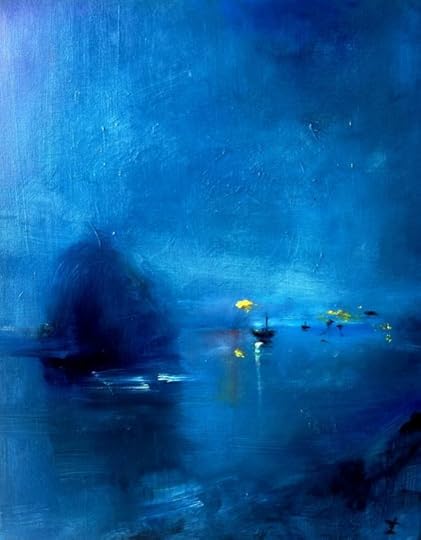
Venise - Saya Becuwe
Was it possible that man, having thought about it for so long, had not yet understood that beauty is ineffable and that neither beings nor things can be fathomed?
The First Evening is an introspective vignette on a newlywed couple departing on honeymoon to Montreux which is psychologically and biographically interesting, as this is a reworking by Marguerite Yourcenar of a story her father, Michel Cleenewerck de Crayencour, wrote in 1905, to which she added wry reflections on the relationship between her father and her mother Fernande (who died giving birth to Marguerite) and in which she mercilessly paints the newlywed woman as seen through the eyes of her world-weary, more mature husband – the kind of woman Yourcenar certainly not wanted to be like herself – gullible, fearful, a baby-machine, paltry, a piece of decoration or plaything for a spouse that is already tired of her before even touching her. The story breathes disappointment with life and wistfulness - and resignation in life like it is, feeling ‘neither fear nor desire to be elsewhere, perhaps there was no elsewhere just as there was no exit’.
Zachary Johnson
The last story, An Evil Spell, depicts a exorcist-esque scene among Italian immigrants in the South of France, which in a sense echoes the more contemporary feminist vision on witchhood and ends with a bitter lesson - if you do not fit into the norm and threaten to get ostracised by society, you could as well use the transformative power such gives you as it is better to be feared than loved.
A central theme encompassing the stories is the powerlessness of humankind vis-à-vis nature, love and destiny. These tales aren’t characterized yet by the erudite, sophisticated style of The Abyss nor imply the multi-layered-ness of Coup de Grâce. Still they are intriguing, as some of the motifs and images will return in her later work, and because of revealing subliminally the peculiar view of the young Yourcenar on femininity and womanhood. Some of the female characters in the stories seem to illustrate how Marguerite Yourcenar at that age was a person strongly in search of her identity as a woman and a writer, exploring how to become a woman on her own terms. Her struggle with what she considered the weakness of the female body as a darker and inferior part of herself (‘happiness doesn’t lie in the depths of a body’) seems reflected in a perturbing view on women (mouthed by her male characters) which is condescending and almost misogynistic and in her choice to portray female characters as in contrast with her ideal self, presenting women as ridden with a penchant for suffering reminding of Sophie in Coup de Grâce or exposing them to torture, violence, humiliation and rape - hard not to see a certain self-hate of Yourcenar mirrored in this early work.
I look forward to read her autobiographical trilogy Le labyrinthe du monde within a few months.
A Blue Tale and Other Stories comprises three stories written between 1927 and 1930 - A Blue Tale (Conte bleu), The First Evening (Le premier soir) and An Evil Spell (Maléfice) - which come across as three exercises in style, miniature finger exercises of the young Marguerite Yourcenar (1903-1987) discovering herself as a writer. Yourcenar didn’t consider these early stories as accomplished works – much of her work she kept rewriting over and over again – and she judged the last story as ‘conventional’.
A Blue tale foreshadows her later work Oriental Tales. It is a symbolist, moral tale literally drenched in blue metaphors, adjectives and images and playing with fairy tale ingredients in an oriental setting. Yourcenar apparently also intended writing a red and a white tale, but unlike the blue tale those weren’t found in her documents - which made me wonder if she, like Krzytof Kieslowski in his Three colours film trilogy, by referring to the Liberté, égalité, fraternité represented by the colours of the French flag, had a similar intractable take on the said principles in mind as well.
Venise - Saya Becuwe
Was it possible that man, having thought about it for so long, had not yet understood that beauty is ineffable and that neither beings nor things can be fathomed?
The First Evening is an introspective vignette on a newlywed couple departing on honeymoon to Montreux which is psychologically and biographically interesting, as this is a reworking by Marguerite Yourcenar of a story her father, Michel Cleenewerck de Crayencour, wrote in 1905, to which she added wry reflections on the relationship between her father and her mother Fernande (who died giving birth to Marguerite) and in which she mercilessly paints the newlywed woman as seen through the eyes of her world-weary, more mature husband – the kind of woman Yourcenar certainly not wanted to be like herself – gullible, fearful, a baby-machine, paltry, a piece of decoration or plaything for a spouse that is already tired of her before even touching her. The story breathes disappointment with life and wistfulness - and resignation in life like it is, feeling ‘neither fear nor desire to be elsewhere, perhaps there was no elsewhere just as there was no exit’.
Zachary Johnson
The last story, An Evil Spell, depicts a exorcist-esque scene among Italian immigrants in the South of France, which in a sense echoes the more contemporary feminist vision on witchhood and ends with a bitter lesson - if you do not fit into the norm and threaten to get ostracised by society, you could as well use the transformative power such gives you as it is better to be feared than loved.
A central theme encompassing the stories is the powerlessness of humankind vis-à-vis nature, love and destiny. These tales aren’t characterized yet by the erudite, sophisticated style of The Abyss nor imply the multi-layered-ness of Coup de Grâce. Still they are intriguing, as some of the motifs and images will return in her later work, and because of revealing subliminally the peculiar view of the young Yourcenar on femininity and womanhood. Some of the female characters in the stories seem to illustrate how Marguerite Yourcenar at that age was a person strongly in search of her identity as a woman and a writer, exploring how to become a woman on her own terms. Her struggle with what she considered the weakness of the female body as a darker and inferior part of herself (‘happiness doesn’t lie in the depths of a body’) seems reflected in a perturbing view on women (mouthed by her male characters) which is condescending and almost misogynistic and in her choice to portray female characters as in contrast with her ideal self, presenting women as ridden with a penchant for suffering reminding of Sophie in Coup de Grâce or exposing them to torture, violence, humiliation and rape - hard not to see a certain self-hate of Yourcenar mirrored in this early work.
I look forward to read her autobiographical trilogy Le labyrinthe du monde within a few months.

July 26, 2021
Recolección de relatos de Yourcenar, constituye mi primera lectura de la autora tras Memorias de Adriano. Todos los elementos de su estilo están presentes aquí. La sutileza, la delicadeza en la elección de las palabras. Muy recomendable si quieren conocerla.

December 8, 2025
I knew going into this, a compilation of three early short stories, that this likely wasn't the best introduction to a major writer I've been long meaning to catch up with, but as I've recently been reading about the color blue, it seemed appropriate to finally pluck this off my shelf. I wasn't wrong, but it turned out to be a best case scenario: I'm now eager to read more.
The previously unpublished title story is a curious literary experiment but is ultimately, to my mind at least, the least successful of the trio. It is interesting to see how many different ways Yourcenar can entwine references to blue into this tale, which is written in a style to evoke myth, but in the end it doesn't amount to much; it perhaps might have worked better within context of two other planned but never written companion stories featuring white & red.
I thought the other two stories were rather wonderful, albeit in different ways. "The First Evening," from an unfinished manuscript written by the author's father but completed & revised by his daughter, utilizes one of my favorite literary tropes: the exploration of the diverging interior lives of two connected people, their separate streams of thoughts like two melodies circling each other but never able to fully sync. It's hard to know what to attribute to which author, but I found it exquisitely written. "An Evil Spell," on the other hand, is witchy & unexpectedly wild, a pressure cooker of a story that builds to an eruption that upends the order of a specific community. I thought it was also quite excellent, recalling to mind Sylvia Townsend Warner's Lolly Willowes .
This collection's forward calls these stories, written between 1927-30, as "curiosities." This is not to diminish their quality but to acknowledge their origins in the apprenticeship period of a talented young writer who would go on to become one of the greats.
"Yet none of this might happen. There are other possibilities, moments of happiness or of sadness that one has neglected to invite, and that seek revenge by arriving all of a sudden, unannounced."
The previously unpublished title story is a curious literary experiment but is ultimately, to my mind at least, the least successful of the trio. It is interesting to see how many different ways Yourcenar can entwine references to blue into this tale, which is written in a style to evoke myth, but in the end it doesn't amount to much; it perhaps might have worked better within context of two other planned but never written companion stories featuring white & red.
I thought the other two stories were rather wonderful, albeit in different ways. "The First Evening," from an unfinished manuscript written by the author's father but completed & revised by his daughter, utilizes one of my favorite literary tropes: the exploration of the diverging interior lives of two connected people, their separate streams of thoughts like two melodies circling each other but never able to fully sync. It's hard to know what to attribute to which author, but I found it exquisitely written. "An Evil Spell," on the other hand, is witchy & unexpectedly wild, a pressure cooker of a story that builds to an eruption that upends the order of a specific community. I thought it was also quite excellent, recalling to mind Sylvia Townsend Warner's Lolly Willowes .
This collection's forward calls these stories, written between 1927-30, as "curiosities." This is not to diminish their quality but to acknowledge their origins in the apprenticeship period of a talented young writer who would go on to become one of the greats.
"Yet none of this might happen. There are other possibilities, moments of happiness or of sadness that one has neglected to invite, and that seek revenge by arriving all of a sudden, unannounced."

July 8, 2021
Le premier soir ♡ Du Yourcenar tout craché. Cynique, révélateur, humain.
Read
June 22, 2026Tre små noveller fra Marguerite Yourcenars pure ungdom. Eller faktisk er en af dem – den klart bedste, dvs. den, hvor man tydeligst kan mærke den senere Yourcenars stemme, hendes særegne usentimentale livsklogskab, hendes ophøjede, aldrende blik på menneskelivet – ikke kun skrevet af hende, men oprindelig begyndelsen på et ufærdigt romanmanuskript af hendes far, som hun på hans opfordring omskrev til en novelle og udgav under eget navn.
Skønt at kunne falde over sådan en bog i Politikens Boghal! Alle boghandlere burde have det sortiment.
Skønt at kunne falde over sådan en bog i Politikens Boghal! Alle boghandlere burde have det sortiment.

October 22, 2017
"Possibile che, dopo tanto tempo [...] non avessero compreso che la bellezza è incomunicabile [...]? Vogavano, su quel lago tanto clemente da essere calmo, su illuminate barche guastanotte, e si vantavano di essere felici. Né li faceva soffrire l'idea che un lago, chiuso da ogni parte, non offra sortita alcuna verso l'altrove [...]. Non uno che tentasse di infilarsi nell'angusta scissura del Rodano, che a quell'ora null'altro era se non una colata più liquida della notte".

April 23, 2022
Tre racconti curiosi, l’ultimo dei quali, Il maleficio, è il mio preferito.
La Yourcenar è delicata, trascina il lettore attraverso sensazioni contrastanti con tatto, senza sconvolgerlo ma con creando un effetto che rimane nel tempo nelle sensazioni del lettore alla fine.
La Yourcenar è delicata, trascina il lettore attraverso sensazioni contrastanti con tatto, senza sconvolgerlo ma con creando un effetto che rimane nel tempo nelle sensazioni del lettore alla fine.

March 2, 2025
Yourcenar jovem escreveu estas três ficções que mostram um potencial que continuará a desenvolver.
This entire review has been hidden because of spoilers.

March 31, 2013
This book is a real delight. Each tale immerses the reader into a unique world of people seeking themselves unconsciously.

January 4, 2012
J'avoue avoir beaucoup de mal avec l'écriture de Marguerite Yourcenar. Une lecture intéressante mais sans plus.

July 28, 2022
Es la segunda vez en mi vida que viajo al lado de Yourcenar. En la primera, hace más de quince años, me llevó de la mano a Roma, al lado de Adriano, la epístola dirigida a Marco Aurelio en la que habla de su legado, sus expediciones contra los dacios, la destrucción de los templos, las intrigas en el Senado, el olor del incienso y un sin fin de imágenes y sensaciones que quedaron entonces. Ahora leo Cuento azul, un libro que tiene tres relatos: Azul, La primera noche y El maleficio. He leído en el prólogo que se trata de escrituras iniciáticas. Los tres cuentos tienen temporalidades diferentes y me parecen ricos en el adorno del lenguaje y cierta formalidad descriptiva que saluda a sus antecesores escritores.
Azul es el cuento de una mujer sin nombre. Unos mercaderes del Mediterráneo son acogidos en una isla y escucharon que en las grutas había inmensas cantidades de zafiros. Una esclava sordomuda (la mujer sin nombre) los condujo hasta esas grutas y estos hombres codiciosos no tenían suficientes manos para llevarse las piedras. Tomaron lo que pudieron, y luego a la mujer sin nombre para venderla al príncipe veneciano del Negroponto que “gustaba de las mujeres heridas o afectadas de alguna invalidez”. No tenían idea lo que significaría poseer esas piedras ni llevar a la mujer sin nombre desnuda sobre la cubierta del barco. El segundo cuento, La primera noche, está escrito a cuatro mandos con su padre, según lo que informa el prólogo. Se trata de la luna de miel de una pareja. Los narradores nos hablan desde la mente del marido y nos proponen una tensión dramática: él está arrepentido de haberse casado, y ella no tiene la menor idea de eso. Esa tensión se profundiza cuando él recibe un telegrama en el hotel donde se hospedaban. El telegrama funciona como una especie de alivio temporal para el marido. Y finalmente, en El maleficio se confronta la enfermedad con la brujería, las razones para enfermar (hasta morir) y redimirse: los celos en Amande y el deseo en Algénare la piamontesa. Este último cuento es mi preferido de los tres.
Me gustaron mucho estos cuentos muy femeninos sobre lo femenino. Llenos de bellas imágenes y una prosa emocional en la cual es fácil sentir empatía por las personajes en detrimento de lo masculino. Me gustan las atmósferas azules en los tres relatos: el Mediterráneo, el lago Leman y los rasgos centelleantes de la noche. Es muy lindo lo que este color representa. Observo imágenes azules recientes de azulejos en las aceras de un puerto italiano, pasamanos de viaductos, la línea de horizonte del Mediterráneo, un volcán a lo lejos, o el mismo cielo. En mí producen una sensación de emociones profundas. Continúo mi viaje.
Azul es el cuento de una mujer sin nombre. Unos mercaderes del Mediterráneo son acogidos en una isla y escucharon que en las grutas había inmensas cantidades de zafiros. Una esclava sordomuda (la mujer sin nombre) los condujo hasta esas grutas y estos hombres codiciosos no tenían suficientes manos para llevarse las piedras. Tomaron lo que pudieron, y luego a la mujer sin nombre para venderla al príncipe veneciano del Negroponto que “gustaba de las mujeres heridas o afectadas de alguna invalidez”. No tenían idea lo que significaría poseer esas piedras ni llevar a la mujer sin nombre desnuda sobre la cubierta del barco. El segundo cuento, La primera noche, está escrito a cuatro mandos con su padre, según lo que informa el prólogo. Se trata de la luna de miel de una pareja. Los narradores nos hablan desde la mente del marido y nos proponen una tensión dramática: él está arrepentido de haberse casado, y ella no tiene la menor idea de eso. Esa tensión se profundiza cuando él recibe un telegrama en el hotel donde se hospedaban. El telegrama funciona como una especie de alivio temporal para el marido. Y finalmente, en El maleficio se confronta la enfermedad con la brujería, las razones para enfermar (hasta morir) y redimirse: los celos en Amande y el deseo en Algénare la piamontesa. Este último cuento es mi preferido de los tres.
Me gustaron mucho estos cuentos muy femeninos sobre lo femenino. Llenos de bellas imágenes y una prosa emocional en la cual es fácil sentir empatía por las personajes en detrimento de lo masculino. Me gustan las atmósferas azules en los tres relatos: el Mediterráneo, el lago Leman y los rasgos centelleantes de la noche. Es muy lindo lo que este color representa. Observo imágenes azules recientes de azulejos en las aceras de un puerto italiano, pasamanos de viaductos, la línea de horizonte del Mediterráneo, un volcán a lo lejos, o el mismo cielo. En mí producen una sensación de emociones profundas. Continúo mi viaje.

July 7, 2014
Tenía la costumbre de saltar los prólogos para que no me arruinaran la experiencia de ir descubriendo la trama lentamente. Esta vez no sé qué me pasó, creo que el prólogo de Josyane Savigneau me atrapó desde el inicio, así que lo leí y no me importó que me dijera de antemano el desenlace de alguna de las historias. Después de todo, lo que más aprecio y disfruto de Yourcenar no es la historia contada, sino su poder descriptivo. Curiosamente, a pesar de que el Cuento Azul es la historia principal de este libro (y una historia de imágenes bellas), no fue la que más me impactó. Quizá porque me interesan más las descripciones de la psique cultural, tal como en El maleficio, o las narraciones a manera de reflexiones introspectivas de los personajes, como en La primera noche. De cualquier manera, leer a Yourcenar es siempre un placer.

April 12, 2015
Mi favorito sin duda fue Maleficio; estuve fascinada de principio a fin, más y más desde que Algénare va tomando protagonismo. Y ese final, en el que las estrellas le trazan el alfabeto de las brujas, es precioso.

December 8, 2011
quel délice de relire ces nouvelles de marguerite yourcenar O:-) une œuvre incomparable

July 5, 2017
"...usually we are miserable only by virtue of what we remember or what we expect."

November 4, 2022
Cada línea, cada palabra está meticulosamente escogida para formar una imagen además de contar una historia, con un adjetivo Yourcenar cuenta lo que a otro autor le tomarían páginas enteras, un dominio del lenguaje y una técnica inigualables. Además las historias con varias capas de profundidad y que dan para diferentes niveles de análisis

November 22, 2025
¡Qué maravilla la pluma de Marguerite! Mucho me demoré en leer esta autora, primera mujer miembro de
la Academia Francesa. Me quedo con las ansias de descubrir el resto de su obra.
Estos cuentos son cada uno un universo aparte pero tienen en común una forma de contar cautivadora, de apariencia ligera pero llena de observaciones perspicaces y justas sobre las emociones y el espíritu humano.
la Academia Francesa. Me quedo con las ansias de descubrir el resto de su obra.
Estos cuentos son cada uno un universo aparte pero tienen en común una forma de contar cautivadora, de apariencia ligera pero llena de observaciones perspicaces y justas sobre las emociones y el espíritu humano.

November 10, 2025
Wow, really beautiful and poignant short stories. The last one is particularly haunting.

November 25, 2023
The last story in this trio has really stuck around in my head. I can picture the described evening clear as day.

September 26, 2025
Oriental Tales by Marguerite Yourcenar
Wonderful stories
How Wang- Fo was Saved
This is the first in the series.
Wang –Fo is such a great painter that at one point, when he creates an image of a lake, water pours in to the “reality” out from the “imagination”. The imagination of the painter blends with, or invades the reality of the tale. The painter is such a keen observer that, when his loyal companion is beheaded next to him, after he had tried to defend his master, Wang- Fo is fascinated by red color of the blood spilled on the pavement.
Ling is the disciple who will stop at nothing for his mentor, indeed he gives his life and in doing that, he is careful to prevent the blood from spoiling his master’s dress.
Ling’s wife commits suicide, because her husband had become so attached to Wang-Fo that he had no other purpose in life other than to follow and serve the great master.
A bit horrifying at times, but an extraordinary tale.
Marko’s Smile
Marko is the epitome of a hero. He knows no fear and he fights anyone.
He has a mistress and hero that he is mistreats her after she had cooked a goat that was not that young:
- How dare you cook an ancient animal for me?!
And he throws away the food, upsetting the woman so much that she gets to town and betrays her lover, getting the population of the village to come and kill their mortal enemy.
Marko tries to escape into the sea, but they catch him in a rather strange manner- with something like a lasso. They drag him out of the waves and he looks stone dead.
The angry lover, who knows him best, says:
- Marko is not dead, no wave can kill him… or words to that effect
So they try in different ways to establish “rigor motis” or a definite state of death.
- Put him on cross and put nails into his body
So they start knocking him over.
Still unconvinced, the woman insists and they put hot coals and then they call women to dance around him.
Yes is too much for the valiant fighter.
Beauty and dance are too much for a mortal soul, may be the message. He smiles, the young woman sees him and does all she can to protect him.
The Milk of Death
This story is inspired from a Balkan story and I must say that we have a similar one- Manole’s Legend.
Three builders come to a breaking point, when they see that their construction is not holding. So they come to the conclusion that human sacrifice is needed and one of their wives will do the trick. Here there are some differences between the Romanian story and the one told by Marguerite Yourcenar.
In our version, the wife is simply walled up, while she is crying and breaking the heart of the reader. In this one, pleads with the builders to be allowed to keep on breast feeding her infant, even she will be trapped inside. They agree and allow space for her beasts and then for eyes.
They brought the infant who could feed on this Milk of Death for an incredible two years, until he did not need it any more.
I also loved the other tales included here, in particular The Last Love of Prince Genji.
Here there is an irony, for I had started the original story of Genji, included on the Guardian list of the best books ever, but did not like it that much.
Marguerite Yourcenar has tried to fill a space in that original story that had inspired her and to think about what could have happened.
I loved these stories and had appreciated Marguerite Yourcenar before, with The Memories of Hadrian.
Wonderful stories
How Wang- Fo was Saved
This is the first in the series.
Wang –Fo is such a great painter that at one point, when he creates an image of a lake, water pours in to the “reality” out from the “imagination”. The imagination of the painter blends with, or invades the reality of the tale. The painter is such a keen observer that, when his loyal companion is beheaded next to him, after he had tried to defend his master, Wang- Fo is fascinated by red color of the blood spilled on the pavement.
Ling is the disciple who will stop at nothing for his mentor, indeed he gives his life and in doing that, he is careful to prevent the blood from spoiling his master’s dress.
Ling’s wife commits suicide, because her husband had become so attached to Wang-Fo that he had no other purpose in life other than to follow and serve the great master.
A bit horrifying at times, but an extraordinary tale.
Marko’s Smile
Marko is the epitome of a hero. He knows no fear and he fights anyone.
He has a mistress and hero that he is mistreats her after she had cooked a goat that was not that young:
- How dare you cook an ancient animal for me?!
And he throws away the food, upsetting the woman so much that she gets to town and betrays her lover, getting the population of the village to come and kill their mortal enemy.
Marko tries to escape into the sea, but they catch him in a rather strange manner- with something like a lasso. They drag him out of the waves and he looks stone dead.
The angry lover, who knows him best, says:
- Marko is not dead, no wave can kill him… or words to that effect
So they try in different ways to establish “rigor motis” or a definite state of death.
- Put him on cross and put nails into his body
So they start knocking him over.
Still unconvinced, the woman insists and they put hot coals and then they call women to dance around him.
Yes is too much for the valiant fighter.
Beauty and dance are too much for a mortal soul, may be the message. He smiles, the young woman sees him and does all she can to protect him.
The Milk of Death
This story is inspired from a Balkan story and I must say that we have a similar one- Manole’s Legend.
Three builders come to a breaking point, when they see that their construction is not holding. So they come to the conclusion that human sacrifice is needed and one of their wives will do the trick. Here there are some differences between the Romanian story and the one told by Marguerite Yourcenar.
In our version, the wife is simply walled up, while she is crying and breaking the heart of the reader. In this one, pleads with the builders to be allowed to keep on breast feeding her infant, even she will be trapped inside. They agree and allow space for her beasts and then for eyes.
They brought the infant who could feed on this Milk of Death for an incredible two years, until he did not need it any more.
I also loved the other tales included here, in particular The Last Love of Prince Genji.
Here there is an irony, for I had started the original story of Genji, included on the Guardian list of the best books ever, but did not like it that much.
Marguerite Yourcenar has tried to fill a space in that original story that had inspired her and to think about what could have happened.
I loved these stories and had appreciated Marguerite Yourcenar before, with The Memories of Hadrian.

April 13, 2017
De este libro, y de los relatos que los compone, el de Maleficio es el que me gusto más-

February 6, 2019
Strongly disliked the first of the three stories. Although Yourcenar is a great, I can't quite justify giving a book of three stories more than three stars when I didn't like a third of it.

March 22, 2022
Mais quelle écriture. Jamais déçue.

July 1, 2025
O primeiro conto me deixou abismada - é realmente impressionante. A narrativa de Marguerite Yourcenar tem algo de poético e melancólico, quase hipnótico e onírico, que transporta o leitor para um universo simultaneamente concreto e simbólico. Em CONTO AZUL, mercadores europeus viajam pelo Oriente em busca de safiras, mas a aura mística da narrativa transforma essa jornada em uma travessia filosófica e sensorial. A história emana uma espiritualidade discreta, uma beleza rarefeita. É uma verdadeira joia literária. Estou convencida de que, especialmente para quem tem pouca bagagem de leitura, esse conto pode ser um divisor de águas — não apenas pelo impacto estético, mas pela forma como sugere múltiplas camadas de interpretação, provocando o leitor sem jamais lhe impor respostas.
No conto A PRIMEIRA NOITE, o protagonista Georges me remeteu imediatamente a Frédéric Moreau, de A Educação Sentimental, de Flaubert. Ambos são figuras deslumbradas por ideais de status e sofisticação social, mas incapazes de se comprometerem com o real. Vivem entediados e insatisfeitos, são volúveis e, sobretudo, superficiais. Falta-lhes não apenas profundidade, mas também autenticidade nas relações. São homens fascinados apenas pelo que lhes escapa, o que é distante, inacessível, enigmático. Como se apenas o mistério — ou mesmo a presença da morte — fosse capaz de romper o torpor existencial em que estão imersos. São exemplos do chamado “homem sensível” que, longe de revelar complexidade emocional, esconde sob essa máscara uma imaturidade afetiva e um narcisismo desolador.
Já em MALEFÍCIO, Yourcenar constrói, na figura de Algenara, uma personagem atravessada pelo ressentimento e pela exclusão. Mais pobre que as demais, tratada por vezes como servente e socialmente invisível, Algenara inveja Amanda - bela, amada, desejada. Seu sentimento não é apenas rivalidade: é dor, humilhação, a desesperança de quem se sente irrelevante. A crença em seus próprios “poderes ocultos” torna-se um artifício vital: ao acreditar que é capaz de provocar a morte da amiga apenas com sua vontade, e ao perceber que todos estão dispostos a acreditar nisso, Algenara se reinventa. Passa da mediocridade social a uma posição de temor e fascínio. O malefício, nesse conto, não é mágico - é simbólico e coletivo. É o desejo de ser vista, de ser alguém, que se alia ao ressentimento e cria uma identidade poderosa, ainda que perversa.
Algo que chama a atenção nos três contos é a ausência de transcendência, de compaixão, de qualquer forma de caridade verdadeira, que grita silenciosamente. É como se os personagens vivessem num mundo privado de um horizonte espiritual, presos em si mesmos - no ego, no desejo, no ressentimento. A falta de Deus - ou, no mínimo, da dimensão do sagrado - parece mesmo abrir espaço para o vazio ético e emocional que os consome.
No conto A PRIMEIRA NOITE, o protagonista Georges me remeteu imediatamente a Frédéric Moreau, de A Educação Sentimental, de Flaubert. Ambos são figuras deslumbradas por ideais de status e sofisticação social, mas incapazes de se comprometerem com o real. Vivem entediados e insatisfeitos, são volúveis e, sobretudo, superficiais. Falta-lhes não apenas profundidade, mas também autenticidade nas relações. São homens fascinados apenas pelo que lhes escapa, o que é distante, inacessível, enigmático. Como se apenas o mistério — ou mesmo a presença da morte — fosse capaz de romper o torpor existencial em que estão imersos. São exemplos do chamado “homem sensível” que, longe de revelar complexidade emocional, esconde sob essa máscara uma imaturidade afetiva e um narcisismo desolador.
Já em MALEFÍCIO, Yourcenar constrói, na figura de Algenara, uma personagem atravessada pelo ressentimento e pela exclusão. Mais pobre que as demais, tratada por vezes como servente e socialmente invisível, Algenara inveja Amanda - bela, amada, desejada. Seu sentimento não é apenas rivalidade: é dor, humilhação, a desesperança de quem se sente irrelevante. A crença em seus próprios “poderes ocultos” torna-se um artifício vital: ao acreditar que é capaz de provocar a morte da amiga apenas com sua vontade, e ao perceber que todos estão dispostos a acreditar nisso, Algenara se reinventa. Passa da mediocridade social a uma posição de temor e fascínio. O malefício, nesse conto, não é mágico - é simbólico e coletivo. É o desejo de ser vista, de ser alguém, que se alia ao ressentimento e cria uma identidade poderosa, ainda que perversa.
Algo que chama a atenção nos três contos é a ausência de transcendência, de compaixão, de qualquer forma de caridade verdadeira, que grita silenciosamente. É como se os personagens vivessem num mundo privado de um horizonte espiritual, presos em si mesmos - no ego, no desejo, no ressentimento. A falta de Deus - ou, no mínimo, da dimensão do sagrado - parece mesmo abrir espaço para o vazio ético e emocional que os consome.

December 14, 2022
Not the best Yourcenar according to me, but that's understandable as she wrote these novellas when she was fairly young if I recall correctly. None of them stood out to me in particular, but they weren't terrible either. I just found them disappointing compared to her Oriental tales.

October 1, 2026
3.75/5 - I think what I have learned from this year of ferociously reading is that I like to read and discuss. These are easily little stories to read and I read one a day during lunch but I really want someone to discuss with.

June 11, 2021
Un cuento con tan cuidadosa estética pero al mismo tiempo marcado por crudos y terribles detalles , solo una prodigiosa pluma puede unir contrastes con tan gran belleza
December 14, 2021
Muy recomendable para conocer a la autora.

January 28, 2022
"El maleficio" es una joya que deja muchas ganas de seguir leyendo a Yourcenar.
February 17, 2023
good ass book with cool ass writing
Displaying 1 - 30 of 39 reviews