

What do you think?

The Ball is Round: A Global History of Soccer
Traces the history of the world's most popular sport from its earliest origins to the present day, looking at the game in terms of its political, cultural, and social roles in countries around the world.
1008 pages, Paperback
First published January 1, 2006
About the author
David Goldblatt
81 books115 followersLibrarians note: There is more than one author in the Goodreads database with this name.
David Goldblatt is a highly experienced sports writer, broadcaster, and journalist. He is the author of The Ball is Round: A Global History of Football (Penguin, 2006), the definitive historical account of the world’s game. He has also written the World Football Yearbook (Dorling Kindersley, 2002), which was published in nine languages and ran to three editions.
As a journalist, he has written for most of the quality broadsheet newspapers including the Guardian, the Observer, the Financial Times, and The Independent on Sunday, as well as for magazines such as the New Statesman and the New Left Review. He is a regular reviewer of sports books for The Independent and The Times Literary Supplement and is currently the sports’ columnist for Prospect magazine.
As a freelance reporter he has worked for BBC Radio 4 and the BBC World Service, including producing documentaries on football in Jerusalem and the politics of football in Kenya. He has also appeared on other BBC radio programmes including The World Today, The World Tonight, The Sunday Morning Show, and Africa – Have Your Say.
In addition to his extensive writing and broadcasting career, he has also taught the sociology of sport at the University of Bristol and has run literacy programmes at both Bristol City and Bristol Rovers football clubs, as well as teaching sport, film, and media at the Watershed arts cinema, also in Bristol.
David Goldblatt is a highly experienced sports writer, broadcaster, and journalist. He is the author of The Ball is Round: A Global History of Football (Penguin, 2006), the definitive historical account of the world’s game. He has also written the World Football Yearbook (Dorling Kindersley, 2002), which was published in nine languages and ran to three editions.
As a journalist, he has written for most of the quality broadsheet newspapers including the Guardian, the Observer, the Financial Times, and The Independent on Sunday, as well as for magazines such as the New Statesman and the New Left Review. He is a regular reviewer of sports books for The Independent and The Times Literary Supplement and is currently the sports’ columnist for Prospect magazine.
As a freelance reporter he has worked for BBC Radio 4 and the BBC World Service, including producing documentaries on football in Jerusalem and the politics of football in Kenya. He has also appeared on other BBC radio programmes including The World Today, The World Tonight, The Sunday Morning Show, and Africa – Have Your Say.
In addition to his extensive writing and broadcasting career, he has also taught the sociology of sport at the University of Bristol and has run literacy programmes at both Bristol City and Bristol Rovers football clubs, as well as teaching sport, film, and media at the Watershed arts cinema, also in Bristol.
Ratings & Reviews
Friends & Following
Create a free account to discover what your friends think of this book!
Community Reviews
Displaying 1 - 30 of 190 reviews

July 30, 2011
This is a great, 900-page book. The astute reader will note that the first adjective is somewhat surprising in light of the second.
Here's what I can tell you about The Ball Is Round: As you read it, you will feel your brain getting bigger. Seriously. The author, David Goldblatt, is not only an expert on the history of soccer; he has an incredible grasp of the vectors that shape world history – from colonialism, to economics, to military power, to governmental competencies. The subtitle, A Global History of Soccer, is probably the most apt description you can get for this book, provided you understand that the word "global" is as equally operative as the word "soccer." Goldblatt manages to weave history's threads together in an engaging and immensely readable way. What you'll discover as you get deeper into this book is the symbiotic and, at times, parasitic relationship soccer has with global history and vice versa.
Colonial history and economic development are two of the biggest indicators of whether or not a country will have a good soccer team. Most often, according to Goldblatt, soccer is a result of history, a product of these factors. However, this book is most interesting when it's describing those times when soccer stops being a product of history and becomes an actual shaper of history – the times when a nation's soccer team has an impact on the strength of a governing party or when the failure of a team cripples the psyche of a nation. Those are the passages when this book is truly riveting.
Of course, all the usual caveats apply for any 900-page book. It's heavy as a brick and I basically spent the better part of my summer working my way through it. So if you're going to tackle this one you have to be committed. And there are times when this book may pull back the veil a bit too much for true die-hard soccer fans. Hearing about the huge number of match-fixing scandals, the frequently despicable fan behavior, and the endemic corruption of soccer's governing body, FIFA, may dim the true fan's enthusiasm a bit. But in the end, if you like soccer and have even a passing interest in history, you really must read this book. Your brain will be bigger when you're done.
Here's what I can tell you about The Ball Is Round: As you read it, you will feel your brain getting bigger. Seriously. The author, David Goldblatt, is not only an expert on the history of soccer; he has an incredible grasp of the vectors that shape world history – from colonialism, to economics, to military power, to governmental competencies. The subtitle, A Global History of Soccer, is probably the most apt description you can get for this book, provided you understand that the word "global" is as equally operative as the word "soccer." Goldblatt manages to weave history's threads together in an engaging and immensely readable way. What you'll discover as you get deeper into this book is the symbiotic and, at times, parasitic relationship soccer has with global history and vice versa.
Colonial history and economic development are two of the biggest indicators of whether or not a country will have a good soccer team. Most often, according to Goldblatt, soccer is a result of history, a product of these factors. However, this book is most interesting when it's describing those times when soccer stops being a product of history and becomes an actual shaper of history – the times when a nation's soccer team has an impact on the strength of a governing party or when the failure of a team cripples the psyche of a nation. Those are the passages when this book is truly riveting.
Of course, all the usual caveats apply for any 900-page book. It's heavy as a brick and I basically spent the better part of my summer working my way through it. So if you're going to tackle this one you have to be committed. And there are times when this book may pull back the veil a bit too much for true die-hard soccer fans. Hearing about the huge number of match-fixing scandals, the frequently despicable fan behavior, and the endemic corruption of soccer's governing body, FIFA, may dim the true fan's enthusiasm a bit. But in the end, if you like soccer and have even a passing interest in history, you really must read this book. Your brain will be bigger when you're done.

July 18, 2014
This is a mammoth book, just over 900 pages. Broken up by continent-specific chapters within chronological sections. Goldblatt covers soccer within the cultural context of the nation he is discussing, giving plenty of international history lessons along the way. My soccer knowledge goes no further back than Cobi Jones and the 1994 World Cup (and even then it's pretty spotty), so learning about the early development of the sport and it's growth in the Americas and Africa was all brand-new. I could have probably done with a shorter book, but picked this up based on the recommendation of Men in Blazers, a part of ESPN's WC coverage who have since moved to NBC.
One interesting nugget was the discussion of professionalizing soccer that each nation had to have as soccer's popularity grew. Those who chose to professionalize soccer earlier had a HUGE advantage when it came to international competition, over those who thought even practicing was ungentlemanly. I couldn't help but think of college football and the widening gap between SEC and B1G teams. While the B1G chooses to think of itself as the noble gentleman, the SEC is innovating with big money behind it (infer from that what you will).
One interesting nugget was the discussion of professionalizing soccer that each nation had to have as soccer's popularity grew. Those who chose to professionalize soccer earlier had a HUGE advantage when it came to international competition, over those who thought even practicing was ungentlemanly. I couldn't help but think of college football and the widening gap between SEC and B1G teams. While the B1G chooses to think of itself as the noble gentleman, the SEC is innovating with big money behind it (infer from that what you will).

February 12, 2013
The final whistle has been blown; the fat lady has sat down again; the boisterous crowd are flooding away through the exits from rows A-Z....shaking their heads in wonder at such a memorable game. I feel a little churlish,after reading such a tome,of both profound depth & touch-line-hugging width,to shake my head & sound a note of disappointment at Goldlatt's exhaustive & relentless neo-Marxist interpretation of Football...run through with a pallid internationalism & a predictable sneer at England & its dismay...at seeing our beautiful game hijacked by so many enthusiastic charlatans,rogues,megalomaniacs & card-carrying communists & vile fascists. Goldblatt has an apparently sentimental attachment to Third World politics ( A white,Jewish,Tottenham-supporting North Londoner with dreadlocks!!?). I have a word for such posers; though far be it from me,as a 'play up & play the game' gentleman-scholar-athlete to use it in polite company.
In a nutshell then...I admire his scholarship, but question his motives;a very political survey of the development of football,coloured by Goldblatt's evident training/indoctrination as a socialist economist & sociologist,& an apologist for some terrible men,& some contemptible regimes.
(And,on a point of fact;it wasn't the Fulham-supporting Matthew Simmonds who upset Eric Cantona on that notorious night in S.E.25 in January 1995,when the psychotic Frenchman went doolally...it was me,a Crystal Palace fan! I addressed him in perfect French...he heard me...& the rest is history! What did I shout? That's for me to know! But it wasn't "It's an early bath for you,Mr Cantona!"!!And I & many others too,declined Paul Ince's kind offer of some fisticuffs."Come on then...we'll take you all on!".Being well-mannered Palace fans,we had some class!).
In a nutshell then...I admire his scholarship, but question his motives;a very political survey of the development of football,coloured by Goldblatt's evident training/indoctrination as a socialist economist & sociologist,& an apologist for some terrible men,& some contemptible regimes.
(And,on a point of fact;it wasn't the Fulham-supporting Matthew Simmonds who upset Eric Cantona on that notorious night in S.E.25 in January 1995,when the psychotic Frenchman went doolally...it was me,a Crystal Palace fan! I addressed him in perfect French...he heard me...& the rest is history! What did I shout? That's for me to know! But it wasn't "It's an early bath for you,Mr Cantona!"!!And I & many others too,declined Paul Ince's kind offer of some fisticuffs."Come on then...we'll take you all on!".Being well-mannered Palace fans,we had some class!).

May 28, 2021
3.5 stars by brute force accumulation of information but also weirdly ... this almost-1000 page global history of football doesn't have enough football in it. probably need a disclaimer that i read this during sleepless newborn-feeding sessions so i might be projecting some of my disquiet at trying to teach a tiny pink human to drink from a bottle onto david goldbatt's authorial discretion. the material on soccer's more distant history was stronger. maybe this is unavoidable when a british white person (a white tottenham supporter with dreadlocks no less) writes about the global south, but i caught some whiffs of polite liberal clucking esp in the material on brazilian (and even italian) political dysfunction. his chapter on north america and the 1994 world cup felt way off - i'm not an MLS fan but it's just not true to say that the world cup didn't get much attention from americans in 1994. that stinker made me wonder about whether to trust some of his other material, but his editorializations aside, this is an impressive feat of hammering a big old almanac of scores and squad lists into a coherent narrative history.

December 29, 2018
Extraordinarily detailed, if inevitably Anglo-tinged look at the history and context of football.

May 11, 2021
David Goldblatt on võrratu jalgpallisotsioloog, kelle podcastisari "The Game of Our Lives" on soovituslik kuulamine isegi jalgpallikaugele ajaloo- ja poliitikahuvilisele. Et keegi peale paadunud vutihuvilise jaksab ette võtta seda pea 1000-leheküljelist tellist, on küll kaheldav, ent tegemist on tõeliselt monumentaalse tööga, mis räägib põhjalikul, valdkondadeülesel ja kriitilisel moel lahti jalgpalli eelajaloo, väljakujunemise 19. sajandi Inglismaal ning globaalse võidukäigu 20. sajandil. See on raamat nii Pelést, Maradonast, Cruyffist, maailmameistrivõistlustel ja väljakutel toimuvast, kui ka kolonialismist, rahvuslusest, identiteedist, sotsiaalsest mobiilsusest, spordiantropoloogiast ja veel paljust-paljust muust. Eriti harivad on maailmasõdadevahelist Euroopat ning Lõuna-Ameerika kirglikku ning korruptiivset vutikultuuri kirjeldavad osad. Tõelise vana kooli intellektuaali elegantsuse ning ilukirjandusliku tunnetusega kirjutatud, ilmselt autoriteetseim leitav materjal suuremat osa maailma hullutavast spordialast. 5/5

November 16, 2022
Це справді глобальна історія - тут і Африка, і Азія, і особливо Латинська Америка, і все це з екскурсом в політичну та соціальну історію, щоб розуміти весь контекст. Однак таку тему, як виявилось, неможливо всерйоз покрити навіть 1000-сторінковою томиною. Розповідь неминуче поверхова і торкається тільки ключових тенденцій і подій. Але це, в принципі, саме те, що я хотів, тому не жаліюсь.

February 11, 2023
Excellent. A tour-de-force. A history of the modern world told through football. Unbelievably broad in scope, surprisingly deep in detail and also very, very long.
If you don't care for football very much but are interested in social, political and economic history, there's a lot of value on this book for you. Conversely, if you care a lot about football but not so much about history, you probably won't like this very much.
I like both of these things and therefore found the book to be fascinating.
If you don't care for football very much but are interested in social, political and economic history, there's a lot of value on this book for you. Conversely, if you care a lot about football but not so much about history, you probably won't like this very much.
I like both of these things and therefore found the book to be fascinating.

March 13, 2021
Really interesting read and highly recommended for fans of the game. Class, economics, politics, industrialization, commercialization, and modernization are the driving factors behind Goldblatt's sweeping analysis.
April 10, 2013
The book that I read was The Ball is Round: A Global History of Soccer by David Goldblatt, a great soccer book for all soccer player and soccer fans. I started reading this book a years ago when I finished reading a Michael Jordon book and I was interested in sport books. When i saw this book a year ago I was thinking of the last Goodreads book review and thought about the basketball book that I read and now, I started reading a soccer book about the best history of soccer. I was interested in this book because I thought that there were going to part of history a long time ago that I did not know about and maybe read more about the best soccer player that ever lived in the past. Another thing that I was interested in was the details that the author did in the story, by explaining how the fan there angry at the referee in one moment of the story. It was ever pleasant that the author would talk about the background information about the fans and the referees, so that the reader can get to know what he did in the past.
I recommend this book to my friends because it is interesting and amazing. I believe that my friends will like this book more than my friends that are girls because in the beginning of the story it talks about the soccer history of the best soccer leagues of the world. In the middle of the story it talked about a player that made 91 in a season. In the story they give put great details about match and the author puts incredible grasp of the vectors of some world history moments. If girls read this book they will not know who that player is and will ask a lot of questions. They will not be able to finish the book all the way , but that’s what I think probably there will be someone who is interested in the book and it history.
In the story the book becomes a little uninteresting when it beginning talking about how they wanted to spread soccer throw out the world and they started to make the Aussies, US, and Canada play soccer, but they rejected soccer. Soccer then spread to Europe and Latin America, as the book more interesting it stops being a history. The book changes from a history to a story, a story about the great players in the post WWII era. The story talks about the success of the World Cup in the 70s and 80s.
In the book it seemed daunting at first, being almost 1000 pages but I had to finish it really slowly because it was so good that I did not want to finish it. Usually I would take a break from a large book and do something else for a while but I could not bring myself to do that with this book. It was very informative and really exposed the underside of the Beautiful Game.
I could rate this book The Ball is Round: A Global History of Soccer I will rated it as a four because it interested me in reading more books about sports. I would read lots books that are about sports and I recommend this book to all kinds of ages. At the end of the book it compares the soccer player of the present time and the past time. It talks about how the fans loved to watch their favorite player play and some think that the player know are not the same player from the past.
I recommend this book to my friends because it is interesting and amazing. I believe that my friends will like this book more than my friends that are girls because in the beginning of the story it talks about the soccer history of the best soccer leagues of the world. In the middle of the story it talked about a player that made 91 in a season. In the story they give put great details about match and the author puts incredible grasp of the vectors of some world history moments. If girls read this book they will not know who that player is and will ask a lot of questions. They will not be able to finish the book all the way , but that’s what I think probably there will be someone who is interested in the book and it history.
In the story the book becomes a little uninteresting when it beginning talking about how they wanted to spread soccer throw out the world and they started to make the Aussies, US, and Canada play soccer, but they rejected soccer. Soccer then spread to Europe and Latin America, as the book more interesting it stops being a history. The book changes from a history to a story, a story about the great players in the post WWII era. The story talks about the success of the World Cup in the 70s and 80s.
In the book it seemed daunting at first, being almost 1000 pages but I had to finish it really slowly because it was so good that I did not want to finish it. Usually I would take a break from a large book and do something else for a while but I could not bring myself to do that with this book. It was very informative and really exposed the underside of the Beautiful Game.
I could rate this book The Ball is Round: A Global History of Soccer I will rated it as a four because it interested me in reading more books about sports. I would read lots books that are about sports and I recommend this book to all kinds of ages. At the end of the book it compares the soccer player of the present time and the past time. It talks about how the fans loved to watch their favorite player play and some think that the player know are not the same player from the past.

April 16, 2011
I have read many soccer history books, but none have ever reached the width and scale of what David Goldblatt has achieved. He has covered almost every single country in the World, and he has broken up the chapters into fifteen year sections to make it more digestable. But even so, he has packed so much information into this book, that it is sometimes hard to keep all the dates, numbers, names and teams straight. I have been forced to pull out my atlas a number of times to help me keep all of the cities, and teams, and their placement in relation to each other straight in my head. This is a very dense and scholarly work, worthy of being on any university library's shelf. My favorite parts, which I have learned the most from was David's coverage of the history and developement of the European Cup, which later became the UEFA Champion's League. He used the Champion's league to measure the developement of different leagues over time, and this was very insightful and informative.

November 10, 2018
Here's the thing about this book: to read it, it's not enough just to have an interest in soccer, you also have to have interest - and pretty deep literacy - in geopolitics, economics, and contemporary cultural history. It contains fascinating anecdotes from important moments in soccer, i.e. what most people probably think they're getting when they pick the book up, but placed in extremely deep and detailed historical and socioeconomic context.
I'm inclined to give it high marks because I learned so much, and because I'm so impressed by the book as a research achievement. And not for nothing, but Mr. Goldblatt's vocabulary is truly staggering (I was an English major, so that's not something I say lightly).
All that said, depending on how much you're willing to wade through to get the soccer out of this soccer book, your mileage may vary.
I'm inclined to give it high marks because I learned so much, and because I'm so impressed by the book as a research achievement. And not for nothing, but Mr. Goldblatt's vocabulary is truly staggering (I was an English major, so that's not something I say lightly).
All that said, depending on how much you're willing to wade through to get the soccer out of this soccer book, your mileage may vary.
May 22, 2021
A very in depth book on the evolution of football from the English public schools to the (my favourite line) a global religion in search of a god. The author is exhaustive in going from country to country to chart the evolution of the game. This can be somewhat tedious in that once you have understood that British sailors and engineers brought the game to Argentina you don’t really need the same in depth accounting for Chile. Or linking the game to industrialisation and urbanisation is Austria, then Hungary, then Czechoslovakia etc etc. Still you can admire the thoroughness of it all I suppose.
In the end this book exists best as a reference book to be dipped into with an amazing depth but little passion to engage those like me who haven’t really cared that much for a long time
In the end this book exists best as a reference book to be dipped into with an amazing depth but little passion to engage those like me who haven’t really cared that much for a long time

April 14, 2008
This 900-page behemoth explains the 150-year evolution of soccer through history, sociology, and economics.
It's simultaneously both too much and too little: too much focus on the big picture and cause-and-effect, and too little focus on the individual lives and stories that humanize history and make it compelling. Soccer captures the heart and imagination like no other sport, but only glimpses of that passion are offered within these antiseptic pages.
Framing a story over six continents and almost two centuries is an amazing accomplishment nonetheless, and only fans with the most encyclopedic knowledge of the game will walk away feeling cheated.
It's simultaneously both too much and too little: too much focus on the big picture and cause-and-effect, and too little focus on the individual lives and stories that humanize history and make it compelling. Soccer captures the heart and imagination like no other sport, but only glimpses of that passion are offered within these antiseptic pages.
Framing a story over six continents and almost two centuries is an amazing accomplishment nonetheless, and only fans with the most encyclopedic knowledge of the game will walk away feeling cheated.

June 13, 2010
if you like this review i now have website: www.michaelkamakana.com
100710: everything you ever need to know about football... everything you do not need to know, as well. i wanted to read this before the world cup championship game… just made it. this tells me many things i did not know about the game, clarifies my hopes for the game, outlines the way it has become the world’s game- and how intimately bound with economics, technology, politics, even religion. it is sobering to realize this elevation of a game to a sort of lens on our world. we can admit the world is unfair, perhaps: but we want the game to be fair!
100710: everything you ever need to know about football... everything you do not need to know, as well. i wanted to read this before the world cup championship game… just made it. this tells me many things i did not know about the game, clarifies my hopes for the game, outlines the way it has become the world’s game- and how intimately bound with economics, technology, politics, even religion. it is sobering to realize this elevation of a game to a sort of lens on our world. we can admit the world is unfair, perhaps: but we want the game to be fair!
August 11, 2023
I read this book when it first came out in paperback in 2006 and re-read it recently on Kindle. I loved it the first time I read it but got even more out of it the second time. Its a long book but if you have any interest in football whatsoever its pretty much essential. One of the best football books that has ever been written.

February 19, 2008
Very comprehensive, well written mega-history!

September 20, 2012
Pack a lunch because this 900 page epic will take you on a journey you will never forget.
Currently Reading
July 23, 2019This time I read “DAYS”. It is soccer manga. There are a lot of soccer manga so I guess writing script is the most difficult part for author. If there is same or similar one, readers notice the fact and they can criticize it. However “DAYS” is completely different from other soccer manga that I’ve read ever. It is shounen manga so angular and bold. It’s usual thing. The author often uses realistic pictures but sometimes he uses iconic picture. The picture is narrow line and background is realistic. I can imagine he touched up a lot and I could see various screentone/toner. The main character has no talent and his character design isn’t raffish but I was attracted to him.

August 21, 2021
Goldblatt wrote an outstanding, breath-taking book, with breadth and depth. If you like football, go freaking read it. It's fascinating, intelligent, wait I'm running out of adjectives.
It covers pretty much everything from the beginning to 2006 and Goldblatt's cynical, socioeconomical commentary never gets old. The part about the 1994 World Cup was a prime example of storytelling, and the part about Brazil's corruption is a tragicomedy Shakespeare can't equal.
This behemoth is one of the greatest works of nonfiction ever. I will never forget it.
It covers pretty much everything from the beginning to 2006 and Goldblatt's cynical, socioeconomical commentary never gets old. The part about the 1994 World Cup was a prime example of storytelling, and the part about Brazil's corruption is a tragicomedy Shakespeare can't equal.
This behemoth is one of the greatest works of nonfiction ever. I will never forget it.

April 7, 2026
3.5 Whew! This was a long one! I appreciate how Goldblatt laid out the book as there are so many moving pieces. And, while this is an incredibly detailed history of the sport, I felt we were too in the weeds at times. Other times, I wanted a more compelling narrative. There is plenty of intrigue, strategy, and personality to go around. I listened to this as an audio book (39 hours) because I have a student working on this topic. I think I might have gotten more out of it if I read it, but I have enough to adequately assess my student's work.

Read
September 15, 2024what a journey
lowkey skipped a few chapters that weren’t relevant to my diss but a dub is a dub?
lowkey skipped a few chapters that weren’t relevant to my diss but a dub is a dub?
May 18, 2026
As 900+ page books go, this one was decent. I’ll always be jealous of writers who can manage the Stuart Hall-inflected cultural marxist history so briskly.

Want to Read
June 1, 2026my assigned reading before next Tuesday. first soccer game and god forbid I look stupid

June 2, 2022
Have to admit I thought this book was super impressive. I also have to admit that I did skip large swathes of it where I just wasn't interested in how football developed in certain countries. Yes very biased of me. For me the biggest learning from this book which literally started a couple of 1000 years back and took you through the global history, as the name suggests, of the sport, was the realization that the football we see today may potentially be just a sheen and a covering for the battle that it really is. As I often say my own boys : sometimes the game turns into a fight. Not always necessarily a fist to fist fight but it came across very strongly from the book : the tribal nature of the game with 11 V 11 on the field but then 40,000 versus 40,000 spectators off the field made it very clearly a battle no matter how much you try to cover it up. This also came across very strongly in the sections where it talks about away the animosity between the fans and sometimes even the players was actualized both on and off the pitch. Some of the stories of injuries that fans had suffered from projectiles being launched from the other end of the fan base were truly horrific (see below Vincenzo Paparelli). I also found it super interesting, how, for a very long time the sport itself couldn't decide whether or not it should be allowed to kick each other on the shins or you should play with your hands or not play with your hands, or it should be an amalgamation of both etc etc. The simplicity of the sport and the way it spread everyone knows about but yes, the fact that it allows us to come together on a Saturday afternoon in a big stadium and have that cathartic moment(s) was evidenced again and again in this incredible book. Hugely recommended - here are the best bits:
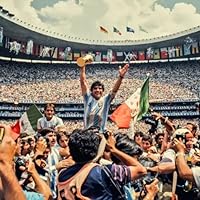
It was the last World cup when a crowd actually stormed onto the field at the moment the match ended. Maradona would be the last captain to hold the trophy aloft not merely a scrum of FIFA bureaucrats and the global media but with the people who had come to see him lifting him onto their shoulders.
He was as David Miller named him pythagoras in boots. But it was as a team player that he really excelled for Cruyff was an on-field director, when not running he was talking and when not on the ball he was pointing to calling for it ushering others into space alerting everyone around him to the dangers and possibilities of the moment. (sunny: I call this xBoxing – dictating the game vocally using communications as though you were controlling the game using an xbox controller :)
Italians had invented marking space rather than players and the Dutch invented playing according to one space rather than once pre allotted place in the division Of Labor. Our system was also a solution to a physical problem how can you play for 90 minutes and remain strong? If I is left back run 70 meters up the wing it's not good if I immediately have to run back 70 to my starting place. So if the left midfielder takes my place the left winger takes the midfield position then it shortens the distance is. That was the philosophy of total football.
In a remarkable anticipation of the spatial thinking of Dutch football later in the decade Herrera instructed: create empty spaces. In football as in life, in painting, in music, empty spaces and silences are as important as those that are filled.
Although formerly a midfield player Alfredo di Stefano ran the entire length of the field displaying a work rate and fitness that were unmatched at the time. His expectations of teammates was equally demanding. When amancio played his first game for Real Madrid and found no shield on his shirt he mentioned it to distefano who snapped back: “you've got to sweat in it first, sonny”. He did not merely trackback but defended deep organizing and marshalling the team at set pieces. He didn't just instruct but cajoled and ordered other and doing so he visibly raised the games of others around him. He scored over 800 goals in a career from a midfield position which was incredible. His posture at rest and in flight was remarkably straight and poised, his head was always up, his long neck, eyes always scanning and looking. Herrera when asked to compare him to Pele suggested that if the Brazilian was the violins then di stephano was the entire orchestra.
The German build up to the 1954 World Cup was very low key. Publicly expressed bellicose nationalism of any kind (post ww2) remained politically and psychologically unacceptable. The teams performances while competent gave no plausible reason to think about victory. Indeed the very idea of Germany broad winning anything was an emotional and cultural tinderbox best left alone.
The rippling and flamboyant individualism had been central to the distinct criollo football of the Rio de La Plata was Now merged with the stern conditions and imperatives / professionalisation the Scottish passing game.
The rest of the pitch would be steadily encircled with a raised bank which gave some clients an advantage point for standing spectators. Some clubs went so far as to invite the dumping of waste and spoil to build this up. When Fulham FC built Craven Cottage they used Street sweepings while many clubs in mining areas use slag with ashes to raise their viewing platforms
Healthy nations require healthy elites and thus the psychosexual health of the upper class school boys when right to the heart of the concerns of Victorian bodily culture. The Victorian public school was the building House of a new kind of masculinity in which the distinguishing characteristics of the male sex were not intellectual or genital but physical and moral. A combination that would become known as muscular Christianity chimed with many other elements of mid Victorian thought.
Some people believe football is a matter of life and death: I am very disappointed with that attitude. I can assure you it is much much more important than that. Bill Shankly.
Around half the planet watched the 2006 World Cup final, three billion human beings have never done anything simultaneously before.
Football the game the world plays, offers a metaphor for the dilemmas that sit at the very center of any moral framework or political program that takes the Reformation rather than the abolition of modernity
Any lower boy in this house who does not play football once a day and twice on half holiday will be fined half a crown and kicked. (Notice at Eton college mid 19th century).
The army was called to rugby in 1797 to put down a pupil revolt while the militia was summoned to Winchester in 1818 with fixed bayonets. It was their sixth such visit to the school in 50 years. Games were a central component of the boys culture. All the usual playground amusements of tag catch and hoopla could be found but public school boys showed a distinct preference for cruelty and violence. “Toozling” was the slang at Harrow for killing small songbirds.
Kelly Hutchinson-Almond of the Loretta school in Edinburgh instituted the daily playing of games created the school uniform that looked speciously like a football shirt, endorsed running in the winter snow and chose a school song called “go like blazes”.
Sport physically hardened up the Victorian ruling class for the task of imperial conquest and global hegemony in an era when office work would otherwise enfeeble them.
Wellington had indeed been right when he claimed that the bottle of Waterloo had been won on the playing fields of Eton.
Second between those who favored hacking, where players delivery targeted their opponents shins as a way of stopping them in the tackle, and those who opposed to the practice. Mr Campbell from the Blackheath club remarked of the plan that to dispense with hacking “you will do away with the courage and pluck of the game and I will be bound to bring over a lot of Frenchman who would beat you with a week's practice”.
Most teams fielded 2 backs 1/2 back and seven forwards. Although the backs would often boot the ball far up the field most of the time the ball moved at the feet of the individuals dribbling the ball towards the opponents goal. Passing was only considered as a last resort and indicated failure even dishonor. (why instinctively kid want to run with the ball themselves and not pass at all)
Boys of Droop St primary in West London founded Queens Park Rangers in 1885 while Sunderland AFC started life in 1879 in the local speech training college.
Scottish Football Association was created in 1873 and an English style FA Cup soon followed on. Glasgow’s precocious reputation was enhanced by hosting the very first official international game in 1872 between England and Scotland at the West of Scotland cricket ground.
Football was and is cheaper and easier to organize play and learn than either of those other teams sports. Football is played more easily and with less danger to the participants on poor quality services: for working men they could not afford to miss a full days pay and this would not be an inconsiderable factor in choosing the kicking game over the handling game.
The team never took up the opportunity to score a penalty and always left the goal mouth undefended when their opponents were awarded one on the grounds that the foul must have been sufficiently serious in the first place to merit a goal.
Some observers like the puritanical German Marxist Karl kaytsky said that football functioned as an opiate, pure and simple, a diversion from the more pressing tasks of industrial organization end revolutionary politics.
The crowd was overwhelmingly good humored well behaved and self policing with an immense tolerance for the low standards of comfort and scant regard from the authorities for their sight lines or well being. There is some suggestion that working class life of the time inured many to the low level scuffling and drunken fisticuffs that might break out.
Football is a fascination of the devil and a twin sister of the drink system
In 1916 the clumsily named “conmebol” confederation sudamerica de futbol the first continental Football Association almost 40 years in advance of its European equivalent Uefa : it was founded during an international tournament organized by the Argentinian Football Association in Buenos Aires. As with its predecessor tournament in 1910 the final pitted Argentina against Uruguay.
Football is an English game with a big ball. Usually it is played with people with solid muscles and strong legs. A week one would only be an onlooker in such a mess.
Ball work and practice games were highly restricted on the bizarre assumption that this would keep the team hungry for the ball when Saturday came. Weather they would know what to do with it when it eventually arrived was another point.
Chapman's Arsenal does displayed many of the key characteristic of modern “Fordist” production process: a high degree of specialization of tasks: systematic, repeatable sequences of tasks, task design, close observation and control of players by management.
Given the precision and technicality of its language, Italian football was a much more systematic in its analysis of micro level tactics than any other football culture: closed marking prized the denial of space to playmakers pursued.
The dominant view of Jews and Christian Europe was a weak physically based race and untrusted in physical activity of any kind. More than that they were right. The consequence of the ghetto the narrow Jewish streets were that our poor limbs forgot how to move joyfully: in the gloom of our sunless houses we became accustomed to nervous blinking out of fear of constant persecution, the timber of our voices was extinguished to an anxious whisper.
With two games to go before the end of 1925 league Hakoah on the title win Alexander Fabian scores an 87th minute equalizer. Fabian however was the goalkeeper and had one arm in a sling. In an era before substitutes he swapped places with a forward after breaking a bone in a collision. Muscular Judaism had come of age.
The English were focused and disciplined combining collective organization and physical force the prerequisites of an industrial labor force turning out and industrial product. On the Rio de La Plata when industrialisation had not yet so completely stamped its imprint on the economy, landscapes or rhythms of life masculinity was more restless impetuous and individualistic spurning crude forces in favor of virtuoso agility.
It is well to remember that if you play football with a man then you won't want to kill him no matter what the politicians think about it. We want to foster a real brotherhood of man, and the best way to do it in my view is by encouraging the nations to meet each other in games. Vice president of the British Olympic Association.
The Football League Official Charles sutcliff said: I don't care a brass Farthing about the improvement of the game in France, Belgium Austria or Germany. FIFA does not appeal to me. Its an organization where such football associations as those of Uruguay and Paraguay Brazil and Egypt Bohemia and pan Russia are coequal with England Scotland Wales and Ireland sand this seems to me to be a case of magnifying the midgets.
In 1929 at FIFA's Barcelona Congress Jules Rimet awarded compensation to Uruguay and commissioned a golden trophy then known as “the goddess of victory” and only latter as the coupe Jules Rimet made by French sculptor abel lafleur.
Then the following day Uruguay after going a goal down to Yugoslavia scored six themselves, the equalizer supposedly scored after a policeman kept a ball in that should have been a Yugoslav throw.
Hitler himself is reputed to have had almost no interest in the game at all. He recognized both the political utility of international sport the emotional potency of the spectacular and the economic and military values of the supporting healthy nation but he played no sport himself and only showed an enthusiasm for boxing and motor racing.
The cultural tone for the city in the early 1960s. The most discernible shift in the habits of portenos was the relocation of the free time from the streets to the living room as middle class Argentina, like everybody else, began to choose the TV over the cinema.
Johan Cruyff would judge the quality of a shot or a pass by its timbre.
The national team is so full of foreigners and so conditioned by foreign tactics that it no longer plays like a team of real Spaniards with passion and aggression with reality and above all with fury. The ultranationalists now had their moment. In 1963 foreign players were banned from Spanish football, a position maintained for a decade.
Giorgio bertotto One of the leading referees in football administrators coined the term psychological slavery to describe the unconscious but systematic bias of referees to the big clubs after a particularly skewed set of decisions in the game between Venezia and Inter Milan in 1967. Inter after all went over 100 games at one point without conceding a single penalty and that was playing a system with the last man invariably tackling inside the box.
Arthur hopcraft described the cop end at Liverpool in the 1950s as hideously uncomfortable. The steps are as greasy as a school playground lavatory. The air is rancid with beer and onions and belching and worse. The language is a gross purple of obscenity. When the crowd surges a man can be lifted off the ground in the crush as if by some soft sided crane grabbed and dangled about for minutes on end perhaps never letting go to the spot from which the monster made its first bite.
Things tip towards panic in late 1965 when a dead hand grenade was thrown from the Millwall end onto the pitch at Brentford.
Africa's course is all the more surprising when one considers the fact that in the bantu speaking cultures that cover most of the continent South of the sahel there is no indigenous word for the ball.
Someone somewhere was going to get very hurt and the Rome Derby in 1979 that happened to a lazio fan Vincenzo paparelli. He was struck by a nautical rocket. It had been launched over 150 meters away on the other side of the stadium and entered his brain through his left eye. He was the first person to die in an Italian stadium since the Salerno fan had a heart attack when taking part in a pitch invasion in 1963.
.
It was the last World cup when a crowd actually stormed onto the field at the moment the match ended. Maradona would be the last captain to hold the trophy aloft not merely a scrum of FIFA bureaucrats and the global media but with the people who had come to see him lifting him onto their shoulders.
He was as David Miller named him pythagoras in boots. But it was as a team player that he really excelled for Cruyff was an on-field director, when not running he was talking and when not on the ball he was pointing to calling for it ushering others into space alerting everyone around him to the dangers and possibilities of the moment. (sunny: I call this xBoxing – dictating the game vocally using communications as though you were controlling the game using an xbox controller :)
Italians had invented marking space rather than players and the Dutch invented playing according to one space rather than once pre allotted place in the division Of Labor. Our system was also a solution to a physical problem how can you play for 90 minutes and remain strong? If I is left back run 70 meters up the wing it's not good if I immediately have to run back 70 to my starting place. So if the left midfielder takes my place the left winger takes the midfield position then it shortens the distance is. That was the philosophy of total football.
In a remarkable anticipation of the spatial thinking of Dutch football later in the decade Herrera instructed: create empty spaces. In football as in life, in painting, in music, empty spaces and silences are as important as those that are filled.
Although formerly a midfield player Alfredo di Stefano ran the entire length of the field displaying a work rate and fitness that were unmatched at the time. His expectations of teammates was equally demanding. When amancio played his first game for Real Madrid and found no shield on his shirt he mentioned it to distefano who snapped back: “you've got to sweat in it first, sonny”. He did not merely trackback but defended deep organizing and marshalling the team at set pieces. He didn't just instruct but cajoled and ordered other and doing so he visibly raised the games of others around him. He scored over 800 goals in a career from a midfield position which was incredible. His posture at rest and in flight was remarkably straight and poised, his head was always up, his long neck, eyes always scanning and looking. Herrera when asked to compare him to Pele suggested that if the Brazilian was the violins then di stephano was the entire orchestra.
The German build up to the 1954 World Cup was very low key. Publicly expressed bellicose nationalism of any kind (post ww2) remained politically and psychologically unacceptable. The teams performances while competent gave no plausible reason to think about victory. Indeed the very idea of Germany broad winning anything was an emotional and cultural tinderbox best left alone.
The rippling and flamboyant individualism had been central to the distinct criollo football of the Rio de La Plata was Now merged with the stern conditions and imperatives / professionalisation the Scottish passing game.
The rest of the pitch would be steadily encircled with a raised bank which gave some clients an advantage point for standing spectators. Some clubs went so far as to invite the dumping of waste and spoil to build this up. When Fulham FC built Craven Cottage they used Street sweepings while many clubs in mining areas use slag with ashes to raise their viewing platforms
Healthy nations require healthy elites and thus the psychosexual health of the upper class school boys when right to the heart of the concerns of Victorian bodily culture. The Victorian public school was the building House of a new kind of masculinity in which the distinguishing characteristics of the male sex were not intellectual or genital but physical and moral. A combination that would become known as muscular Christianity chimed with many other elements of mid Victorian thought.
Some people believe football is a matter of life and death: I am very disappointed with that attitude. I can assure you it is much much more important than that. Bill Shankly.
Around half the planet watched the 2006 World Cup final, three billion human beings have never done anything simultaneously before.
Football the game the world plays, offers a metaphor for the dilemmas that sit at the very center of any moral framework or political program that takes the Reformation rather than the abolition of modernity
Any lower boy in this house who does not play football once a day and twice on half holiday will be fined half a crown and kicked. (Notice at Eton college mid 19th century).
The army was called to rugby in 1797 to put down a pupil revolt while the militia was summoned to Winchester in 1818 with fixed bayonets. It was their sixth such visit to the school in 50 years. Games were a central component of the boys culture. All the usual playground amusements of tag catch and hoopla could be found but public school boys showed a distinct preference for cruelty and violence. “Toozling” was the slang at Harrow for killing small songbirds.
Kelly Hutchinson-Almond of the Loretta school in Edinburgh instituted the daily playing of games created the school uniform that looked speciously like a football shirt, endorsed running in the winter snow and chose a school song called “go like blazes”.
Sport physically hardened up the Victorian ruling class for the task of imperial conquest and global hegemony in an era when office work would otherwise enfeeble them.
Wellington had indeed been right when he claimed that the bottle of Waterloo had been won on the playing fields of Eton.
Second between those who favored hacking, where players delivery targeted their opponents shins as a way of stopping them in the tackle, and those who opposed to the practice. Mr Campbell from the Blackheath club remarked of the plan that to dispense with hacking “you will do away with the courage and pluck of the game and I will be bound to bring over a lot of Frenchman who would beat you with a week's practice”.
Most teams fielded 2 backs 1/2 back and seven forwards. Although the backs would often boot the ball far up the field most of the time the ball moved at the feet of the individuals dribbling the ball towards the opponents goal. Passing was only considered as a last resort and indicated failure even dishonor. (why instinctively kid want to run with the ball themselves and not pass at all)
Boys of Droop St primary in West London founded Queens Park Rangers in 1885 while Sunderland AFC started life in 1879 in the local speech training college.
Scottish Football Association was created in 1873 and an English style FA Cup soon followed on. Glasgow’s precocious reputation was enhanced by hosting the very first official international game in 1872 between England and Scotland at the West of Scotland cricket ground.
Football was and is cheaper and easier to organize play and learn than either of those other teams sports. Football is played more easily and with less danger to the participants on poor quality services: for working men they could not afford to miss a full days pay and this would not be an inconsiderable factor in choosing the kicking game over the handling game.
The team never took up the opportunity to score a penalty and always left the goal mouth undefended when their opponents were awarded one on the grounds that the foul must have been sufficiently serious in the first place to merit a goal.
Some observers like the puritanical German Marxist Karl kaytsky said that football functioned as an opiate, pure and simple, a diversion from the more pressing tasks of industrial organization end revolutionary politics.
The crowd was overwhelmingly good humored well behaved and self policing with an immense tolerance for the low standards of comfort and scant regard from the authorities for their sight lines or well being. There is some suggestion that working class life of the time inured many to the low level scuffling and drunken fisticuffs that might break out.
Football is a fascination of the devil and a twin sister of the drink system
In 1916 the clumsily named “conmebol” confederation sudamerica de futbol the first continental Football Association almost 40 years in advance of its European equivalent Uefa : it was founded during an international tournament organized by the Argentinian Football Association in Buenos Aires. As with its predecessor tournament in 1910 the final pitted Argentina against Uruguay.
Football is an English game with a big ball. Usually it is played with people with solid muscles and strong legs. A week one would only be an onlooker in such a mess.
Ball work and practice games were highly restricted on the bizarre assumption that this would keep the team hungry for the ball when Saturday came. Weather they would know what to do with it when it eventually arrived was another point.
Chapman's Arsenal does displayed many of the key characteristic of modern “Fordist” production process: a high degree of specialization of tasks: systematic, repeatable sequences of tasks, task design, close observation and control of players by management.
Given the precision and technicality of its language, Italian football was a much more systematic in its analysis of micro level tactics than any other football culture: closed marking prized the denial of space to playmakers pursued.
The dominant view of Jews and Christian Europe was a weak physically based race and untrusted in physical activity of any kind. More than that they were right. The consequence of the ghetto the narrow Jewish streets were that our poor limbs forgot how to move joyfully: in the gloom of our sunless houses we became accustomed to nervous blinking out of fear of constant persecution, the timber of our voices was extinguished to an anxious whisper.
With two games to go before the end of 1925 league Hakoah on the title win Alexander Fabian scores an 87th minute equalizer. Fabian however was the goalkeeper and had one arm in a sling. In an era before substitutes he swapped places with a forward after breaking a bone in a collision. Muscular Judaism had come of age.
The English were focused and disciplined combining collective organization and physical force the prerequisites of an industrial labor force turning out and industrial product. On the Rio de La Plata when industrialisation had not yet so completely stamped its imprint on the economy, landscapes or rhythms of life masculinity was more restless impetuous and individualistic spurning crude forces in favor of virtuoso agility.
It is well to remember that if you play football with a man then you won't want to kill him no matter what the politicians think about it. We want to foster a real brotherhood of man, and the best way to do it in my view is by encouraging the nations to meet each other in games. Vice president of the British Olympic Association.
The Football League Official Charles sutcliff said: I don't care a brass Farthing about the improvement of the game in France, Belgium Austria or Germany. FIFA does not appeal to me. Its an organization where such football associations as those of Uruguay and Paraguay Brazil and Egypt Bohemia and pan Russia are coequal with England Scotland Wales and Ireland sand this seems to me to be a case of magnifying the midgets.
In 1929 at FIFA's Barcelona Congress Jules Rimet awarded compensation to Uruguay and commissioned a golden trophy then known as “the goddess of victory” and only latter as the coupe Jules Rimet made by French sculptor abel lafleur.
Then the following day Uruguay after going a goal down to Yugoslavia scored six themselves, the equalizer supposedly scored after a policeman kept a ball in that should have been a Yugoslav throw.
Hitler himself is reputed to have had almost no interest in the game at all. He recognized both the political utility of international sport the emotional potency of the spectacular and the economic and military values of the supporting healthy nation but he played no sport himself and only showed an enthusiasm for boxing and motor racing.
The cultural tone for the city in the early 1960s. The most discernible shift in the habits of portenos was the relocation of the free time from the streets to the living room as middle class Argentina, like everybody else, began to choose the TV over the cinema.
Johan Cruyff would judge the quality of a shot or a pass by its timbre.
The national team is so full of foreigners and so conditioned by foreign tactics that it no longer plays like a team of real Spaniards with passion and aggression with reality and above all with fury. The ultranationalists now had their moment. In 1963 foreign players were banned from Spanish football, a position maintained for a decade.
Giorgio bertotto One of the leading referees in football administrators coined the term psychological slavery to describe the unconscious but systematic bias of referees to the big clubs after a particularly skewed set of decisions in the game between Venezia and Inter Milan in 1967. Inter after all went over 100 games at one point without conceding a single penalty and that was playing a system with the last man invariably tackling inside the box.
Arthur hopcraft described the cop end at Liverpool in the 1950s as hideously uncomfortable. The steps are as greasy as a school playground lavatory. The air is rancid with beer and onions and belching and worse. The language is a gross purple of obscenity. When the crowd surges a man can be lifted off the ground in the crush as if by some soft sided crane grabbed and dangled about for minutes on end perhaps never letting go to the spot from which the monster made its first bite.
Things tip towards panic in late 1965 when a dead hand grenade was thrown from the Millwall end onto the pitch at Brentford.
Africa's course is all the more surprising when one considers the fact that in the bantu speaking cultures that cover most of the continent South of the sahel there is no indigenous word for the ball.
Someone somewhere was going to get very hurt and the Rome Derby in 1979 that happened to a lazio fan Vincenzo paparelli. He was struck by a nautical rocket. It had been launched over 150 meters away on the other side of the stadium and entered his brain through his left eye. He was the first person to die in an Italian stadium since the Salerno fan had a heart attack when taking part in a pitch invasion in 1963.
.
September 28, 2025
Encyclopedic. If you want all the history, it's here, but there's a lot and not really an arc.

December 17, 2013
A history, mostly of the last two centuries, combining [Association] football and general social history. Sometimes the intertwining requires work from the author: offers of microcosm to macrocosmic interpretation, or examining the economic underpinnings of teams to those of their larger society; but sometimes events are like a 'connect the dot' puzzle with only one unfinished line: the election of the Paulista Corinthian team president as Brasil [Brazil] contemplated de-militarization with the two sporting camps' slates titled: 'Order and Truth,' versus 'Corinthian Democracy.'
Other thoughts:
It speaks of:
1) the material conditions for the modern game (industrialization and related urbanization with intra- and inter-city transit)--see 3.I for the English case;
2) the relation to literature that describes a notion of national identity (see the discussion of Freyre and Filho re Brasil in 8.IV);
3) the relation to architecture as political metaphor (see the discussion of Parc Lescure in 9.IV for a French example);
4) the game as ritualized combat between modern heads of state (Tito vs. Stalin, Helsinki Olympics, 1952);
5) the parallel between the violence of the Onganía regime (Argentina, 1960s) and of anti-fútbol in 10.IV;
6) the strikers (my pun intended) as the vanguard. See the colonial Rhodesia case with team captains/ union leaders Benjamin Burombo and Sipanbaniso Manyoba and the events of 1947 in 12.III.
7) I know of fanzines from SFF; it was interesting to hear that in Britain in the '70s/'80s (and elsewhere later) they were big in football. See 14.II and the mention of 'Not the View' in 14.III. It made me wonder about the culture and economics of fanzines across sub-cultures.
8) An SF story I once read has more context after reading about Luton Town's banning of away fans in the '86-'87 season (14.III). In it a guy from our time transported to the future subverted the placid away robot fans--human away fans were banned--and made them become hooligans, and thus restored the game. [The story was 'Courageous New Planet' by Bob Shaw in "Dark Night in Toyland" (1989).]
9) The description (inter alia) of terrible corruption (bought or threatened refs, fixed games, transfer fees comingled with money laundering) of the game in eastern and southern Europe, in Africa, in Latin America and in southeast Asia (gambling) brought to mind a way of second guessing transparency indices. Here it is: In un-suspect countries take a statistical measure of some precisely defined deviation between aggregate predictions in gambling forms and results; this is your baseline. Measure the same in suspect countries, the ratio of the absolute value of its difference to the baseline, where sufficient to be meaningful, is your alternate transparency index.
Caveats:
10) Americans may find some of the language unfamiliar. Some of it will merely make for a bumpier read, such as the omissions (from an American point of view) of the definite article in contexts like a team or stadium name, or an unfamiliar but contextually clear use of an existing
word like 'tout' and 'fixtures' (British) for 'scalper' and 'schedules' (American). But sometimes the first specialized use of a term isn't at all clear, and a Google search on " definition'" will get you a lot of false leads.
11) His skill with words is sometimes quite enjoyable (see his bolded description of 25/5/1967 Celtic over Internazionale), but not always. I am thinking particularly of one instance were he said 'mendacious and dishonest,' which seemed redundant, and the frequent and--to me--imprecise use of 'hysterical.'
Other thoughts:
It speaks of:
1) the material conditions for the modern game (industrialization and related urbanization with intra- and inter-city transit)--see 3.I for the English case;
2) the relation to literature that describes a notion of national identity (see the discussion of Freyre and Filho re Brasil in 8.IV);
3) the relation to architecture as political metaphor (see the discussion of Parc Lescure in 9.IV for a French example);
4) the game as ritualized combat between modern heads of state (Tito vs. Stalin, Helsinki Olympics, 1952);
5) the parallel between the violence of the Onganía regime (Argentina, 1960s) and of anti-fútbol in 10.IV;
6) the strikers (my pun intended) as the vanguard. See the colonial Rhodesia case with team captains/ union leaders Benjamin Burombo and Sipanbaniso Manyoba and the events of 1947 in 12.III.
7) I know of fanzines from SFF; it was interesting to hear that in Britain in the '70s/'80s (and elsewhere later) they were big in football. See 14.II and the mention of 'Not the View' in 14.III. It made me wonder about the culture and economics of fanzines across sub-cultures.
8) An SF story I once read has more context after reading about Luton Town's banning of away fans in the '86-'87 season (14.III). In it a guy from our time transported to the future subverted the placid away robot fans--human away fans were banned--and made them become hooligans, and thus restored the game. [The story was 'Courageous New Planet' by Bob Shaw in "Dark Night in Toyland" (1989).]
9) The description (inter alia) of terrible corruption (bought or threatened refs, fixed games, transfer fees comingled with money laundering) of the game in eastern and southern Europe, in Africa, in Latin America and in southeast Asia (gambling) brought to mind a way of second guessing transparency indices. Here it is: In un-suspect countries take a statistical measure of some precisely defined deviation between aggregate predictions in gambling forms and results; this is your baseline. Measure the same in suspect countries, the ratio of the absolute value of its difference to the baseline, where sufficient to be meaningful, is your alternate transparency index.
Caveats:
10) Americans may find some of the language unfamiliar. Some of it will merely make for a bumpier read, such as the omissions (from an American point of view) of the definite article in contexts like a team or stadium name, or an unfamiliar but contextually clear use of an existing
word like 'tout' and 'fixtures' (British) for 'scalper' and 'schedules' (American). But sometimes the first specialized use of a term isn't at all clear, and a Google search on " definition'" will get you a lot of false leads.
11) His skill with words is sometimes quite enjoyable (see his bolded description of 25/5/1967 Celtic over Internazionale), but not always. I am thinking particularly of one instance were he said 'mendacious and dishonest,' which seemed redundant, and the frequent and--to me--imprecise use of 'hysterical.'
This entire review has been hidden because of spoilers.

December 17, 2022
If you’re searching for a comprehensive overview of football history, this is the obvious go-to. It is an enormous, well-reviewed, book.
And yet, it’s bang average.
Like many liberal histories, the author appears to feel the need to equivalise competing political interests at all times (for example, desperately reaching to compare the influence of far-right Croatian nationalists on their Australian football clubs [ustaše and fascist sympathisers within the Melbourne Knights, see Melbourne Croatia, support scandalised *this year’s* Australia Cup final] to those in Serbian clubs [which were virtually non-existent — the author references JUST Footscray without recognising the identification with “Jugoslavia United [Soccer Team]”]) and to diminish violent and destructive imperial influence throughout the global south (the author references “American cultural and political influence” or similar time and time again, but never formulates a systemic analysis of how this influence came to be or how it continues to influence the development of football — this makes his Angloid sneering at Latin and African political dysfunction hard to stomach). Outside of the macro, Goldblatt similarly fails to analyse domestic politics in any sort of depth (which would require some sort of class analysis), speaking about the PSI and PSOE governments of the late 1980s in Italy and Spain, for example, as “shifts to the left” before outlining how each implemented brutal and corrupt neoliberal policies on their nation’s working class. If you were undertaking a genuine analysis of the politics of these nations (not just reading “socialist” in a party’s name and looking at election results), you’d understand that the ascendancy of the PSI and PSOE in this period was predicated against the highly popular communist parties in both nations; the trade off for allowing “socialists” a degree more power in each nation was that these very same politicians would crush militant unions and introduce austerity. Corruption was never some unfortunate consequence of the latinate inability to build sold institutions, its the tradeoff for parties abandoning the class they’re meant to represent. Spain joined NATO (and, relevantly if you have researched Gladio, worked with the terrorist GAL during their dirty war against ETA, leading to at least 27 killings), privatised Telefónica and ENDESA and ripped the guts out of mining and industry under the PSOE. To classify these governments as left-wing in any meaningful way is flawed history — and it explains why Goldblatt can’t really explain a lot of the superstructural social and cultural breakdown downstream from these *rightward* shifts.
On a similar note, the author’s position on anything communistic is emotional and ill-informed. There is extensive literature out there on the structure and governance of football under communism, yet this is entirely ignored (he does reference Edelman’s work on Spartak Moscow). Riordan’s research, for example, demonstrates that a) football governance across Eastern Europe and the rest of the communist bloc (Cuba and China in particular) was not uniform, and b) communist states were pioneers in, for example, state support for sporting development (since copied in the United States, Australia and Britain, amongst others), community construction of football stadiums, joint ownership, women’s football and equitable financing across multi-sport clubs. Besides, how does a sporting history of the world barely mention Lobanovskyi? The author frames Puskas’ defection from Hungary and Honved as a moment of liberation against “Soviet imperialism”; flatly ignoring that Puskas moved to play in *fascist* Spain. On China — which, again, Riordan examines in fascinating detail — Goldblatt completely misses the forest (China’s non-participation in FIFA and Olympic events was multi-faceted, but mostly as a result of these institutions recognising Taiwan from 1958 until 1979) for the trees (editorialising — orientalising — screeds about the Great Leap Forward, GPCR and Mao more broadly).
Positively, the beginning of the book is really excellent and makes very compelling arguments for why the game failed to spread in Oceania and North America but succeeded so strongly in Latin America, amongst others. There are two reasons for this. Firstly, the early timeline doesn’t jump around spasmodically like later in the text. A globe-spanning history of the development of football will always be hard to thread together, but Goldblatt’s timelines are particularly odd, jumping back into previous decades or forward to others to fit narratives framed by another. Secondly, this this period isn’t tainted like its successors by the competing political interests that cloud analysis in this text and — looking to the (surprisingly light for a 1,000 page book) bibliography — associated source material. As the book progresses, the spectre of communism — and editorialised anti-communism — haunts it.
To round off the review, the treatment of the turbulent 1970s and 1980s is the best case study for the strengths and weaknesses of the book. The book does a decent job of outlining the social forces that led to hooliganism and associated stadium disasters, though, as noted above it is hampered by an inability to fully understand the political dynamics of the time. In Spain, for example, Goldblatt notes “In 1982 the election of the Spanish Socialists (PSOE) under Felipe González set the seal on Spain’s democratisation, unleashing wild celebrations among the young and a sense that the country could finally shake off the authoritarian restrictions of the old order. Like most of Spanish youth, the young men gathered in Spain’s foot-ball stadiums were increasingly dissatisfied by and alienated from traditional organisations with their narrow horizons and old hierarchies, in this case the supporters’ clubs known as peña.” How does this make sense? Politically, the young were liberated by the dynamic PSOE of 1982, yet throughout the ‘80s, these same disenfranchised youth became disassociated hooligans? Understanding the PSOE as a rightward and brutal reassertion of liberal capitalism on a largely radical working class would explain this disaffection (a disaffection that intensified throughout the 1980s into the 1990s before rearing its head again in the 2000s), but the author has already committed his political understanding of the “democratisation” process to another mast.
Moreover, in describing the stadium disasters of the 1980s, Goldblatt completely undermines the gravity of Hillsborough by excoriating the Soviet authorities for the Luzhniki disaster, quoting “over three hundred fatalities”. This tally is clearly referencing the Sovetsky Sport figure of 340 from 1989, which has been completely discredited. The common estimate today is around 66. If you’re making a claim to the Sovetsky figure of exactly 340 (which was quoted around the world in Western papers), why not say 340? There’s no other source that suggests higher than 300 but not 340. It appears a very disingenuous attempt to ignore figures from the Andropov *or* perestroika investigations in favour of a number that once again places the Soviet Union as the real malevolent European actor of the period. Goldblatt also fails to mention the enormous investigation into the disaster undertaken by the Andropov government (with 150 witnesses called to trial and a 10 volume report) that led to the prosecution of four officials and the dismissal of interior minister Nikolai Shchelokov. What are the 96 Hillsborough deaths and complete lack of successful legal action against the perpetrators if the Soviets actually killed over 300? It’s poor history and renders the page or so on Hillsborough (and the disgusting behaviour of the British political class in relation to it) hollow, which is a travesty.
Finally, the many pages on hooliganism, though compelling, also reflect another quirk of the text: for a 1,000 page history of football, there’s very little football in it. A few tournaments and games are highlighted throughout, but there’s a relative lack of detail on important players, squads, clubs and moments. For a social history that fails to do much examination of the proletarian experience (preferring, instead, for broad stroke analysis — the word “authoritarian” is thrown about almost as much as the letter E), it isn’t all that great on major characters in the game (outside of a handful of FIFA presidents) either.
In sum, a social history of football light on social history and football. I hope I’ll stumble across something better next year.
And yet, it’s bang average.
Like many liberal histories, the author appears to feel the need to equivalise competing political interests at all times (for example, desperately reaching to compare the influence of far-right Croatian nationalists on their Australian football clubs [ustaše and fascist sympathisers within the Melbourne Knights, see Melbourne Croatia, support scandalised *this year’s* Australia Cup final] to those in Serbian clubs [which were virtually non-existent — the author references JUST Footscray without recognising the identification with “Jugoslavia United [Soccer Team]”]) and to diminish violent and destructive imperial influence throughout the global south (the author references “American cultural and political influence” or similar time and time again, but never formulates a systemic analysis of how this influence came to be or how it continues to influence the development of football — this makes his Angloid sneering at Latin and African political dysfunction hard to stomach). Outside of the macro, Goldblatt similarly fails to analyse domestic politics in any sort of depth (which would require some sort of class analysis), speaking about the PSI and PSOE governments of the late 1980s in Italy and Spain, for example, as “shifts to the left” before outlining how each implemented brutal and corrupt neoliberal policies on their nation’s working class. If you were undertaking a genuine analysis of the politics of these nations (not just reading “socialist” in a party’s name and looking at election results), you’d understand that the ascendancy of the PSI and PSOE in this period was predicated against the highly popular communist parties in both nations; the trade off for allowing “socialists” a degree more power in each nation was that these very same politicians would crush militant unions and introduce austerity. Corruption was never some unfortunate consequence of the latinate inability to build sold institutions, its the tradeoff for parties abandoning the class they’re meant to represent. Spain joined NATO (and, relevantly if you have researched Gladio, worked with the terrorist GAL during their dirty war against ETA, leading to at least 27 killings), privatised Telefónica and ENDESA and ripped the guts out of mining and industry under the PSOE. To classify these governments as left-wing in any meaningful way is flawed history — and it explains why Goldblatt can’t really explain a lot of the superstructural social and cultural breakdown downstream from these *rightward* shifts.
On a similar note, the author’s position on anything communistic is emotional and ill-informed. There is extensive literature out there on the structure and governance of football under communism, yet this is entirely ignored (he does reference Edelman’s work on Spartak Moscow). Riordan’s research, for example, demonstrates that a) football governance across Eastern Europe and the rest of the communist bloc (Cuba and China in particular) was not uniform, and b) communist states were pioneers in, for example, state support for sporting development (since copied in the United States, Australia and Britain, amongst others), community construction of football stadiums, joint ownership, women’s football and equitable financing across multi-sport clubs. Besides, how does a sporting history of the world barely mention Lobanovskyi? The author frames Puskas’ defection from Hungary and Honved as a moment of liberation against “Soviet imperialism”; flatly ignoring that Puskas moved to play in *fascist* Spain. On China — which, again, Riordan examines in fascinating detail — Goldblatt completely misses the forest (China’s non-participation in FIFA and Olympic events was multi-faceted, but mostly as a result of these institutions recognising Taiwan from 1958 until 1979) for the trees (editorialising — orientalising — screeds about the Great Leap Forward, GPCR and Mao more broadly).
Positively, the beginning of the book is really excellent and makes very compelling arguments for why the game failed to spread in Oceania and North America but succeeded so strongly in Latin America, amongst others. There are two reasons for this. Firstly, the early timeline doesn’t jump around spasmodically like later in the text. A globe-spanning history of the development of football will always be hard to thread together, but Goldblatt’s timelines are particularly odd, jumping back into previous decades or forward to others to fit narratives framed by another. Secondly, this this period isn’t tainted like its successors by the competing political interests that cloud analysis in this text and — looking to the (surprisingly light for a 1,000 page book) bibliography — associated source material. As the book progresses, the spectre of communism — and editorialised anti-communism — haunts it.
To round off the review, the treatment of the turbulent 1970s and 1980s is the best case study for the strengths and weaknesses of the book. The book does a decent job of outlining the social forces that led to hooliganism and associated stadium disasters, though, as noted above it is hampered by an inability to fully understand the political dynamics of the time. In Spain, for example, Goldblatt notes “In 1982 the election of the Spanish Socialists (PSOE) under Felipe González set the seal on Spain’s democratisation, unleashing wild celebrations among the young and a sense that the country could finally shake off the authoritarian restrictions of the old order. Like most of Spanish youth, the young men gathered in Spain’s foot-ball stadiums were increasingly dissatisfied by and alienated from traditional organisations with their narrow horizons and old hierarchies, in this case the supporters’ clubs known as peña.” How does this make sense? Politically, the young were liberated by the dynamic PSOE of 1982, yet throughout the ‘80s, these same disenfranchised youth became disassociated hooligans? Understanding the PSOE as a rightward and brutal reassertion of liberal capitalism on a largely radical working class would explain this disaffection (a disaffection that intensified throughout the 1980s into the 1990s before rearing its head again in the 2000s), but the author has already committed his political understanding of the “democratisation” process to another mast.
Moreover, in describing the stadium disasters of the 1980s, Goldblatt completely undermines the gravity of Hillsborough by excoriating the Soviet authorities for the Luzhniki disaster, quoting “over three hundred fatalities”. This tally is clearly referencing the Sovetsky Sport figure of 340 from 1989, which has been completely discredited. The common estimate today is around 66. If you’re making a claim to the Sovetsky figure of exactly 340 (which was quoted around the world in Western papers), why not say 340? There’s no other source that suggests higher than 300 but not 340. It appears a very disingenuous attempt to ignore figures from the Andropov *or* perestroika investigations in favour of a number that once again places the Soviet Union as the real malevolent European actor of the period. Goldblatt also fails to mention the enormous investigation into the disaster undertaken by the Andropov government (with 150 witnesses called to trial and a 10 volume report) that led to the prosecution of four officials and the dismissal of interior minister Nikolai Shchelokov. What are the 96 Hillsborough deaths and complete lack of successful legal action against the perpetrators if the Soviets actually killed over 300? It’s poor history and renders the page or so on Hillsborough (and the disgusting behaviour of the British political class in relation to it) hollow, which is a travesty.
Finally, the many pages on hooliganism, though compelling, also reflect another quirk of the text: for a 1,000 page history of football, there’s very little football in it. A few tournaments and games are highlighted throughout, but there’s a relative lack of detail on important players, squads, clubs and moments. For a social history that fails to do much examination of the proletarian experience (preferring, instead, for broad stroke analysis — the word “authoritarian” is thrown about almost as much as the letter E), it isn’t all that great on major characters in the game (outside of a handful of FIFA presidents) either.
In sum, a social history of football light on social history and football. I hope I’ll stumble across something better next year.

November 21, 2018
Remarkable and comprehensive book. Wonderful.

March 29, 2010
I'm not really sure where to start... so bullet points:
--very long, but very well organized. I was never lost and Goldblatt covers the entire world, I mean every where but... Mexico which was weird. But if Mexico is the only country he 'forgets' well it's not the end of the world.
--The book becomes weaker as it moves along, the beginning is fantastic (how football started, why the US/Canada/Aussies rejected football, why the Scots took to it, the spread of the game in Europe and Latin America) but then as the book moves along it stops being a history as much as a anthropological study of the game. Instead of focusing on the great players in the post WWII era, Goldblatt spends time writing about violence in football (why it's there, stadium disasters, etc). This is all important, but too much time is spend on the more minor disasters or incidents.
--I would have liked to also known more about the success of clubs and countries and the meaning of these clubs to the fans/cities/areas they are located. Also, while he nailed the expansion and success of the World Cup in the 70s and 80s, it would have been nice if more time was spent on the actual World Cups themselves.
--There are times when it being a social history is a ton of fun.
--A book like this is not going to be perfect. But unless you really want to throw yourself in to football (as you'll be referring to it after you read it), then by all means, do it. But if you're just a causal fan or someone who's sort of interested... just move along. This isn't for the fair weather fan or the I'm half interested in the game... this is for someone who already has a very good understanding of the game and it's tactics.
--As I said, I would have loved to learn more about changing tactics, the star players, the clubs (who won what and when), and the World Cup/Euro/Champions League. But what you get is a mix of only the biggest stars to play the game (Pele, Maradona, etc), the politics of why a World Cup was hosted where, and a very general understanding of the clubs/countries. At times the book is fantastic (how TV and TV money is changing the game, the beginning history of the game) but I'm not sure how much 'more' I know about football today than I did before I began the book. It's a history of 20th century and the roll football played socially during the 20th century, as opposed to an actual history, player by player, tournament by tournament, blow by blow history of football.
--very long, but very well organized. I was never lost and Goldblatt covers the entire world, I mean every where but... Mexico which was weird. But if Mexico is the only country he 'forgets' well it's not the end of the world.
--The book becomes weaker as it moves along, the beginning is fantastic (how football started, why the US/Canada/Aussies rejected football, why the Scots took to it, the spread of the game in Europe and Latin America) but then as the book moves along it stops being a history as much as a anthropological study of the game. Instead of focusing on the great players in the post WWII era, Goldblatt spends time writing about violence in football (why it's there, stadium disasters, etc). This is all important, but too much time is spend on the more minor disasters or incidents.
--I would have liked to also known more about the success of clubs and countries and the meaning of these clubs to the fans/cities/areas they are located. Also, while he nailed the expansion and success of the World Cup in the 70s and 80s, it would have been nice if more time was spent on the actual World Cups themselves.
--There are times when it being a social history is a ton of fun.
--A book like this is not going to be perfect. But unless you really want to throw yourself in to football (as you'll be referring to it after you read it), then by all means, do it. But if you're just a causal fan or someone who's sort of interested... just move along. This isn't for the fair weather fan or the I'm half interested in the game... this is for someone who already has a very good understanding of the game and it's tactics.
--As I said, I would have loved to learn more about changing tactics, the star players, the clubs (who won what and when), and the World Cup/Euro/Champions League. But what you get is a mix of only the biggest stars to play the game (Pele, Maradona, etc), the politics of why a World Cup was hosted where, and a very general understanding of the clubs/countries. At times the book is fantastic (how TV and TV money is changing the game, the beginning history of the game) but I'm not sure how much 'more' I know about football today than I did before I began the book. It's a history of 20th century and the roll football played socially during the 20th century, as opposed to an actual history, player by player, tournament by tournament, blow by blow history of football.
Displaying 1 - 30 of 190 reviews