Jump to ratings and reviews
Rate this book

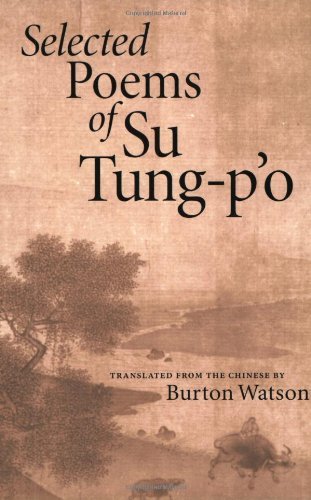
Selected Poems of Su Tung-Po by Shih Su (1-Jan-1994) Paperback

Rate this book
Su Tung-p'o was a civil servant who traveled to numerous political posts throughout the state. Hence, much of his poetry is a catalogue of his travels--their diverse landscapes, inhabitants, songs and folklore. With his lyrical precision and astonishing eye for detail, Su Tung-p'o renders the Chinese countryside with a vivid "Purple plums, yellow melons--the village roads smell sweet; / Black gauze cap, white hemp robe--traveling clothes are cool." Less aesthetically rigid than earlier Chinese poets, he sought inspiration both in issues of philosophical complexity and matters of everyday life. This expansiveness, combined with a sophisticated sense of image and metaphor, created a body of work that is strikingly modern. Or, in Su Tung-p'o's own "We're like a rabbit darting from preying hawks . . . lightning glimpsed through a crack." Copyright 1994 Reed Business Information, Inc.

Paperback

First published January 1, 1993

6 people are currently reading
109 people want to read

About the author

Su Tung-p'o

9 books1 follower

Ratings & Reviews

What do you think?
Rate this book

Friends & Following

Create a free account to discover what your friends think of this book!

Community Reviews

5 stars
32 (41%)
4 stars
29 (37%)
3 stars
14 (17%)
2 stars
2 (2%)
1 star
1 (1%)
Displaying 1 - 13 of 13 reviews
Profile Image for Greg.
654 reviews99 followers
January 19, 2018
This is a very interesting collection of poems written by the master Su Tung-P’o in the eleventh century. I can’t really comment on the translation except to say that the translation renders the language as poetry, which is no small feat. Overall, I found them interesting and enjoyable. Shockingly, there are countless references to getting drunk…it seems that Su Tung-P’o enjoyed his wine regularly. To me, the best poems evoke a romantic, naturalistic quality.

Black Clouds – Spilled Ink

Black clouds – spilled ink half blotting out the hills;
pale rain – bouncing beads that splatter in the boat.
Land-rolling wind comes, blasts and scatters them:
below Lake Watch Tower, water like sky.


I really enjoyed the prose poems included in this collection, in fact, they were my favorite. An example comes from Two Prose Poems on the Red Cliff – First Prose Poem:


A fresh breeze blew softly across the water, leaving the waves unruffled. As I picked up the wine jar and poured a drink for my friends, I hummed a poem to the moon and sang a phrase on its strange beauty…
I felt a boundless exhilaration, as though I were sailing on the void or riding the wind and didn’t know where to stop. I was filled with a lightness, as though I had left the world and were standing alone, or had sprouted wings and were flying up to join the immortals…


Overall, a melancholy tone pervades, mixed with beautiful imagery. A great example of this is Above the River, Heavy on the Heart

Above the river, heavy on the heart, thousand-fold hills:
layers of green floating in the sky like mist.
Mountains? clouds? too far away to tell
till clouds part, mist scatters, on mountains that remain.


All in all, a very worthy read.

See my other reviews here!
27 reviews
July 9, 2025
so, so beautiful! my favorite poem (to whet your appetite)

The hundred rivers day and night flow on,
we and all things following;
only the heart remains unmoved,
clutching the past.
I recall when we stayed at Huai-yüan Stop, door shut against fall heat,
eating boiled greens, studying,
wiping away the sweat, you and I.
The west wind suddenly turned cold;
dried leaves blew in the window.
You got up for a heavier coat
and took hold of my hand:
We won't be young for long -
I needn't tell you.
Probably we'll have to part,
hard to tell when success may come -
even then I felt a chill of sorrow,
and now when both of us are old -
too late to look for a lost road,
too late, I'm afraid, to study the Way.
This fall I began talks to buy some land;
if I build a house, it should be done by spring. Nights at Snow Hall, in wind and rain,
already I hear you talking to me.
1,349 reviews7 followers
July 14, 2020
During his years as a government official, Su Tung-p’o moved every three years, as required by law. During his many travels, he wrote several of these poems and, when he was in prison for criticizing the government, he continued to write. Su observes everything and is able to put his thoughts beautifully into poetry. Burton Watson’s translations makes these poems highly accessible.
Profile Image for Richard Rogers.
Author 5 books11 followers
November 3, 2022
This is an excellent collection of poetry. I found a lot to enjoy and a lot to personally connect to here.

First of all, I have a strong preference for mostly poetry in books of poetry--I rant elsewhere about making poetry books look too much like textbooks--and this has the perfect (for me) proportions: a useful introduction; many uninterrupted pages of poetry; and, where helpful, notes and explanations, especially biographical, placing the poetry in the context of the poet's life. But not too too much of that. Very sensibly, the poetry is organized in chronological order, which I find helpful.

Second, I find myself liking the poet himself, agreeing with a lot of his worldview and attitude, which makes it easier to connect with his art. He cares about his work in government, wanting to help the people he serves, caring enough that he dares to speak his mind too freely. He values family and friends, he accepts the ups and downs of changing fortune, he loves the natural world, he likes entertaining and having good conversation, and he enjoys a quiet retreat, even if he's living in poverty. His patience and dignity in the face of imperial disapproval and exile (a topic about which I don't quite understand everything) is inspiring, actually. I guess he practiced Zen long enough to get quite good at it... ;)

Third--or maybe I should have made it first--his poetry (and the very readable translation of it) is much to my taste, in subject matter, complexity, sense of humor, emotional content, length, and theme. Not that it's easy in every way; these still are 1000 years old, filled with references that fly by me unless there's a note with it. But still, reading these, one can hear the voice of another human, a man who thinks like I do in a surprising number of ways, who worries about the same things. When he grieves for a young wife gone ten years, you get it.

I realized near the end of the book (and verified by looking up old interviews) that this poet was the inspiration for a character in Guy Gavriel Kay's River of Stars, a fantasy set in a kind-of Sung Dynasty. I liked the character, and the connection made me like the poetry even more. It magnified for me the sense of bittersweet longing and regret that pervades his writing, especially in the last years, because that's the primary emotion in the novel.

And I happened to read the translation Kay favored, so... that's cool.

I suppose I don't need to recommend this book. A much finer writer (and, no doubt, reader) than me already did. But I'll cosign.
Profile Image for Zadignose.
307 reviews176 followers
Read
August 5, 2024
For years I've browsed this book on rare occasions, dipping in for a poem here or there, so finally I decided to sit down and read the whole thing.

The irony is that one of the better poems is a scathing attack on a poet of an earlier age, and part of this poem is an apt criticism of Su's own poetry!

 Good passages I rarely find--
lone flowers poking up from the mud--


But enough cruelty. There are some appealing flowers in there. Here's a fun one about getting drunk:

 Climbing Cloud Dragon Mountain (1078)

Drunk, I race up Yellow Grass Hill,
slope strewn with boulders like flocks of sheep,
at the top collapse on a bed of stone,
staring at white clouds in a bottomless sky.
My song sinks to the valley on long autumn winds.
Passers-by look up, gaze southeast,
clap their hands and laugh: "The governor's gone mad!"


Overall, Su's poems are a sort of diary in verse, with a lot of natural-image poetry and meditations on the passage of time, long separation from home and his brother, time spent on rivers and crossing mountains, and it reflects the events of his own life, going from being a well-established government official, to exile, to restored status, to further exile, as political shifts impacted his life and reputation.

Poems near the middle of the collection seemed best to me. Some of the poems in the period of 1084-1093, I'm sorry to say, feel phony to me, though of course I don't have access to the original language of the poems and may be missing something. But here, in the period of his return to grace, he seems to have found a gateway to success and respect by writing poems that echo Buddhist themes. Was this his "sell-out" period? Anyway, it made him acceptable and I'm sure for many of his admirers through the centuries, some of these poem would be regarded as his best. I think he just figured out which buttons to push. Not that it stopped authorities from exiling him again anyway when the political winds again shifted.
Profile Image for Ruskoley.
350 reviews1 follower
November 15, 2017
Sometimes one reads ancient Chinese poetry and it seems impossible to penetrate. Could be the translation, could be the distance of time and culture. This collection, however, resonates in current day even as it must have in the 11th Century.

The poems are full of nature, but not in some verbose fake manner. These poems give you the sense that the poet is really fond of nature, but doesn't take such lauding to an extreme.

And the poet is so melancholic at times, some poems made me sad. But no matter how sorrowful or lonely the poet must feel, he always seems to be a dedicated public servant and he keeps a positive outlook. He can't help but remember the treasured past, but he always looks to the future.

I really liked this collection and all of the introduction/notes were exceedingly helpful. I wish we had more and more of Su's works.
Profile Image for John Pedersen.
272 reviews2 followers
September 15, 2007
These poems, written by a Sung dynasty government functionary, are startlingly modern in tone. The translation by Burton Watson is clear and fresh which probably helps, but the concerns that Su Tung-P'o struggles with will be familiar to anyone almost 1000 years later; our place in a vast cosmos, the loneliness of traveling long distances, the comforts of spending time with friends, uncertainties about the future.
Profile Image for Hunter Marston.
413 reviews18 followers
April 17, 2013
has a lot of boring poems but a great many gems. and the gems are worth the read. over. and over. again.
Displaying 1 - 13 of 13 reviews

Can't find what you're looking for?

Get help and learn more about the design.