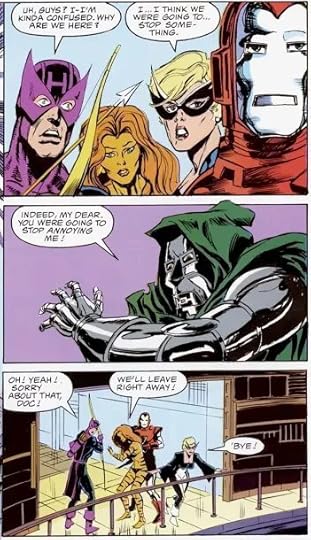
Doctor Doom claims the world! Thanks to a power-amplifying boost from the nefarious Purple Man, God Emperor Doom turns the human population, including the Avengers, into his mind slaves!
This GN is set before West Coast Avengers (1985) #1.
I was surprised at how well this story flowed. It wasn’t overrun with text which was very nice for an extra long comic.
Doom creates a machine he calls a Psycho-Prism that enhances the Purple Man’s powers. This machine is what allows the dictator to take over the world.
There is no one to stop him. But what he does is actually make the world a better place, ending war, violence and famine.
Having undergone a 30 day experiment, Simon Williams, was not affected by the initial blast. He meets a woman called Ellen who helps him remember the freedom of choice and enacts a plan to free his fellow Avengers.
It mostly works. Hawkeye does try to free his wife but Mockingbird’s will was too weak and she calls Doom. Tony also struggles to remain free when the Avengers close in on the giant Psycho-Prism Kilgrave is trapped in.
Doom could have stopped his enemies. But he chose not to. He learned that to ‘control fate’ was a hollow dream.
In the end, the heroes question their decision but ultimately must be content, embracing the good and the bad of the world.
A thought this was fun. Dr. Doom finally wins by brainwashing the world. Wonder Man wakes up from an experiment 30 days later to find the whole world has changed and he's the only one not under control. It's up to him to figure out what to do. I like that even though Doom has won, it's something of a loss for him as well, as there's no longer anyone to challenge him. That ending was great too.
Still one of best Marvel stories about Dr Doom's psychology and the ending was just great. Why to become emperor of the world just to get bored and without challenges makin you feel alive? I forgot once a time Doom already ruled the world from White House before Ellis' Doom 2099 cyberpunk saga, glad having re-read this one after years.
The thing about this comic book is that it is not just a typical superhero vs. supervillain story, but also a commentary on free will and freedom. Obviously, not as great as other famous works of literature that discuss the same topics, but still makes you wonder about a what if? scenario at the end.
This graphic novel is a lot of fun. What strikes me is that, if this story was to be told today, Marvel would probably spread it out across at least a year’s worth of issues, with multiple tie-ins across their entire line. In the ‘80s, it’s a done-in-one story that filled just 62 pages. Longer and more drawn out isn’t always better, folks.
This graphic novel has a great premise: Doom taking over the world. It also deals with it somewhat well, with him ultimately being discontent. I even like the setup of Simon being the hero after he emerges from 30 days in a sensory deprivation tank. Unfortunately, the story doesn't go much deeper than that. The problem is dealt with in a relatively perfunctory way when all the pieces come together [6/10].
Una storia buona, incentrata principalmente su Dr. Doom e sul suo desiderio di conquista e dominio del mondo. Alla base della storia è la concezione che Destino ha di se come miglior governante possibile del pianeta, e lo dimostra anche quando riesce a piegare la volontà di quasi tutti gli esseri senzienti della Terra. Ma scopre che ciò non lo soddisfa, bensì lo riduce a un burocrate. Qui davvero comprende che la vera soddisfazione l'avrà quando il mondo si rivolgerà a lui per esserne governato. I Vendicatori, tutto sommato, giocano un ruolo secondario, per quanto importante, nel ristabilire lo status quo. Non sono loro che vincono, è Victor che si riprende il pallone e se ne va, interrompendo il gioco.
A classic Avengers story that shows the true colors of Doctor Doom-a super villain hellbent on fixing the world at any price. As Doctor Doom takes total control of the world, the Avengers fight to dethrone him so that the world can come back to its "normal" state. But who is the true villain here?
This entire review has been hidden because of spoilers.
No se si en este comic voy con Doom, que en un mes acaba con las guerras, el hambre y la desigualdad. La alternativa pro guerra del capi américa no se si me termina de convencer...
Technically read this in the Doctor Doom Omnibus. I still have a few of the original Marvel Treasury books (and kind of wish I had this one.)
It's pretty standard stuff for late 80's writing: namely, the simplicity of a villain with a plot to take over the world and a band of heroes who try to stop him. Keep in mind it's more of a West Coast Avengers story; it's not a modern event where all the heroes are involved.
I liked Doom's overall plan, and there are a few small moments where Michelinie exams his motivations. I loved the initial moment between Doom and as well as the examinations of Doom's politics. His position definitely generates a discussion about democratic freedom versus being ruled by a single person (and the various shades of despotic rule) but it is only touched on lightly within the story.
And like many stories from that time period, the reader has to suspend belief on a few things, for example: why didn't resist? It also feels like it needed a few more pages to expand a couple of subplots. If this were a mini-series it probably would have been (or stretched beyond what was necessary), but fitting it into a specific page count for the original Treasury size probably forced some of the writing.
As a whole, it's an important piece of history in the tapestry that is Doctor Doom.
There's not a whole lot to be said about this (rather short) global conquest of Dr. Doom. The writing is of the typical sort for a comic written twenty years ago (e.g., characters explain what they're doing way too often, etc.), and the only character who's even worth reading about in this volume is the doctor himself. Everyone else just punches and kicks and really makes no decision other than the obvious one: "We have to stop evil, because it's evil!"
Well, okay--to be fair, there is one minor philosophical question here that must be answered by our heroes. But it's not something they exactly struggle over; the "right" decision is immediately obvious to the Avengers, without so much as a moment's contemplation. It's really a shame, too, because this is something that probably could have been explored a little more deeply to make the story more interesting; I'd have loved to see a big group discussion on the matter, with the team's philosophies being split into two conflicting sides.
Still, despite the lackluster approach to the insights of our heroes, Doctor Doom actually goes through some serious internal struggle that helps highlight the attributes of his character. But at the end of the day, I'm not sure it's enough to save the story.
Then again, if you've got a copy of Emperor Doom available, there's no real reason not to give it a whirl--it's a short book, and it won't exactly take a big bite out of your time anyway.
A very interesting story, one that not only focuses on some individual Avengers, but that gives us some great insight into Dr. Doom. I've always loved the ending of this one.
This graphic novel was so good. I found it because I was bored at an event, about to reread "God Loves, Man Kills," when I learned of the line of graphic novels that marvel used to put out. To my surprise, I found this one, which sparked my interest because of the ongoing "One World Under Doom" storyline that has progressed throughout this year. This story was so much better, if I am being honest. This story did not present Doom as a god among men like modern comics have made him, it just keeps the old FF supervillain, a man who believes he has always won when he, in fact, always loses. Even better, this story is short, not drawn out unnecessarily for better sales. I have seen no one talk about the similarities between these two stories, but it is so obvious that Marvel is just trying to cash in on some classic comics gold, to absolutely no avail (critically, that is. I'm sure they're making bank on the current event). Besides the comparisons, this graphic novel has wonderful art and a great framing device through Wonder Man. The question posed throughout about the good Doom has done opposed to what was done to get it was very interesting, but I think it could have been expanded on a lot better. Overall, great classic Marvel read.
I enjoyed this concept piece from the 80s. The idea is what would happen if Dr. Doom uses the Purple Man to mind control the world and become emperor? He creates world peace, stops wars, ends hate, and makes life better for everyone. The thing is, nobody has real control of their bodies or minds. The only Avengers who isn’t controlled by Doom’s mental trap is Wonder Man, who brings back the other Avengers, who thwart Doom’s plan. The question at the end of the story is that, by stopping Doom (and subsequently war and strife returning), did they make the right choice. Is free will worth it if it means people are free to create war and strife? I think is surprisingly relevant today.
This entire review has been hidden because of spoilers.
I guess at the end Emperor Doom feels inconclusive and kind of anti-climactic, we don’t get a very clear sense of an ending. On the other hand, that is kind of the point, the ying-yang of heroes needing villains and villains needing heroes. And I do like how it leaves Iron Man being the one who is most unsure… It’s just that the pacing, the set of characters, the dialogue, all of it comes together to form a story that I felt began in the middle, spent too much time on the setup and very quickly paced through the angles that could’ve been interesting. Well I guess it did make me think something… Still I will stick with my rating for the overall comic.
This was first published in 1987 so I probably bought my copy shortly after. I have read this several times over the years but would not have recorded reading it as I would have considered it to be a comic.
David Michelinie was one of Marvel's better writers at the time so even though this is a tale of Doom taking over the world and how the Avengers defeat him Michelinie does add a few lines that may make people think about the way the world is.
Decent art and Doom proving once again why he is comic' greatest villain, because he genuinely believes that the World would be a better place under his control, and this story proves him right, to a degree, which raises some interesting questions as to where humanity was in the late 80s, although some of it is still relevant today.
Emperor Doom asked the question, “What happens when the megalomaniac succeeds in ruling the world … and he’s good at it? And he realizes that fighting The Avengers is a lot more fun than attending meetings about Eastern European pork futures?”
What a great premise! What an enjoyable comic! This one is an all-timer.
A really fun read. Doctor Doom finally succeeds and conquerors earth. It’s a clever story with a great ending. Another solid entry into the 80’s graphic novel series. While enjoyable it’s not as great as other entries like X-Men: God Loves and Man Kills or Daredevil:Love and War. If you’re a fan of Doctor Doom you will like this story.
This was my absolute favorite graphic novel growing up, one I read countless times, and I recently got a new copy. It still holds up. It's the most philosophically interesting story in comics, one that ponders the relative importance of free will. It's a story I honestly think everyone should read.
Loved the storyline! I’m a newbie when it comes to Marvel, their heroes, villains, and the powers they have so I was definitely challenged by this read. Once I caught on though, I was impressed!
It was fine. An amusement, but nothing to write home about. If you like yourself some Doctor Doom, there's one or two little moments of Doom being Doom. But otherwise it was pretty meh. I picked it up second hand for about £3 and I am happy with it based on that. If I'd paid more than a fiver I'd be complaining. Pretty mediocre to below average plot. Cool idea but simplistic and brain-dead execution. There are one or two great looking panels (the one of Namor disguised in a trenchcoat in the rain stood out to me as a striking piece of artwork), but there's also a lot of lazy, uninteresting panels mixed in there too. If you want a more interesting (and leagues better) "the bad guy wins" story, with fantastic artwork throughout, I'd recommend "Empire" by Mark Waide.
This entire review has been hidden because of spoilers.
The Avengers – Emperor Doom (GN) (1987), escritor David Michelinie calificación 3/5 estrellas.
Wonder Man se queda en un artefacto parecido a una cama solar recibiendo estudios de Tony Stark, al despertar ve como el Doctor Doom controla el mundo, desde su hinbernacion.
En ese tiempo Doctor Doom con la ayuda de Namor qué ha sido manipulado. Llegaron hasta la casa Blanca.
Esta trama es como la trama de Supervillains Team-Up #14, donde Doctor Doom controla la mente de los Superhéroes.
Aquí en esta historia ponen como este dictador cariturizado, anticuado y con aires de científico loco pone orden en el mundo.
Pero es sabido que Doctor Doom esta destinado a perder siempre en este universo de fantasía, creado para mentes infantiles y plagado de Superhéroes.
Simon Williams the Wonder Man debe hacer entender a the Avengers Captain America, The Wasp qué Doom los controla.
This entire review has been hidden because of spoilers.
Sobre la figura de Jim Shooter se han escrito páginas y páginas tanto de críticas como de alabanzas. Su labor como editor Marvel allá por los setenta siempre ha sido tomada como ejemplo y es que sus decisiones no dejaban indiferente a nadie. Una de las que más se ha llegado a celebrarse con el paso del tiempo fue el nacimiento del formato de novela gráfica, un proyecto que veía la luz con la intención de dar a los autores un poco más de espacio para idear historias que no estuvieran limitadas a las 24 páginas mensuales. Títulos especiales que merecían un formato de mejor calidad y que se salían de la continuidad establecida. Aprovechando el gran éxito que esta iniciativa tuvo en su momento (y que ahora Marvel va a retomar), en 1987, se publicó este ‘Los Vengadores: emperador Muerte‘ que años después de su primera aparición en nuestro país, Panini rescata del olvido. Resulta paradójico que una historia como ésta, con casi 30 años de vida, recoja algunas ideas y planteamientos que hoy en día están de máxima actualidad. Por todos es conocida la sed de poder que el monarca de Latveria siempre ha tenido. Los 4 Fantásticos casi siempre han estado ahí para frenar sus maquiavélicos planes pero cuando Muerte se rodea de poderosos aliados, la cosa cambia bastante. En este volumen, la intención de Victor Von Doom es hacerse con el control del mundo, como otras tantas veces, sin embargo, en esta ocasión pretende hacerlo de manera pacífica. Sus manos no se mancharán con sangre de inocentes y para ello contará con los poderes de control mental del Hombre Purpura (un personaje que ya usó Bendis en su imprescindible ‘Alias‘). Juntos construirán una máquina con la que someterán a su voluntad a toda la población mundial para, de esta manera, (auto)proclamarse monarca absoluto.
Leída la historia con la “sabiduría” y la experiencia que otorga la edad, podemos encontrar ciertos paralelismos con la situación actual que nos ha tocado vivir: quizás el poder no esté en manos de un dictador con armadura y una sábana color verde aceituna, pero no es menos cierto que las mejores tajadas se la reparten entre muy pocos. El guión de David Michelinie es tan simple como efectivo y parece proponer respuestas a la pregunta tantas veces formulada de: ¿y si finalmente los villanos consiguieran hacerse con el poder?, un planteamiento que algo similar al que nos contó Mark Gruenwald (que junto a Jim Shooter echan una mano a Michelinie) en su clásico ‘Escuadrón Supremo‘. La edición de Panini, como siempre, es de sobresaliente. Un tomo de tapa dura algo más grande de lo normal y con un papel de gran calidad para poder deleitarnos con el buen hacer de Bob Hall, hombre de confianza de la época y que con un estilo eficiente y sin muchos adornos, conseguía firmar trabajos de gran calidad. La línea Marvel Graphic Novels siempre alberga sorpresas como ésta y para este año anuncian algunas joyitas que hacía tiempo merecían una edición en condiciones. Próxima parada, ‘Triunfo y tormento‘, también con Muerte como protagonista y el dibujo de cierto novato llamado Mike Mignola.
Los años 80 fueron una época de grandes cambios y replanteos para el cómic estadounidense. A los experimentos narrativos, temáticos, estéticos y hasta empresariales se sumó el de los formatos, que hasta el momento prácticamente se limitaban a los clásicos “comic-books” en grapas, alguna recopilación esporádica y poco más. Fue en el año 1982 que Marvel dio inicio a su colección Marvel Graphic Novels, comenzando con hoy clásica La muerte del Capitán Marvel (The Death of Captain Marvel). Esta colección que consistió en tomos de más de 50 páginas con historias completas y con un formato similar al de los álbumes europeos duró más de una década y en ella
se editaron cerca de 40 libros de historietas con la más variada gama de personajes, tanto de la propia Marvel como licencias insólitas para la época, como la de Elric de Melniboné, famoso personaje de fantasía de Michael Moorcock.
Es en este contexto que se publica, en 1988, Los Vengadores: Emperador Muerte (Marvel Graphic Novel: Emperor Doom), un cómic escrito por David Michelinie y dibujado por Bob Hall, y que Panini reeditó hace poco en un prolijo tomo tapa dura. La historia narra un plan del Dr. Muerte para dominar el mundo a través del control mental y cómo comienza a mejorar el planeta una vez que cede involuntariamente ante su benevolente bota de hierro. Las cosas parecen encaminarse hacia una utopía hasta que un grupo de rebeldes (Vengadores que lograron salvarse de su influjo gracias a los poderes iónicos del Hombre Maravilla) deciden derrocar a
Muerte en una guerra relámpago, precipitando lastribulaciones, lamentos y ocaso del tonto emperador imaginario, o no. En resumen, una historia con un guion elaborado, dibujos muy expresivos y dinámicos y las justas dosis de acción, elementos de ciencia ficción, planteos filosóficos -con conclusiones cuestionables- y trajes colorinches con los que a tantas veces nos sorprenden los buenos comics de superhéroes.