An evenhanded account of a tragic clash of cultures On November 27, 1868, the U.S. Seventh Cavalry under Lt. Col. George Armstrong Custer attacked a Southern Cheyenne village along the Washita River in present-day western Oklahoma. The subsequent U.S. victory signaled the end of the Cheyennes’ traditional way of life and resulted in the death of Black Kettle, their most prominent peace chief. In this remarkably balanced history, Jerome A. Greene describes the causes, conduct, and consequences of the event even as he addresses the multiple controversies surrounding the conflict. As Greene explains, the engagement brought both praise and condemnation for Custer and carried long-range implications for his stunning defeat at the Battle of the Little Bighorn eight years later.
“Within minutes of the assault, the troops controlled the village. The tribesmen, scattered among the surrounding topography, fought back as best they could against the soldiers, who rooted them out of lodges and hiding places. Some of the women came at the troopers brandishing pistols and were shot. One group of women and children tore across the rising prairie southwest of Custer’s command knoll, pursued by men from Captain Meyers’s command who were shooting at them, ‘killing them without mercy,’ said [Scout Ben] Clark. ‘I was riding to the south, when I came in view of fully half of Meyers’s men, chasing the panic-stricken women and children…’ Some noncombatants…remained in their lodges throughout the attack, passing the anxious moments likely singing prayer songs…” - Jerome Greene, Washita: The U.S. Army and the Southern Cheyenne, 1867-1869
Back in the summer of 2010, my wife and I took an epic American road trip. We’d just gotten married a few months before, and hadn’t gone on a honeymoon yet. Since my idea of a honeymoon is visiting battlefields, we hopped in the car and set off with a list of sites to hit.
We saw the Civil War battlefields of Shiloh and Vicksburg and the Texas Revolution’s San Jacinto. We drank Texas-sized margaritas in San Antonio, and then visited the Alamo.
On our way back home, we made a day-long detour for the National Park Service’s version of a hidden track: the Washita Battlefield National Historic Site, somewhere in Oklahoma.
We were the only ones there, which might have been for any number of reasons. The battlefield takes a while to reach. It was late in August and kids were going back to school. It was hotter than hell. In any event, as the only two visitors, we got the VIP treatment. The Park Rangers were so nice, I decided to make a donation via the gift shop.
I asked the person manning the counter for the best book on the Washita. She pointed to Jerome Greene’s Washita.
***
The helpful ranger – who may not have seen anyone for days – explained that Greene used to work for the National Park Service as a historian, and had spent a lot of time at the battlefield doing research. Convinced, I purchased the book and left the visitor center for the actual battle site.
It being August in Oklahoma, my wife stayed in the air-conditioned car hand-writing divorce papers on the back of a hotel receipt, while I got out to do the interpretive loop. Recognizing I should not dawdle, I jogged from marker to marker, trying to consume the history in as efficient manner as possible.
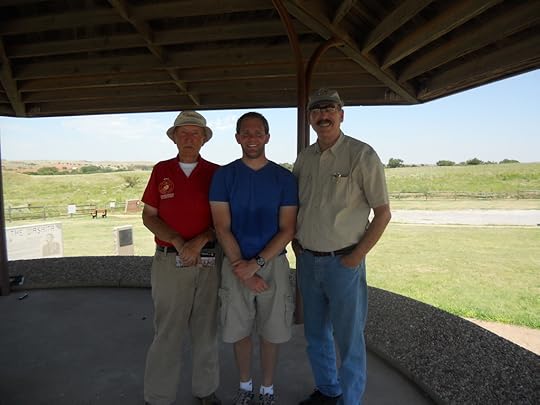
When I finished, I returned to the parking lot, where I found we’d been joined by three people. One was a park ranger. The other two turned out to be Jerome Greene and famed Civil War historian Ed Bearss. Greene signed my book. Bearss delivered part of his monologue from Ken Burns’s The Civil War which he had apparently committed to memory.
Ed Bearrs, myself (sweating profusely), and Washita author Jerome Greene, at the Washita Battlefield in 2010
It was a good day.
***
Filled with glowing feelings, I read Washita right away. But for whatever reason, I never got around to writing anything about it. This meant that no one ever got to learn the sad story of how the most famous celebrity I ever met was Ed Bearss. Some years later, I decided to read it again, and tell people about it on the internet. Given that it’s less than 200 pages long, it’s not a huge commitment.
***
To be honest, Washita is good, but not transcendent history writing. It is sturdy and well-constructed. It is brisk but covers all the angles. It is – when I think about it – the perfect kind of book to sell in the gift shop of a visitor center that is dedicated to the subject of that book.
Green starts appropriately enough with the Sand Creek Massacre of 1864. Approximately 150 men, women, and children were killed at Sand Creek by members of Colonel John Chivington’s Colorado Volunteers. The village belonged to peace chief Black Kettle, who escaped with the remnants of his band only to find himself on the receiving end of George Custer’s 7th Cavalry in 1868.
The Sand Creek Massacre left relations between the U.S. and Plains Tribes in a poor state. Greene devotes the next two chapters to laying out the full context of this relationship. In 1867, Winfield Hancock – whose career dramatically peaked at Gettysburg – led an expedition against the Cheyenne and Lakota to negotiate peace. Ultimately, in a fit of pique, Hancock burned a Cheyenne village. As a peace offering, arson isn’t the best option. Perhaps unsurprisingly, the following summer saw a number of Indian raids against white settlers.
Captives were taken. Rapes were reported. Passions were inflamed. Bad ideas formed.
Phil Sheridan ordered a winter campaign, knowing that heavy snows made it difficult for Indian villages and their grass-fed ponies to move. The plan utilized the Army’s favorite tactic: converging columns. Three different forces would fall upon the unsuspecting tribes as they entered their winter encampments. Custer’s 7th Cavalry was tasked with the villages along the Washita River.
***
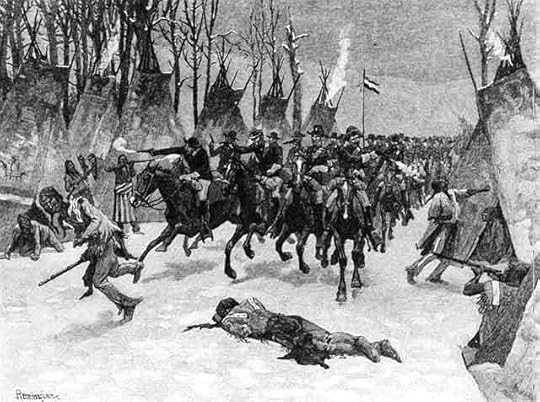
Greene delivers a serviceable narrative that follows Custer and his men into present-day Oklahoma. On November 29, 1868, a war party trail led Custer to ill-starred Black Kettle and his Cheyenne. As he did at the Little Big Horn some years later, Custer eschewed a proper reconnaissance in favor of an attack from multiple directions. His men plunged into the village, the music from the band quickly cut off by saliva freezing in the instruments.
Custer’s quick victory almost turned into his downfall – though he learned no lesson here – as the surrounding hillsides filled with warriors from other villages along the Washita of which Custer hadn’t been aware. Custer gathered the Indian noncombatants as a kind of human shield and marched boldly towards the gathering forces. The Indians scattered at the bluff, allowing Custer to march away. He left behind nineteen troopers under the command of Major Joel Elliott, who had disappeared during the attack, allegedly screaming “Here’s for a brevet or a coffin!” Only later would the bodies of his small contingent be discovered, where they’d been cut off and annihilated. Custer was widely criticized at the time, though it’s likely Elliott’s men were already dead by the time Custer knew they were missing.
Custer's 7th plunges into the village of Cheyenne Chief Black Kettle. Black Kettle, who survived Sand Creek, did not escape the Washita
Greene is a very careful historian, which is probably a function of years working for the NPS, where history and politics are always on a collision course. He sticks very close to his sources, giving little air to opinionated interpretation. This leads to storytelling that is sometimes listless and a bit flat.
The over-modulated tone feels especially wrong in Greene’s coverage of the controversial aftermath of the Washita. For instance, there is evidence that the 7th Cavalry’s officers created a quasi-brothel and systematically raped Cheyenne captives. This allegation – which Greene tends to accept based on corroborating witnesses – is dealt with in a single paragraph and goes otherwise unremarked upon.
Greene concludes with a chapter on other Washita controversies, such as the presence or absence of white captives; whether Black Kettle’s village had been guilty of depredations; and whether Washita should be classified as a battle or massacre. All these hot-button issues are dealt with by a careful weighing of evidence. If nothing else, Greene does a very good job of laying out all sides of an issue. As a vessel for communicating information Washita succeeds. As a vessel for memorably conveying information, it does not.
Interestingly, Greene refined his style for his book on Wounded Knee, American Carnage. As the title implies, Greene definitely takes a stance on the 7th Cavalry’s later behavior.
***
I tend to overemphasize literary qualities in the history I read. To be clear, this is a very good book on the Washita if you are specifically looking for a book on the Washita. The information is there, and the sources are there, and you won’t be able to study the battle effectively without having given it a read. But if you’re more of a generalist with a passing interest in the American Indian Wars, there are better books to check out.
Of course, this is also a good book to have on hand if you happen to run into Jerome Greene, because he will obligingly sign it for you, and even agree to a picture, even if you are drenched in sweat from having run around the Washita interpretive loop in heat and humidity that can only be described as absolute.
Washita is a detailed account and analysis of the events leading to and following the Washita battle/massacre; and to the so-called Indian wars of the latter 1800’s. The book is readable, very well documented (extensive appendices and references sections), and is objective in its analyses. Visitors to Washita Bsttlefield may want to buy the book and reference Appendix A - Monuments and Resources of the Washita Encounter Site - as they tour the area. Challenges for me in reading Washita were understanding the military hierarchy, remembering the names of all the leaders on both sides, and not knowing the locations of the various forts. Otherwise, I enjoyed the book as I try to learn more from and about our history.
Jerome A. Greene is among the best historians of the Indian Wars, and his book "Washita: The U.S. Army and the Southern Cheyennes, 1867-1869" helps prove this claim.
While Greene's book includes a fine narrative of how the battle unfolded, it is much more than a simple military history of the event. Greene masterfully documents the background of the Cheyenne-U.S. Army hostilities of the 1860's in general and the tensions between Euro-Americans and Native-Americans on the Southern Plains in particular. The horrors of the Sand Creek Massacre cast a long shadow over Cheyenne-U.S. relations and contributed not only to a breach in the relations between the two peoples, but also to an internal division between the main Cheyenne groups and the Dog Soldiers, a growing Cheyenne military society.
Readers will find Greene's account well balanced in its sources and approach to the subject, and exhaustive in its research. Also addressed are the lingering controversies of the fight, such as the question of whether the fight along the banks of the Washita constitute a "massacre" or a "battle." In addition to being a fine military history of the U.S. Army's campaign against the tribes of the Southern Plains in 1868-69, Greene's work also contains a fair amount of information about Cheyenne culture and the pressures that tribe faced as a result of the westward expansion of the U.S. in the decade after the end of the Civil War.