Jump to ratings and reviews
Rate this book

Followed by the Lark

Rate this book
A novel as wise as it is tender, a meditation on the miracle of friendship and the heartbreak of change, Followed by the Lark inhabits the life of Henry David Thoreau.

Composed in small scenes, Followed by the Lark is a novel of meditations―on loss, on change, on the danger and healing that come from communion with the natural world.

Henry David Thoreau's connection to nature was tied to his feelings of grief; before he was twenty-seven years old and went to live at Walden Pond, two of those closest to him had died―his older brother, John, and his friend Charles Wheeler. Nature provided solace for these losses, but the world was changing around him. The forests were being destroyed by the logging industry. Wildlife was increasingly slaughtered for profit and sport. The railroad clanged through his quiet hometown. And the catastrophes of the American Civil War were beginning to stir just as his own life was coming to an end. Haunting in its quiet spaces, in the way it imagines the missed connections in his relationships, Followed by the Lark is uncommon in its combination of scope and brevity, in its communion with its subject while still maintaining critical distance.

Thoreau’s life in the early nineteenth century seems firmly in the past, but his time bears striking similarities to ours. As she explores these intersections in Followed by the Lark, Helen Humphreys elegantly, insistently illustrates how Thoreau’s concerns are still, vitally, our own.

240 pages, Hardcover

Published February 13, 2024

40 people are currently reading
983 people want to read

About the author

Helen Humphreys

31 books421 followers
Helen Humphreys is the author of five books of poetry, eleven novels, and three works of non-fiction. She was born in Kingston-on-Thames, England, and now lives in Kingston, Ontario, Canada.

Her first novel, Leaving Earth (1997), won the 1998 City of Toronto Book Award and was a New York Times Notable Book of the Year. Her second novel, Afterimage (2000), won the 2000 Rogers Writers' Trust Fiction Prize, was nominated for the Commonwealth Writers' Prize, and was a New York Times Notable Book of the Year. Her third novel, The Lost Garden (2002), was a 2003 Canada Reads selection, a national bestseller, and was also a New York Times Notable Book of the Year. Wild Dogs (2004) won the 2005 Lambda Prize for fiction, has been optioned for film, and was produced as a stage play at CanStage in Toronto in the fall of 2008. Coventry (2008) was a #1 national bestseller, was chosen as one of the top 100 books of the year by the Globe & Mail, and was chosen one of the top ten books of the year by both the Ottawa Citizen and NOW Magazine.

Humphreys's work of creative non-fiction, The Frozen Thames (2007), was a #1 national bestseller. Her collections of poetry include Gods and Other Mortals (1986); Nuns Looking Anxious, Listening to Radios (1990); and, The Perils of Geography (1995). Her latest collection, Anthem (1999), won the 2000 Canadian Authors Association Award for Poetry.

Helen Humphreys's fiction is published in Canada by HarperCollins, and in the U.S. by W.W. Norton. The Frozen Thames was published by McClelland & Stewart in Canada, and by Bantam in the U.S. Her work has been translated into many languages.

Ratings & Reviews

What do you think?
Rate this book

Friends & Following

Create a free account to discover what your friends think of this book!

Community Reviews

5 stars
177 (29%)
4 stars
255 (43%)
3 stars
130 (21%)
2 stars
23 (3%)
1 star
6 (1%)
Displaying 1 - 30 of 136 reviews
Profile Image for Diane S ☔.
4,901 reviews14.6k followers
March 4, 2024
This is the seventh book I have read by this author. I just love the way she writes. There is a lovely, lulling way to which she tells her story. Captivating. Plus, here she tells the story of Thoreau, who is one of my all-time favorites. The man I would have loved to meet. His love of nature, which Humphrey perfectly described, his need for quiet and solitude, are qualities I admire.

She divides the book by a grouping of years and though this is a short book she covers much. Thoreau's losses and loves, his friendship with Emerson, not without strife and his constant curiosity about the natural world. His wonderful relationship with his younger sister Sophie, whom shared his interests.

Just a wonderful read.
Profile Image for Alan (on December semi-hiatus) Teder.
2,702 reviews249 followers
July 24, 2025
Nature's Child 🍁
A review of the HarperCollins Publishers hardcover (February 13, 2024) released simultaneously with the eBook/Audiobook.
He hoarded his experiences and impressions during the day and then at night wrote them up in his journal. The page became his intimate as much as the lily and the bream and the bobolink. It waited patiently for his attentions all day and then absorbed everything he had to give, leaving him spent and replete by the time he laid his pen down and closed the book.
Followed by the Lark is a fictional biography of the American naturalist writer Henry David Thoreau (1817-1862) who is best known for his memoirs A Week on the Concord and Merrimack Rivers (1849) and Walden or, Life in the Woods (1854), his essay Civil Disobedience (1849) and his extensive Journals (1837-1861).

Humphreys did a thorough reading of the journals and arranges her biography in short chronological vignettes, many of which are inspired by the writings on any given day. The overall impression is one of Thoreau's obsession with communing with nature and aside from a few intimate friends and family his avoidance of society in general. Humphreys writes in her characteristic lyrical and often poetic style which gives a very idealized picture of Thoreau.

Although the love of nature is the dominating theme there is a constant undercurrent of how precious life is and how easily people in that era were subject to illness and death by diseases such as tetanus and tuberculosis. You shudder to read that Thoreau had to get false teeth by the age of 33 as his own had rotted away.

Politics are only briefly mentioned in relation to the Thoreau family's opposition to slavery and their friendship with abolitionist John Brown. Although Thoreau's essay of Civil Disobedience would seem to be extremely topical currently in the age of Trump and ICE, it is not even mentioned. The book was of course written well before Trump's 2nd Presidency.

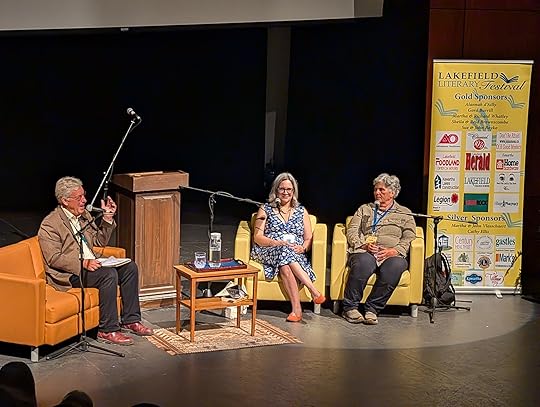
I read Followed by the Lark due to author Helen Humphreys appearance at the 2025 Lakefield Literary Festival which I recently attended. I've enjoyed several of her previous books as well such as The Frozen Thames (2007), Machine Without Horses (2018), Rabbit Foot Bill (2020) and A Dog Called Fig (2022).


(L to R) Moderator John Boyko, author Jennifer Robson (Coronation Year) and author Helen Humphreys (Followed by the Lark) at the 2025 Lakefield Literary Festival. Image sourced from Facebook.

Trivia and Links
Henry David Thoreau's works are in the Public Domain and can be read online at various sources such as Project Gutenberg, Standard eBooks and WikiSource.
Profile Image for Sarah-Hope.
1,466 reviews207 followers
January 31, 2024
I really enjoy Helen Humphreys' writing. She has a way of putting words together that lets the reader float along, buoyant almost. My absolute favorite of her books, The Frozen Thames, offers a rich series of vignettes of, yes, the frozen Thames. It's historically informed, taking readers from one winter to another, observing the subtle changes that become huge over time.

In terms of style, Followed by the Lark is very like The Frozen Thames. The chapters are brief, the language nothing less than a pleasure. Followed by the Lark tells the story of Henry David Thoreau, opening with brief childhood and college scenes, then moving on to his adulthood. Humphreys spent an enormous amount of time with Thoreau's journals both before and while writing this book. In the book as in life (and his journals, I assume), subtle changes gradually develop into much bigger things. Followed by the Lark is written in third person and focuses on small moments: a walk with a neighbor, a search for a specific flower, an unexpected meeting with a hummingbird. The details of the natural world are ever-present. Thoreau marvels at them, and the reader sees them both through the mind's eye and Thoreau's eyes.

Humphreys' Thoreau generally holds people at a distance. He prefers silent rambles through the words and again and again bemoans the conversation his walking partners seem to view as a necessity. Over time, he finds the imperfections in almost everyone. He'll withdraw, then sometimes come a bit closer again when he sees his own imperfections, and they remind him to be more generous of spirit with others.

Fore readers looking for a "capital N" novel or a biography, Followed by the Lark will disappoint. It certainly isn't plot-driven. It's more a mood piece, an invocation and extended exploration of a way of looking at the world. There's no point where the reader begins to race through the pages, full of "what next?" questions. But when you've had enough of racing and questions reading Followed by the Lark can be an experience of a deep and comfortable peace.

I received a free electronic review copy of this title from the publisher via Edelweiss; the opinions are my own.
Profile Image for Moonkiszt.
3,020 reviews333 followers
March 15, 2024
Followed by the Lark is a gentle, quiet retelling of Henry David Thoreau's life, from the first bluebird to the last. Whether he's close by Walden or tramping the hills, he is filled with wonders, yearnings, and his calculations, lists and catalogs; he makes notations, compares each year with the next and the past, keeps track of each sunrise, season and star path. There in his world, using his journal and notes, Helen Humphreys weaves in his poetry, tied to thoughts, tied to the whens and wheres, the whos crossing his path, or footprints left in the snow or grass, wrapped with songs sounding from afar.

A very zen-full read, one to keep close by.

*A sincere thank you to Helen Humphreys, Farrar, Straus and Giroux, and NetGalley for an ARC to read and independently review.*
Profile Image for Janice.
1,600 reviews61 followers
May 8, 2024
This was a 4.5 read for me. I loved the time that Thoreau spent studying and feeling immersed in the natural world. The author did a good job bringing several historical figures to life.
Profile Image for Trevor.
61 reviews
Read
February 20, 2024
Wowie. My reading this came about from an Atlantic article about Thoreau and the misconceptions about his solitary nature. I’m so incredibly pleased I picked it up.

For much of the last year, Thoreau has been my model of a well lived life. I would like to thank Ben Shattuck’s “Six walks” for formally introducing me to Thoreau.

Loved this book immensely!! Helen Humphreys takes so much care in characterizing Thoreau. It reminds me that no question or curiosity is solely mine because it has undoubtedly been had before me. Comforting to know I’m part of a long line of question askers.
Profile Image for Kyle.
934 reviews28 followers
March 10, 2024
Probably not for everyone, but the calm, introspective and contemplative prose of this novel really spoke to me. I feel it is a book that I will return to again and again, and that certain passages will take on different meanings at different stages in my own life, the way that “Le Petit Prince” does.

I really loved this one, Ms. Humphreys.
5/5
Profile Image for Margi.
277 reviews9 followers
February 26, 2024
A quiet, contemplative peek into the life of Thoreau and his detailed observations of the natural world. Glimpses of the future from a deeply thoughtful man.
639 reviews24 followers
July 31, 2023
Thanks to Netgalley and FSG for the ebook. A fascinating novel that follows Henry David Thoreau through most of his life. It’s great at capturing the few life long friends, the early deaths, including his older brother John, that crushed him and made him question so much and the other family members that were with him his entire life, but the book seems to pull off a magic trick in the sense that half of the book is Thoreau describing tress, flowers, plants, animals, big and small, and even the weather and somehow this is not in any way distancing, it actually brings Thoreau into much sharper view.
Profile Image for Wendy.
146 reviews3 followers
February 22, 2024
Can a work of fiction be calming, almost mediative in tone? I believe that's what this quiet but beautiful novel is, artfully crafting the story of 19th century American naturalist, poet, and abolitionist Henry David Thoreau. It seems the perfect work to grace these chaotic, frenetic, post Covid days.... Author Helen Humpreys takes a peaceful, thoughtful magnifying glass to the beauty around us during a simple nature walk, with the revolution of the seasons and years and moon and allows us all to share it.
Not a book for those wanting intrigue, a fast paced plot, romance but a lovely little book in its own right.
Profile Image for Michela nonostante.
180 reviews3 followers
July 6, 2025
La scrittura poetica di Humphreys insieme alle passeggiate meditative di Thoreau mi hanno portato pace e fresco in questo luglio torrido.
È una magia, come la migliore letteratura: non ho letto di marmotte e querce: ero lì a vederle. Ho pattinato sul lago ghiacciato, temuto per le influenze, fatto visita agli amici di una vita e sofferto durante le battute di caccia.
Profile Image for Barbara McVeigh.
664 reviews14 followers
March 5, 2024
A quiet book of beautiful observations. Short passages in short chapters. As I was halfway through, I asked myself: But what’s the story? How does it all hang together?

It’s change, I suppose. Life is perpetual change, and there’s joy to be had in seeing that change within the constancy of the four seasons. The turmoil of world events is kept in the background of the novel. The smallest natural detail has more weight than any of the things that humans can create.

We’ve certainly seen the return of the blackbirds in this early spring. Has anyone out there seen a bluebird?
Profile Image for Shannon.
8,279 reviews426 followers
February 14, 2024
Literary fiction at its best from a master Canadian writer at the top of her craft. I didn't know much about the life of Henry David Thoreau and Helen Humphreys was able to capture its essence in these little snapshot vingettes in the most affecting way! An entertaining, quick read sure to leave you thinking long after you finish. Many thanks to NetGalley and the publisher for an early digital copy in exchange for my honest review! I especially loved the bird artwork in the print copy of the book!
Profile Image for Enid Wray.
1,438 reviews75 followers
Read
October 29, 2023
I have such an on-again off-again relationship with Ms. Humphrey’s writing.

I generally adore her historical fiction - The Evening Chorus is still an especial favourite of mine. I enjoy (some) of her forays into mediation on the natural world - The Ghost Orchard, for instance. Equally, I enjoy (some) of her ‘fact based fiction” - as in Rabbit Foot Bill.

But then there are titles like, sadly, this one… which just isn’t working for me.

I have no idea who the intended reader for this title is…

I am approx ⅓ of the way through this and I am finding that I am spending as much time fact-checking - or attempting to fact check - as I am actually reading.

Rabbit Foot Bill was clearly fact inspired fiction, and this reader had no difficulty in keeping the two clear. But this? This reads more like a(n attempt at) biography. And it is not at all clear to this reader where the fact and the fiction begin and end.

I totally get that this is - probably - my problem, but for me, it is a problem.

Sadly I have so many other titles on my TBR pile that I am leaving off finishing this one.

Thanks to the publisher and Edelweiss for granting me access to an early digital review copy.

DNF
Profile Image for ❀ Susan.
931 reviews70 followers
March 28, 2024
Helen Humphreys does not disappoint in her melodic snippets, sharing the life of Henry David Thoreau and his appreciation of the natural world. She shares bits of his life in a seasonal rhythm noting the changes in the trees, the ponds and as the birds migrate and return for spring.

It is reflective and notes all of the loss his family suffered - his sister, brother (a dreadful death from lockjaw after cutting himself sharpening his shaving blade), father (TB) and his own death at 44 years of age from consumption (TB). He appreciated his walks, camping trips and floats down the river while life slowly left him until he could travel no more and died listening to his remaining sister tell the story of his float down the river with his beloved brother, John, who had died at the age of 22.

Followed by the Lark makes me want to learn more about Henry Thoreau, his sojourn beside Walden Pond and his connections with Ralph Waldo Emerson, Bronson (the father of Louisa May Alcott) and Walt Whitman. It makes me reflect on the challenges of a time before curative medicine and before life got so busy that many don't take time to appreciate the nature around us.
Profile Image for Shannan.
373 reviews15 followers
May 22, 2024
I enjoyed this one. I especially enjoyed seeing Thoreau immersed in nature, but not alone in nature as I’ve often pictured him. He was there with Sophia,who was just as avid as he was about nature and often spent time with friends. I also very much enjoyed the depiction of Thoreau and Emerson‘s relationship throughout the years.
Profile Image for Lisa Marie.
99 reviews13 followers
February 27, 2024
It isn’t anything that I thought it would be to be honest, but I was moved. It was deeply sentimental, a great view on the beauty and grief of life. I also loved the history and the love for nature and animals. It was heartfelt and a great short read. The audiobook was great. I would recommend.
63 reviews
May 2, 2024
this is a really lovely, peaceful read and it feels like you're just floating along with her writing
Profile Image for Amy Strizic.
116 reviews
August 4, 2024
This one… wow. A gentle and peaceful read, rife with natural imagery in a way that includes you in the scene. I thought it funny and beautiful, and a wonderful interesting way to connect to such an important historical person. Definite recommendation for any nature-loving reader.
301 reviews1 follower
April 10, 2025
Helen Humphrey’s has presented us with a lovely, gently meditative book on the life of Henry Thoreau. His total love of nature, opens up our eyes to the beauty that surrounds us every day.
Profile Image for Holli.
336 reviews28 followers
April 5, 2024
Loved this so much. Filled with many small and transcendent moments. Also humor and tenderness. Humphreys says this: "Henry David Thoreau’s words were my companion during the writing of this novel. I read through all of his journals and his voice guided mine. I appreciated his wise and witty counsel and hope that this book conveys some of his mercurial spirit."

The novel is told in small vignettes that capture the times and Thoreau's reactions to his surroundings, people, and events. Already, animals were losing habitat, forests were being destroyed, and Thoreau could see an ecological crisis looming. His family was devoted to abolition and were part of the underground railroad. He lost beloved siblings and friends to illness and he himself died at age 44 of tuberculosis. Thoreau's way of coping was to go to the forest, the river, the mountain, the pond. He counted and catalogued and surveyed nature as a way to keep himself grounded in the present moment. In that way, the novel offers an antidote to the anxiety of the current milieu, which isn't all that different from Thoreau's.

The title comes from a small, seemingly incidental passage that nevertheless captures the spirit of the novel and the solace that Thoreau found in the cyclical good news of nature:

"THE first bluebird was the line where winter crossed into spring. Often Henry heard the birds rather than saw them, as though their song arrived before they did and the little stir of notes was what set the snow to melting.

Spring was a long catalogue of what had returned. The bluebird was followed by the song sparrow, who was followed by the lark. Then there were the frogs, and the constant low hum of the bees as they awakened and drifted among the new flower heads."


Below are quotes and passages that I found especially beautiful:


P. 107
More than once Alek had come upon Henry poking about in the undergrowth, or lying on his stomach on the ground, examining insects.

Henry loved that Alek, in answer to the question about the world, talked about the escaped chickens. He wondered if Alek even knew the real news of the world. And then he immediately thought that the runaway chickens were as real as any of the rest of it. 


P. 111
IN May Henry took Emerson with him when he went to Sawmill Brook to look for a yellow violet. They hadn't been out botanizing together for some time, and Henry found that he had to explain a lot of what he was doing instead of Emerson naturally understanding. He realized with a start that although Emerson wrote a lot about nature, he wasn't actually out in it all that much.

The violet proved elusive, but Henry waded out into the brook to look at some bogbean. He had been keeping careful track of when various plants came into bloom, as he meant to make a kalendar for the environment around Concord.

It's been out approximately five days, he said to Emerson, after examining the bogbean.

Not six, said Emerson. Or four and a half.

But Henry had heard the song of a redstart and had left the brook in search of the bird, spyglass in hand. Emerson was still smirking over the bogbean, and Henry had darted off after the redstart and found two grosbeaks and was now fol- lowing the song of the mysterious night warbler that he had heard for years now, but had never been able to identify.

There you are, he said, when Emerson finally caught up. You've missed so much.


P. 115

A FTER much asking, Henry finally took Daniel to see the site where his little house on Walden Pond used to stand. Each time he had returned to the spot, the depression in the ground was a little more overgrown and it was harder to distinguish the site as having once belonged to him, as having been a place where he had once lived.

But Daniel had arrived at the spot with a head full of ideas about what it was, and so he was not disappointed in the shal- low pit filled with seedling trees and grass.

He paced out the dimensions of the house and stood for a long time at each of the corners.

It really was a modest affair, said Henry, embarrassed by the reverence. I only lived in it for a little while.

Yes, but you wrote the book there, said Daniel, moving to stand meaningfully by the remains of the fireplace.

Well, only some of it, said Henry. I was writing another book most of the time.

But Daniel was undeterred. His mythical Walden was a much more powerful dream than Henry's reality.

You lived here in complete solitude.

Actually, I often had visitors. And there were many passersby.

And there were others living in the wood-former slaves and some!Irish families.

You revelled in the company of the birds and beasts.

It wasn't all halcyon, said Henry. I was particularly bothered by one woodchuck who was eating through my bean field.

Daniel had walked purposefully down to the shores of the pond and was gazing out over the water.

You swam here, he said.

Yes.

And drank the water.

Yes.

Daniel bent down and scooped a handful of water from the pond. He closed his eyes and brought the water slowly to his lips.

Nectar! he pronounced, so joyfully that Henry gave up try- ing to fight him and knelt down to drink beside his admirer.


P. 134
IN January Henry made a trip to the Natural History Rooms in Boston. There was only twenty miles between Concord and Boston, so the journey was easily made by rail. Henry liked to go to the Natural History Rooms whenever he had a question about nature that needed answering. On this visit he looked at a little grebe and a coot and a golden eagle, all dead, then at a live young bald eagle being kept in the cellars of the museum. By imitating the song of the night warbler for the professor who worked there, Henry finally had its identification con- firmed as a white-throated sparrow, who apparently sang its tuneful flight of notes both day and night. While it was a relief to finally know what the bird was that had been puzzling him for years, it was always just a little disappointing when a mystery was solved.

P. 135-138
Dr. Maungwudaus complained about having to speak English to the crowd, said he had to twist his jaws about to make the words. Then he went on to talk about his native lan- guage and how the words the Chippewa used for nature were to do with engagement. They were not the static descriptions that scientists used. In Henry's language there was one idea of tree, but in Dr. Maungwudaus's there were many. There was a word for a single oak tree, and a separate word for a grove of oaks, and another word for a tree that had been struck by lightning, and a term for an event that happened beside a tree. The English scientific terms were words for indoors, but the Chippewa language had been made and used outdoors. Henry had felt it before, on the ill-fated moose hunting trip, but now, on this March evening in Concord, he could see clearly how shoddy the language he existed within was for the natural world where he spent most of his time. How could he hope to
describe what he felt and experienced using the inadequate language he was born into?

THE first bluebird was the line where winter crossed into spring. Often Henry heard the birds rather than saw them, as though their song arrived before they did and the little stir of notes was what set the snow to melting.

Spring was a long catalogue of what had returned. The bluebird was followed by the song sparrow, who was followed by the lark. Then there were the frogs, and the constant low hum of the bees as they awakened and drifted among the new flower heads.

Snipe, said Sophia, when she passed Henry on the landing Old news, he said. I heard it yesterday. Even with all his attention, with his daily walks, with writing everything down, it was impossible to keep on top of spring At a certain point it just raced ahead, and Henry was left stum bling behind, never able to catch up to what was blooming of fruiting or here on the wing. He used to be frustrated by this but now that he was older, he just gave over to it when it hap pened. He was even a bit relieved when it did happen, when spring became a green furnace that burned through every hour.

WHEN Henry played his flute outdoors, he tried to insinuate the music into the landscape, as though the notes he released into the air were no different from birdsong or the murmur of the wind through the pines. He wanted his actions and him- self to be as natural as any other part of the woods and ponds and meadows where he spent his time.

Whereas once he thought that it was necessary for a writer to have something monumental to say, now he no longer cared. A singular voice that rose above all other voices to declaim its truth didn't seem as important as the erasure of the individ- ual voice in the chorus of nature's cacophony. It was the tone he wanted to get right now, not the words. And while he still wanted to write for readers, he no longer wanted the type of literary career that was cultivated by Emerson or Whitman. Fame seemed hollow to him when compared to the fullness of the forest.

For an hour Henry stood motionless in front of a small wood- land pond filled with spring peepers. He was trying to under- stand their song, and to decide whether every frog had its own individual cadence or if the overall blend was the aim. In early April the peepers were the loudest constant in the landscape, a hum repeated later in spring in fainter form by the bees. Standing by the lip of the pond, as still as any rush or tree, Henry filled his ears with the sound of the frogs. He could think of no other concert where his attention would be so unrelentingly rapt.

Peepers, he said to Sophia when he found her on the road walking home.

First catkins, she said, opening her hand to show Henry the plump cylinders lying on her palm like fat caterpillars.

Spring has begun, said Henry as they walked up the steps to their front door.

Yes, said Sophia, turning the handle. And we were there for it, right at the beginning.

There was a map for the seasons and they had both learnt it by now. Henry would be forty-one this year and Sophia thirty-nine. They had lived long enough on the earth, and in Concord, to know what to expect when.


P. 155
JOHN Brown and his band of vigilante soldiers had been fight- ing pro-slavery forces in Kansas, including murdering five unarmed men and boys, whom they had dragged from their homes in the middle of the night. Now Brown was moving his fight to Virginia. Some men in the north, including a reverend in Concord, were leaving their homes and families to go south to fight with Brown. But there were many who disagreed with his extreme violence.

Henry wished sometimes that he could be a man who would stride off into battle like that, but he knew that he was too peaceable a soul for that kind of fight. His strength was his observations and his words. The best he could do was to string a line of moments together and hope that they glittered and shone.


P. 185

Edward has already heard the first bluebird, said Henry.

Edward often hears the first bluebird, said Sophia. His blue- bird must be the swiftest of all the bluebirds, making the trip to his house weeks ahead of ours.

They both looked towards the back door of the house, where John's bluebird box still hung, a little dishevelled, from its perch in the poplar.

We have to face the sad truth, said Sophia. We have a very slow bluebird.

Perhaps we have an old bluebird, said Henry.

Slow and old. And possibly also with a poor sense of direction.


P. 188

One evening he sat down by a small bed of bluets. just three feet by two feet, and counted the flowers. They were jammed right up against one another, so tightly packed that he could not see the ground beneath them. He counted and watched a humblebee rolling from flower head to flower head. gathering pollen. The bee was as methodical as Henry, and they finished their tasks at roughly the same time. There were three thousand bluets in that flower bed, the humblebee and Henry having visited each and every one.


THE Crows woke him; their ragged calling roused him from his bed and pulled him to the window. They flew over the house and garden, circling the treetops but never settling. A great drift of crows. There must have been close to a hundred. although their constant motion made it impossible to count

them. The birds seemed so restless, and their insistent cries almost sounded angry, or at least irritated. I wish I spoke crow, said Henry at breakfast.

When crows fly over the house, my father used to say, it is an ill omen for those who live there, said Cynthia.

I meant speaking with crows, not speaking about them, said Henry.

Cynthia looked confused.

Mother, said Sophia, scraping butter across her toast, Henry means that this morning he wants to be a crow.


P. 201
THERE was work to be had surveying woodlots, as land had become more valuable and landowners were parcelling up what they had and offering some of it up for sale. Many of these woodlots had the stumps from older trees on them, and Henry often counted the rings to determine the age at which the tree had been felled. Many of the stumps were young trees. twenty-six years old at most, but there were some larger white pine stumps, one of which had an impressive ninety rings. Henry counted 116 rings on a white oak and 135 on a pitch pine. There were several chestnut stumps whose rings indi- cated they were well over a hundred years old. When all the large timber was being felled, these would have been young trees and left standing.

The counting of the tree rings was calming to Henry. He stood before a stump and dragged his finger slowly across it as he said the numbers out loud like an incantation. The meditative murmuring blocked out other thoughts and kept the moment firmly here, in the cold morning of the woodlot, head bowed over the tree stump, muttering a numeric prayer.


P. 214

WHEN Henry returned from New Bedford, he and Sophia spent a day together at Walden Pond. It was very much like any day they had ever spent together, in that they were involved in their separate activities, occasionally coming together to remark on what Henry was looking at or what Sophia was sketching.

It was a perfect September day, with a pure blue sky and warmth in the air. Henry collected grapes from one of the wild vines near the edge of the pond. Behind him, Sophia drew the trees.

Later they stood at the shore, looking out at the ripples on the pond and listening to the chatter of the birds.

This is my earliest memory, said Sophia. I was very small and I was here with you and mother and father, practically right here on this very spot. It was a day like this one, and I was holding onto your hand.

Yes, I remember that day, said Henry. I have always remembered that day.

And now I will remember this one also, said Sophia. For the both of us.
Profile Image for Jan.
604 reviews8 followers
October 16, 2024
A dreamy sort of book that taught me about Henry David Thoreau and what he observed, measured, and cared about.
Profile Image for Linda.
1,009 reviews8 followers
March 2, 2024
I loved this book. I always have Thoreau's "Walden' with me, and this helped me understand him as a person.
1,053 reviews4 followers
August 20, 2024
Interesting take on Thoreau's relationship with nature and how it draws people towards him and also repels them.
Profile Image for Mike Mills.
319 reviews
April 14, 2024
Hand in hand, this book is an outright compliment to the life and times of Henry David Thoreau. Told with a series of lyrical vignettes that really helps one understand the man. Very meditative and contemplative about the simpler and more fulfilling way of life. A great book to revisit now and then. 4/5
Profile Image for Byram.
413 reviews1 follower
February 20, 2024
This fictionally embellished accounting of Henry David Thoreau was a real treat. He’s painted as the loner who built an isolated cabin at the edge of Walden to love plainly and along nature as part of a Transcendentalist experiment, but his life was so much richer than that, his bonds with humans and nature spoke so much more complex. Weaving in personal details of expenses before and after with the zeitgeist of pre-Civil War anxieties, this paints a concise and rich picture of the man behind the work of you don’t feel like pouring through his extensive journals yourself. A beautiful, informative, and serene book that will deepen your appreciation for the man and the book
Profile Image for Donna M.
763 reviews7 followers
February 23, 2024
So good. The style of the books really fits the man.
Profile Image for Kym.
736 reviews1 follower
August 23, 2023
As a fan of Helen Humphreys’ writing, I was eager to read an ARC copy of her forthcoming novel, Followed by the Lark, to be published in February 2024.

Followed by the Lark reveals the imagined interior life of American naturalist, essayist, and philosopher Henry David Thoreau. Humphreys’ beautiful interpretation seems perfectly suited to the gentle, thoughtful man most associated with Walden Pond. The overall narrative has a poetic feel with beautiful language, a lyrical setting, and a gentle cadence and pace. Humphreys blends fact and fiction brilliantly as she brings Henry David Thoreau to life.

I recommend this book for readers interested in learning more about Henry David Thoreau and his lifetime devotion to the natural world.

Thank you to Farrar, Strauss and Giroux and NetGalley for providing an advance copy of this book in exchange for my honest review. The book will be published on February 13, 2024.

4 stars.
Profile Image for Kathy Stinson.
Author 58 books76 followers
May 12, 2024
I can see why some would find this book about the life of a man so into nature and surveying a bit tedious. Thoreau was, it seems an odd character. To me the novel read like a series of prose poems, not for everyone for sure, but I appreciated the language, the attention to detail, and how those details sometimes stand in for something more.
Displaying 1 - 30 of 136 reviews

Can't find what you're looking for?

Get help and learn more about the design.