

What do you think?

Corey Fah Does Social Mobility
A novel that celebrates radical queer survival and gleefully takes a hammer to false notions of success
This is the story of Corey Fah, a writer who has hit the literary their novel has just won the prize for the Fictionalization of Social Evils. But the actual trophy, and with it the funds, hovers peskily out of reach.
Neon-beige, with UFO-like qualities, the elusive trophy leads Corey, with their partner Drew and eight-legged companion Bambi Pavok, on a spectacular quest through their childhood in the Forest and an unlikely stint on reality TV. Navigating those twin horrors, along with wormholes and time loops, Corey learns―the hard way―the difference between a prize and a gift.
Following the Goldsmiths Prize–winning Sterling Karat Gold , Isabel Waidner’s bold and buoyant new novel is about coming into one’s own, the labor of love, the tendency of history to repeat itself, and what ensues when a large amount of cultural capital is suddenly deposited in a place it has never been before.
This is the story of Corey Fah, a writer who has hit the literary their novel has just won the prize for the Fictionalization of Social Evils. But the actual trophy, and with it the funds, hovers peskily out of reach.
Neon-beige, with UFO-like qualities, the elusive trophy leads Corey, with their partner Drew and eight-legged companion Bambi Pavok, on a spectacular quest through their childhood in the Forest and an unlikely stint on reality TV. Navigating those twin horrors, along with wormholes and time loops, Corey learns―the hard way―the difference between a prize and a gift.
Following the Goldsmiths Prize–winning Sterling Karat Gold , Isabel Waidner’s bold and buoyant new novel is about coming into one’s own, the labor of love, the tendency of history to repeat itself, and what ensues when a large amount of cultural capital is suddenly deposited in a place it has never been before.
160 pages, Paperback
First published July 27, 2023
About the author
Isabel Waidner
13 books149 followersIsabel Waidner is a writer and critical theorist.
Their books include We Are Made Of Diamond Stuff (2019), Gaudy Bauble (2017) and Liberating the Canon: An Anthology of Innovative Literature (ed., 2018), published by Dostoyevsky Wannabe.
Waidner's critical and creative texts have appeared in journals including AQNB, Cambridge Literary Review, The Happy Hypocrite, Tank Magazine and Tripwire.
They are the co-founder of the event series Queers Read This at the Institute of Contemporary Art (with Richard Porter), and an academic at University of Roehampton, London.
Their books include We Are Made Of Diamond Stuff (2019), Gaudy Bauble (2017) and Liberating the Canon: An Anthology of Innovative Literature (ed., 2018), published by Dostoyevsky Wannabe.
Waidner's critical and creative texts have appeared in journals including AQNB, Cambridge Literary Review, The Happy Hypocrite, Tank Magazine and Tripwire.
They are the co-founder of the event series Queers Read This at the Institute of Contemporary Art (with Richard Porter), and an academic at University of Roehampton, London.
Ratings & Reviews
Friends & Following
Create a free account to discover what your friends think of this book!
Community Reviews
Displaying 1 - 30 of 198 reviews

May 6, 2023
Shortlisted for the Arthur C Clarke award
I tested my theory on them, about the redistribution of cultural capital leading to irregularities in the space-time continuum, affecting disadvantaged prize recipients disproportionately.
My first encounter with Isabel Waidner's work was in September 2017 when their Gaudy Bauble was entered, and later shortlisted, for the 2018 Republic of Consciousness Prize, of which I was then a readers-panel judge.
The novel began with the memorable, and in the light of Waidner's profile since, historic, line: A formidable micro-horse sprang across a Formica tabletop. By the end of a first paragraph that included the designs on a sweater becoming animate, and which concluded and this was just the beginning, I realised this was something very different to anything I'd read previously, Awkwardgarde fiction, potentially trailblazing as the authorial stand-in put it before the narrative baton was seized from them by a pegasus, and I must admit it took me several reads of that first page, and a read of the author's PhD thesis, before I really understood what they had achieved: Transliterary, a new genre of its own, "sharing agency (the capacity to influence the narrative) across assemblages of human and nonhuman, fictional and real, material and semiotic 'actors' ... to subvert normative versions of authorship, intentionality, causality, and process."
By the time of Waidner's 2nd novel We are Made of Diamond Stuff, I was convinced that they were, in the words that opened my review, Britain's most exciting and important writer, an impression that was fully confirmed by Stirling Karat Gold, which won the one prize that for me compares to the Republic of Consciousness in its literary ambition, the Goldsmiths Prize.
And winning that Prize “as a writer lacking the structural privileges related to class, native status and cisgender” (as Waidner comments in an afterword, thanking the Prize organisers and judges) combined with a striking authorial comparison in a Goodreads review by a well-regarded blogger was the starting point for this, Isabel Waidner's fourth novel, a brilliant exploration of one of the most neglected barriers to social mobility, cultural capital.
The novel opens in an "International Capital" city, an othered version of London with some Eatern European influences in the mix, Koszmar Circus based on the real-life Arnold Circus in Tower Hamlets:
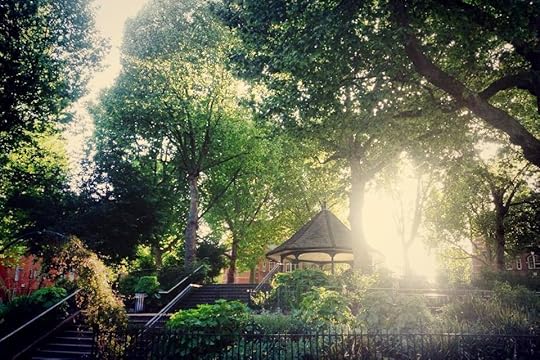
I found myself at Koszmar Circus, beneath the old bandstand’s prominent, pyramid-shaped roof, contemplating a UFO. When I say UFO I don’t mean spaceship. I mean it in the literal sense, Unidentified Flying Object. Circa half a metre tall, it hovered directly in my eyeline. It radiated neon beige, what a concept. I just stood there, one hand on my head, the other on my hip, considering the likelihood.
Was still thinking on it, still processing, when I noticed someone or something moving behind me. I turned around and saw it was Bambi. When I say Bambi I mean Bambi, but not as we know him. On top of his famously unsteady legs, he had four spider’s legs, grand total was eight. Besides, he had multiple sets of eyes, like that seraph-filtered kitty on Instagram, or most common spiders: pavouk, in one Euro language. The fawn looked at me, batting four sets of lashes, giving disarming smile. Off he went, hustling around the bandstand, rattling the local blue tits to the core.
My modus operandi was disassociation and tonight was no exception.
Our first-person narrator, the blogger Corey Fah, has been awarded the 2024 Award for the Fictionalisation of Social Evils for their novel: Headlines ranged from unknown Fah wins £10k prize for ‘mind-bending’ debut novel to blogger takes major literary award. I couldn’t help notice the disproportionate number of mentions of the ‘inclusion agenda’ that the prize had adopted, allegedly. They have gone to collect their trophy, which proves to be the UFO, which they don't have the cultural capital to recognise is how the literary scene, in this novel's world, operates.
The arachnoid Bambi in this opening scene is inspired by Bambi Gregor (1993) by Nicole Eisenman, itself, I assume, inspired by Kafka's Gregor Samsa.
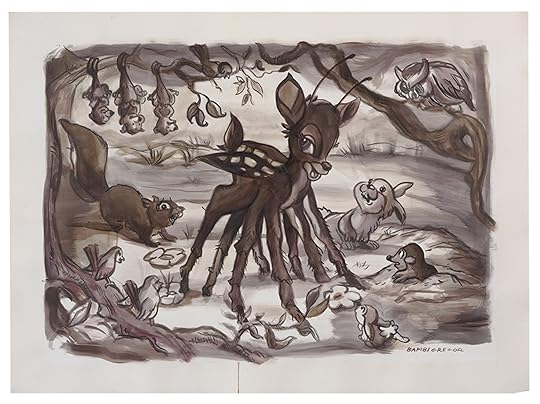
Waidner explains the influence of Eisenman's work in this article in Frieze, as well as the link to the cover of Camille Roy's Honey Mine:

But the blue birds in this passage (and those in Bambi the Movie) provide a key link to the 2nd key strand of the novel. Corey and their partner Drew share a regular ritual of watching a daytime TV show, St Orton Gets to the Bottom of It, hosted by a presenter with the pseudonym Sean St Orton:
Sean purported he used to be shit-hot playwright in the 1960s. He ’d gone by a different name then, I forget, not sure I ever knew. Said he’d escaped a domestic violence situation in ’67, his homosexual lover coming for him in the studio flat the couple had shared on Kalapács Road, coincidentally in the Huàirén borough, not far from estate. He’d got out by disappearing through what he ’d termed a červí díra –a space-and-time-defying passageway, a trans-dimensional wormhole – that earlier that year had opened up in his flat inexplicably, on the floor by his bed.
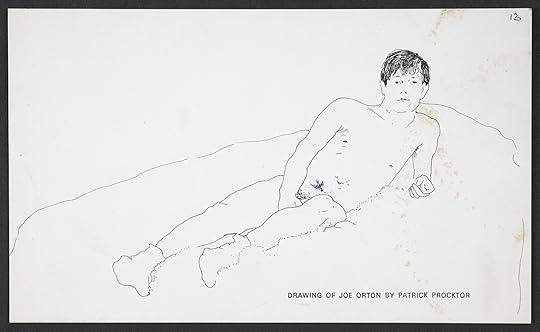
"Sean", who supports a tattoo of a blue swallow on his stomach, is of course a version of Joe Orton in an alternative timeline where he escaped the real-life fate of the playwright. From Prick Up Your Ears: The Biography of Joe Orton by John Lahr describing the murder scene:
The swallow tattoo is also clearly visible on Patrick Proctor's 1967 sketch of Orton, which was enclosed in the programme for Orton's play Crimes of Passion. The copy in the British Library particularly notable for the swallow having been coloured in with a blue biro by the director of the play, Peter Gill
And when one digs further one starts to create more mental links:
Later in the novel, Bambi Pavok's leporine companion Fumper plays a key role, including some twitterpating activity, and another famous blue "bir, bir! Birrd!" (to use Bambi Pavok's stumbling first words) is Larry, Twitter's famous logo (at least until Elon Musk decided to temporarily change it to pump crypto currency), although in the novel Corey is more active on Substack.
And there is also a neat but coincidental link from the St Orton Gets to the Bottom of It TV show to the TV show Get Aquinas In Here which is a key element of the novel The Doloriad by Missouri Williams which won the 2023 edition of the Republic of Consciousness Prize, where Waidner themselves was a judge for this same prize that had first recognised their work (and I'm now a Trustee of the Prize).
In the novel St Orton was also the winner of the The Award for the Fictionalisation of Social Evils in 1967. In real-life Orton's own surrealist novel Head to Toe was published posthumously and was only recognised by awards in 2010 when it was longlisted for the The Lost Man Booker Prize, "a one-off prize to honour the books that missed out on the opportunity to win the Booker Prize in 1970" due to a shift then in prize year eligibility. Given the rules require the author to be living, I think Orton's book would not actually have been eligible and Waidner's own take on the book suggests it probably wasn't to the standard of his plays:
These last items may be to read into the novel things that aren't there. Although Sean St Orton and Corey Fah towards the novel's end pass on the torch of creativity, and a future version of the prize, to another character from the 'swampy' part of town, Mallory or Malachi Hölderlin. But such are Waidner's creative powers that the reader, or this reader at least, can't help but go on their own chains of association, or is it disassociation.
However this is a tighter and more self-contained novel than the author's previous works. Really the only references the reader needs to know are Bambi the Disney Movie, and elements of Joe Orton's own biography. The review by my identical twin, aka Gumble's Yard - Golden Reviewer, and fellow 2018 Republic of Consciouness Prize judge explains in detail the references that are present and how the story comes, brilliantly, together.
But this is a novel that demands to be read not just studied - and is an ideal starting point for Waidner's work.
And unlike Orton's belated Booker recognition 40 years after his book was posthumously published, this is a novel that demands to be immediately recognised by the 2023 Booker Prize.
6 stars if I could but rounded down to 5 because Goodreads.
I tested my theory on them, about the redistribution of cultural capital leading to irregularities in the space-time continuum, affecting disadvantaged prize recipients disproportionately.
My first encounter with Isabel Waidner's work was in September 2017 when their Gaudy Bauble was entered, and later shortlisted, for the 2018 Republic of Consciousness Prize, of which I was then a readers-panel judge.
The novel began with the memorable, and in the light of Waidner's profile since, historic, line: A formidable micro-horse sprang across a Formica tabletop. By the end of a first paragraph that included the designs on a sweater becoming animate, and which concluded and this was just the beginning, I realised this was something very different to anything I'd read previously, Awkwardgarde fiction, potentially trailblazing as the authorial stand-in put it before the narrative baton was seized from them by a pegasus, and I must admit it took me several reads of that first page, and a read of the author's PhD thesis, before I really understood what they had achieved: Transliterary, a new genre of its own, "sharing agency (the capacity to influence the narrative) across assemblages of human and nonhuman, fictional and real, material and semiotic 'actors' ... to subvert normative versions of authorship, intentionality, causality, and process."
By the time of Waidner's 2nd novel We are Made of Diamond Stuff, I was convinced that they were, in the words that opened my review, Britain's most exciting and important writer, an impression that was fully confirmed by Stirling Karat Gold, which won the one prize that for me compares to the Republic of Consciousness in its literary ambition, the Goldsmiths Prize.
And winning that Prize “as a writer lacking the structural privileges related to class, native status and cisgender” (as Waidner comments in an afterword, thanking the Prize organisers and judges) combined with a striking authorial comparison in a Goodreads review by a well-regarded blogger was the starting point for this, Isabel Waidner's fourth novel, a brilliant exploration of one of the most neglected barriers to social mobility, cultural capital.
The novel opens in an "International Capital" city, an othered version of London with some Eatern European influences in the mix, Koszmar Circus based on the real-life Arnold Circus in Tower Hamlets:
I found myself at Koszmar Circus, beneath the old bandstand’s prominent, pyramid-shaped roof, contemplating a UFO. When I say UFO I don’t mean spaceship. I mean it in the literal sense, Unidentified Flying Object. Circa half a metre tall, it hovered directly in my eyeline. It radiated neon beige, what a concept. I just stood there, one hand on my head, the other on my hip, considering the likelihood.
Was still thinking on it, still processing, when I noticed someone or something moving behind me. I turned around and saw it was Bambi. When I say Bambi I mean Bambi, but not as we know him. On top of his famously unsteady legs, he had four spider’s legs, grand total was eight. Besides, he had multiple sets of eyes, like that seraph-filtered kitty on Instagram, or most common spiders: pavouk, in one Euro language. The fawn looked at me, batting four sets of lashes, giving disarming smile. Off he went, hustling around the bandstand, rattling the local blue tits to the core.
My modus operandi was disassociation and tonight was no exception.
Our first-person narrator, the blogger Corey Fah, has been awarded the 2024 Award for the Fictionalisation of Social Evils for their novel: Headlines ranged from unknown Fah wins £10k prize for ‘mind-bending’ debut novel to blogger takes major literary award. I couldn’t help notice the disproportionate number of mentions of the ‘inclusion agenda’ that the prize had adopted, allegedly. They have gone to collect their trophy, which proves to be the UFO, which they don't have the cultural capital to recognise is how the literary scene, in this novel's world, operates.
The arachnoid Bambi in this opening scene is inspired by Bambi Gregor (1993) by Nicole Eisenman, itself, I assume, inspired by Kafka's Gregor Samsa.
Waidner explains the influence of Eisenman's work in this article in Frieze, as well as the link to the cover of Camille Roy's Honey Mine:
But the blue birds in this passage (and those in Bambi the Movie) provide a key link to the 2nd key strand of the novel. Corey and their partner Drew share a regular ritual of watching a daytime TV show, St Orton Gets to the Bottom of It, hosted by a presenter with the pseudonym Sean St Orton:
Sean purported he used to be shit-hot playwright in the 1960s. He ’d gone by a different name then, I forget, not sure I ever knew. Said he’d escaped a domestic violence situation in ’67, his homosexual lover coming for him in the studio flat the couple had shared on Kalapács Road, coincidentally in the Huàirén borough, not far from estate. He’d got out by disappearing through what he ’d termed a červí díra –a space-and-time-defying passageway, a trans-dimensional wormhole – that earlier that year had opened up in his flat inexplicably, on the floor by his bed.
"Sean", who supports a tattoo of a blue swallow on his stomach, is of course a version of Joe Orton in an alternative timeline where he escaped the real-life fate of the playwright. From Prick Up Your Ears: The Biography of Joe Orton by John Lahr describing the murder scene:
Two stools, two chairs, two single divan beds, and now, so the police discovered, two bodies. The only identifying mark on Orton's body was a blue swallow tattooed over his appendix scar. Orton was planning to refurbish the design. He wanted a flock of swallows on the wing arching across his stomach like porcelain ducks over a mantelpiece.
The swallow tattoo is also clearly visible on Patrick Proctor's 1967 sketch of Orton, which was enclosed in the programme for Orton's play Crimes of Passion. The copy in the British Library particularly notable for the swallow having been coloured in with a blue biro by the director of the play, Peter Gill
And when one digs further one starts to create more mental links:
Later in the novel, Bambi Pavok's leporine companion Fumper plays a key role, including some twitterpating activity, and another famous blue "bir, bir! Birrd!" (to use Bambi Pavok's stumbling first words) is Larry, Twitter's famous logo (at least until Elon Musk decided to temporarily change it to pump crypto currency), although in the novel Corey is more active on Substack.
And there is also a neat but coincidental link from the St Orton Gets to the Bottom of It TV show to the TV show Get Aquinas In Here which is a key element of the novel The Doloriad by Missouri Williams which won the 2023 edition of the Republic of Consciousness Prize, where Waidner themselves was a judge for this same prize that had first recognised their work (and I'm now a Trustee of the Prize).
In the novel St Orton was also the winner of the The Award for the Fictionalisation of Social Evils in 1967. In real-life Orton's own surrealist novel Head to Toe was published posthumously and was only recognised by awards in 2010 when it was longlisted for the The Lost Man Booker Prize, "a one-off prize to honour the books that missed out on the opportunity to win the Booker Prize in 1970" due to a shift then in prize year eligibility. Given the rules require the author to be living, I think Orton's book would not actually have been eligible and Waidner's own take on the book suggests it probably wasn't to the standard of his plays:
Researching my latest novel-in-progress, I re-read British sixties playwright Joe Orton’s entire back catalogue, including his early novel Head to Toe. First published in the seventies, it was written before his hugely successful satirical plays including Loot, known for their hilarious social critiques and stark realism. This, however, is the story of Gombold, who finds himself in the head of a giant a hundred miles high, yes, and sets about traveling downwards, that is, along the trajectory of the expansive body.
En route, Gombold encounters a gender-bending policewoman; finds himself in an assassination squad targeting the prime minister; and enlists in a war between the left and right butt cheeks. No, really. I love and admire Joe Orton—a gay working-class literary maverick, an autodidactic ex-convict—and consider his work a significant part of the cultural fabric that makes writers like myself possible now. But Head to Toe? Obscure for a reason. I wish Orton, who was killed by his lover at the age of just thirty-four, had lived long enough to make another, late-style attempt at surrealism. He would’ve nailed it.
These last items may be to read into the novel things that aren't there. Although Sean St Orton and Corey Fah towards the novel's end pass on the torch of creativity, and a future version of the prize, to another character from the 'swampy' part of town, Mallory or Malachi Hölderlin. But such are Waidner's creative powers that the reader, or this reader at least, can't help but go on their own chains of association, or is it disassociation.
However this is a tighter and more self-contained novel than the author's previous works. Really the only references the reader needs to know are Bambi the Disney Movie, and elements of Joe Orton's own biography. The review by my identical twin, aka Gumble's Yard - Golden Reviewer, and fellow 2018 Republic of Consciouness Prize judge explains in detail the references that are present and how the story comes, brilliantly, together.
But this is a novel that demands to be read not just studied - and is an ideal starting point for Waidner's work.
And unlike Orton's belated Booker recognition 40 years after his book was posthumously published, this is a novel that demands to be immediately recognised by the 2023 Booker Prize.
6 stars if I could but rounded down to 5 because Goodreads.
July 29, 2023
The Fun in Fah
Review of the Hamish Hamilton hardcover edition (July 13, 2023).
In a future world, writer Corey Fah wins a literary award, but faces a Catch-22 where they can't collect the prize money until they have the physical trophy in hand. The trophy is unfortunately airborne and subject to teleportation. Trying to capitalize on their overnight success Fah goes on a TV show "St Orton Gets to the Bottom of It" (a show that attempts to find the truth about the existence of wormholes), where their appearance is ruined by Fah's mutant 8-legged spider/deer Bambi Pavok. The host St. Orton disappears and Fah agrees to become a replacement with their own show "Corey Fah Does Social Mobility." Fah is able to find a solution to it all in the end.

A photograph of the author Isabel Waidner by Karen Robinson, The Observer. Image sourced from The Guardian (see link below).
This mind-bending fantasy adventure from author Isabel Waidner follows their own Goldsmith's Prize winner Sterling Karat Gold (2021) which I reviewed as a ⭐⭐⭐⭐⭐ star Solid Gold Fun. This time the inspiration is Waidner's own inability to collect an actual trophy for the Goldsmith's (due to the pandemic) with a further science fiction slant of turning London into a future international capital where Czech appears to be the new lingua franca and the existence of wormholes transports characters such as playwright Joe Orton (1933-1967) into a future where he is rescued from his own murder. And I'm not even getting into the mutant creatures inspired by Disney movies and the bizarre venison-burger chain "Frikadellen".

A photograph of the playwright Joe Orton. Image sourced from Joe Orton: his brief but brilliant theatre career - in pictures at The Guardian, May 7, 2014.
This was an entertaining novel from Waidner which combined science-fiction with parody and commentary on social issues and phenomena. I've enjoyed everything from Waidner since their first books Gaudy Bauble (2017) and We Are Made Of Diamond Stuff (2019), which I was introduced to thanks to the Republic of Consciousness Prize, where they have been consistently nominated.
Other Reviews
A Surreal Journey by Lara Pawson, The Guardian, July 7, 2023.
Playfully Surreal Dark Fable by Em Strang, The The Observer, July 16, 2023.
Review of the Hamish Hamilton hardcover edition (July 13, 2023).
Was I in the wrong place, I wondered. Had I misunderstood the instructions. Detail had, I want to say, not been forthcoming. More like, withheld. 'It'll be self-explanatory,' the prize coordinator had said. The assumption had been that a winner would know how to collect. That prize culture etiquette, its unwritten rules and regulations, would be second nature to them. But I didn't, know how to collect, and they weren't, second nature to me. I'd not won an award before, and neither had anybody I knew.
In a future world, writer Corey Fah wins a literary award, but faces a Catch-22 where they can't collect the prize money until they have the physical trophy in hand. The trophy is unfortunately airborne and subject to teleportation. Trying to capitalize on their overnight success Fah goes on a TV show "St Orton Gets to the Bottom of It" (a show that attempts to find the truth about the existence of wormholes), where their appearance is ruined by Fah's mutant 8-legged spider/deer Bambi Pavok. The host St. Orton disappears and Fah agrees to become a replacement with their own show "Corey Fah Does Social Mobility." Fah is able to find a solution to it all in the end.
A photograph of the author Isabel Waidner by Karen Robinson, The Observer. Image sourced from The Guardian (see link below).
This mind-bending fantasy adventure from author Isabel Waidner follows their own Goldsmith's Prize winner Sterling Karat Gold (2021) which I reviewed as a ⭐⭐⭐⭐⭐ star Solid Gold Fun. This time the inspiration is Waidner's own inability to collect an actual trophy for the Goldsmith's (due to the pandemic) with a further science fiction slant of turning London into a future international capital where Czech appears to be the new lingua franca and the existence of wormholes transports characters such as playwright Joe Orton (1933-1967) into a future where he is rescued from his own murder. And I'm not even getting into the mutant creatures inspired by Disney movies and the bizarre venison-burger chain "Frikadellen".
A photograph of the playwright Joe Orton. Image sourced from Joe Orton: his brief but brilliant theatre career - in pictures at The Guardian, May 7, 2014.
This was an entertaining novel from Waidner which combined science-fiction with parody and commentary on social issues and phenomena. I've enjoyed everything from Waidner since their first books Gaudy Bauble (2017) and We Are Made Of Diamond Stuff (2019), which I was introduced to thanks to the Republic of Consciousness Prize, where they have been consistently nominated.
Other Reviews
A Surreal Journey by Lara Pawson, The Guardian, July 7, 2023.
Playfully Surreal Dark Fable by Em Strang, The The Observer, July 16, 2023.

January 30, 2026
Caustic, unhinged, surreal, wild—Waidner is a delicious outlier in modern fiction.

April 27, 2023
Isabel Waidner was only familiar to me as the winner of the 2021 Goldsmith's Prize for their novel Sterling Karat Gold. This new novel was sold to me through a glowing review by Kamila Shamsie. With its title I had no idea what to expect, but I was intrigued and excited to discover a new literary voice.
Isabel Waidner is an experimental, playful novelist, and their novel is full of many contemporary references points. Corey Fah is not a novel in its traditional sense - it feels like something very modern, very 21st century. Yet one of they key cornerstones of this work is the 1942 film Bambi.
This is a very difficult book to review without spoiling many of its surprises. Let's just tell you it involves time travel, alternate realities, UFOs and chat shows. That makes it sound sci-fi. It isn't that. Let's just tell you it is a novel about literary values, prize culture, and artistic privilege but that makes it sound elitist. It isn't that either.
So what is Corey Fah Does Social Mobility? It is a unique, funny, challenging, and charming slice of modernity. It is the novel which could easily bring Waidner their third Goldsmith's nomination. It could easily bring them their first Booker longlist. It is that good.
Thank you to the publishers and Netgalley for the ARC.
Isabel Waidner is an experimental, playful novelist, and their novel is full of many contemporary references points. Corey Fah is not a novel in its traditional sense - it feels like something very modern, very 21st century. Yet one of they key cornerstones of this work is the 1942 film Bambi.
This is a very difficult book to review without spoiling many of its surprises. Let's just tell you it involves time travel, alternate realities, UFOs and chat shows. That makes it sound sci-fi. It isn't that. Let's just tell you it is a novel about literary values, prize culture, and artistic privilege but that makes it sound elitist. It isn't that either.
So what is Corey Fah Does Social Mobility? It is a unique, funny, challenging, and charming slice of modernity. It is the novel which could easily bring Waidner their third Goldsmith's nomination. It could easily bring them their first Booker longlist. It is that good.
Thank you to the publishers and Netgalley for the ARC.

Did Not Finish
September 8, 2023DNF @ 23%
I tried… but this was very much not my kind of thing.
I tried… but this was very much not my kind of thing.

January 28, 2024
I really needed this.* This is queer literature at its best. It queers space, with its faux-Eastern European language toponyms. It took me a while to pick up on this because, in my native language, Koszmar Circus and Proklety Field actually made sense, which I suspect is not the case for native English speakers. It queers time, with its time loops exploding straight time. It queers genre, with its pop culture references and mix of literary forms. It queers gender, with its non-binary characters. Finally, it queers species, with the eight-legged and four-eyed Bambi Pavok becoming human (or vice versa?). And on top of all that, it is so much fun, while never losing the sight of class, that is social positionality of the author/characters and the novel itself.
*I have spent the last few weeks reading the longlist for the NIN Award, supposedly the most prestigious literary prize in Serbia, and the experience has been dreadful, to say the least. The books chosen ranged from ineptly written and poorly researched to homophobic, and I couldn't wait to get back to my own kind.
*I have spent the last few weeks reading the longlist for the NIN Award, supposedly the most prestigious literary prize in Serbia, and the experience has been dreadful, to say the least. The books chosen ranged from ineptly written and poorly researched to homophobic, and I couldn't wait to get back to my own kind.

October 30, 2023
My 4th foray into the weird, wacky, zany whatever - world of Isabel Waidner. A unique voice and so therefore to be treasured.

July 19, 2023
This was definitely a book I read

August 18, 2023
This book was easier to follow than We Are Made of Diamond Stuff or Sterling Karat Gold, but still as brilliant. Mx Waidner addresses compassion for the familiar and lack of compassion for the other, the price of fame and winning awards, how gaining some social capital with no real idea of how to use it in positive ways or how to use it all can turn one’s life upside down and take one to places that are disorienting, and uses Bambi’s father as an example of achieving absolute power then grinding one’s own community in order to turn a profit. These are just the obvious issues in this engaging story.
It’s difficult to summarize an avant-garde novel and I’m sure over the next few days as I discuss the book with other readers I’ll discover what I missed on my first read.
In all of their books Isabel Waidner makes us open our minds to get past our habitual ways of viewing reality. They deconstruct the “normal” and the familiar so that we understand that there are many ways of being and that we can and should love everyone, even the other. The world would be a better place if everyone read and reread their books.
It’s difficult to summarize an avant-garde novel and I’m sure over the next few days as I discuss the book with other readers I’ll discover what I missed on my first read.
In all of their books Isabel Waidner makes us open our minds to get past our habitual ways of viewing reality. They deconstruct the “normal” and the familiar so that we understand that there are many ways of being and that we can and should love everyone, even the other. The world would be a better place if everyone read and reread their books.

April 30, 2023
Corey Fah Does Social Mobility is an experimental novel, very much in Waidner's typical style, which explores writing, cultural capital and social mobility, trying to balance things in your life, reality TV, and an eight legged horror a bit like Bambi. Corey Fah has won a literary prize, but is unable to collect the trophy, because it keeps flying away. Corey's partner Drew just wants to watch their usual favourite daytime TV show, but it turns out the host has links to the strange occurrences when Corey tries to get the trophy, and it seems that winning was only the start of Corey's problems.
I loved Waidner's previous novels, We Are Made Of Diamond Stuff and Sterling Karat Gold, and I might've enjoyed this one even more, in which they manage to combine dreamlike, surreal happenings and a horror-style version of Bambi with a sharp attack on class and culture, borders and identities. The book also provides a sweet domestic love story at its heart and an exciting detour into an alternate history for Joe Orton, amongst other things. There's so much stuff packed in, but there's only a few main references to understand, making it accessible for a book that takes its source material so playfully.
This is a book that is delightful to read, cutting yet funny, and also bittersweet, especially for anyone who has dreamed of achieving things that feel far too out of reach. The experimental and surreal style blends the political and domestic with so many little details that cut into the binaries and boundaries we encounter. I just love how Waidner's books seem to enact a kind of non-binary poetics in which boundaries are there for disrupting and gender, like many other facets of identity, is there for people to do with what they will, in a revolutionary way. An exciting book, but also a strangely sweet story of trying to find your way even when the prize literally seems trapped by Kafkaesque rules.
I loved Waidner's previous novels, We Are Made Of Diamond Stuff and Sterling Karat Gold, and I might've enjoyed this one even more, in which they manage to combine dreamlike, surreal happenings and a horror-style version of Bambi with a sharp attack on class and culture, borders and identities. The book also provides a sweet domestic love story at its heart and an exciting detour into an alternate history for Joe Orton, amongst other things. There's so much stuff packed in, but there's only a few main references to understand, making it accessible for a book that takes its source material so playfully.
This is a book that is delightful to read, cutting yet funny, and also bittersweet, especially for anyone who has dreamed of achieving things that feel far too out of reach. The experimental and surreal style blends the political and domestic with so many little details that cut into the binaries and boundaries we encounter. I just love how Waidner's books seem to enact a kind of non-binary poetics in which boundaries are there for disrupting and gender, like many other facets of identity, is there for people to do with what they will, in a revolutionary way. An exciting book, but also a strangely sweet story of trying to find your way even when the prize literally seems trapped by Kafkaesque rules.

April 21, 2025
Reader's Digest Version OR, 'Those "Down In The Well" (Bevis Frond) of Book Reviews and Need to Catch the Fuck Up' Review:
Nothing, and I mean NOTHING, about Waidner should work for me on paper. The fact that it does, and does so strikingly, is testament to their idiosyncratic charm. To me, Waidner reads like an early Ali Smith that REALLY loves Crass (which, really, everyone should) and flamethrowing the Academy's walls for eternal teenage kicks. Her obsessive pop cult, pseudo-cute/pigfuck, 'everything blendered including structural sacred cows' funkiness just, well, delights me. None of this feels like bad Acker, maybe Waidner's closest literary progenitor. Maybe Acker? Beats me. I neither know nor care to; this most recent book is humming with life and louche-couched urgency, all spun yarn streaming out of a beautiful puss full-a rainbow face paint. AKA: It's pretty goddamn glorious.
Nothing, and I mean NOTHING, about Waidner should work for me on paper. The fact that it does, and does so strikingly, is testament to their idiosyncratic charm. To me, Waidner reads like an early Ali Smith that REALLY loves Crass (which, really, everyone should) and flamethrowing the Academy's walls for eternal teenage kicks. Her obsessive pop cult, pseudo-cute/pigfuck, 'everything blendered including structural sacred cows' funkiness just, well, delights me. None of this feels like bad Acker, maybe Waidner's closest literary progenitor. Maybe Acker? Beats me. I neither know nor care to; this most recent book is humming with life and louche-couched urgency, all spun yarn streaming out of a beautiful puss full-a rainbow face paint. AKA: It's pretty goddamn glorious.

July 31, 2023
Weird, wild and funny.

September 14, 2023
Not sure what I just read but I loved every moment.
July 18, 2023
"My modus operandi was dissociation and tonight was no exception".
Corey Fah has won a literary award - the Award for the Fictionalisation of Social Evils - and has been told to go and collect their award from Koszmar Circus, which should be "self-explanatory". When Corey goes to collect their award, which they need in order to identify themselves and take part in the book tour, and to collect the prize money, there is no award in sight but Corey comes back with Bambi Pavok, a creature which is half a deer, half a spider. Their partner Drew offers to help find the award. At one point, they both become a guest on Drew's favourite talkshow, which investigates cervi dira - a wormhole/ time travel phenomenon - but the host, Sean, seems distracted and moody, and everything goes wrong.
As a book it is hard to summarise - it sounds crazy and it is, hallucinogenic at times - not to mention the character's many dreams and nightmares, featuring frikadellen, deer burgers and TV shows, but it also felt fun, warm, clever in its commentary on class, privileges, and social capital, and success. It is experimental - something that would often deter me from reading, but I was drawn by the blurb on the back, the cover, and I don't regret giving it a try - I found it so enjoyable in its weirdness and so touchingly funny.
Free copy sent by Netgalley.
Corey Fah has won a literary award - the Award for the Fictionalisation of Social Evils - and has been told to go and collect their award from Koszmar Circus, which should be "self-explanatory". When Corey goes to collect their award, which they need in order to identify themselves and take part in the book tour, and to collect the prize money, there is no award in sight but Corey comes back with Bambi Pavok, a creature which is half a deer, half a spider. Their partner Drew offers to help find the award. At one point, they both become a guest on Drew's favourite talkshow, which investigates cervi dira - a wormhole/ time travel phenomenon - but the host, Sean, seems distracted and moody, and everything goes wrong.
As a book it is hard to summarise - it sounds crazy and it is, hallucinogenic at times - not to mention the character's many dreams and nightmares, featuring frikadellen, deer burgers and TV shows, but it also felt fun, warm, clever in its commentary on class, privileges, and social capital, and success. It is experimental - something that would often deter me from reading, but I was drawn by the blurb on the back, the cover, and I don't regret giving it a try - I found it so enjoyable in its weirdness and so touchingly funny.
Free copy sent by Netgalley.
August 7, 2024
Maybe someone would like this more than I did if they were really into sentence fragments, Disney’s Bambi, talk shows, and being confused. But unluckily for me I was not into those things.

July 14, 2025
This is a surreal story that employs an alternate version of the tale of Bambi as a narrative device. The titular Corey Fah has won a literary award for the “Fictionalization of Social Evils,” but the award itself proves almost impossible to collect. The trophy remains out of reach, and its physical possession is required to collect the corresponding monetary prize. In this book Bambi Pavok is an eight-legged combination of arachnid and deer. The primary theme involves “othering.” Waidner sets up the question of why feelings of sympathy are often influenced by physical qualities. It also pokes fun at the literary prize community.
It is structured in interwoven pieces, including the attempt to collect the award and the story of the hybrid creature Bambi Pavok (which Corey has brought home to their partner Drew). It also involves a reality television show (Social Mobility) where Bambi Pavok suddenly holds appeal as an oddity. Wormholes and time loops add to the zaniness. I must admit that I did not initially “get” all the cultural references and had to look up Joe Orton. This is not a book for anyone looking for a traditional narrative, but if you are interested in something a bit off the beaten path that has a positive message of acceptance, give it a try.
It is structured in interwoven pieces, including the attempt to collect the award and the story of the hybrid creature Bambi Pavok (which Corey has brought home to their partner Drew). It also involves a reality television show (Social Mobility) where Bambi Pavok suddenly holds appeal as an oddity. Wormholes and time loops add to the zaniness. I must admit that I did not initially “get” all the cultural references and had to look up Joe Orton. This is not a book for anyone looking for a traditional narrative, but if you are interested in something a bit off the beaten path that has a positive message of acceptance, give it a try.

September 1, 2024
3.5 stars
At a public online event in 2021, Isabel Waidner was announced the winner of the Goldsmiths Prize: their third novel, Sterling Karat Gold , was recognised as a work of ''fiction that breaks the mold,'' with a judge congratulating them for their ability to bring together ''the real and the mythic, the beautiful and the grotesque, to mind-bending effect''. However, the Goldsmiths art department was closed due to lockdown, meaning nobody could make Waidner the usual customised trophy. They were to make do with the £10,000 prize money, promptly credited.
Corey Fah is not so lucky: they will only get the money from winning the Award for the Fictionalisation of Social Evils if they – a queer, immigrant, working-class write living in a one-bed flat on a 1960s social housing estate – can track down and collect the missing trophy "before the judges change their minds". But that neon beige signifier of literary and cultural capital is a shimmering, elusive thing, and not knowing the prize culture etiquette, its unwritten rules and regulations, will drive Corey and their partner Drew Szumski to the edge – or at least through trans-dimensional wormholes, endless time loops, and the hotseat of a cult-favourite not-quite-primetime TV show.
Corey Fah Does Social Mobility is a radical, subversive novel that uses acerbic wit and a seriously surrealist takedown of British literary conventions to address themes like inequality, injustice, and social and cultural deprivation. Social mobility here is revealed in its true form: as the publisher's blurb calls it, less a simple, linear, achievable step up the ladder and more a hopeful leap in the void, one that puts the disadvantaged up against all the History that has made them so and places the burden of the redistribution of cultural capital squarely on their shoulders.
Corey Fah's is a madcap adventure, but not one they set on by choice. And if it involves spacetime travel, monsters with a cartoon quality (Bambi Pavok), an unsettling blend of Czech and English that subtly drives home the parallels (yet again) with Kafka, and an oblique homage to playwright Joe Orton, it is because the concerns of the marginalised can't be articulated within conventional frames of reference either, less so at a time when the collapse of reality is magnified and writ large.
Waidner gets this – aside from winning the Goldsmiths Prize, they have also been shortlisted for awards that laud works concerned with “Social Evils,” such as the Orwell Prize for Political Fiction. In Corey Fah Does Social Mobility, they distort both reality and fiction towards their own ends: missing conjunctions and squashed grammatical rules, a complete (and refreshing) disregard for anthropocentric (let alone linear) storytelling, and an uncommonly (for 'literary fiction') slapstick sense of humour all combine here to backlight Social Evils without once manipulating readers' emotions for the desired effect. In fact, the delivery is decidedly detached, which allows the the violence in the novel – and of the real world it seeks to fictionalise – to be presented in its true, illogical, ridiculous form.
A distinctive, intellectually flamboyant, and purposefully bizarre satire that refuses to tell it like it isn't.
At a public online event in 2021, Isabel Waidner was announced the winner of the Goldsmiths Prize: their third novel, Sterling Karat Gold , was recognised as a work of ''fiction that breaks the mold,'' with a judge congratulating them for their ability to bring together ''the real and the mythic, the beautiful and the grotesque, to mind-bending effect''. However, the Goldsmiths art department was closed due to lockdown, meaning nobody could make Waidner the usual customised trophy. They were to make do with the £10,000 prize money, promptly credited.
Corey Fah is not so lucky: they will only get the money from winning the Award for the Fictionalisation of Social Evils if they – a queer, immigrant, working-class write living in a one-bed flat on a 1960s social housing estate – can track down and collect the missing trophy "before the judges change their minds". But that neon beige signifier of literary and cultural capital is a shimmering, elusive thing, and not knowing the prize culture etiquette, its unwritten rules and regulations, will drive Corey and their partner Drew Szumski to the edge – or at least through trans-dimensional wormholes, endless time loops, and the hotseat of a cult-favourite not-quite-primetime TV show.
Corey Fah Does Social Mobility is a radical, subversive novel that uses acerbic wit and a seriously surrealist takedown of British literary conventions to address themes like inequality, injustice, and social and cultural deprivation. Social mobility here is revealed in its true form: as the publisher's blurb calls it, less a simple, linear, achievable step up the ladder and more a hopeful leap in the void, one that puts the disadvantaged up against all the History that has made them so and places the burden of the redistribution of cultural capital squarely on their shoulders.
Corey Fah's is a madcap adventure, but not one they set on by choice. And if it involves spacetime travel, monsters with a cartoon quality (Bambi Pavok), an unsettling blend of Czech and English that subtly drives home the parallels (yet again) with Kafka, and an oblique homage to playwright Joe Orton, it is because the concerns of the marginalised can't be articulated within conventional frames of reference either, less so at a time when the collapse of reality is magnified and writ large.
Waidner gets this – aside from winning the Goldsmiths Prize, they have also been shortlisted for awards that laud works concerned with “Social Evils,” such as the Orwell Prize for Political Fiction. In Corey Fah Does Social Mobility, they distort both reality and fiction towards their own ends: missing conjunctions and squashed grammatical rules, a complete (and refreshing) disregard for anthropocentric (let alone linear) storytelling, and an uncommonly (for 'literary fiction') slapstick sense of humour all combine here to backlight Social Evils without once manipulating readers' emotions for the desired effect. In fact, the delivery is decidedly detached, which allows the the violence in the novel – and of the real world it seeks to fictionalise – to be presented in its true, illogical, ridiculous form.
A distinctive, intellectually flamboyant, and purposefully bizarre satire that refuses to tell it like it isn't.

January 4, 2025
"interesting" maybe more the operative word here than "good". The social commentary felt quite confused. for one, I don't immensely care about social commentary regarding literary prizes. Found it funny at times but in quite a random way. Found the Adam Mars Jones lrb review unusually clarifying, for him. Quite piqued to read something else by waidner.

May 11, 2023
Corey Fah has won a literary award. To verify their identity and receive their prize money, they’ll have to collect their trophy - a UFO that flies off when they try to retrieve it. Instead, they end up taking home Bambi Pavok - a strange deer/spider hybrid that has come through a wormhole.
This short novel is so utterly bizarre that writing a coherent review feels like quite a challenge. Waidner’s writing is smart, funny and surreal. The novel is packed with so many small details that it feels impossible to really get everything that it has to offer on a first reading. This, however, is not a criticism - this is exactly the kind of novel that you’ll want to revisit.
The world of the novel is eerie and strange, set in a non-specific city somewhere in Europe, 2024 - and also a forest in the 60s. Waidner plays with concepts of time, time travel, wormholes and time loops with no concern of getting too bogged down in logistics; it doesn’t matter how or why things are happening - they’re happening, just go with it.
This is a really wild, fun novel, covering a lot of big ideas without ever feeling like a chore. I loved it, and I think it’ll only improve with a reread.
Thanks to Netgalley and Penguin for the e-ARC!
This short novel is so utterly bizarre that writing a coherent review feels like quite a challenge. Waidner’s writing is smart, funny and surreal. The novel is packed with so many small details that it feels impossible to really get everything that it has to offer on a first reading. This, however, is not a criticism - this is exactly the kind of novel that you’ll want to revisit.
The world of the novel is eerie and strange, set in a non-specific city somewhere in Europe, 2024 - and also a forest in the 60s. Waidner plays with concepts of time, time travel, wormholes and time loops with no concern of getting too bogged down in logistics; it doesn’t matter how or why things are happening - they’re happening, just go with it.
This is a really wild, fun novel, covering a lot of big ideas without ever feeling like a chore. I loved it, and I think it’ll only improve with a reread.
Thanks to Netgalley and Penguin for the e-ARC!
August 4, 2025
A surreal, playful, surprisingly gripping novel. I tried to describe it to a few friends while reading and struggled. At one level, it's about the protagonist Corey Fah and their partner Drew, struggling to "do social mobility" under late capitalism. When Corey wins a prestigious literary prize (the "Award for the Fictionalisation of Social Evils" - the moment I knew I would love this book), this seems as if it will change Corey and Drew's lives. Instead, the struggle to retrieve the elusive trophy becomes a Kafka-esque motif in which bureaucratic obstacles and time loops keep Corey from the social capital this prize should offer. Meanwhile, in the middle of this very 21st century novel, the 1942 figure of Bambi gets a reprieve as Bambi Pavok, a many-limbed and much more disruptive alternative to the original. I don't know if I fully understood the Bambi Pavok narrative arc, but I enjoyed it purely as part of the novel's broader surrealism and queer aesthetics (in which time, space, gender and love are queered to open up new futures).

September 3, 2023
Isabel Waidner Gets To The Point in glorious style. It would be selling this short to describe it as a mashup of low fantasy, bildungsroman and progressive polemic, but it does take elements from all of those. Most of all this is a funny and subversive story about the difficulty of social mobility for the unprivileged. There’s a satire and allegory galore. The ending is a tour de force and very sweet. Gonna miss you Bambi Pavok.

September 3, 2023
Waidner always makes me think and leaves me pondering many a tangent/reference/symbol. They have a delightful sense of humor and wit often carried along by a magnetic narrative voice. All that applies to this novel, as well. But I think where I get caught up is that the playfulness seems to work against the satire and cultural criticism. It's a little too charming. It feels like Waidner is pulling their punches... Avoiding the knockout, so to speak. It's like an incredibly timely and apt comedic surrealist critique whose sharpest teeth have been pulled.
It didn't help my reading any that I am completely unfamiliar with British playwright Joe Orton and his biography. I love that Waidner champions the voice and cultural rise/place of those whose identities have long been othered/silenced/overlooked/denied/attacked, but I found my attention waning as the story progressed.
This might be Waidner's easiest narrative to follow of their four novels, but, for me, it felt less edgy and experimental than the others (which sounds ridiculous given the wormholes and Bambi Pavok). It's also possible that my not being British means I have a harder time truly appreciating the positioning of such a book within the contemporary British political and social landscape.
It didn't help my reading any that I am completely unfamiliar with British playwright Joe Orton and his biography. I love that Waidner champions the voice and cultural rise/place of those whose identities have long been othered/silenced/overlooked/denied/attacked, but I found my attention waning as the story progressed.
This might be Waidner's easiest narrative to follow of their four novels, but, for me, it felt less edgy and experimental than the others (which sounds ridiculous given the wormholes and Bambi Pavok). It's also possible that my not being British means I have a harder time truly appreciating the positioning of such a book within the contemporary British political and social landscape.

October 9, 2024
This was alright; massive scope and ingenuity, hurtling around all over the place, but also kind of insubstantial. It went by at a gallop but felt like a plod. This book does a pretty good job of aligning the reader with the alienated protagonist, who wins a writing prize but is never told the rules of how to collect it. Like them, you kind of learn to accept the confusion, which will make no great effort to explain itself anyway. Easier to just get on with it, and maybe you'll grow to understand, sort of. The book is scattered with untranslated foreign words (ominous) and broken sentences that add to this whole effect. But unlike Merve Emre (who's quoted on the front cover), I just didn't find this all as "radical, joyful, hilarious" as she temptingly promised. In parts, the messages even felt regurgitated.
And another thing – if you've never watched the Disney movie Bambi (like me), I'd recommend looking it up on Wikipedia before you read. I don't think the Bambi references are even trying to be obscure, but seriously, who knew Bambi had a father? And a girlfriend? Twitterpating??
And another thing – if you've never watched the Disney movie Bambi (like me), I'd recommend looking it up on Wikipedia before you read. I don't think the Bambi references are even trying to be obscure, but seriously, who knew Bambi had a father? And a girlfriend? Twitterpating??

February 12, 2024
Stunning. Surreal. I inhaled this book.

July 11, 2023
It feels like I’m the only one on here who just doesn’t get the hype?
Bizarre, non-sensical, I got it then I just didn’t ~ in some parts why I weirdly liked this despite finding it incredibly hard to follow along with.
A notable, distinct writing style nevertheless.
Bizarre, non-sensical, I got it then I just didn’t ~ in some parts why I weirdly liked this despite finding it incredibly hard to follow along with.
A notable, distinct writing style nevertheless.

July 22, 2023
A wild and exhilarating ride worth every page.

February 16, 2025
”You know when you can’t look, but you also can’t look away?”
This quote perfectly describes my journey with this novella. I feel like have so many and so few things to say, with no idea where to begin.
Credit must be given to the author for providing a very unique style of writing that is completely distinguishable from anything else in the genre. The story, likewise, was completely original and metaphysical and downright kooky.
Alas, I fear that I still did not enjoy it. Though, I also think this has less to do with the quality of the novel and comes more down to my own personal preferences.
This quote perfectly describes my journey with this novella. I feel like have so many and so few things to say, with no idea where to begin.
Credit must be given to the author for providing a very unique style of writing that is completely distinguishable from anything else in the genre. The story, likewise, was completely original and metaphysical and downright kooky.
Alas, I fear that I still did not enjoy it. Though, I also think this has less to do with the quality of the novel and comes more down to my own personal preferences.

December 13, 2023
Experimentele narratief die resulteert in een rollercoaster van onverklaarbare gebeurtenissen in het verlengde van science-fiction, de Eerie, fantasy en een Bambi met vier gewone poten en vier spinnepoten.
Bijna even crazy als onze werkelijkheid.
Bijna even crazy als onze werkelijkheid.
January 13, 2025
love it when you pick up a random book because of its title and the color of the cover and it actually turns out to be a banger. bambi pavok, you will always be famous <3



February 23, 2025
Corey Fah har vunnit ett litteraturpris och har svårt att plocka upp den för den tp-ar bort hela tiden. Inmixat med en modern tappning av Bambi som är en mix mellan spindel o rådjur. Där han blir mobbad av Stampe och hans pappa tvingar han jobba på hans snabbmatskedja Frikadellen i skogen. Sen ramlar han in i ett maskhål, fast på slaviska, där han krockar med Coreys liv Hade säkert gillat mer om jag fattat alla kafka-referenser. Men så påläst är jag inte och då blir det bara massa konstigheter på varandra. Påhittigt, det ska författaren ha.
Displaying 1 - 30 of 198 reviews