

What do you think?

Light
"A day in the life of Claude Monet in the summer of 1900...a luminous prose poem of a novel...unhurried, richly descriptive, rarely ornamental or excessive—indeed, a kind of impressionism in words."
The New York Times Book Review (as quoted on the back cover)
The New York Times Book Review (as quoted on the back cover)
121 pages, Mass Market Paperback
First published September 1, 1989
About the author
Eva Figes
42 books36 followersEva Figes (born Eva Unger) is a German-born English author.
Figes has written novels, literary criticism, studies of feminism, and vivid memoirs relating to her Berlin childhood and later experiences as a Jewish refugee from Hitler's Germany. She arrived in Britain in 1939 with her parents and a younger brother. Figes is now a resident of north London and the mother of the academic Orlando Figes and writer Kate Figes.
In the 1960s she was associated with an informal group of experimental British writers influenced by Rayner Heppenstall, which included Stefan Themerson, Ann Quin and its informal leader, B. S. Johnson.
Figes's fiction has certain similarities with the writings of Virginia Woolf. The 1983 novel, Light, is an impressionistic portrait of a single day in the life of Claude Monet from sunrise to sunset.
Figes has written novels, literary criticism, studies of feminism, and vivid memoirs relating to her Berlin childhood and later experiences as a Jewish refugee from Hitler's Germany. She arrived in Britain in 1939 with her parents and a younger brother. Figes is now a resident of north London and the mother of the academic Orlando Figes and writer Kate Figes.
In the 1960s she was associated with an informal group of experimental British writers influenced by Rayner Heppenstall, which included Stefan Themerson, Ann Quin and its informal leader, B. S. Johnson.
Figes's fiction has certain similarities with the writings of Virginia Woolf. The 1983 novel, Light, is an impressionistic portrait of a single day in the life of Claude Monet from sunrise to sunset.
Ratings & Reviews
Friends & Following
Create a free account to discover what your friends think of this book!
Community Reviews
Displaying 1 - 30 of 83 reviews

September 21, 2025
Reading this novel felt like watching Eva Figes paint a master copy of Claude Monet’s garden paintings, except she used words instead of pigments to create her piece of art.
Light takes place on a single day and begins before the sun rises. Claude Monet awakens early and walks out into his lush garden to paint the pre-dawn light of Giverny.
As the sun moves through the sky, the reader moves along with it.
Although Claude Monet—like the sun itself—is the center of the story’s universe, we also hear the thoughts and feelings of the family, friends, and household staff who orbit around him. Each of them perceive Claude Monet, his artwork, their connection to him, and their place in “the household universe” differently.
The story closes as the day closes, with the setting of the sun and the disappearance of light.
It was fascinating to see Claude Monet, my very favorite painter, in this intimate way.
This story reminded me that the great bodies of work we all admire, whether it’s art, music, writing, etc… have human beings behind them. Those people have/had a family, friends, likes and disliked, as well as thoughts, feelings, and a spirit of their own.
My favorite element of this story was how Eva Figes made *light* and shadow feel like additional (and unexpected) characters. As an artist and oil painter myself, I loved how this core “artistic philosophy” (the importance of light and shadow in the painting process) was explored.
This poetic and vivid novel is, like all of Monet’s paintings, a breathtaking work of art.
Light takes place on a single day and begins before the sun rises. Claude Monet awakens early and walks out into his lush garden to paint the pre-dawn light of Giverny.
As the sun moves through the sky, the reader moves along with it.
Although Claude Monet—like the sun itself—is the center of the story’s universe, we also hear the thoughts and feelings of the family, friends, and household staff who orbit around him. Each of them perceive Claude Monet, his artwork, their connection to him, and their place in “the household universe” differently.
The story closes as the day closes, with the setting of the sun and the disappearance of light.
It was fascinating to see Claude Monet, my very favorite painter, in this intimate way.
This story reminded me that the great bodies of work we all admire, whether it’s art, music, writing, etc… have human beings behind them. Those people have/had a family, friends, likes and disliked, as well as thoughts, feelings, and a spirit of their own.
My favorite element of this story was how Eva Figes made *light* and shadow feel like additional (and unexpected) characters. As an artist and oil painter myself, I loved how this core “artistic philosophy” (the importance of light and shadow in the painting process) was explored.
This poetic and vivid novel is, like all of Monet’s paintings, a breathtaking work of art.

June 26, 2018
A day in the life of Monet, but so much more. It’s not just about the painter’s observations, but also those of all the family members around him, as seen through their different states of mind.
The writing is lovely--the way noticed details provide a richness that reveals a character’s inner life. Through all of the description, a story evolves.
Monet’s wife Alice is depressed. It has been a year since her daughter died, leaving two small children for Alice and her older children to tend to while Claude is out raging that the gardeners haven’t cleared all the bugs off the lily pond. We become the gardener dangling his hand from the boat into the water, Alice closing her eyes in struggling sleeplessness, and their granddaughter Lily musing about how far away a year is and the smell of grandparents.
“…everything about Grandpapa was on the surface, outside where you could see and hear and touch it, but grandmama was just the opposite: the secret of grandmama was concealed in her black dress, in the folds of her gown and what she might wear underneath. It was buried in her face, too, in the slack mouth and soft white cheeks, and the pale eyes that said nothing.”
Lily’s thoughts were my favorite. Reading them was like stepping back in time and noticing things the way I did as a child.
Next time I stare into a Monet painting, I’ll see this family reflected, with all their shades and colors, and it will be even more beautiful.
Maybe light does go on forever.
The writing is lovely--the way noticed details provide a richness that reveals a character’s inner life. Through all of the description, a story evolves.
Monet’s wife Alice is depressed. It has been a year since her daughter died, leaving two small children for Alice and her older children to tend to while Claude is out raging that the gardeners haven’t cleared all the bugs off the lily pond. We become the gardener dangling his hand from the boat into the water, Alice closing her eyes in struggling sleeplessness, and their granddaughter Lily musing about how far away a year is and the smell of grandparents.
“…everything about Grandpapa was on the surface, outside where you could see and hear and touch it, but grandmama was just the opposite: the secret of grandmama was concealed in her black dress, in the folds of her gown and what she might wear underneath. It was buried in her face, too, in the slack mouth and soft white cheeks, and the pale eyes that said nothing.”
Lily’s thoughts were my favorite. Reading them was like stepping back in time and noticing things the way I did as a child.
Next time I stare into a Monet painting, I’ll see this family reflected, with all their shades and colors, and it will be even more beautiful.
Maybe light does go on forever.

May 29, 2014
A book of impressionistic psalms to the presence and fading of time through the eyes of an aging Monet. I assumed this would be the totality of the book when I purchased it. Figes had this idea plus others. I gripped my chair through the rapid changing of point of view, the scenery, Monet, the complexity of each moment and each person in his family during one sunny day.
Short at 91 pages Figes slips into the rapid weave of her story with a deftness to be admired even as I read, reading slowly to be there in each moment. Monet spending much of his day trying to capture the moment of light's beauty, attempting to see "Through it," and what was there. If not painting he observed, pondered. So much happening beneath the surface with each passing moment.
Her style is exquisite, staid. Experiencing slowly the imagery is to be taken into another world. Within these pages are instructions about seeing, awareness, the value of seeking perfection when it does not exist but how the luminosity of each of life's details does. They are and will be there for me to see now that I have seen the world through this fictional Monet's eyes, through the author's eye, Figes.
She wrote an early work on the Women's Movement. Though never mentioned, since this is a fully rendered account of one day in Monet's and his family's life, it is quite clear that the women's lives are totally determined by the men. Monet is not only the master of painting but master of his house and his decisions are final. He is though hampered by time refusing to stand still for him with the advent of the car and life changing too rapidly and for no good reason. Already two wives are gone, a daughter has died, his wife dressed constantly in black spending much time at her daughter's grave otherwise withdrawn, leaves him wanting the past, not the rushing elusive present-like the train passing near the property a number of times a day its smoke hovering after it has gone.He sees his lost one's in others, is confused and helpless about his wife. Yet he wakes in the morning, this morning, elated that there is the chance, opportunity, he will see through the dazzle of light and within his net of colors and textures of paints, capture time's moment which will make all else okay.
Short at 91 pages Figes slips into the rapid weave of her story with a deftness to be admired even as I read, reading slowly to be there in each moment. Monet spending much of his day trying to capture the moment of light's beauty, attempting to see "Through it," and what was there. If not painting he observed, pondered. So much happening beneath the surface with each passing moment.
Her style is exquisite, staid. Experiencing slowly the imagery is to be taken into another world. Within these pages are instructions about seeing, awareness, the value of seeking perfection when it does not exist but how the luminosity of each of life's details does. They are and will be there for me to see now that I have seen the world through this fictional Monet's eyes, through the author's eye, Figes.
She wrote an early work on the Women's Movement. Though never mentioned, since this is a fully rendered account of one day in Monet's and his family's life, it is quite clear that the women's lives are totally determined by the men. Monet is not only the master of painting but master of his house and his decisions are final. He is though hampered by time refusing to stand still for him with the advent of the car and life changing too rapidly and for no good reason. Already two wives are gone, a daughter has died, his wife dressed constantly in black spending much time at her daughter's grave otherwise withdrawn, leaves him wanting the past, not the rushing elusive present-like the train passing near the property a number of times a day its smoke hovering after it has gone.He sees his lost one's in others, is confused and helpless about his wife. Yet he wakes in the morning, this morning, elated that there is the chance, opportunity, he will see through the dazzle of light and within his net of colors and textures of paints, capture time's moment which will make all else okay.

July 18, 2018
Language. People. Painting.
Suzanne Hoschedé (d. 1899)

1. Language.
Eva Figes' 1983 novella is a tribute to two people. Most obviously to Claude Monet, taking as its entire subject a day in the life of the painter and his family at their home in Giverny. But also to Virginia Woolf: for her time-frame of a single day (Summer, 1900); for her willingness to write a novel entirely of perception and feelings, without external action; and especially for her use of language less for factual communication than as an element in its own right. Fluid, lambent, Eva Figes' language is much like Monet's light; it is the medium that dissolves everything into a shimmering stream that runs through the book from beginning to end. A passage like this, for example, might almost be one of Virginia Woolf's interludes in The Waves :
And beyond the overgrown surface of the lily pond sunlight shimmered in the row of poplars, filtered through the green tent of the willow tree, shone on the open hillside, the sloping roofs and sheets hung out to dry in sunlit courtyeards. It bounced from the glass panes of the greenhouse, settled into the dust where hens pecked and strutted, drank the dark stains from the drips of wet washing and water tossed out of doors. It crept up on cool zinc milk churns, standing in shadow, and lost itself in the dark thickets of yew trees standing guard over house and garden. Indoors it fell across waxed floorboards, faded bedspreads and cushions, showing up dust in rooms where the maid had not yet been. It dried out Lily's cobweb, and turned some of the climbing roses limp on the trellis. It hummed in the wings of insects, shone on the long line of the railway track, blistered the paint of window shutters, and formed a haze, a mirage above the long gass of the pasture so that the line of trees down by the river had become dim, seemed about to dissolve in bright light, a green incandescence against the faded sky. […]There are times when I begin to wonder whether Figes may be trying a bit too hard, but to write like this in your second or third language is pretty amazing. The novella is short enough for one to read it simply as an extended prose-poem, enjoying the words for themselves, seeing the pictures that they conjure up in terms of the light and color of the Impressionist master. Figes can write this way because, important though Virginia Woolf may be, it is Claude Monet who is her ultimate truth.
But although the book invites you to read it on this sensuous level, it is not the only one. There are numerous characters other than Claude Monet himself; Figes does not supply any back-story, and only gradually do you figure out who they are and how they relate; this is a book written for those who already know Monet and something of his family. Speaking for myself, when a writer deals with real people and real facts, I want to know those facts, so before long I was reading with iPad Wikipedia by my side. As a trained art historian, also, I wanted more than just the general reflection of Monet's paintings, but was hoping for something that might illuminate his process and offer insight into his thinking. Merely-sensuous readers may do without them, but these levels helped me, so I want to address them here.
2. People.
First, some background, without which the characters are pretty difficult to figure out. Monet had two children with his first wife, Camille: Jean (b. 1867) and Michel (b. 1878). When Camille died in 1879, he was sharing his house with the family of one of his patrons, Ernest Hoschedé, whose wife Alice and daughter Suzanne had both served as his models. But Ernest declared bankruptcy and had to work away from home, leaving Monet for weeks at a time with Alice. He married her in 1892, a year after Ernest's death. The group that Figes depicts at Giverny in 1900 thus includes members of both families.
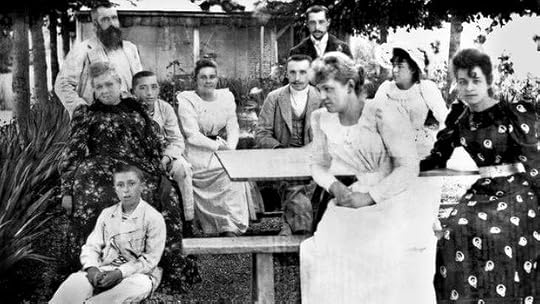
The Monet and Hoschedé families in 1880
The photo above shows several of the people we will meet in the novel twenty years later. The two standing figures are Claude Monet (left) and his son Michel. Alice Hoschedé is seated directly in front of the painter, with her youngest son, Jean-Pierre (possibly fathered by Monet) on the ground at her knees. The other women are all her daughters. Blanche (seated behind the table) married Monet's elder son Jean, who is next to her. By the time the book opens, Marthe (in front, wearing white) will have become the family's de facto housekeeper; Gabrielle (behind) will just have received a proposal of marriage; and Suzanne, the stunner in the patterned dress, has been dead for a year.
At first I could not understand why the publishers chose an 1886 painting of Suzanne, Woman with a Parasol, for the cover of a novel set in 1900. But I reproduce it myself at the head of this review, for although Suzanne never appears, her presence and spirit fills the entire book. Claude Monet remembers her with joy. Her mother Alice still mourns for her, falling into a deep depression. Jimmy and Lily, her two young children with her American husband, the painter Theodore Earl Butler, now live with their grandparents and are looked after by their aunt Marthe. And Figes uses Lily's viewpoint especially as a fresh counterpoint to those of the older characters, bringing her own kind of light whenever she appears:
Lily picked up a single petal, stroked its soft pink skin now brown at the edge, and tried blowing it into the air. It dropped on her pinafore, so she picked up a handful and tossed the whole lot into the air. She watched them fall slowly, flutter, catching the slanting light. Everything smelled fresh and damp now, as though the sun, where it came through the trees, was still cool and distant. She found beads of water caught in a curl of leaf, hanging from the tips of fern, cupped in a flower. But it was in a damp corner behind a heap of drying dead flowers and cut grass that she found the most astonishing sight of all, a cobweb strung between two posts, she hardly dared breathe for fear of disturbing it, a thousand drops of water gleaming in the tension of its fragile hold.Besides the gardener, cook, and housemaid, there are two non-family figures who may require explanation. One is the Abbé Anatole Toussaint, the parish priest, a charming character who serves as a consoler for Alice, the only ardent churchgoer among them, but also as a pleasantly non-judgmental moral reference for Claude. The other is Octave Mirbeau, journalist, art critic, salon cynic, neighbor—and fellow gardener. Monet delights in taking him on a tour of the gardens, showing him the orchids in his hothouse and the latest improvements to his beloved lily pond.

The gardens at Giverny today.
3. Painting.
He studied the surface of the water, following the lily pads arranged like islands, an archipelago, seduced by the apparently random pattern until it was caught in the encircling clasp of the bridge, held there, like the belt round the curve of a woman's middle, or my hands, touching. Ah, I have you, he thought, smiling, all of you trapped, earth, water and sky. You thought you could escape, now that I am getting old, that you could run away, now I am slowing down, too old to track you down across wild landscapes. You did not think I could seduce you by luring you into my own back yard.Although Monet would paint many other subjects, his studies of the lily pond he built at Giverny would occupy him for the last quarter-century of his life. Figes emphasizes that this was more than a pleasant place for him to live, but a deliberate attempt to provide himself with a subject for painting that he could follow, at different times of day, and in minute variations, for years to come. She takes you with the sixty-year-old painter as he goes out in search of the pre-dawn light, puts the canvas aside as sunrise shifts the colors, takes another to capture the new effect, works for half an hour, moves on. "Monet is nothing but an eye," said Cézanne, "but my God, what an eye!" By describing everything in minute detail, Figes has us see with Monet's eyes, and amazes us with his refusal to paint anything he does not presently see through those eyes, even the memory of something he saw mere minutes ago.
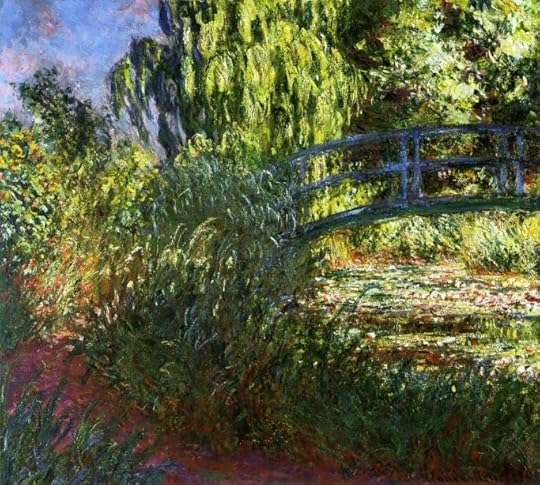
Lily Pond and Path by the Water, 1900
Figes chose to set her novella in 1900, no doubt because the few family events that give the book its plot—the death of Suzanne, a couple of impending marriages—center comfortably around that year. But it does not quite fit with what she tells us of Monet's painting. If you look at a chronological survey of his art (you can find one here), you will see that all the Giverny paintings from 1900 are richly impastoed and crammed with detail, such as the lily pond picture above. But Figes gives the painter a different vision, which he expresses in different ways several times in the short book:
Almost square, a total balance between water and sky. In still water all things are still. Cool colours only, blue fading to mist grey, smooth now, things smudging, trees fading into sky, melting in water. No dense strokes now, bright light playing off the surface of things, small, playful. I have broken through the envelope, the opaque surface of things. Odd that it should have taken so long to reach this point, knowing it, as I did, to be my element. I was blinded, dazzled by the rush of things moving, running tides, spray caught in sunlight. Looking at, not through. The bright skin of things, the shimmering envelope. But now, before the sunrise, no bright yellow to come between me and it, I look through the cool bluegrey surface to the thing itself.Later, she says, "He has to look through things now, since nothing is solid, to show how light and those things it illumines are both transubstantial, both tenuous." This idea of breaking through the envelope, of light and the things it illuminates being equally ethereal, is I think a true insight. So what does it matter that it does not describe the paintings of 1900, but the long series he began only a few years later? In Figes' tribute, her words become one with Monet's light, sharing the same miraculous dissolution of substance.
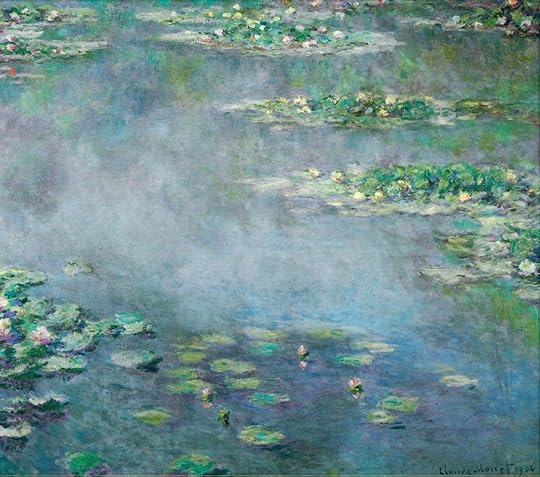
Water Lilies, 1905

October 20, 2016
2.5 Stars
This book didn't do much for me but there some moments of lovely writing - particularly those scenes describing Giverny. The back of this book says it's a novel - it is most definitely not. It's less than 150 pages and anyone who looks at it can tell it's not a novel. It's a day-in-the-life at Giverny with Monet and Company. Overall nothing really happens and is quite dull but I suppose all of our daily lives, if we read them written down, would read quite dull as well. It's a quick read and the cover is lovely but it really didn't do much for me.
You could probably zip through this in one good sitting and be none the worse for it.
This book didn't do much for me but there some moments of lovely writing - particularly those scenes describing Giverny. The back of this book says it's a novel - it is most definitely not. It's less than 150 pages and anyone who looks at it can tell it's not a novel. It's a day-in-the-life at Giverny with Monet and Company. Overall nothing really happens and is quite dull but I suppose all of our daily lives, if we read them written down, would read quite dull as well. It's a quick read and the cover is lovely but it really didn't do much for me.
You could probably zip through this in one good sitting and be none the worse for it.

January 1, 2022
A gorgeous little book. A day in the life of Monet and family and associates — their thoughts, their surroundings. Not much happens, but so much happens. (A personal highlight: a lunch scene where Octave Mirabeau makes an appearance and bonds with a holy man over a shared passion for botany!) And the prose… well, for example:
“Shadows lengthened across the garden, creeping up on glowing patches of color still in sunlight. They fell slanting from pergolas and pyramids across gravel paths and flowerbeds, gathered under shrubs and began to spill slowly. Trees now engulfed portions of the garden in mysterious pools of shadow where dark stirred on dark, liquid indigo moving on colors of leaf shadow to form darker hues and shades.”
(p. 86)
Stunning. This is one of those books I was genuinely sad to finish. I could have lived in that world, that language, for hundreds of pages. But alas, Figes was a master of restraint and so all we have are these 121 essentially perfect pages.
My final book of 2021, and what a way to go out. Light is a stunningly beautiful short novel and Figes is a forgotten master of the form. Poetic, vivid, emotional, understated, absolutely brilliant.
Highly recommended.
“Shadows lengthened across the garden, creeping up on glowing patches of color still in sunlight. They fell slanting from pergolas and pyramids across gravel paths and flowerbeds, gathered under shrubs and began to spill slowly. Trees now engulfed portions of the garden in mysterious pools of shadow where dark stirred on dark, liquid indigo moving on colors of leaf shadow to form darker hues and shades.”
(p. 86)
Stunning. This is one of those books I was genuinely sad to finish. I could have lived in that world, that language, for hundreds of pages. But alas, Figes was a master of restraint and so all we have are these 121 essentially perfect pages.
My final book of 2021, and what a way to go out. Light is a stunningly beautiful short novel and Figes is a forgotten master of the form. Poetic, vivid, emotional, understated, absolutely brilliant.
Highly recommended.
August 24, 2019
Hele goede beschrijvingen over hoe het licht veranderd gedurende de dag in de tuin van de schilder monet. En beschrijving van zijn gezin op die dag.
Alleen zoek ik meer in een boek en heb ik het geduld niet voor langdurige beschrijvingen van landschap en licht. Ben meer van het verhaal
Alleen zoek ik meer in een boek en heb ik het geduld niet voor langdurige beschrijvingen van landschap en licht. Ben meer van het verhaal

November 17, 2024
I read this as part of my casual ongoing project to read books from my birth year. This was recently reissued and I can see why it is considered a lost classic and was much admired by Figes’ fellow authors. A circadian novel, it presents Claude Monet and his circle of family, friends and servants at home in Giverny. The perspective shifts nimbly between characters and the prose is appropriately painterly: “The water lilies had begun to open, layer upon layer of petals folded back to the sky, revealing a variety of colour. The shadow of the willow lost depth as the sun began to climb, light filtering through a forest of long green fingers. A small white cloud, the first to be seen on this particular morning, drifted across the sky above the lily pond”. There are also neat little hints about the march of time: “‘Telephone poles are ruining my landscapes,’ grumbled Claude”. But this story takes plotlessness to a whole new level, and I lost patience far before the end, despite the low page count, and so skimmed half or more. If you are a lover of lyrical writing and can tolerate stasis, it may well be your cup of tea.
Originally published on my blog, Bookish Beck.
Originally published on my blog, Bookish Beck.

December 8, 2015
This book takes place over the course of one day. The author strains to draw pictures with words. It's almost as if she put a series of Monet's paintings in front of her and proceeded to write about them. "Almost square, a total balance between water and sky. In still water all things are still. Cool colours only, blue fading to mist grey, smooth now, things smudging, trees fading into sky, melting water."
There was a lot of that.
We experience this day - its light, its small trials and large griefs - through the viewpoints of Monet, his wife, his neighbor, his gardener, his local priest, his son, his step-daughters, his grandchildren. It's quite a large cast of characters for such a small book. Art, politics, religion and the wonders of a red balloon are thrown at us. There is no ending, except night and a brief coda. There is no story except for the inconsequential events of a summer day. Apparently, that was enough for Eva Figes. It is not enough for me. It was a struggle to get through the minutiae of the day.
There was a lot of that.
We experience this day - its light, its small trials and large griefs - through the viewpoints of Monet, his wife, his neighbor, his gardener, his local priest, his son, his step-daughters, his grandchildren. It's quite a large cast of characters for such a small book. Art, politics, religion and the wonders of a red balloon are thrown at us. There is no ending, except night and a brief coda. There is no story except for the inconsequential events of a summer day. Apparently, that was enough for Eva Figes. It is not enough for me. It was a struggle to get through the minutiae of the day.

November 15, 2021
" He had been wrong to think of light as a veil, playful and shimmering, between him and solid things. That was how a young man saw things, in midsummer, and at midday. But now, especially in the early morning and in the evening, he saw it for the illusion it was. He had to look through things now, since nothing is solid, to show how light and those things it illumines are both transubstantial, both tenuous."
 Eva Figes, 1932 — 2012
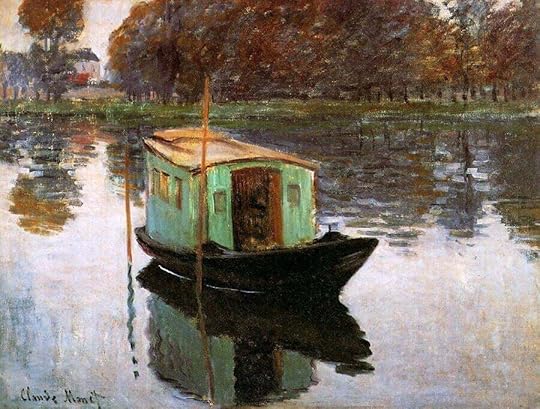 The Studio Boat (Le Bateau-atelier) by Claude Monet,1876
Originally published in 1983, " Light " is but a singular plot, yet with multiple stories, and tours the gardens and the household routines of French Impressionist Claude Monet. Here, the reader travels this physical journey with family members, guests, and domestic staff, via a single, warm, summer day; from the first light of dawn, to its rose and gold sunset, it engages each characters emotional peregrination during the course of that day; all within in the light and shadow of the famous French painter. Dialogue is minimal, and thus subordinated to the changing lush descriptions of the surrounding landscape, and supporting the players it envelopes; complementing and focusing on their mood, and continually changing in that application of light.
There is both melancholy and joy in the stories presented; the simple delights of the very young, the deep mourning and despair of the very old; the enthusiasm of anticipated travel, and the consolation of remaining stable and static; the regret in past choices and the hope found in future consequence. And in them all, the play of light: creating bright luminosity for joy, and deep shadow in pain, bold color from some obtuse fixture, or dynamic movement from a still lifelessness, and even in the humble honest reflection in the still waters of patience.
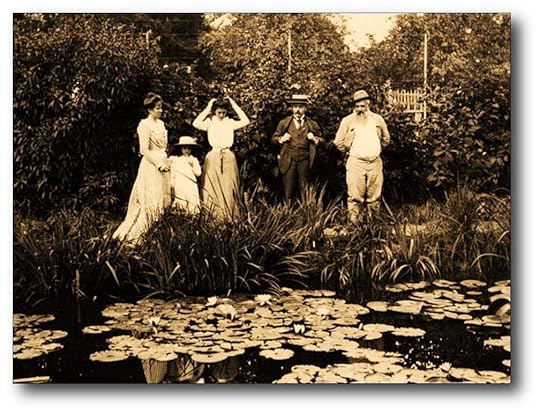 Germaine, Lili, (far left) & Claude Monet at Giverny. (1900)
As a note of personal preference, I truly enjoyed time spent reading Light: With Monet at Giverny , and thus give it my highest rating. It touches on a subject, a time in history, a notable character, and a narrative well presented in both style and form. It took me where I wanted to go. I also appreciate this novella as much for what it isn’t —a vacuous pop-culture ventilation— as for what it truly is: another form of impressionistic art; immediate, yet delivered slower in tempo, crafted softer in timbre, and bathed in a motif that is a gradual, simple, undulating projection on life itself; all prompted, adjured, teased, comforted, revealed and ultimately enhanced by an ever-present, life embracing, ambient glow.
Light: with Monet at Giverny.
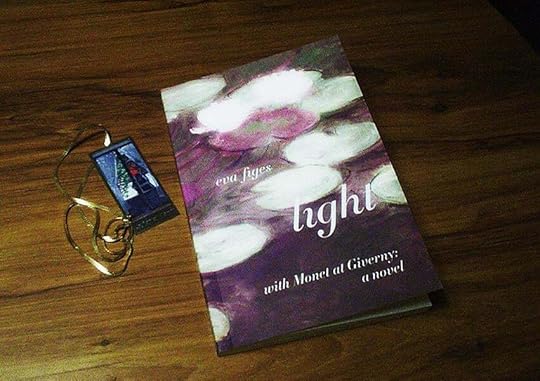
Eva Figes, 1932 — 2012 The Impressionist painting, in its most fundamental aspect, is simplicity of subject, immediacy in brush stroke, and dedicated attention to angle, intensity, and the cohesive quality of light. It's uncommon art, created by an uncommon artist, and in her novel, Light: With Monet at Giverny, English author Eva Figes also creates a similar brevity, an impressionistic sense of immediacy, and the repetition of a vital cohesive quality in an evocative and picturesque narrative. Her motif, is light.
" . . . light had begun to touch the trees, which broke into a thousand surfaces, leaves & branches throwing off light and colour. He could not look at his canvas now, because of what was happening on the river . . . Everything was always in flux, he thought, noticing a dark reddish hue close to the banks where the high trees overshadowed the water. It was both his overriding difficulty, and essential to him."
The Studio Boat (Le Bateau-atelier) by Claude Monet,1876 Originally published in 1983, " Light " is but a singular plot, yet with multiple stories, and tours the gardens and the household routines of French Impressionist Claude Monet. Here, the reader travels this physical journey with family members, guests, and domestic staff, via a single, warm, summer day; from the first light of dawn, to its rose and gold sunset, it engages each characters emotional peregrination during the course of that day; all within in the light and shadow of the famous French painter. Dialogue is minimal, and thus subordinated to the changing lush descriptions of the surrounding landscape, and supporting the players it envelopes; complementing and focusing on their mood, and continually changing in that application of light.
There is both melancholy and joy in the stories presented; the simple delights of the very young, the deep mourning and despair of the very old; the enthusiasm of anticipated travel, and the consolation of remaining stable and static; the regret in past choices and the hope found in future consequence. And in them all, the play of light: creating bright luminosity for joy, and deep shadow in pain, bold color from some obtuse fixture, or dynamic movement from a still lifelessness, and even in the humble honest reflection in the still waters of patience.
"It was not unlike what he could see for himself: each day light playing, defining, and transforming what would otherwise be merely grey amorphous matter, whether leaf, water, or rock. As with each new dawn the miracle of creation was recreated with the coming of first light."
Germaine, Lili, (far left) & Claude Monet at Giverny. (1900) As a note of personal preference, I truly enjoyed time spent reading Light: With Monet at Giverny , and thus give it my highest rating. It touches on a subject, a time in history, a notable character, and a narrative well presented in both style and form. It took me where I wanted to go. I also appreciate this novella as much for what it isn’t —a vacuous pop-culture ventilation— as for what it truly is: another form of impressionistic art; immediate, yet delivered slower in tempo, crafted softer in timbre, and bathed in a motif that is a gradual, simple, undulating projection on life itself; all prompted, adjured, teased, comforted, revealed and ultimately enhanced by an ever-present, life embracing, ambient glow.
Light: with Monet at Giverny.
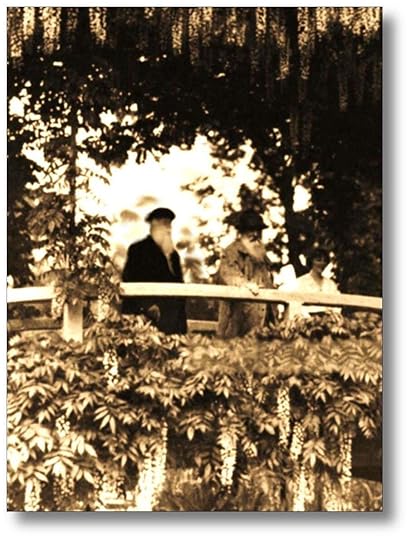
"Claude had stopped at the high point of the wooden arc. He always did. When guests were taken on a tour of the garden they lingered longest here . . . the two men rested their hands on the rail & stood for a while looking down at the water, their own reflections almost immersed in the darker reflection cast by the bridge itself , so that only their heads were outlined in the light of shining water."
Thank you Hannah

August 7, 2025
This is so much more than the ‘day in Monet’s garden’ jt is sold as (though that element is masterfully lovely): we actually flit between the family members around the painting too, and Figes weaves these strands into a shimmering snapshot of life on this day in 1900. She’s very interested in inner lives, and a portrait of each character emerges via their own noticings — what they light on, shaded by their state of mind.
I came for descriptions of light and these were my favourite parts. And not just through Monet painting — though these passages are so rich and evocative.
Figes is very good at forcing you to pause, linger, consider. I sat and reread many passages in real time.
I came for descriptions of light and these were my favourite parts. And not just through Monet painting — though these passages are so rich and evocative.
Figes is very good at forcing you to pause, linger, consider. I sat and reread many passages in real time.

October 10, 2025
Terminado de leer en la madrugada. miren que me gustan las cosas bonitas y las novelas un tanto pulcras, pero creo que he cambiado y quizá ya no me gustan tanto. Un poco demasiado edulcorado para mi gusto, pero no es un mal libro.

February 26, 2026
This is obviously a very Beautiful and Good Book- but i just didn’t like it very much!!!
so descriptive I think I stopped paying attention
I really like reading about painting but this just didn’t feel true or relatable, sort of like a fantasy idea of what it means to paint
also- why do we have to call Marthe fat and “stout” all the time?
so descriptive I think I stopped paying attention
I really like reading about painting but this just didn’t feel true or relatable, sort of like a fantasy idea of what it means to paint
also- why do we have to call Marthe fat and “stout” all the time?

October 3, 2025
Beautiful little book describing a day in the life of the Monet family, but focusing mainly on the garden and how the light changes it throughout the day. The writing was stunning.

January 17, 2026
“vivimos en una nube de luz en continua transformación, una especie de envoltura. eso es lo que yo intento atrapar.”
una delicadeza de libro. lo he disfrutado mucho :)
una delicadeza de libro. lo he disfrutado mucho :)
September 8, 2025
While reading Light, I kept thinking back to Michael Ondaatje's superb poem, Light, whereupon he recollects and flashes back upon time, family, generations, memory.
Where Ondaatje immerses us in a midsummer night lightning storm, Figes guides us through the prismatic passage of daylight as it reveals and reflects across lives and landscapes.
In Light, Figes shifts perspectives - artist, gardener, parent, grandchild, friends - just as the landscape changes moment by moment during the passing of minutes and hours. Grief, joy, expectation, worry, wonder - all reflected through multiple viewpoints.
A short novel, but one to be enjoyed slowly.
Where Ondaatje immerses us in a midsummer night lightning storm, Figes guides us through the prismatic passage of daylight as it reveals and reflects across lives and landscapes.
In Light, Figes shifts perspectives - artist, gardener, parent, grandchild, friends - just as the landscape changes moment by moment during the passing of minutes and hours. Grief, joy, expectation, worry, wonder - all reflected through multiple viewpoints.
A short novel, but one to be enjoyed slowly.

September 17, 2014
In brief summary: It's a series of moments—sense impressions, really—with metaphorical significance. A strong feminist thread runs throughout. Occasionally, it did hit that perfect note. (Monet's wife Alice was written quite well.) But, overall, this fell a bit flat in my opinion. I liked it better the first time I read it when it was called To the Lighthouse. *drops the mic*

Read
April 25, 2025I’m not going to rate this, since I honestly have no clue what the purpose of this story is, but the imagery and descriptions of nature and color were stunning, and I was sufficiently engaged throughout. We follow Claude Monet and his family through a singular day, and although I did find Marthe’s perspective interesting, I kept finding myself waiting to return to Claude, so we could see the world through his artistic eyes.
Read
September 14, 2025In places a mesmerising read, controlled observations, the garden's subdued metaphors, the lillies opening into flower. The garden life, his creation, a living vision, time, in places carries on unaware of its limitations, an hour?, a day, a summer?.
Think my library has a few more by Figes which I'll have to sample again.
Think my library has a few more by Figes which I'll have to sample again.

May 31, 2022
Once the racism and antisemitism started to sneak in, I just couldn’t care about the pretty writing anymore.
June 13, 2024
Oh my god……ate, licked the plate, wiped crumbs off the table…..as close as it gets to perfect
April 11, 2025
Reads like a Monet painting/ Figes does her painting with words.

July 26, 2025
reads like a painting of monet, beautifully poetic, emotional and captivating

February 28, 2026
Stunning. It taught me new ways of seeing the world

April 1, 2026
He passat un dia a casa Claude Monet!! Llibre súper immersiu 🌺🌼🌸🌷🌻

February 19, 2025
Read it while waiting for my concert to start and was done 10 min before it started. Perfect! Quite liked the actual book as well.

May 22, 2020
I can't express how exquisite this book is. Susan Hill describes it as 'A small masterpiece'. I agree.
One day in the life of Monet and his family at Giverny, beautifully observed. It tracks the changes in the light throughout the day and the small changes that occur for the family. It shows a respect for Monet and his work but doesn't make him into a god.
At times this reminded me of Virginia Woolf's To The Lighthouse. Figes observes in detail the passing of time. However, Light is uplifting and almost relaxing. There is tension and some darkness but overall it is elevating and inspiring. Not to be cliched, but it is full of light.
One day in the life of Monet and his family at Giverny, beautifully observed. It tracks the changes in the light throughout the day and the small changes that occur for the family. It shows a respect for Monet and his work but doesn't make him into a god.
At times this reminded me of Virginia Woolf's To The Lighthouse. Figes observes in detail the passing of time. However, Light is uplifting and almost relaxing. There is tension and some darkness but overall it is elevating and inspiring. Not to be cliched, but it is full of light.

August 5, 2013
I really enjoyed reading a novel that replaced "action" with the flowing, tremulous, ever-changing journey of light: across the land around Giverny, across (and reflecting) the lives of the central characters of Claude Monet and his family. The writing was deft and poetic, and I reveled in the dreamy sadness of the novella. Light was a character as well as key element in this work, and this made it an unusual and refreshing reading experience for me.

October 12, 2008
To the credits on the back cover, "A luminous prose poem" and "A small masterpiece" I can only add "An exquisite haiku". This beautiful novella describes one day in the life of Claude Monet, his family and his friends. I have visited Giverney and now, thanks to Eva Figes, I can almost imagine they were there. "Was it yesterday, or a century ago?".

March 3, 2012
I read this in conjunction with the Humanities class at work. If it is possible it reads like a Monet painting. It is a stream of consciousness novel about a day in the life of Monet at Giverny. The language is stunning. If you close your eyes you can picture his paintings. What a gift to be able to write like that!
Displaying 1 - 30 of 83 reviews