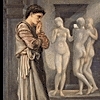
A great house. A family dispossessed. A sensitive young man. A powerful landowner. An epic love that springs up between two men. Set in the post-Napoleonic years of the 1820's, Standish is a tale of two men - one man discovering his sexuality and the other struggling to overcome his traumatic past. Ambrose Standish, a studious and fragile young man, has dreams of regaining the great house his grandfather lost in a card game. When Rafe Goshawk returns from the continent to claim the estate, their meeting sets them on a path of desire and betrayal which threatens to tear both of their worlds apart. Painting a picture of homosexuality in Georgian England, Standish is a love story of how the decisions of two men affect their journey through Europe and through life.
Born in Essex, England in 1959, Erastes attended Southend High School for Girls.
Erastes is the penname of a female author who lives in Norfolk, UK. She drew her inspiration to write historical fiction from works such as Gaywyck by Vincent Virga and the novels of Mary Renault. Erastes was the Director of the Erotic Authors Association for two years and is an active member of the Historical Novel Society. She is the moderator of Speak Its Name, an influential blog dedicated to gay historical fiction.
Erastes has been writing since 2003, and details of all her books and short stories can be found on her website.
Her second novel, "Transgressions," was one of the flagship releases by Running Press in their M/M Historical Romance line which is being marketed directly at the existing romance market and was shortlisted for a Lambda award in 2010.
Her releases for 2011 are: Mere Mortals - Lethe Press in April Muffled Drum - Carina Press in July Junction X - Cheyenne Press in November
Erastes is represented by The Schiavone Literary Agency, Inc.
Bibilography
Novels/Novellas
Mere Mortals - to be published by Lethe Press in March 2011 Muffled Drum - to be published by Carina Press in July 2011 Tributary - published in Last Gasp by Noble Romance Publishing (novella) Transgressions - published by Perseus Books (novel) Frost Fair - published by Cheyenne Publishing(novella) Hard & Fast - published in "Speak Its Name" by Cheyenne Publishing (novella) Chiaroscuro - published in "Night Moves" by Aspen Mountain Press December 2007 (novella) Standish - published by PD Publishing November 2006 (novel)
Short Stories
Right Hand Man - published in Unmasked II, more erotic tales of gay superheroes by STARbooks. Whatever the Risk - published in the Queer Dimensions anthology by Queered Fiction The Snow Queen - published in the I DO anthology by MLR Press If you can't stand the Heat - to be published by Cleis press Drug Colours - published by Lethe Press in "Best Gay Short Stories" Show Don't Tell - published in MEN Magazine March 2008 Fire & Ice - published by Cleis Press in their Erotic Alphabet series "J is for Jealousy" Lifeline - published in Alyson Book's "Cruising" anthology Drug Colours - published in Cleis Press's "Where the Boys are: Urban Gay Migrations" Anthology Ribinks - published by The Drabbler The Bird - published in Alyson's "Fast Balls" Baseball Anthology Matelotage - published in Alyson's "Treasure Trails" Pirate Anthology Lucky - published in "Love in a Lock up" by Starbooks In the Dark - published in "Ultimate Gay Erotica 2007" by Alyson Books Ten Kisses - published in "Connections" by Iris Print My Best Customer - published in "Travelrotica" by Alyson Books Petard - published by Clean Sheets His Story Teller - runner up in Torquere Press' "Do it yourself" competition Bright Souls - published by Alyson Books in Ultimate Gay Erotica 2005 Sin of the Tongue - published by Torquere Press Lifeline - published by Torquere Press Bright Souls published by Torquere Press
Audio – 1 star Story – 1.5 star round up because I liked the writing
This story reminded me of the old time historical romance novels I used to read where it was all about the drama and angst. Don’t get me wrong, I’ve come to appreciate a nice angsty story these days, but not when it overshadows the romance to the point that the story becomes more depressing and/or frustrating than heartfelt. I need to care about the characters and root for their relationship. In this case, I didn’t. I reached a point where I was just listening to find out what would happen next. With soooo much going on in the story (lots of characters and their povs), I was curious to find out how it would all pan out within the short 257 pages. It was a soap opera of events.
And, worst of all for me, a lengthy separation between the MCs that led to a very dissatisfying ending. I know I stopped caring at some point, but still, after all the craziness, I felt a better ending was warranted. It was the ending that had me changing my score from 2.5 round up to 3 to a 1.5 round up to 2.
What can I say... I love it. And hate it. Standish is a book that once you start reading it, you can put it down, but it's also a book not easy to love. It's dark, hard, absolutely not about handsome men in frilly dresses who fall in love and easily walk together toward the sunset.
I love Standish (the book) because Erastes makes me feel the emotions of Rafe, the main characters, and the joy of Ambrose, his lover.
I hate Standish cause Erastes describes the real world, where the true love is never simple, and where an happily ever after is not so common.
You want the perfect hero, dark, tortured but always on the right side of things? Then don't read Standish. Rafe is everything but perfect. Is a man led by the passion, and sometimes the passion guides him to the wrong path. And Ambrose, the other hero, is sometimes fragile, sometimes strong, but always human. And like everyone he wants love, and like everyone it would not be simple for him to reach it, and maybe love will be where he is not searching.
Ambrose and Rafe see each other like Ganymede and Zeus. Ganymede, the guy who, with his beauty, stole the role of God's cupbearer to Ebe. Ganymede served ambrosia to Zeus, so also the name of Ambrose recall this legend. He is the object and nourishment of the love of Rafe. In a romance perfect world Rafe must save Ambrose from every trouble and perilious... in the real world we have the tragedy, but also the love that forgives anything.
When I'm happy I want the laugh, when I'm sad I want to cry... Standish stays in between. And let me say: it's not a romance, if we consider the normal level of the romance. But it's a beautiful romance, when we consider that in this category we can put some very lost pearl.
So thanks to Erastes for this book, I will put it in my bookshelf, but think I will take it often.
What a story! This is harrowing love story between the young scholar Ambrose Standish and the wealthy Rafe Goshawk. Erastes describes in great detail setting of ninteenth century England, their saga travels from the affluence of the centerpiece of the story, the English country house Standish, to the other end of the specturum and awful conditions one of the MC's had to survive in England. Not your typical love story, and so heartbreaking through much of the book. This relationship between two men who deply love each other but their lack of communication, jealousy, betrayal, and secrets are their downfall. The effects and how individually they survive and what kind of person they become. I did have a few issues with the story, one charater in particular as well as their motives, additionally I had some problems with actions of one of the MC's. This was not an easy read, hard to put down, and kept me thinking.
Erastes. Oh, Erastes. You’ve done it again, reduced me to a sniveling, sobbing mess; for all my apathy towards people and sometimes slightly sociopathic tendencies—you’ve rendered me a wreck.
I loved this book so much i can’t even begin to describe how much it touched me. There were many instances when i had to put it down, wipe away the tears and look around me, remind myself that I’m not Rafe nor Ambrose and I’m not a late 19th century sodomite. My heart broke with everything these two went through. I had a strong urge to jump through the pages and time and realities and grab Ambrose, bring him back with me, and take care of him like i would a precious first born baby. I’ve never known myself to have such violent thoughts before this book, the horrible things i wanted to inflict on everyone who so much as looked wrong in Ambrose’s direction were staggering.
I love Ambrose so much I’m probably mainly sobbing from relief that he doesn’t actually exist and hadn’t had actually been through those abysmal horrors. And the thought that people were hanged in England for daring to love not even a century ago is killing me.
And Rafe. Oh, Rafe Rafe Rafe Rafe Rafe i hated him so much my hate is only paralleled by my love for him. I felt everything that fucker felt and pitied and sympathized with him more than Ambrose because he’s so human. So unapologetically human, so awful and..Oh, God. He’s so complex i can never do him justice with my inadequate descriptions. And i can never forgive him for what he’s done but i love him and would take him back ALWAYS.
This book ruined me. Its no light read. If you’re looking for an emotional roller coaster/ground-breaking/woefully and acutely painful read then this is the one for you. If you’ve done some wrong and feel contrite and in need of a penance then look no more.
Sometimes, I like a book that makes me go "what the heck did I just read", but that's not the case here.
It's full of flowery purple prose and typical romance novel cliches, but Yet it doesn't read as a drama or a tragedy either. It's full of angst, but in ways that only served to make me raise an eyebrow rather than feel for the characters. The characters, by the way, are either inconsistent or completely flat, and sometimes non-sequiturish, appearing, doing bizarre things for no clear reason, then making themselves scarce. (Yes, Italian sex-fiend, I'm looking at you in particular, but not just you.)
But the worst thing about this whole mess of a book, is that it's usually not quite bad enough to give up on entirely, and consequently I ended up suffering through all of it, only to figure at the end that yes, it was actually bad enough to give up on, but now it's too late to unread it.
The one thing I can say for this book is that it kept me reading it to the last page. However, I wasn't satisfied by the end and tossed it down in a bit of a huff.
I was trepidatious when I decided to read this book due to it being a historical. I always find that these stories can only end with a happy-for-now ending unless they fudge history a bit. Or are extremely clever. When Standish opens on the quintessential historical romance set-up and characters, I was relieved. I was going to be just fine with a fudged history. Not to say that Erastes didn't do a bang-up job of capturing the feeling and setting of the time. That was very nicely done, I thought. I assumed, though, that we were going to trip through the time period's land mines on a cloud of fuzzy romance, which I was fine with.
I was good for the first fifty pages. And then, quite suddenly, both main characters did a complete 180 in their personality. It didn't feel right. I began to roll my eyes and sigh with all the flowery words of devotion pouring out of the characters' mouths instead of the cutting wit they had previously been trading. It became too sappy for my tastes, but I stuck with it. Just when I thought I had had enough, the author tossed in a neat turn. The author does this several times throughout the book. But in the end, I couldn't help but feel as if it had just been more of a pitchman's shout of "But wait!"
I was dissatisfied with the characters, losing any sort of emotional involvement I had in Rafe early on when he behaved callously to a character that did not deserve it nor was his reaction expected after all of Rafe's flowery memories of him. I did not like the resolution of several of the characters. There seemed to be a convoluted moral there that did not come across. And I was completely dissatisfied with another personality change in the main characters just before the overly dramatic ending.
Ambrose's character was the most stable and the most likable in the book. He stuck to his beliefs until just before the end. The writing style was different, a bit loose, with varying POVs that flowed throughout each other. I wasn't sure about it, at first, but it wasn't awful. The setting and the time period were portrayed well, if a bit fuzzy in some places. The fuzziness I forgave for the most part, mainly because the facts were good, even when the characters' behavior seemed to ignore those facts. I also forgave the typos, though due only to not having paid for the book. I borrowed it.
This was my first book by Erastes and I may try another. But I can't say Standish was my cup of tea.
I was surprised by this book. I wasn't sure how I'd feel about it going in, but I ended up liking it a lot more than I expected myself to. This book would rate a higher three but not quite a four. It has romance in it, but I wouldn't necessarily call it that. To anyone considering picking the book up -- be aware that there is infidelity.
There are only two things that I really didn't like about the book, but they play a huge part in the book so that's why my rating isn't as high as it would've otherwise been.
Infidelity is something that I really hate in books, especially when there's a stupid or ridiculous reason for it. I could kind of understand Rafe's reason behind his unfaithfulness, but I never found myself forgiving him for it enough that I felt him and Ambrose should be together. Rafe was the one who kept seeking out Alvisi, knowing what he was doing was wrong. I was absolutely livid that he cheated--like, full-on he-fucked-him-cheated--on Ambrose the very first time that he ventured out of their home post-rape. Thanks to Alivis's machinations, Ambrose finds them together later, but I thought it was so much worse that Rafe cheated on him while they were actually out together. I was just...how could he do that?? Ambrose got raped because Francis was jealous because he was Rafe's new lover. He couldn't even just concentrate on Ambrose for their outing? Instead, as soon as Ambrose disappears from his view, he decides it's a great time to go cheat on him.
I was glad that Ambrose had a backbone and left. I was a little wary of Fleury and then pleasantly surprised by him. I think he was my favourite character in the whole novel and I hated that .
The other thing that was a damper for me, and prevented me from , was Rafe's continued association with Alvisi. I hated that he stayed with him--for weeks, if not months--after Ambrose left. Like...what are you doing, buddy?? I don't think I would've hated it so much if he'd found a new lover...it just drove me insane that he stayed with him.
It also pissed me off that Rafe was trying to equate his suffering to Ambrose's in the end.
"I am well aware of what I put you through, Ambrose. Do you think that whatever you have suffered, I have not?"
Bitch, please. How about no. Rafe's suffering was in a hell of his own making. He didn't have to seek out Alivis every single night to slake his lust instead of staying with Ambrose, who was mentally recovering after having been raped by Francis, an ex-lover of Rafe's, out of jealousy. He didn't have to continue to fuck Alivis after Ambrose leaves him upon discovering his betrayal. He didn't have to write those letters to assuage his own guilt and send copies of them all over the place, letters which ultimately led to Ambrose being jailed.
Sorry, but no...Rafe's suffering was not on par with Ambrose's and it pissed me off so much that he tried to liken them.
Honestly, ending-wise, I'm just going to go ahead and choose to believe that
That was one scary book and I loved it! So much angst, hate, violence and betrayal. So much love to go with it, too. I will be reading this one again pretty soon. Thanks for the rec, Sandra.
I always love a book that makes me feel a whole spectrum of emotions and this novel did all that and more. This would be my fourth book of Erastes and she didn't fail to deliver a quality historical romance of high caliber.
Fair warning to my fellow readers who don't want to read about cheating, rape, child abuse and graphic elements because this will be a very unpleasant experience if you're not inclined to read such scenes. Having said that, I feel that without these painful elements, it would not have made the strong impact that it did, which I am sure, will haunt me for the next few days.
This book is so rich in detail that it (had the author been so inclined) could have been divided into several spin-offs. However, the author's integrity to weave one solid story made me admire her all the more. The relationship development was spot on and the back story of each secondary character was so well crafted that it made me love both antagonists and protagonists alike.
Through out the book, I have loved, hated, cried and laughed at Rafe and Ambrose. Their unfailing faults, destructive tendencies, and sporadic bouts of stupidity rattled me to the core but eventually made me fall in love with them over and over again because it showed the painful reality of human weakness. There were pet peeves of mine that were present in the book like the lack of communication between the two but what made up for all of that was the unpredictability of the plot. Just when I thought I had it all figured out, I was proven wrong more than once. I tell you, it is so AWSOME to have that element in ANY book. Just goes to show how gifted the author is.
And if that wasn't enough, man oh man, the dialogue was so freaking romantic it (honest to God) gave me goose bumps!
“Rafe, you once gave your heart into my keeping, and I have kept it with me through every hour since our parting, even if I did not know that it was there. Now, either claim it back, or take mine in return,” he choked. “For without you writing the story of my life, I have no need of it.”
*sniff*
Okay, I have to stop gushing and read my next Erastes book now ^_^
This book is a good read if you are in the mood for an intense drama about love, sex and loss among a varied collection of gay men in 1820’s England. The book is fast paced and engrossing with impressively well-defined characters.
The plot revolves around two men, one a naïve scholar named Ambrose and the other an emotionally damaged aristocrat named Rafe. While a love affair is at the heart of this story, it is not really a romance novel; the plot is much darker and complex. The protagonists are flawed and surprisingly self-destructive, but are still redeeming nonetheless. Many parts of the book are tender (and downright sexy), but much of it is stark and even blatantly disturbing. The author incorporates several well-developed supporting players throughout the tale, making the book much more rich and satisfying than I anticipated.
Standish is not an easy read, but I found it to be a rewarding one. I normally don’t like historical dramas, but I liked this, so I highly recommend giving it a turn.
I loved this book up until a certain point. It was nice and romantic and sweet for the 1820's and then it was ruined for me. I hate cheating and when someone means more to you than your own life I do not believe you can or have the desire to cheat. I hated this book because of that reason. It could have been a wonderful book but it was just a horrible fact that it was ruined. I think some people may like this if they can get over the cheating but I could not. :)
This is a saga about the ins and outs, the ups and downs of forever love between Ambrose Standish & the Earl Rafe Goshawk. This tale has everything an epic story should have sweet romance, heartbreak, dueling, murder, trauma, thievery, prostitution, imprisonment, jealousy, lust, compassion, brutality, and finally love. I liked and disliked the MCs and even some of the minor characters. I enjoyed the intriguing premise and storytelling. However, there were also weak parts: the later scene with the menacing warden was weak; the scene between the highwayman and second antagonist also a bit contrived. Overall, a memorable tale.
SlashReaders: I went into this book hoping for a little more despite the main character being named Ambrose. The book failed utterly and completely. I admire the author's aspirations to draw historical gay romance back into the main stream of things but he's not going to do it like this.
The characters were flat, the story line was plausible but just not well pulled off. For instance in the thirty or so pages of the book. The main character and Rafe (the new master of Standish) more or less don't hit it off and Rafe is all about his unrequited lust for Ambrose. However in the span of ten to twenty pages we go from, 'I want to throw you down and rape the snot out of you but oh how shall I resist' to Ambrose seeing his first dick and feeling a little funny. To Rafe kisses him and there are no doubts Ambrose falls into the bed and goes, 'Oh I've loved you since I first saw you sort of crap.'
It's just so horribly unbelievable that it makes me want to scream. The book began to get a little more believable towards the end. Like the author rushed through all the stuff at the beginning so that he could get to what came later. However that's just not going to pull a book off. When we get to the second off when more characters start coming in, it gets a little but only marginally.
I think that the author just needed to slow down and take more time developing things. Because all of his side characters seem to come across the page so much better than his main characters. And I enjoyed Rafe's son but he seemed to be there was nothing but a shadow character a foil for certain events to take place or to hold Rafe back. The boy needed to become more of his own entity to make it work. Right now he's just a tool that's being used that could be left out completely.
So my advice on this book while it had potential and it has possibly it just tries to do too much in too short a span of time which makes it fall flat. So it's not worth the money or the time spent reading it. It's just an unsatisfying frustration (though granted, I read it in a couple of days.) Anyway yeah, the author could get somewhere but he needs to slow down a little.
Poised to hate the man whose father made off with the title to his ancestral home, the young Ambrose Standish gets in over his head when his loathing gives way to first love and naive passion. Rafe Goshawk, a rake of a man, comes to claim more than the prized estate. He wagers a secret bid to win and eventually possess Ambrose. Without a prayer of hope in resisting, Ambrose is overtaken by the wealthy and sophisticated Rafe, and by tragic circumstances that spin them wildly out of control. Set in Georgian England, Standish brilliantly delivers in the quite eloquent language of the era a story of love between two men, their tale built upon the innate peril of opposites joined and the grave threat of social prejudice against homosexuals.
Ambrose is set to be a delicious sacrificial lamb from the beginning, his innocence and humility glittering jewels in the eyes of a cad like Rafe. Ambrose's fall is inevitable. That foreshadowing drives the plot well, though the pace moves slowly in some places. Author Erastes still manages to sustain the expected sympathy for Ambrose, also revealing hidden heart-soreness in Rafe along the way. Unraveling the complex tangle of Rafe's feelings and Ambrose's insecurities Erastes shows how Rafe's wounds fuel his utter lack of self control, which precludes his ability to confide in Ambrose about his tormented past or to root honestly into their bond. Feeling sympathy for Rafe is unexpected though it is a significant facet of his character and nuance of their journey together. Factor in an unlikely foil to both Ambrose and Rafe, and Erastes creates tangible tension through the novel's end.
Despite it's familiar arrangement of romantic archetypes this story is no boy bodice ripper. No one begins defiantly pinned on his back only to end up clawing at buttocks and begging for more. There is no mixed intent in the hearts of these men. No, these characters are genuinely madly in love from beginning to end. Theirs is the lesson that abiding love does not conquer all, particularly in such a sexually stifling culture, where they are left to repeatedly assess how to move on.
Three stars is low for me, as something has to be truly awful to warrant only one or two. Standish is well written, deep, and utterly realistic in many of its themes. However, the "deep" nature of this book may actually be its down fall. It's a little TOO deep, to the point of being unrealistically neurotic. One would swear the characters had read too many pop-psychology books and were over-analyzing themselves, and this in a time frame BEFORE psychology.
What really killed it for me (and warranted the three stars) was the ending. I will not spoil it for you, but I will merely say that Erastes is a fantastic author with a very big problem writing endings. It is the same problem in Mere Mortals...and ending that builds up to promise and then just falls face first over a cliff, leaving the reader to wonder if pages are actually missing.
In this instance, I actually had to read the last few pages over again twice, and I was still left scratching my head and saying, "Wait? What happened? What does THAT mean?" Yeah. I can understand leaving the readers to fill in their own blanks in a epilogue sense, but it would be nice if the author could at least tell us which side of the street the damn blanks are on! =/
I see this a great deal in British literature in general, and especially when authors are attempting to create the aura of the old Gothic novels. They seem to think that tragedy equals depth, pain equals realism, vagueness equals sly artistry. It's doesn't. Stop it. A satisfying, happy ending is NOT a cop out or a childish popular balm. I feel like I'm reading misery for misery's sake. =(
First, I should say, that this rating is a purely emotional thing. Emotional in a good way, cause, though being not really well written, this book is like a depository of feelings.
Sometimes "Standish" shocked me, sometimes made me smile, sometimes I was enraged, sad, angry, furious, yes, thanks to this book I experienced many different emotions. Though the majority of those emotions were bleak, the fact that this book made me feel all the things that were felt by the characters is undeniable and very important to me.
As a matter of fact, I'm not a fan of all those lovey-dovey happy endings, but God knows how I wanted this book to have an ending of that sort.
I really admired the way the Regency Romance trope was subverted in this story, while feeling deeply annoyed by the main protagonists. On their own I'd only have given it 3.5 stars - sorry, I need to find something likeable in heroes - but there were a couple of subsidiary characters, one goodish and one evil, who won my old tired heart such as it is, so it merits a 4. The historical bits weren't heavy handed to distract from the story but at no point did I wonder what decade of which century I was in. The sense of period was intense and I enjoyed "watching" the story in my head as though it was a movie. An excellent read.
Not bad. Could have used the skills of a good editor, and the plot was somewhat predicable. Typical romance formula with a few tweeks here and there. Not enough depth to the characters or emotional insight. For all their initial animosity they certainly seemed to fall head-over-heels in love rather swiftly.
i hated the ending.if the book had finished 20 pages sooner,i'd have probably given it 4 stars.not five, because i do not get the character of Alvisi in the book at all.why was he so addictive? he was merely a human,right? he was the symbol of devil,i think.but he certainly wasn't the bad guy.Rafe had a choice.he definitely didn't deserve that ending.
A very enjoyable book that was well written and never boring. A gay romance set in the late 1700's England. Concerns a wealthy aristocrat who inherited an ill-gotten estate and the rightful owner's son. Though peppered with graphic sexual descriptions, it never becomes tedious or gratuitous within the story.
I loved this book until Paris and then Venice. Then it totally fell apart. I was getting to like Rafe, I loved Ambrose, but I just could not bear to go on through so much potential angst. Sorry, deeply disappointed that I couldn't go on.
https://carpelibrumonlinebookstore.co... A great house. A family dispossessed. A sensitive young man. A powerful landowner. An epic love that springs up between two men.
Set in the post-Napoleonic years of the 1820s, Standish is a tale of two men—one man discovering his sexuality and the other struggling to overcome his traumatic past. Ambrose Standish, a studious and fragile young man, has dreams of regaining the great house his grandfather lost in a card game. When Rafe Goshawk returns from the continent to claim the estate, their meeting sets them on a path of desire and betrayal which threatens to tear both of their worlds apart. Painting a picture of homosexuality in Georgian England, Standish is a love story of how the decisions of two men affect their journey through Europe and through life.
I enjoyed Standish, though not as much as Transgressions. There's plenty of interesting story and character development in Standish, but it seems to be compressed into too small a space, so that it sometimes moved too fast from one major plot point to the next. I'd like to see things drawn out a bit more, especially in the first half of the book.
Of the two main characters I found Ambrose more sympathetic, and he's the one that comes off the worst in terms of having bad things happen to him, where Rafe gets away with more, and in fact causes suffering for others. I like the way the character development takes them to the opposite places they were at the start of the story. Ambrose starts out weak physically and naïve, unworldly and sheltered. Rafe is strong and hard and a man of the world, with some horrible experiences in his past. But by the end Ambrose is stronger for the suffering he's endured and Rafe is almost broken by the suffering he's caused. So that's a very nice reversal of fortune.
There are some weaknesses that do tell of it being an early book and they are aspects that are improved on in later work by this author. Head-hopping for example. Now, 3rd person omniscient is a perfectly fine POV and in a way, fits historicals, as it’s the way novels written at the time these ones were set were generally written, when they weren't first person. And in this case at least most of the time I could tell whose head I was in. But there were a few jarring bits, where we see not just what someone's thinking about right then in the scene, but then get a chunk of backstory or flashback, which I found kind of disorienting.
The story is meaty and dramatic, in that there's no skirting around the dangers that these men face in their lives. And Ambrose is the one as I said who gets the worst of it, being without money and influence, where Rafe can buy himself out of trouble.
The structure of the story is different from many romances (and Transgressions is similar) in that after they initially fall in love and start developing a relationship, they are forced apart and remain apart for most of the book. But there's always a feeling of inevitable fate that they will come back together, after passing through various torments and trials on the way, and will they still feel the same for each other after all the changes those trials have wrought?
This entire review has been hidden because of spoilers.
Standish is a historical fiction novel written by Erastes. I’d seen this book mentioned in various places, so when my library network purchased a digital copy, I knew it was finally time to check it out.
The first thing you need to know about Standish is that this is not a conventional m/m historical romance. If that is what you’re expecting, then you’re going to be disappointed.
Ambrose Standish is a sickly young man who lives in the English countryside with his sisters. They spend their days in genteel poverty in the shadow of Standish- the great country house that their grandfather lost in a card game.
Ambrose’s life changes forever when Rafe Goshawk returns from Europe to take up residence at Standish. Rafe is looking for a tutor for his son, and sees hiring Ambrose as a way to apologize for the whole losing-your-birthright thing.
There’s a minor amount of resisting forbidden urges, but eventually Ambrose and Rafe give in to temptation. How lovely! Sounds great! Happily ever after? Not so fast!
But wait- this is only the beginning. For some reason, Rafe decides that country life is too stifling, and so decides to return to Europe. He invites Ambrose along, and that’s when things start to get wild.
Standish delivers an absolute roller coaster of plot points, including but not limited to rape, infidelity, heartbreak, and much much more. This is a grand historical epic, and there are very few moments when there is not over the top drama. Many of the characters are more archetypical rather than being fleshed out, but that helps to keep the story moving along; there’s never a dull moment.
I would recommend Standish to anyone who enjoys m/m historical fiction. Readers might not like some of the characters, or agree with many of their decisions, but they will most definitely be entertained. This is a mashup of Regency fiction and reality television. I would certainly read more from Erastes is the future.
Never does the phrase 'don't judge a book by it's cover' apply more aptly than here!
An innocuous title written by an enigmatic name. Only after reading previous reviews did I finally succumb and buy the book. What a story! True love never does run smoothly in this rich novel of murder,rape,infidelity, sorrow, hate and love, brutality,etc. - in the extreme. Ambrose Standish whose family originally owned the house becomes a tutor to Rafe's son (the current owner). Ambrose feelings of hate and resentment toward Rafe grow from a lifetime of looking at the estate house that should have been his.
But they fall in love. Then through misinterpretation, miscommunication and misunderstandings the beautiful love between Rafe and Ambrose is gone but not destroyed. The story revolves around the love they had but through a series of unfortunate events is lost through misinterpretation, mis-commincation, etc. I couldn't put the book down because I needed to know if they were ever going to find their love for each other again.
Therein, lies the crux of this extraordinary novel. There love for each other was never enough to bring them together because of circumstances whirling around them. Well-developed characters, and such a great descriptive narrative of Standish, the prison and the secondary characters. The brutality of Rafe's upbringing in the lap of luxery combined with the beautiful, innocent Ambrose and their love for each other was nothing short of one of the best love stories I have read in a long time. Everyone loved Ambrose. Totally unpredicatable.
I had high hopes for this one and for the first thirty pages I thought I had found a gem. The writing was great the descriptions perfect the characters loveable if a little under developed. But then it went downhill. So much so that it suddenly felt like a different book. I could not phantom what was going on at first, I thought the events must be a dream and at any time the character was going to wake up and the book would go on being like it was before. But... no. I have no idea what happened but the abrupt falling in love in the course of a sentence or two was way out of character for either of the two men. Where the hell did that come from. Out of nowhere, that’s where. It did pick up a little later on but overall the story was a little too ridiculous for me to really appreciate it.
The writing was too simple, the plot predictable in some parts yet unpredictable in Trenberry, Alvisi and Fleury's characters and actions. I like that the main characters suffer; rape, betrayal, torture, temptation, incarceration and these go on to color their lives henceforth; they were good plot devices. This made the book edgier, and yet its not too painful as Rafe's wealth, love and conscience always appears to smooth things out. Though simple, overly over the top and unsubtle, the writing is good enough to produce some tears, Rafe's pain and love especially heartbreaking. A good read and a realistic portrayal of olden day homosexuality.