Jump to ratings and reviews
Rate this book

Dumarest of Terra #1

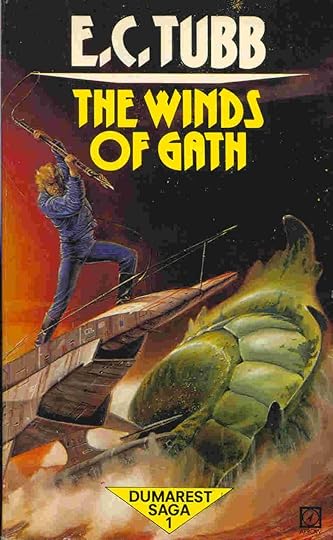
The Winds of Gath

Rate this book
This is the tale of Earl Dumarest. Space-wanderer, gladiator-for-hire, seeker of Man's forgotten home. Dumarest's search begins on the ghost-world of Gath, where he becomes unwilling champion of the Matriarch of Kund, and must undergo a fight-to-the-death at stormtime. Victory could give Dumarest his first clue to the whereabouts of the planet he fled from as a child - an obscure world scarred by ancient wars, which lies countless light years from the thickly populated centre of the galaxy; a world no-one else in the inhabited universe believed exists. Earth, the birthplace of Man.
(First published 1967)

192 pages, Kindle Edition

First published January 1, 1967

53 people are currently reading
659 people want to read

About the author

E.C. Tubb

382 books85 followers
Edwin Charles Tubb was a writer of science fiction, fantasy and western novels. He published over 140 novels and 230 short stories and novellas, and is best known for The Dumarest Saga (US collective title: Dumarest of Terra) an epic science-fiction saga set in the far future.

Much of Tubb's work has been written under pseudonyms including Gregory Kern, Carl Maddox, Alan Guthrie, Eric Storm and George Holt. He has used 58 pen names over five decades of writing although some of these were publishers' house names also used by other writers: Volsted Gridban (along with John Russell Fearn), Gill Hunt (with John Brunner and Dennis Hughes), King Lang (with George Hay and John W Jennison), Roy Sheldon (with H. J. Campbell) and Brian Shaw. Tubb's Charles Grey alias was solely his own and acquired a big following in the early 1950s.

An avid reader of pulp science-fiction and fantasy in his youth, Tubb found that he had a particular talent as a writer of stories in that genre when his short story 'No Short Cuts' was published in New Worlds magazine in 1951. He opted for a full-time career as a writer and soon became renowned for the speed and diversity of his output.

Tubb contributed to many of the science fiction magazines of the 1950s including Futuristic Science Stories, Science Fantasy, Nebula and Galaxy Science Fiction. He contributed heavily to Authentic Science Fiction editing the magazine for nearly two years, from February 1956 until it folded in October 1957. During this time, he found it so difficult to find good writers to contribute to the magazine, that he often wrote most of the stories himself under a variety of pseudonyms: one issue of Authentic was written entirely by Tubb, including the letters column.

His main work in the science fiction genre, the Dumarest series, appeared from 1967 to 1985, with two final volumes in 1997 and 2008. His second major series, the Cap Kennedy series, was written from 1973 to 1983.

In recent years Tubb updated many of his 1950s science fiction novels for 21st century readers.

Tubb was one of the co-founders of the British Science Fiction Association.

Ratings & Reviews

What do you think?
Rate this book

Friends & Following

Create a free account to discover what your friends think of this book!

Community Reviews

5 stars
132 (22%)
4 stars
224 (37%)
3 stars
187 (31%)
2 stars
47 (7%)
1 star
10 (1%)
Displaying 1 - 30 of 71 reviews
Profile Image for mark monday.
1,880 reviews6,305 followers
May 27, 2019
Let me tell you of Earl Dumarest:

Traveler... Adventurer... Mercenary... Serial Monogamist.

First and foremost, he is from Old Earth, also known as Terra, and he longs to return home.

TERRA: the seed from which all worlds grew! In the millennia since colony ships left her soil, she has become a tale that few have heard, an improbable legend that even those few doubt. A myth, a joke, a SHANGRI-LA, a fable from songs! But Earl knows she exists, and he will find her!

In his early days, young Earl stowed away on a cargo ship from Earth. He had many adventures, ones that took him further and further away from his planet of birth - so far away that he lost the path back. The Dumarest Saga concerns the various misadventures of Earl as he searches for clues to return home, and evades the horrible Cybers, dread agents of the devious Cyclan.

THE CYCLAN: A galaxy-wide organization whose goal is to bring order the universe through THE POWER OF LOGIC. Their agents, the Cybers, are modified from puberty to be divested of all emotions and to perform their duties as good machines. Their secret plan: CONTROL THE UNIVERSE! All Must Be Cyclan, or Perish! Their premier goal: Find Earl Dumarest At All Costs!

Young Earl learned many things on Old Earth, and even more in his travel from Earth. Fighting skills. Hunting skills. Honor. Humility. Caution. Kindness. Open-mindedness. A dry and sardonic but seldom cynical sense of humor. A strong dislike for small-minded assholes. The ability to keep his mouth shut. The ability to recognize an enemy. The ability to please a woman.

THE LADIES: A galaxy full of them! But do not take Earl Dumarest for a typical starship-hopping Lothario; indeed, he loves them all! But the love of Dumarest is, for many, the Kiss of Death. Rare is the woman who survives at the end of the tale. Often they are double agents, agents who will find Earl's loving ways to be anathema to their deceit, and in the end, will give him their secrets... and their hearts! Or they are adventurers and travelers themselves, and see in Earl a kindred spirit, and so come to his aid. And sometimes they are maidens in need of a rescuer - a role custom-made for Dumarest! No matter the nature of the lady in question, they will fall for Earl's manly charms. Gentleman Earl will also fall in love, a deep and abiding love, one that would end his quest, far from Earth, in the arms of a loving companion... and yet it is never to be. Each novel features a uniquely enchanting woman; yet no woman is destined to love Earl beyond novel's end. A SAD FATE is destined for the women of Earl Dumarest!

The Earl Dumarest Saga is a long one - it includes over 30 novels, written over the course of 40 years! They feature fun stuff like deadly arena fights, races to the death, a sentient planet, a cyborg cult. The writing is tight, never self-indulgent, and reminiscent of Jack Vance at his driest.

Earl himself is a man's man, good in a fight, good in a hunt, good in the sack - and always respectful of women. He's no James Bond; he is is a cruelty-free Everyman, although a far more studly and competent version. You can read one of these 70s-style, quasi-pulp Earl Dumarest novels in maybe a couple hours or so. They are a lot of fun!
Profile Image for Karl.
3,258 reviews371 followers
May 16, 2020
The ACE SF Double had a 21 year life span.

books in the "Dumarest of Terra" series helped get me through college.

Dumarest is usually described as of medium height, with brown hair, wearing nondescript grey clothing and carries a knife in his boot.

He struggles against the Cyclan, a group of cybernetically enhanced humans who want to rule universe and are hunting Earl because he has the secret of the “Affinity Twin”, 15 biological molecular units that allow those injected to switch minds. The Cylan have lost this secret formula and will not stop until they have Earl, and it, in their hands again.

Counter to the Cyclan is the Church of the Universal Brotherhood, a humanitarian organization of monks who give comfort and aid when they can, the secret cost for this - to submit to hypnosis compelling one to forgo violence forever more.

All Dumarest wishes to do is to return to Earth and live out his days, but he does not know the spatial coordinates for the planet, lost through time and distance and perhaps on purpose by the Cyclan. Over the 33 books he gains clues, slowly and painfully as to the possible location of a place most doubt exists.

Dumarest is woken up from "cold sleep" three days early with good news and bad news. The good news is that he survived - yet again - the one in eight mortality rate associated with "riding low" along with the farm animals and other people too poor to travel in space awake. The bad news is that the space ship is re-routed to the armpit of the galaxy - a world named Gath, which is a poor place with no jobs, little food, no way off and only one reason people travel to Gath, to experience the haunting psychosis inducing music generated by an oddly-formed mountain range when the "winds of Gath" start blowing.

Dumarest is ejected to the planet and runs into his friend, Megan, so maybe it's not such a big universe after all. Dumarest fails at fishing, because the fishes are apparently more interested in eating the Travellers on their flimsy raft than being served up for dinner. Starving and desparate, Dumarest fights a battle to the death with the trained fighter of the Prince of Emmened. Dumarest wins, which is fortunate or we wouldn't have the next 34 books, and then he's sucked into the high politics of the tiny world of Gath.

Dumarest is introduced to the Matriarch of Kundar, who is visiting Gath with her ward, the Lady Seena, who may be her heir apparent. The Matriarch is served by a Cyclan - a human being trained and surgically altered to be emotionless and a cog of a great scheming organization. The Prince of Emmened may hold a grudge against Dumarest, but he definitely has his eyes on the Lady Seena. The Factor of Gath is not above turning men into beasts for a few bucks. In the middle of this, the Brotherhood arrives on Gath, bringing their commitment to charity and humanity as a rare, rare bit of kindness to this brutal reality.

In "The Winds of Gath," E.C. Tubb introduces the main cliches that will dominate and drive Dumarest through the next 34 books. Dumarest wants to return to his lost home world, a world that everyone denies exists, called "Earth." The Cyclan seem to be hostile to Dumarest for no immediately apparent reason. The Brotherhood is there to provide support.

I loved this series.

E.C. Tubb (1967 - 2008)


Profile Image for Rob Thompson.
745 reviews45 followers
September 29, 2024
E.C. Tubb's "The Winds of Gath" is a solid entry in the classic space opera genre, offering readers an intriguing blend of adventure, mystery, and alien landscapes. As the first instalment in the long-running Dumarest of Terra series, it sets a promising foundation for the saga to come.

The story follows Earl Dumarest, a resourceful and hardened traveler, as he finds himself stranded on the planet Gath. Tubb's worldbuilding shines as he paints a vivid picture of this alien world, complete with its eerie, music-like winds and the enigmatic Matriarch. The author's imaginative touch brings a sense of wonder and otherworldliness that is quintessential to good science fiction.

Tubb's prose is lean and effective, driving the plot forward at a brisk pace. The action sequences are well-crafted, keeping readers on the edge of their seats. However, some may find the characterization a bit thin, with supporting characters often feeling more like plot devices than fully realized individuals.

The novel's strength lies in its exploration of human nature against the backdrop of a harsh, unforgiving universe. Dumarest is an engaging protagonist, his determination and adaptability making him easy to root for as he navigates both physical dangers and political intrigue.

While "The Winds of Gath" may not break new ground in the genre, it excels at delivering a satisfying, pulpy space adventure. Its relatively short length makes it a quick, entertaining read, perfect for fans of classic sci-fi looking for a dose of interstellar action.

The book does leave some questions unanswered, clearly setting up for future instalments. While this may frustrate some readers looking for a fully self-contained story, it effectively piques interest in the broader series.

In conclusion, "The Winds of Gath" is a well-executed space opera that, despite some minor flaws, offers an enjoyable escape into a richly imagined future. It's a strong start to the Dumarest saga and a testament to Tubb's storytelling prowess.
Profile Image for Jared Millet.
Author 20 books66 followers
February 22, 2018
I can’t remember when I first became aware of the Dumarest series, but the concept sold me right off the bat: a lone traveler searching the galaxy for his lost homeworld, Earth. There were two problems: the series was long out of print and there were a godawful lot of books in it. But lo and behold, some kind soul of a publisher released them all as cheap ebooks! Well, here we go.

The first book begins with Dumarest at a dead end on the planet Gath. It’s not where he meant to be, but the ship he’d booked passage on got commandeered by some planetary aristocrats on a tourist jaunt so there he is. Dumarest isn’t a tourist but a traveler, someone who stays on one world just long enough to make enough money for passage to the next. The trouble with Gath is that that isn’t possible – there’s no civilization to speak of and no way to earn one’s keep except for slaving for tourist aristos who visit the planet to experience its unique wind storms, storms in which the voices of the dead are said to be heard.

Throw in two conniving parties of planetary rulers and their retinues, a church that offers pacification as a reward for penitence, and a galactic order of human-computer hybrids with plots of its own and you’ve got the makings of some fine pulp. Dumarest is also a good hero because he’s not invulnerable – he bleeds, he’s strong but not like Conan or Tarzan, and has to rely on his wits more than anything to stay alive. Won’t be too long before I get to book 2.
Profile Image for Jim Kuenzli.
494 reviews41 followers
January 6, 2024
This is the first on a 30 plus book series of the space adventure/space opera side of science fiction written in 1967. I thoroughly enjoyed this. It’s pretty much an introduction to Dumarest, a space traveler, adventurer, mercenary etc. Some of the concepts that develop over the series are presented here along with a nice political intrigue/ mystery on the Planet of Gath. Dumarest is from Earth, yet no one seems to know it exists, and certain individuals want to keep it that way. I will definitely be reading more of this series.
Profile Image for Deb Omnivorous Reader.
1,992 reviews177 followers
January 4, 2022
This is a book I have read and re-read many times but I seem to never have reviewed it before. It is a little hard to review a book with new or unbiased eyes, when you have been re-reading it for over forty years, but here goes.

This is the first E. C. Tubb book in the Dumarest sage. After this many years I have no idea if it was the first one I found, already a sci-fi addict at twelve or so, doggedly excavating every singe fantasy/sci-fi book I could find in the two or three second hand book shops which catered to English speakers in my corner of the Middle East. It was certainly one of the first ones I came across though.

In hindsight, having read most of the series by now (though I just can't get my hands on #30 - 32, I fear I will NEVER know the ending) Winds of Gath is one of the outstandingly best ones. It is well written and rarely repeats itself, which puts it way ahead of some of the later ones in the series, where Tubb must have been getting a bit bored with them. The descriptions of Gath, its flora and fauna and geology as well as the atmospheric conditions which cause the titular winds, all these things are really nicely written. One gets a sense that the author is still interesting and involved in the world-building and invested in the plot.

Dumarest himself is as much as a cipher as he is in later books, but as we encounter him here for the first time he is a very experienced traveller. He has grown mature traveling low through the universe and now wants to find the home planet he originated from and go back there. This is his problem, one he must have encountered elsewhere in the galaxy but which only now becomes a problem; no one has heard of his home planet except as a myth.

So this book starts with the mature experienced protagonist (a trend that I realise is very different from today, where ever ' epic' seems to start with kids) and while there may be less room for character growth I do think that it makes for great adventures. Here on Gath, the adventure could never be the same with a inexperienced protagonist but as he is Dumarest conquers; he saves the lovely lady from kidnap and enslavement or worse, he solves the mystery and he makes it off planet to his next adventure. I would call this a great adventure sci-fi (though it would probably be space opera if written today) and I enjoyed every moment of re-reading, as the last ones I read were toward the end of the series I was struck all over again with how nicely the early ones were written and the descriptiveness that goes into the world building.
Profile Image for Angus McKeogh.
1,380 reviews81 followers
October 14, 2018
I’m not sure if this genre is considered “space opera” or what. But this is the short first novel in a series of 40-something plus books following a space traveler trying to return to Earth. The first chapter was in this vein, then a corny almost fantasy novel follows in all the successive chapters, excepting the final few paragraphs that refer to the initial narrative again. Much too hard boiled but doesn’t manage to pull it off. Just mediocre. I’m certainly not overly eager to delve into the next 40 odd books.
Profile Image for Charles.
Author 41 books288 followers
August 12, 2009
This is the first of the Dumarest series. It's not bad but some of the later ones are better, I thought.
Profile Image for Roddy Williams.
862 reviews41 followers
February 8, 2014
Apart from the Perry Rhodan series, this may well qualify as the longest literary Space Opera of the Twentieth Century, at once both generally unrecognised and under-rated, it comprises of some 31 volumes published at roughly six-monthly intervals between 1967 and 1985, with a further two volumes published in 1997 and 2008.
Dumarest is a seasoned fighter with lightning responses, working his passage around a galaxy of thousands of planets, attempting to return to the planet he ran away from as a child: Earth. Earth however, so everyone believes, is a myth, but Dumarest picks up clues on his long journey, along with a secret which could put the Cyclan - a ruthless semi-religious brotherhood of scarlet-robed human computers who have had all their emotions suppressed in order to maximise the efficiency of their minds - in complete control of the Galaxy.
The environments and societies are unremittingly bleak, controlled by exploitative corporate or feudal regimes, well-realised if a little romantic in style. The books are episodic and tend to become repetitive. Dumarest, for instance, is inevitably romantically pursued by unfeasibly beautiful women (and on at least one occasion by a man) while being pursued for quite different reasons by the agents of the Cyclan, who are more often than not despatched efficiently at the end of each book by our hero. Thus, Dumarest is driven on, both by the object of his search, and the pursuit by his enemies.
Frustratingly, the saga was not concluded until 2008 with the final volume 'Child of Earth' not long before Tubb's death in 2010. It would make a good TV series. Certainly I always had a soft spot for the agents of the Cyclan who not only make excellent and dangerous adversaries but have fabulous scarlet robes.
The Cyclan are dedicated to statistics, facts, analysis, deduction and prediction, which is how they are often able to deduce Dumarest's most probable location. They are the wicked Sherlock Holmes's of Space, the Evil Accountants of Satan, implanted with cybernetic links which, when they place themselves in deep trance, put them in communion with the rulers of the Brotherhood; a gestalt of disembodied brains from retired Cyclan agents, hidden deep below ground on a secret planet. It doesn't take the powers of the Cyclan to deduce fairly early on in the series that the secret home-world of the Cyclan is Earth.
‘The Winds of Gath’ introduces us to Dumarest, a born fighter, travelling from planet to planet, eking out a living and the money to pay for the next passage, all the time searching for clues as to the location of the planet of his birth; lost mythical Earth.
While travelling frozen, his starship is commandeered by the Matriarch of Kund and her entourage, who charter the ship to take them to Gath.
Gath, like Mercury, does not revolve on its axis and possesses only the ribbon-like strip of habitable land between the sun-scorched side and the dark frozen side.
At the time of the famous storms, a geological formation in the mountains causes the wind to produce sounds which register on the human brain as the voices of the dead.
The Matriarch has employed the services of The Cyclan, a semi-gestalt organisation of cerebral eunuchs, divorced from the distractions of emotion, who employ pure logical reasoning (as in the Mentats of Herbert’s ‘Dune’ series).
Dumarest gets himself unwillingly involved in the politics between the Matriarch and a sadistic spoiled prince of another planetary dynasty, just as everyone is joining the journey to the mountains to experience the voices of the storm.
Despite the gothic overtones and the interstellar feudal dynasties, religious brotherhoods and Tubb's unrelenting depictions of man’s inhumanity to man, it is surprisingly up-beat, well-written and far superior to much of the episodic TV we have today.
Like Herbert, Tubb balances the almost medieval feudal with the futuristic. The monarchies and dynastic class structures, combined with the monks’ robes of the ideologically opposed brotherhoods, conspire to create a somewhat industrial gothic atmosphere.
Profile Image for Micha.
169 reviews
September 16, 2021
I find that I have better luck when I randomly pick from books written in the 70s and 80s or earlier. As compared to books written in the last 10 years, 20 years maybe, out of all the heaps of garbage that are coming out these days.

I really enjoyed this book as it was not bogged down with minutia. A good amount of action and story.
Profile Image for Stephan.
285 reviews7 followers
March 22, 2020
I was positively surprised by this first book of the (eventually) epic Dumarest saga. I only knew E.C. Tubb from more-or-less badly translated and usually shortened German editions found in the half-off bin in the 80s. Thanks to the SF Gateway E-book edition, I could finally read the original Winds of Gath, first published in 1967.

Tubb creates a galaxy not unlike A. Bertram Chandler's Galactic Rim, or in more modern times, Firefly, with many effectively independent planets, with different levels of population and development, connected at least in part by independent traders operating somewhat like tramp ships on Earth in the early 20th century. And in large parts of this galaxy, the strong and rich can act essentially as they like, at least with respect to the less fortunate.

While this basic concept is quite generic, I like the way Tubb managed to colour in the details quite effectively. The book starts with the protagonist, Earl Dumarest, awaking from some kind of hibernation after taking a "low passage", i.e. a space trip stowed away unconscious, with a significant risk of not waking up again. His ship had been redirected after he was already frozen, and he finds himself unexpectedly on the planet of Gath - a tourist destination very bad for "travellers" like him, because there is little chance of earning money for another leg. The party that commandeered his ship travelled high - awake, in luxury, and under drugs that slows the metabolism so that the trip appears to be shorter. Like most other tourists, they come to Gath to experience "the storm", a regular meteorological event where winds blowing through a mountain range create an entrancing soundscape.

A lot of action and intrigue follows, with Dumarest often near the center of the action, and being critical in helping one party achieve success. The story ends with his (temporary) success essentially ensured, but a double cliffhanger encouraging the reader to get the next volume of the story.

The book was first published in 1967 - one year before Dick's Do Androids dream of Electric Sheep, and contemporary with the first John Grimes book. It goes beyond the simple space adventure story I had expected, with many characters that are neither black nor white - the scale goes to deep dark (if with a somewhat exaggerated comical bent), but most characters have quite complex motivations. In particular the ambiguity of the Cyclan and the psychological effects of the titular Winds of Gath lifted this beyond just a good yarn for me. It's not good enough to make me read the full series, but compared to the first Doc Savage I read shortly before this, it's literate gold...
Profile Image for Jefferson.
643 reviews14 followers
March 24, 2023
Compact, Pulpy, Gritty, Philosophical, Political, and Bleak Space Opera

Mark Monday’s fun reviews of the early books in E. C. Tubb’s 33-volume (!) Dumarest series made me dive in. The first book, The Winds of Gath (1967), is a compact space opera: pulpy, sexy (a little), tricky, philosophical, political, imaginative, violent, and bleak.

The novel starts with Earl Dumarest waking up from being “doped, frozen, ninety per cent dead” in one of the many “coffin-like boxes” in “the steerage for travellers willing to gamble against the fifteen per cent mortality rate.” He learns that he didn’t reach his contracted destination world because a powerful party had the ship rerouted to planet Gath. This is a problem because whereas his target world had a viable economy that would enable him, a “penniless traveler,” to earn the money to go elsewhere, Gath is a tourist planet famed for its winds blowing through mountain caves, rumored to sound like voices from people from your past. Will Dumarest be permanently stuck on Gath?

Tubb distinguishes between tourists, who have the money to space “travel High,” which is safer and easier, and sightsee rather than work, and travelers like Dumarest, who have no savings and need to “travel Low,” which is unhealthier and riskier, and work hard wherever they go to scrape together enough money to travel Low to another world.

In addition to Dumarest, numerous point of view characters propel the story. There’s Dumarest’s hapless acquaintance Megan (“Man, am I sorry to see you!”) who’s been stranded on Gath for over a year and is on the verge of dying there.

There’s the octogenarian Matriarch of Kund, who’s guarded by taciturn, masculine women, rules over a system of worlds, and has diverted Dumarest’s spaceship to Gath because her ward Seena Thoth, a lovely, naïve young lady, has been the target of assassination attempts.

The Matriarch’s advisor Dyne is a “Cyber,” ostensibly giving objective and rational counsel because he was modified at an early age: “He was a coldly logical machine of flesh and blood, a detached, dispassionate human robot.” Cybers belong to the Cyclan, a “gestalt” of telepathically linked brains with long-term plans for ruling all inhabited worlds, because, being freed from emotion, they think they’ll do a better job than humans can do.

Indeed, the decadent “Prince of Emmened who had ruined a world by his whims and would ruin more unless stopped by an assassin,” is a malign tourist who gets his jollies from ravishing young ladies or watching his trained fighter Moidor (!) kill strangers.

Luckily, the Church of Universal Brotherhood sends monks out “striving to turn men from what they were into what they should be,” and one of them, Ely, is humane and shames the slimy authorities of Gath for exploiting travelers. Tubb complicates his “good” figures, though, so the monks travel High and hand out communion-like wafers treated with euphoric drugs whose effects wear off, so Megan regularly attends their services to maintain his wafer high.

The plot has Dumarest trying to survive till he can work up the money to get to another planet and other characters preparing for the winds of Gath while tending to murky matters. It proceeds to an apocalyptic climax with sanity compromising wind voices, multiple assassination attempts, a magic mirror, a tricky coffin, a foiled plot, a damsel in distress (with frostbitten feet), and more.


Throughout, Tubb’s writing is lean and able, capable of sublime flights and lurid fancies, and endowed with the less-is-more ethos of 1960s and 70s SF.

Dynamic description:
“It came with a continuous rolling of thunder which tore at the ears and numbed the senses. The lightning was a web of electric fire across the sky, stabbing at the ground, searing wetly into the sea. The rain was a deluge, pounding the ground into mud, turning the air almost solid with its moisture.”

Neat SF writing:
“With shocking abruptness, the universe slowed down. It hadn’t, of course. It was just that his own metabolism, reflexes and sensory apparatus had suddenly begun operating at almost forty times the normal rate. The danger lay in accepting the illusion of a slowed universe as reality.”

Corny dialogue:
“You will wear earmuffs at all times. Do you understand? You will not attempt to listen to the noises of Gath. Now go!”

Tubb’s characterization is rudimentary, but the Matriarch has depth (e.g., “A man, dust for over eighty years, now talking and breathing at her side, his voice, his beloved voice, soft in her ears”). And in hardboiled Dumarest’s past lurk a beloved father figure and an unidentified lover, though “He was not a man who regretted the past. Not when the future looked so black.” He can kill at a pinch, but although he opines that “In combat there are no rules” and will kick your knee if he can’t reach your groin, he’s no sadist. He helps people in trouble and not only to win favors. He has a goal: rather than aimlessly traveling around from planet to planet, he’s moving “deeper and deeper into the inhabited worlds” as he tries to find Earth, his home.

To other people, Earth is a myth, to Dumarest, a “desert, a barren wilderness in which nothing grows. It is scarred with old wounds, littered with the ruins of bygone ages. But there is life, of a kind, and ships come to tend that life.”

In addition to the dying Earth, the novel boasts plenty of SF stuff: various worlds of various cultures, including (gasp!) at least two Matriarchies; space travel; the ability to slow down or speed up time for individuals; cybernetic advisors; exotic weapons like vibratory darts. Some of it smacks of hyper 60s western culture, like the many drugs, the great medical care for the rich, the tourism industry, the admen, and the fear of (or attraction to) strong women in charge. So far, much on income gaps: “There was a romance clinging to the concept of slavery which appealed to the rich.” So far, no alien aliens, just a variety of human beings. So far, no people of color or LGBTQ people: Dumarest and Seena are very white hetero.

There are interesting moments where characters muse on human nature and life, like the paradox between people being animals but having higher selves, the “perversity in human nature which gloried at the bestialisation of its own kind,” the belief that “Life is a lottery,” and the hope that “the travellers might take a hand in their own destiny.”

There are loose ends: vanishing characters, telepathic animals, Dumarest’s past, etc.

But you gotta love a space opera that ends:

“A gust of wind swept from the mountains and he heard the music of Gath.
Deeper now, slower, but quite unmistakable.
The empty sound of inane, gargantuan laughter.”

If you like Jack Vance and especially Barrington J. Bayley, you should try Tubb. I’m on to book 2 in the series!
55 reviews2 followers
September 21, 2020
This one is a tough one. On the one hand, I really enjoyed the whole "winds" mystery, and Winds of Gath also rubs my love for golden era science fiction just the right way. On the other hand calling the characters two-dimensional card-board cutouts would be doing an injustice to card-board cutouts.

The story itself also lacks depth; it's a pulp-ish concatenation of usually fairly random action sequences. It's still entertaining enough, and the book is a quick read. It doesn't get boring, but it does leave the reader with a bit of an "uh, so that was it?" feeling. Even the main event - when the Winds of Gath rise - felt underwhelming.

Since very little technology is described in detail, it has aged fairly well - it's really more an adventure novel than a science fiction novel in many way.

If you are into the "lone wanderer in space" type of fiction, then you'll enjoy this. If you are interested in historic science fiction, you will want to read this book as it clearly was a major inspiration for the Traveller role-playing game. If you like your heroes manly, your damsels in distress, and jump-cuts to the next action sequence, you will like this. If Dumarest as a series interests you, you will obviously want to start with this book.

If, on the other hand, you like in-depth character building or brilliant story-arcs, then Winds of Gath can be safely avoided.

Rating: Solid 3 out 5. There is no way it earns a 4, but a 2 would do it injustice.
Profile Image for John.
829 reviews22 followers
July 3, 2024
Space opera adventure in a relatively grimdark setting. Its depiction of women isn't the best, complete with a story of a man killed after falsely being accused of rape.

I read this because it was a major influence on the Traveller role-playing game, which is obvious to anyone reading it who is familiar with the original Traveller RPG. The interesting thing is that what it contributed was all the stuff that I disliked, didn't really care that much about, and/or never used. Fast and slow drugs that speed up or slow down the perception of the user. The Low Passage travel method that has a relatively high chance of killing the passenger. The nobility system.

Not a terrible book, but not really my thing.

Edit: read again because it came up again as a big inspiration for understanding Traveller (even the name of the game likely comes from this book), and I couldn't remember much about it. Knowing that I was going into a grim book this time helped some, but not quite enough to give it another star.
Profile Image for Derek.
1,382 reviews8 followers
January 7, 2012
The setting feels weirdly off-kilter, as Tubb conceives of technologies and drugs that lie far from the space-opera cliche, and planetary cultures not derived from Earth. So, sort of like _Dune_ or _Pillars of Eternity_. An egg-laying insect is an assassin's weapon, the dried body of a poisonous eel is a vicious whip, and people inject themselves with slow-time, to multiply their metabolic rate. Anyone going into this expecting a conventional space opera will be disappointed.

Profile Image for Tom.
1,186 reviews3 followers
May 23, 2022
In theory, we read genre fiction for the ideas, but at the end of the day, many times the ideas don't vary too much from book to book. The tropes are ingrained, and Tubb employs plenty of the standard tropes here, but, in among them, the new ideas were so startling, so joyously psychedelic. It's the kind of gem in the rough that makes you remember why you're reading 40+-year-old paperbacks in the first place.
Profile Image for Mark.
95 reviews2 followers
May 7, 2018
Very good..i was surprised to see it was written in 1967 as it was a seamless story. If you are a fan of the old RPG Traveller, then this may appeal to you as there is some terminology that GDW may have used for their game.

Tubb wrote many more books in this serious and i intend on reading as many as i can.
Profile Image for Victor.
6 reviews2 followers
October 9, 2020
First of a long science fiction series; very influential on the origins and development of the SF RPG Traveller from GDW (published in 1977) - I've read the older Ace double and would be interested in seeing if the later Ace edition had more material. The UK original edition is said to have more to it, as I learned from staff at Uncle Hugo's Science Fiction Bookstore.
Profile Image for Bob.
129 reviews1 follower
October 22, 2017
A fun quick read. Very clever. I'm going to start reading more of these older, shorter SF novels.
265 reviews4 followers
December 13, 2020
Five stars? Really? Yes, although perhaps more out of nostalgia than much else. The Dumarest saga has been part of my life for most of it. I first came across it when Starburst magazine printed a review of, I think, book 17, when it was first published. I was pre-teen and don't remember what about that review resonated with my, but I know I bought a copy of the book at my local WH Smith's shortly after and, for a time, I was hooked. I bought new volumes as they came out and hunted down past volumes in second hand bookshops.

I remember, on a school trip to the Lake District, browsing a spinner rack to see if this particular shop had anything I needed. An older couple were talking next to me, the man thinking he had read one of the volumes in the rack, recognising the title, but not the cover. I broke in, describing the cover of the copy I owned, which turned out to be the one he knew. One of them enthused that I must be a Dumarest expert...

I got excited a twenty-odd years back when The Return was published, bought it, read it and thought it was on Ok ending, happy that Earl's story had... well, spoilers. I hadn't read the originals for ages and probably didn't realise there were unanswered questions. Somehow I missed that one more book had been published.

I never completed the series and still need a handful of books to do so. But, in the age of the internet that shouldn't be difficult, should it? Yesterday, on a whim, I decided to re-read The Winds of Gath (partly as a way of getting 100 books logged this year - they are, after all, thin) expecting it to be a case of memory playing tricks. They couldn't possibly be as good as I remembered, right?

And yet, I thoroughly enjoyed it. So much SF from the 60s and 70s is, to me, dense and impenetrable. This is light and easy-going, but still replete with action, intrigue and character. We join Earl's story partway through, so you know that he has already travelled, fought, loved and lost. Dumarest himself is a sort of everyday superhero - not particularly trained better than those who become his adversaries, but more quick-witted - kind to his friends, respectful of his women and ruthless to his enemies. His universe is well drawn. There's nothing unique about the traveller visiting a new place, having and adventure and moving on (The Fugitive, The Incredible Hulk anybody?), but there doesn't really need to be when the places, the characters and the stories are enjoyable.

I'm going to go through this series, for the first time, in order. Maybe as an adult I'll pick up nuances that I missed before. One thing is certain, after a certain amount of trepidation before re-reading the first book, I'm looking forward to the rest.
Profile Image for Ian Adams.
169 reviews
September 16, 2024
“The Winds of Gath” (1967)

Overall Rating 7/10 – Gathtastic

Plot
Our protagonist, Earl Dumarest, finds himself on a tourist planet renowned for its spectacular storms, in which the winds create a very special experience. An experience that often results in death. Of course, it isn’t that simple – he quickly finds himself embroiled within a multiple political pots – oh, and of course, a gladiator style fight.

Writing Style
Easy, flowing sentences. The occasional loss of fluidity. An occasional spattering of obscure words
Very modern style. Quite easy to watch the film unfold in your head but dis-jointed sectional plots.

Point of View/Voice
Written in the 3rd Person / Past Tense (standard convention)

Critique
This is the first E. C. Tubb novel in the Dumarest series and was written in 1967. Just like its successor (“Derai”, the 2nd book in the series) I struggled to stay focused as the plot jumped around like a feral flying flea. Add to that, confusion as to who the characters were (trying to remember so much while casting yourself onto a trampoline can be challenging) and you find yourself wondering what on Earth is going on. Well, not on” Earth” since the novel is set in a distant Cosmos. I have also previously read the 8th book (Veruchia) and this problem wasn’t really present there. So, I guess, somewhere between book #2 and book #8, the author has fixed the problem. I may be able to report that position more accurately later as I do intend to keep reading the saga (for now anyway).

In this story, the pre-amble was fairly lengthy and it took a considerable amount of the book before I was able to properly understand what was going on. By the time I was reaching towards the end, the plot had unfolded into something really quite good and quite clever. It’s just a pity I didn’t really understand that earlier because I struggled “keeping track”. Part of the reason for this (I think) is that the author’s style is such that he plunges you into “something” without explaining it first. You can usually sort it out afterwards but not before confusion has writhed through your neural net.

Still, I am glad I made it to the end, it was worth it.
Profile Image for Jim Mann.
837 reviews6 followers
July 10, 2023
In the 1960s and 1970s, the SF field had a number of short novels (in the 130 to 175 page or so range). Often they were published as part of an Ace Double, though many were standalone. There were some gems amongst these, notably by Samuel Delany and Roger Zelazny. But many were minor novels, of the type that you could read on a pleasant afternoon while trying to decide what meatier novel you might want to read next. The Winds of Gath falls into the latter category.

This is the first novel in the Dumarest of Terra series, a series that now spans 33 books. Earl Dumarest is a hero in the classic adventure novel style: tough, resourceful, but yet basically enough of a good guy that readers can identify with him and want to follow his adventures. He is a traveller, moving around trying to find out how to get back to Earth, a planet he left as a child and which many people across the galaxy view as a myth.

In The Winds of Gath, Dumarest is awakened from the hibernation used by star travelers on the cheap to find that he isn't arriving at the planet he thought he was headed toward. A very rich family has instead hired the ship to deliver them to Gath, a place where at its height the winds can give visions or maybe even show someone their past memories. Dumarest finds himself involved in several plots, but in the end (as the reader would expect, knowing that a) he is the hero of the novel and b) there are 32 more novels about him to come) it all works out for him.

The novel is fun, light entertainment, in part readable because of its short length. Had this been a recent novel, where the author felt compelled to stretch it to 400 pages, I'd probably have given up 50 pages in, as it wouldn't have been worth the time investment needed to read 400 pages. But at 150 pages, it was a pleasant, quick read.
58 reviews
October 19, 2023
Classic sci-fi genre novel.
I didn't even expect to like this novel, but to be honest, I found it much better than I'd expected. I bought it because I've been on a 60s-80s Sci-fi with old school fantastic covers kick lately, and I saw E. C. Tubb's name on some suggested lists for pulp sci-fi, and I loved a lot of the covers. I bought this as an Ace Double with the second novel in the series, Derai, just to add to my collection of old-fashioned paperback trash. The story is well-structured, with a small helping of depth: political intrigue, social commentary, and almost a bit of character development. The prose is simple but effective--nothing purple here--without being too dry. The main character, though a bit aimless and just a tad capitalistically selfish, shows enough of honor and altruism to make him likable.
Some of the story is a bit outdated, sexist but not misogynistic. There's a bit too much of falling in love without any substance, background, or future, but it's forgivable since it doesn't dominate the plot at all.
As another reviewer before me has said, this "pulp" novel from the 60s is surprisingly good compared to the genre fiction (and even some of the so-called "literary fiction") being sold today, but I won't get on a soapbox about current publishing trends. I thoroughly enjoyed this novel, and I'll be buying and reading more from this series. I doubt I'll make it through all 33, but I'm excited that I've found a new go-to easy read to kill time with. 4.5 out of 5 stars, and I'm feeling generous, so I'll round it up to 5.
Profile Image for Blake.
1,310 reviews44 followers
July 5, 2024
(FYI I tend to only review one book per series, unless I want to change my scoring by 0.50 or more of a star. -- I tend not to read reviews until after I read a book, so I go in with an open mind.)

I'm finally going through my physical library owned book list, to add more older basic reviews. If I liked a book enough to keep then they are at the least a 3 star.

I'm only adding one book per author and I'm not going to re-read every book to be more accurate, not when I have 1000s of new to me authors to try (I can't say no to free books....)

First time read the author's work?: Yes

Will you be reading more?: Yes

Would you recommend?: Yes


------------
How I rate Stars: 5* = I loved (must read all I can find by the author)
4* = I really enjoyed (got to read all the series and try other books by the author).
3* = I enjoyed (I will continue to read the series)
or
3* = Good book just not my thing (I realised I don't like the genre or picked up a kids book to review in error.)

All of the above scores means I would recommend them!
-
2* = it was okay (I might give the next book in the series a try, to see if that was better IMHO.)
1* = Disliked

Note: adding these basic 'reviews' after finding out that some people see the stars differently than I do - hoping this clarifies how I feel about the book. :-)
Profile Image for Pedro Pascoe.
228 reviews4 followers
October 30, 2023
Another book that had been sitting on my shelf of shame for decades that I have finally dragged out of shelf purgatory and read. The impetus for this particular read was a mention of this saga's infuence on the Traveller RPG system, and right off the bat with chapter 1, I can see why.

The Winds of Gath, all Traveller inspiration aside, is a serviceable sf piece from the '60's, published a few years after the publication of Dune, and it's easy to see the lifts from Dune appear in this book (minus the political and written clout of Herbert, of course).

A mishap throws our protagonist on a planet that isn't his destination, and he is embroiled in a mystery which he is able to solve. That's about it. It's a start to an epic saga spanning a couple of dozen books, if memory serves, and while I'm mildly interested in chasing up the rest, it's proving a bit difficult to find them, so this may be as far as I go with the Dumarest Saga. A low 3 with potential for the rest of the saga, should I ever be able to track them down in a timely manner without incurring much expense.
Profile Image for STIMBOT5000.
20 reviews3 followers
July 23, 2022
Back in the 80s I was given a bunch of the Dumarest books by my old grandad (Pops) but I never did read them. They were among many pulp scifi and fantasy novels that came my way over the yrs and, as there are only so many hours in the day, they never made it to my reading roster before I moved in with my other half. As a result they went to charity. 20 odd yrs later The Winds of Gath fell back into my hands via The Old Pier Bookshop in Morecambe (resulting from a podcasting plan with my better half). I was pleasantly surprised to find that this first episode in the adventures of Earl Dumarest is an entertaining blend of scifi, detective mystery and western that travels quickly and doesn't outstay its welcome. Whilst evidently having some Dune-like influences in there, it also includes a lot of tropes that may be common now but certainly weren't in the late 60s. You can hear our thoughts in more detail on the Breakfast in the Ruins podcast - available on all good podcatchers.
Profile Image for Gbolahan.
588 reviews11 followers
July 16, 2017
Oh, the nostalgia!

I'm giving it 3.5 stars, by the way.

Read Dumarest Book 3, Toyman, some 20 years ago and I've been intrigued since. Imagine my delight to realise I can easily read the whole series of about 33 books finally...!

I liked this first book. I wasn't really expecting much, just wanted to have fun.
Dumarest is that stone cold hardass I remember from my childhood. I really like the guy, he's real to me.
The science part was fair, then became awesome when Earl went on his slowtime walk/run. That was exactly what I needed in Scifi. The detailed explanation of the science and what to expect when you're moving and metabolising at 40 times the normal human rate.

I'm glad I finally started this series. And no matter how long it takes me, I'll finish it. I hope Dumarest gets a rest from his journey at the end.
Profile Image for Diana.
89 reviews10 followers
April 1, 2021
My younger brothers introduced me to Dumarest back in early 1970s. I think this is when the paperback took off; at least in Australia? Earlier in USA probably and now pulp fiction international. Now -50 years later -Dumarest appears to still have a following. He's a cool hero, and adds something more to the basic requirements. Yes he's smart, strong, ingenious, cunning, a great fighter, and as well, he cares for people and he lives by his ethics.
What can I add? This book does the job well. It's meant to be light easy reading, compelling enough to read quickly as one is hooked by the action. Mostly it's seeing how well Dumarest will deal with all that comes his way. In a universe so expansive, Earth is but a lost legend. Can Earl find his way home? Thus begins the first episode recorded of his epic search.
Profile Image for Ruskoley.
357 reviews1 follower
June 12, 2024
The lack of bogged down backstory makes this novel read freshly, quickly, and with purpose. I have gotten somewhat weary of the bloated and over-written novels. This one - at points jarringly sudden in its transitions from scene-to-scene - reads really well. It has a little vintage feel, it has a lot that feels like "Dune" and the espionage stories of the pulps in the 60s. The characters and plot may seem a bit wooden or odd, but this is such a fun little novel regardless of all of its flaws that I am very glad I read it. Strangely satisfying and fun read.
Profile Image for Ryan.
267 reviews3 followers
November 29, 2024
It's all the good things you'd expect from a pulp book without hitting a next level to be great. There is some fun adventure and interesting ideas but it's a slapdash narrative and sometimes you don't know exactly what is going on because he's already on to the next thing.

The hero, as expected, is the perfect character. I come to expect that in these kinds of books so it doesn't bother me personally.

Fun enough where I am not against reading more of the series but I won't go out of my way to pick them up
Displaying 1 - 30 of 71 reviews

Join the discussion

Can't find what you're looking for?

Get help and learn more about the design.