One of my favorite photographs I have of my mom is on a family trip to New York in 1994. We are on a boat going to Ellis Island and she is smiling, giddy, the Manhattan skyline in the background. A native New Yorker, this was our first trip back to New York in over ten years. The twin towers are prominent in the background, and little did she, or any of us, know that less than ten years later they would be gone, destroyed, obliterated in a puff of smoke. These images had not entered the fabric of our collective conscience in 1994; my mom was just another New Yorker happy to be home for a week. I know that my parents were not present in the gritty world that was New York City of 1974. They had just moved back from Israel and were moving on with their lives toward adulthood, their personal worlds spinning forward to another time and place.
A few times in a generation, the world produces writers so gifted that they are beyond compare. One of these writers in the early 21st century is Colum McCann. His prose is like no other, and I have been reading through his novels every few months to space them out and savor their words. McCann was not present in 1974 New York either. Born in Dublin, he has called New York home for many years and writes about the city with as much care and love as he does about Ireland. He lived in Manhattan on September 11, 2001, and his father-in-law escaped the Twin Towers and successfully arrived at the McCann’s apartment. His loafers remained in McCann’s bedroom closet for years, a reminder of the towers that were and the resilient New York that would rebuild itself from the rubble. Let the Great World Spin is McCann’s opus that won the National Book Award in 2009. Although set on August 7, 1974, the novel, which features the Twin Towers front and center, is McCann’s way of grieving the terrorist attacks of 9-11. The great world of New York City spun before 9-11 and would keep spinning afterward. This National Book Award winning novel is New York transplant McCann’s take on the grittiness that comprised New York during the 1970s.
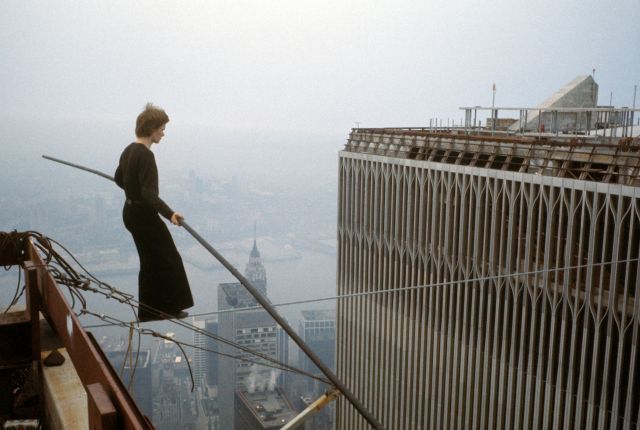
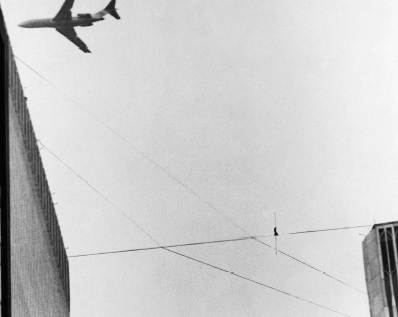
Somnambulist Philippe Petit crossed the Twin Towers on a tightrope on August 7, 1974. Midtown Manhattan stopped spinning during his walk because they could not believe that there was a man in the sky. Books had been written about Petit before and McCann does feature him in the novel, but Let the Great World Spin is an ode to New York and what occurred there on that day while Petit transversed the sky. A theme of 1970s New York is that the Bronx was burning because government officials had let the borough go to pot. In 1974, the area above the Deegan Expressway was home to prostitutes and dilapidated project apartments. John Corrigan, known as Corrigan or Corrie, is a pseudo priest and member of an order that attempts to save the destitute of society from themselves. He has moved from Dublin to New York and made the prostitutes of the Bronx his own personal project. He chose to live among what others would call scum and opened his apartment to the hookers so that they could have a clean bathroom and cups of coffee during the night. The women of the night, a mother-daughter team named Tillie and Jazzlyn especially, loved Corrie, and he remained loyal to them, even when society had given up on them. He believed with love and perhaps a small dose of religion that even the prostitutes, good girls who had gone down the wrong path, could be redeemed by society.
In August of 1974, Corrie’s brother Ciaran has just arrived from Dublin in hopes of making a new life for himself in New York. He finds Corrie’s station in life to be despicable and urges him to find a better place to live or to at least keep the prostitutes out of the apartment. Ciaran even comes with Corrie to his day job, driving a nursing home van, and witnesses the tender loving care that he gives to each resident. At the nursing home, Corrie is smitten with Guatemalan refugee and widow, a nurse named Adelita, who he playfully calls Adie to match his Corrie. Corrie’s core principles come to a nexus, much like Father Ralph in Coleen McCullough’s The Thorn Birds, as the priest is forced to choose between his vows and the one love of his life. Ciaran can feel the tension in his brother and hopes that for his sake that G-D will send a sign to make the choice for him. Ciaran is resigned to the fact that Corrie’s world spins around its own axis; he is happy living assisting the scum of society as life in New York moves on without him. Ciaran realizes that the Bronx is not the Manhattan that never sleeps that he has seen in images and, unlike Corrie, knows that Dublin is his home.
While the Bronx prepares to burn three years later, grieving mothers of Vietnam soldiers converge to meet at a rap session at the Park Avenue apartment of one its members. Claire’s son Joshua was not your typical Vietnam conscript. An precursor to those who created Silicon Valley a generation later, Joshua was a Stanford graduate, computer genius and piano prodigy, who was asked by the government to hack into Saigon’s computers. Because this was in 1974 and not the 21st century, Joshua had to be stationed in a computer room in Saigon, until a detonated grenade cut his life short while he dined at a coffee house with army officers. Claire’s world felt as though it stopped spinning until she answered an ad to join the grieving mothers group, a group of middle class women in awe of her station in life that largely shut her out. Claire rationalizes her feelings to these women by noting that their boys must have been friends in Vietnam and are cavorting together in heaven. The only African American woman in the group, a lady from the Bronx named Gloria, lost all three of her sons to the war. She knows that her sons and Joshua probably never crossed paths but appreciates Claire’s gesture in a way the other women do not. Gloria goes against her better judgment and chooses to be Claire’s friend even though after August 7, 1974, the other ladies from distinct stations in life will probably never meet again; their world’s will keep spinning forward.
One other storyline transverses the novel in Blaine and Lara, a post hippie, artist couple who decide to live in the 1920s and move off the grid to a lake side cabin in Poughkeepsie. Other than the grief group women, Blaine is about the least likable character for me; yet, their story is necessary in that is both far fetched, even for the 1970s, and it helps to bring the other storylines together. After writing this opus, McCann developed a formula that worked for him: dividing a novel into three or four sections, flushing out distinct characters and events in the first two parts, only to have everyone come together as the book reaches its denouement. Although formulaic, McCann’s prose is superior and his novels distinct stories, that this format does not seem trite. The world has to spin toward a point in time where people pick up their lives from the ashes: the hookers, the hippies, the early computer hackers, the grieving mothers. August 7, 1974 may have been a turning point in all of their lives, but eventually life has to go on, or it will stop at a standstill. At the book’s conclusion as characters from all of McCann’s storylines come together in a post 9-11 world to reveal how the world spun on from that one point in time and will keep spinning as the world exists.
My edition of Let The Great World Spin contains an author interview with Colum McCann. Readers get an insight into his writing process as we learn that this novel was his ode to the resiliency of post 9-11 New York even though it was set in the past. McCann got his title from an Alfred Tennyson poem who got his idea from a 6th century epic poem by Arabic writer Mu’allaquat. Whether one is a hooker or nursing home worker from 1970s New York, a former New Yorker returning on a visit in 1990s New York, or a Dubliner who makes Manhattan home in 21st century New York, the city is comprised of resilient people who will continue to rebuild the city from tragedy. The world and its people will spin on through time.
✨ 5 star 🌎 read ✨