Jump to ratings and reviews
Rate this book

Let's Talk About Race by Julius Lester

Rate this book
Excellent Book

Hardcover

First published January 1, 2005

16 people are currently reading
1038 people want to read

About the author

Karen Barbour

27 books3 followers
Karen Barbour has illustrated many books for children, including You Were Loved Before You Were Born; Fire! Fire! Hurry! Hurry!; I Have an Olive Tree; and Marvelous Math: A Book of Poems, which was a Parents' Choice Gold Award winner. She wrote and illustrated Little Nino's Pizzeria, a Reading Rainbow selection. Her paintings have been exhibited in New York, Los Angeles, San Francisco, Tokyo, and Rome. She lives in Point Reyes Station, California.

Ratings & Reviews

What do you think?
Rate this book

Friends & Following

Create a free account to discover what your friends think of this book!

Community Reviews

5 stars
411 (47%)
4 stars
282 (32%)
3 stars
120 (13%)
2 stars
38 (4%)
1 star
10 (1%)
Displaying 1 - 30 of 201 reviews
Profile Image for Melki.
7,260 reviews2,606 followers
December 2, 2017
Former University of Massachusetts professor Julius Lester presents a beautifully illustrated book about our lives and the stories we tell.

description

Just as I am a story and you are a story and countries tell stories about themselves, race is a story, too. Whether you're black like me or Asian, Hispanic or white, each race has a story about itself. And that story is almost always the same: "MY RACE IS BETTER THAN YOUR RACE." Some stories are true. Some are not. Those who say "MY RACE IS BETTER THAN YOUR RACE" are telling a story that is not true.

The author offers ideas as to why some people may think their race is better, and urges us all to look inside ourselves.

Beneath everyone's skin are the same hard bones.

He suggests that:

Suppose, just suppose, one day we -- I mean everyone in the whole world -- decided to take off all our clothes and all our skin and all our hair.

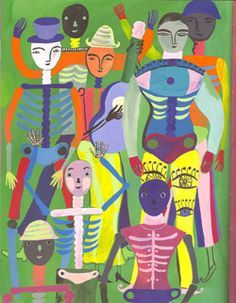
This rather creepy thought is made palatable by Karen Barbour's lovely illustration of our skinless bodies.

description

Beneath the skin we all look alike.

description

Your race is not all that you are. My race is not all that I am.

This book should be in every library, and every classroom. Though written over ten years ago, we need it now more than ever.

description
Profile Image for Mariah Roze.
1,056 reviews1,055 followers
February 7, 2017
I have been wanting to read this book with my students forever and I am so glad I finally was able to do that. My students loved this book. It opened up a lot of discussions for us and it also was simple so they could follow along. This book taught about how we all look the same under our skin, so we should not be judging another person till we actually get to know them.
Profile Image for Ana Maria.
176 reviews39 followers
October 30, 2020
Muchas de las cosas que importan no se ven a simple vista, se descubren con la mirada, el tacto y con la versión que los demás se atreven a darte de sí mismos.
Profile Image for Ebookwormy1.
1,830 reviews364 followers
June 27, 2016
Julius Lester tackles a topic not usually seen in children's books. The effort is admirable, and I WANT to enthusiastically recommend it, but it just doesn't settle well with me.

He makes the point that race doesn't completely define someone, and that we are all made up of many different stories, many different parts that all make the whole of 'who someone is'. This part is done well. Although I realized that he doesn't allow any leeway for someone who has parts of their story missing (don't know relatives, adopted, etc).

Then he spends the rest of the book talking about race specifically, which seems to undermine his previous efforts. Even though he is emphasizing race is not all there is to his identity, focus upon it instead of the other aspects of his story, makes it a BIG DEAL. In the end, his solution is for us all to take off all our clothes and skin and see that we are the same. Call me crazy, but my precocious child would consider taking off his skin if not warned otherwise!

The drawings are colorful and interesting but at the same time weird and unsettling, especially at the end of the book where he discusses taking off our skin.

I can see that it could be used to start discussion, but overall, I was disappointed.
Profile Image for Berls.
1,027 reviews41 followers
February 20, 2017
OMG I love this book and the message! The kids get it and get to interact while reading it! So glad I found it and will definitely be buying a copy for my class library.
Profile Image for 538PM_Bela Patel.
8 reviews
October 8, 2013
This book introduces race as one part of an individual's story by an award winning author. This a great book to help children understand that everyone is the same inside, the differences are in the details of our own stories. No one is better than anyone else based on their differences. It allows children to explore their own thoughts about race and what makes them unique. It is a thoughtful book with compelling pictures and layered illustrations that encourage reader to linger on each page. This would be great book to start a discussion about race and judging people based on their skin color, hair, clothes, etc..

Age: 4-8 years
Grade: 1-5

A 2005 Gustavus Myers Outstanding Book Award
Award winning author
New York Public Library's "One Hundred Titles for Reading and Sharing"
Child Magazine Best Book
Profile Image for Michelle G..
74 reviews
May 15, 2009
A picture book that isn't preachy but slices straight to the point. Treats racism as a story that isn't true. Which story will we believe? The one that is told to us, or the one that we find out for ourselves?
Profile Image for Maggi Rohde.
922 reviews16 followers
October 1, 2015
There is something wonderful about Julius Lester's prose. It sounds like a grandpa sitting next to you and talking, just talking -- telling you his wisdom, but never making you feel bad for not already knowing. This is the beginning, for all children, for all people.
Profile Image for Elizabeth.
2,032 reviews66 followers
July 15, 2020
I confess myself disappointed. After hearing this book repeatedly recommended for engaging children in antiracist conversations, I had pretty high hopes, and I already enjoyed some of Lester's previous work. This is just... not what I had expected or hoped for.

The illustrations are lovely and the storytelling style is very engaging. It was a bit frustrating to see that it was largely a vehicle to support colourblindness. The story focuses on acknowledging our sameness and de-emphasizes our differences, even differences that should be explored, understood, and celebrated, not out of a sense of superiority but out of a sense of self-love and community and more.

This book has its merits, but it's hard to imagine using it as an effective teaching tool with kids. It was published in 2005, when I was 12 years old, and I can definitely say this kind of colourblindness is something that was prominent then and it took a lot of unlearning for me personally.
Profile Image for Beth.
69 reviews2 followers
February 14, 2009
So much more than the title indicates, differences and sameness illustrated with images and brief text and powerful words.
Profile Image for Trevor.
483 reviews14 followers
January 11, 2018
A brilliant picture book that discusses a serious topic in a way that kids can understand. Julius Lester brings himself into the story, letting readers know who he is and how race affects him. My favorite line is "Why would some people say their race is better than another? Because they feel bad about themselves. Because they are afraid. Because."
Profile Image for Chinook.
2,333 reviews19 followers
July 30, 2020
I love this book. I love how it approaches the topic by discussing people’s stories and I love the way it involves the physical action of touching your bones under your skin and I especially love how hilarious is it to read to a three and five year old about taking their skin off. Because it was funny and also really effective.
Profile Image for Jordan Pierre.
81 reviews1 follower
February 18, 2021
I give this a 4.28. Its an interactive children's book that talks about the human world, how we exist, & how we relate to one another. Race is actually subjective and it is what we represent ourselves as. It is not biologically defined, nor does it mean one race is superior to another. Also taken into consideration is how wealth doesn't define us, nor does privilege, religion, preference, sexuality or language. We are all about 99.9 % genetically identical & if we stripped ourselves of our skin, culture, and personalities we would all look one in the same.
Profile Image for Stephanie Croaning.
953 reviews21 followers
May 26, 2017
This book is a great way to begin talking to children about the subject of race and prejudice. It encourages everyone to look beyond the outside of a person to discover who they really are.

Picture book, non-fiction, empathy
Interest Level: K-5; Reading Level: 3.0
5 out of 5 stars

Julius Lester does a great job presenting the idea of race and how sometimes people form opinions about others before getting to know them. The narrator begins with:
I am a story.
So are you. So is everyone.
My story begins the same way yours does:
"I was born on ------."
After sharing favorite color and hobbies and other tidbits, the narrator mentions that he is black. He mentions that sometimes people think they are better than someone because of how much money their parents make or the size of their house...or the color of their skin...but those stories aren't true. The true story is what you can feel if you press your cheekbone or arm. You feel bones underneath. If everyone took off their skin, underneath we are all the same.
Untitled
"Do I look at you and think I know your story when I don't even know your name? Or do I look at you and wonder..." This is a powerful and very important question for everyone to ponder, but especially children. If we ever want to make the world a place where everyone is valued, young people must ask themselves these questions and develop empathy for those who are different.

Julius Lester has written a very powerful book that is meant to get children thinking about the topic of race and prejudice. His words are powerful but do not condemn the reader for not thinking about this issue. He merely invites the reader to explore and consider. I believe that every school and public library should have a copy of this book. The interactive nature of the text would make for a very good read-aloud experience.
Profile Image for Bridgit.
26 reviews
October 21, 2012
Grade/interest level: Primary/Upper Elementary
Reading level: not found
Genre: Contemporary Realistic Fiction
Main Characters: narrator/author
Setting: United States
POV: narrator

Author/narrator Julius Lester addresses his readers and explores the concept of racism and how people view and treat each other. He explores how people are commonly human, but also have unique traits and experiences that make them unique. At the end, he invites the readers to take off their skin as they embrace the world and each other.

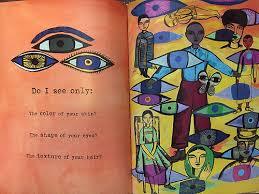
I really enjoyed this book. The illustrations are beautifully done and add to the complex topic of race. I really appreciated how Julius Lester explained that people seemt to have a tendency to feel superiorer based on accomplishments, class, what they own, etc., in addition to their race or culture. My only criticism is that as he lists the different ethnicities found in America, he skips over Middle Easterners, and I would be concerned about that considering the post-9/11 political events and discourse in the U.S. For my class, I'd introduce this as a read-aloud for the beginning of the year. The content is good, but is still basic and needs to be added to. If my students were in primary grades, I'd definitely do a picture walk first because the illustrations are striking and tell a lot.
50 reviews
September 10, 2016
The book Let's Talk about Race by Julius Lester is a picture, biography, and fiction book about people disliking people based on race. The author explains that we are all the same under our skin so we really have no reason to judge anyone based on skin color. Julius then talks about how we are so much more than our race and tells us some of the things he likes to do. At the end, Julius asks you if you, too, will take your skin off and not judge others. I selected this book because of this part at the end. This is a great question at the end because it lets the children reflect on what they just read and learn that people should not judge others based on their skin color or anything of that sort. This text can build knowledge on diversity because it explains that at lot of people judge others based on their race and skin color and this book lets children know that you shouldn't judge someone based on their race and skin color. I thought this book was interesting because this book not only is a fictional picture book, but it is also some what of a biography of the author. This book real connecting with me on a personal level because I know some people who judge others based on their skin color and culture. This is an excellent book explaining that judging others based on differences in appearance is a bad thing.
40 reviews
October 25, 2017
The book opens with the recurring line/ message throughout the text, and that is “I am a story”. Lester describes all people as a story, and emphasizes how we all have a different, unique beginning and elements throughout. Karen Barbour uses vibrant colors and images to emphasize that our lives are all stories, but the difference lies in the details. It discusses race as well as superiority and the feelings involved with being put down based on race.
This book can also be seen as a guide to help children see that we are all the same on the inside. “Beneath everyone’s skin are the same hard bones”. His helps reinforce that idea that we are all the same when you take away our skin. I also like the author’s idea in which if a person is stripped down to the bone, we would not be able to tell anyone apart. The imagery used throughout the book helps change understand this greater theme of how from many, we are one. Lester closes with “Beneath the skin we all look alike. You and Me”. This can help children understand that although we may look different from one another, but underneath our skin, we are all the same.
This book was much more in depth with diversity than the first as it uses real life experiences to emphasize the realities of diversity. And although race may be not always easy for educators to talk about, this book helps bridge that gap.
Profile Image for Jill.
244 reviews5 followers
January 14, 2021
Just read this to my 4th graders and it’s amazing. So much rich discussion afterwards.
Profile Image for Cara Byrne.
3,824 reviews37 followers
October 11, 2017
"I am a story. So are you. So is everyone. My story begins the same way yours does: 'I was born on -----.' Take me, for example. I was born on January 27, 1939, in St. Louis, Missouri. (I'm kind of old, huh?)."

In his brief picture book, Lester speaks directly to the child reader, encouraging him or her to tell his or her story, defining all of the attributes of him or herself (like favorite food, religion, heritage, etc.). Lester then asks the child to define and acknowledge his or her race, while also understanding that race is complicated because people have used/use race to prove that they are better than another. To contradict these beliefs, Lester encourages the child to realize that "Beneath our skin I look like you and you look like me."He contrives the body in a strange way - asking the child to touch and press on his or her bones to recognize that we all have similar looking bones inside of us. He ends the book by asking the reader, 'I'll take off my skin. Will you take off yours?" Karen Barbour's illustrations are gorgeous - they are colorful and bold - giving life to Lester's complicated message. Overall, I appreciate Lester's work here, though this is not my favorite book for children that challenges racism.
Profile Image for Josiah.
3,480 reviews156 followers
March 8, 2010
One of the truly great writers of our time leads this thoughtful and sometimes quirky examination into the issues of what makes us different from each other, and what ultimately makes us very much the same. Julius Lester never follows the beaten trail in his writings; he always challenges and pushes us forward into new experiences, like those in this book. The tone of the words is direct and packed with many good ideas, building upon the idea that all of us are much more than any single aspect of our person: race, age, weight, height, social status, etc. As Julius Lester points out, it is only when we allow ourselves to delve deeper into each other's character, asking questions about mutual likes and dislikes, about where we were born and the pictures formed by our own personal histories, that we can begin to truly know each other and bridge the illusory gaps that seem to separate us.

This is an excellent book, written by one of the most consistently great authors that I have ever read. I would consider giving two and a half stars to Let's Talk About Race.
Profile Image for Shaye Miller.
1,236 reviews98 followers
December 31, 2018
I love this picture book. It's likely intended for children, but would be great for convo with middle graders and even teens as they attempt to cross racial lines and break down barriers.

I'll take off my skin. Will you take off yours?

The artwork is lovely -- providing both imagination mixed with realistic conversation. The variety of skin tones shared with personal details is fantastic! Oh my, everyone should get this one on their K-12 shelves. Picture books are great for everyone. This one can simplify the subject and help people ease into what might otherwise be a difficult topic.

For more #kidlit, #mglit, and #yalit book reviews, visit The Miller Memo.
Profile Image for Kate.
669 reviews22 followers
May 30, 2018
This book is poorly named. It is a book about seeing beyond race to what makes people similar and seeing people’s stories instead of their race. The illustrations are great, the message is nice, and it provides plenty to think about.

Unfortunately it promotes color blindness at the expense of addressing the fact that we live in an unjust world and experience the world differently because of race and that outcomes are drastically different for different racial groups.

Profile Image for Suzie.
1,009 reviews
October 4, 2020
Judging by the title, I thought this book might be too heavy for my kindergartner. But when I looked at what was inside, at the whole story, I saw how great it was. (Do you see what I did there?) ;-) What a great way to talk about race, or any aspect of a person that makes them feel better than someone else. Unique illustrations too.
Profile Image for Erin.
4,555 reviews56 followers
Read
August 10, 2021
Parts of this were absolutely fantastic. I enjoyed the illustrations, which are vibrantly colorful. I loved the idea that we are all stories made up of many things, not just our race, but also our family history, our likes and dislikes, where and when we were born, our religion, and more and more things. Our stories can be similar, even if there are also differences. I appreciated his point that underneath our skin, our bones look very much alike, and that when we see a person we should not just take in what they appear to be, but we should start asking questions and wondering about that person's story.

Where I think this book falls short, in no small part because it was published in 2005, is in not also taking a hot minute to celebrate race. There is an impression left that if we all just peeled off our skin, everything would be good. We just need to look beyond race to the full person within. I think there is a greater appreciation now (over 15 years later) that it's not enough to ignore race, we also need to celebrate those differences. Because the fact is those racial characteristics as determined by society are also part of our stories, and in order to tell a person's full story we can't ignore the hard parts.

In short, this is a largely feel-good introduction about how race should not cause us to make assumptions about someone. But it is not an in-depth exploration of what race is and how it affects people's lives and stories.
25 reviews1 follower
January 24, 2022
This book addresses the hot topic of race and identity. This book exemplifies that race is a part of who people are, but it does not define the person they want to be. Underneath, we all look the same.
Displaying 1 - 30 of 201 reviews

Can't find what you're looking for?

Get help and learn more about the design.