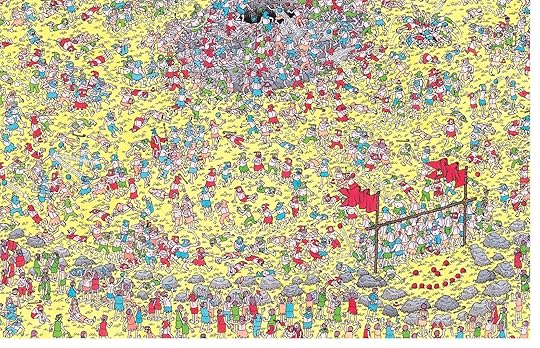
Looking for Waldo? Search no more. The time has come and we’ re celebrating our favorite wanderer in style!
For over a quarter of a century, the bespectacled Waldo has held a place as a beloved cultural icon. Candlewick has reissued the classic Waldo adventure with special features worthy of a stalwart hero. This Where's Waldo? deluxe edition boasts:
— a striking jacketed cover
— an original poster on the underside of the jacket
— a spot-the-difference game between the jacket and self-cover designs
— a gatefold with a visual checklist on every spread
— a never-before-seen section of artwork revealed on every spread
Martin Handford, the man behind the mind-boggling Waldo books, began his career as a freelance illustrator specializing in drawing crowd scenes. The turning point came when he was asked to create a book showcasing his impressive talent, and the character Waldo was born—originally to provide a link between each scene. "I can't tell you how pleased I am that Waldo has taken on a life of his own," Martin Handford says. "I'd like to inspire children to open their minds to explore subjects more, to be aware of what's going on around them. I'd like them to see wonder in places that may not have occurred to them." Martin Handford lives in England.
I knew the concept of the Where's Waldo books, but until my son got interested in them, I didn't know much about them. Can I just say how addicting they are? Searching for Waldo on every page is a self-challenge that makes you push for your personal best; when you can't find him, you do not give up. You change tactics by taking out your contacts, reaching for your reading glasses, or tossing your glasses aside so you can stick the book as far up to your face as possible. You scan haphazardly at first, hoping to get a surprise glimpse of him, but when he doesn't appear you create a grid and search every inch left to right and top to bottom until you spot him. These books are a lot of fun and perusing them has turned into a family affair. Long after my son loses interest and goes to play his Lego Star Wars game, my husband and I lie on the bed, each taking a side of the book, competing to see who can find Waldo, Wenda, Odlaw, the Wizard, the dog's tail, and Waldo's tiny possessions.
Where's Wally (Waldo?) has always struck me as a metaphor for... Oh fuck it... How can someone wearing such ridiculous clothing be so hard to find!!! And when you finally do, you can't lose him again, he's just always there, on the page... Invading your darkest thoughts... Hiding in the bushes beind you when you walk home in the dark... And why do people insist on putting a circle around him when they read it in the doctor's surgery!?! THAT DEFEATS THE WHOLE POINT, JERKS!!! Oh dear... I must lie down now.
Even though my star rating for Martin Handford's 1987 search-and-find (wordless) picture book Where's Waldo? is four stars, I do and very readily admit to not actually ever having all that much liked "reading" either Where's Waldo? or any of the sequels (and that with regard to my actual feelings regarding what Handford is visually presenting with and in his Where's Waldo? books, well, my ratings should probably be a very high two or a very low three stars). For Handford's illustrations, they are truth be told simply too woefully busy, too garishly coloured and also much too cartoon-like for my aesthetic tastes and that searching for Waldo has therefore never been all that much fun, has always been rather annoyingly frustrating, too hard on my eyes and often in fact leaving me with both eyestrain and tension headaches. And indeed and yes, I would thus most definitely much rather always be reading written words than doing search-and-find activities and in particular if the presented pictures are like they are with Where's Waldo? just teeming with masses of humanity and giving me due to this also a very uncomfortable sense of visual claustrophobia, as I absolutely do majorly despise and am kind of even a bit frightened by crowds (and that Martin Handford basically having huge amounts of people squeezed like proverbial sardines in Where's Waldo et al, this just does not really do anything at all for me and is certainly not in any way hugely visually engaging and/or pleasantly entertaining).
However, as much as the Where's Waldo? books are not personally all that enjoyable, I am nevertheless still going to be rating the original Where's Waldo? book with almost five stars and simply because there is absolutely NO REASON WHATSOEVER for Where's Waldo? to have been challenged and restricted and seemingly according to the American Library Association (the ALA) even being number eighty-seven of the top one hundred most challenged American books from 1990 to 1999, and all because there is ONE single image in Martin Handford's beach scene of Where's Waldo? that, oh the puritanical moronic American Bible thumping horror, supposedly shows a topless female sun bather. But indeed, even after multiple perusals of Where's Waldo?, I certainly have never noticed and registered the latter, and well, even if I had, the very idea of banning and restricting, of censoring Where's Waldo? because within all the masses of humanity inhabiting the pages, Handford has (and only maybe) depicted one woman going topless on the beach, that is absolutely ridiculous, that is totally mentally unhinged, that is hugely and ignorantly stupid, and also makes me as a person of German background and with a healthy and sane (read Western European) attitude towards both my body and towards naturally occurring nudity shake my head both laughingly and also hugely derisively (and not to mention that I also have to wonder what kind of absolute and horrible FREAKSHOW would meticulously go through the huge amounts of depicted people in Where's Waldo? to locate the one single image of a topless sunbather).
And finally just to say that unfortunately, the publisher and Mark Handford have sadly also seemingly caved to the demands and ravings of those puritanical book banning morons as I have heard and read that more recent editions of Where's Waldo? have put a bikini top on the topless sun bather, sigh (and really shameful).
Nunca me convenció mucho esa propuesta de buscar a Wally. Primero, porque cuando era chico el personaje me creepeaba un poco. Siempre con una sonrisa antinatural, mirando fijamente a la cuarta pared, siempre con la misma vestimenta y una tendencia insalubre a mezclarse con grandes grupos de personas. Su lenguaje se aproximaba al absurdo, un estilo que no sé por qué se considera que apela a los niños, pero que a mí nunca me gustó. Para colmo, Wally venía de una tierra colmada de réplicas de sí mismo, quizás la confluencia de varios universos paralelos; todo un statement sobre la poca importancia de la experiencia individual. En resumen, no quería encontrar a Wally, y si me cruzaba con él era por accidente.
Pero estos libros me gustaron mucho, a pesar de Wally. Y fue por el talento de su autor no para esconder cosas, sino para dibujar grandes escenas multitudinarias. Parece que estas fueron siempre la especialidad de Handford. Wally apareció como una idea incidental, un elemento para darle cohesión a escenas inconexas, y también para darle una tarea concreta al lector / observador. A Handford, como le ha pasado a otra gente, lo incidental lo convirtió en millonario. Hay que reconocer que Wally, heredero del flâneur decimonónico, es un motivo poderoso, en especial si se tiene en cuenta la poca cantidad de materias primas necesarias para construirlo. Su diseño está apenas unos pasos más allá de lo icónico, y estimo que ninguno de sus libros llega al millar de palabras. Ahí está también el asiento de su creepytud escasamente infantil. Hay que volver al texto de Poe, “El hombre de la multitud”. y ver lo cerca que está de Wally su personaje central, para entender esto.
En realidad, de chico no solo no quería buscar a Wally, sino que no quería buscar nada. Para cada imagen, como es sabido, el libro propone una serie de objetos, situaciones o personajes que el lector podría tratar de encontrar. Una buena manera de mantener a los niños entretenidos, porque eran los años 80s y todavía no imperaban las pantallas, que pueden cumplir la misma función (lo que no quiere decir que Wally no siga siendo popular con los niños). En ese entonces yo ya era un rebelde, y renunciaba a las búsquedas guiadas. En lugar de eso, simplemente miraba las escenas. Las miraba por horas. Las muchedumbres de Handford son, por supuesto, limitadas, pero también, en un sentido que voy a pasar a explicar, inagotables. Da la impresión de que siempre hay nuevas escenas que descubrir, y esto, por más que parezca naif e infantil, es en el fondo un enorme logro técnico.
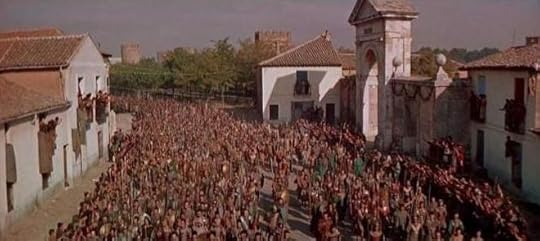
Vamos a empezar con el estilo de las imágenes en sí. Según el propio Martin Handford, las dos primeras experiencias que inspiraron sus multitudes fueron las épicas cinematográficas y el jugar con soldaditos, y esas escenas fueron las que primero trató de reflejar con sus dibujos. Lo que se reúne en esas experiencias (que, a decir verdad, son la misma) es la muchedumbre como una uniformidad en apariencia, que sin embargo se puede diseccionar en pequeñas unidades. La muchedumbre parece un todo, pero son muchas cosas las que tienen lugar en su interior, casi tantas como los hombrecitos que la componen. Lo que el jugar con soldaditos tiene, y el cine no, es una combinación de estática y dinamismo que también podemos ver en los dibujos. Se trata de una escena congelada, digamos, que el chico que juega puede ir avanzando de a una escena por vez, por turnos. Además, la escena puede observarse bien en conjunto o bien puntualmente, saltando de un plano al otro. Esta son las operaciones básicas que se pueden hacer con los posters de Handford.
Espartaco (1960), una de las películas con más extras en la historia del cine
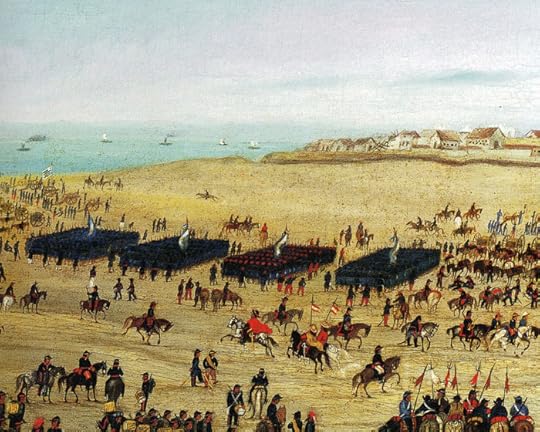
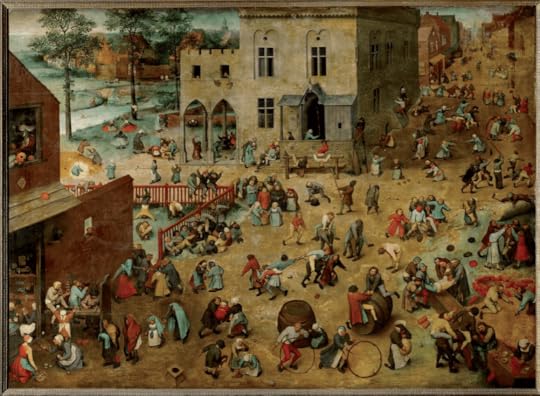
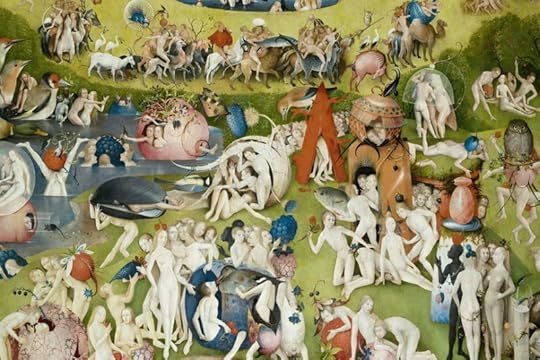
Ahora bien, reflejar esta experiencia en un plano a la vez estático y bidimensional no es tan simple como podría parecer. Si tuviéramos que buscar a los precursores de Handford tendríamos que remontarnos primero a Pieter Brughel el Viejo, con sus famosas pinturas de aldeas flamencas en plenos eventos sociales, a las escenas alucinadas de El Bosco, y ¿por qué no? a las pinturas bélicas de Cándido López. Estas son al menos las referencias en las que yo puedo pensar, que no soy un experto en el arte ni en su historia. Todos estos artistas, y Handford también, se apoyan en una perspectiva distorsionada. En realidad, todo el arte visual funciona así. En estas escenas multitudinarias, el observador se coloca en un punto imposible, en el que toda la escena puede percibirse a la vez. Es lo que se llama, según tengo entendido, una perspectiva isométrica. Pero dicha perspectiva se aplica únicamente al escenario: las figuras humanas que aparecen se nos presentan, en cambio, vistas de frente, aunque estén paradas en ese plano inclinado. Ese es el truco fundamental que nos habilita la percepción de la escena.
Handford y sus precursores: las imágenes bélicas de Cándido López
Aquí, Handford sumó otra innovación: las figuras están asimismo escasamente afectadas por la perspectiva lineal. Esto quiere decir que no se hacen más pequeñas cuanto más lejos están, algo que sí ocurre en las pinturas que mencioné, o bien que se hacen más pequeñas pero a destiempo con el escenario. La combinación que resulta es rarísima: vemos el fondo como a vuelo de pájaro, y las figuras como si las viéramos de frente. Nuestro cerebro, sin embargo, no se sobresalta. La doble perspectiva va de la mano con la doble identidad de las muchedumbres: como un todo homogéneo, y como una suma de diferentes partes. Nuestra percepción puede enfocarse en uno de los dos aspectos: ver el todo, o ver una de las partes, pero nunca ambas a la vez (igual que, al escuchar una pieza de música, podemos enfocarnos en una de las voces, o en la combinación de todas, pero no en todas y cada una a la vez). Por esta imposibilidad, es difícil descubrir la discrepancia en la perspectiva.
Aldeas medievales de Pieter Brughel vs Martin Handford. Nótese la diferencia en el uso de la perspectiva
También es gracias a esto que la experiencia visual se transforma en una experiencia narrativa. Hay por lo menos dos narrativas en Wally, ambas muy laxas. La primera es la que ocurre en el interior de cada escena; la segunda, la que se desarrolla entre escenas. En una y otra, especialmente en la segunda, le cabe al lector un papel muy importante. Para empezar, a medida que navegamos cada una de las escenas, podemos ir viendo distintas microescenas. En muchas de ellas, el tiempo es un factor tan falseado como las perspectivas. Quiero decir, lo que ocurre no ocurre siempre en simultáneo, sino que en el movimiento de un dibujo al otro podrían pasar unos segundos. En esto, los dibujos funcionan como un cómic, donde el tiempo transcurre no solo entre viñeta y viñeta, sino a veces también en el interior de las viñetas, aunque estas parezcan estáticas (por ejemplo, un globo de diálogo ya nos indica un trascurso de algunos segundos, según el ejemplo de Scott McCloud). El tiempo avanza con cada microescena, pero tiene que volver a cero cuando contemplamos la escena total. Como siempre se puede volver al punto de partida, no importa la manera ni el orden en que se lean las microescenas. Todos los recorridos posibles están abiertos. La segunda narrativa tiene lugar en la suma de las escenas, como decía, y es lo que podríamos llamar los mythos de Wally: los personajes recurrentes, su historia. Tampoco aquí los libros proporcionan mucha información, ni palabras, de manera que hay que ir reconstruyéndolos a retazos. Esto último nunca me llamó mucho la atención, supongo que por lo que decía antes sobre lo creepy del personaje. La idea de un mundo todo hecho de Wallys, o de una especie de multiverso donde coexistían los Wallys de distintas realidades, era de avanzada en ese entonces, pero también material ligeramente pesadillesco.
Antes mencionaba al Bosco, y creo también en cuanto a los contenidos se pueden tender algunas líneas hacia este artista. Mi libro favorito de la colección de Wally fue siempre The Fantastic Journey, en el que nuestro antihéroe recorría sucesivamente distintos mundos con tonos ligeramente mitológicos, pero ninguno identificable. En uno, había gigantes atacando una aldea humana. En otro, una reunión de criaturas de pesadilla en un castillo negro. Otro, el cielo de una ciudad que podría ser Bagdad, atravesado por alfombras mágicas de distinto tipo. También una batalla entre monjes de fuego y monjes de agua. En todas estas escenas se trataba no solo de observar lo que pasaba sino de no entenderlo completamente, como en las obras del genio de Brabante. Sobre todo, me acuerdo de un poster con un juego de pelota cuyas reglas eran totalmente imposibles de comprender.
I used to find these books endlessly fascinating as a child, especially the more odd and mystical elements. Of course, what I liked most was the frantic detail. There were entire stories laid out in these pictures, and no doubt they helped me to question how much meaning and action one could put into a single image.
In high school, I made a short series of my own called The Necro Files (ha ha, aren't sixteen year-olds funny?). It would feature a different odd locale (Atlantis, a circus) and then all of my different friends and acquaintances being killed by themed characters.
The theme of each character was the method by which they would inflict death upon you. There was pointed-stick man, decapitation man, and even spinal paralysis man. Some of them were even incidental or accidental killers (failed suicide attempt man was a favorite). Needless to say, I was glad to live in that brief period just after Columbine before such drawings would have had me expelled.
Like the Penguin book down below, many people feel like I either look like Waldo, or worst, I am Waldo. I often take the bus, and I try to avoid bus transportation during school hours - because the kids love to say 'Hey I just found Waldo!" It's get tiresome after awhile.
And on top of that I can never find Waldo in these pictures. I have to ask my neighborhood kid on the block where Waldo is. And you know they usually say ' hey he's right in front of me.' Meaning .... me of course.
loved this book so much so read it countless times this book was a gift from my hubby also got the jigsaw puzzle as well puzzle & book where done in three days once you start you can't stop so I would be very delighted to recommend this book to all you big kids out there you know who you are hehe so get it read it you'll love it.😏😀
Following Waldo on his travels was fantastic, but the story wasn't there and the characters were very 2D. While I didn't 100% it, I did find the core four on each page. I'll have to fully complete it another time.
Waldo is pretty average at hiding. He's usually completely exposed, not even trying.
Odlaw does a much better job, often forcing a dreaded rescan of the page. His hiding in the Zoo was top tier, as well as in the Department Store.
Wenda is probably the best of the core four. Usually hidden so well you only see her face.
The wizard guy is actually surprisingly good at hiding. You'd think his staff would make him stick out more, but there were quite a few pages where he was my last to find.
The characters didn't really develop as much as I was hoping. Why are they always hiding? What is the purpose of this journey? Why does Odlaw look just like Waldo but with a yellow/black color scheme? And the biggest question, why is there a wizard?
I'm intrigued enough to continue on and look forward to starting book 2 soon.
The Waldo books actually are about a man's ability to both engage with and disappear into the body politic. In fact, he is grooming himself to be a politician. He selects attire that lets him stick out yet blend in; he goes to the same burger joints when he wants to show off his proletarian diet, gets around to and fro so fast you can barely see 'im as he schmoozes and shakes lots of hands in the crowd. And the guy keeps movin'. Movin' along; a moving target; perfecting those chameleon skills of disappearance that will serve him so well when he becomes a politician so he can shield himself from real people and real issues and hide in that bubble of special interests. Where's Waldo? Is he at the press conference, or the Senate cloak room, or at a fundraiser, or pow-wowing in some sequestered backroom with oil and pharmaceutical lobbyists? Who knows? He's so damned hard to find.
OK, maybe Waldo isn't about any of that. I do know he provided hours of fun back in the day when my kids were l'il guys.
(KevinR@Ky 2016, rewritten entirely, simply for my amusement)
This was such a hit when it first came out back in the 1980s -- I used it as a gift for our work Christmas Party. It was a favorite, with everybody wanting to get a glimpse of at least one page. It remains a staple on our shelves.
P.S. The rating is based on my impression when I first saw the book. Now, compared with other 'search and find' titles, I'll rate this one 3.
Sucesso completo! O Wally é só um detalhe, a pequena fica me perguntando tudo em cada cena. Mesmo assim não é lá um livro infantil, principalmente no volume 2 (uma aventura na história) onde violência é sugerida. Mas o véu da inocência cobre tudo isso e ela se concentra nas partes divertidas e informativas. Acho que as imagens fornecem mesmo uma “consciência do todo” como na primeira cena onde toda uma cidade é retratada.
“Where’s Wally?” A question asked by so many, yet answered by so few. Today I am going to change that for you, but in order to do so we must answer a different question.
“Who’s Wally?” Now this can be up for debate. Is Wally a histrionic exhibitionist who wears unique striped clothing to stand out from his peers? begging for us to spot him and give him the attention he so desperately yearns for. we find him often quickly and easily hiding in plain sight, grinning ear to ear like a psychopath, because is he really hiding? no, he’s here to be found. This theory is extremely relevant today with the rise of performativity and social media, doing things to stand out from others and to be seen. Another answer to Wally’s identity is a shy introvert hiding in dense crowds, desperately trying to fit in yet no matter how hard he tries he is found. A cruel endless torture as he stands there praying for peace, wishing to be like everyone else, yet day by day, hour by hour our gaze casts over pages scanning, probing until our pupils transfix upon his unique profile, and then we cheer, exclaim, we laugh in his specky face for we have found him again, we have won and he has lost. Although he does improve in his quest for concealment further on in the book, so do we, his striped hat, nervous grin, soulless eyes ingrained into our memory. We know exactly what we’re looking for and my god do we look for it. I do find it ironic that in his pursuit for anonymity he has only become more recognisable. An outcast, an oddball, a freak who will never change, never be happy and we can all see it… yet we continue to cackle in his face, using his misfortune as our amusement perpetually. his struggles immortalised in ink and paper.
Therefore it is clear Wally is a just like the rest of us, a person with forthcomings and shortfalls, has triumphs and failures in different rights and this proves that no matter what you believe Wally is merely human just like us, trying to navigate his way in an ever changing complex world. One he cannot keep up with, the time, the place, the people may change yet he stays the same. There is undoubtedly something beautifully comforting about his consistency and inertia in such confusing times. See Wally is not just a person but a metaphor, a concept, a lesson to us all that although the place we are in may change and so may the people, perchance ;) even we look different, but deep down we are still ourselves and we always will be. So, the next time somebody asks you “Where’s Wally?” You can answer “He’s everywhere”.
Where's Waldo? Is an awesome way to look at what students see during a first, second, and third (or more) perusal of art, stories, and other items of interest. Students don't always know the purpose of rereading, but they might spend ten or more minutes scouring the page to find Waldo among a crowd. Where's Waldo? books are ones that most students will know and have encountered at some point in their lives, so bringing these into the classroom will interest students, and they will be eager to participate in a fun exercise using these books. As an educator, I would be able to show them the importance of looking back over something to gain further comprehension and explore the relationship between rereading and comprehension. Students could be given a certain time frame to look at a page in the book, and for each time frame I will give them a goal (not just to find Waldo), but to look at the scene itself, then the characters, and then if they haven't already found Waldo, they can spend the last time frame to look for him. At the end of each time period, students will be given one minute to write what they found in accordance with their goals, students will then repeat this two more times, and then finally they will write about what each new opportunity to look did for their understanding of the scene in which Waldo is placed, its difficulty level, or other factors that they noticed during this time. This idea is inspired by Kelly Gallagher's ideas regarding visuals in his chapter on Analyzing and Interpreting in Write Like This. Students could also write using the prompt "Unwritten Rules," also from Gallagher, and explore the Unwritten rules of Where's Waldo? What is the best strategy for these books? They should strive for ten rules and think strategically about what might work best when looking for something specific. Students could go off of this same strategy and write about "Unwritten Rules" for finding something that is lost, or "Unwritten Rules" for finding someone when you get separated from them in an unfamiliar area. This will help students to think deeply about things that they may experience frequently in their lives.
"Where's Waldo?" is a heart wrenching tale about a poor orphan named Waldo. After his parents died he was put into orphanage after orphanage, school after school. He was bullied wherever he went because he had only one set of clothes that his mother bought him. He was just a kid he didn't have any money. He would hide from the bullies but be spotted due to his striped shirt. The kids would often slam their beefy fingers into Waldo's face when they found him. These bullies found him wherever he went. It was just a game to them. "I found him! I win!" they would say as they repeatedly thrusted their fingers into Waldo's eyes and glasses. Each page in this book is a new day for Waldo. A new, unstoppable, hell every day.
Personally I believe Waldo is what represents what humans desire most. To fit in. But no matter how much we try, how much we hide our true selves, we will never escape our demons. We can wake up in the morning and say "it's a new day, it's going to be better than the last," all we want; but the sun coming up on the horizon doesn't determine what type of day you will have. You have to make your day your own.
Waldo is a lesson of what not to be. Waldo has never faced his fears, he just keeps running. He is an example of what happens when you don't take action. When you don't seize the moment. When you just let things happen. We as a species, do not have claws to kill. We do not have wings to fly away. We do not have armored skin to protect us from the world. We have our brains and each other that's it-- and when both fail, you fail as a human. The greats did not become the greats by sitting on their ass. They worked hard for it every single day. They did not let life just slip by, they seized the day every day till they died. Now that's what you must do. You must take the lesson that Martin Handford has obviously intended for us to learn through this wonderful novella. "Do not run from your problems, face them head on. Don't be a Waldo. Waldo is stupid. Waldo is a stupid name. Who names their kid Waldo?" - Martin Handford
I liked this book first time around, but persistent re-reads by my youngest daughter meant that my enjoyment of, and patience with, the book, did not last long.
I found it remarkable that at age 4 she could remember every half-promise or insinuation of a promise ever mad by myself, my wife, her grandparents and her elder sister.... she could also remember every word [parrot-fashion] in every book that we read together.... but do you think she could remember where sodding Wally was?
No...not on your life! So we had to go through the charade of looking for him... night after night after night after night after night after... you get the picture?
Where's Waldo is an iconic search and find activity book that has been entertaining people for 30 years. This 30th Special Anniversary Edition would make a great gift for those fans of Waldo or search and finds in general.
My parents shared Where's Waldo with me and I had fun passing it on to my daughter. I had trouble finding Waldo and his friends as usual, but that's what makes it interesting. I loved the post cards that introduced each scene and I enjoyed the letter in the back of the book. It gave the "Where's Waldo Around the World" feel.
Final Verdict: I would recommend this book to all Waldo fans and fans of search and finds. This special 30th anniversary edition is one that should be added to any Waldo collection.
There have always been fads in books for children, pop culture tie-ins and gimmicks to increase a book's appeal. This is one I still enjoy. Handford was the first and continues to be the best, but even the rip-offs of his style are pleasing. It's fun to sit and look at the vast pictures, rich in detail and humor, searching out something which isn't hidden, exactly, but can be very hard to find.
The younger child in particular was a huge fan of these. Of course, they're a gateway drug. She moved up to the I Spy puzzles, and now she's looking for Easter eggs in the opening credits of Futurama. Take my warning to heart.