

What do you think?
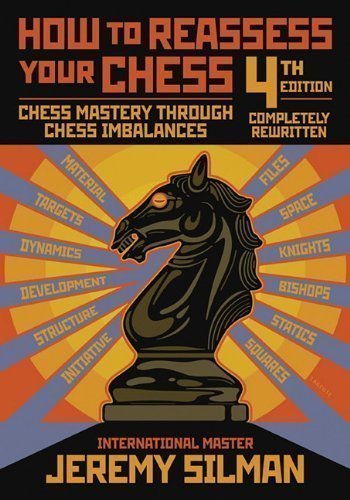
How to Reassess Your Chess, Fourth edition by Silman, Jeremy 4th (fourth) Edition
How to Reassess Your Chess is the popular step-by-step course that will create a marked improvement in anyone's game. In clear, direct language, Silman shows how to dissect a position, recognize its individual parts and ultimately find the move that conforms to the needs of that particular situation. By explaining the thought processes that go into a master's choice of move, the author presents a system of thought that makes advanced strategies seem clear, logical and at times even obvious. How the Reassess Your Chess offers invaluable knowledge and insight that cannot be found in any other book.
Unknown Binding
Ratings & Reviews
Friends & Following
Create a free account to discover what your friends think of this book!
Community Reviews
Displaying 1 - 30 of 84 reviews

April 1, 2018
The Tao of Chess

Blade Runner (1982) - Ridley Scott
My opinion on the book:
The guy teaches you how to state the situation in any moment of a game.
And he does so efficiently, by displaying general principles illustrated by games, analysed both by praxis and computer analysis, backed with exercises, sprinkled with amusing anecdotes :)
Whatever your mastery, you can nibble crumbs of know-how and insight useful in any level of competition.
❖Opening, middle game, endgame
❖Quality sacrifice, positional sacrifice, tactics
❖King safety
❖Piece coordination
❖Space advantage
❖Superior minor piece
❖Pawn structures, holes, open files, isolated pawns, passed pawns & anti-passed-pawn strategies
❖Statics & dynamics
❖Planning
All themes epitomized in the keystone concept...
❖Imbalances!
By far the most user-friendly well-rounded one-volume chess textbook I've read to this day!
Some chess channels on YouTube I enjoy to follow from time to time :
Game analyses & find the move:
Agadmator
ASMR Chess
GothamChess
And the studies by Leontxo García :)
https://www.youtube.com/watch?v=BcyLn...
https://www.youtube.com/watch?v=TJO4P...
https://www.youtube.com/watch?v=npS9B...
Opening theory:
Krishna Prem
Hanging Pawns
Gambits:
Eric Rosen
Chess blitz and rapid:
GMHikaru
Chessexplained
Also see:
Chess methods:
Breviary of Chess
L'art de faire mat
Chess Master vs. Chess Amateur
Collections of games:
Mammoth Book of the World's Greatest Chess Games: Improve Your Chess by Studying the Greatest Games of All time
The Life and Games of Mikhail Tal
Soundtrack & stop-motion chess :)
https://www.youtube.com/watch?v=FyVqe...
https://www.youtube.com/watch?v=_r1sM...
https://www.youtube.com/watch?v=YXM3w...
Blade Runner (1982) - Ridley Scott
'in real games, your opponent will constantly try to feed you lies and you have to learn to ignore everything he says and seek your own truth in each and every position.'
'The fact is, a player that fights to the bitter end becomes feared, with even higher rated players knowing such an opponent has no respect for anyone and will take you to the brink each and every time he sits down.'
'They leap over other pieces, they prance about in a strange drunken gait, their movements make them seem almost alien compared to the other chessmen, and they can make us laugh when we see a Knight do an octopus imitation by forking the whole royal family and estate (attacking King, Queen, and both country homes/Rooks all at once). However, as any clown-wise child will tell you, there is also something scary about them. They seem docile, but behind the facade and horse-like grin is a psychopath, and nothing is safe.'
My opinion on the book:
The guy teaches you how to state the situation in any moment of a game.
And he does so efficiently, by displaying general principles illustrated by games, analysed both by praxis and computer analysis, backed with exercises, sprinkled with amusing anecdotes :)
Whatever your mastery, you can nibble crumbs of know-how and insight useful in any level of competition.
❖Opening, middle game, endgame
❖Quality sacrifice, positional sacrifice, tactics
❖King safety
❖Piece coordination
❖Space advantage
❖Superior minor piece
❖Pawn structures, holes, open files, isolated pawns, passed pawns & anti-passed-pawn strategies
❖Statics & dynamics
❖Planning
All themes epitomized in the keystone concept...
❖Imbalances!
By far the most user-friendly well-rounded one-volume chess textbook I've read to this day!
Some chess channels on YouTube I enjoy to follow from time to time :
Game analyses & find the move:
Agadmator
ASMR Chess
GothamChess
And the studies by Leontxo García :)
https://www.youtube.com/watch?v=BcyLn...
https://www.youtube.com/watch?v=TJO4P...
https://www.youtube.com/watch?v=npS9B...
Opening theory:
Krishna Prem
Hanging Pawns
Gambits:
Eric Rosen
Chess blitz and rapid:
GMHikaru
Chessexplained
Also see:
Chess methods:
Breviary of Chess
L'art de faire mat
Chess Master vs. Chess Amateur
Collections of games:
Mammoth Book of the World's Greatest Chess Games: Improve Your Chess by Studying the Greatest Games of All time
The Life and Games of Mikhail Tal
Soundtrack & stop-motion chess :)
https://www.youtube.com/watch?v=FyVqe...
https://www.youtube.com/watch?v=_r1sM...
https://www.youtube.com/watch?v=YXM3w...

August 21, 2012
One of the best chess books out there. The only one that I like better is another book by this same author, The Amateur's Mind: Turning Chess Misconceptions Into Chess Mastery. Silman changed the way I looked at chess positions. He added humor and analogy to how I looked at positions. I still think of terms like Running from Ghosts and the curse of the mindless king hunter when looking at a position. Those are concepts Silman introduced me to in The Amateur's Mind. This book is more about the importance of piece placement when choosing a move. Many consider this to be the chess player's bible. It is taken for granted among tournament players that they have either read this book, own this book, or are at least familiar enough with this book to understand casual references to it. Certain terms from this book have become common terms used to describe chess concepts. Jeremy Silman will go down in history as one of the greatest chess teachers that ever lived.

August 18, 2008
[This review was written in 2005 and refers only to the THIRD edition.]
If you can only get one book to improve your game, this one is it. Examples and exercises that cover ALL phases of the game, and even if you don't buy into Silman's "thinking technique" this book will introduce you to many advanced concepts (knights vs. bishops, bishop pair, support points, etc.)
THE KEY OF COURSE IS NOT JUST TO READ THE BOOK, BUT TO SET UP POSITIONS AND FOLLOW ALONG AS SILMAN EXPLAINS THEM: EVERY SINGLE ONE, ON EVERY SINGLE PAGE. Spend a couple months with this book, commit to reading/working three pages a day or so and you will be stunned at your improvement, as I was.
If you can only get one book to improve your game, this one is it. Examples and exercises that cover ALL phases of the game, and even if you don't buy into Silman's "thinking technique" this book will introduce you to many advanced concepts (knights vs. bishops, bishop pair, support points, etc.)
THE KEY OF COURSE IS NOT JUST TO READ THE BOOK, BUT TO SET UP POSITIONS AND FOLLOW ALONG AS SILMAN EXPLAINS THEM: EVERY SINGLE ONE, ON EVERY SINGLE PAGE. Spend a couple months with this book, commit to reading/working three pages a day or so and you will be stunned at your improvement, as I was.
October 12, 2016
I am crap at chess. I spent a lot of money on books that I thought would at least make me competitive. Nothing worked. I think these chess books will all sit in a box gathering dust and one day I might get the urge to rejoin the local club and get butchered by 12 year olds so then may have a further look. (Generic review for all half finished chess books I will never finish

August 2, 2013
I have only just completed the 2nd chapter. My 2 cents:
1)A book on positional play/ strategy and planning.
2)if you are looking for tactics, openings or endgame you should look elsewhere
3)Silman recommends 1400-2100 rated players for this book. I would say 1700 and above. Players under 1700 I would say are more to gain by learning tactics as positional play/planning does not quite come into play when you tend to loose a pawn in a 2-3 move variation.
4)his theory of imbalances gives me a intutional view of why my game never went above the 1900-2000 mark.
5)Now i see the light beyond the horizon. When after being stuck at a position you don't know what to do next. And end up pushing wood (plastic) and waiting for an error on your opponents part.
6)know the position. let the board talk to you and plans will develop accordingly.
nice book. recommended for players above 1700. ---- my opinion
1)A book on positional play/ strategy and planning.
2)if you are looking for tactics, openings or endgame you should look elsewhere
3)Silman recommends 1400-2100 rated players for this book. I would say 1700 and above. Players under 1700 I would say are more to gain by learning tactics as positional play/planning does not quite come into play when you tend to loose a pawn in a 2-3 move variation.
4)his theory of imbalances gives me a intutional view of why my game never went above the 1900-2000 mark.
5)Now i see the light beyond the horizon. When after being stuck at a position you don't know what to do next. And end up pushing wood (plastic) and waiting for an error on your opponents part.
6)know the position. let the board talk to you and plans will develop accordingly.
nice book. recommended for players above 1700. ---- my opinion

August 4, 2024
خیلی از بخش هاش با کتاب amateur's mind از همین نویسنده تکراری بود ولی در کل مفید بود.

Want to Read
December 29, 2020Silman's book does two things:
1. Introduces the major strategic elements that players should be looking for in every position (minor piece advantage, open lines, pawn structure, king safety, lead in development, etc.)
2. A systematic THOUGHT PROCESS. Namely, look for all the strategic "imbalances" (Silman's term) in the position, formulate a PLAN, find candidate moves that advance that plan, and only then calculate.
On the first matter, Silman's book is a decent introduction for beginners to these strategic concepts, but by no means the only one. Euwe's Middlegame books are probably more comprehensive and Pachman's book is excellent too. There are many other books that will talk about these concepts, some more "systematic" than others. If Silman has any advantage over those other books it's in that he 1) is friendly for beginners, and 2) organizes the "imbalances" into a nice, concise "list", so the beginner can think through each of them at a time like a checklist. At higher levels, you probably have a better judgement to be able to see with one glance which are the most important elements of any given position. But at a beginner level, he gives the player a "systematic" list to go through so they are sure they didn't miss anything.
On the second matter, having a systematic thought process is a great thing for a beginner to learn, but in truth, there are problems with sticking to Silman's. First, at beginner levels, there are other parts of the thought process that a player has to learn to become natural at. For example, scanning for checks and hanging pieces. So many authors over the ages have come up with countless systems of thought that they claim beginners should stick to and improve their rating. Some focus on preventing blunders (gothamchess's "Danger Level", or Dan Heisman's "Hope Chess" - virtually every coach has their own system with their own trademarked name), others are about calculation (who remembers Kotov's Think Like a Grandmaster), while others are focused on coming up with a strategy or positional plan. Beginners can be led to believe that one system is the "right" one, and Silman certainly gives the impression that his is the best (naturally). But in truth, no one system works for everyone, and no system works in every position. For some players, and in some positions, looking out for tactics is most important. In others, formulating a plan is important (and then there's the question: when do I know it's the right time to stop and make a plan?). Silman's book is valuable because it gives beginners a process for thinking, but at a certain point, beginners learn that there isn't just one thought process.
People who don't like Silman's book probably have a problem with either one of the two things I mentioned above. Either they think it isn't the best way to introduce strategical concepts (maybe Silman's list isn't comprehensive enough, or they think it's too difficult for beginners). Or, they don't like Silman's system of thinking.
I think Silman does a very good job on both accounts. As I mentioned, although it probably isn't the BEST or most comprehensive book on strategy (I'm partial to Euwe's), it is a pretty good one for intermediate players (maybe Winning Chess Strategies by Yasser Seirawan is best for lower-rated players, but I wouldn't know - I haven't looked at it, but it's just what I've heard). As far as giving beginners a "system", I do think that most players should be learning how to look out for blunders and tactics first, and there should also be the disclaimer that there are many thought processes and Silman's is by no means the only one, but I still think it is very helpful for players to learn how to be disciplined and for that Silman's book is as good as any.
1. Introduces the major strategic elements that players should be looking for in every position (minor piece advantage, open lines, pawn structure, king safety, lead in development, etc.)
2. A systematic THOUGHT PROCESS. Namely, look for all the strategic "imbalances" (Silman's term) in the position, formulate a PLAN, find candidate moves that advance that plan, and only then calculate.
On the first matter, Silman's book is a decent introduction for beginners to these strategic concepts, but by no means the only one. Euwe's Middlegame books are probably more comprehensive and Pachman's book is excellent too. There are many other books that will talk about these concepts, some more "systematic" than others. If Silman has any advantage over those other books it's in that he 1) is friendly for beginners, and 2) organizes the "imbalances" into a nice, concise "list", so the beginner can think through each of them at a time like a checklist. At higher levels, you probably have a better judgement to be able to see with one glance which are the most important elements of any given position. But at a beginner level, he gives the player a "systematic" list to go through so they are sure they didn't miss anything.
On the second matter, having a systematic thought process is a great thing for a beginner to learn, but in truth, there are problems with sticking to Silman's. First, at beginner levels, there are other parts of the thought process that a player has to learn to become natural at. For example, scanning for checks and hanging pieces. So many authors over the ages have come up with countless systems of thought that they claim beginners should stick to and improve their rating. Some focus on preventing blunders (gothamchess's "Danger Level", or Dan Heisman's "Hope Chess" - virtually every coach has their own system with their own trademarked name), others are about calculation (who remembers Kotov's Think Like a Grandmaster), while others are focused on coming up with a strategy or positional plan. Beginners can be led to believe that one system is the "right" one, and Silman certainly gives the impression that his is the best (naturally). But in truth, no one system works for everyone, and no system works in every position. For some players, and in some positions, looking out for tactics is most important. In others, formulating a plan is important (and then there's the question: when do I know it's the right time to stop and make a plan?). Silman's book is valuable because it gives beginners a process for thinking, but at a certain point, beginners learn that there isn't just one thought process.
People who don't like Silman's book probably have a problem with either one of the two things I mentioned above. Either they think it isn't the best way to introduce strategical concepts (maybe Silman's list isn't comprehensive enough, or they think it's too difficult for beginners). Or, they don't like Silman's system of thinking.
I think Silman does a very good job on both accounts. As I mentioned, although it probably isn't the BEST or most comprehensive book on strategy (I'm partial to Euwe's), it is a pretty good one for intermediate players (maybe Winning Chess Strategies by Yasser Seirawan is best for lower-rated players, but I wouldn't know - I haven't looked at it, but it's just what I've heard). As far as giving beginners a "system", I do think that most players should be learning how to look out for blunders and tactics first, and there should also be the disclaimer that there are many thought processes and Silman's is by no means the only one, but I still think it is very helpful for players to learn how to be disciplined and for that Silman's book is as good as any.

October 7, 2018
A very good read. I can imagine a beginner player gaining 500-1000 ELO points by carefully reading this book. Now I know weak squares, statics vs dynamics, and a few more concepts that may or may not make me a better chess player. Looks like mastering chess requires a level of memory and dedication that's just not possible for adults.

August 17, 2012
Silman's great contribution to chess instruction! This is a MUST read for anyone looking to seriously improve their playing. I consider this to be one of the most important books ever written on chess strategy.

October 7, 2014
Amazing book. This book fits perfectly someone in the ELO rang 1500-2000. It continues Amateur's Mind ideas, going much further. Once again, Silman describes incredibly well its imbalances framework. After reading this book, you should be able to assess a big number of positions, by identifying all the described imbalances, which helps a lot when finding plans for the position.
This book is huge, but it is worthful to be read from cover to cover, specially with the very easy to read ( often humourous) style. Another great point is the number of exercises. Silman took his time choosing the exercises that fit very well the material covered in the chapters. One can solve even the highest graded problems, even being average rated.
Although I am a big fan of this book, I would say there is still a bit room for improvement (at least for my particular taste). First of all, in the middle of the imbalances talk, Silman includes a few chapters about psychology, which I found particularly unhelpful. I think most people who read this book will share my opinion. The great advances I've done after reading this book was a better understanding of middlegame strategies, and how to elaborate a plan. The second point is that there are too many variations. Once again, I think we get lost in tactics, when the focus of the book is strategy ( at least in my understanding). The third point is a shallow one. I couldn't find any pgn's to help follow the book. PGN's usually help a lot an average player like me. I think such master piece should come with a pgn link to help follow the book.
--
I will briefly describe the 9 parts here:
1. The Concept of imbalances
Describes the main imbalances. Superior Minor Piece. Pawn Structure. Space. Material. Control of a key file. Control of a hole/ weak square. Lead in development. Initiative. King safety. Statics vs Dynamics.
Throughout the book Silman describes them with greater detail.
2. Minor Pieces.
Here comes the knight - bishop battle Knights like central, protected squares and closed positions. Bishops like open diagonals and open position. Tall Pawn, Active/Passive Bishops. Bishops of opposite colours tend to be drawn positions, in which pawn structure and king safety are much more important than material ( one tends to sacrifice material in such positions).
Knights. Blockade passed pawns. Go to any square in the board. Like advanced support points.
Bishops. Can arrest a Knight. When you move a pawn, check your bishops! TO avoid Tall Pawns, put your bishop outside the pawn chain.
Exchange your bad pieces against the good ones of the opponent! Two Bishops > Bishop + Knight. Try to exchange the bishops in that case, and put your knight into an advanced support point ( or close the center).
3. Rooks
Probably the easiest part. Rooks like open files. Like any other imbalance, don't wait them to magically happen! Create ( or steal ) them! Once that done, you can go to the preferred places of rooks : 7th and 8th ranks.
4. Psychological Meanderings
I am not a big fan of this part. This is a big part of the book
- So what the position tells you, not what it suits you best.
- Don't enter in the opponent's game. Follow your plan. Once again, do what the position tells.
- Pay attention, specially when winning - it is more common to fall in those cases.
5. Target Consciousness
Visualize the main weakness of your opponent ( and yours) position, and go for it! Never lose track of these weaknesses, as it is probably how you will need to pursue your plan. Pay attention to weak pawns ( isolated, backward, doubled, tripled), and specially weak squares. Most amateurs go always in the hunt of opponent's monarch, when in master's games much of the struggle involves important squares (usually weak, central ones) of the board. Embrace the "inner" square.
When you are developed and your opponent's king is still in the middle, this should raise a huge neon sign in front of you. Search for ways to punish your opponent's vulnerable king. Don't allow him to castle. Open lines.
If you have an isolated pawn, without compensation, try to exchange all the rooks and queens. If your opponent has a backward pawn, trade minor pieces, and/or put a piece in front of it, so it cannot advance.
6. Static Vs Dynamics
This is a very nice chapter. Chess should be seen as a battle of two different ideologies. And there is no better example than static vs dynamics. Whereas material advantages ( tend to ) stay forever, imbalances like initiative and developed pieces are quite ephemeral, so they need to be used soon, otherwise you lose it. In general you need to cash in your dynamic plus to a static ( and durable ) one.
7. Space
Space , space space! This is a very big advantage, specially in closed positions, where you can play cat and mouse, and "do in 20 what you can do in 2".
To fight against space, use break pawns, and try to exchange a few pieces to liberate space. See what your opponent leave behind. As Fischer said, "to gain squares you need to leave squares".
Play where your pawn chain points. Avoid exchanges if you have more space.
8. Passed Pawns
It can be a static powerhouse or a dynamic gane winner. Blockade ! PAwn Majority => Passed Pawn ! Passed pawns are not always good: If the struggle is elsewhere/ pawn is bockaded/it is a weakness.
9. Other Imbalances
Imbalances in the openings: Try to study the main imbalances of each position.
--
That's it. I can't wait to do the exercises of the workbook companion book.
May 12, 2026
This is a book designed to take the intermediate player and level up their game to analyze positions on a deeper level, so I cannot recommend this to newer chess players, but for someone who's looking to take that leap to the advanced level this book really helped me, it's a book that really opened up a lot of position concepts I had never considered. The exercises and analysis are very detailed and really help open up the thought process of an advanced player.
January 2, 2026
beste schaakboek ooit
August 25, 2023
Reading about chess is, frankly, just SO boring, but my chess.com ranking has gone up since reading this (as has my appreciation for the infinite nuances of the game!, so it does its job!

July 15, 2008
The best chess book for the intermediate player. More than any other author, Silman explains how to truly think about chess and provides the fundamental skills necessary to improve your play to the next level.

Read
August 20, 2012Liked it. Seems very good, but I don't really know how to play chess...

July 19, 2022
Phenomenal book for anyone interested in chess! Silman is funny, vicious, and insightful. I will now always tell myself “what a trash move how can I capitalize on this?” instead of get worried about a threat. Thank you Jeremy Silman.
January 26, 2026
This book took me a long time to work through, as perhaps any serious chess book should. Its reputation is deserved; for me, it significantly reshaped my understanding of positional play and produced clear rating gains both OTB and online.
That said, (in my opinion) Silman is less funny than he thinks he is. The humour, meant to lighten the study, often felt forced and distracting.
My study was also stymied by game analysis that was often excessively slow and detailed. I worked through every exercise, but much of the exposition felt unnecessary once the imbalances-based approach had been internalised. 4.15/5
That said, (in my opinion) Silman is less funny than he thinks he is. The humour, meant to lighten the study, often felt forced and distracting.
My study was also stymied by game analysis that was often excessively slow and detailed. I worked through every exercise, but much of the exposition felt unnecessary once the imbalances-based approach had been internalised. 4.15/5

September 29, 2017
2026-08-17:
How to reassess your chess, 4th edition, Jeremy Silman.
Rating 4,3/5.
This book is 658 pages in its expanded 4th edition (1,16 kg) is an interesting book for some broad topics which may not be discussed in other books. Maybe around 1500-2000 rating range would be optimal.
One plus is the amount of excercises. The explanations and annotations can be very rewarding. Like some have pointed out the books strength is the systematic thought process. It’s not a pure tactics or strategy book it’s a mix.
I like the fact that classic books are references at the end of the book. It could be worth going for classics first for the most bang for your buck like an endgame book, or Nimzowitsch “my system” Capablanca chess fundamentals I would prioritize first. And yes I would probably read Silmans endgame book first if I was starting out as a beginner.
Im not sure how to categorize the book but main concept is imbalances - a technique for evaluating chess positions - which are broken down into the following:
1) Superior minor piece
2) pawn structure
3) space
4) material
5) control of key file or square
6) lead in development
7) initiative
Thinking process:
1) Determine your position based on positive or negative chess imbalances
2) Determine the side of the board to play on
3) Dream up fantasy positions
4) Try to acheive fantasy position, if not dream up another one
5) Look at candidate moves. candidate moves are all moves that lead to fantasy position.
Although for advanced players I’m not sure what are the key takeaways; maybe the generic lesson; have a checklist.
How to reassess your chess, 4th edition, Jeremy Silman.
Rating 4,3/5.
This book is 658 pages in its expanded 4th edition (1,16 kg) is an interesting book for some broad topics which may not be discussed in other books. Maybe around 1500-2000 rating range would be optimal.
One plus is the amount of excercises. The explanations and annotations can be very rewarding. Like some have pointed out the books strength is the systematic thought process. It’s not a pure tactics or strategy book it’s a mix.
I like the fact that classic books are references at the end of the book. It could be worth going for classics first for the most bang for your buck like an endgame book, or Nimzowitsch “my system” Capablanca chess fundamentals I would prioritize first. And yes I would probably read Silmans endgame book first if I was starting out as a beginner.
Im not sure how to categorize the book but main concept is imbalances - a technique for evaluating chess positions - which are broken down into the following:
1) Superior minor piece
2) pawn structure
3) space
4) material
5) control of key file or square
6) lead in development
7) initiative
Thinking process:
1) Determine your position based on positive or negative chess imbalances
2) Determine the side of the board to play on
3) Dream up fantasy positions
4) Try to acheive fantasy position, if not dream up another one
5) Look at candidate moves. candidate moves are all moves that lead to fantasy position.
Although for advanced players I’m not sure what are the key takeaways; maybe the generic lesson; have a checklist.
June 9, 2022
I did every diagram move by move in a the "Studies" section of Lichess. It took me about a year (spending about 5 hours per week with this book).
Lamentably, I started out with a Chess.com rating of 1160. After completing the book I'm 1190. The author states the book is for 1400 to 2000 - -clearly probably above my level. I learned a lot, but need to work on discipline to avoid middle game blunders.
Lamentably, I started out with a Chess.com rating of 1160. After completing the book I'm 1190. The author states the book is for 1400 to 2000 - -clearly probably above my level. I learned a lot, but need to work on discipline to avoid middle game blunders.
March 10, 2011
Well, it's Jeremy Silman, so of course the book is good. I think I liked the 3rd edition better though. I had more trouble getting through this one, for some reason, and I didn't like the exercises as much. I think the 3rd edition is a bit more accessible, and more broadly based. The fourth edition is more advanced and more focused on his imbalances approach to chess.
March 1, 2012
One of the best and most instructive chess books ever written for the amateur player.
Want to Read
October 7, 2021Hola alguien tiene este explendido libro en ideoma español??
This entire review has been hidden because of spoilers.

May 17, 2026
It took me 5 years!! to finish this book (going by the date started here) and man, I am tired. People look back at their life and think what would their life be if for some other road taken at the crossroads. I too do the same from time to time, especially staring at a computer screen, or sitting in front of some 11 year old kid on a chessboard in round 7 of some random chess tournament, in a hopeless losing position, or worse, in a completely winning position but unable to find out what to do next and just watching the clock slowly ticking towards zero. To stop the pain of finding the right move, I think I momentarily slip into that alternate reality where I never picked up chess in the first place and lived happily ever after.
Enough of the sidelines. How do we rate books? Let's go by the random criteria I can think of.
Did I enjoy the book?
No. It was painful where I have to make myself sit through the endless variations Mr. Silman throws at me, assuming I can visualize things in my head and see his point. Well, do I have news for you, Mr. Silman!
Did I improve in chess?
No. At the board, rarely do I think of good bishop or bad knight or space advantage or passed pawns or what not. I just think of one thing: what should I play next. How do I think? I do not know! I think every time I think of something different, with the only consistency being in my mistakes. Sometimes I try to think of these things, but it is harder than it sounds, and most of the time I think of the wrong things. Half-knowledge is more dangerous than ignorance, something something.
Do I recommend this book to you?
Absolutely.
You see, chess is a hard thing, like a miniature of life itself. Whenever I am playing in a tournament in Chhattisgarh, they find some useless MLA or sarkari babu as a chief guest, and whenever they come it is always the same script. Chess improves thinking capability, teaches you things that will be useful in life. Mantri ji will relate chess to politics and will be happy with himself for thinking of such clever similarities between chess and politics. One time, one esteemed IPS officer went overboard and told a bunch of 7 and 11 year old kids to stay away from drugs!! While some of the fathers looked on passively, happily chewing tobacco. (Damn, sideline again, I blame this book for it.)
Well, where was I? Yes, chess is hard, like many other things in life. And what to do when you find yourself facing a hard problem? That is the only commonality I think chess has with anything else in life, and probably the only skill one can take from it that can be applied somewhere else. A problem can be viewed from many different points of view, and that is where this book comes in. It gives you different vantage points from which to see the same thing. Of course, it is going to be hard, because you are so accustomed to viewing things from your favorite point of view for so long that it is hard to look at things from another angle. One can think of chess as a conversation between two people, and you will find it much easier to play if you know what the other person is trying to say. This book is an attempt to teach you how to listen to your opponent and to the board. It tells you two things again and again: first, there is no easy way, and second, if you keep at it, you will make progress. You will be amazed at what a blunt chisel can do to the hardest rock if you just keep at it. I am not sure if the second point is true for life, but it certainly feels true for chess.
Coming to the book itself, it is comprehensive. It talks about all kinds of imbalances, from obvious ones like having an extra piece, to not so obvious ones like initiative, chess psychology, and what not. This book is certainly not an easy read, but compared to other chess books, it is definitely one of the best I have read. Reading it once will not suffice, and I feel like I have to go back again (dreading it already). But over time, it will get easier. The annotated games are nice, and you will not grasp every point completely, but that too will get better with time. I had to skip many things in order to finish the book, but that is okay in this case. I was hoping to do better on the second run. But that is up to you, I think. If you patiently go through every variation and give your brain time to think it through, maybe you will just need to read it once. To each their own.
To anyone reading this review: good luck, enjoy the process, and do not get hung up on your rating.
October 14, 2024
As someone who skipped past the tests and so still gets back rank mated by people rated <700 I think this book could use a GPT annotated overhaul
Notes
Imbalance list -
Superior minor piece
Pawn structure
Space
Material
Control of key file
Control of hole / weak square
Lead in development
King safety
Static v dynamic
Knight - squid, octopus, jester: equal to rook if on 6th rank, better than bishop on blockade - can both attack and defend.
Bishops as active (outside pawn-chain, on uncluttered diagonal), useful (doing important defensive or dynamic work), or tall-pawn (blocked). Set up battery for queen.
Target consciousness -
isolated pawn (attack, trade minor pieces, pile up rook/queen; defend, exchange rooks)
backward pawn (keep it backward place a piece in front of it, trade minor pieces, pile up rook/queen etc then add another weakness elsewhere to add to defensive burden)
Doubled pawn (though adds control of squares, gains space)
Tripled pawn (irish pawn center)
Weak square; holes or can be isolated from rest of army by creation of artificial support point.
Positional statics (holes, weak pawns, material, lack of space etc) vs tactical dynamics (active pieces, combinations, attacking potential)
Pawn-chain points to direction where you want to play.
Side with more space avoids exchanges. Against space - exchange pieces, use pawn breaks to crack the facade, target weak squares in wake of space-gain, use space-gainers as targets.
Blockade turns a passed pawn into a traitor
Notes
Imbalance list -
Superior minor piece
Pawn structure
Space
Material
Control of key file
Control of hole / weak square
Lead in development
King safety
Static v dynamic
Knight - squid, octopus, jester: equal to rook if on 6th rank, better than bishop on blockade - can both attack and defend.
Bishops as active (outside pawn-chain, on uncluttered diagonal), useful (doing important defensive or dynamic work), or tall-pawn (blocked). Set up battery for queen.
Target consciousness -
isolated pawn (attack, trade minor pieces, pile up rook/queen; defend, exchange rooks)
backward pawn (keep it backward place a piece in front of it, trade minor pieces, pile up rook/queen etc then add another weakness elsewhere to add to defensive burden)
Doubled pawn (though adds control of squares, gains space)
Tripled pawn (irish pawn center)
Weak square; holes or can be isolated from rest of army by creation of artificial support point.
Positional statics (holes, weak pawns, material, lack of space etc) vs tactical dynamics (active pieces, combinations, attacking potential)
Pawn-chain points to direction where you want to play.
Side with more space avoids exchanges. Against space - exchange pieces, use pawn breaks to crack the facade, target weak squares in wake of space-gain, use space-gainers as targets.
Blockade turns a passed pawn into a traitor

February 14, 2024
Well, this one's not for everyone, and unfortunately it wasn't for me neither.
If you're a 1000+- elo player like me this one's not for you, and it's definitely for anyone below 800, this book is intended for much more experienced players, like 1500 to 2000+. And from what I gathered here with all those setups and plays and puzzles of sorts, I'll have to rewire myself and thing very differently from the way I think when playing. SO, you'll pretty much have to restart learning chess for sure.
Not saying that this didn't help per se, but you will definitely need to put in some serious work, and set up your own chess board and try all the things Silman explains why this and that for every move, and learn to play the board, not the pieces.
You will find many thoughts on play, strategy, and planning. I went in basically to learn more but I desperately want to improve my late game, and if you're looking for openings or late game strategies like me, you will not find much to learn about that from this one.
If you're a 1000+- elo player like me this one's not for you, and it's definitely for anyone below 800, this book is intended for much more experienced players, like 1500 to 2000+. And from what I gathered here with all those setups and plays and puzzles of sorts, I'll have to rewire myself and thing very differently from the way I think when playing. SO, you'll pretty much have to restart learning chess for sure.
Not saying that this didn't help per se, but you will definitely need to put in some serious work, and set up your own chess board and try all the things Silman explains why this and that for every move, and learn to play the board, not the pieces.
You will find many thoughts on play, strategy, and planning. I went in basically to learn more but I desperately want to improve my late game, and if you're looking for openings or late game strategies like me, you will not find much to learn about that from this one.

September 13, 2024
Wildly popular, but when you boil it down it’s just a collection of rules of thumb. Firmly in the Kotov Soviet School of Chess where making plans is key and if you don’t have plans you’re bound to fail so you better make plans and you better understand the elements of the position before you calculate moves or else. But it’s just not how chess players think, even grandmasters. In reality all of this takes place subconsciously, and calculation and tactics and strategy and positional considerations all occur at once. Trying to force amateur chess players to couch their middlegame understanding with plans plans plans just risks them playing inflexibly and not listening to their intuition and calculations—similar to playing the same moves in the opening over and over.
November 28, 2025
One of, if not the, greatest chess instruction books ever written. This book didn’t make my rating jump like a puzzle book would, but I felt myself grow as a player in a slower, more controlled way. Silman raised my floor and pushed my ceiling.
An extremely long and dense book, I put probably close to 300h into reading it and painstakingly going through every variation and turning them into game files.
Highly recommended for avid chess improvers who have gotten stuck at 2000 rapid plateau. Not recommended for anyone who doesn’t really enjoy studying chess diligently. One gets from this book what they put in, and as I read it my understanding of learning chess, as well as chess itself, was transformed.
An extremely long and dense book, I put probably close to 300h into reading it and painstakingly going through every variation and turning them into game files.
Highly recommended for avid chess improvers who have gotten stuck at 2000 rapid plateau. Not recommended for anyone who doesn’t really enjoy studying chess diligently. One gets from this book what they put in, and as I read it my understanding of learning chess, as well as chess itself, was transformed.
May 8, 2018
took my a while to get through the book as I'd read it only each morning while having breakfast. it really improved my chess and my breakfast experience.
I'm still a total beginner and will read the book again to pick up on additional details and reinforce the concepts.
The concept theme of imbalances is well explained and each chapter is filled with personal anecdotes and real life games to support a teaching.
veryr enjoyable!
I'm still a total beginner and will read the book again to pick up on additional details and reinforce the concepts.
The concept theme of imbalances is well explained and each chapter is filled with personal anecdotes and real life games to support a teaching.
veryr enjoyable!
February 7, 2023
I think this book says it is written for a chess player with a rating of 1200-1500. Listen well to that. I must not be anywhere near that rating because I just could not follow the book. The lessons use nomenclature to guide you through, and my understanding of nomenclature is so limited it took me too long to even understand/see the moves that I missed the lessons.
I got through the Knights chapter, and that was that.
I got through the Knights chapter, and that was that.

September 23, 2025
probably should have read "the amateur's mind" first but I erroneously thought that "how to reassess your chess" was a re-branded version of that book. having said that, what I learned the most from this book is how much of a beginner I really am and how I need to learn basic chess notation. I will probably need to buy a decent wood board and find a proper chess GUI. again. basic-bitch shit.
Displaying 1 - 30 of 84 reviews