Jump to ratings and reviews
Rate this book

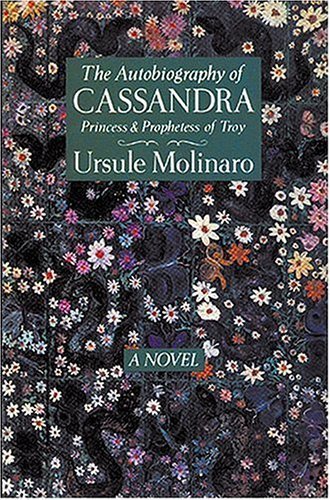
Autobiography of Cassandra, Princess and Prophetess of Troy by Ursule Molinaro

Rate this book
This novel tells the Homeric story of Troy from the perspective of the woman who was condemned not to be believed -- the perfect spokesperson for a contemporary feminist novel. Written with Molinaro's typical flair for concision, Cassandra is second only to the classic Positions with White Roses as Molinaro's best novel. And Molinaro has been sensitive to readers whose knowledge of Greek mythology is imperfect (meaning most of us) by providing a witty glossary of the mortals and gods who people this dramatic and subversive story of courage and sacrifice.

Paperback

First published January 1, 1979

2 people are currently reading
240 people want to read

About the author

Ursule Molinaro

52 books3 followers
Ursule Molinaro (1916, Paris -10 July 2000, New York City) was a prolific novelist, playwright, translator and visual artist, the author of 12 novels, two collections of short prose works, innumerable short stories for literary magazines and dozens of translations from the French and German. She lived and wrote in French in Paris until shortly after World War II, when she came to New York in 1949 to work as a multilingual proofreader for the newly formed United Nations. Just a few years later, having realized that she would stay in the United States, she made the decision to systematically retrain herself not only to write, but to dream, think, and speak, in the language of her new soil. In the latter part of her life, she developed a method for teaching creative writing that relied wholly upon the oral and taught creative writing at several universities and in her home until her death in 2000.

(from Wikipedia)

Ratings & Reviews

What do you think?
Rate this book

Friends & Following

Create a free account to discover what your friends think of this book!

Community Reviews

5 stars
11 (34%)
4 stars
14 (43%)
3 stars
4 (12%)
2 stars
2 (6%)
1 star
1 (3%)
Displaying 1 - 8 of 8 reviews
Profile Image for Marc.
986 reviews135 followers
June 3, 2023
Who would believe Cassandra's autobiography?
"Truth which was my life-long obsession (& obsesses me still) appears to be even more evasive in retrospect.
—& if possible even less popular. I’m sure that men who may happen to read me today will dismiss my findings with an indignant shrug."

This doesn't stop Cassandra from hijacking Molinaro's position as a writer to get the truth out into our hands. This is a hard book to react to for me. It's a type of historical and personal redress for Cassandra despite her loss of faith.
"But when Apollo spat into my mouth & made me unbelievable, he drowned my faith. I stopped believing that the gods had the good of mortals in mind. & that our misfortunes were selfmade; the consequences of our disobedience or lack of understanding. I began to think that the gods were solely interested in themselves. In power, for which they seemed to be eternally scheming. It was a wise mortal who managed to live unnoticed.
Since then I’ve come to realize that gods wear out. It is the office that remains immortal.
The ruling symbol of one culture is declared taboo by its conquerors. & to the conquerors’ conquerors it becomes untouchable. Obscene."

Molinaro use some very odd spacing, line breaks, ampersands, and unstated jumps in logic/thought which give this book a peculiar rhythm. I'm not sure if this was... Well, really, I'm not entirely sure why this was. I could speculate, but the impact it had was to give Cassandra a very distinct voice: wry, insightful, angry, and... gossipy. While it is certainly about her life it feels very much her perspective on the culture and the characters around her (their peculiarities, sexual perversities, misperceived personality traits and flaws).

As she tells it, the war was far more about trade routes than Helen, as well the changing culture, especially with respect to female identity:
"Homer was writing five centuries after the fall, when knowledge had become unbecoming for a woman. He could not let intelligence & beauty share the same female face, if he desired to be read. He thought that he was being kinder to my memory, making me beautiful rather than wise.
But without my knowledge I become unimportant. & banal. Just another beautiful princess who walked the streets of Troy. A minor Helen.
Poor Helen. Legend has made of her the sample type of the new woman that came about with male supremacy. Placidly beautiful, without a mind of her own. Open to the windy choice of men. Of any man, as long as she was loved. & kept. She has become the classic femme fatale with whose defenseless image modern Hellenistic pigs still play their ever-adolescent games of solitaire."
It's an interesting look at a minor Greek character giving her a second chance at being heard through a first person perspective. It made me want to read more about Cassandra, so Aeschylus's The Oresteia is now on the reading list for later this year (hopefully).
--------------------
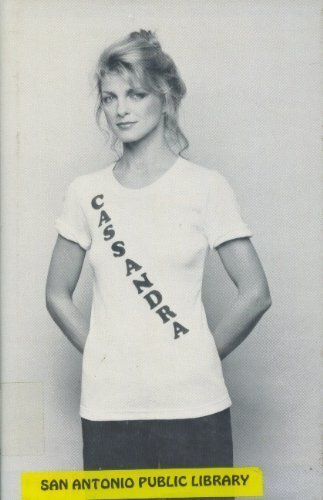
You know what's a modern day Greek tragedy? The fact that GR doesn't have this version of the book's cover included in their editions (this is the edition I read).
64 reviews6 followers
April 19, 2025
Edited Review – April 2025.

Unfortunately, this book is nearly unreadable due to its intentional stylistic choices like: “&” instead of “and,” placing periods where they don’t belong, inconsistent spacing, and other formatting issues. If the author wanted to portray Cassandra’s alleged incoherence through a “stream of consciousness” style, it ultimately undermines her character. In Greek mythology, Cassandra never spoke incoherently or erratically as Molinaro portrays. In Aeschylus' and Euripides' works, Cassandra delivers her oracles with sharp logic, precise metaphors, and even biting irony. She is intelligent and her speech is articulate. Her curse was not incoherence, but having the power of persuasion removed from her. Her curse was that no one believed her, not that people couldn’t understand her. The idea that Cassandra was “mad” or “confused/confusing” is a common misconception, which this novel unfortunately reinforces.

That said, The Autobiography of Cassandra is impressive in many ways, especially considering it was published in 1979, long before modern retellings like Christa Wolf’s Cassandra (1983) or Marion Zimmer Bradley’s The Firebrand (1987). This makes its editing flaws even more frustrating.

Molinaro’s Cassandra speaks in a sharp voice, often emotionally detached, and brutally honest. Apollo is the embodiment of patriarchy, and Cassandra expresses her resentment and trauma throughout the book. Apollo is deeply vilified and depicted as a selfish, vengeful rapist. .
On the other hand, "matriarchy" (embodied by Clytemnestra) isn’t idealized either.

Interestingly, while the book repeatedly highlights the injustice towards women, Molinaro’s portrayal of other female characters is surprisingly unfeminist. Hecuba, Andromache, Polyxena, and Iphigenia are all stripped of their virtues, dignity and heroism. Andromache is written as a posessive and selfish wife; Polyxena’s sacrifice lacks all agency or nobility; Iphigenia is not even Agamemnon’s daughter, etc. It becomes difficult to connect with these women or admire them, which feels contradictory given the novel’s critique of patriarchy.

It’s also odd that Molinaro’s Cassandra is purposedly not very feminine, even quite androgynous. It feels like another contradiction. Molinaro is supposed to be defending women, but Cassandra herself, in her own words, is not the embodiment of a “normal woman”. Throughout the book Cassandra repeatedly states that she is not like "the other women", so, ultimately, I’m not sure what kind of womanhood Molinaro is defending.

The novel also relies on some mythological misreadings. The most blatant might be the claim that Homer “erased” Cassandra’s prophetic role because he couldn’t tolerate a woman being both beautiful and intelligent, which is completely inaccurate. In Iliad Book 24, Cassandra is the one who first sees Priam returning with Hector’s body (a moment that might hint at her prophetic awareness) and she is the one who announces it to the city. Also, Homer includes many female characters who are both beautiful and clever. For example, Agamemnon praised Chryseis because she was smart, skillful, had a pleasant personality, and was beautiful. Homeric women were praised not only for their looks (as average patriarchy imposes), but also for their intelligence and skills, especially weaving skills. Either Molinaro misread Homer, or she deliberately distorted him to fit her narrative.

Male characters are often vilified too, though I appreciate that Molinaro respects the ancient portrayal of Agamemnon as loving and kind towards Cassandra. He is depicted as deeply affectionate, and even tries to prevent Polyxena’s sacrifice, just like in the myths.

Another structural problem is that, despite being titled The Autobiography of Cassandra, the book spends a disproportionate amount of time focusing on other characters. Cassandra talks extensively about her relationships with her mother, Helen, Hector, Helenus, and so on, but very little about her own inner world. Somehow this reduces Cassandra’s identity to the war, men, and her family: others, not her. We're briefly told that Cassandra longed to be a prophetess to help others, but it feels like Cassandra is not a subject on her own and lacks agency. In myth, she was a tragic character, but she still managed to reclaim her agency when she could.

Despite all these criticisms, I still think the novel is remarkable for its time. Some passages are beautifully written, and I highlighted many lines. I especially appreciated the portrayal of Agamemnon and Cassandra’s relationship as complex and emotionally nuanced, which is quite faithful to the original myths (unlike modern retellings where Agamemnon is vilified and depicted as violent to Cassandra).
24 reviews
Read
July 18, 2022
Hidden gem

Really enjoyed among the Trojan women retelling hidden gems give it a try I wasn't sure but lovely surprise for when you want an easy read
Profile Image for McKenna.
Author 3 books7 followers
June 1, 2025
Such a sucker for reinterpretations. This is such a unique take on it as well. I highly recommend
2 reviews
Read
May 16, 2014
I found this book while I was researching the stories about Cassandra for a creative writing assignment at college. I really enjoyed it and I'm on the lookout for my own copy since I've decided that this is a book that I must have in my library.

To start with, I really like first person novels since they are like someone sitting across a table from me telling me their story. Secondly, I have a fascination with the old stories as I see them as the Creation Myth of our Western society.

To be quite blunt, this is a very good read. It is fascinating in its relation of mythical characters and the personalities of the Trojan War It covers the war in a detail that I had never experienced before and I was hooked right from the beginning.

Cassandra's tale starts 3000 years after the end of the war as she's trying to make sense of it all, having spent three millennia pondering the events and talking to anyone in the underworld their view on the war, the events leading up to it, and the aftermath. She is speaking from the view of the vanquished and not from that of the Victors who usually write history. It is her intent to set the record straight and to ask why it had to happen and was it all worth it.

If you're into the Greco-Roman myths, if you're into speculative history, or if you just like sitting down and listening to someone's story you will find this book a great read. I can't recommend it more highly.
303 reviews4 followers
December 18, 2024
This is Cassandra's story after she has mulled over the events of her life for three thousand years. She has ample reason to dislike Apollo who she spurned. Molinaro made me realize that there are several myths where Apollo was spurned by women, one turning into a tree to get away from him and another who threw herself down a well. So already here is one instance in the book where a feminist point of view upsets Greek mythology's male centered remembrance of accounts to show its misogyny.
Cassandra got a bad reputation for her gloomy predictions and was cursed with the fact that no one listened to her. Here is her own story of her complicated family and their interactions leading up to the Trojan War.
Much like C. S. Lewis' "Til We Have Faces" in which he re writes Psyche's sister's story to humanize her and show her good intentions, Molinaro's "autobiography" humanizes Cassandra. At the end, Cassandra regrets that her predictions were not "artful" as in song or poetry. That sometimes "facts oppress the truth." Truth can only "breathe freely ...in poetry & art." If she had given her knowledge "an aesthetic form, my people might have stayed to listen & might have learned their future for the sheer pleasure of my metric flow."
Here she never backs down at the honesty of her predictions, but with the understanding of three thousand years has come to realize that she made enemies with them. This, her "autobiography," is the art that allows her truth to breathe.
Displaying 1 - 8 of 8 reviews

Can't find what you're looking for?

Get help and learn more about the design.