The Nibelungs, in case you were wondering, are the royal house of the Burgundians – and the Burgundians, whose name lives on in the Burgundy region of east-central France that produces some of the world’s finest wine, were a Germanic tribe that migrated to the Rhine River region around the city of Worms in the early 5th century A.D. All of this information can be helpful for the modern reader who wants to understand the compelling, troubling, and exceedingly violent work that is The Nibelungenlied (The Song of the Nibelungs), a German-language epic poem that is one of the founding documents of German literature.
The Nibelungenlied was composed by an unknown poet, in the area around Passau in modern-day Austria, sometime around the year 1200. The Middle Ages were a rough time in central Europe; Germany was a region, not a country – a place where small German-speaking states were constantly waging war upon one another – and therefore it should be no surprise that this poem that came to be considered characteristically German is a thoroughly medieval tale of blood, death, and revenge.
The anonymous poet who composed The Nibelungenlied drew upon earlier Norse accounts of the legendary hero Sigurd or Sigurðr, whose story is told in medieval Icelandic works like the Völsunga saga and the Poetic Edda; but in turning the Norse Sigurd into the German Siegfried, the poet took the work in some new directions of his own.
As The Nibelungenlied begins, Siegfried, who has already proven himself in battle against the Saxons, travels to Worms because of his love for Kriemhild, princess of Burgundy; the fact that the two have never met seems little more than a technicality. When Siegfried first sees his destined lady-love, Kriemhild “emerged like the dawn from the dark clouds, freeing from much distress him who secretly cherished her and indeed long had done so” (pp. 47-48). The feeling, it turns out, is mutual, as Kriemhild “soon conveyed her liking”, and Siegfried “had reason to bless his good fortune that the young woman whom he cherished in his thoughts was so well-disposed towards him” (pp. 49-50). It’s love at first sight – but sadly, a love that is destined to end unhappily, with even unhappier consequences for many.
You see, Kriemhild’s brother is Gunther, king of the Burgundians, and Gunther won’t let his sister marry Siegfried unless Siegfried helps Gunther win the love of the Icelandic queen Brunhild. And Gunther, it seems, is no Siegfried. When Gunther, with the help of some deception on Siegfried’s part, is able to marry Brunhild, the wedding night doesn’t go well. When Gunther, ardent for his new bride, “tumbled her shift for her…the haughty girl reached for the girdle of stout silk cord that she wore about her waist, and subjected him to great suffering and shame; for in return for being baulked of her sleep, she bound him hand and foot, carried him to a nail, and hung him on a wall. She had put a stop to his love-making!” (p. 88) Well, that’s embarrassing.
Some further deception on Siegfried’s part enables Gunther to consummate his marriage to Brunhild – taking away, in the process, the super-human powers that the queen of Iceland had once possessed – but the path is set for tragedy. Quarrelling between the two queens leads to a rift between Siegfried and Gunther. Hagen of Tronje, a vassal of King Gunther, feels that his king and queen have been dishonoured, and decides that Siegfried must die. King Gunther objects at first, but later consents.
A day of hunting is arranged, and on the fateful day Kriemhild doesn’t want Siegfried to go off on the hunt. “I dreamt last night – and an ill-omened dream it was…that two boars chased you over the heath and the flowers were dyed with blood! How can I help weeping so? I stand in great dread of some attempt against your life. – What if we have offended any men who have the power to vent their malice on us? Stay away, my lord, I urge you” (p. 124). But in spite of Kriemhild’s tearful insistence that “I fear you will come to grief”, Siegfried blithely states that “I know of no people who bear me any hatred” and assures her that “I shall return in a few days’ time, my darling” (p. 125). Spoiler alert: it doesn’t turn out that way.
Hagen knows that Siegfried, who once slew a dragon and bathed in its blood, is, like Achilles, invulnerable everywhere but in one spot – a place on his back that Kriemhild, at Hagen’s request, has obligingly marked with a cross on the back of Siegfried’s tunic. (Really?) What follows should be no surprise:
“[A]s Siegfried bent over the brook and drank, Hagen hurled the spear at the cross, so that the hero’s heart’s blood leapt from the wound and splashed against Hagen’s clothes. No warrior will ever do a darker deed” (p. 130).
The dying Siegfried denounces his murderers: “You vile cowards….What good has my service done now that you have slain me? I was always loyal to you, but now I have paid for it. Alas, you have wronged your kinsmen so that all who are born in days to come will be dishonoured by your deed” (p. 131).
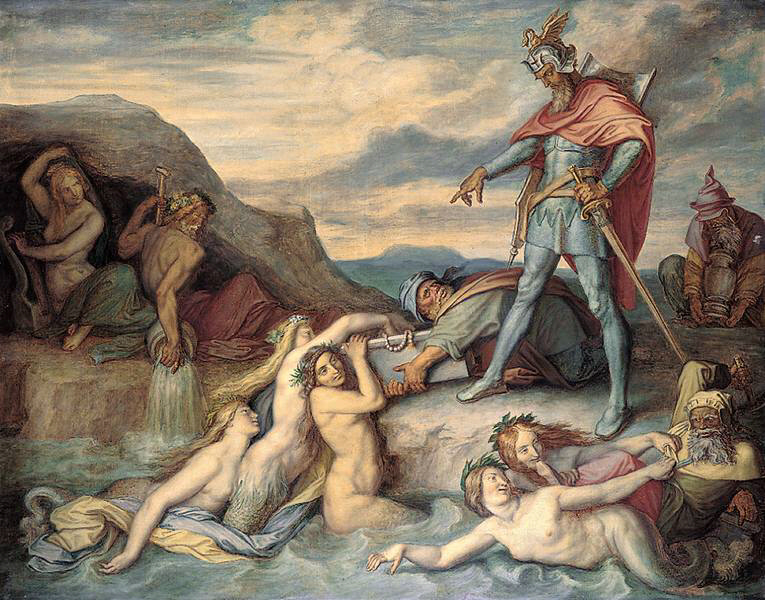
The treasure of the Nibelungs is Kriemhild’s dowry, and therefore should be hers by right. But Hagen, intending to make sure that Kriemhild cannot use that treasure of the Nibelungs to raise an army and take revenge, “took the entire treasure and sank it in the Rhine at Locheim, imagining he would make use of it someday” (p. 149). In response, “Kriemhild could not have borne him greater malice”, and her “heart was burdened with sorrow that was ever fresh for the passing of her lord and the loss of all her treasure” (p. 149).
For the remainder of Kriemhild’s life, the one motivation of this once sweet and optimistic princess is revenge against Hagen – and indeed against all the Burgundian kings, by whom she feels betrayed. And she will get her revenge, but at an exceedingly high cost.
The occasion for Kriemhild’s revenge occurs when she awakens the romantic interest of the Hunnish king Etzel. Please be advised that “Etzel” is the poet’s name for Attila – yes, that Attila: Attila the Hun, who ravaged the Western Roman Empire from 451 to 453 A.D. Etzel’s queen, Helche, has recently died, and Etzel sends to Burgundy for Kriemhild.
Kriemhild travels to Hungary – evidently the Nibelungenlied poet does not realize that the Huns were not Hungarian, but rather were of an entirely different cultural stock. When Kriemhild meets Etzel, the poet records that Kriemhild “received the illustrious monarch kindly with a kiss, to bestow which she pushed back her wimple and revealed her lovely face all radiant amid the gold of her hair, so that many a man declared that Queen Helche had not been lovelier” (p. 172). This dramatic and fateful meeting is today commemorated by a monument in Tulln an der Donau, Austria.
Kriemhild marries Etzel – a Christian marrying a pagan – not out of love, but rather so that she can gain an army and take her revenge. One feels sorry for Attila – he is “as happy as he could possibly be”, especially after Kriemhild bears him a son named Ortlieb; but Kriemhild weeps in secret, mourns for her dead Siegfried, and forever plans her revenge. Etzel is but a pawn in Kriemhild's exceedingly bloody-minded game of thrones.
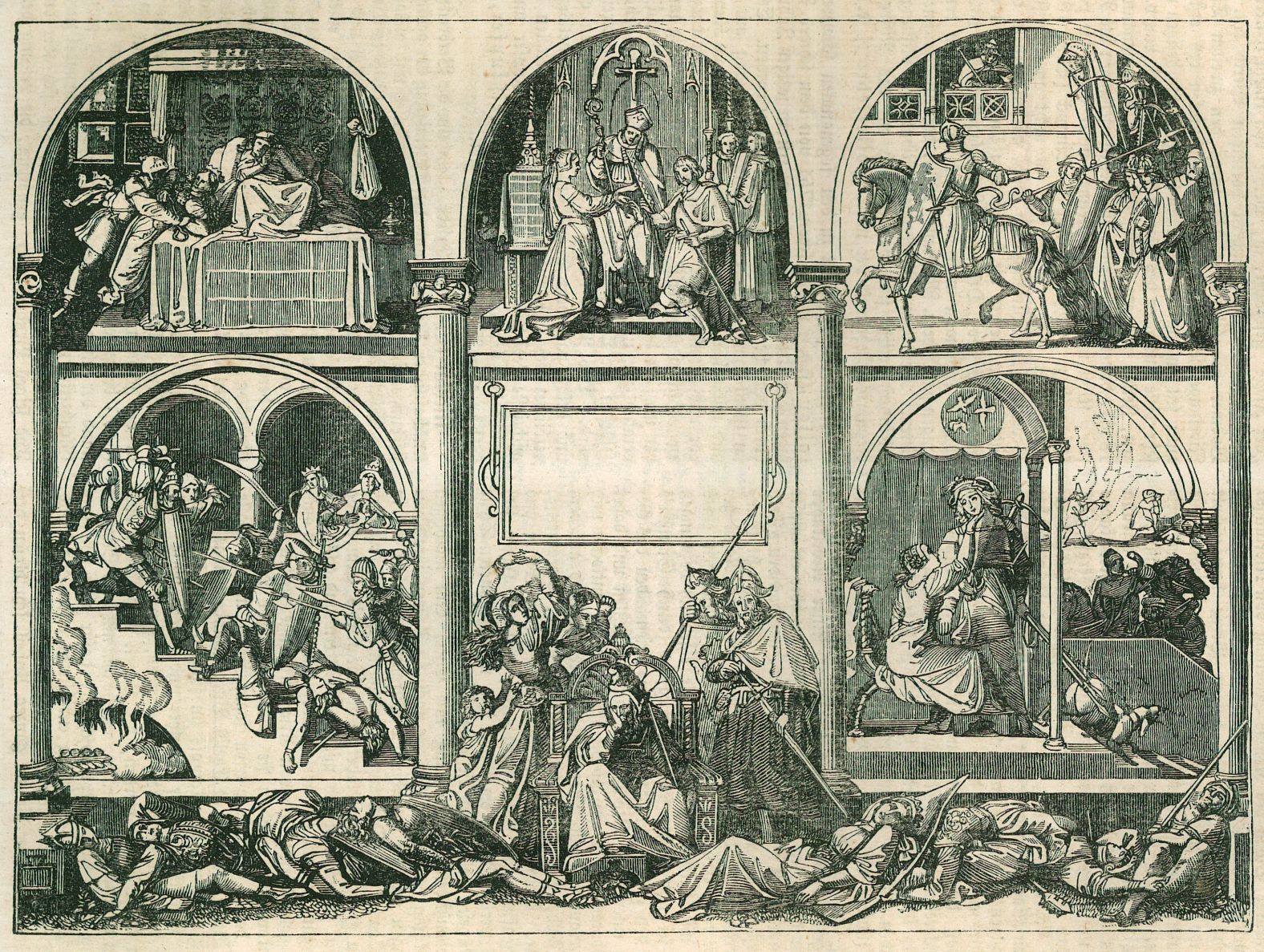
Eventually, Kriemhild arranges things such that all the high nobles and knights of the Burgundian court will travel to the Hunnish court in Hungary. Acts of violence between individual Huns and Burgundians quickly escalate toward full-scale war, as epitomized when Hagen recalls Kriemhild’s ongoing dedication to vengeance and then “struck Ortlieb so that the blood washed along the sword to his hands and the boy’s head fell into the Queen’s lap, unleashing a vast and savage slaughter among warriors” (p. 243).
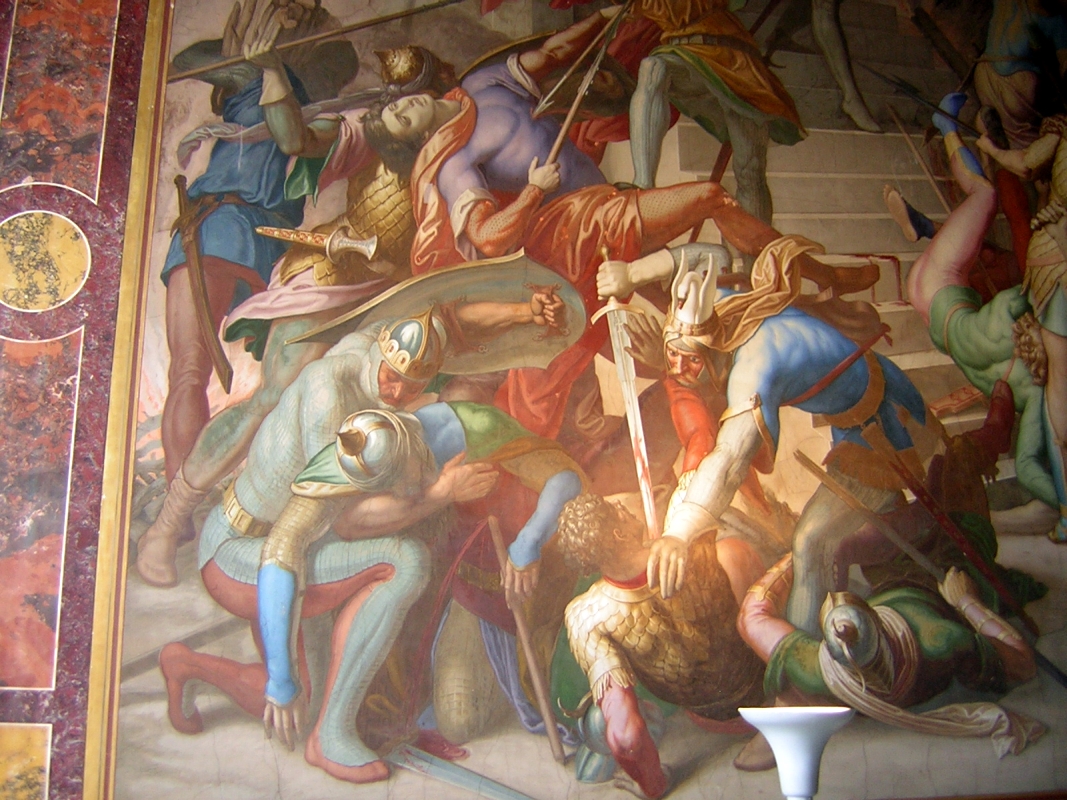
In a fight within Etzel’s royal hall, the Burgundians kill 7,000 (!) Huns, and throw their corpses out of the hall. Kriemhild has her own idea for striking back against the Burgundians, telling her Hunnish knights, “I shall pay back Hagen’s arrogance in full. Do not let a man leave the building anywhere, while I have the hall fired at all four corners. Thus shall all my sorrows be utterly revenged!” (p. 261) And thus, amidst vast destruction and loss of life on both sides, the Burgundians move toward a Thermopylae- or Alamo-style denouement.
After the Burgundians have been destroyed, and Hagen and Gunther have been imprisoned, Kriemhild offers to let Hagen live if Hagen will reveal where he hid the treasure. Hagen refuses. What follows is one of the most dramatic scenes in an exceedingly dramatic poem:
“I shall make an end!” cried the noble lady, and she commanded them to take her brother [Gunther]’s life. They struck off his head, and she carried it to Hagen by the hair. Great was the grief it gave him.
When the unhappy warrior saw his brother’s head, he said to Kriemhild: “You have made an end as you desired, and things have run their course as I imagined. The noble King of Burgundy is dead….Now none knows of the treasure but God and I! You she-devil, it shall stay hidden from you forever!” (p. 290)
And after Kriemhild's Cain-style murder of her brother Gunther, there is still more blood to be shed before the poem finally rings down the curtain on, as the poet puts it, “The Nibelungs’ Last Stand” (p. 291).
I read The Nibelungenlied in the context of a visit to Worms, Germany. In that beautiful little city that is said to have been the capital of the 5th-century Burgundian Kingdom, there is a Nibelungen Tower on the Nibelungen Bridge that flows over the Rhine, along with a very fine Nibelungen Museum. The modern city of Worms is a perfect place in which to ponder the power and the influence of this important poem.
And its influence has been wide-ranging. One sees echoes of The Nibelungenlied in Richard Wagner’s four-part musical drama Der Ring des Nibelungen (The Ring of the Nibelungs) (1876), a work that in turn may or may not have influenced the composition of J.R.R. Tolkien's three-part fantasy epic The Lord of the Rings (1954-55).
And, on a more menacing note, it is a matter of record – of sad record – that The Nibelungenlied, in the 19th and early 20th centuries, became associated with the totalitarian strain of German nationalism, from the beginnings of Prussian ascendancy through the end of the Second World War. The Nibelungen Museum in Worms acknowledges these difficult aspects of the poem’s history, including the ways in which the Nazi regime utilized the poem for propaganda purposes.
More than 800 years ago, a German-speaking poet set down a poem that would mean very different things to the people of different future centuries. With the fierce and uncompromising quality of its scenes of violence, the intensity of its emotions, the way in which it shows great love metamorphosing into revenge-minded hate, The Nibelungenlied remains an important epic poem, and a vital – and troubling – glimpse into the German history of its own time, and of later times.