

What do you think?

We, the Drowned
In 1848 a motley crew of Danish sailors sets sail from a small town of Marstal to fight the Germans. Not all of them return - and those who do will never be the same again. Among them is the daredevil Laurids Madsen, who promptly escapes again into the anonymity of the high seas. Spanning four generations, two world wars and a hundred years, We, The Drowned is an epic tale of adventure, ruthlessness and passion.
693 pages, Paperback
First published January 1, 2006
About the author
Carsten Jensen
47 books311 followersCarsten Jensen was born 1952. He first made his name as a columnist and literary critic for the Copenhagen daily Politiken, and has written novels, essays and travel books.
Jensen was awarded the Golden Laurels for "I Have Seen the World Begin" and the Danske Banks Litteraturpris, Denmark’s most prestigious literary award, for "We, the Drowned."
Jensen was awarded the Golden Laurels for "I Have Seen the World Begin" and the Danske Banks Litteraturpris, Denmark’s most prestigious literary award, for "We, the Drowned."
Ratings & Reviews
Friends & Following
Create a free account to discover what your friends think of this book!
Community Reviews
Displaying 1 - 30 of 1,592 reviews

August 20, 2012
What do you say about a book that, after you finished it, you sat staring at a wall for fifteen minutes while tears flowed down your cheeks? It’s miraculous. I don’t feel that that’s enough, this review isn’t enough. I loved this book, I cannot do it justice. Still, it’s a good challenge to force yourself to examine what made you love a book, so here we go:
This book is the ocean.
It’s about a fight with God. The book covers roughly 200 years of history, and the sea is the only constant character, a godlike being, who is more of a God to the sailors upon her than God could ever be. No one feels like God condemns them to death, but the depths and ice reach out, and grab the sailors one by one, leaving families in Marstal to grieve over a missing body. The sea has power over every aspect of their lives and they are enthralled to it.
It’s a romance. A romance with a frontier, the men that pine for freedom, and the women that pine for their men. It’s all mystery and fate and destiny, and the depths of the soul that, like the sea, are boundless.
It’s about the darkness of men. Our bodies are vessels with an ability to store up so much raw power of hate and love. There are always seems to be death and darkness waiting back in Marstal, while the sea provides relief. Yet in the end men turn the sea into an even larger, more dangerous weapon of death, and then, relief can be found back home, in Marstal. The tides turn, they give, and they take, just like the book, just like history.
I read this and Lonesome Dove at the same time, and I was struck by author’s ability to use their narrative form to mimic their respective frontier. In Lonesome Dove the words were sparse, the sentences short, the events highly sequential- because that’s how cowboys are, do what is in front of you, then move on to the next thing. This book was more like the ocean, it was heavy and large, there were multiple voices, it was chaotic, and you had to follow a lot of characters at once. You flowed from one story to the next, and tried never to forget a moment or a person.
Occasionally the story was told from one characters perspective, but more often it was written in the very rare first-person collective, “we.” I loved this. It made the story so involving. Who was we? It was all of us. The story is often hard to read. Its dark, and it reaches for your heart, but at times there are moments of such humor, such dark humor, that I burst out laughing. Then you really feel like you are joining in the sorrows and joys of everyone else in the town.
LATER NOTE: I was just reflecting on the "we", perhaps that "We, the Drowned" and it is they, the missing from Marstal, those unable to participate anymore, are telling the story at times.
The book was also a great history lesson. I love maritime history; I have shelves of maritime history books in my home library. I learned a lot about the pains and tribulations of the sailors, which are often left out of historical texts. I learned more than I probably cared to about WWII. The WWII sections were brilliant, and terrible. There is no foreknowledge of ships necessary to understand this book, but even if you know a bit, you’ll probably learn something.
I’m giving this book 5 stars, because I loved it. Though it does have its fault- particularly the middle section felt heavy and a bit flat, I felt that the author could have tidied it. You felt as landlocked as Albert Madsen and it was stifling, which may have been the point, but a reader should never be stifled for more than fifty pages. I was so relieved to finally enter the life of Knud Erik. If you’ve reached this place and you are struggling, push through! The ending is truly one of the most beautiful I’ve ever seen.
"We thought we knew everything about him. But that's not how life is. When all's said and done, we can never truly know one another."
This book is the ocean.
It’s about a fight with God. The book covers roughly 200 years of history, and the sea is the only constant character, a godlike being, who is more of a God to the sailors upon her than God could ever be. No one feels like God condemns them to death, but the depths and ice reach out, and grab the sailors one by one, leaving families in Marstal to grieve over a missing body. The sea has power over every aspect of their lives and they are enthralled to it.
It’s a romance. A romance with a frontier, the men that pine for freedom, and the women that pine for their men. It’s all mystery and fate and destiny, and the depths of the soul that, like the sea, are boundless.
It’s about the darkness of men. Our bodies are vessels with an ability to store up so much raw power of hate and love. There are always seems to be death and darkness waiting back in Marstal, while the sea provides relief. Yet in the end men turn the sea into an even larger, more dangerous weapon of death, and then, relief can be found back home, in Marstal. The tides turn, they give, and they take, just like the book, just like history.
I read this and Lonesome Dove at the same time, and I was struck by author’s ability to use their narrative form to mimic their respective frontier. In Lonesome Dove the words were sparse, the sentences short, the events highly sequential- because that’s how cowboys are, do what is in front of you, then move on to the next thing. This book was more like the ocean, it was heavy and large, there were multiple voices, it was chaotic, and you had to follow a lot of characters at once. You flowed from one story to the next, and tried never to forget a moment or a person.
Occasionally the story was told from one characters perspective, but more often it was written in the very rare first-person collective, “we.” I loved this. It made the story so involving. Who was we? It was all of us. The story is often hard to read. Its dark, and it reaches for your heart, but at times there are moments of such humor, such dark humor, that I burst out laughing. Then you really feel like you are joining in the sorrows and joys of everyone else in the town.
LATER NOTE: I was just reflecting on the "we", perhaps that "We, the Drowned" and it is they, the missing from Marstal, those unable to participate anymore, are telling the story at times.
The book was also a great history lesson. I love maritime history; I have shelves of maritime history books in my home library. I learned a lot about the pains and tribulations of the sailors, which are often left out of historical texts. I learned more than I probably cared to about WWII. The WWII sections were brilliant, and terrible. There is no foreknowledge of ships necessary to understand this book, but even if you know a bit, you’ll probably learn something.
I’m giving this book 5 stars, because I loved it. Though it does have its fault- particularly the middle section felt heavy and a bit flat, I felt that the author could have tidied it. You felt as landlocked as Albert Madsen and it was stifling, which may have been the point, but a reader should never be stifled for more than fifty pages. I was so relieved to finally enter the life of Knud Erik. If you’ve reached this place and you are struggling, push through! The ending is truly one of the most beautiful I’ve ever seen.
"We thought we knew everything about him. But that's not how life is. When all's said and done, we can never truly know one another."

December 21, 2025
Time tells its stories… And its tales grab one by the throat right away…
Irony is a mighty weapon… But war doesn’t comprehend irony… War deals in death…
The book follows the lives of the port dwellers from generation to generation… Captivity… Sadistic teacher… Madsen’s son is out of school… He is a sailor now… He gets even with a villainous tyrant… The son wants to find his father…
A dire secret becomes revealed… The son is shipwrecked but survives…
The beginning of a new century… The son is old and prosperous… Many changes have come… The world war is raging around… The old man befriends a little boy… His old soul is full of anguish… The old leave the world but life continues… The young ones come forth…
The sea remains silent, it keeps its mysteries on its bottom.
Many years ago there lived a man called Laurids Madsen, who went up to Heaven and came down again, thanks to his boots.
He didn’t soar as high as the tip of the mast on a full-rigged ship; in fact he got no farther than the main. Once up there, he stood outside the pearly gates and saw Saint Peter – though the guardian of the gateway to the Hereafter merely flashed his bare ass at him.
Irony is a mighty weapon… But war doesn’t comprehend irony… War deals in death…
Screams of horror rose from the crammed beach when the cannonballs started crashing down on us. Death was arbitrary. Burning debris rained from the heavens, wreaking destruction wherever it landed, so that the hour of victory was marked only by the sound of men screaming. This, then, was the dying ship’s final salute to the victors and the vanquished: a murderous broadside that attacked both friend and foe alike.
The book follows the lives of the port dwellers from generation to generation… Captivity… Sadistic teacher… Madsen’s son is out of school… He is a sailor now… He gets even with a villainous tyrant… The son wants to find his father…
“What do you want from your father?”
“A man needs a yardstick.”
“A yardstick? Find another one. A ship, your own actions. Let the Pacific be your yardstick. Look at the swell. You’ll not find a bigger swell anywhere. It has half the globe for its run-up. You’re young. You have the whole world. Don’t bother yourself with the past.”
A dire secret becomes revealed… The son is shipwrecked but survives…
The beginning of a new century… The son is old and prosperous… Many changes have come… The world war is raging around… The old man befriends a little boy… His old soul is full of anguish… The old leave the world but life continues… The young ones come forth…
The orchestra outside our windows played the same tune every day: it was nameless, but it was everywhere. Even in bed, asleep, we’d dream of the water.
But the women never heard its music. They couldn’t – or they didn’t want to. Outside the home, they never looked toward the harbor, but always inland, across the island. They stayed behind and filled the gaps we left. We heard the sirens’ song while our wives and mothers blocked their ears and bent over the washtub.
The sea remains silent, it keeps its mysteries on its bottom.

December 1, 2016
Никога не знаеш, кога ще те грабне приключението, нито пък къде може да те отведе...
Всичко започна за мен един понеделник - хората около мен чакаха при зъболекаря, а аз бях в Дания, на война с Германия на борда на платноход, в плен, после плавах из Южните морета и така и не разбрах, кога ми е дошъл реда да седна на стола за мъчения. :)
През седмицата имах доста работа, но си мислех за Марстал и неговите моряци. Сам съм бил няколко години моряк и знам, какво е да ти влезе морска вода в кръвта, да усетиш полюшването на палубата под краката си или точно когато се унасяш преди сън! Лесно се прихваща заразата и е почти невъзможно да се излекува човек.
А историята от много интересна, стана изведнъж и красива, много красива.
Обикнах Албърт, защото хората като него са редки и са солта на земята. Обикнах и останалите марсталци, защото Карстен ги направи близки и понятни за мен. Стилът му на писане е без претенции, но му се получава прекрасно. Историите вплетени в тази тухла са безкрайно много и на толкова различни нива!
Това което се случи на Кнуд Ерик го преживях много тежко, почти все едно на мен се случваше. Никой не заслужава подобна съдба.
В петък вечерта не можах да оставя книгата преди да я дочета, а това напоследък рядко ми се случва.
Краят бе страхотен, както и подобава на такъв магнум опус за борбата на човека с природата си, с морето и заобикалящия го свят!!!
Големи пет звезди, препоръчвам я горещо и за мен това ще е книга, която ще препрочета неведнъж.
Благодаря на издателство Жанет 45 за куража да издаде това произведение на изкуството и за безупречната работа по публикуването му. Ще заеме достойно място в личната ми библиотека и очаквам от тях още предложения. Отличен превод на Мария Змийчарова!
Цитати:
Този е по памет - Прогресът носи по-добър живот, но го прави и различен, невъзможен за разбиране от по-старите хора.
"Жените харесват мъже, които ги карат да се смеят. Но обичат мъже, които ги карат да плачат. Уважават само това, което не разбират. Цялата работа е в уважението. Херман познавал света достатъчно добре, за да знае, че не любовта прави живота на мъжа поносим, а уважението. А в уважението винаги има доза страх."
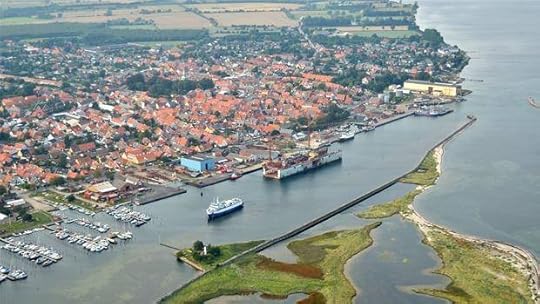
Марстал днес:
P.S. Интересен разговор на г-н Стефан Русинов, с преводача на книгата г-жа Мария Змийчарова:
https://belejkapod.wordpress.com/2020...
Всичко започна за мен един понеделник - хората около мен чакаха при зъболекаря, а аз бях в Дания, на война с Германия на борда на платноход, в плен, после плавах из Южните морета и така и не разбрах, кога ми е дошъл реда да седна на стола за мъчения. :)
През седмицата имах доста работа, но си мислех за Марстал и неговите моряци. Сам съм бил няколко години моряк и знам, какво е да ти влезе морска вода в кръвта, да усетиш полюшването на палубата под краката си или точно когато се унасяш преди сън! Лесно се прихваща заразата и е почти невъзможно да се излекува човек.
А историята от много интересна, стана изведнъж и красива, много красива.
Обикнах Албърт, защото хората като него са редки и са солта на земята. Обикнах и останалите марсталци, защото Карстен ги направи близки и понятни за мен. Стилът му на писане е без претенции, но му се получава прекрасно. Историите вплетени в тази тухла са безкрайно много и на толкова различни нива!
Това което се случи на Кнуд Ерик го преживях много тежко, почти все едно на мен се случваше. Никой не заслужава подобна съдба.
В петък вечерта не можах да оставя книгата преди да я дочета, а това напоследък рядко ми се случва.
Краят бе страхотен, както и подобава на такъв магнум опус за борбата на човека с природата си, с морето и заобикалящия го свят!!!
Големи пет звезди, препоръчвам я горещо и за мен това ще е книга, която ще препрочета неведнъж.
Благодаря на издателство Жанет 45 за куража да издаде това произведение на изкуството и за безупречната работа по публикуването му. Ще заеме достойно място в личната ми библиотека и очаквам от тях още предложения. Отличен превод на Мария Змийчарова!
Цитати:
Този е по памет - Прогресът носи по-добър живот, но го прави и различен, невъзможен за разбиране от по-старите хора.
"Жените харесват мъже, които ги карат да се смеят. Но обичат мъже, които ги карат да плачат. Уважават само това, което не разбират. Цялата работа е в уважението. Херман познавал света достатъчно добре, за да знае, че не любовта прави живота на мъжа поносим, а уважението. А в уважението винаги има доза страх."
Марстал днес:
P.S. Интересен разговор на г-н Стефан Русинов, с преводача на книгата г-жа Мария Змийчарова:
https://belejkapod.wordpress.com/2020...

March 7, 2017
Bulgarian review below/Ревюто на български е по-долу
If you stand on the deck of your life and look at the horizon, you will see them emerge. The spectres dwelling in the past and the drowned inhabiting the present. You will see how the surf is trying to cast them ashore on some marooned coast, but they are always there reminding you of themselves, and there’s no other way. Because they are us. We, the drowned.
Despite its volume, the novel has a lace structure and the text breathes lightly. There is lightness to the reader’s breath too. You breathe in the story quickly like you would gulp for air, and the intoxication goes to your head. The style reminded me so much of Eleanor Catton’s “The Luminaries” – perhaps because of the adventure theme, the meekness, the soft melancholy and the lack of pomposity in the phrasing. Jensen uses his journalistic bias with a deft hand and frequently sets bait sentences that both reveal what follows, but leave enough to the imagination to leave you wondering and craving to unravel the Gordian knot of the plot.
“We, the drowned” begins with a departure and a war. The departure is to Heaven, where you can see only Saint Peter’s ass obviously, and the war... well, it is waged against an opponent you know you can’t defeat, but it’s woven into human nature to never give up. Even when the biggest wave has whelmed you and your lungs are burning for a breath of air. Especially then. The novel is a collection of stories. Just as our own life is never completely detached, the characters pass the story as a ball, and the events gradually threaded into a string of pearls that has neither beginning nor end. The pearls are gathered from the four corners of the world, but what they have in common is that they were born from the ocean. And those who have hunted for them know that one day they might also end up at the bottom of the ocean. Some connections, though bitter, are stronger than the self-preservation instinct. So you learn to shed sadness as unnecessary skin and keep moving forward. And tell stories. Salty like tears and sea.
“I could navigate from a chart; I could determine my position using a sextant. I was in an unknown place in the Pacific on a ship with no captain and I could still find my way. But I had no way of mapping my own mind or the course of my life.”
Years come and go with the ebb and flow and only the shreds of past remain. You observe life through a spyglass, and it spreads before you coaxing you with its alluring colors. You rove with an insatiable pale fire and seek something unbeknownst to you, but you also long for peace and quiet. You finally get back home. Or you don’t. And you hope to have lived at least a little, to have had a worthy life, and to land on your feet and in your sea boots.
“Two drowning people can't save each other. All they can do is drag each other down.”
~~~~~~~~~~~
Ако човек застане на палубата на живота си и се взре в хоризонта, ще ги види как изплуват. Привиденията на миналото и удавниците на настоящето. Ще види как прибоят се опитва да ги изхвърли на някой далечен бряг, но те винаги са там и напомнят за себе си и няма как да е иначе. Защото те са ние. Ние, удавниците.
Въпреки обема си, романът има дантелена структура и текстът диша леко. Леко диша и четящият. Вдишва историята бързо и на големи глътки и опиянението го удря в главата. Стилът много ми напомни на Елинор Катън в „Светилата“ – може би заради приключенската тематика, заради кротостта, леката меланхолия и липсата на помпозност в изказа. Йенсен вещо използва журналистическия си уклон и начесто пуска изречения стърви, които едновременно разкриват какво следва, но и оставят достатъчно на въображението, та да се почудиш и да искаш да разнищиш докрай тая работа.
„Ние, удавниците“ започва с едно заминаване и с една война. Заминаването е до Рая, където явно можеш да видиш единствено задника на Свети Петър, а войната… е, тя се води с противник, който знаеш, че няма как да победиш, но в човешката природа е никога да не се отказваш. Дори когато те е заляла най-голямата вълнà и белите ти дробове горят за глътка въздух. Всъщност най-вече тогава. Романът е сбор от истории. Точно както собственият ни живот никога не е сам за себе си, така и тук персонажите си подават разказа като топка и постепенно събитията се превръщат в един цялостен перлен наниз, който няма начало и край. Перлите са събирани от всички кътчета на света, но общото между тях е, че са родени от морето. А тези, които са ги ловили, знаят, че един ден може би също ще идат на дъното на морето. Някои връзки обаче, макар и горчиви, са по-крепки от инстинкта за самосъхранение. Затова се научаваш да събличаш тъгата като ненужна кожа и да продължаваш напред. И да разказваш истории. Солени като сълзи и море.
„Можех да навигирам по морска карта. Можех да определям местонахождението си с помощта на секстанта. Намирах се някъде насред Тихия океан на борда на кораб без капитан и все пак щях да намеря пътя си. Но нямах карта за това, което е вътре в мен, нито курс, който да следвам през живота.“
С прилива и отлива идват и си отиват годините и остават само скърпени късчета минало. Наблюдаваш живота през далекоглед и той се е ширнал пред теб мамещ и подкупващо пъстър. Ненаситно странстваш и търсиш незнайно какво, но и копнееш по спокойствие и дом. Накрая се завръщаш. Или не. И се надяваш да си живял поне мъничко, да е било достойно и да умреш прав в ботушите си.
„Един удавник не може да спаси друг. Може само да го повлече надолу със себе си.“
If you stand on the deck of your life and look at the horizon, you will see them emerge. The spectres dwelling in the past and the drowned inhabiting the present. You will see how the surf is trying to cast them ashore on some marooned coast, but they are always there reminding you of themselves, and there’s no other way. Because they are us. We, the drowned.
Despite its volume, the novel has a lace structure and the text breathes lightly. There is lightness to the reader’s breath too. You breathe in the story quickly like you would gulp for air, and the intoxication goes to your head. The style reminded me so much of Eleanor Catton’s “The Luminaries” – perhaps because of the adventure theme, the meekness, the soft melancholy and the lack of pomposity in the phrasing. Jensen uses his journalistic bias with a deft hand and frequently sets bait sentences that both reveal what follows, but leave enough to the imagination to leave you wondering and craving to unravel the Gordian knot of the plot.
“We, the drowned” begins with a departure and a war. The departure is to Heaven, where you can see only Saint Peter’s ass obviously, and the war... well, it is waged against an opponent you know you can’t defeat, but it’s woven into human nature to never give up. Even when the biggest wave has whelmed you and your lungs are burning for a breath of air. Especially then. The novel is a collection of stories. Just as our own life is never completely detached, the characters pass the story as a ball, and the events gradually threaded into a string of pearls that has neither beginning nor end. The pearls are gathered from the four corners of the world, but what they have in common is that they were born from the ocean. And those who have hunted for them know that one day they might also end up at the bottom of the ocean. Some connections, though bitter, are stronger than the self-preservation instinct. So you learn to shed sadness as unnecessary skin and keep moving forward. And tell stories. Salty like tears and sea.
“I could navigate from a chart; I could determine my position using a sextant. I was in an unknown place in the Pacific on a ship with no captain and I could still find my way. But I had no way of mapping my own mind or the course of my life.”
Years come and go with the ebb and flow and only the shreds of past remain. You observe life through a spyglass, and it spreads before you coaxing you with its alluring colors. You rove with an insatiable pale fire and seek something unbeknownst to you, but you also long for peace and quiet. You finally get back home. Or you don’t. And you hope to have lived at least a little, to have had a worthy life, and to land on your feet and in your sea boots.
“Two drowning people can't save each other. All they can do is drag each other down.”
~~~~~~~~~~~
Ако човек застане на палубата на живота си и се взре в хоризонта, ще ги види как изплуват. Привиденията на миналото и удавниците на настоящето. Ще види как прибоят се опитва да ги изхвърли на някой далечен бряг, но те винаги са там и напомнят за себе си и няма как да е иначе. Защото те са ние. Ние, удавниците.
Въпреки обема си, романът има дантелена структура и текстът диша леко. Леко диша и четящият. Вдишва историята бързо и на големи глътки и опиянението го удря в главата. Стилът много ми напомни на Елинор Катън в „Светилата“ – може би заради приключенската тематика, заради кротостта, леката меланхолия и липсата на помпозност в изказа. Йенсен вещо използва журналистическия си уклон и начесто пуска изречения стърви, които едновременно разкриват какво следва, но и оставят достатъчно на въображението, та да се почудиш и да искаш да разнищиш докрай тая работа.
„Ние, удавниците“ започва с едно заминаване и с една война. Заминаването е до Рая, където явно можеш да видиш единствено задника на Свети Петър, а войната… е, тя се води с противник, който знаеш, че няма как да победиш, но в човешката природа е никога да не се отказваш. Дори когато те е заляла най-голямата вълнà и белите ти дробове горят за глътка въздух. Всъщност най-вече тогава. Романът е сбор от истории. Точно както собственият ни живот никога не е сам за себе си, така и тук персонажите си подават разказа като топка и постепенно събитията се превръщат в един цялостен перлен наниз, който няма начало и край. Перлите са събирани от всички кътчета на света, но общото между тях е, че са родени от морето. А тези, които са ги ловили, знаят, че един ден може би също ще идат на дъното на морето. Някои връзки обаче, макар и горчиви, са по-крепки от инстинкта за самосъхранение. Затова се научаваш да събличаш тъгата като ненужна кожа и да продължаваш напред. И да разказваш истории. Солени като сълзи и море.
„Можех да навигирам по морска карта. Можех да определям местонахождението си с помощта на секстанта. Намирах се някъде насред Тихия океан на борда на кораб без капитан и все пак щях да намеря пътя си. Но нямах карта за това, което е вътре в мен, нито курс, който да следвам през живота.“
С прилива и отлива идват и си отиват годините и остават само скърпени късчета минало. Наблюдаваш живота през далекоглед и той се е ширнал пред теб мамещ и подкупващо пъстър. Ненаситно странстваш и търсиш незнайно какво, но и копнееш по спокойствие и дом. Накрая се завръщаш. Или не. И се надяваш да си живял поне мъничко, да е било достойно и да умреш прав в ботушите си.
„Един удавник не може да спаси друг. Може само да го повлече надолу със себе си.“

September 24, 2019
«Muchísimos de ellos habían muerto. No sabíamos cuántos. Al día siguiente los contaríamos. Y en los años sucesivos los lloraríamos, como hemos hecho siempre. Pero esa noche bailamos con los ahogados, y ellos éramos nosotros».
Hacía mucho tiempo que venía persiguiendo la idea de leer este libro.
Las reseñas de los lectores aquí en Goodreads me fueron convenciendo y puedo decir hoy con inmensa satisfacción que no estaban equivocados. Ha sido una experiencia de lectura maravillosa e incomparable. Este libro es un monumento literario.
El sólo hecho de leer en su contratapa que fue ganador del premio literario más prestigioso de su país, Dinamarca y que fue elegido como la mejor novela de los últimos veinticinco años, me daba la sensación del porte y la excelencia que esta novela traía en sus páginas.
Puedo asegurar sin equivocarme que si Herman Melville, Robert Louis Stevenson y Joseph Conrad hubieron podido leer esta imponente novela de Carsten Jensen, la hubieran disfrutado enormemente, ya que este escritor danés es un más que digno sucesor de estos tres autores que hicieron del mar y de su experiencia real en él su mejor ficción.
Ha sido un viaje maravilloso que abarca casi cien años de marinos, de hombres de mar, de generaciones de estos héroes que todo lo arriesgaban entre las olas más peligrosas, la guerra y el frío extremo. Un verdadero paseo por las aguas de todos los océanos y en los barcos más disímiles posibles.
La historia comienza en el año 1849 contando lo que le pasa a uno de los tres personajes claves en los que Jensen basa todo el libro, el marino Laurids Madsen y en donde el autor nos mete de lleno en un verdadero infierno, como lo es la guerra y que en este caso se se desarrolla en el mar y a un punto tal que las descripciones de este inicio verdaderamente escalofriante me hicieron recordar a los primeros veinticinco minutos de la película "Buscando al soldado Ryan". El nivel de crudeza es altísimo.
La dinámica narrativa de Jensen oscila entre las viejas novelas de mar, con detalles del policial negro, sazonada con pinceladas poéticas y es altamente convincente. Su prosa es sólida, no da resquicio a dudas ni tiene fisuras o flojedades. Es clara y va directo al grano, sin rodeos, pero a la vez sostiene un dinamismo armonioso. Todo encaja y nada queda librado al azar.
Es como si en una coctelera, Jensen mezclara los mejores ingredientes de las novelas "Moby Dick" de Melville (aunque él reconoce haberse inspirado en "Chaqueta blanca", de "El corazón de las tinieblas" y "Tifón" de Joseph Conrad para narrar los momentos más oscuros y sórdidos de lo que atraviesan emocionalmente sus personajes (Jensen se apoya también en "La línea de sombra" de Conrad) y en "La isla del tesoro" de Stevenson para contarnos los sucesos dignos de las aventuras más entretenidas de los personajes cuando son niños.
Todo tiene un balance, una porción de tragedia y otra de sonrisas (que son pocas), pero en líneas generales el dramatismo sostiene gran parte de cada una de las historias que vamos conociendo a medida que atravesamos las distintas generaciones de estos intrépidos hombres de mar.
De todas maneras, todo aquello que Herman Melville nos cuenta en sus novelas acerca de la vida del hombre de mar, Jensen lo plantea a modo de interrogante y con esto deja latente la necesidad en el lector acerca del devenir de la historia, ya que todos los sucesos están encadenados entre sí.
"Nosotros, los ahogados" es una una novela sobre la pérdida y la ausencia y con la muerte, omnipresente, como reguladora de todo. El mar es el personaje principal y los seres humanos, los secundarios.
Como marcara previamente, Laurids Madsen uno de los tres personajes principales. Los otros dos son Albert Madsen, su hijo y Knud Erik Friis, un niño al que Albert adopta como propio y que continuará la saga de estas historias hasta su adultez, culminándola 96 años después de Laurdis, durante la Segunda Guerra Mundial en 1945.
En el medio conoceremos a muchísimos personajes más, desde la época de escuela Albert Madsen, donde nos encontramos que la enseñanza danesa era múcho más brutal que la enseñanza inglesa a cargo del temible maestro Isager, hasta que se siguen narrando las distintas aventuras arriba de los barcos.
La novela está ampliamante ambientada en la marítima ciudad de Marstal en Dinamarca y alrededor de ellas se entretejen las historias más variadas: desde el monstruoso primer oficial O'Connor hasta la leyenda de la cabeza del famoso capitan James Cook reducida por los aborígenes, del intrépido Jack Lewis, de Herman Frandsen, "el asesino de gaviotas", quien encadenará sus hechos hasta el final de la novela y de lo que fue para Dinamarca estar actívamente inmersa en la Primera y Segunda Guerra Mundial.
En la sacrificada vida de Klara Friis, madre de Knud Erik, de las peripecias de Anton, de Kristian y la banda de Albert, de miss Sophie y su niño Bluetooth y de tantas cosas que pasan en las casi setecientas páginas que posee este libro tan alucinante que escribió Carsten Jensen y que recomiendo a aquellos que tengan ganas de leer literatura en serio, bien narrada y con todos los ingredientes posibles.
Lo que verdaderamente persiste en la memoria del lector son estos personajes maravillosos que nos regaló Carsten Jensen, en sus vidas y sus aventuras, en esos barcos a vela, a vapor y de guerra y por supuesto en el mar, ese eterno dios.
Todos los marinos que desfilan por las páginas de este libro aseguran que decidieron elegir esa vida tan azarosa y sacrificada, pero se equivocan.
Es el mar quien los eligió a ellos.
Hacía mucho tiempo que venía persiguiendo la idea de leer este libro.
Las reseñas de los lectores aquí en Goodreads me fueron convenciendo y puedo decir hoy con inmensa satisfacción que no estaban equivocados. Ha sido una experiencia de lectura maravillosa e incomparable. Este libro es un monumento literario.
El sólo hecho de leer en su contratapa que fue ganador del premio literario más prestigioso de su país, Dinamarca y que fue elegido como la mejor novela de los últimos veinticinco años, me daba la sensación del porte y la excelencia que esta novela traía en sus páginas.
Puedo asegurar sin equivocarme que si Herman Melville, Robert Louis Stevenson y Joseph Conrad hubieron podido leer esta imponente novela de Carsten Jensen, la hubieran disfrutado enormemente, ya que este escritor danés es un más que digno sucesor de estos tres autores que hicieron del mar y de su experiencia real en él su mejor ficción.
Ha sido un viaje maravilloso que abarca casi cien años de marinos, de hombres de mar, de generaciones de estos héroes que todo lo arriesgaban entre las olas más peligrosas, la guerra y el frío extremo. Un verdadero paseo por las aguas de todos los océanos y en los barcos más disímiles posibles.
La historia comienza en el año 1849 contando lo que le pasa a uno de los tres personajes claves en los que Jensen basa todo el libro, el marino Laurids Madsen y en donde el autor nos mete de lleno en un verdadero infierno, como lo es la guerra y que en este caso se se desarrolla en el mar y a un punto tal que las descripciones de este inicio verdaderamente escalofriante me hicieron recordar a los primeros veinticinco minutos de la película "Buscando al soldado Ryan". El nivel de crudeza es altísimo.
La dinámica narrativa de Jensen oscila entre las viejas novelas de mar, con detalles del policial negro, sazonada con pinceladas poéticas y es altamente convincente. Su prosa es sólida, no da resquicio a dudas ni tiene fisuras o flojedades. Es clara y va directo al grano, sin rodeos, pero a la vez sostiene un dinamismo armonioso. Todo encaja y nada queda librado al azar.
Es como si en una coctelera, Jensen mezclara los mejores ingredientes de las novelas "Moby Dick" de Melville (aunque él reconoce haberse inspirado en "Chaqueta blanca", de "El corazón de las tinieblas" y "Tifón" de Joseph Conrad para narrar los momentos más oscuros y sórdidos de lo que atraviesan emocionalmente sus personajes (Jensen se apoya también en "La línea de sombra" de Conrad) y en "La isla del tesoro" de Stevenson para contarnos los sucesos dignos de las aventuras más entretenidas de los personajes cuando son niños.
Todo tiene un balance, una porción de tragedia y otra de sonrisas (que son pocas), pero en líneas generales el dramatismo sostiene gran parte de cada una de las historias que vamos conociendo a medida que atravesamos las distintas generaciones de estos intrépidos hombres de mar.
De todas maneras, todo aquello que Herman Melville nos cuenta en sus novelas acerca de la vida del hombre de mar, Jensen lo plantea a modo de interrogante y con esto deja latente la necesidad en el lector acerca del devenir de la historia, ya que todos los sucesos están encadenados entre sí.
"Nosotros, los ahogados" es una una novela sobre la pérdida y la ausencia y con la muerte, omnipresente, como reguladora de todo. El mar es el personaje principal y los seres humanos, los secundarios.
Como marcara previamente, Laurids Madsen uno de los tres personajes principales. Los otros dos son Albert Madsen, su hijo y Knud Erik Friis, un niño al que Albert adopta como propio y que continuará la saga de estas historias hasta su adultez, culminándola 96 años después de Laurdis, durante la Segunda Guerra Mundial en 1945.
En el medio conoceremos a muchísimos personajes más, desde la época de escuela Albert Madsen, donde nos encontramos que la enseñanza danesa era múcho más brutal que la enseñanza inglesa a cargo del temible maestro Isager, hasta que se siguen narrando las distintas aventuras arriba de los barcos.
La novela está ampliamante ambientada en la marítima ciudad de Marstal en Dinamarca y alrededor de ellas se entretejen las historias más variadas: desde el monstruoso primer oficial O'Connor hasta la leyenda de la cabeza del famoso capitan James Cook reducida por los aborígenes, del intrépido Jack Lewis, de Herman Frandsen, "el asesino de gaviotas", quien encadenará sus hechos hasta el final de la novela y de lo que fue para Dinamarca estar actívamente inmersa en la Primera y Segunda Guerra Mundial.
En la sacrificada vida de Klara Friis, madre de Knud Erik, de las peripecias de Anton, de Kristian y la banda de Albert, de miss Sophie y su niño Bluetooth y de tantas cosas que pasan en las casi setecientas páginas que posee este libro tan alucinante que escribió Carsten Jensen y que recomiendo a aquellos que tengan ganas de leer literatura en serio, bien narrada y con todos los ingredientes posibles.
Lo que verdaderamente persiste en la memoria del lector son estos personajes maravillosos que nos regaló Carsten Jensen, en sus vidas y sus aventuras, en esos barcos a vela, a vapor y de guerra y por supuesto en el mar, ese eterno dios.
Todos los marinos que desfilan por las páginas de este libro aseguran que decidieron elegir esa vida tan azarosa y sacrificada, pero se equivocan.
Es el mar quien los eligió a ellos.

September 11, 2022
„Ние, удавниците“ е грандиозен морски епос! Толкова силно ме развълнува... За мен, по въздействие и сила на отправените послания, книгата застава наравно с великолепната „Ужас“ на Дан Симънс...
Карстен Йенсен невероятно вълнуващо разказва за несгодите на моряшкия начин на живот в рамките на около столетие, както и историята на пристанищния град Марстал! Авторът убедително вплита в сюжета и разкрива страшно негативното влияние на различни войни и други форми на насилие върху няколко поколения датчани, което е може би най-голямото от всички достойнства на романа! В крайна сметка, човешкият гняв е много по-разрушителен и с дългосрочни ужасяващи последствия за самото човечество, отколкото всяка природна стихия.
„Ние, удавниците“ е също така изпълнена със спиращи дъха приключения и страхотни колоритни персонажи... Книгата със сигурност ще докосне емоциите и даде разнообразни теми за размисъл на всеки читател!
„Думите на капитана, че О’Конър не прави нищо без причина, били точно обратното на истината. Той правел всичко без причина. Удрял и налагал, и трошал кости без никаква друга причина, освен че му доставяло удоволствие. Не наказвал моряците за провинения. Играел си с тях, както би си играл един бог с вярващите. Причината за страданията си те трябвало да намерят сами...“
Карстен Йенсен невероятно вълнуващо разказва за несгодите на моряшкия начин на живот в рамките на около столетие, както и историята на пристанищния град Марстал! Авторът убедително вплита в сюжета и разкрива страшно негативното влияние на различни войни и други форми на насилие върху няколко поколения датчани, което е може би най-голямото от всички достойнства на романа! В крайна сметка, човешкият гняв е много по-разрушителен и с дългосрочни ужасяващи последствия за самото човечество, отколкото всяка природна стихия.
„Ние, удавниците“ е също така изпълнена със спиращи дъха приключения и страхотни колоритни персонажи... Книгата със сигурност ще докосне емоциите и даде разнообразни теми за размисъл на всеки читател!
„Думите на капитана, че О’Конър не прави нищо без причина, били точно обратното на истината. Той правел всичко без причина. Удрял и налагал, и трошал кости без никаква друга причина, освен че му доставяло удоволствие. Не наказвал моряците за провинения. Играел си с тях, както би си играл един бог с вярващите. Причината за страданията си те трябвало да намерят сами...“

July 26, 2024
I need to determine where to begin. Not that this book leaves me indifferent - far from it - but it seems so self-sufficient, saying everything there is to say, that I'm unsure how to approach this review. This book is like that beautiful two-masted ship from the distant days of the sailing navy, surrounded by a sea whirlpool on the book's cover.
The story, set in the coastal village of Marstal in Denmark, spans nearly a century, from the rise of the long-distance sailing navy to its demise, from 1848 to 1945, in a war (against Prussia) to the other (the Second World War). This book is a historical treasure, a detailed chronicle of the great times of the sailing navy, the lives of complex characters, and a profound reflection on society. Its unique narrative style, a literary masterpiece, will leave you intellectually stimulated and engaged, especially if you are interested in maritime history.
I became attached to the main characters, Albert Madsen, a young and ambitious sailor, and Knud Erik, a seasoned captain with a troubled past. But I will remember this book's description of the fascination with the sea. I have never seen a description that seems so accurate, which captures both the passion and the repulsion for the sea and life at sea. "The sailors had barely returned, their bodies bruised by their eternal struggles against the sea, that they asked for more and set off again on a war footing, never satisfied with these lashes which rained for all sides, from the storm, the waves, the cold, the bad food, terrible hygiene, the crudeness of their language among themselves, the violence which fell, as if by chance, on the weakest." (Chapter III, "The Sailor", Part III). This ambivalence is effectively conveyed throughout the book through beautifully crafted sentences that hit the mark. It is a big tip of the hat to the translator because the sentences flow, the images speak for themselves, and the translator has done fundamental work on the language to render the original poetic style in Portuguese without heaviness.
It's a type of book that I have rarely read, perhaps one of the most beautiful on the condition of a sailor, exploring its ambiguity between fascination and resignation, fatalism and desire, fear and courage. It may interest readers who have no particular attraction to the sea, as life on a boat is a mirror that amplifies the shortcomings of life on land. Still, since I like this book above all the maritime descriptions, I recommend it to those who have already set foot on a boat or have an insistent and inexplicable dream of doing so one day.
The story, set in the coastal village of Marstal in Denmark, spans nearly a century, from the rise of the long-distance sailing navy to its demise, from 1848 to 1945, in a war (against Prussia) to the other (the Second World War). This book is a historical treasure, a detailed chronicle of the great times of the sailing navy, the lives of complex characters, and a profound reflection on society. Its unique narrative style, a literary masterpiece, will leave you intellectually stimulated and engaged, especially if you are interested in maritime history.
I became attached to the main characters, Albert Madsen, a young and ambitious sailor, and Knud Erik, a seasoned captain with a troubled past. But I will remember this book's description of the fascination with the sea. I have never seen a description that seems so accurate, which captures both the passion and the repulsion for the sea and life at sea. "The sailors had barely returned, their bodies bruised by their eternal struggles against the sea, that they asked for more and set off again on a war footing, never satisfied with these lashes which rained for all sides, from the storm, the waves, the cold, the bad food, terrible hygiene, the crudeness of their language among themselves, the violence which fell, as if by chance, on the weakest." (Chapter III, "The Sailor", Part III). This ambivalence is effectively conveyed throughout the book through beautifully crafted sentences that hit the mark. It is a big tip of the hat to the translator because the sentences flow, the images speak for themselves, and the translator has done fundamental work on the language to render the original poetic style in Portuguese without heaviness.
It's a type of book that I have rarely read, perhaps one of the most beautiful on the condition of a sailor, exploring its ambiguity between fascination and resignation, fatalism and desire, fear and courage. It may interest readers who have no particular attraction to the sea, as life on a boat is a mirror that amplifies the shortcomings of life on land. Still, since I like this book above all the maritime descriptions, I recommend it to those who have already set foot on a boat or have an insistent and inexplicable dream of doing so one day.

Read
March 20, 2012It was a big book. I read it. Now I don't know what to make of it.
It was a big baggy monster. Its language oddly stiff and awkward. It was a tell don't show book. And I'm not sure why so many supposedly hard-boiled people were so shocked at the sight of Captain Cook's shrunken head either.
At one point the book reminded me of One Hundred Years of Solitude and I thought that Jensen wanted to write a Danish version of that, but with a shipyard financial scandal instead of a fruit plantation. However the book doesn't retell Danish history between 1848 and 1945 in the same way that Marquez recreates Columbia's history through the experience of one town. The Baltic setting invites comparison with Buddenbrooks which similarly deals with the changing generations but in a tighter, focussed way.
The narrative is about the inhabitants of the Danish coastal town of Marstal and their relationship with the sea-going life. There's a sense of the development of the town, increasing prosperity and better material conditions. On the whole it comes across as a novelization based on an oral history project backed up by raiding the archives at the town museum.
This narrative is made up of different voices which are spliced together in a continuous I or we that represents various individuals or groups through the course of the novel. The effect is dislocating. It led to me to expect that the narrative voice would ultimately be that of the eponymous drowned - but no. Nor did I get a sense of why the narrative voice was changing, other than authorial convenience (unless of course it really was an oral history project that had gone rogue).
It's the kind of book in which things just happen. The town grows. The violence that seems so ingrained stops. A poor person appears, and she's obviously poor because she's described as being part of a culture of poverty even though none of the other townsfolk seem materially any different from her.
Much of the book is taken up by the influence of the sea. The lure of far places but also the loss of sailors. Though the danger and destructiveness of the sea is trumped by wartime violence. While this is bowel loosening in the 1848 war unfortunately all the danger is having an erotic effect during WWII (on the characters - the reader is safe from such side effects). The novel stops in 1945 so the issue of how a generation for whom the air raid has become intertwined with eroticism will cope in peacetime isn't explored.
Perhaps this is inevitable in a long, modern novel but there seemed to be a lot of recognisable incidents from other places. The man with prophetic foresight of those who will die seems to have stepped out of The German Lesson, the baby burnt in firestorm clutched by its mother was that from Winfried Georg Sebald, the incident of shooting at insulators with air gun, don't I remember that from the old West German TV epic "Heimat" and isn't that Congo story there actually a version of Heart of Darkness but retold in two pages and with the Imperialism dropped?
But apart from all that it's not a bad book. I got used to the style about half way through and if you fancy a novel set on a Danish Island that tells stories across the generations of the men who went to sea and the women who were left behind then this non-political One Hundred Years of Solitude could be the book for you. Sprawling open ended, non-committal epic.
It was a big baggy monster. Its language oddly stiff and awkward. It was a tell don't show book. And I'm not sure why so many supposedly hard-boiled people were so shocked at the sight of Captain Cook's shrunken head either.
At one point the book reminded me of One Hundred Years of Solitude and I thought that Jensen wanted to write a Danish version of that, but with a shipyard financial scandal instead of a fruit plantation. However the book doesn't retell Danish history between 1848 and 1945 in the same way that Marquez recreates Columbia's history through the experience of one town. The Baltic setting invites comparison with Buddenbrooks which similarly deals with the changing generations but in a tighter, focussed way.
The narrative is about the inhabitants of the Danish coastal town of Marstal and their relationship with the sea-going life. There's a sense of the development of the town, increasing prosperity and better material conditions. On the whole it comes across as a novelization based on an oral history project backed up by raiding the archives at the town museum.
This narrative is made up of different voices which are spliced together in a continuous I or we that represents various individuals or groups through the course of the novel. The effect is dislocating. It led to me to expect that the narrative voice would ultimately be that of the eponymous drowned - but no. Nor did I get a sense of why the narrative voice was changing, other than authorial convenience (unless of course it really was an oral history project that had gone rogue).
It's the kind of book in which things just happen. The town grows. The violence that seems so ingrained stops. A poor person appears, and she's obviously poor because she's described as being part of a culture of poverty even though none of the other townsfolk seem materially any different from her.
Much of the book is taken up by the influence of the sea. The lure of far places but also the loss of sailors. Though the danger and destructiveness of the sea is trumped by wartime violence. While this is bowel loosening in the 1848 war unfortunately all the danger is having an erotic effect during WWII (on the characters - the reader is safe from such side effects). The novel stops in 1945 so the issue of how a generation for whom the air raid has become intertwined with eroticism will cope in peacetime isn't explored.
Perhaps this is inevitable in a long, modern novel but there seemed to be a lot of recognisable incidents from other places. The man with prophetic foresight of those who will die seems to have stepped out of The German Lesson, the baby burnt in firestorm clutched by its mother was that from Winfried Georg Sebald, the incident of shooting at insulators with air gun, don't I remember that from the old West German TV epic "Heimat" and isn't that Congo story there actually a version of Heart of Darkness but retold in two pages and with the Imperialism dropped?
But apart from all that it's not a bad book. I got used to the style about half way through and if you fancy a novel set on a Danish Island that tells stories across the generations of the men who went to sea and the women who were left behind then this non-political One Hundred Years of Solitude could be the book for you. Sprawling open ended, non-committal epic.

March 5, 2011
Like any self-respecting Minnesotan, I grew up loving the water. During our three warm months, I would fish, swim, and water ski. During our nine cold months, I would ice fish, drunk-swim, and ice-water-ski. But I don’t need to interact with the water. I enjoy it just as much – if not more – on a passive basis. Just plop me down on a beach with a book and a beer, and I’ve found my heaven. Water, you see, invites one to contemplate; it soothes the soul; it stirs the imagination. (Also, so does beer).
As a water-lover, I always enjoyed my family’s twice-yearly trips to Duluth, on Minnesota’s north shore, which sits alongside the great inland ocean of Lake Superior. In the winter, we’d go skiing at Lutsen during the day, while spending the night at a lakeside cottage with picture windows facing the water. On those blustery evenings, we’d light a fire and stare out at the waves, which crashed with a sound like thunder against the breakers. In the summer, we’d hike portions of the Superior Trail, visit the lighthouse at Split Rock, and search for agates on the beach (which I’ve come to learn is simply a way to occupy kids, when the water is too cold for swimming).
I still love Duluth, the coastal feel of it. Once, it was the quintessential port city: founded by the French near a natural portage; situated at a nexus of water and rail; at one time as busy a shipping hub as New York City. It was a city that thrived on, and was given life by, Lake Superior. That was the good. The bad, of course, were those November gales made famous by the balladeer Gordon Lightfoot.
Today, Duluth feels more like a college town than a port city. Still, when you walk down by the shore, with the dead fish smell, the mournful bellow of a foghorn, the winking lights of navigation buoys, and a long ore boat stretched out on the horizon, you can’t help but be swept away by the romance of men setting out to the sea.
It was that romance that led me to take a flyer on Carsten Jensen’s We, the Drowned, which spans nearly a century in the life of the Danish port town of Marstal.
Normally, a book like We, the Drowned would give me pause. Not only is it 675 pages long, but it’s translated from Danish to English. (And there are few things in book-land quite so nightmarish as a bad translation). Beyond that is the difficulty in writing generation-spanning novels. Since the scope of the story is beyond a single human life, an author runs the risk of creating a book without a spine. Finally, the first line of the book – “Many years ago there lived a man called Laurids Madsen, who went up to Heaven and came down again, thanks to his boots” – smacked of magical-realism. And I hate magical realism.
As it turns out, none of my fears were warranted. The translation read clean, the author found a clever way to connect the decades, and beyond that first line, there is very little magic to be found.
We, the Drowned can be divided into three main sections. The first and last sections (also the best of the book) take place mainly at sea; the middle section is landlocked.
The story begins in 1848, when Denmark went to war against the German state of Schleswig-Holstein. Almost before you’ve met a single character (and certainly before you’ve figured out who the main character is), Jensen treats you to a singularly ferocious naval engagement, in which Danish ships shell a German shore battery.
Denmark loses the naval engagement, and the Danes on the ships are taken prisoner. Here, we are introduced to Laurids Madsen, who was blown into the air by an explosion, but landed on his feet. Shortly after his introduction, though, Laurids ships off to sea and disappears. The story then begins to tighten around Laurids’ son, Albert.
Frankly, it took awhile for me to get my bearings with We, the Drowned. There was no immediately-discernable plot, only events; there were no sharply-etched characters, only names. (And Danish names, no less, which don’t exactly roll off the tongue).
Indeed, for a time, I thought the novel seemed more a collection of short stories about Marstal than a complete novel. There was no narrative through-line; rather, it was vignette after vignette, each anecdote connected only vaguely to the one before. (This is not to say the vignettes were without quality. There is an amazing chapter about Marstal’s school and its brutal, terrifying teacher, Isager. Though the novel’s main characters barely appear in this chapter, if at all, it reverberates throughout the rest of the book).
This early uncertainty is compounded by Jensen’s choice of narrative viewpoint; or, more specifically, his refusal to settle on one narrative viewpoint. The point-of-view in We, the Drowned is always shifting. At times during the novel, Jensen utilizes a standard, third-person omniscient viewpoint. For one section, he switches to the first person singular. The bulk of the story, however, is told in the rarer first-person collective, using the pronoun “we.”
The advantage to this point-of-view is that it gives you intimacy (you are made part of the unfolding story) without sacrificing scope (unlike the first person, singular, you see things through many eyes). The problem, though, especially at the start, is that you aren’t quite sure who the protagonist is supposed to be, much less the identity of the authoritatively-voiced “we.”
Things get on track and – for the most part, stay that way – once Jensen latches the story to Albert Madsen, who leaves Marstal to find his father. This leads to a series of high-seas adventures that include a shrunken head, a fight against cannibalistic natives (not politically correct, but entertaining!), a murderous first mate, a shipwreck, a ship stalled in the doldrums, and visits to a half-dozen or more exotic ports-of-call.
This happy momentum slows a bit when We, the Drowned makes its first big temporal leap. With jarring suddenness, Jensen ends one chapter with Albert still a young man, and opens the next with Albert nearing old age. He has become a wealthy broker; however, he has never married or had any children. He is introduced to a young widow, Klara, and her young son, Knud Erick. Albert and Klara begin a relationship that, to Jensen’s credit, is thorny and complicated and realistically awkward. Albert’s relationship with Knud Erick is more the stuff of novels, as Albert teaches Knud the things he will need to know for the third part of the novel, when he will become the main character.
That the middle section of We, the Drowned is slow is not solely a function of Jensen suddenly losing his talent mid-book. Mostly, it’s the result of the varying settings: the thrall of the wide blue ocean verses the sedateness of a provincial Danish village.
Moreover, Jensen uses this time to introduce female characters into the heretofore all-male world of sailors. Indeed, one of Jensen’s main themes is the odd life-cycle in the town of Marstal. The men go down to the sea on ships, leaving the women and children behind. The men drown; the boys grow up and follow their fathers and drown; and the graveyards of Marstal are filled with old women. Klara, who has been made bitter by the loss of her husband and the pull of the sea, gives voice to this theme.
Still, Jensen is not entirely blameless. He lets this land-based section get baggy and shapeless. Most of this time is spent on Klara’s King Canute-like crusade to destroy the shipping industry in Marstal, and therefore stop the men from drowning. This episode is far longer than necessary, and includes pages-worth of excessive dialogue and extraneous characters belaboring a rather simple plot point.
Just when I was at the point of despair, when I thought of how such a promising novel had faltered, the novel enters its third act. Knud becomes a man and goes to sea; like Albert before him, he has various adventures that tie into the mythology of Marstal.
The most powerful and gut-wrenching of these escapades is the cataclysm of the Second World War. With Denmark occupied by the Nazis, Knud escapes to Great Britain and becomes a captain of a merchant ship. Jensen’s portrayal of convoy duty is as memorable and lasting as his earlier description of wooden sailing vessels at war:
I haven’t read the Danish version of We, the Drowned for the fundamental reason I don’t speak Danish. (I do have three and a half years of high school German, though! Ich mochte ein bier, bitte!) Accordingly, I cannot speak to the faithfulness of the translation. I can say, however, that I had no trouble reading it. We, the Drowned has been transformed into direct, plainspoken English, with few flourishes. The only problem I had on this point was the book’s tendency towards lazy idioms and shopworn clichés. I cannot say, however, whether the fault lies with the translators or the author.
I will blame Jensen squarely for the bloated middle section I discussed above. There seems to be a definite dichotomy in his writing style. When Jensen is dealing with naval battles or storms or a scene of dialogue between two sailors, his prose is terse, carefully-hewn, and evocative. But when Jensen is on land, his prose often gets soggy, swollen with Hallmark-card corniness and penny-ante philosophizing.
Other minor annoyances include a heavy reliance on outrageous coincidence (with so many characters finding each other, one starts to doubt the size of the ocean), and a few too many facile references to Homer and Conrad.
All this is to say, I suppose, that We, the Drowned is wildly inconsistent in tone and quality. But it is also wildly ambitious and consistently entertaining. Even those sections on dry land (about which I have griped at length) have pleasures to offer the reader. Messiness in an epic novel is not as fatal a flaw as it would be in a slim work of literary fiction. To the contrary, messiness can be endearing. Here, Jensen starts with a small town, but everything else is big: big characters, battles, storms, adventures. A big ocean upon which all these things play out. We, the Drowned is proudly overstuffed. By the end of the novel, this overstuffed quality has become its crowning virtue. All the accumulated details combine for an effective emotional punch in the solar plexus.
We, the Drowned does not follow the traditional structure of a novel. There is no overarching plot heading towards resolution. It would be wrong, as well, to call this a journey. Instead, We, the Drowned is more like a visit. Jensen invites you to share the life of a town, and the lives of its villagers, and to experience their stories of battles and loves won and lost, and to share with them their transfixion with the sea, which like a god, gave all and took all.
As a water-lover, I always enjoyed my family’s twice-yearly trips to Duluth, on Minnesota’s north shore, which sits alongside the great inland ocean of Lake Superior. In the winter, we’d go skiing at Lutsen during the day, while spending the night at a lakeside cottage with picture windows facing the water. On those blustery evenings, we’d light a fire and stare out at the waves, which crashed with a sound like thunder against the breakers. In the summer, we’d hike portions of the Superior Trail, visit the lighthouse at Split Rock, and search for agates on the beach (which I’ve come to learn is simply a way to occupy kids, when the water is too cold for swimming).
I still love Duluth, the coastal feel of it. Once, it was the quintessential port city: founded by the French near a natural portage; situated at a nexus of water and rail; at one time as busy a shipping hub as New York City. It was a city that thrived on, and was given life by, Lake Superior. That was the good. The bad, of course, were those November gales made famous by the balladeer Gordon Lightfoot.
Today, Duluth feels more like a college town than a port city. Still, when you walk down by the shore, with the dead fish smell, the mournful bellow of a foghorn, the winking lights of navigation buoys, and a long ore boat stretched out on the horizon, you can’t help but be swept away by the romance of men setting out to the sea.
It was that romance that led me to take a flyer on Carsten Jensen’s We, the Drowned, which spans nearly a century in the life of the Danish port town of Marstal.
Normally, a book like We, the Drowned would give me pause. Not only is it 675 pages long, but it’s translated from Danish to English. (And there are few things in book-land quite so nightmarish as a bad translation). Beyond that is the difficulty in writing generation-spanning novels. Since the scope of the story is beyond a single human life, an author runs the risk of creating a book without a spine. Finally, the first line of the book – “Many years ago there lived a man called Laurids Madsen, who went up to Heaven and came down again, thanks to his boots” – smacked of magical-realism. And I hate magical realism.
As it turns out, none of my fears were warranted. The translation read clean, the author found a clever way to connect the decades, and beyond that first line, there is very little magic to be found.
We, the Drowned can be divided into three main sections. The first and last sections (also the best of the book) take place mainly at sea; the middle section is landlocked.
The story begins in 1848, when Denmark went to war against the German state of Schleswig-Holstein. Almost before you’ve met a single character (and certainly before you’ve figured out who the main character is), Jensen treats you to a singularly ferocious naval engagement, in which Danish ships shell a German shore battery.
The first hit cleared our aft deck of eleven men. We’d been calling the cannonballs “gray peas,” but the thing that shot low across the deck, tearing rail, cannon ports, and people apart in a shower of wooden splinters, was no pea. Ejnar saw its approach and registered every meter of its journey as it swept across the deck, shearing the legs off one man and sending them flying in one direction while the rest of him went in another. It sliced off a shoulder here and smashed a skull there. It was hurtling toward him, with bone splinters, blood, and hair stuck to it. He let himself fall backward and saw it shoot past. He later said it took off his bootlaces in passing; that’s how close it came before it tore out through the quarterdeck aft.
Denmark loses the naval engagement, and the Danes on the ships are taken prisoner. Here, we are introduced to Laurids Madsen, who was blown into the air by an explosion, but landed on his feet. Shortly after his introduction, though, Laurids ships off to sea and disappears. The story then begins to tighten around Laurids’ son, Albert.
Frankly, it took awhile for me to get my bearings with We, the Drowned. There was no immediately-discernable plot, only events; there were no sharply-etched characters, only names. (And Danish names, no less, which don’t exactly roll off the tongue).
Indeed, for a time, I thought the novel seemed more a collection of short stories about Marstal than a complete novel. There was no narrative through-line; rather, it was vignette after vignette, each anecdote connected only vaguely to the one before. (This is not to say the vignettes were without quality. There is an amazing chapter about Marstal’s school and its brutal, terrifying teacher, Isager. Though the novel’s main characters barely appear in this chapter, if at all, it reverberates throughout the rest of the book).
This early uncertainty is compounded by Jensen’s choice of narrative viewpoint; or, more specifically, his refusal to settle on one narrative viewpoint. The point-of-view in We, the Drowned is always shifting. At times during the novel, Jensen utilizes a standard, third-person omniscient viewpoint. For one section, he switches to the first person singular. The bulk of the story, however, is told in the rarer first-person collective, using the pronoun “we.”
The advantage to this point-of-view is that it gives you intimacy (you are made part of the unfolding story) without sacrificing scope (unlike the first person, singular, you see things through many eyes). The problem, though, especially at the start, is that you aren’t quite sure who the protagonist is supposed to be, much less the identity of the authoritatively-voiced “we.”
Things get on track and – for the most part, stay that way – once Jensen latches the story to Albert Madsen, who leaves Marstal to find his father. This leads to a series of high-seas adventures that include a shrunken head, a fight against cannibalistic natives (not politically correct, but entertaining!), a murderous first mate, a shipwreck, a ship stalled in the doldrums, and visits to a half-dozen or more exotic ports-of-call.
This happy momentum slows a bit when We, the Drowned makes its first big temporal leap. With jarring suddenness, Jensen ends one chapter with Albert still a young man, and opens the next with Albert nearing old age. He has become a wealthy broker; however, he has never married or had any children. He is introduced to a young widow, Klara, and her young son, Knud Erick. Albert and Klara begin a relationship that, to Jensen’s credit, is thorny and complicated and realistically awkward. Albert’s relationship with Knud Erick is more the stuff of novels, as Albert teaches Knud the things he will need to know for the third part of the novel, when he will become the main character.
That the middle section of We, the Drowned is slow is not solely a function of Jensen suddenly losing his talent mid-book. Mostly, it’s the result of the varying settings: the thrall of the wide blue ocean verses the sedateness of a provincial Danish village.
Moreover, Jensen uses this time to introduce female characters into the heretofore all-male world of sailors. Indeed, one of Jensen’s main themes is the odd life-cycle in the town of Marstal. The men go down to the sea on ships, leaving the women and children behind. The men drown; the boys grow up and follow their fathers and drown; and the graveyards of Marstal are filled with old women. Klara, who has been made bitter by the loss of her husband and the pull of the sea, gives voice to this theme.
Still, Jensen is not entirely blameless. He lets this land-based section get baggy and shapeless. Most of this time is spent on Klara’s King Canute-like crusade to destroy the shipping industry in Marstal, and therefore stop the men from drowning. This episode is far longer than necessary, and includes pages-worth of excessive dialogue and extraneous characters belaboring a rather simple plot point.
Just when I was at the point of despair, when I thought of how such a promising novel had faltered, the novel enters its third act. Knud becomes a man and goes to sea; like Albert before him, he has various adventures that tie into the mythology of Marstal.
The most powerful and gut-wrenching of these escapades is the cataclysm of the Second World War. With Denmark occupied by the Nazis, Knud escapes to Great Britain and becomes a captain of a merchant ship. Jensen’s portrayal of convoy duty is as memorable and lasting as his earlier description of wooden sailing vessels at war:
Escort vessels sailing at the rear of the convoy were tasked with picking up survivors, but they were often prevented from doing so by the wrath of the bombers or forced to divert their course to avoid torpedoes. Then the shipwrecked men would drift behind and disappear on the vast sea. The last trace of them would be the red distress lights on their life jackets…When a ship was torpedoed, the destroyers would speed over to the attacking submarine and drop their depth charges. Any survivors in the water would implode from the enormous pressure, strong enough to rip away the U-boat’s armored steel plates, or be propelled into the air on a powerful geyser of water, with their lungs forced out through their mouths: tattered human remains of which not even a scream was left…They had orders not to deviate from course because the danger of colliding with the other ships in the convoy…[Knud had] stood on the bridge his hands on the wheel, and sailed right into a whole poppy field of red distress lights in front of the Nimbus’s bow. He’d heard the frantic pummeling against the ship when the life-jacketed survivors drifted alongside and desperately tried to push off, so as not to be caught by the screw propeller. The ship’s wake foamed red with blood from the severed body parts being churned around, while he stood on the bridge wing, looking back.
I haven’t read the Danish version of We, the Drowned for the fundamental reason I don’t speak Danish. (I do have three and a half years of high school German, though! Ich mochte ein bier, bitte!) Accordingly, I cannot speak to the faithfulness of the translation. I can say, however, that I had no trouble reading it. We, the Drowned has been transformed into direct, plainspoken English, with few flourishes. The only problem I had on this point was the book’s tendency towards lazy idioms and shopworn clichés. I cannot say, however, whether the fault lies with the translators or the author.
I will blame Jensen squarely for the bloated middle section I discussed above. There seems to be a definite dichotomy in his writing style. When Jensen is dealing with naval battles or storms or a scene of dialogue between two sailors, his prose is terse, carefully-hewn, and evocative. But when Jensen is on land, his prose often gets soggy, swollen with Hallmark-card corniness and penny-ante philosophizing.
Other minor annoyances include a heavy reliance on outrageous coincidence (with so many characters finding each other, one starts to doubt the size of the ocean), and a few too many facile references to Homer and Conrad.
All this is to say, I suppose, that We, the Drowned is wildly inconsistent in tone and quality. But it is also wildly ambitious and consistently entertaining. Even those sections on dry land (about which I have griped at length) have pleasures to offer the reader. Messiness in an epic novel is not as fatal a flaw as it would be in a slim work of literary fiction. To the contrary, messiness can be endearing. Here, Jensen starts with a small town, but everything else is big: big characters, battles, storms, adventures. A big ocean upon which all these things play out. We, the Drowned is proudly overstuffed. By the end of the novel, this overstuffed quality has become its crowning virtue. All the accumulated details combine for an effective emotional punch in the solar plexus.
We, the Drowned does not follow the traditional structure of a novel. There is no overarching plot heading towards resolution. It would be wrong, as well, to call this a journey. Instead, We, the Drowned is more like a visit. Jensen invites you to share the life of a town, and the lives of its villagers, and to experience their stories of battles and loves won and lost, and to share with them their transfixion with the sea, which like a god, gave all and took all.

May 6, 2011
I know I absolutely loved this book, but I fear I will be unable to properly explain why.
It is all in the lines. Some are beautiful, and yet their beauty is not the main thing. It is that each line had me thinking. Something happens, a person does something and then a line expresses the dilemma a person now faces. This is what made the book for me. Life is complicated, people are complicated and I like books that show you this. I felt that over and over again, in every paragraph, I was drawn into a character’s search for understanding. War, nature, friendship, love - all pull you in more than one direction. Look at the sea. Look at the havoc and destruction of a storm there. Flip the coin and look at the beauty it holds. Even during war there can bee kindness and goodness. Love can rip you apart. Am I comprehensible?
Does this above sound way too philosophical? It is done with a light touch. Never heavy.
The characters are not good or bad. Each is good and bad, all in the same person.
This is a book filled with adventures – storms and travel and murder and love and friendship. Superb description of ten year-old boys….and what they get up to. Their escapades are equally exciting! The plot keeps moving. I was constantly surprised at the twists and turns of the events. There is history too. The story starts and ends and intermittently returns to a small town in Denmark. That town really exists. It is Marstal on the island Ärö. It is a seafaring town. The book can be classified as historical fiction too, following the events of the townsfolk from 1848 through 1945. It starts with war, the German invasion of Denmark in 1849, the border moved further north in several steps, continues through WW1 and concludes with WW2. Shipping in wartime is an unbroken thread. Dangers at sea too. How did the wars and a seafaring life affect not only the men but also the women and children of the island? What holds these people together? That is a central theme. Over a century you watch generations of boys learn how to become men. Women learn how to cope without men. Yet look at the title: We, the Drowned. That first person plural means something. It says something very strong. Community. “We” are the people of Marstal.
There is a touch of magical realism woven into the book. This makes it a piece of art, of imagination. It frees the reader from the restrictions of logic and reason. Through the addition of magical realism the events don't have to conform to reality, which is something I usually want, but I don’t need it here, not in this book. The magic is cleverly woven into the story. It serves a purpose. It leaves a message.
The audiobook narration by Simon Vance is absolutely stellar. You never think about it; it flows so smoothly. It is read slowly when it should be read slowly and fast when it should be read fast. It is read with pretty good Danish pronunciation. I only know Swedish, but it sounded right. To my ears the name Knud, sounded occasionally like Knuth, just a minor blemish though.
Read the second chapter of this review again. That is why I love this book.
It is all in the lines. Some are beautiful, and yet their beauty is not the main thing. It is that each line had me thinking. Something happens, a person does something and then a line expresses the dilemma a person now faces. This is what made the book for me. Life is complicated, people are complicated and I like books that show you this. I felt that over and over again, in every paragraph, I was drawn into a character’s search for understanding. War, nature, friendship, love - all pull you in more than one direction. Look at the sea. Look at the havoc and destruction of a storm there. Flip the coin and look at the beauty it holds. Even during war there can bee kindness and goodness. Love can rip you apart. Am I comprehensible?
Does this above sound way too philosophical? It is done with a light touch. Never heavy.
The characters are not good or bad. Each is good and bad, all in the same person.
This is a book filled with adventures – storms and travel and murder and love and friendship. Superb description of ten year-old boys….and what they get up to. Their escapades are equally exciting! The plot keeps moving. I was constantly surprised at the twists and turns of the events. There is history too. The story starts and ends and intermittently returns to a small town in Denmark. That town really exists. It is Marstal on the island Ärö. It is a seafaring town. The book can be classified as historical fiction too, following the events of the townsfolk from 1848 through 1945. It starts with war, the German invasion of Denmark in 1849, the border moved further north in several steps, continues through WW1 and concludes with WW2. Shipping in wartime is an unbroken thread. Dangers at sea too. How did the wars and a seafaring life affect not only the men but also the women and children of the island? What holds these people together? That is a central theme. Over a century you watch generations of boys learn how to become men. Women learn how to cope without men. Yet look at the title: We, the Drowned. That first person plural means something. It says something very strong. Community. “We” are the people of Marstal.
There is a touch of magical realism woven into the book. This makes it a piece of art, of imagination. It frees the reader from the restrictions of logic and reason. Through the addition of magical realism the events don't have to conform to reality, which is something I usually want, but I don’t need it here, not in this book. The magic is cleverly woven into the story. It serves a purpose. It leaves a message.
The audiobook narration by Simon Vance is absolutely stellar. You never think about it; it flows so smoothly. It is read slowly when it should be read slowly and fast when it should be read fast. It is read with pretty good Danish pronunciation. I only know Swedish, but it sounded right. To my ears the name Knud, sounded occasionally like Knuth, just a minor blemish though.
Read the second chapter of this review again. That is why I love this book.

August 21, 2018
WOW! This book here is one of the best examples of why I love reading so much. I've been through a slight reading slump for a few months (thanks, Javier Marias, I guess...) but the history of this amazing Marstal island in the Baltic sea and of its roving sailors proved to be the best medicine I needed.
Many years ago there lived a man called Laurids Madsen, who went up to Heaven and came down again, thanks to his boots.
The story of a common sailor, and of his set of heavy handmade boots, becomes under the masterful pen of Carsten Jensen, the history of a mighty warship, of an island in the Baltic sea, of the birth of a nation (Denmark). Several generation of Marstal sailors pick up the narrative thread and guide us across the sea lanes, from the Baltic to newly settled Australia, across the Pacific to Hawaii and to the spice islands, then to the rowdy ports of South America or to frozen Newfoundland – sometimes returning to their home island, more often sunk to the bottom of the ocean in a storm or in another war.
The sea was ever-changing, and yet it left him with an impression of sameness. In the autumn he saw it congeal beneath low-hanging layers of stratocumulus cloud. The water moved sluggishly, like liquid mercury. The temperature fell, and when winter announced itself, he saw his own life reflected in the slowly freezing surface of the water.
The clouds above the frozen sea changed, but he was already familiar with them all. There was plenty for the eye to feast on, but nothing for the soul. He had a hunger for something that no sky could satisfy. Somewhere on the planet there had to be a different kind of light. A sea that mirrored new constellations. A bigger moon. A hotter sun.
What drove so many sons of Marstal to a cruel and often fatal life at sea? Tradition? Economic hardships? ( In earlier days, we'd had to cram our houses right on the shoreline because there'd been no room anywhere else: the gentry and the peasants owned the fields. With no other choices open to us, we'd turned our gaze seaward. The oceans were our America: they reached farther than any prairie, untamed as on the first day of creation. Nobody owned them. ) Or the call of adventure? Laurids Madsen takes his heavy boots and disappears somewhere in the Far Eastern seas. His son Albert goes to school in Marstal, suffers under the heavy blows of a sadistic teacher, and dreams of escaping in his turn from shore. To his bitter surprise, life onboard a sailing ship is even harder and more unjust than the one he experienced in school.
"They thrash you on board ship too. It never ends. It goes on and on. You might as well get used to it now."
Stoicism and determination is a valuable lesson for the boys who survive the beatings. As he raises himself from cabin boy to able seaman to pilot, Albert is ready to search for his missing father and for the indefinable 'meaning of life' among the smugglers and the cannibals of the Pacific.
The word 'freedom' was something the world had taught me recently and I'd had to sail far to grasp its meaning. In Hobart Town I heard that word from men who chained themselves to their own greed. Freedom had a thousand faces. But so did crime. The thought of what a man might do made me dizzy.
On the subject of freedom, Jensen has an observation that I have held in high esteem since my school days, taught in different forms by different authors and philosophers: ignorance and selfishness do not equal freedom. In order to really appreciate freedom, one must experience first how to live without it. Jack Lewis is an illegal slave trader, and has this to say:
The savages have no concept of freedom. They're free, but they don't know it. So before they can learn to value their freedom, they must first lose it.
The book reads both like a history and like an adventure novel, but as I got more and more involved in the life of the Marstallers, I began to notice the passion of the author for his subject (he is himself a native of the island), and the lyrical touches that remind me quite strongly of my favorite nautical storyteller, Patrick O'Brian.
There comes a time in the life of a sailor when he no longer belongs ashore. It's then that he surrenders to the Pacific, where no land blocks the eye, where sky and ocean mirror each other until 'above' and 'below' have lost their meaning, and the Milky Way looks like the spume of a breaking wave and the globe itself rolls like a boat in the midst of the sinking and heaving surf of that starry sky, and the sun is nothing but a tiny glowing dot of phosphorescence on the night sea.
also,
A sailor's often asked why he goes ashore. Whenever anyone put that question to Albert, he'd always reply that he hadn't gone ashore, he'd just swapped a small deck for a big one. The whole world was moving forward just like a ship at sea. And our island was just a ship on the endless ocean of time, heading into the future.
Of particular interest in the novel is the form of narration, alternating between third person and second person collective. The "WE" from the title is to be found very frequently in the description of the island and of its inhabitants. It might look like a gimmick in the beginning, but it is particularly effective later on, as the purpose of the author becomes clearer: of looking at society and at history as the result of the meshing of individual lives.
Albert Madsen didn't believe in God and he didn't believe in the devil either. He believed, a little, in mankind's capacity for good; as for evil, he'd seen it for himself on board the ships he'd sailed. He also believed in common sense, but even that wasn't his strongest belief. Above all else, Albert Madsen believed in fellowship.
also,
... it wasn't about obeying or disobeying rules. Life had taught him about something far more complicated than justice. Its name was balance.
A mature Albert returns to Marstal to settle down and open a shipping business. The town prospers in its turn, the Marstal sailors become world famous while the wives and daughters mourn the ones who fail to come back. Albert becomes one of the leaders of the community, and decides to celebrate it with a metaphor set in stone:
... his reason for having 230 men drag a fourteen-ton boulder around on a flatbed. Why now, why in the year 1913?
Before it is too late, before we forget who we are, and why we do what we do.
Fellowship, hard work and balance (common sense) have built up Marstal. But, as Albert notes, the year is 1913, and a world cataclysm is approaching. To make matters worse, the age of sail is dying also, to be replaced by steam and diesels. Will the island survive? Albert believes so, but he is in a minority.
Skipper Levinsen had protested when the breakwater was going to be built, saying, "You should provide only for yourself, not for posterity." Once, the whole town had heaped shame on those words.
But now the shortsighted Levinsen had become our role model.
We live in a shortsighted era ourselves, with fascist world leaders who deny science and rely on fear of the other to hold on to power. For me, it's not enough to point out the sins of society, but to look for solutions. Jensen, through the voice of Albert, and through the collective "We" of the novel, does just that. Without glossing over the hardships and the injustice surrounding us, he looks to the past to find strength for the struggles of the future.
He though about the generations, living on from fathers and mothers to sons and daughters, who in turn grew up to be fathers and mothers who had sons and daughters. Life was like one big marching army. Death ran alongside and picked off a soldier here and there, but that didn't affect the army. Its march continued, and its size didn't seem to diminish. On the contrary, it grew on into eternity, so that no one was alone in death. Someone else would always follow. That was what counted. Such was the chain of life: unbreakable.
Albert Madsen will eventually perish, with tears in his eyes about the senseless loss of life and the wholesale destruction of a world war. But the dance of generations will continue with his adoptive son Knud Erik, who hears the call of the far horizons in his turn, and who will be caught in his turn in a global conflagration. I am not going to do a recap of his adventures, except to note the continuous use of the second person narrative, the 'We' that makes Marstallers so strong in the face of adversity.
Here are instead the rest of the quotes I've bookmarked in the text. I believe they are self-explanatory:
"You died in the end," he said to the shrunken head. "But you fought first."
+ + +
One day Marstal will be a good place to grow up in, instead of a place where boys are raised to become fish food, and girls to be their widows. (from Klara Friis, a major character in the story that deserves her own review)
+ + +
There's always someone who needs us. We might forget it sometimes. But it's what keeps us alive.
+ + +
It was hard to become a man. But he wanted to. He dug in his heels and made himself stupid, pigheaded, and tough. He became a human battering ram. He'd gain access to life, he realized, only if he kicked its door in.
+ + +
Sailors were neither better nor worse than other people. It was the situation they found themselves in that encouraged loyalty. In the finite world of the ship, mutual dependency overrode individual survival instinct. Every man knew he'd never make it alone.
+ + +
It's depressing reading, actually. Odysseus is the captain, right? He has fantastic adventures. But he doesn't bring back a single one of his crew alive. That's the part we sailors play in this war. We're Odysseus' crew.
+ + +
And the child took her hand and pulled her into the dance, and our dance was like a tree that grew and grew, adding rings for every year. [...] But tonight we danced with the drowned. And they were us.

January 21, 2017
Не съм особен почитател на приключенските романи, свързани с морето и за малко щях да се размина с тази страхотна книга. Добре, че на панаира на книгата все пак реших да я прелистя и след десетина минути се усетих, че съм се подпряла на щанда и чета, чета.
"Ние, удавниците" няма нищо общо с обикновен приключенски роман за морето. Това не пречи да е написана страшно увлекателно. Йенсен е разказвач от класа и осемстотинте страници изобщо не се усещат. Четеш и няма насищане.
Действието се развива в рамките на век и за мен е не толкова разказ за морето, колкото разказ за минаващото време и как хората се справят с него - лично, докато всеки един пораства, променя се, остарява, стига до смъртта; и заедно - докато воюват, търгуват, откриват нови земи, съобразяват се или не се съобразяват с технологичния напредък.
Времето е морето. Вълните на новостите идват към брега. Някой успява да ги яхне, друг да плува въпреки тях, трети ги гледа от брега и чака да го залеят и всеки си плаща цената за своите действия и бездействия - лично и като част от обществото.
Хареса ми как са направени връзките между отделните истории, как точно като в живота, уж случайностите събират, разделят и пак събират героите. Ботушите на Мадсен; кучето на жената на учителя; черепът на Кук; корабът, нападнат от пеперуди; маслените бисквити срещу технологичния напредък; Алберт, който сам става паметник на колебанията и неизбежното отстъпление на старостта, и на остарелите кораби, нрави; как да прогониш един убиец от града с поглед - това са само част от любимите ми образи и случки в "Ние, удавниците".
Богата история, разказана увлекателно, четеш за приключенията на героите, усещаш, че за друго става въпрос, провокира те да мислиш, да чоплиш, а финалът... много бих искала да разкажа финала на всички, четете по-бързо, че не знам докога ще се удържа!
"Ние, удавниците" няма нищо общо с обикновен приключенски роман за морето. Това не пречи да е написана страшно увлекателно. Йенсен е разказвач от класа и осемстотинте страници изобщо не се усещат. Четеш и няма насищане.
Действието се развива в рамките на век и за мен е не толкова разказ за морето, колкото разказ за минаващото време и как хората се справят с него - лично, докато всеки един пораства, променя се, остарява, стига до смъртта; и заедно - докато воюват, търгуват, откриват нови земи, съобразяват се или не се съобразяват с технологичния напредък.
Времето е морето. Вълните на новостите идват към брега. Някой успява да ги яхне, друг да плува въпреки тях, трети ги гледа от брега и чака да го залеят и всеки си плаща цената за своите действия и бездействия - лично и като част от обществото.
Хареса ми как са направени връзките между отделните истории, как точно като в живота, уж случайностите събират, разделят и пак събират героите. Ботушите на Мадсен; кучето на жената на учителя; черепът на Кук; корабът, нападнат от пеперуди; маслените бисквити срещу технологичния напредък; Алберт, който сам става паметник на колебанията и неизбежното отстъпление на старостта, и на остарелите кораби, нрави; как да прогониш един убиец от града с поглед - това са само част от любимите ми образи и случки в "Ние, удавниците".
Богата история, разказана увлекателно, четеш за приключенията на героите, усещаш, че за друго става въпрос, провокира те да мислиш, да чоплиш, а финалът... много бих искала да разкажа финала на всички, четете по-бързо, че не знам докога ще се удържа!

February 4, 2025
4.5✨
“Atât de mulți dintre ei erau morți. Cât de mulți, nu știam. Mâine aveam să-i numărăm. Și în următorii ani aveam să-i plângem, așa cum am făcut întotdeauna.
Dar în seara asta dansam cu înecații și ei eram noi.”
“Atât de mulți dintre ei erau morți. Cât de mulți, nu știam. Mâine aveam să-i numărăm. Și în următorii ani aveam să-i plângem, așa cum am făcut întotdeauna.
Dar în seara asta dansam cu înecații și ei eram noi.”

July 25, 2011
(A revised version of this short review of my favorite work in translation appeared on the National Book Critics Circle blog in September 2018.)
I spent five days utterly submerged in this magnificent Danish seafaring epic. From the first line onwards, it is an enthralling combination of history and legend: “Many years ago there lived a man called Laurids Madsen, who went up to heaven and came down again thanks to his boots.”
Jensen traces the history of Marstal, a small island off the coast of Denmark, from war with the Germans in the 1850s through to the aftermath of World War II. Over the decades readers meet four generations of fathers and sons, whose journeys reflect the island’s dependence on the sea.
Although Jensen also includes first-person and third-person omniscient sections, his predominant use of the first-person plural is particularly clever because the identity of the narrating group shifts as the story progresses: first it is Marstallers generally, then it is schoolboy peers, later it’s the widows left behind on the island.
Having this mutable body of observers – almost like the chorus in a Homeric myth – allows Jensen to show every situation from the inside, but also to introduce occasional doubt about what has happened. A good example is the masterfully postmodern chapter following a central character’s death. Here are a few lines: “We don’t know if that’s how it actually happened. We don’t know what [he] thought or did in his final hours…We don’t really know anything, and we each have our own version of the story.”
This book is marvelous; my only complaint about it may be that there was a bit too much to take in: too many events, too many brilliant scenes, too many memorable images. I might have been content for it to have centered on the character of Albert alone, with just a flashback to his father’s mythical escape from death. But of course that wouldn’t have fulfilled Jensen’s intention of tracing Marstal life over several generations of war, peace and seafaring adventure.
The book has many clearly identifiable influences, from Homer to Heart of Darkness via Robinson Crusoe, and reminded me of Matthew Kneale’s English Passengers in tone and scope. Perhaps the two most impressive things about it are the unusual blend of narrative perspectives and the fact that, although it is a translation from the Danish, it reads as fluently and beautifully as any English novel I’ve read. I can only think of perhaps one or two instances (in nearly 700 pages) where the translation read somewhat awkwardly, but the language certainly didn’t inhibit my enjoyment of the novel.
At a time when all things Scandinavian are in vogue, I can’t see why this glorious epic shouldn’t take the world by storm.
(Part of this review appeared in an article on the first-person plural at Bookkaholic.)
I spent five days utterly submerged in this magnificent Danish seafaring epic. From the first line onwards, it is an enthralling combination of history and legend: “Many years ago there lived a man called Laurids Madsen, who went up to heaven and came down again thanks to his boots.”
Jensen traces the history of Marstal, a small island off the coast of Denmark, from war with the Germans in the 1850s through to the aftermath of World War II. Over the decades readers meet four generations of fathers and sons, whose journeys reflect the island’s dependence on the sea.
Although Jensen also includes first-person and third-person omniscient sections, his predominant use of the first-person plural is particularly clever because the identity of the narrating group shifts as the story progresses: first it is Marstallers generally, then it is schoolboy peers, later it’s the widows left behind on the island.
Having this mutable body of observers – almost like the chorus in a Homeric myth – allows Jensen to show every situation from the inside, but also to introduce occasional doubt about what has happened. A good example is the masterfully postmodern chapter following a central character’s death. Here are a few lines: “We don’t know if that’s how it actually happened. We don’t know what [he] thought or did in his final hours…We don’t really know anything, and we each have our own version of the story.”
This book is marvelous; my only complaint about it may be that there was a bit too much to take in: too many events, too many brilliant scenes, too many memorable images. I might have been content for it to have centered on the character of Albert alone, with just a flashback to his father’s mythical escape from death. But of course that wouldn’t have fulfilled Jensen’s intention of tracing Marstal life over several generations of war, peace and seafaring adventure.
The book has many clearly identifiable influences, from Homer to Heart of Darkness via Robinson Crusoe, and reminded me of Matthew Kneale’s English Passengers in tone and scope. Perhaps the two most impressive things about it are the unusual blend of narrative perspectives and the fact that, although it is a translation from the Danish, it reads as fluently and beautifully as any English novel I’ve read. I can only think of perhaps one or two instances (in nearly 700 pages) where the translation read somewhat awkwardly, but the language certainly didn’t inhibit my enjoyment of the novel.
At a time when all things Scandinavian are in vogue, I can’t see why this glorious epic shouldn’t take the world by storm.
(Part of this review appeared in an article on the first-person plural at Bookkaholic.)

December 23, 2021
"Ето тази вечер танцувахме с удавниците и те бяхме ние."
Разкош, изпълнен с високи вълни и тъмни води. Обожавам тази книга, а приключението, през което ме накара да премина, е всичко, което обичам в една книга - нито миг скука, задъхани описания, исторически събития, интригуващи герои.
Как се радвам, че се реших да подхвана книгата на Карстен Йенсен. Сърцето ми остана в Марстал.
Разкош, изпълнен с високи вълни и тъмни води. Обожавам тази книга, а приключението, през което ме накара да премина, е всичко, което обичам в една книга - нито миг скука, задъхани описания, исторически събития, интригуващи герои.
Как се радвам, че се реших да подхвана книгата на Карстен Йенсен. Сърцето ми остана в Марстал.

August 30, 2021
Морето взима, морето дава.
Не е тайна, че животът се е зародил в световния океан и животът в това пристанищно градче Марстал сякаш също е подчинен на приливите и отливите. На вълните, бурите и най-вече на корабите. Техният втори дом или по-скоро първи дом за мъжете на Марстал и прокоба за техните вдовици.
Близо 100 години от историята на града, а най-вече забележителни и ексцентрични типажи се разказва между тези има-няма 900 стр. Честно казано, между тях не намерих някоя излишна. Приключение до приключение, един стремеж към морето или към унищожението му. Ще проследим как платноходите са изместени от параходите, а те от железните моторни чудовища. Но в същото време душите и кодексът на моряците не се променя кой знае колко. На края маршрутите за марсталци остават само най-опасните, но дори и това няма да изкорени солената им морска закалка. Ще каже човек, че вместо майчина кърма са отпили първо глътка от водата. Нещо все ги тегли натам, дори да е предвестник на гибел.
Четох книгата с едно голямо прекъсване и трябва да споделя, че като я подхванах да я довърша, си спомнях всичко отпреди. Това е показателно какво впечатление ми е направила и какво е майсторството на разказвача.
Тя е пример и за това как се прави един такъв тип исторически роман, който не е с действителни лица, но събирателни, типологизирани образи. Най-простото - отиваш в местния исторически музей и молиш уредника да ти разказва, разказва ... Авторът накрая признава, че нещо такова е направил. Разбира се, проучването му е твърде мащабно, това си личи чудесно.
Трудно ще сгрешите с тази препоръка. Аз от GR я набелязах и се сдобих веднага с нея, а ето че година по-късно вече успях и да я прочета. И през всичкото това време бях сигурен в предстоящото приключение. И в нито един момент не се подведох.
Накрая живи и мъртви удавници ще се слеят в едно. Малко ми напомни на сцената със страшното "хоро" на Страшимиров. Дали не е датският му епичен вариант? Само че душманинът в Дания е също и причина и начин на живот.
Не е тайна, че животът се е зародил в световния океан и животът в това пристанищно градче Марстал сякаш също е подчинен на приливите и отливите. На вълните, бурите и най-вече на корабите. Техният втори дом или по-скоро първи дом за мъжете на Марстал и прокоба за техните вдовици.
Близо 100 години от историята на града, а най-вече забележителни и ексцентрични типажи се разказва между тези има-няма 900 стр. Честно казано, между тях не намерих някоя излишна. Приключение до приключение, един стремеж към морето или към унищожението му. Ще проследим как платноходите са изместени от параходите, а те от железните моторни чудовища. Но в същото време душите и кодексът на моряците не се променя кой знае колко. На края маршрутите за марсталци остават само най-опасните, но дори и това няма да изкорени солената им морска закалка. Ще каже човек, че вместо майчина кърма са отпили първо глътка от водата. Нещо все ги тегли натам, дори да е предвестник на гибел.
Четох книгата с едно голямо прекъсване и трябва да споделя, че като я подхванах да я довърша, си спомнях всичко отпреди. Това е показателно какво впечатление ми е направила и какво е майсторството на разказвача.
Тя е пример и за това как се прави един такъв тип исторически роман, който не е с действителни лица, но събирателни, типологизирани образи. Най-простото - отиваш в местния исторически музей и молиш уредника да ти разказва, разказва ... Авторът накрая признава, че нещо такова е направил. Разбира се, проучването му е твърде мащабно, това си личи чудесно.
Трудно ще сгрешите с тази препоръка. Аз от GR я набелязах и се сдобих веднага с нея, а ето че година по-късно вече успях и да я прочета. И през всичкото това време бях сигурен в предстоящото приключение. И в нито един момент не се подведох.
Накрая живи и мъртви удавници ще се слеят в едно. Малко ми напомни на сцената със страшното "хоро" на Страшимиров. Дали не е датският му епичен вариант? Само че душманинът в Дания е също и причина и начин на живот.

January 18, 2017
Ако искаш да продължиш и да оцелееш, трябва да се научиш да забравяш.
Незабравим обаче е този роман. Едно пътуване през времето и моретата, през човешките животи, с техните низости и падения, с надеждите им и с желанията. Толкова много характери, толкова много съдби, обединени и разделени от морето, от войната и от войната с морето, но и с любовта към него. Морето, което е една голяма любов, но и носи смърт. Притегателната му сила е равна на силата, с която изхвърля удавниците. Мястото, където мъртвите оставят без гроб и ненамерени.
Всъщност, това е роман за целия живот и борбите, които всеки един от нас води. Тук морето е фон и метафора и разкрива дуалистичната природа на всичко по пътя ни.
Героите са много и много различни. Историите има пленителните, вълнуващи, някои са тъжни, от други те обзема яд, трети са недовършени, както често остават много истории в живота.
Езикът на Карстен Йенсен е мек и нежен, много красив, а от него лъха сила и мъжество - каквито са и повечето истории на героите - силни. Много харесах този стил - ненатрапчив, изчистен, дори изящен. От него лъха на честност, на преживяно и на познание, без претенция и без да насилва думите.
Това е книга към която знам, че ще се връщам много пъти. Все едно, че е безкрайна книга.
Не познавам автора, но вярвам, че е човек с голяма душа. Няма как да напишеш така тази книга, ако не си широко скроен като морето. И голям, голям талант.
Шапки долу!
Незабравим обаче е този роман. Едно пътуване през времето и моретата, през човешките животи, с техните низости и падения, с надеждите им и с желанията. Толкова много характери, толкова много съдби, обединени и разделени от морето, от войната и от войната с морето, но и с любовта към него. Морето, което е една голяма любов, но и носи смърт. Притегателната му сила е равна на силата, с която изхвърля удавниците. Мястото, където мъртвите оставят без гроб и ненамерени.
Всъщност, това е роман за целия живот и борбите, които всеки един от нас води. Тук морето е фон и метафора и разкрива дуалистичната природа на всичко по пътя ни.
Героите са много и много различни. Историите има пленителните, вълнуващи, някои са тъжни, от други те обзема яд, трети са недовършени, както често остават много истории в живота.
Езикът на Карстен Йенсен е мек и нежен, много красив, а от него лъха сила и мъжество - каквито са и повечето истории на героите - силни. Много харесах този стил - ненатрапчив, изчистен, дори изящен. От него лъха на честност, на преживяно и на познание, без претенция и без да насилва думите.
Това е книга към която знам, че ще се връщам много пъти. Все едно, че е безкрайна книга.
Не познавам автора, но вярвам, че е човек с голяма душа. Няма как да напишеш така тази книга, ако не си широко скроен като морето. И голям, голям талант.
Шапки долу!

March 2, 2017
This book draws you like a sea stream.
Luckily, it is not only about seafaring or the life of sea men. Jensen takes a deeper look into a world, build upon and gravitating entirely around the sea, or better The Sea. The book comprises of different smaller stories or episodes (I was having this particular feeling sometimes that I was watching a TV-series of more or less undefended episodes, which is, to my taste, not something by default bad).
The atmosphere of the histories is composed in a (slightly) dark mood- mostly because of the insights provided to the depths of the different personages (not to mention the depths of the sea which is always present as an environment where everything happens, as a leading force of life, of the narration and the foundation of the overall book spirit, as could be presupposed). Those personages often carry different dimensions of brokenness which often tends to be manifested through their actions in the course of the story/-ies.
I really enjoyed the first 500 pages, reading them almost in a measured pace. The last 200, though, I find quite tough to read for no particular reason. It was wither some form of fatigue or just the book did not catch me enough with its stories and people any more. The final was not bad anyway.
Overall, there were plenty of good moments and thoughts which I really liked and was trying to share on the way of my reading.
Update: almost a year later, I still remember the atmosphere of the book, the very *taste* of experiencing it; I think this is the half-star that was missing for 4.

October 11, 2022
Феноменален роман!
Когато съм в състояние ще допълня...
Когато съм в състояние ще допълня...

February 12, 2017
Първата по-дебела книга, която си спомням, че зачетох някъде на 7-8 години беше „Капитани на фрегати“. Помня задушните следобеди при баба ми и как бавно, но уверено напредвах през страниците. Мисля, че точно това беше моментът, в който се влюбих в четенето.
Започнах да чета „Ние, удавниците“ с очакването, че ще се насладя на подобни истории за морски битки и приключения.
Но тази книга се оказа нещо повече – цял един свят – необозрим и непредвидим.
Още няколко думи в блога -> https://dateareader.wordpress.com/201...
Започнах да чета „Ние, удавниците“ с очакването, че ще се насладя на подобни истории за морски битки и приключения.
Но тази книга се оказа нещо повече – цял един свят – необозрим и непредвидим.
Още няколко думи в блога -> https://dateareader.wordpress.com/201...

March 2, 2022
This novel begins in 1848 and ends in 1945. It tells the story of the town of Marstal in Denmark and its sailors. Jensen is an excellent story teller and though it's a very long book (686 pages) for the most part I was thoroughly engaged. The various storylines are alive with dramatic tension and there's a good deal of wisdom in the writing.

September 10, 2022
И ето така, в един дъждовен септемврийски ден, прочетох една от най-добрите си книги!

August 9, 2021
“Could it be that nature doesn’t care whether we live or die?”
This book offers classic sailor stories, adding a slightly moralistic and naturalistic touch. Jensen follows various characters from the Danish village of Marstal through the 19th and 20th centuries, each from a different narrative perspective. The sea is what binds the characters, and Jensen uses all the literary genres associated with it, starting with a slightly hilarious description of a naval battle. Personally, I found Albert Madsen's search for his eccentric father the most compelling. You will also notice that Jensen is a bit showy with references to classic 19th and 20th century writers like Stevenson and Conrad. And that more weighty themes are regularly touched upon, such as what is the meaning of life, whether good and evil really exist, what exactly man is, and so on, without this being really explored. This book has more to offer than ordinary holiday reading, but not so much more than that.
This book offers classic sailor stories, adding a slightly moralistic and naturalistic touch. Jensen follows various characters from the Danish village of Marstal through the 19th and 20th centuries, each from a different narrative perspective. The sea is what binds the characters, and Jensen uses all the literary genres associated with it, starting with a slightly hilarious description of a naval battle. Personally, I found Albert Madsen's search for his eccentric father the most compelling. You will also notice that Jensen is a bit showy with references to classic 19th and 20th century writers like Stevenson and Conrad. And that more weighty themes are regularly touched upon, such as what is the meaning of life, whether good and evil really exist, what exactly man is, and so on, without this being really explored. This book has more to offer than ordinary holiday reading, but not so much more than that.

December 21, 2016
Това беше любов от първо изречение. Прекрасен.

December 22, 2016
В контраст с обема на творбата, аз ще бъда доста лаконична - това е наистина една от най-добрите книги, които съм чела досега. Огромен, велик, чутовен роман!

March 24, 2020
Как се пише за книга-титан?
Смея ли?
Не, но въпреки това ще го направя, защото ми се струва, че твърде малко хора са прочели тази книга. Дори само един човек да не я прочел, пак бих казала същото. Тя си заслужава. Това, което Карстен Йенсен е създал е едновременно космополитно и миниатюрно. Този роман въплъщава в себе си целия спектър на емоциониалния свят на един човек.
Ако "Сто години самота" беше написана по този начин, щях да я дочета. Не може да вземеш историята на три поколения, не може да разказжеш историята на един цял век в 5 изречения.
Ето така го правиш, като Карстен Йенсен - в 800 страници наситени с всяка нотка от емоционалното, индивидуалното, социалното и световното израстване и деградация на един човешки век.
Отне ми почти три месеца, за да прочета "Ние, удавниците". Умишлено. Всеки път я оставях с воля и усилие и нямах търпение отново да заплавам в морето заедно с удавниците. Да бъда една от тях. Не прелиташ през такава книга, макар че можеш. Тя те повлича във вълните си, също като морето тя е единственото, което може да противостои на гравитацията и да те остави безтегловен на носа на някой марсталски кораб, неспособен да се върнеш сам в реалността.
Не. Четеш такива книги бавно, потъваш във всяка страница, вихриш се във всяка буря. И оцеляваш. Или се давиш.
Ние удавниците е от онези книги. Които просто говорят за живота без натрапена философия и смелен на прах, разтапящ се в мозъка екзистенциализъм.
Това е животът на удавниците. Всичко започва с една война и завършва един век по-късно с друга.
Марсталци са моряци. Морето е тяхна любов и смърт, то ги влече към себе си и отблъсква със суровия си нрав. То е стремеж и живот. То е бягство и мъжка сила. То е препитание и гроб.
В Марстал единственото, което можеш да направиш е да станеш моряк. Но там никой не става моряк по задължение. Морето е спасение и пример. То е заветната цел за всяко момче. А най-страшното е да не можеш да се качиш на кораб. Да останеш с жените.
Всички наричат Марстал град на моряците, но той всъщност е град на жените. Защото в Марстал остават само жените на моряците и техните деца, докато момчетата не пораснат достатъчно, за да бъдат моряци. В Марстал жените са майки и бащи, баби и дядовици, вдовици и сирачета. Те са всичко, те са семейството и опората на бъдещите юнги.
Плаках и се смях с тях, загубих се и се открих. Карстен Йенсен не пише художствена литература, а история. Алберт, Кнут Ерик, Херман, Антон, Лауридс, те не са герои. Те са хора, истински. Самоотвержени и окаяни, такива каквито само морето и солта могат да изваят.
(Тежка въздишка) Е, опитах. Истината е, че съм абсолютно неспособна да напиша текст, който да обхваща всичко в тази книга, дори половина не мога да опиша. Невъзможно е да се предаде емоционалния заряд, който носи тази книга. Той е като светкавица в морето - ако не те убие, със сигурност ще запомниш гледката за цял живот. Да ви разкажа за "Ние, удавниците", да ви споделя защо обичам нейните герои, би отнело вечност. Защото те са десетки. Цял един град, цял един свят.
Затова ще ви кажа само едно последно нещо. Прочетете тази книга, ако не сте. Запазете й едно специално място във вашата библиотека, за да я дадете на момчетата и момичетата си някой ден, когато пораснат, когато станат родители самите те, когато са се сблъскали с живота. Тогава ще могат да я оценят. И ще я запазят в своята библиотека за вашите внуци.
"Ние, удавниците" е прекрасна. Изминаха три седмици, откакто затворих и последната страница, а помня всяка нейна думичка, всеки моряк, всяка сълза. И още ме вълнува. Оставям ви някои от любимите ми цитати. Те сами говорят за себе си по-добре от всичко останало.
"Вече дори не смеехме да се огледаме от страх да не срещнем лицето на някой приятел и да не се впие в нас погледът му, който ни умолява за отдих, и се изпълва с омраза, сякаш ранените виняха нас, които все още стояхме на краката си, за късмета ни и единственото, което искаха, беше да са на наше място. Не можехме дори да кажем по някоя утешителна дума, защото нямаше да се чуе сред гърмежите. Трябваше да се задоволим само с потупване по рамото. Но сякаш самите ние, останали все още невредими, предпочитахме компанията на себеподобните си и избягвахме ранените, макар те да имаха по-голяма нужда от утреха. Ние, живите, обърнахме гръб на тези, които смъртта вече беше белязала."
"Утехата да посетиш гроба, да заведеш децата там и да им говориш за баша им пред камъка с неговото име, да забравиш тежките мисли, докато плевиш бурените, или пък да се потопиш в тих разговор с мъртвеца под земята - на моряшката вдовица това не й се полагаше. За нея има само парче хартия, с което официално й съобщават, че корабът, на който мъжът й е бил капитан или матрос, е потънал "заедно с всичко живо на борда" - бездушен израз, който изравнява хората с плъховете в трюма - в този и този ден, на това и това място, най-често на такава голяма дълбочина, че няма надежда да бъде изваден. Рибите са били единствените свидетели. А на нея й остава да прибере листа в чекмеджето на скрина си. Това единтъвеното погребение за удавника. "
"Казват, че тези, които не са погребани в осветена земя, стават и тръгват отново. И скоро Лауридс тръгна отново, но не по земята. Превърна се в призрак в сърцето на Каролине и не я оставяше на мира нито за миг, защото не правеше разлика между ден и нощ, докато в крайна сметка и Каролине спря да ги различава. Денем, когато трябваше да си гледа задачите, тя изпитваше копнеж. Нощем, когато трябваше да намери покой или да изплаче цялата си мъка, я измъчваха тревоги за бита. И започна да й личи. Измършавя и посивя сякаш беше направена от същия призрачнен въздух, който витаеше в сърцето й.
Само ръцете й не изгубиха силата си. С тях вадеше вода от кладенеца, всяка сутрин палеше печката, чистеше и переше, печеше хляб и тъчеше, гледаше четири деца и им раздаваше плесници, кото звъняха в ушите им достатъчно силно, за да им напомнят за изчезналия Лауридс."
"Бащите рядко си бяха вкъщи, но понякога изведнъж се оказваше, че вече никога няма да се приберат. Това беше цялата разлика между живия и мъртвия баща. Не беше кой знае колко голяма, но достатъчна, за да плачем понякога, когато никой не ни вижда. "
"Животът е като огромна армия в поход. Острани подтичва смъртта и събаря ту един, ту друг, но в редиците на армията това не се отразява. Тя продължава напред, а числеността й не личи да намалява, напротив. Тя се разраства в безкрайността и точно затова никой никога не остава насаме със смъртта. Веднага идва следващият. Това е важното. Такава е веригата на живота - непрекъсната."
"Детето се разплакало. Не било видяло нищо, но се досещало какво се е случило.
- Вече никога ли няма да видим Антон? - попитало то.
- Не - казала жената, за която Гунар Якобсен предполагаше, че е майката. - Антон е мъртъв. Няма го вече.
Що за брутални думи, помисли си Гунар Якобсен, той никога не би се изразил така пред децата си. Но дълбоко в себе си оценил директния отговор. На децата на войната се казва истината."
http://readersense.blogspot.com/2020/...
Смея ли?
Не, но въпреки това ще го направя, защото ми се струва, че твърде малко хора са прочели тази книга. Дори само един човек да не я прочел, пак бих казала същото. Тя си заслужава. Това, което Карстен Йенсен е създал е едновременно космополитно и миниатюрно. Този роман въплъщава в себе си целия спектър на емоциониалния свят на един човек.
Ако "Сто години самота" беше написана по този начин, щях да я дочета. Не може да вземеш историята на три поколения, не може да разказжеш историята на един цял век в 5 изречения.
Ето така го правиш, като Карстен Йенсен - в 800 страници наситени с всяка нотка от емоционалното, индивидуалното, социалното и световното израстване и деградация на един човешки век.
Отне ми почти три месеца, за да прочета "Ние, удавниците". Умишлено. Всеки път я оставях с воля и усилие и нямах търпение отново да заплавам в морето заедно с удавниците. Да бъда една от тях. Не прелиташ през такава книга, макар че можеш. Тя те повлича във вълните си, също като морето тя е единственото, което може да противостои на гравитацията и да те остави безтегловен на носа на някой марсталски кораб, неспособен да се върнеш сам в реалността.
Не. Четеш такива книги бавно, потъваш във всяка страница, вихриш се във всяка буря. И оцеляваш. Или се давиш.
Ние удавниците е от онези книги. Които просто говорят за живота без натрапена философия и смелен на прах, разтапящ се в мозъка екзистенциализъм.
Това е животът на удавниците. Всичко започва с една война и завършва един век по-късно с друга.
Марсталци са моряци. Морето е тяхна любов и смърт, то ги влече към себе си и отблъсква със суровия си нрав. То е стремеж и живот. То е бягство и мъжка сила. То е препитание и гроб.
В Марстал единственото, което можеш да направиш е да станеш моряк. Но там никой не става моряк по задължение. Морето е спасение и пример. То е заветната цел за всяко момче. А най-страшното е да не можеш да се качиш на кораб. Да останеш с жените.
Всички наричат Марстал град на моряците, но той всъщност е град на жените. Защото в Марстал остават само жените на моряците и техните деца, докато момчетата не пораснат достатъчно, за да бъдат моряци. В Марстал жените са майки и бащи, баби и дядовици, вдовици и сирачета. Те са всичко, те са семейството и опората на бъдещите юнги.
Плаках и се смях с тях, загубих се и се открих. Карстен Йенсен не пише художствена литература, а история. Алберт, Кнут Ерик, Херман, Антон, Лауридс, те не са герои. Те са хора, истински. Самоотвержени и окаяни, такива каквито само морето и солта могат да изваят.
(Тежка въздишка) Е, опитах. Истината е, че съм абсолютно неспособна да напиша текст, който да обхваща всичко в тази книга, дори половина не мога да опиша. Невъзможно е да се предаде емоционалния заряд, който носи тази книга. Той е като светкавица в морето - ако не те убие, със сигурност ще запомниш гледката за цял живот. Да ви разкажа за "Ние, удавниците", да ви споделя защо обичам нейните герои, би отнело вечност. Защото те са десетки. Цял един град, цял един свят.
Затова ще ви кажа само едно последно нещо. Прочетете тази книга, ако не сте. Запазете й едно специално място във вашата библиотека, за да я дадете на момчетата и момичетата си някой ден, когато пораснат, когато станат родители самите те, когато са се сблъскали с живота. Тогава ще могат да я оценят. И ще я запазят в своята библиотека за вашите внуци.
"Ние, удавниците" е прекрасна. Изминаха три седмици, откакто затворих и последната страница, а помня всяка нейна думичка, всеки моряк, всяка сълза. И още ме вълнува. Оставям ви някои от любимите ми цитати. Те сами говорят за себе си по-добре от всичко останало.
"Вече дори не смеехме да се огледаме от страх да не срещнем лицето на някой приятел и да не се впие в нас погледът му, който ни умолява за отдих, и се изпълва с омраза, сякаш ранените виняха нас, които все още стояхме на краката си, за късмета ни и единственото, което искаха, беше да са на наше място. Не можехме дори да кажем по някоя утешителна дума, защото нямаше да се чуе сред гърмежите. Трябваше да се задоволим само с потупване по рамото. Но сякаш самите ние, останали все още невредими, предпочитахме компанията на себеподобните си и избягвахме ранените, макар те да имаха по-голяма нужда от утреха. Ние, живите, обърнахме гръб на тези, които смъртта вече беше белязала."
"Утехата да посетиш гроба, да заведеш децата там и да им говориш за баша им пред камъка с неговото име, да забравиш тежките мисли, докато плевиш бурените, или пък да се потопиш в тих разговор с мъртвеца под земята - на моряшката вдовица това не й се полагаше. За нея има само парче хартия, с което официално й съобщават, че корабът, на който мъжът й е бил капитан или матрос, е потънал "заедно с всичко живо на борда" - бездушен израз, който изравнява хората с плъховете в трюма - в този и този ден, на това и това място, най-често на такава голяма дълбочина, че няма надежда да бъде изваден. Рибите са били единствените свидетели. А на нея й остава да прибере листа в чекмеджето на скрина си. Това единтъвеното погребение за удавника. "
"Казват, че тези, които не са погребани в осветена земя, стават и тръгват отново. И скоро Лауридс тръгна отново, но не по земята. Превърна се в призрак в сърцето на Каролине и не я оставяше на мира нито за миг, защото не правеше разлика между ден и нощ, докато в крайна сметка и Каролине спря да ги различава. Денем, когато трябваше да си гледа задачите, тя изпитваше копнеж. Нощем, когато трябваше да намери покой или да изплаче цялата си мъка, я измъчваха тревоги за бита. И започна да й личи. Измършавя и посивя сякаш беше направена от същия призрачнен въздух, който витаеше в сърцето й.
Само ръцете й не изгубиха силата си. С тях вадеше вода от кладенеца, всяка сутрин палеше печката, чистеше и переше, печеше хляб и тъчеше, гледаше четири деца и им раздаваше плесници, кото звъняха в ушите им достатъчно силно, за да им напомнят за изчезналия Лауридс."
"Бащите рядко си бяха вкъщи, но понякога изведнъж се оказваше, че вече никога няма да се приберат. Това беше цялата разлика между живия и мъртвия баща. Не беше кой знае колко голяма, но достатъчна, за да плачем понякога, когато никой не ни вижда. "
"Животът е като огромна армия в поход. Острани подтичва смъртта и събаря ту един, ту друг, но в редиците на армията това не се отразява. Тя продължава напред, а числеността й не личи да намалява, напротив. Тя се разраства в безкрайността и точно затова никой никога не остава насаме със смъртта. Веднага идва следващият. Това е важното. Такава е веригата на живота - непрекъсната."
"Детето се разплакало. Не било видяло нищо, но се досещало какво се е случило.
- Вече никога ли няма да видим Антон? - попитало то.
- Не - казала жената, за която Гунар Якобсен предполагаше, че е майката. - Антон е мъртъв. Няма го вече.
Що за брутални думи, помисли си Гунар Якобсен, той никога не би се изразил така пред децата си. Но дълбоко в себе си оценил директния отговор. На децата на войната се казва истината."
http://readersense.blogspot.com/2020/...

October 25, 2017
I love being surprised by books. I had heard wonderful things about this book, but I wasn't won over by the blurb. I mean, a book about sailors and boats, how interesting could that really be? Aye aye Captain, loading and unloading on docks, scurvy, maggoty sea biscuits, twenty seven ways of tying a rope. Come on, 700pp of that doesn't sound like riveting reading.
But I was wrong on two counts. While there is sailing and some life on boats, there is so much more going on with these characters. The characters themselves are developed and interesting, the town Marstel is fascinating and you want it and those within it to survive, the places they visit and the adventures are intriguing. And it's riveting reading.
The sea is a character in this book. It is pervasive and lingering. It is purpose and reason for being. It is executioner and sustainer. It is complex and constant. And I have so much more of an appreciation for those who choose to live their life somewhat on it than before (don't mention that to my father, the sailor).
Please do not interpret the time it took me to read the book as a reflection of it. I picked it up and put it down as other reads and challenges came up. It was too big to take overseas. However, the ease that I could pick it up and slip back in is a testament to the writing. It is also a book that I thought of frequently when I was not reading it. And that's a pretty high recommendation when that occurs for over 9 months.
But I was wrong on two counts. While there is sailing and some life on boats, there is so much more going on with these characters. The characters themselves are developed and interesting, the town Marstel is fascinating and you want it and those within it to survive, the places they visit and the adventures are intriguing. And it's riveting reading.
The sea is a character in this book. It is pervasive and lingering. It is purpose and reason for being. It is executioner and sustainer. It is complex and constant. And I have so much more of an appreciation for those who choose to live their life somewhat on it than before (don't mention that to my father, the sailor).
Please do not interpret the time it took me to read the book as a reflection of it. I picked it up and put it down as other reads and challenges came up. It was too big to take overseas. However, the ease that I could pick it up and slip back in is a testament to the writing. It is also a book that I thought of frequently when I was not reading it. And that's a pretty high recommendation when that occurs for over 9 months.

December 11, 2016
Ние, удавниците, свидетелстваме пред вас: http://knigolandia.info/book-review/n...
Карстен Йенсен рисува историята на датския град Марстал в продължение на точно един век – от средата на XIX до края на Втората световна война. Век, в който платноходите се заменят от параходи, а те от своя страна започват да отстъпват място на тези с моторни двигатели… век, в който Марстал от легендарен град на моряци потъва бавно до маргинално пристанище, а корабите му един по един поемат в последния си път към морските дълбини. Малко автори в света са имали възможността да напишат такова обяснение в любов на родния си град, а размахът на Йенсен е повече от впечатляващ. И отсега ви казвам – ни една от тия над 800 страници не доскучава, точно обратното, хипнотичното въздействие на редуващите се приключения през десетилетията отнася далеч, далеч (“Терзае ме неутолим порив към далечното. Обичам да бродя из непристъпни морета…”, както пише Мелвил в “Моби Дик”).
ИК Жанет 45
http://knigolandia.info/book-review/n...
Карстен Йенсен рисува историята на датския град Марстал в продължение на точно един век – от средата на XIX до края на Втората световна война. Век, в който платноходите се заменят от параходи, а те от своя страна започват да отстъпват място на тези с моторни двигатели… век, в който Марстал от легендарен град на моряци потъва бавно до маргинално пристанище, а корабите му един по един поемат в последния си път към морските дълбини. Малко автори в света са имали възможността да напишат такова обяснение в любов на родния си град, а размахът на Йенсен е повече от впечатляващ. И отсега ви казвам – ни една от тия над 800 страници не доскучава, точно обратното, хипнотичното въздействие на редуващите се приключения през десетилетията отнася далеч, далеч (“Терзае ме неутолим порив към далечното. Обичам да бродя из непристъпни морета…”, както пише Мелвил в “Моби Дик”).
ИК Жанет 45
http://knigolandia.info/book-review/n...

Read
October 25, 2020Стогодишна поредица от смайващо разнообразни сцени с всякакви персонажи, места, състояния и ситуации, разказани с хладен, но нежен и поетичен глас и преведени на страшно удовлетворителен български език. Едно от най-разширяващите ми изживявания тази година.
С преводачката Мария Змийчарова записахме разговор за работата ѝ по книгата.
С преводачката Мария Змийчарова записахме разговор за работата ѝ по книгата.

August 20, 2020
„Какво кара една жена да се влюби в моряк? Това, че морякът е изгубен, свързан с нещо далечно, недостижимо, всъщност неразбираем дори за себе си? Това, че заминава? Това, че се връща отново?
В Марстал отговорът беше ясен. Нямаше кой знае какъв избор. Пред скромните марсталци въпросът дали синът да стане моряк, или не, изобщо не стоеше. От първия си ден момчето принадлежи на морето. Единственият въпрос е за името на кораба, на който ще е първото му плаване.“
А аз съм влюбена в Карстен Йенсен и в звученето на датския език още от документалния филм за него в рамките на фестивала Master of Art. И това е документален филм, в който самият писател разказва за себе си, за литературата, за книгите си и чете от тях в жилището си. Такъв омайващ глас, с толкова точни и близки до мен думи, няма как да не донесе очакване за такъв глас и в романа „Ние, удавниците“.
Филмът и гласът на Йенсен ме накарах да прочета книгата – мен, нямаща нищо общо с моряците и севера. Първите 500 страници четох в унес заради очаквано добрия стил на писателя. Не просто приключенска книга, не само морски истории, а писане, което е способно да те потопи и в далечни светове; може да се каже, че малко ми напомня на другия северняк Йон Калман Стефансон – пак моряци и там разбира се.
След първите 500 страници (след Алберт) се поизморих от безкрайните несгоди на сушата и на пътешествия, което си е пак плюс за автора. Изморяваш се като четеш, защото си там с героите. И най-вече – когато е война. Отново. Романът започва с война и завършва с война. Не можеше да не си помисля – жителите на Марстал едва ли не са приели удавниците като част от живота си. Но войните? Могат ли да бъдат приети? Там се загубва разсъдък и взор.
„Блутуут беше свикнал с руини.“
„Една такава мъничка гледка така лесно може да се изпълни с грозни гледки, че скоро да не остане място за друго. После очите обявяват стачка и остават съвсем празни.“
„Онези сред нас, които бяха умели моряци, не бяха опитни войници, а тези, които разбираха от военни действия, нямаха и бегла представа от мореплаване.“
Мога да кажа също, че това е и „обикновен“ роман – в смисъл не само моряшки, а изобщо за удавници, каквито могат да бъдат всички хора с изпитания в живота, с колебания, с липса или присъствие на съвест.
„И тя като него беше удавница.
Всичко в него угасна. Един удавник не може да спаси друг. Може само да го повлече надолу със себе си.“
Романът е и за жените. Тези, които изпращат синове, съпрузи, бащи, братя; и рядко ги посрещат. Дали отдадени на нов екзотичен живот или погълнати от морето – често ги няма после моряците… От деца, от 14-15 годишни, наричани мъже в този век и занаят.
„Сбогувахме се с майките си.“
„Да различаваме един вид кораби от друг със самочувствието на опитни моряци – това го бяхме научили много преди Исагер да почне да ни набива буквите в главите.“
„От необятната шир на Тихия океан струеше някаква мистика, която моят папа тру сигурно също е усетил някога, а усетиш ли я веднъж, никога не се завръщаш вкъщи.“
И все пак преди всичко – животът по море. Колкото по-отдалечено време, толкова повече жестокост, насилие и смърт. Още преди корабите – подготовка за този живот с учителския камшик. И повод отново да си кажа – добре че не живеем в миналите векове. Но какво е времето – нали винаги има един (и много) Блутуут. След като е имало Лауридс, Алберт, Кнуд Ерик и бебе; ние – свидетели или не.
Отличен финал. Отличен превод.
„От такива хора има нужда светът, не от войнстващи националисти и подстрекатели. Страхувам се, че тази война ще унищожи самата същност на моряшкия живот.“
„Сега крача по тясната пътека на добродетелта.“
В Марстал отговорът беше ясен. Нямаше кой знае какъв избор. Пред скромните марсталци въпросът дали синът да стане моряк, или не, изобщо не стоеше. От първия си ден момчето принадлежи на морето. Единственият въпрос е за името на кораба, на който ще е първото му плаване.“
А аз съм влюбена в Карстен Йенсен и в звученето на датския език още от документалния филм за него в рамките на фестивала Master of Art. И това е документален филм, в който самият писател разказва за себе си, за литературата, за книгите си и чете от тях в жилището си. Такъв омайващ глас, с толкова точни и близки до мен думи, няма как да не донесе очакване за такъв глас и в романа „Ние, удавниците“.
Филмът и гласът на Йенсен ме накарах да прочета книгата – мен, нямаща нищо общо с моряците и севера. Първите 500 страници четох в унес заради очаквано добрия стил на писателя. Не просто приключенска книга, не само морски истории, а писане, което е способно да те потопи и в далечни светове; може да се каже, че малко ми напомня на другия северняк Йон Калман Стефансон – пак моряци и там разбира се.
След първите 500 страници (след Алберт) се поизморих от безкрайните несгоди на сушата и на пътешествия, което си е пак плюс за автора. Изморяваш се като четеш, защото си там с героите. И най-вече – когато е война. Отново. Романът започва с война и завършва с война. Не можеше да не си помисля – жителите на Марстал едва ли не са приели удавниците като част от живота си. Но войните? Могат ли да бъдат приети? Там се загубва разсъдък и взор.
„Блутуут беше свикнал с руини.“
„Една такава мъничка гледка така лесно може да се изпълни с грозни гледки, че скоро да не остане място за друго. После очите обявяват стачка и остават съвсем празни.“
„Онези сред нас, които бяха умели моряци, не бяха опитни войници, а тези, които разбираха от военни действия, нямаха и бегла представа от мореплаване.“
Мога да кажа също, че това е и „обикновен“ роман – в смисъл не само моряшки, а изобщо за удавници, каквито могат да бъдат всички хора с изпитания в живота, с колебания, с липса или присъствие на съвест.
„И тя като него беше удавница.
Всичко в него угасна. Един удавник не може да спаси друг. Може само да го повлече надолу със себе си.“
Романът е и за жените. Тези, които изпращат синове, съпрузи, бащи, братя; и рядко ги посрещат. Дали отдадени на нов екзотичен живот или погълнати от морето – често ги няма после моряците… От деца, от 14-15 годишни, наричани мъже в този век и занаят.
„Сбогувахме се с майките си.“
„Да различаваме един вид кораби от друг със самочувствието на опитни моряци – това го бяхме научили много преди Исагер да почне да ни набива буквите в главите.“
„От необятната шир на Тихия океан струеше някаква мистика, която моят папа тру сигурно също е усетил някога, а усетиш ли я веднъж, никога не се завръщаш вкъщи.“
И все пак преди всичко – животът по море. Колкото по-отдалечено време, толкова повече жестокост, насилие и смърт. Още преди корабите – подготовка за този живот с учителския камшик. И повод отново да си кажа – добре че не живеем в миналите векове. Но какво е времето – нали винаги има един (и много) Блутуут. След като е имало Лауридс, Алберт, Кнуд Ерик и бебе; ние – свидетели или не.
Отличен финал. Отличен превод.
„От такива хора има нужда светът, не от войнстващи националисти и подстрекатели. Страхувам се, че тази война ще унищожи самата същност на моряшкия живот.“
„Сега крача по тясната пътека на добродетелта.“
Displaying 1 - 30 of 1,592 reviews