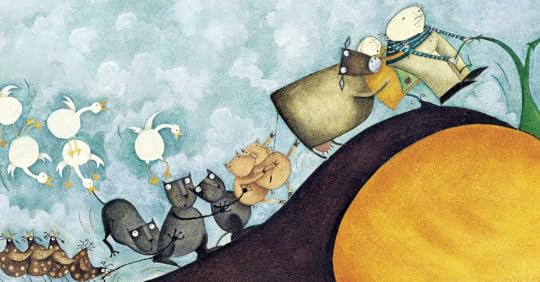
This hilarious retelling of the classic Russian tale about a farmer whose turnip is impossible to pull from the ground uses simple vocabulary and is ideal for reading aloud. Its cumulative theme will soon have young readers gleefully joining in, and Irish artist Niamh Sharkey s wonderfully quirky illustrations will delight and fascinate all ages.
Aleksey Nikolayevich Tolstoy, nicknamed the Comrade Count, was a Russian writer who wrote in many genres but specialized in science fiction and historical novels.
This is the second Portuguese book I've read this year. It is the Portuguese translation of "The Gigantic Turnip" by Aleksey Nikolayevich Tolstoy. The book is a Russian folktale about a gigantic turnip that needs to be harvested and the teamwork it takes. While it wasn't my favourite Children's book, the illustrations were lovely.
Smooth re-telling of the Russian folktale, in picture book format. Sticks close to the original but adds some extra animals. Text relates this cumulative story with flair. Good incorporation of colors and numbers/counting. Illustrations look modern but quaint, which is just the right combination to enliven this old tale and appeal to today's children. The orange color of the turnip works well artistically within the book's color scheme, but isn't true to a real-life representation of a turnip, which is usually white with some purple tones.
A good, serviceable version of the familiar story. And haters, it's supposed to be repetitive.
I like the folksy illustrations, except for the orange turnip. Most kids aren't super familiar with turnips (you should talk about them and root veggies before reading) and can't we let it be its pretty little white with hints of purple self?
Good for preschool-1st, older graders if working on folktale unit
This is a delightful version of the Russian traditional tale. It follows an old man and an old woman who sow vegetable seeds in their garden and after several months, a gigantic turnip has grown. It’s so big, the old man and the old woman cannot pull it out by themselves, so they rely on their animals to help them. It is a lovely story about teamwork, but also proves that being the smallest doesn’t always mean you’re the weakest. Lots of discussion points to have with children.
The storyline is simple and easy to follow. I like that it teaches children about sowing seeds, plant growth, the months of the year and the seasons. Some children might not know where their peas come from at lunchtime, so this is a great discussion point. Lots of cross curricula discussion points! The language is quite simple, with many synonyms for specific words, such as pulled (heaved, tugged, yanked) and definitely lends itself to independent reading or reading in pairs in KS1. The typeface is interesting, too. On the first page the word ‘crooked’ is displayed in a wonky fashion and the lettering of ‘overgrown’ is that each letter gets bigger. On the following page, the text is written around the illustrations. This double page spread is excellent for counting with young children and there is a huge amount of repetition throughout. I can understand that people might get bored of the repetition, but I think that’s the point of the story. This story is perfect for KS1 because the more you repeat throughout the book, the more likely it is that the children will join in. You could act the story out or even do an assembly around teamwork. My favourite page of the book is the last page because it is humorous and heart-warming. I like that it is a bit different from other traditional tales, as I feel children automatically think of Hansel and Gretel etc.
Niamh Sharkey, the illustrator, works with oil paints to create rich, charming illustrations throughout. Even the simplest paintings have such detail, and the colours are so different on each page. They really portray the quaint, picturesque life of the old man and old woman.
Although I do like the story, I feel it is quite simple and unsure whether it could be used further than KS1. I’m not sure enough happens within the storyline to keep children engaged for very long and this is why I have given it 3 stars.
The Mama: This is one those fun nonsense stories where there's a large task to be done, and more and more animals are unsuccessfully added until at the very end, the tiniest animal of all brings victory. (Think Little Blue Truck...) The story itself is pleasantly written and easy to read, but the illustrations make the story. My 7yo just giggled and giggled looking at the animals' silly antics depicted in the illustrations. This edition we picked up at the library includes an audio CD of the story read by Niamh Sharkey. She does an excellent job! 💜 Altogether, this is a delightful, fun read aloud and well worth my 50 cent contribution to the library. 😊
My official rating would be 4 stars because the overall content is fairly slim, but the giggles it brought definitely earned it its 5 stars requested by my 7yo. 💜
The 7yo: I really liked how at the end it says, "The cats fell on the hens" ... It sounds like "The cats fell on their heads." 😂 And the geese were really, really funny, and in one of the pictures, its beak was halfway into the cat's tail! And one of the pigs is hanging onto the cow and not pulling. 😂 And it's just really, really funny. I hope everyone who reads it has a fun time reading it. 😁
I loved this book. The illustrations pair so well with the story of the gigantic turnip. Great use of characters that reappear in the book later on and strong educational introduction to how vegetables grow! The illustration of the turnip and the characters efforts to pull it out of the ground offers light-hearted humour to children and adults. In the end, it is the smallest creature they need the most, providing a great moral lesson that the smallest are not always the weakest. A great one to read again and again.
A traditional tale both in narrative and aesthetic style, TGBET is a light-hearted, warm tale with a tiny hero at its end. The book follows an engaging rhythm and pattern and uses repetition throughout - a good book for young readers to help read with their expert guide. The book's language is accessible and will therefore help these young readers start to recognise the words' form as they go. Finally, the story concludes with the help of a tiny hero - a character that children might empathise with, and feel reassured that heroes can indeed be small.
A very nicely illustrated children's book told in a manner for the younger aged groups. Reminded me of when I was in first to third grades and the stories read on the TV show "Captain Kangaroo." This version is simple, clear, easy to read to, or by, a child. So many critters are involved with a certain enormous turnip and the outcome of their efforts are certainly rewarding. Being short enough for a bedtime story book, this version would make an excellent choice for a ten minute or less read and may even become a favorite when the grand-kids visit.
In my opinion, this is a very good book for young children between the ages of 6 and 8. There are a number of things that can be taught from the book — synonyms, tenses, vocabulary, numbers and adjectives, for example. There are also interesting textual features and images that make the book fun to read. As a bonus, there is also an associated audio book for which the QR code is provided in the book. I have yet to hear it, though.
Moral: If we all work together, we can achieve greatness. Yes, this folk tale from 19th century literature is about communism. You MAGA people better run far from this.
Length: It’s a bit redundant, but it’s not that painful to repeat every animal on each page.
Favorite Line: “The old man pulled and heaved and tugged and yanked, but the turnip would not move.”
Overall Impression: If you’re going to do communism right, dear comrade, you have to work together and share the work. That’s what happens here and the turnip (spoiler) is removed from the ground. Nobody makes a million dollars selling the turnip or putting it out there on social media to get followers. They just sit down and break bread (pardon me, a turnip) together and eat. I’m not sure the system is better, but it seems kinder. And in these times, I’d much rather Mavis read something like this than by the capitalist crooks who run this country.
An early retelling of an old folktale about how it takes a village, or at least an entire barnyard working together to pull a stubborn root vegetable from the cold and rocky ground. Also a cute lesson on how even the littlest member can make a difference. This repetitive story would make a fun read-aloud.
A picture book, but I'm counting it because 1) it's not my native language and 2) counting it will encourage me to read more Spanish-language books. No idea why people are giving this book three stars or less. Is it because the moral wasn't well translated? I can't think of any other reason. It's a story about a giant turnip that takes an entire farm to pull out. It's got excellent illustrations. What could be better than that?
My sister owned this book in the early 1970s. I loved looking at the pictures, but the artwork used to kind of freak me out. There was something about the little birds here and there sitting on the turnip and the mouse (or mice) that gave me the creeps.
I think it gave me a trauma and warped my brain, and for that, I thank illustrator Helen Oxenbury.
An okay story about an enormous turnip that requires the help of multiple animals in order to pull it from the ground. I'm not a big fan of books or songs where I have to repeat a list of all of the other animals/things that happened previously (I'm looking at you, "Twelve Days of Christmas"!), so I am not planning on checking this one out anytime soon.
é quase um clássico se já não o é. tem a ligação aos animais, a terra, ao semear para comer, à natureza e depois também reforça alguma repetição com os números, salienta a importância que todos podem contribuir para um grande feito, até mesmo o mais pequenino que neste caso é representado pelo ratinho. tenho ideia que é ucraniano, embora nas biografias apareça como russo ;)
This entire review has been hidden because of spoilers.
An old man plants a seed and hopes for it to grow into a large turnip. Instead, the fully grown turnip is so enormous that all of the people and the animals at the farm are needed to pull it out of the ground. Great flannel story material for its easy repetition.
This was such a cute story-- the basis that I've read before using other vegetables. But this was the first time I'd read using a turnip. My kids who I read to also really like this, and that the farm animals helped out =)
Not nearly as good as I remembered. Even the illustrations vary picture to picture (black dog varies in size and breed is occasionally light grey; mouse was large and grey then tiny and yellow). Granddaughter looks like she is 50.
Hilariante! O Velhinho, a velhinha, a vaca, os dois porcos, os três gatos, as quatro galinhas, os cinco gansos….. Acho que de cada vez que virava a página não conseguia parar de rir com o meu filho!