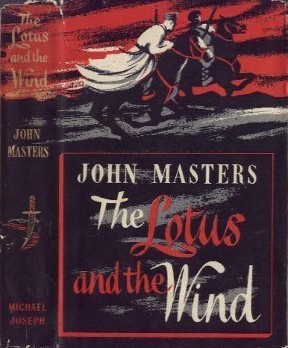
In 1879 Lieutenant Robin Savage is serving in the second Anglo-Afghan war as Britain and the Russian Empire engage in the Great Game that will decide AfghanistanOCOs future. Unjustly accused of cowardice Lieutenant Savage joins the Secret Service to prove his loyalty and he must unravel the mystery of ?AtlarOCO, the word written by an Afghan stranger in his own blood, to thwart the ambitions of Tsarist Russia. Only SavageOCOs love of the empty spaces of AfghanistanOCOs plains and his own courage will protect him as he sets out with a faithful Gurkha orderly to the furthest frontier of the British Empire. John Masters captures the beauty, the strangeness and the splendour of the British Raj and evokes the tensions and conflicts of nineteenth-century Afghanistan with an authority unlike that of any other writer."
Masters was the son of a lieutenant-colonel whose family had a long tradition of service in the Indian Army. He was educated at Wellington and Sandhurst. On graduating from Sandhurst in 1933, he was seconded to the Duke of Cornwall's Light Infantry (DCLI) for a year before applying to serve with the 4th Prince of Wales's Own Gurkha Rifles. He saw service on the North-West Frontier with the 2nd battalion of the regiment, and was rapidly given a variety of appointments within the battalion and the regimental depot, becoming the Adjutant of the 2nd battalion in early 1939.
During World War II his battalion was sent to Basra in Iraq, during the brief Anglo-Iraqi War. Masters subsequently served in Iraq, Syria and Persia. In early 1942, he attended the Indian Army Staff College at Quetta. Here he met the wife of a fellow officer and began an affair. They were later to marry. This caused a small scandal at the time.
After Staff College he first served as Brigade Major in 114th Indian Infantry Brigade before being "poached" by "Joe" Lentaigne, another officer from 4th Gurkhas, to be Brigade Major in 111th Indian Infantry Brigade, a Chindit formation. From March, 1944, the brigade served behind the Japanese lines in Burma. On the death of General Orde Wingate on 24 April, Lentaigne became the Chindits' overall commander and Masters commanded the main body of 111 Brigade.
In May, the brigade was ordered to hold a position code-named ‘Blackpool’ near Mogaung in northern Burma. The isolated position was attacked with great intensity for seventeen days and eventually the brigade was forced to withdraw. Masters had to order the medical orderlies to shoot 19 of his own men, casualties who had no hope of recovery or rescue. Masters later wrote about these events in the second volume of his autobiography, The Road Past Mandalay.
After briefly commanding the 3rd battalion of his regiment, Masters subsequently became GSO1 (the Chief of Staff) of Indian 19th Infantry Division, which was heavily involved in the later stages of the Burma Campaign, until the end of the war. After a spell as a staff officer in GHQ India in Delhi, he then served as an instructor at the British Army Staff College, Camberley. He left the army after this posting, and moved to the United States, where he attempted to set up a business promoting walking tours in the Himalayas, one of his hobbies. The business was not a success and, to make ends meet, he decided to write of his experiences in the army. When his novels proved popular, he became a full-time writer.
In later life, Masters and his wife Barbara moved to Santa Fe, New Mexico, USA. He died in 1983 from complications following heart surgery. His family and friends scattered his ashes from an aeroplane over the mountain trails he loved to hike. General Sir Michael Rose, the former UN commander in Bosnia, is a stepson of Masters.
He was a thin-faced, fragile Galahad, riding against the world’s meanness, the fine lines of his profile set off by the merciless severity of the background hills.
Robin Savage, the fourth or fifth scion of the family engaged in daring and dangerous adventures on the Indian subcontinent, is presented to us as a young officer of the British Raj in the year 1879, about the time of the ill-fated military incursions into Afghanistan. Like previous Savage men in the interconnected historical novels penned by Masters, he is portrayed as the white saviour of the dark races, a rather unsavoury aspect of the author’s ethos that has become more and more annoying as I delve deeper into the multi-generation saga. But I must also acknowledge that John Masters is a very good storyteller, which keeps me coming back despite my misgivings.
While the first Savages to come to India were rogues and opportunists, Robin is cut from a different cloth. An introvert with communication issues, he is suspected by his peers of cowardice and arrogance. In the eyes of the author, he is a kind of Messiah, misunderstood in his pure quest for a higher purpose. That purpose defined mostly in terms of bringing civilization to savages.
The tribes want to shoot each other. They do not want law and order. They want the blood feud. They want to guard their own idea of honour in their own way. Therefore, are we guilty of oppression when we enforce peace, law and order on them?
This quote is not really uttered by Robin Savage, but by one of his superior officers. Robin is supposed to have more empathy for the plight of the locals, but he still subscribes fully to the theory of white supremacy and to the tenets of the Big Game: that the British were selfless agents dedicated to developing India for its own good and to preventing the dastardly Russians from encroaching on its poor, defenseless borders. A game that translates in the real world into pre-emptive invading those border regions, like Afghanistan.
The novel moves along at a decent pace in regards to these military and political issues, with Robin playing of course a central, one-man role in saving the whole North West Frontier from a Russian invasion. I will not go into details, other than to say that behind the obvious bias of the author for its own side and the vilifying of the adversary, Masters is in good form conveying a sense of the vastness of the landscape and of the ruggedness of the locals. The pacing is a bit off, with a lot of introspective moments and traveling from one end of the map to the other chasing red herrings and elusive Russian spies. But I still consider the novel a good page-turner, mostly because I am also interested in learning more about these places and these people, and I don’t think I will be able to visit them in person, given the current conflicts in the region.
A second aspect of the story I would like to comment on is the friendship between Robin and his young Gurkha batman. While their respect for each other and their steadfast loyalty is admirable, I cannot help noticing the underlying core of their relative positions. We are never allowed to forget that one is the master and the other the servant. I believe Masters doesn’t even realize how condescending and insulting in a casual way he is to Jagbir and to the other men in his platoon, so ingrained is the mentality from his own days serving in a Gurkha regiment.
Like a dog, Jagbir felt his need before he could express it in words.
I have a feeling Robin is just about ready to pat him on the head and tell him what a good boy he is.
In another part of the novel, in cantonment in Peshawar, another casual remark notices how the sepoys (the former Indian soldiers who mutinied a generation before) are called niggers or worse, while the Gurkhas are called ‘Johnny’ and allowed to drink alongside their masters, as if this is a great privilege. But enough of this ...
What I have discussed so far is only half of the present novel. The other half is told from the perspective of Anne Hildreth, a young woman from a military family in the same Gurkha regiment where Robin serves. She is in love with our idealistic sir Galahad, and she struggles to pull him out of his protective, taciturn shell. Masters quite transparently subscribes here to the theory that men are from Mars and women from Venus, a view that might have been popular in 1879, but leaves a rather sour aftertaste in today’s world.
You know, some men are cats, some dogs. No women are cats. I haven’t met one who really, in herself, wants above everything else to walk by herself. But some men do. [...] And some men are thought to be cats, but they aren’t. They want love, companionship, and all the rest, but for one reason or another they can’t get it. They just have to make the best job they can of pretending to be cats.
Despite the clear exposition, the theory seems a little cheap and demeaning, yet I sort of liked both Robin and Anne as they attempt to bridge their difference in temperament. That this is the central theme of the novel is emphasized by the title and by the reiteration of the theory by Anne, somewhere later in the novel.
She had learned that this strange power – let her call it the wind, as Robin did – moved in men but not in women. It was far more mysterious than the so-called ‘mystery’ of sexual love, which was no mystery. The wind set even the most humdrum of men to dreaming of escape and free movement, footloose athwart bare landscapes. Another power, the motionless calm of the lotus, existed in all women and bred in the most untamed, the most ethereal of them, longing for a place of her own, children, a hearth, human love.
In conclusion: not the best offer from Masters in his Indian saga, but still interesting enough for a completist like me.
By his own admission, John Masters wrote "potboilers" (as he discussed in his autobiography "Pilgrim Son"). This certainly fits that bill, although it is an extremely well-written one.
Masters superbly communicates the life of a soldier, and life in the field in wartime. He is an excellent poet of the mountains- some of his best written scenes take place in elevations most of us will never go.
His descriptions of combat culminate in anti-climactic moments which have deep import for the characters that undergo them. There is no undue drama.
What I didn't like about this novel- which upholds the best traditions of the spy genre- are the way that the women are characterized. In his previous two installments in the "Savage Family Saga", his female leads had stronger feminist streaks. In this volume, the female lead is a bit subservient. However...the thoughts that Masters invests in this woman are probably closer to the mark about how women in the late 19th century viewed relations between them and their husbands, than the previous two "Savage Wives". So- it's not a serious complaint, just dated writing. (It was written in the 1950's, after all.)
This was a good, solid spy-novel. Intrigue, cloak-and-dagger, arduous physical reconnaissance, deception, well drawn characters, and very interesting considering it was a Cold War-era spy novel written about the first Cold War with the Russians...
Good stuff. Looking forward to seeing how the rest of the Savage family fares in the past and future.
John Masters' family saga with Bill Nighy and Juliet Stevenson.
Plot from wiki - The story is told through the viewpoint of Lieutenant Robin Savage and the innocent but determined Anne Hildreth, although Savage's viewpoint predominates later in the novel. It begins in 1879, when Britain and Afghanistan are engaged in the Second Anglo-Afghan War.
Anne Hildreth and Robin Savage have met and become attracted to each other before the narrative starts. Anne is the daughter of a Commissariat officer and is travelling with her parents to the military post at Peshawar in the North-West Frontier Province of India. En route, she witnesses the murder of an Afghan stranger.
Meanwhile, Robin is part of a military column in Afghanistan. He is the son of a distinguished soldier and has almost been forced to follow in his father's footsteps, but has no taste for action. As the result of an accident, and a superior officer's bungling, he is accused of cowardice, and is also sent to Peshawar to await a Military Court of Inquiry.
Life threatens to be awkward, but an acquaintance, Major Hayling, connects a souvenir collected by Robin in Afghanistan with the murder witnessed by Anne. Realising that Robin's true passion is for solitude and empty spaces, he recruits him into the Secret Service and sends him in disguise into Central Asia. Accompanied by a faithful Gurkha orderly, Robin sets out to discover the motive behind the murder and determine whether it is connected with the ambitions of Tsarist Russia.
Surface issues deal with The Game, however underlying issues mean a Razor's Edge feel to proceedings. Wonderful.
One of Masters' Indian novels featuring the Savage family. This one is an elegiac, moving account of a spying mission in the Nineteenth Century Great Game between Britain and Russia in Afghanistan and Central Asia. Robin Savage, a solitary misfit accused falsely of cowardice, is both restrained and released by his loving wife, protected by his Gurkha orderly while he pursues his alter ego the Russian agent, Murilov. This is a well written, exciting and intelligent adventure story.
British India 19th century. Story of Robin Savage who becomes a secret agent to spy on the movements of the Russians who are planning an invasian into India. Robin is a dreamer and goes where the wind goes. He is loved bij Anne, but he is continually in doubt. At last he meets two russian agents, the Muralev's, who try to deceive him. Robin feels a strong connection with them. For Robin the Muralev's are like a mirror for his own relationship with Anne.
The first chapters where a bit slow, but from the moment Robin becomes a secret agent it becomes very interesting. The last chapter should have been omittes since it spoils the dream like conclusion, therefore 3 stars and not 4 which it deserves for half of the book.
Excellent writing from Masters: he knows the subject, and tells an engaging, convincing spy story. Jagbir is the true hero, for me. His relationship with Savage is the heart of the story.
Actally read the 1965 Penguin re-print (originally 3' 6 !!). Not my fav JM - as the hero, though understandably damaged by his childhood experiences, is so selfish/self centred I wanted to hurl the book across the room. I need to be free dahling to do whatever I want whenever but need you to be my rock (stay home and do the baby thing)...gaaah Ok it's very much of it's time (fictionally and literally) but even so....Bhowhanai Junction suits me much better
Ah, the Savage men! Robin was my favourite followed by William (The Deceivers). Didn't care much for Rodney and Peter...couldn't even finish (didn't get far past the beginning) their books.