

What do you think?

Sinica Leidensia #99
Imperial Warlord: A Biography of Cao Cao 155-220 AD
数世纪以来,曹操以中国历史上最奸诈者的面目示人。另一方面,曹操生于秩序倾颓的汉末乱世,在一定程度上重建了中国北方大部分地区的政治秩序。他不仅自身是一位优秀的诗人,还引领了中国早期文学史上最为灿烂辉煌的时代。在任何文明中,都少有人能有如此才华、取得如此成就,能够在去世后仍如此受关注的更是凤毛麟角。
曹操在历史文献、考古材料以及他自己的作品中给我们留下了相当丰富的信息。尽管曹操的大部分故事因敌人的诽谤以及数代后的浪漫主义热情而变得混乱不明,但其核心事实仍然可考;很少能有距我们如此遥远但事迹又如此清晰的人物了。本书综合陈寿编撰的官方正史《三国志》及裴松之注释等史料,努力为我们还原一个最为接近历史原貌的曹操。
曹操在历史文献、考古材料以及他自己的作品中给我们留下了相当丰富的信息。尽管曹操的大部分故事因敌人的诽谤以及数代后的浪漫主义热情而变得混乱不明,但其核心事实仍然可考;很少能有距我们如此遥远但事迹又如此清晰的人物了。本书综合陈寿编撰的官方正史《三国志》及裴松之注释等史料,努力为我们还原一个最为接近历史原貌的曹操。
568 pages, Hardcover
First published August 18, 2010
About the author
Rafe de Crespigny
25 books14 followersRichard Rafe Champion de Crespigny, also known by his Chinese name Zhang Leifu (Chinese: 張磊夫), is an Australian sinologist and historian. He is an adjunct professor in the College of Asia and the Pacific at the Australian National University. He specialises in the history, geography and literature of the Han dynasty, particularly the translation and historiography of material concerning the Han dynasty and the Three Kingdoms period.
Ratings & Reviews
Friends & Following
Create a free account to discover what your friends think of this book!
Community Reviews
Displaying 1 - 8 of 8 reviews

Read
May 24, 2016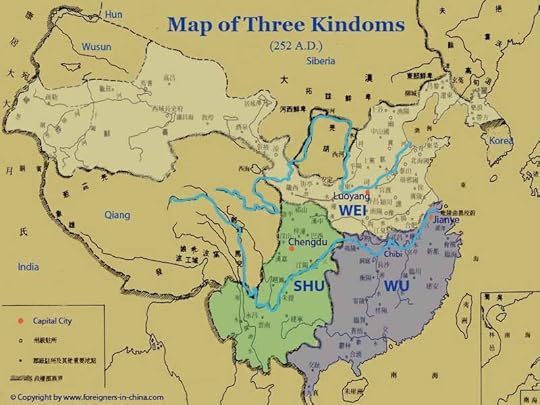
The union of Wei, Shu and Wu essentially represents Han China in the mid-2nd century
The End of the Han Empire
From the Yuan dynasty roman fleuve, Romance of the Three Kingdoms, to recent blockbuster movies like Red Cliff, Cao Cao (155-220) has been portrayed as the consummate villainous warlord consumed by personal ambition, a portrayal that overlooks the fact that he introduced a revolution in Chinese lyric poetry and was the patron of an important cultural revival, just to mention a few points that don't quite fit with the popular image. He failed to unify China under his rule (but then so did everybody else until the fairly short-lived Sui dynasty was founded in 581), but his descendants ruled the state of Wei during the Three Kingdom period and one of his sons, Cao Zhi, became one of the greatest poets in China's long tradition. So who was this man, Cao Cao, actually?
Fortunately, we are exceptionally blessed with a relatively large amount of extant contemporary sources concerning Cao, and in Imperial Warlord: A Biography of Cao Cao (2010) the Late Han/Three Kingdoms specialist, Rafe de Crespigny, brings these often contradictory sources together into an unexpectedly complete picture of the man and his turbulent times.
When Cao was born in 155, the Han dynasty had ruled China for nearly four centuries. The Han had certainly already faced serious problems, but by the time Cao was a young man matters were coming to a head. Setbacks in the centuries long struggle with northern "barbarians", a series of underage emperors with grasping regents, significant religious/proletarian uprisings such as the misnamed Yellow Turban rebellion, and yet other factors had transformed the wobbling of the dynasty into a teetering. Of course, the Chinese state stretched from Korea to Vietnam to central Asia and encompassed approximately fifty million registered inhabitants at this time, so it was a wonder that the Han were able to kept it all together for as long as they did.
As bad as it is for many these days, most can count their blessings that they did not live in north central China in the late 2nd century, for that is where occurred the worst of the devastation during the long military free-for-all between the dozens of ambitious men vying for personal advantage as the reins of the Han slipped off entirely. It is a sad story of treachery, murder, revenge and unprincipled angling for personal gain that includes the catastrophe of the sacking and burning of the capital city of Luoyang in which important cultural accomplishments of the Han empire were irretrievably lost.
De Crespigny follows the entire trajectory of Cao's life from his birth to an adopted son of a powerful eunuch and his military and political apprenticeship in his twenties, through his eventful, up-and-down rise to prominence during the civil war (*) when he acquired control over the young emperor(**) and his famous failure to extend his rule below the Yangtze at the Battle of the Red Cliffs in 208, to his death in 220 in the re-built city of Luoyang.
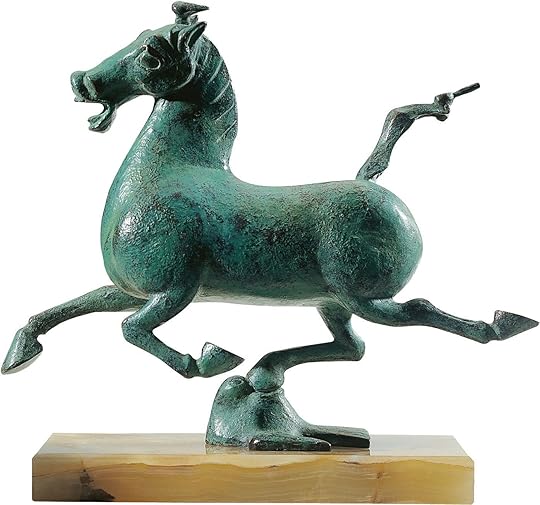
Late Han bronze
Though Cao Cao was as ruthless as many of his contemporaries in that violent age, he was able to forgive and welcome former opponents into his service in such a way that he retained their loyalty, and he tended to incorporate conquered armies into his own instead of destroying them. He also recognized that a satisfied peasantry was essential to his rule and formed domestic policies to that end.
De Crespigny provides a very detailed political, military, administrative and, to a lesser extent, social history of China at the end of the 2nd and beginning of the 3rd century of our era. But he does detour into cultural matters, since Cao Cao was an important poet and presided over "an extraordinary flourishing of literary and scholarly talent" examined in Chapter Eight of this book. Cao was one of the first to adapt a more plain-spoken tradition of versification in order to express emotion in his own name, and I shall close with an excerpt from a poem he wrote in 207 after a lengthy period of campaigning in the north, shortly before he began his ill-fated attempt to conquer the south.
Each region of the world is different;
North of the River it is fiercely cold:
Ice drifts down the streams
And boats find it hard to go on.
The ground is harder than a spade,
Weeds flourish in the fields.
The water is gone and flows no longer
And the ice is firm enough to walk.
Gentlemen hide in distress,
As bullies care little for the laws.
Always in my heart are sighing and sorrow,
Much grief, and sympathy for their plight.
Fortune indeed is come
And singing expresses our hopes.
(*) Which effectively began with a massacre of the thousands of eunuchs who had accumulated wealth and power in the imperial court and administration and the confiscation of the boy emperor's person by the general Dong Zhuo in 189.
(**) The escapades and travails of the last Han emperor, Liu Xie, make interesting reading. Captured and held at the age of eight years by Dong Zhuo, he escaped at age thirteen and then wandered around western China trying to stay alive and independent, a peregrination that included escaping malefactors by climbing down a cliff face on an unfurled roll of bloody silk. He returned to ruined Luoyang in order to re-establish the capital, where he fell into Cao's grasp at the age of fifteen, "accepted" his invitation to move to Cao's early capital city of Xu and remained there until his abdication twenty-five years later under Cao's son's pressures.

November 6, 2023
The quest to read through imperial chinese history continues but this has been a really intriguing and exciting book to read while on the journey
November 10, 2021
The only book in English about one of East Asia’s most remarkable historical figures. There are discussions on many aspects of life and warfare in late Han period that help me appreciate Cao Cao a lot better than from reading the popular novel Romance of Three Kingdoms. The book cites many historical records about Cao that were written shortly after the Three Kingdoms period and evaluates the potential biases of these sources. For example, the story about Cao putting to death a VIP’s relative for violating the law turned out to come from a source hostile to the Cao Wei. Same for the story about Cao using the head of one officer who managed supply to assuage the anger of his soldiers.
The book also contains the author’s translations of Cao Cao’s many well known poems. Yes, one of ancient China’s most accomplished warlords is also a remarkable poet.
My only complain is that it is published in the form of an academic book that costs $300 if you don’t have a university library account. Please don’t download from libgen.
The book also contains the author’s translations of Cao Cao’s many well known poems. Yes, one of ancient China’s most accomplished warlords is also a remarkable poet.
My only complain is that it is published in the form of an academic book that costs $300 if you don’t have a university library account. Please don’t download from libgen.

March 18, 2020
This is really good. Surprisingly accessible given that i can read this despite the academic tone of this book. I hope the author would consider releasing his works in cheap paperback editions for all of us, casual fans of this period in history.
September 9, 2020
a rather adequate biography of what has to be the Three Kingdom's most notable warlord. However, the book is merely a collection of all the information available, and is limited as such. Personally this book taught me nothing the Sanguozhi, Weilue, and Zizhi Tongjian couldn't have.
April 12, 2023
张磊夫作为研究东汉三国的大家,在该书中全景式地呈现了曹操的一生和汉末纷乱动荡的历史。因而,该书既可视为关于曹操的传记,也可当做东汉末年史来读。美中不足的是,译者火候欠佳,讹误不少,影响了对原书的理解。
July 16, 2021
I'm glad that a book like this exists. There are very few biographies in English of people from Chinese history, especially prior to the 20th century. Major figures, the Chinese equivalents of Julius Caesar or George Washington, often have no biography that is available. Cao Cao is one of those major figures of Chinese history.
This book is, for the most part, a scholarly narrative biography of Cao Cao's life, though with many tangents to discuss the general history of the time, and later in the book a few of the chapters are thematic rather than chronological. There are many notes that provide additional background; they can be read or skipped depending on your level of interest.
Crespigny writes very well and is interesting to read. The book is not dry, though it can be difficult to keep track of the many names and places. The many maps throughout the book, as well as the map in the back of the book, together make it easier to keep track of where the action is taking place.
This book is, for the most part, a scholarly narrative biography of Cao Cao's life, though with many tangents to discuss the general history of the time, and later in the book a few of the chapters are thematic rather than chronological. There are many notes that provide additional background; they can be read or skipped depending on your level of interest.
Crespigny writes very well and is interesting to read. The book is not dry, though it can be difficult to keep track of the many names and places. The many maps throughout the book, as well as the map in the back of the book, together make it easier to keep track of where the action is taking place.

February 28, 2021
海量的史料细节错误 作为外国研究者 好像没办法避免 先评价着备份...... 读毕 机翻然后人工修改的吧?外国人写的中国史 史料上的错误可以降低一个评判档次 最后一章很好
Displaying 1 - 8 of 8 reviews