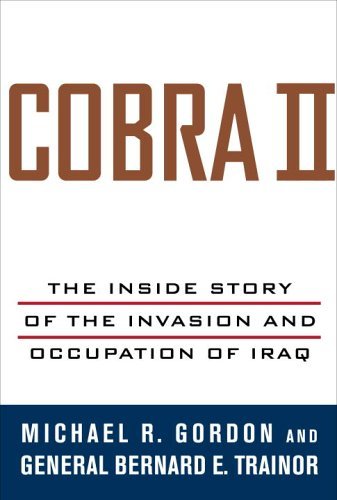
Written by the chief military correspondent of the New York Times and a prominent retired Marine general, this is the definitive account of the invasion of Iraq.A stunning work of investigative journalism, Cobra II describes in riveting detail how the American rush to Baghdad provided the opportunity for the virulent insurgency that followed. As Gordon and Trainor show, the brutal aftermath was not inevitable and was a surprise to the generals on both sides. Based on access to unseen documents and exclusive interviews with the men and women at the heart of the war, Cobra II provides firsthand accounts of the fighting on the ground and the high-level planning behind the scenes. Now with a new afterword that addresses what transpired after the fateful events of the summer of 2003, this is a peerless re-creation and analysis of the central event of our times.
MICHAEL R. GORDON is the chief military correspondent for The New York Times, where he has worked since 1985. He is the coauthor, with Bernard E. Trainor, of The Generals' War and Cobra II.
First and last several chapters cover politics and planning -- the latter mostly lacking unless supplied by Don Rumsfeld. In between is an extended account of the conflict and US forces moved north to Baghdad and beyond.
Pages 82-83 and 501: Had there been any WMD, Rumsfeld's plan to make war with a light mobile force would have resulted in the most feared counter-measure: the spread of WMD to terrorists before enough troops could find and control the WMD and prevent it falling into the hands of Osama. In this respect, the plan didn’t make any sense!
Pages 138-139: The Zinni postwar plan is buried by Rumsfeld.
Page 144: Postwar planning office is so underfunded that the planners beg and raid a trade fair for office supplies.
Page 159: Rumsfeld rejects expertise of State Department types regarding postwar planning, arguing that “fresh ideas and new blood were needed.”
Page 441: “The Iraqis [taken prisoner:] had a hard time understanding something,” Williams recalled. “Shoshana is Panamanian. Edgar is Hispanic. Joe is Philippine, and Patrick (Miller) is from Kansas. The Iraqis could not conceive how we could all have been in the same army and not fight one another. One Iraqi said to me, ‘You no fighting each other? Why?’”
Page 461: “Rumsfeld just ground Franks down. . . The nature of Rumsfeld is that you just get tired of arguing with him.” – Tom White, Secretary of the Army
Pages 462-463: “On April 24, troops from the 82nd Airborne took up positions in a schoolhouse in Fallujah, the first time that U.S. forces had installed themselves in the Sunni city. . . . On a wall outside the mayor’s building next to the Army’s makeshift compound protesters hung a sign in English that proclaimed, ‘U.S. killers, we’ll kick you out.’” . . . Two days later, Bush flew to the deck of the Abraham Lincoln aircraft carrier. Standing before a banner announcing ‘Mission Accomplished,’ the president said that the major combat phase of the war had been completed … but events on the ground were sending the opposite message.”
Page 463: “The Pentagon was determined to avoid open-ended military commitments like those in Bosnia and Kosovo, and to withdraw the vast majority of the American forces in three to four months. The State Department had mismanaged the postwar efforts in the Balkans, and Afghanistan was headed the same way. With the Defense Department now in charge of Iraq after the fall of Saddam things would run more smoothly.”
Page 475: “Bremer was not an expert on the Middle East and in his years as a diplomat had never been posted in the region, but in Rumsfeld’s Pentagon that was considered a plus.”
Page 477: Nation-building was an area Bremer had not been involved in during his earlier career as a diplomat. The message of the RAND study was that large peacekeeping forces were better than small ones. Not only did small forces encourage adversaries to think they could challenge the peacekeepers but they also led the occupation force to rely more on firepower to make up for their limited numbers. That raised the risk of civilian casualties and increased disaffection among the population. ‘The highest levels of casualties have occurred in the operations with the lowest levels of U.S. troops, suggesting an inverse ratio between force levels and the level of risk,’ the RAND study noted.”
Page 483: Rumsfeld instructs Bremer to establish the “New Iraqi Corps . . . For all the talk of building Iraqi pride, the name of the new force betrayed a certain cultural insensitivity: NIC, which pronounced, sounded very much like ‘fuck’ in Arabic.”
Page 495: “The United States mission in Iraq … was made all the more difficult by the administration’s aversion to nation-building and its determination not to study the lessons of its predecessors. It was an ideology they came in with and an overreaction to the Clinton administration. The Bush administration looked at the Bosnia/Kosovo model and decided that it was fundamentally flawed. They concluded that it encouraged an artificial dependency on the part of the host country by committing a larger footprint of U.S. troops. They preferred a small presence to force the host country to do its own nation-building. … this is desirable only if there is security. Without security, the model breaks down quickly, which was the case in Iraq.”
Page 501: “The failure to read the early signs of the insurgency and to adapt accordingly was all the more surprising given the Bush administration’s assertions that Saddam’s regime was allied with Osama bin Laden and terrorist organizations like Abu Musab al-Zarqawi’s and given confirmed intelligence reports that jihadists had infiltrated from Syria. Had the administration taken its own counsel to heart, it would have been planning to wage a counterinsurgency and conduct antiterrorist operations as soon as Baghdad fell.”
Page 506: “The cost to the administration’s foreign policy was considerable: instead of sending a cautioning message of American strength to Iran and North Korea, the United States was bogged down in a conflict that absorbed its military efforts. Instead of demonstrating the liberating power of democratic rule, the United States had inadvertently sent a message that the transition to a representative government was fraught with peril. Instead of demonstrating the sort of success that would have attracted allies to send forces to share the burden of occupation, American and British forces found themselves virtually alone.”
This is the very disturbing story of how a handful of politicos can lead a nation into a war in which the rationale for going to war was completely flawed. The same people who were so gung ho for going to war also gave almost no thought to what was going to happen after the goal of toppling Saddam Hussein was achieved. This should be a cautionary tale, but our American leaders never seem to learn from past mistakes.
This should be required reading for all presidential administrations on how NOT to go war. This truly is a tale of how absolute power corrupts absolutely.
This was a very interesting book. The authors certainly aren't experts on special operations, though... Also, Douglas Feith, Rumsfeld's undersecretary for policy has authored a book entitled War and Decision: Inside the Pentagon at the Dawn of the War on Terrorism, which lays out a reasonable defense of the policies that the authors criticize. I personally agree with Gordon and Bernard, but definitely check out Feith's book as well. I can't find the document "Team Tank: Armor in Support of Special Operations", published in "Veritas:Journal of Army Special Operations History" (Winter 2005) anywhere. The Iraqi Perspectives Report was the main source for their account of how Saddam planned and executed his military actions. It was recently declassified and CHOCK-FULL of interesting information, most of which is not even in the book. Definitely check it out. Click here for the report
I was assigned to CFLCC while Michael Gordon was with us, observing and gathering information to write this book. I know he particularly studied LTG David McKiernan, CFLCC Commander, and unsurprisingly, the book does him and our HQs justice. I was also in Baghdad during the Garner and Bremer times, as CJTF-7 was standing up. Frankly, it's eerie to read through most of this and remember it, matching all of it with my own memories. Overall, a very detailed, honest, and I believe accurate-in-its-assessments book about "OIF Actual" as we sometimes called it.
No matter what you think about the war-you should read this book. It is riveting and made me think. It has been described as one of the best books ever written on the modern military, and I can see why.
There is a good amount of military-speak, but the authors have a glossary that helps you through.
If you know anyone in the military, or are concerned about what the hell is going on over there, read this book.
Somebody remind me why on Earth we were in Iraq...? *Reads book* Oh, right, it was a scam start to finish and our troops were basically set up to fail out there.
Gordon and Trainor's 2006 "Cobra II" bills itself as the story of the invasion and occupation of Iraq. But it's really only a story of the former because, as history so painfully showed, not nearly enough attention was paid to the occupation until it was too late and the US was waist-deep in occupation. None of the planners sought an occupation (having rejected Clintonian nation-building as it existed in Bosnia and expecting Iraqi institutions to do the bulk of the work) and while it's trite to say that Rumsfeld et al thought they could fight a war "on the cheap" -- what remains true is that, by and large, the invasion of Iraq for the purpose of toppling of the Hussein government was a success. That's cold comfort as the invasion obviously turned into an occupation/counter-insurgency almost immediately -- thereby changing the mission.
2/3 of the book covers the on-the-ground invasion itself and the success, failures, and mistakes that such a massive undertaking necessarily implies. Messages get garbled, units get lost, and people make bad decisions. While it's superficially easy to blame Tommy Franks and CENTCOM for the plan, it basically worked. The collective failure is in what happened next and the failure to adequately plan for it.
In that regard, nobody comes across terribly well. Franks, CENTCOM, Rumsfeld, the CIA, Powell, Bremer, etc. There were just so many underlying assumptions that proved so spectacularly WRONG that what happened feels almost inevitable (this is also a function of Gordon's "hindsight is 20/20" writing style). Gordon's style is supremely historical, but it's not above being critical. The CIA was comically wrong about the supposed fragility of Saddam's regime and the inability to account for the fedayeen. Bremer and his CPA was also comically wrong about the level of Baathification in the Army which informed the disastrous decision to disband it (fueling the insurgency).
Gordon's combat narrative focuses a little too heavily on events that occupied a lot of media space (the capture/rescue of PFC Jessica Lynch, the firing on the Palestine Hotel, etc), but in retrospect, mattered very little in the overall story of the invasion. This is a minor quibble and understandable given the outsized coverage these incidents received at the time.
The biggest boon in this history is the reports of interviews with captured members of Saddam's regime/military who help give insight into Saddam's thinking and strategies in the run-up to the war. His "deterrence-by-doubt" approach of never being totally honest about his WMD capabilities is one such example.
All told, Cobra II is an outstanding, insightful, and fair look at the start of America's second longest war.
A fantastic, detailed account of the actions leading up to the 2003 invasion of Iraq along with the first few months of combat. Lots of lessons on civil-military relations and combat.
This is a deeply in-depth and interesting account of the prewar military planning, the invasion itself, and the immediate postwar aftermath. It is clearly and engagingly written and comprehensive. G and T have a balanced but incisive critique of the Bush administration and military's strategy for Iraq. They praise the military in several respects, including its proficiency in joint warfare, its rapid victory, and its avoidance of civilian casualties during the invasion. However, they find several faults worth noting. First, the military anticipated a showdown with the Republican Guard and other conventional units, but they ended up mostly fighting irregular Fedayeen, who did a pretty good job harassing and slowing down US forces. Franks was slow to react to this threat, and criticized commanders on the ground who were trying to consolidate ground against the Fedayeen as opposed to sprinting towards Baghdad. Second, Rumsfeld was so fixed against doing nation-building, that he and others did only the bare minimum of postwar planning. I had heard this before about 10 times, but Gordon adds key details and an interesting interpretation. He argues that the decision not to plan for the postwar reconstruction was a deliberate decision by the Rumsfeld administration, who believed the US should not be involved in such tasks, rather than a negligent omission. Third, the US was far too confident in the ability of technology, or the so-called Revolution in Military Affairs, to clear away the fog of war and lead the US to an easy victory. Not only did the fog of war remain during the invasion, our lack of planning and knowledge about Iraq meant that the fog of war lingered heavily in the postwar period. We didn't know much about the power brokers of society, the views of Iraqi civilians, or the slowly forming insurgency. The ignorance of people like Rumsfeld, Franks, and Bremer led us to crucial early mistakes, including de-Baathification, the dissolution of the entire Iraqi army and police forces, the canceling of local elections, the failure to restore basic services, and the failure to stop the looting. The Rumsfeld crew believed that you wouldn't need more troops to lock the country down than to invade it, so they "off-ramped" units as much as possible in the early going, units that could have played key roles in stabilizing the country. In other words, Rumsfeld and Franks conceived of the war as a strictly military affair, when all wars are political at their cores, especially ones that involve occupying, reforming, and rebuilding an entire society.
G and T also give readers a fascinating inside look at Saddam Hussein's political and military strategy based on classified interviews with regime members. Shortly before the war, SH actually got a group of Iraqi leaders together and told them that he had no more WMD. I have often wondered why if this was the case he didn't just come totally clean with the UN and avoid being invaded. The reason G and T give is that SH needed the appearance of having WMD in order to keep the Kurds and Shiites from challenging his role. If he spilled the beans to the external enemy (US), he would be putting himself at risk to the internal enemies, which he always feared more. The US was fortunate that SH was such a paranoid bungler and that most of his conventional forces just bailed on him. It could have been a lot worse if he had been a competent and inspirational leader.
I haven't read a more thorough and generally engaging book on the history of the invasion and the immediate aftermath since Fiasco. I still recommend Fiasco to most readers because it covers a broader span of time and includes a broader range of topics. My only complaint is that G and T could have done a better job orienting lay readers during the more tactical and operational sections of the book. I got a bit lost in regards to where different unit movements were happening on the maps, which were all front loaded at the start of the book. Still, this is an outstanding complement to Ricks and a key piece of figuring out the Iraq War.
A magisterial account of the 2003 Invasion of Iraq and the early days of the Occupation. Damning in it's account of mismanagement in government, this book is a must-read for readers looking to understand what went wrong in the summer of 2003.
When I arrived for a new, and unique, position at the 354th Civil Affairs Command I asked a respected Lieutenant Colonel what books he would recommend to best understand Civil Affairs. This was one of the two books he recommended.
The authors have a deep knowledge of the initial Iraq invasion and the book serves as a great narrative on the planning, execution and subsequent fumbling of managing a "post-liberated" Iraq. The Civil Affairs component isn't addressed until the last couple chapters of the book. Was pleased to see my first Army assignement, the 432nd CA Bn, was indirectly mentioned as a "Civil Affairs Unit from Green Bay..."
If there is a villian in this book the authors have presented you Donald Rumsfeld who apparently can't get anything right. I agree that the former Secretary of Defense made some bad choices, had an antiquated management and communication style and was a bad team player at times (in particular I think highly of Colin Powell and think he should of been listened to more often). In my opinion, the authors criticism of him is over the top. War is hell, but the US did end up beating one of the world's largest military in a month. Every casualty is a tragedy, but America has lost more American's in a single hour during our nation's history than we did during the entire war. In short, the authors come across at times as cynical. History is difficult to judge, we assume all would of worked out if we never engaged Iraq.
I do appreciate that the book pulled back the curtain on some matters that have been largely misinterpreted or under reported by the media. Those that lived through the war remember President Bush's infamous "Mission Accomplished" announcement while visiting sailors in the region. In hindsight we know the war was just about to begin. What the book made clear was that President Bush was in part doing this because he was seeking Arab nations assistance in moving Iraq forward and those nations hinted they would be willing if it was clear the war was over and rebuilding was the now the mission. I think that background is important before stones are cast.
If you are a military officer, history buff or national politics guru it's worth a read. I would not recommend to my friends that were not in those two categories.
This book, due to its length and extraordinary level of operational and strategic detail, will not be for everyone. But for those who want a serious and deeply informed understanding of the American invasion of Iraq in 2003, Cobra II is an essential work. Written by Michael R. Gordon and Bernard E. Trainor, the book provides a comprehensive account of the planning, execution, and aftermath of the Iraq War, and stands as one of the most authoritative narratives on the subject. General George Patton’s Third Army, in its World War II drive from Normandy, named the operation Cobra. Lt. General David McKiernan, the Third Army commander, decided to name the drive to Baghdad Cobra II. You can’t go wrong emulating Patton.
An enormous amount of material is covered here, from the internal debates within the administration of George W. Bush, to the Pentagon’s war planning under Donald Rumsfeld, to the execution of the “light footprint” invasion strategy that toppled Saddam Hussein’s regime with remarkable speed. The authors carefully trace the evolution of the war plan, including the tension between traditional military doctrine and Rumsfeld’s push for a leaner, faster force, and the consequences of those decisions as American troops moved rapidly toward Baghdad. Equally important is the book’s examination of what was not adequately planned—the postwar occupation—which ultimately proved to be far more difficult and consequential than the invasion itself. That failure was highlighted repeatedly. Marine General Anthony Zinni had his own thoughts.
“The Jordanians and Kuwaitis, in particular, were concerned that Saddam’s days might be numbered and that Iraq might implode if he was toppled, leading to chaos on their frontier. Zinni was also concerned that Iraq could shatter and he then would be called on to restore order and keep the nation from fragmenting along ethnic lines. Containing Saddam was not the problem. It was filling a a potential power vacuum that worried him. Zinni was not eager to invade Iraq and thought the idea of arming anti-Saddam insurgents was lunacy, but if the Iraqi’s did the job themselves he had to be ready.”
Cobra II The Inside Story of the Invasion and Occupation of Iraq Michael Gordon & General Bernard E. Trainor pg. 26
Gordon and Trainor do an excellent job of showing how the various components of the operation were interconnected. Intelligence assessments regarding weapons of mass destruction, assumptions about how Iraqi forces and civilians would react, and confidence in rapid regime collapse all fed into a strategy that achieved initial military success but left significant gaps in the transition to stability. The authors present these connections in a clear and compelling way, demonstrating how decisions made months or even years before the invasion shaped outcomes on the ground. The detail on the military aspects is pretty deep, and on this point there was a citation of a military saying that bears repeating:
“Amateurs talk about strategy, professionals talk about logistics.”
Cobra II The Inside Story of the Invasion and Occupation of Iraq Michael Gordon & General Bernard E. Trainor pg. 96
Rumsfeld’s insistence on a “small footprint” had more than a single flaw. It created some true logistical nightmares for the real war planners. The military war planners well understood the problems with the nonsense being put forward by Rumsfeld and his team. I was a bit disappointed that the famous quote attributed to Tommy Franks in describing the intellectual ability of Doug Feith was not included in the book. Feith, despite that, still draws some heavy, well deserved criticism. A discussion of the administration plan to recruit Iraqi freedom fighters to “aid” the U.S. military turned into a total fiasco, leading to the book’s observation that:
“White House officials and CENTCOM said that the fiasco showed that Feith and his team were better at drafting conservative policy manifestos than instituting programs.”
Cobra II The Inside Story of the Invasion and Occupation of Iraq Michael Gordon & General Bernard E. Trainor pg. 107
The book does not shy away from criticism. There is a clear-eyed assessment of the shortcomings in planning for the occupation, including the disbanding of the Iraqi army and the failure to anticipate the insurgency that followed. At the same time, the authors give due credit to the professionalism and adaptability of U.S. military commanders in the field, who executed a complex and fast-moving campaign under significant constraints. The narrative strikes a careful balance, avoiding both polemic and apology, and instead focusing on a detailed reconstruction of events and decisions.
For the student of military history and foreign policy, the cast of characters is both extensive and consequential. Figures such as Tommy Franks, Paul Wolfowitz, and Jay Garner play central roles, along with numerous others in both the military and civilian leadership. Beside the criticism of the Administration Tommy Franks did not really come off well, though I have a fondness for him, likely in part because of his accurate assessment of Feith. Franks was in a difficult position, balancing the military needs as he understood them and the ridiculous amount of interference from Rumsfeld. A military decision to omit some key military units (First Armored and First Cavalry) that Franks wanted was Rumsfeld driven, though later there would be some explanation that Franks had approved.
“‘We had First Armored and First Cavalry in the flow,’Franks said. ‘Don Rumsfeld did in fact make the decision to off-ramp the First Cavalry Division.’ Tom White, the civilian Army secretary, had a less charitable view. ‘Rumsfeld just ground Franks down,’ White said. ‘If you grind away at the military guys long enough, they will finally say, “Screw it, I’ll do the best I can with what I have.’ The nature of Rumsfeld is that you just get tired of arguing with him.’”
Cobra II The Inside Story of the Invasion and Occupation of Iraq Michael Gordon & General Bernard E. Trainor pg. 461
The authors provide insight into their personalities, their disagreements, and their influence on the conduct of the war. As with any work of this scope, the authors are ultimately constructing a narrative that will help define how this conflict is remembered, but they do so with a level of rigor and sourcing that lends the book considerable credibility.
The Iraq War remains one of the most controversial foreign policy decisions in modern American history. Cobra II does not attempt to resolve that debate, but it does provide an indispensable foundation for understanding how and why the war unfolded as it did. For historians, policy analysts, and serious readers of contemporary history, this book is essential reading.
This is a must read book on the military strategy and tactics in the invasion of Iraq. One can only be impressed with the swift victory and the valor of American troops. The use of information direct from the front gives this book a genuine sense of authenticity regarding the war. For details about the invasion of Iraq, this is a "must read."
Equally important, though, is the brief concluding analysis by the authors of what happened after the successful capture of Baghdad. And this, of course, is the rub. Poor postwar planning clearly undermined the original military success. The authors note the following problematic factors affecting post-invasion events:
1. Misreading the enemy and the structure of political power in Iraq; 2. Overreliance on technological advancement; 3. Failure to adapt to developments on the battlefield; 4. Dysfunction of American military structures; 5. The Administration's disdain for nation-building.
Again, a key work on the actual details of the invasion with some useful lessons as to what went wrong afterwards. . . . By now, timebound on implications, witht he "facts on the ground" having moved ahead.
Nonetheless, a good examination of the invasion itself.
Cobra II is a blow-by-blow account of the initial invasion of Iraq written by a journalist and a general: Michael R. Gordon, a New York Times reporter imbedded with the invasion force, and Bernard E Trainor, a retired Marine general who also wrote for the New York Times. The dual-author effort results in a kind of anonymous prose style, journeyman-like but still readable. This isn’t an official account but it seems to be a careful one.
The book does an excellent job of describing the decision-making in going to war and an even better job of describing the actual invasion. It falls down describing the disastrous aftermath of the military victory, a not-insignificant failing given the book’s subtitle, “The Inside Story of the Invasion and Occupation of Iraq.”
Actually the main title of the presages the start of the great deception. Cobra was the name of the campaign of George Patton to break out of Normandy and liberate France. To equate the attack on an undermatched, underequipped army of a small, deteriorating despot with the victory over the Nazis shows the height of hubris.
The story is bracketed by the mistakes of two great examples of arrogance: the dismissive impatience of Donald Rumsfeld and the scattered imperiousness of David Bremmer. It’s a lesson to us that both these men could have come out of central casting: the avuncular secretary of defense whose few moments of well-phrased wisdom (“democracy is messy”) are subverted by his complete lack of insight; and then the envoy (you know we’re in trouble when an American has the title “envoy”), with his perfect suits and combat boots.
Cobra II shows Rumsfeld undermining his generals and basic military common sense from the start by pushing for a small, quick invasion. Rumsfeld believes in the element of surprise, hitting a foe before he can prepare. The reasoning falls apart given the emergence of diplomatic efforts, which had they been successful would have saved the world a lot of trouble. Given how much time the USA really had to move troops and how long Saddam Hussain had to prepare, there was little reason for an under-manned invasion force. The book shows how reckless Rumsfeld could be. There is a practice in the US military called TPFDL, which is a computerized system that automatically triggers the sending of personnel and equipment that would be sent along once a particular combat unit was ordered to battle. Rumsfeld messed with that system so fewer troops would be sent.
Cobra II is best when it chronicles the actual invasion, sometimes at the what-truck-drove-into-what-ditch level. Although the US military was vastly superior with great defensive armor, the book shows the terror that a soldier feels getting shot at from all sides.
This nuts and bolts account is compellingly specific. Kuwait had reinforced its border with Iraq with 1,600-volt fencing and anti-tank ditches and berms. They weren’t crazy about taking them down for the invasion. They had to be talked into letting contractors taking down 36 sections of fence so the invasion could commence.
Then there is some grim humor: The initial invasion force on Bagdad missing the exit to the airport; the second Bagdad thrust taking advantage of ambiguity of its orders to drive right into the center of town so some stateside Army officials found out about the occupation from reporters.
I don’t think I’m alone when I say that war books but me into a simplistic, good-guys versus bad-guys frame of mind. I hung on every shot, hoping the US soldiers dodged the bullet and that enemy resistance was overcome. It takes a bit of mind adjustment then to see things from others’ eyes. American weapons are horrific for opponents. For Iraqis who made smart defensive stands were quickly overwhelmed when the U.S. ground commanders called in air strikes. It’s not treasonous to wonder at the fate of opposing soldiers who are, after all, defending their own country.
For all the bravery and skill of the front-line U.S troops, this campaign was really like playing the easy, early levels of a video game. In one major U.S. air campaign, the Iraqis had countered brilliantly, lighting and darkening their city’s to identify the incoming aircraft for anticraft fire. The US was staggered, with an Apache helicopter shot down and most of the helicopters full of bullet holes. It was a shocking defeat, but I don’t think there was a single U.S. fatality.
In fact, U.S. deaths were usually because of out-of-the-blue, lucky shots. As for the Iraqis, you read the U.S. soldiers making “quick work” of a batch of resisting soldiers and you forget the bloody consequences.
As effective as the book is describing the combat, as it proceeds, it starts to read like someone trying to finish a term paper late at night. In the 500 pages of text, the move on Bagdad doesn’t start until page 375. Perhaps deadline pressures explain why the book goes light on details after the US made it to Bagdad. (Inexplicably, the book doesn’t detail the capture of Saddam Hussein.)
The final pages of Cobra II are a not particularly informative about the mishandling of the occupation. Troops that were on ships slated to be landed were turned back by Rumsfeld and some existing troops were sent home, befuddling the generals. Bremmer made the storied blunder of disbanding the Iraqi army, creating 300K angry, desperate men. Then he refused to let any members of the Baathist party hold office, decapitating the government.
Rumsfeld for his part seemed to have his own version of the Potty Barn Rule: If you break it, run out of the store.
So much of Cobra II describes the effort to keep U.S. troops safe as possible. Even the most aggressive seemingly reckless turns in campaigns seem to be designed to keep troops on the move so they won’t be easy targets for Iraqi counterattacks. Fatalities in the invasion could be measured in the dozens, but last time I checked there were around 5,000 U.S. military deaths overall in Iraqi. So many soldiers were picked off in ones or twos after the invasion, often driving poorly armored vehicles.
A reader of Cobra II looking for the story of Americans involvement in Iraqi will come up short. I didn’t know initially that Gordon and Trainor had revisited the story in another book, The Endgame. Maybe that remedies this book’s weakness. But for me, I think I’ll pull Thomas Ricks' Fiasco down from my bookshelf.
starts a little slow with pages filled with acronyms and then becomes flowing military history with true 'Bradley Fighting Vehicle's eye view' of the combat onslaught of US forces into Iraq. contains both air and land military activities and information about the political situation surrounding the invasion and subsequent occupation. thoughtful quotations and clear benefit from the teamwork between the New York Times editor and the Marine general, and the Marines' slightly less coverage compared to the Army compensated for by this text.
a 4 but not a 5. the better military writers have a quality of synthesis and urgency that was to some degree only here in parts in this work. a better writer could have step-by-step shown the balance of forces rather than sort of tied everything together somewhat hapharardly--this book was published in March 2006 so it was fairly clearly a reader market-grabber production, but it is professional and it is organized. doesn't drop to the 3/5.
Cobra II is a major work. It is in this that it is made eminently clear that it is Rummy who was in charge of troop numbers. He pressured the generals, particularly Franks, to reduce the numbers over and over and over again until the General(s), knowing what was good for him/them, acceded.
The war itself was fraught with miscommunications, incompatibilities and wildly inaccurate assumptions. In one instance several Air Force bombers were unable to make it all the way back home from their mission because their refueling connections were incompatible with the system in use on the Navy tanker planes. Many more such FUBAR moments are portrayed here.
If you're looking for a narrative of the second US-Iraq War then this is the book for you (told, of course, entirely from the American point of view but then we haven't left much of a publishing industry in Iraq, have we).
If you're looking for an analysis of consequences, you're not going to find it here. (Consider that Gordon is the second fiddle to the NYT's Judith Miller's pre-war WMD puff pieces.)
Via audiobook. And incredible analysis with such detail, and an amazing story! It is written with a noticeable bias, but it is hard to argue or even disagree with. The story covers macro and micro, spanning all 3 levels of war. It makes for a complete analysis and recount, but sometimes hard to keep track of everything going on. Loved this book. Highly recommend to understand US in Iraq.
This is a superb read for anyone who wants to understand how the United States ended up in the Iraq war with forces that were so woefully unprepared for the mission. The authors are sympathetic to the effective and purposeful use of U.S. military power, which makes their detailed indictment of what actually happened all the more damning.
Cobra II illustrates the many failings of the military campaign in Iraq, and reveals that they could possibly have been avoided with just a little more planning. Who'd have thought? It's an excellent read though if you want all the specifics on just how things went wrong, and how badly.
This was an excellent account of the invasion of Iraq. The book is roughly 600 pages long. The first 188 pages are dedicated to the planning of the invasion, followed by 335 pages of fighting and about 75 pages of peacekeeping. The peacekeeping phase contains an epilogue, and a final chapter entitled “Afterward” with updates since the book was first published.
The planning for the invasion was flawed. Intelligence was flawed. The CIA had done an outstanding job in Afghanistan but botched almost every detail in Iraq including the premise. Saddam did not have significant stockpiles of weapons of mass destruction. He had told his Republican Guard units to destroy whatever they had. He had also ordered a centrifuge which could be used to develop a nuclear bomb etc. It didn’t seem to matter because Dick Cheney wanted to invade and conquer Iraq to demonstrate the might of the United States to the Middle East and the rest of the world. Also, Don Rumsfeld was too heavy handed during the planning phase and insisted on a reduction in forces. Tommy Franks should have insisted on more boots on the ground. Franks should have stood up to Rumsfeld and stopped the Defense Secretary from meddling with the invasion plan. Cobra II was a compromise based on a smaller force. There was very little planning on the aftermath.
The war planning took about eighteen months. The postwar planning began in earnest only a couple of months before the invasion. Bush Cheney, Rumsfeld and Tommy Franks spent most of their time and energy on the least demanding task – defeating Saddam’s weakened conventional forces – and the least amount on the most demanding – rehabilitation of and security for the new Iraq. The result was a surprising contradiction. The United States did not have nearly enough troops to secure the hundreds of suspected WMD sites that had supposedly been identified in Iraq or to secure the nations long porous borders. Had the Iraqis possessed WMD and terrorist groups been prevalent in Iraq as the Bush administration so loudly asserted, U.S. forces might well have failed to prevent the WMD from being spirited out of the country and falling into the hands of dark forces the administration had declared war on.
The shooting war is fast paced and from this point on, the book is impossible to put down. The war starts with the bombing of Dora Farms - a suspected Saddam hideout that he hadn’t been to in 10 years. Again, intelligence is faulty and even laughable. The first casualties are from Fedayeen in pickup trucks. US forces are told not to fire because Iraqis would be surrendering in droves. This didn’t happen. The Marines find themselves fighting a non-conventional foe that are from all parts of the Middle East with “Jihad” stamped on their passports.
In the fog of war, blue on blue encounters happen. Patriot missile batteries shoot down 1 British and 3 US warplanes. At least one Patriot missile battery was fired upon by US aircraft. There was an incident where the Marines mistook some of their own vehicles for Republican Guard. Communications in the lead vehicle were knocked out and couldn’t respond. The Marines called in an A-10 airstrike. The Marines had state-of-the-art markers on their vehicles that the A-10s were not yet equipped to recognize.
The US forces adapted well and did an outstanding job of defeating the enemy where they found them but once again, intelligence failures made the task much harder.
With artillery and A-10s softening the resistance ahead, the brigade pressed on, bypassing resistance whenever possible to maintain momentum. With little intelligence on the enemy, Sanderson relied on reports from pilots to gauge his foe. “It was all movement to contact,” he recalled. “There was very little intelligence and what we did get was often wrong. The best intel came from talking to the pilots.” Six hours after forging ahead, Allyn’s brigade received an intelligence report on an enemy it had already faced. Here was yet another example of how the speed of the attack exceeded the ability of the intelligence systems to support it.
The real problem with Iraq was the rush to pull combat units out and send them home. The country was a mess. Unlike the first Gulf War, US forces intentionally tried to avoid destroying strategic targets but that didn’t matter. For example, the electrical grid was in such bad shape from the first Gulf War and subsequent sanctions that things were never properly fixed and cobbled together. We had a window to secure and fix that country and that window closed. We blew it. The world is a worse place because of Cobra II.
"Cobra II" is a masterful portrait of the invasion and occupation of Iraq beginning in 2003 under the leadership of President George W. Bush, Secretary of Defense Donald Rumsfeld, and General Tommy Franks. The debate over the Iraq War has a long, sordid history in American politics, but the war itself, its planning, operations, victories, and flaws, has not received due attention. Trainor and Gordon take readers from the early planning stages all the way through the fall of Baghdad and occupation of Iraq, all the while shedding light on the tragic consequences of poor decision-making and rushed ignorance. The authors helpfully point out that the folly of the Iraq War isn't necessarily in its lack of planning, but its plans that turned out to be completely wrong or wholly inadequate for the new situation. As one example, the Bush administration did not ignore the issue of whether police training forces should be sent to the country following the successful invasion; instead, the administration intentionally skirted the issue, hoping the issue would be resolved by coalition partners (it wasn't) and a rapid withdrawal of armed forces (they would stay for years afterwards).
The picture that emerges from this book is heroism on the front lines, but poor strategy at the top. Rumsfeld and Franks appear more enamored with their "lightning strike" deployment theories than ensuring Iraq will be equipped with the soldiers and resources required for a long war. Generals spar with civilians once Baghdad falls, leaving a power vacuum and the ingredients for a developing insurgency.
President Bush often pointed to a lack of imagination to explain the tragedy of 9/11. That lack of imagination carried over to the battlefield, as commanders from Franks on down refused to recognize that they were fighting Fedayeen insurgents, not the armed battalions of Iraq's Army anticipated in war planning schemes. If adaptability is the key to military success, there is not much to find that is laudable in the US military's initial approach to invasion and the friction between its planning and the reality on the ground in the first month of the war.
Altogether, this is an important book, particularly for military readers keen to avoid the follies of our long wars in the Middle East.
“The air war commander was conflicted. ‘I’ve got mixed emotions about this,’ he confided to an aide. ‘We’ve conquered a country today and fo the first time we started it.’ The aide quickly corrected the general: Iraq had been ‘liberated.’ ‘You’re right,’ Mosely added. ‘That’s a better way to describe it.’ One day, Mosely ventured, Iraq would become the jewel of the region. This book is a lot different reading it now in 2020 versus when it was written in 2007. Since then Obama has served as president, ISIS proliferated, there was the Arab Spring, etc. A small example of this is an anecdote of an MIA pilot thought to be held prisoner since the Gulf War whose remains were discovered having died when his plane was shot down. I really enjoyed it though because it focuses on the strategic planning that went into the invasion and not just the tactics and war stories once it began. It is an easy to follow story with lots of detail. The author remains mostly unbiased and merely analytical until the epilogue where he outlines what went wrong. He definitely paints Rumsfeld as the “bad guy” with the way Rumsfeld removed anyone who disagreed with him and insisted on a plan that would be disastrous after the invasion was complete. The author also seems to point out quite a few times when the US military unimaginably underestimates the enemy. As far as the book itself there are a few errors that might seem small but make me wonder about the accuracy of the book. For instance there are a couple of stories of KIAs whose names are misspelled. This might seem small but I would say getting the names right of those who gave all is a big piece of any military non-fiction book. All in all worth the read as it provides a good overview of why Iraq ended up the way it did.
The authors show extensive military knowledge and background, and they do a fantastic job of laying the groundwork of the beginnings of the war. Sometimes the neutrality of their position seems to make them appear to be sympathetic to the Republican years, but I interpreted that more as just trying to be only factual - not dealing in rumors. This book was a hard read. As a young Republican, I believed we would find WMDs. The mismanagement of intelligence by the CIA is staggering. Seeing the entire progress of the war laid out, it's impossible to not make arm chair decisions about bungling and deception. It's also hard to not question the prices we, and the people of Iraq, still are paying today.
Cobra II: The Inside Story of the Invasion and Occupation of Iraq, was highly charged and fast paced, giving a surreal view of the events that took place. This book was a good read, and I came away from it with a realistic view of what took place. I recommend this book both for the average person and for those who are or who have been in the military, who would like to glean information in a way that is understandable and interesting, as it reinforces the idea that as Americans, we support our troops.
Interesting in parts, but seems like a summary of other books without a lot of new information (and I haven’t even read many of the referenced memoirs). Some interesting battle details and other elements that were new to me, but it’s long, dense, and those may be easier accessed elsewhere.
If you’re interested in the ground scheme of maneuver for the invasion and/or some of the ploys used in addressing what CENTCOM and intelligence leaders expected, it may be worth a skim or partial read for those sections.
A good book, well researched and documented. Also provides some information from the British point of view. It's a good description of what went wrong and, to a limited extent, why. There is enough detail to support the points brought up, and it is well-written. The information matches what I both know from reading and remember from watching reports at the time. I recommend it.
remarkable indictment of high-level Bush admin officials who planned poorly and reacted slowly, compounding the invasion's inevitable insurgency. particularly critical of Rumsfeld, Franks and the CIA.
A very in-depth look at the Iraq War invasion. Looks at it from all sides; political, military, social. My only qualms is it's a really long book and I was more interested in the battles not the psychology of the main characters in the US and Iraq army.