

What do you think?

Homer Kelly #12
Dead as a Dodo
As part-time detective Homer Kelly sets off on his search for answers to the death of a young priest, who left nothing behind but an inauspicious and cryptic note, he finds a crime far more sinister and troubling. Reprint.
256 pages, Mass Market Paperback
First published January 1, 1996
About the author
Jane Langton
55 books128 followersLangton was born in Boston, Massachusetts. She studied astronomy at Wellesley College and the University of Michigan, receiving a bachelor's degree in 1944. She received an M.A. in art history from the University of Michigan in 1945, and another M.A. from Radcliffe College in 1948. She studied at the Boston Museum School from 1958 to 1959.
In 1961 Langton wrote and illustrated her first book for children, The Majesty of Grace, a story about a young girl during the Depression who is certain she will some day be Queen of England. Langton has since written a children's series, The Hall Family Chronicles, and the Homer Kelly murder mystery novels. She has also written several stand-alone novels and picture books.
Langton's novel The Fledgling is a Newbery Honor book. Her novel Emily Dickinson is Dead was nominated for an Edgar Award and received a Nero Award. The Face on the Wall was an editors' choice selection by The Drood Review of Mystery for 1998.
Langton lives in Lincoln, Massachusetts, near the town of Concord, the setting of many of her novels. Her husband, Bill, died in 1997. Langton has three adult sons: Chris, David and Andy.
Series:
* Hall Family
* Homer Kelly Mystery
In 1961 Langton wrote and illustrated her first book for children, The Majesty of Grace, a story about a young girl during the Depression who is certain she will some day be Queen of England. Langton has since written a children's series, The Hall Family Chronicles, and the Homer Kelly murder mystery novels. She has also written several stand-alone novels and picture books.
Langton's novel The Fledgling is a Newbery Honor book. Her novel Emily Dickinson is Dead was nominated for an Edgar Award and received a Nero Award. The Face on the Wall was an editors' choice selection by The Drood Review of Mystery for 1998.
Langton lives in Lincoln, Massachusetts, near the town of Concord, the setting of many of her novels. Her husband, Bill, died in 1997. Langton has three adult sons: Chris, David and Andy.
Series:
* Hall Family
* Homer Kelly Mystery
Ratings & Reviews
Friends & Following
Create a free account to discover what your friends think of this book!
Community Reviews
Displaying 1 - 25 of 25 reviews

January 24, 2021
When Homer Kelly and his wife Mary leave Harvard behind for his appointment as a visiting fellow at Oxford, they thought he had left his role as part-time detective behind as well. But it isn't long before before the British scholars prove just as adept at making mysteries for their American visitor. When people in college begin dying, Homer (whose reputation as sleuth in scholar's clothing has preceded him) is asked to take a hand. And, of course, the Oxford police don't mind this Yank nosing about in their business. They welcome him with open arms.
So, Homer dons his deerstalker and begins delving into the deaths. First, a night watchman plunges to his death from a glass-topped roof. Why on earth was he crawling about up there? And how on earth did he get there? Then Dr. Helen Clare's argumentative husband takes a similar plunge down a staircase that isn't all there. It had been blocked off for repairs but who removed the barricades and turned off the lights? Then a lovelorn priest who may have been in the process of losing his faith as well as his girl appears to have committed suicide. But what was Hal Shaw, a just-married tutor in biology, doing in the Reverend Oliver Clare's rooms that night? And what does it all have to do with Charles Darwin, some missing specimens from his famous voyage, the great-great-great-great granduncles of Oliver Clare, a stolen painting of a dodo, Alice & Wonderland and Lewis Carroll, and the steeplejack's missing lines and tackle? Homer must help Inspector Mukerji answer all those questions before they can track down the culprit.
Or at least that's what the synapsis is supposed to be. Quite honestly, this is one weird book. The story has Darwin and Alice & Wonderland themes running all through it that are, one surmises, supposed to be relevant and make sense. But they don't. At least not me. In the middle of it all Homer has these bizarre dreams (both the kind while sleeping and the walking around daydreaming kind) mixing the mystery plot up with Carroll's world. I felt very much like Alice when she meets the caterpillar...
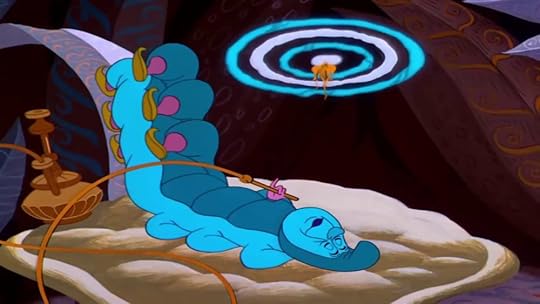
...like Homer (or possibly Langton) had been puffing on one of those hookahs. I get the sense that these Carroll references are supposed to be clever and/or witty, but they strike me as neither.
After wading through all the Wonderland nonsense (and I like Lewis Carroll's work, mind you), I get to the solution. And that, I must say, was a disappointment. I'm not buying the motive (such as it is)--especially not in the late 1990s. Not having been told otherwise, I presume the story takes place about the time that it was published--and I just don't believe that that reasoning works, particularly given who gets killed. Now, if the had been killed, then I'd be better persuaded that the person who did it had the motive given. I could see a certain parallel logic, albeit a bizarre logic [quite in keeping with the whole bizarre nature of the book, though].
Overall, a disappointing read. I love me an academic mystery and I was looking forward to one set in Oxford. I have read a few of Langton's Homer Kelly books previously and while they also had an unusual tone, they seemed to be more in the line of Michael Innes' unusual works. I enjoyed both in the past. However, there are a horde of people on Goodreads handing out four and five star ratings, so your mileage may vary. ★★
*And, if anyone reads this fairly soon (while the details are still fresh in my mind) and can tell me what's significant about what Homer sees when he looks out Oliver Clare's window I would love to be enlightened.
First posted on my blog My Reader's Block.
So, Homer dons his deerstalker and begins delving into the deaths. First, a night watchman plunges to his death from a glass-topped roof. Why on earth was he crawling about up there? And how on earth did he get there? Then Dr. Helen Clare's argumentative husband takes a similar plunge down a staircase that isn't all there. It had been blocked off for repairs but who removed the barricades and turned off the lights? Then a lovelorn priest who may have been in the process of losing his faith as well as his girl appears to have committed suicide. But what was Hal Shaw, a just-married tutor in biology, doing in the Reverend Oliver Clare's rooms that night? And what does it all have to do with Charles Darwin, some missing specimens from his famous voyage, the great-great-great-great granduncles of Oliver Clare, a stolen painting of a dodo, Alice & Wonderland and Lewis Carroll, and the steeplejack's missing lines and tackle? Homer must help Inspector Mukerji answer all those questions before they can track down the culprit.
Or at least that's what the synapsis is supposed to be. Quite honestly, this is one weird book. The story has Darwin and Alice & Wonderland themes running all through it that are, one surmises, supposed to be relevant and make sense. But they don't. At least not me. In the middle of it all Homer has these bizarre dreams (both the kind while sleeping and the walking around daydreaming kind) mixing the mystery plot up with Carroll's world. I felt very much like Alice when she meets the caterpillar...
...like Homer (or possibly Langton) had been puffing on one of those hookahs. I get the sense that these Carroll references are supposed to be clever and/or witty, but they strike me as neither.
After wading through all the Wonderland nonsense (and I like Lewis Carroll's work, mind you), I get to the solution. And that, I must say, was a disappointment. I'm not buying the motive (such as it is)--especially not in the late 1990s. Not having been told otherwise, I presume the story takes place about the time that it was published--and I just don't believe that that reasoning works, particularly given who gets killed. Now, if the had been killed, then I'd be better persuaded that the person who did it had the motive given. I could see a certain parallel logic, albeit a bizarre logic [quite in keeping with the whole bizarre nature of the book, though].
Overall, a disappointing read. I love me an academic mystery and I was looking forward to one set in Oxford. I have read a few of Langton's Homer Kelly books previously and while they also had an unusual tone, they seemed to be more in the line of Michael Innes' unusual works. I enjoyed both in the past. However, there are a horde of people on Goodreads handing out four and five star ratings, so your mileage may vary. ★★
*And, if anyone reads this fairly soon (while the details are still fresh in my mind) and can tell me what's significant about what Homer sees when he looks out Oliver Clare's window I would love to be enlightened.
First posted on my blog My Reader's Block.
May 5, 2012
On the plus side, you have the ever-delightful Homer and Mary Kelly, Oxford University (where Homer is guest-lecturing), a charming Anglo-Indian police detective who is himself a graduate of Oxford, Langton's sketches showing various buildings, the unusual and fascinating science museum background. On the minus side are the various musings about evolution, and the almost complete lack of knowledge of science by two ignoble characters who are nonetheless presented as science students on an advanced level. So while it's an enjoyable read, it's a mixed bag as a novel, especially a mystery novel. Probably it depends on how much you like Langton's other novels.

July 11, 2021
This little mystery was all over the place. 12th book in a series. This was my first and last. The story often dragged, mired in unnecessary details, which included some sightseeing trips into London from Oxford. Each chapter started with a quote from Alice in Wonderland. They were trippy and had nothing to do with the story, that I could figure out, except that Lewis Carroll studied at Oxford. Charles Darwin also studied there and artifacts from his expedition to the Galápogos play a role in the whole mystery. Finally, Homer puts God on trial, argued in front of statues of Aristotle, Galileo, Newton and Darwin, which stand in the courtyard of the Museum of Natural History. The story was all over the place. The resolution gave me no peace.

September 16, 2019
Although the story was interesting and very well-written, I had to mark it down for its ludicrous worship of Charles Darwin and his idiotic theories, and its questioning of the existence of Almighty God, Creator of everything. Towards the end of the book (and this is not a spoiler regarding the mystery), Homer Kelly, in the courtyard of the Oxford University Museum, has an imaginary (in his own head), trial of Charles Darwin as the murderer of God. As if!! As if any finite, puny human could murder the infinite, omnipotent, omniscient Creator of the Universe. It was laughable rubbish.

December 27, 2024
I am a huge fan of this series, but not necessarily this particular book.
Homer and Mary Kelly are a zany couple, engaging “ intellectuals,” and somewhat wacky sleuths. So, under all circumstances, these books are far from traditional mystery novels.
I generally love an academic mystery setting, but this novel became tedious at times in its foray into Darwin and the subject of the evolution of species. Homer was exuberant in his discoveries ( as he is wont to be) and the academic rivalries provided snarky drama.
But, for those who may be tempted to hop into this series, there are far better books in the series. Don’t judge all of the Homer Kelly novels by this one book. I think the author just got a bit overly enthusiastic in the Darwinian research.
Homer and Mary Kelly are a zany couple, engaging “ intellectuals,” and somewhat wacky sleuths. So, under all circumstances, these books are far from traditional mystery novels.
I generally love an academic mystery setting, but this novel became tedious at times in its foray into Darwin and the subject of the evolution of species. Homer was exuberant in his discoveries ( as he is wont to be) and the academic rivalries provided snarky drama.
But, for those who may be tempted to hop into this series, there are far better books in the series. Don’t judge all of the Homer Kelly novels by this one book. I think the author just got a bit overly enthusiastic in the Darwinian research.
November 20, 2023
I've really enjoyed Jane Langton books. This one has Mary and Homer Kelly. who have come to Oxford, England for a short stay while Homer lectures on English Literature at the University. This has the same wit as other Langton works, several characters of various ages and temperaments, unusual circumstances, and a very long and convoluted mystery circling throughout an academic setting. Detective Inspector Mukerji, who quotes poetry from Tagore, is working on many of the same mysteries that are involving Homer and Mary. There are many references to Darwin and his missing specimens, and to God and His creations.
April 2, 2023
My favorite of the series thus far (I'm reading the books sequentially). I read the ebook, which had several typos..maybe the text was added manually because it's an older book? At any rate, although the story wasn't as exciting as some of the other Homer Kelley mysteries, you could tell the author was really enjoying writing the story. An enjoyable and thought-provoking read.

September 14, 2017
Another excellent Homer Kelly mystery. I am in awe of Langton's depth--the research she must do is incredible, and the literary allusions and tie-ins are amazing. All of these make for a highly satisfying read, much more than brain candy.
March 7, 2020
I didn't think this was as good as Langton's other books, but it was still an interesting read. The ending somewhat begged the question.

April 24, 2010
In this novel, Homer and Mary are in Oxford, where Homer has been invited to lecture on American Literature for a term. There's also a whole host of Rhodes Scholars. For reasons not clear logistically but central to the plot, they are connected to the museum of natural history and some of the zoologists there. Homer starts reading Darwin and his feeling that death is the driving force in evolution is a rather dreary motif that is echoed in Oliver Clare's situation.
Lots of interesting twists. Clues come together after-the-fact to help you see to the resolution of the case. There were a few red herrings that sent me down the wrong path, but got neatly tied up near the end. Some of the characters are quite one-dimensional (the ever-so-tiresome Margo and Mark). Her line drawings are enchanting as usual, although I noticed that when people appear they are oddly amorphous.
Did Darwin kill God? Is it really the case that only "natural theology" allows for a reconciliation of the two? I don't think so, but Langton seems to.
Lots of interesting twists. Clues come together after-the-fact to help you see to the resolution of the case. There were a few red herrings that sent me down the wrong path, but got neatly tied up near the end. Some of the characters are quite one-dimensional (the ever-so-tiresome Margo and Mark). Her line drawings are enchanting as usual, although I noticed that when people appear they are oddly amorphous.
Did Darwin kill God? Is it really the case that only "natural theology" allows for a reconciliation of the two? I don't think so, but Langton seems to.
May 25, 2016
#12 in the Homer Kelly series. Oxford University makes an interesting setting and, as always, author Langton's drawing are delightful.
Homer Kelly mystery - William Dubchick is too keen a student of the writings of Charles Darwin to not see that the world of biology has evolved past him. Decades ago, he was the foremost mind in Oxford University's department of natural sciences, but as the field's focus narrowed to the microscopic level he became nothing more than a gray-haired, cantankerous relic. He has a small fiefdom, manned by Helen Farfrae, a committed disciple who, Dubchick is annoyed to learn, someone is trying to kill. It is into this world that Homer Kelly, Emersonian scholar and part-time sleuth, comes to spend a semester lecturing. Though expecting a vacation, he finds Oxford to be a swamp of theft, fraud, and murder. Besides the attempts on Farfrae's life, he must reckon with a murdered priest, the theft of a dodo's portrait, and suspicious claims that long-lost Darwinian artifacts have been found.
Homer Kelly mystery - William Dubchick is too keen a student of the writings of Charles Darwin to not see that the world of biology has evolved past him. Decades ago, he was the foremost mind in Oxford University's department of natural sciences, but as the field's focus narrowed to the microscopic level he became nothing more than a gray-haired, cantankerous relic. He has a small fiefdom, manned by Helen Farfrae, a committed disciple who, Dubchick is annoyed to learn, someone is trying to kill. It is into this world that Homer Kelly, Emersonian scholar and part-time sleuth, comes to spend a semester lecturing. Though expecting a vacation, he finds Oxford to be a swamp of theft, fraud, and murder. Besides the attempts on Farfrae's life, he must reckon with a murdered priest, the theft of a dodo's portrait, and suspicious claims that long-lost Darwinian artifacts have been found.
May 24, 2023
I enjoy Jane Langton’s books, quirky, often funny, and with the charm of her drawings, and this was no exception. Homer Kelly and his wife Mary are always a pleasure to be with. This book takes place in Oxford. The focus is on Darwin’s research; this aspect I found very interesting and I am eager to learn more. But these books are mysteries. I’m reading them first and foremost for the quality and excitement of the mystery, the puzzle that needs to be solved. In this respect this book is a disappointment. Although the mystery is set up well, the resolution is a letdown. One of the principal characters is a young clergyman (Church of England). Langton uses him as a vehicle for a debate about whether or not one can still believe in God after Darwin’s findings. Clearly Langton thinks the answer is no. In the process of hammering in this point, she shortchanges the development of the clergyman as a complex person. In the end, he is no longer credible , and we readers have lost interest in him . . . and in this book.

June 22, 2007
As if to take on the style of the British mysteries, Ms. Langton paces the plot fairly slowly, picking up speed toward the middle of the book. Less formulaic than Agatha Christie, Ms. Langton's book is more along the lines of P.D. James. Her references to Darwinian fact and fiction are formidable, and makes several pages more than simply "light reading." However, the scientific references and theological postulations never become tedious and in fact provide a lovely intellectual backdrop for a somewhat boring set of murders.
For those who enjoy something more than plot, this mystery is highly recommended. Anyone who has been to Oxford will most definitely enjoy Ms. Langton's thorough and fanciful descriptions.
Homer Kelly is as eccentric as he is brilliant, making for an excellent protagonist. However, some of the other characters are lacking in development which leads to a miniscule disappointment in reading the book. Otherwise, a delightfully well-written work.
For those who enjoy something more than plot, this mystery is highly recommended. Anyone who has been to Oxford will most definitely enjoy Ms. Langton's thorough and fanciful descriptions.
Homer Kelly is as eccentric as he is brilliant, making for an excellent protagonist. However, some of the other characters are lacking in development which leads to a miniscule disappointment in reading the book. Otherwise, a delightfully well-written work.

September 5, 2011
I would have given this four or five stars, but the end is punk. Just my opinion, of course. Prior to the last few chapters, though, I enjoyed this Homer and Mary appearance very much, especially as it takes place in Oxford. I've read so many books that take place there, I always feel like I'm visiting a place I've actually been when I read a book set there. If I had time, it would be amusing to rewrite the last few chapters to suit myself.

June 30, 2013
Jane Langton has been one of my favorite writers since the days in which I read her childrens/young adult books to my kids (Diamond in the Window, etc). And I do love Homer, and I do appreciate the quirkiness of Langton's perspective as seen through Homer's whimsical eyes. And, ah England. And, ooh, Darwin.
So yeah, I enjoyed this although there is a kind of disquieting disconnect between the wit and whimsy and the deaths.
(and I enjoyed it so much I immediately wanted more Langton too).
So yeah, I enjoyed this although there is a kind of disquieting disconnect between the wit and whimsy and the deaths.
(and I enjoyed it so much I immediately wanted more Langton too).

June 10, 2016
Homer and Mary Kelly have travelled to Oxford University so that Homer can give a series of lectures on Amerian literature. They have barely settled in when a night watchman at the university is murdered. Homer joins forces with the local constabulary to solve the murder. This is a wonderful series. I love the way the author combined a good mystery with humor and care. This is a series I have loved for years and I was thrilled to find one I hadn't read.
November 2, 2009
Years ago I read a lot of books by Jane Langton, featuring Homer Kelly. Now I am catching up on some of the ones that I missed. I enjoy these mild and humorous mysteries. I am familiar with many of the settings around the Boston area.

November 1, 2013
Not one of my favorites in this series but still enjoyable. This one is set in Oxford. There's a lot about Darwin and Lewis Carroll. I didn't find the mystery as persuasive as usual and the characters weren't as interesting as usual. Still it had her cute drawings.
Read
February 19, 2008Langton, Jane
September 12, 2010
Jane Langton is one of my favorite authors. She dives into her subject, whatever it is. This time it's Darwin.

Read
February 15, 2011http://www.bookcrossing.com/journal/1...
I own a copy and bookcrossed a copy.
I own a copy and bookcrossed a copy.
July 10, 2013
Very fun mystery, set at an Evolutionary Biology conference at Oxford University. Lots of Darwin references, and funny depictions of scientific academia. Many thumbs up.
July 23, 2012
Lots of philosphical musings...perhaps I was just not in the mood.
Read
August 20, 2014Good book.

Read
April 23, 2018No idea when I read it or what I thought of it. I'm clearing out some mysteries to give to the McAllisters, and this is on the "I've read this" bookshelf. I must have liked it or I wouldn't have kept it, but I rarely re-read!
Displaying 1 - 25 of 25 reviews