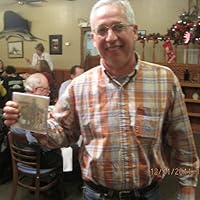
Benjamin Leopold Haas was born in Charlotte , North Carolina in 1926. Mr. Haas stated in an interview that he inherited his love of books from his father, who would bid on hundreds of books at unclaimed freight auctions during the Depression. His imagination was also fired by the stories of the Civil War and Reconstruction told by his grandmother, who had lived through both. “My father was a pioneer operator of motion picture theatres”, Ben wrote. “So, I had free access to every theatre in Charlotte and saw countless films growing up, hooked on the lore of our own South and the Old West.” Dreaming about being a writer, 18-year-old Ben Haas sold a story to a Western pulp magazine. He dropped out of college to support his family. He was self-educated. He served in the U.S. Army from 1945 to 1946. He made Raleigh his home in 1959. Ben and his wife had three sons, Joel, Michael and John. Ben held various jobs until 1961, when he was working for a steel company. He had submitted a manuscript to Beacon Books, and an offer for more came just as he was laid off at the steel company. He became a full-time writer for the rest of his life. Ben wrote every day, every night. “I tried to write 5000 words or more every day, scrupulous in maintaining authenticity”, Ben said. His son Joel later recalled, “My Mom learned to go to sleep to the sound of a typewriter”. His son John told me “It sounded like machine-gun fire coming out of his office”. Writing nonstop over the next 16 years, Ben Haas would create somewhere around 130 books under his own name and a dozen pen names.
In the latter days of The Civil War, Captain Marsh Wales leads his men across the shattered Virginia landscape on a foraging mission, a euphemism for taking whatever they found for the Confederate army. Lee didn't allow looting of the civilian populace so everything was paid for. That it was worthless Confederate dollars didn't matter. His orders were to leave nothing they found: meat animals, staple goods, horses, leather, anything.
Pickings were pretty lean and they men were starving themselves, their horse worn pretty lean.
Then they found Red Oaks, an isolated plantation that seemed untouched by the war.
Two women, a mother and her daughter, lived there with some sixty slaves. Their husbands had gone off to fight for the South leaving them in charge. The master of the plantation had had the foresight to stock up before the war started and, even though the blockade made things tough, they stretched things along. There was even coffee.
And Wales and his men were going to take all off it, a fact that conflicted the good Captain. His own plantation in South Carolina, Ashbrook, lay in ruins, the house burned to the ground, the fields fallow, his slaves gone, his wife, Vivian, run off with an Englishman, pregnant with his child.
The dozen men he had with him had been together for years, but for two. And they were the ones causing the problems.
Lt Vance Channing was an ex-gambler from Tennessee and a man who liked killing. He'd set his eyes on the young woman of the plantation and meant to have her.
Private Sam 'Jeff' Davis was from Alabama and an ex-slave trader with a deep hatred of them. Redneck would certainly be the term today for his background. he resented being here because when he signed up he'd been promised never to have to leave Alabama.
A fine novel of one aspect of the Civil War I'd never considered.
I was looking for something lighter to read between other things and ran across this little paperback. It turned out to be pretty intense. The entire story just covers about 3 or 4 days although there are flashbacks. The main character is Captain Marshall Wales. He is in charge of a Confederate detachment that has to requisition commodities from the civilian population.