

What do you think?

Life Of Mrs E G White Seventh Day Adventist Prophet Her False Claims Refuted 1919 [Leather Bound]
{ 14.60 x 22.86 cms} Leather Binding on Spine and Corners with Golden Leaf Printing on round Spine (extra customization on request like complete leather, Golden Screen printing in Front, Color Leather, Colored book etc.) Reprinted in 2018 with the help of original edition published long back [1919]. This book is printed in black & white, sewing binding for longer life, printed on high quality Paper, re-sized as per Current standards, professionally processed without changing its contents. As these are old books, we processed each page manually and make them readable but in some cases some pages which are blur or missing or black spots. If it is multi volume set, then it is only single volume. We expect that you will understand our compulsion in these books. We found this book important for the readers who want to know more about our old treasure so we brought it back to the shelves. Hope you will like it and give your comments and suggestions. - English, Pages 295. COMPLETE LEATHER WILL COST YOU EXTRA US$ 25 APART FROM THE LEATHER BOUND BOOKS. {FOLIO EDITION IS ALSO AVAILABLE.} . Complete Life Of Mrs E G White Seventh Day Adventist Prophet Her False Claims Refuted 1919 [Leather Bound] D. M. Canright
- GenresChristianity
295 pages, Unknown Binding
First published January 1, 1998
About the author
Dudley Marvin Canright
27 books1 followerAlso known as D.M. Canright
Pastor in the Seventh-day Adventist Church for 22 years, who later left the church and became one of its severest critics.
He joined the church in 1859, at the age of 19, and rose through the ministry to a position of prominence on the General Conference, a committee of Seventh-day Adventist Church leaders.
Pastor in the Seventh-day Adventist Church for 22 years, who later left the church and became one of its severest critics.
He joined the church in 1859, at the age of 19, and rose through the ministry to a position of prominence on the General Conference, a committee of Seventh-day Adventist Church leaders.
Ratings & Reviews
Friends & Following
Create a free account to discover what your friends think of this book!
Community Reviews
Displaying 1 - 5 of 5 reviews

February 19, 2016
Target audience: Common people, anyone interested to find the truth (or at least a part of the truth) about Ellen Gould White, the most important prophet of the Seventh-day Adventist Church and one of the important leaders of the American Third Great Awakening. It is also good to those who want to find out more or research about false prophets in general.
About the author: According to Wikipedia, Dudley Marvin Canright was a pastor in the Seventh-day Adventist Church for 22 years, who later left the church and became one of its severest critics. In 1859, at the age of 19, Dudley journeyed eastwards to attend the Albion Academy, in Albion, New York. To support himself, he worked as a farmhand for Elder Roswell F. Cottrell, a Seventh-day Adventist minister. In the summer of 1859, he attended a camp meeting, held by Elder James White, near Albion. There, he accepted the doctrine of the Advent Message, and was soon baptized into the Seventh-day Adventist Church. Dudley briefly served as secretary to Elder White, who encouraged him to enter the ministry. For 5 years, after converting his entire family to Adventism, Dudley served as an evangelist for the Seventh-day Adventist Church, traveling and preaching across the midwestern U.S. In 1865, at the age of 24, Dudley Canright was ordained by James White and J. N. Loughborough, in a service held at Battle Creek. For 20 years, Canright was a minister and evangelist for the Seventh-day Adventist Church across the United States. He was also a notable contributor to the Adventist periodical, the Review and Herald (now the Adventist Review). During a vacation in Colorado with James and Ellen White in 1873, Canright and his wife had a falling out with them. Canright and James White reconciled later that year. At the 1876 General Conference Session he was 1 of 3 men elected to the General Conference Executive Committee, the most prestigious committee in the denomination. In 1878, Canright was elected President of the Sabbath School Association of the Seventh-day Adventist Church. In 1881, back as a Seventh-day Adventist minister, Canright continued his life as a traveling evangelist for another year. Then, in 1882, he retired from the ministry and bought a farm in Otsego, Michigan. Once again, he began to have doubts about the White family, particularly about Ellen White's purported "gift of prophecy". In 1887 Canright and his wife left the Seventh-day Adventist Church and later he wrote the works against Adventism and Ellen White.
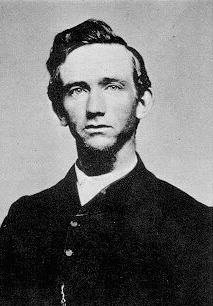
Structure of the book: The 1919 edition by Standard Publishing Company has 291 pages, divided in Preface and 22 parts, which include the Introduction and the Conclusion.
Overview: The sole purpose of this book is to demolish the aura of saint and prophet built by the Seventh-day Adventist Church around Ellen Gould White. And it does it very well. While reading it I laughed a lot of times but I was also surprised how cunning or naive (not to say stupid) people can be.
The book begins with a list of other so-called prophets from the past and compares each one with Ellen White. Then it explains when she became a prophet, why she became a prophet and the context of her prophetic manifestations. Basically, two main events made her a prophet: the failure of William Miller regarding the year 1844 as the end of the world (her family members were Millerites) and the horrible mutilation she suffered while at school. A couple of months after the “Great Disappointment” (as the Millerite failure was named) the prophetic gift of Mrs. White began to manifest (what a coincidence!) and this is how she gained influence within the Millerite-Adventist movement. To me, it seems that both Mormonism and Adventism applied the same strategy: they invented a prophet in order to legitimize their doctrine.
Despite the fact that Mrs. White is presented by the Seventh-Day Adventism Church immaculate, Canright depicts a very different reality: she made countless prophecies that failed, she prophesied about the end of the world many times and failed, she prophesied about the people around her and failed, she prophesied about various events and failed, she used her “gift of prophecy” to make money, she made erroneous interpretations of the Bible, she plagiarized other writings, the church even helped her in her ascension as a prophet by suppressing the failures and banning the opposition.
It is interesting how many things took place in the past, but over time, in the name of religion, they have been hidden, censored or suppressed. The “shut-door” theory, complemented by her visions, through which the Adventist cult was established, insults common sense; you can say that in Heaven happened anything you want (because no one can check) and based on that you can establish any kind of cult. In addition, her prophecies and visions are very grim; they give you the feeling that she hated this world so much that she even enjoyed giving news about its destruction:
I was shown the company present at the Conference. Said the angel: ‘Some food for worms, some subjects of the seven last plagues, some will be alive and remain upon the earth to be translated at the coming of Jesus’
Some are looking too far off for the coming of the Lord. Time has continued a few years longer than they expected, therefore they think it may continue a few years more. . . I saw that the time for Jesus to be in the Holy Place was nearly finished, and that time can not last but a little longer,
My accompanying angel said, 'Time is almost finished. Get ready, get ready, get ready. […] Some of us have had time to get the truth, and to advance step by step, and every step we have taken has given us strength to take the next. But now time is almost finished. . . and what we have been years learning, they will have to learn in a few months"
But the saddest thing is that she made God responsible for her prophetic failures: I have seen that the 1843 chart was directed by the hand of the Lord, and that it should not be altered; that the figures were as the Lord wanted them; that his hand was over, and hid, a mistake in some of the figures.
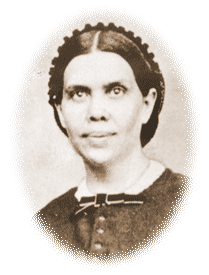
Strong points: Easy to read, easy to follow, light language, no exotic religious terms used.
Weak points: A devout Seventh-day Adventist might perceive this book as a cheap shot. Yes, Canright was a former Adventist. And anyone can see that the book is a mixture of anger, irony, disappointment and hard research. But I personally don’t think it is biased. While researching for my book I came to realize that the alleged prophets can be very cunning persons, but I also know that people can exaggerate things. From experience I can say that I am 99% sure that the book presents the facts as they really were, especially given the fact that there are many quotation of other people who, more or less, said that Ellen G. White was a fraud.
_______________
★★★ Follow us on Goodreads
★★★ Visit our website www.reasonandreligion.org
About the author: According to Wikipedia, Dudley Marvin Canright was a pastor in the Seventh-day Adventist Church for 22 years, who later left the church and became one of its severest critics. In 1859, at the age of 19, Dudley journeyed eastwards to attend the Albion Academy, in Albion, New York. To support himself, he worked as a farmhand for Elder Roswell F. Cottrell, a Seventh-day Adventist minister. In the summer of 1859, he attended a camp meeting, held by Elder James White, near Albion. There, he accepted the doctrine of the Advent Message, and was soon baptized into the Seventh-day Adventist Church. Dudley briefly served as secretary to Elder White, who encouraged him to enter the ministry. For 5 years, after converting his entire family to Adventism, Dudley served as an evangelist for the Seventh-day Adventist Church, traveling and preaching across the midwestern U.S. In 1865, at the age of 24, Dudley Canright was ordained by James White and J. N. Loughborough, in a service held at Battle Creek. For 20 years, Canright was a minister and evangelist for the Seventh-day Adventist Church across the United States. He was also a notable contributor to the Adventist periodical, the Review and Herald (now the Adventist Review). During a vacation in Colorado with James and Ellen White in 1873, Canright and his wife had a falling out with them. Canright and James White reconciled later that year. At the 1876 General Conference Session he was 1 of 3 men elected to the General Conference Executive Committee, the most prestigious committee in the denomination. In 1878, Canright was elected President of the Sabbath School Association of the Seventh-day Adventist Church. In 1881, back as a Seventh-day Adventist minister, Canright continued his life as a traveling evangelist for another year. Then, in 1882, he retired from the ministry and bought a farm in Otsego, Michigan. Once again, he began to have doubts about the White family, particularly about Ellen White's purported "gift of prophecy". In 1887 Canright and his wife left the Seventh-day Adventist Church and later he wrote the works against Adventism and Ellen White.
Structure of the book: The 1919 edition by Standard Publishing Company has 291 pages, divided in Preface and 22 parts, which include the Introduction and the Conclusion.
Overview: The sole purpose of this book is to demolish the aura of saint and prophet built by the Seventh-day Adventist Church around Ellen Gould White. And it does it very well. While reading it I laughed a lot of times but I was also surprised how cunning or naive (not to say stupid) people can be.
The book begins with a list of other so-called prophets from the past and compares each one with Ellen White. Then it explains when she became a prophet, why she became a prophet and the context of her prophetic manifestations. Basically, two main events made her a prophet: the failure of William Miller regarding the year 1844 as the end of the world (her family members were Millerites) and the horrible mutilation she suffered while at school. A couple of months after the “Great Disappointment” (as the Millerite failure was named) the prophetic gift of Mrs. White began to manifest (what a coincidence!) and this is how she gained influence within the Millerite-Adventist movement. To me, it seems that both Mormonism and Adventism applied the same strategy: they invented a prophet in order to legitimize their doctrine.
Despite the fact that Mrs. White is presented by the Seventh-Day Adventism Church immaculate, Canright depicts a very different reality: she made countless prophecies that failed, she prophesied about the end of the world many times and failed, she prophesied about the people around her and failed, she prophesied about various events and failed, she used her “gift of prophecy” to make money, she made erroneous interpretations of the Bible, she plagiarized other writings, the church even helped her in her ascension as a prophet by suppressing the failures and banning the opposition.
It is interesting how many things took place in the past, but over time, in the name of religion, they have been hidden, censored or suppressed. The “shut-door” theory, complemented by her visions, through which the Adventist cult was established, insults common sense; you can say that in Heaven happened anything you want (because no one can check) and based on that you can establish any kind of cult. In addition, her prophecies and visions are very grim; they give you the feeling that she hated this world so much that she even enjoyed giving news about its destruction:
I was shown the company present at the Conference. Said the angel: ‘Some food for worms, some subjects of the seven last plagues, some will be alive and remain upon the earth to be translated at the coming of Jesus’
Some are looking too far off for the coming of the Lord. Time has continued a few years longer than they expected, therefore they think it may continue a few years more. . . I saw that the time for Jesus to be in the Holy Place was nearly finished, and that time can not last but a little longer,
My accompanying angel said, 'Time is almost finished. Get ready, get ready, get ready. […] Some of us have had time to get the truth, and to advance step by step, and every step we have taken has given us strength to take the next. But now time is almost finished. . . and what we have been years learning, they will have to learn in a few months"
But the saddest thing is that she made God responsible for her prophetic failures: I have seen that the 1843 chart was directed by the hand of the Lord, and that it should not be altered; that the figures were as the Lord wanted them; that his hand was over, and hid, a mistake in some of the figures.
Strong points: Easy to read, easy to follow, light language, no exotic religious terms used.
Weak points: A devout Seventh-day Adventist might perceive this book as a cheap shot. Yes, Canright was a former Adventist. And anyone can see that the book is a mixture of anger, irony, disappointment and hard research. But I personally don’t think it is biased. While researching for my book I came to realize that the alleged prophets can be very cunning persons, but I also know that people can exaggerate things. From experience I can say that I am 99% sure that the book presents the facts as they really were, especially given the fact that there are many quotation of other people who, more or less, said that Ellen G. White was a fraud.
_______________
★★★ Follow us on Goodreads
★★★ Visit our website www.reasonandreligion.org

August 3, 2023
I read this with an open mind because I wanted to hear Canright‘s claims with the assumption that his motives were honest. Unfortunately that is not the case. I carefully read his arguments and compared direct quotations or specific claims to original sources whenever possible and my conclusion is that he had a very high opinion of himself and was comfortable stretching the truth at the expense of pretty much everyone in his life, from appearances. Many quotes were presented in a misleading manner or deliberately omitted content that changes the meaning. He also slings accusations concerning faults which are, in fact, his own. For example he has an entire section dedicated to plagiarism accusations and says some very strong things about copying and using other people’s work without giving them credit. And yet, just a few weeks ago I was able to personally see original copies of his book The Bible From Heaven alongside an almost identical book also called The Bible From Heaven by Moses Hull which he had copied and used freely without credit. His logic flip flops depending on what he is trying to prove. In one chapter he tries to prove that Ellen White was weak, easily influenced by church leaders, and effectively a puppet who wrote what she was told. In this chapter he presents her as a nice, harmless but mislead woman with a frail mind and no thoughts of her own. But further in the book he spends another chapter completely undoing that argument by trying to prove that she was dictatorial and controlling, always trying to make church leaders do what she wanted and manipulating them through her testimonies. So which was it? This book is not clear and the arguments are contradictory. Finally, his misogynistic views are quite distasteful and not believable to a 21st century audience. One of his biggest supposed proofs is that Ellen White, being a woman with a womb, naturally suffered from hysteria—a medical condition which science has proven to be non existent and grounded in negative stereotypes about the female gender. I could go on but then I would waste too much time. Suffice to say, there are more solid criticisms of Ellen White out there that Adventist thinkers do need to wrestle with. This is not one of them.
November 14, 2016
Target audience: Common people, anyone interested to find the truth (or at least a part of the truth) about Ellen Gould White, the most important prophet of the Seventh-day Adventist Church and one of the important leaders of the American Third Great Awakening. It is also good to those who want to find out more or research about false prophets in general.
About the author: Dudley Marvin Canright was a pastor in the Seventh-day Adventist Church for 22 years, who later left the church and became one of its severest critics. In 1859, at the age of 19, Dudley journeyed eastwards to attend the Albion Academy, in Albion, New York. To support himself, he worked as a farmhand for Elder Roswell F. Cottrell, a Seventh-day Adventist minister. In the summer of 1859, he attended a camp meeting, held by Elder James White, near Albion. There, he accepted the doctrine of the Advent Message, and was soon baptized into the Seventh-day Adventist Church. Dudley briefly served as secretary to Elder White, who encouraged him to enter the ministry. For 5 years, after converting his entire family to Adventism, Dudley served as an evangelist for the Seventh-day Adventist Church, traveling and preaching across the midwestern U.S. In 1865, at the age of 24, Dudley Canright was ordained by James White and J. N. Loughborough, in a service held at Battle Creek. For 20 years, Canright was a minister and evangelist for the Seventh-day Adventist Church across the United States. He was also a notable contributor to the Adventist periodical, the Review and Herald (now the Adventist Review). During a vacation in Colorado with James and Ellen White in 1873, Canright and his wife had a falling out with them. Canright and James White reconciled later that year. At the 1876 General Conference Session he was 1 of 3 men elected to the General Conference Executive Committee, the most prestigious committee in the denomination. In 1878, Canright was elected President of the Sabbath School Association of the Seventh-day Adventist Church. In 1881, back as a Seventh-day Adventist minister, Canright continued his life as a traveling evangelist for another year. Then, in 1882, he retired from the ministry and bought a farm in Otsego, Michigan. Once again, he began to have doubts about the White family, particularly about Ellen White's purported "gift of prophecy". In 1887 Canright and his wife left the Seventh-day Adventist Church and later he wrote the works against Adventism and Ellen White.
Structure of the book: The 1919 edition by Standard Publishing Company has 291 pages, divided in Preface and 22 parts, which include the Introduction and the Conclusion.
Overview: The sole purpose of this book is to demolish the aura of saint and prophet built by the Seventh-day Adventist Church around Ellen Gould White. And it does it very well. While reading it I laughed a lot of times but I was also surprised how cunning or naive (not to say stupid) people can be.
The book begins with a list of other so-called prophets from the past and compares each one with Ellen White. Then it explains when she became a prophet, why she became a prophet and the context of her prophetic manifestations. Basically, two main events made her a prophet: the failure of William Miller regarding the year 1844 as the end of the world (her family members were Millerites) and the horrible mutilation she suffered while at school. A couple of months after the “Great Disappointment” (as the Millerite failure was named) the prophetic gift of Mrs. White began to manifest (what a coincidence!) and this is how she gained influence within the Millerite-Adventist movement. To me, it seems that both Mormonism and Adventism applied the same strategy: they invented a prophet in order to legitimize their doctrine.
Despite the fact that Mrs. White is presented by the Seventh-Day Adventism Church immaculate, Canright depicts a very different reality: she made countless prophecies that failed, she prophesied about the end of the world many times and failed, she prophesied about the people around her and failed, she prophesied about various events and failed, she used her “gift of prophecy” to make money, she made erroneous interpretations of the Bible, she plagiarized other writings, the church even helped her in her ascension as a prophet by suppressing the failures and banning the opposition.
It is interesting how many things took place in the past, but over time, in the name of religion, they have been hidden, censored or suppressed. The “shut-door” theory, complemented by her visions, through which the Adventist cult was established, insults common sense; you can say that in Heaven happened anything you want (because no one can check) and based on that you can establish any kind of cult. In addition, her prophecies and visions are very grim; they give you the feeling that she hated this world so much that she even enjoyed giving news about its destruction:
I was shown the company present at the Conference. Said the angel: ‘Some food for worms, some subjects of the seven last plagues, some will be alive and remain upon the earth to be translated at the coming of Jesus’
Some are looking too far off for the coming of the Lord. Time has continued a few years longer than they expected, therefore they think it may continue a few years more. . . I saw that the time for Jesus to be in the Holy Place was nearly finished, and that time can not last but a little longer,
My accompanying angel said, 'Time is almost finished. Get ready, get ready, get ready. […] Some of us have had time to get the truth, and to advance step by step, and every step we have taken has given us strength to take the next. But now time is almost finished. . . and what we have been years learning, they will have to learn in a few months"
But the saddest thing is that she made God responsible for her prophetic failures: I have seen that the 1843 chart was directed by the hand of the Lord, and that it should not be altered; that the figures were as the Lord wanted them; that his hand was over, and hid, a mistake in some of the figures.
Strong points: Easy to read, easy to follow, light language, no exotic religious terms used.
Weak points: A devout Seventh-day Adventist might perceive this book as a cheap shot. Yes, Canright was a former Adventist. And anyone can see that the book is a mixture of anger, irony, disappointment and hard research. But I personally don’t think it is biased. While researching for my book I came to realize that the alleged prophets can be very cunning persons, but I also know that people can exaggerate things. From experience I can say that I am 99% sure that the book presents the facts as they really were, especially given the fact that there are many quotation of other people who, more or less, said that Ellen G. White was a fraud.
_______________
★★★ Follow us on Goodreads
★★★ Visit our website www.reasonandreligion.org
About the author: Dudley Marvin Canright was a pastor in the Seventh-day Adventist Church for 22 years, who later left the church and became one of its severest critics. In 1859, at the age of 19, Dudley journeyed eastwards to attend the Albion Academy, in Albion, New York. To support himself, he worked as a farmhand for Elder Roswell F. Cottrell, a Seventh-day Adventist minister. In the summer of 1859, he attended a camp meeting, held by Elder James White, near Albion. There, he accepted the doctrine of the Advent Message, and was soon baptized into the Seventh-day Adventist Church. Dudley briefly served as secretary to Elder White, who encouraged him to enter the ministry. For 5 years, after converting his entire family to Adventism, Dudley served as an evangelist for the Seventh-day Adventist Church, traveling and preaching across the midwestern U.S. In 1865, at the age of 24, Dudley Canright was ordained by James White and J. N. Loughborough, in a service held at Battle Creek. For 20 years, Canright was a minister and evangelist for the Seventh-day Adventist Church across the United States. He was also a notable contributor to the Adventist periodical, the Review and Herald (now the Adventist Review). During a vacation in Colorado with James and Ellen White in 1873, Canright and his wife had a falling out with them. Canright and James White reconciled later that year. At the 1876 General Conference Session he was 1 of 3 men elected to the General Conference Executive Committee, the most prestigious committee in the denomination. In 1878, Canright was elected President of the Sabbath School Association of the Seventh-day Adventist Church. In 1881, back as a Seventh-day Adventist minister, Canright continued his life as a traveling evangelist for another year. Then, in 1882, he retired from the ministry and bought a farm in Otsego, Michigan. Once again, he began to have doubts about the White family, particularly about Ellen White's purported "gift of prophecy". In 1887 Canright and his wife left the Seventh-day Adventist Church and later he wrote the works against Adventism and Ellen White.
Structure of the book: The 1919 edition by Standard Publishing Company has 291 pages, divided in Preface and 22 parts, which include the Introduction and the Conclusion.
Overview: The sole purpose of this book is to demolish the aura of saint and prophet built by the Seventh-day Adventist Church around Ellen Gould White. And it does it very well. While reading it I laughed a lot of times but I was also surprised how cunning or naive (not to say stupid) people can be.
The book begins with a list of other so-called prophets from the past and compares each one with Ellen White. Then it explains when she became a prophet, why she became a prophet and the context of her prophetic manifestations. Basically, two main events made her a prophet: the failure of William Miller regarding the year 1844 as the end of the world (her family members were Millerites) and the horrible mutilation she suffered while at school. A couple of months after the “Great Disappointment” (as the Millerite failure was named) the prophetic gift of Mrs. White began to manifest (what a coincidence!) and this is how she gained influence within the Millerite-Adventist movement. To me, it seems that both Mormonism and Adventism applied the same strategy: they invented a prophet in order to legitimize their doctrine.
Despite the fact that Mrs. White is presented by the Seventh-Day Adventism Church immaculate, Canright depicts a very different reality: she made countless prophecies that failed, she prophesied about the end of the world many times and failed, she prophesied about the people around her and failed, she prophesied about various events and failed, she used her “gift of prophecy” to make money, she made erroneous interpretations of the Bible, she plagiarized other writings, the church even helped her in her ascension as a prophet by suppressing the failures and banning the opposition.
It is interesting how many things took place in the past, but over time, in the name of religion, they have been hidden, censored or suppressed. The “shut-door” theory, complemented by her visions, through which the Adventist cult was established, insults common sense; you can say that in Heaven happened anything you want (because no one can check) and based on that you can establish any kind of cult. In addition, her prophecies and visions are very grim; they give you the feeling that she hated this world so much that she even enjoyed giving news about its destruction:
I was shown the company present at the Conference. Said the angel: ‘Some food for worms, some subjects of the seven last plagues, some will be alive and remain upon the earth to be translated at the coming of Jesus’
Some are looking too far off for the coming of the Lord. Time has continued a few years longer than they expected, therefore they think it may continue a few years more. . . I saw that the time for Jesus to be in the Holy Place was nearly finished, and that time can not last but a little longer,
My accompanying angel said, 'Time is almost finished. Get ready, get ready, get ready. […] Some of us have had time to get the truth, and to advance step by step, and every step we have taken has given us strength to take the next. But now time is almost finished. . . and what we have been years learning, they will have to learn in a few months"
But the saddest thing is that she made God responsible for her prophetic failures: I have seen that the 1843 chart was directed by the hand of the Lord, and that it should not be altered; that the figures were as the Lord wanted them; that his hand was over, and hid, a mistake in some of the figures.
Strong points: Easy to read, easy to follow, light language, no exotic religious terms used.
Weak points: A devout Seventh-day Adventist might perceive this book as a cheap shot. Yes, Canright was a former Adventist. And anyone can see that the book is a mixture of anger, irony, disappointment and hard research. But I personally don’t think it is biased. While researching for my book I came to realize that the alleged prophets can be very cunning persons, but I also know that people can exaggerate things. From experience I can say that I am 99% sure that the book presents the facts as they really were, especially given the fact that there are many quotation of other people who, more or less, said that Ellen G. White was a fraud.
_______________
★★★ Follow us on Goodreads
★★★ Visit our website www.reasonandreligion.org

September 5, 2023
Insightful…and, close to the source.
I believe the most accurate information is found close to the source; Mr. Canright was close to the source, and where he doesn’t know first hand, points to the source of the material. Good book and good information.
I believe the most accurate information is found close to the source; Mr. Canright was close to the source, and where he doesn’t know first hand, points to the source of the material. Good book and good information.
March 4, 2019
This is the story f Ellen Gould White. She was a leader in the Seventh-Day Adventist Church. I had a difficult tie reading the book due to the writing style.
Displaying 1 - 5 of 5 reviews